The reading
What you are looking at
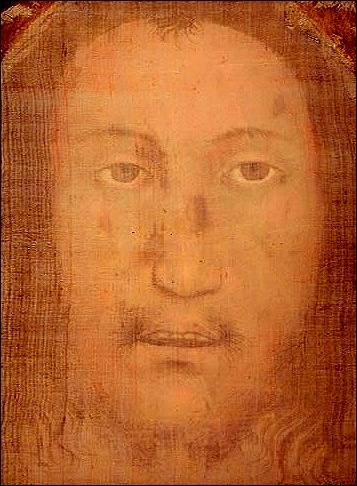
The Shroud of Turin is a linen cloth bearing the faint image of a crucified man.
Many Catholics believe it may be the burial cloth of Jesus Christ.
The Church has not formally declared it authentic, but the Shroud remains one of the most fascinating Christian relics ever studied. The faith of the Church does not rest on it. What follows is a patient look at why the cloth is strange, and at what that strangeness does and does not prove.
1. It is not a normal painting
The image is incredibly faint.
Instead of paint simply covering the cloth, the colour is concentrated on the very outer surface of the tiny linen fibres.
It is almost as though the surface of the fibres has been changed.
2. It has a photographic-negative effect
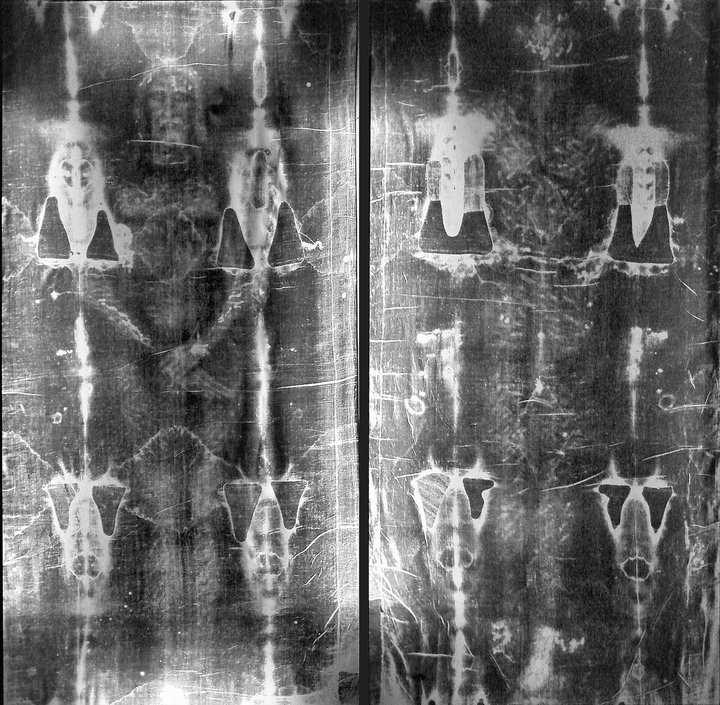
When the Shroud was photographed in 1898, the photographic negative revealed the man's image with remarkable clarity.
In other words, the Shroud contains light-and-dark information that produces an unusually natural-looking image when reversed.
This was discovered long before modern digital imaging.
3. It contains 3D information
The brightness of different parts of the image contains information related to the distance between the body and the cloth.
Simply put: closer to the body, a stronger image. Further away, a weaker image.
A normal painting does not naturally contain this kind of information.
4. It appears to show a crucified man
The image appears to show injuries associated with scourging, crucifixion, wounds around the head, and a wound in the side.
These features have been compared with the Gospel accounts of Jesus' Passion.
The resemblance is particularly striking for Christians because the Gospels describe Jesus being scourged, crowned with thorns, crucified, and pierced in the side.
5. The image is extraordinarily shallow
The body image is concentrated in an extremely thin layer of the fibres.
That creates an unusual scientific problem. How do you create a full human image without simply painting or soaking the cloth?
Modern experiments have investigated several possible mechanisms.
6. Scientists have reproduced some features using ultraviolet radiation
Researchers have experimented with extremely powerful ultraviolet radiation.
They found that very intense ultraviolet pulses can create a similar type of superficial coloration in linen. But this requires highly specialised modern equipment.
The wavelength used in the experiments was around 193 nanometres, in the ultraviolet region.
7. How powerful would it need to be?
The experimental intensities were roughly 2 to 4 billion watts per square centimetre. That is 2,000,000,000 to 4,000,000,000 watts on every square centimetre.
This is not like shining a UV lamp on a piece of cloth. It is an incredibly powerful, concentrated burst of radiation.
8. How much energy?
Scaling the laboratory results to the approximate area of the human body represented on the Shroud gives an estimated 400,000 to 800,000 joules of radiant energy.
A 1,000 kg car travelling at about 62 mph has about 400,000 joules of kinetic energy. At about 88 mph it has about 800,000 joules.
So the estimated radiation energy is roughly comparable to the energy carried by a 1-tonne car travelling at 62 to 88 mph.
A moving car carries that energy continuously. The hypothetical radiation would deliver the energy in an extraordinarily short flash.
9. A kettle
A 2,000-watt kettle would need to run for about 3 to 7 minutes to use the same amount of energy.
So we are talking about several minutes of kettle energy, concentrated into an almost unimaginably short flash.
10. A TNT comparison, as energy only
400,000 to 800,000 joules is roughly equivalent to the energy contained in 95 to 190 grams of TNT.
This does not mean the Shroud involved an explosion. The comparison is simply a way of understanding the amount of energy.
The proposed mechanism is electromagnetic radiation, not TNT.
11. The truly astonishing part: the speed
The energy would need to arrive in roughly 10 billionths of a second. That is 0.00000001 seconds.
Imagine taking the energy of a 1-tonne car travelling at around 88 mph and releasing that energy as radiation in about one hundred-millionth of a second.
That is why the power becomes enormous.
12. Energy and power are not the same thing
At the lower end, the calculation gives roughly 34 trillion watts. Depending on the exact pulse duration and the assumptions, the upper end can be considerably higher. That is 34,000,000,000,000 watts.
Energy is how much. Power is how quickly it is delivered.
The total energy is not the most extraordinary part. The extraordinary part is having such a large amount of radiation arrive almost instantly.
13. How many photons?
At 193 nanometres, each photon carries roughly 6.4 electron-volts of energy.
Scaling the lower estimate gives roughly 400 sextillion photons. That is 400,000,000,000,000,000,000,000 photons.
An almost unimaginably large number of individual packets of light.
14. Could medieval technology have produced this?
Medieval Europe had no lasers, no ultraviolet lasers, no modern optics, no precision radiation equipment, and no technology capable of producing controlled nanosecond UV pulses.
The laboratory experiments use technology developed many centuries later.
So if an ultraviolet process similar to these experiments actually produced the Shroud image, medieval technology could not have produced that process.
This does not by itself prove a supernatural event. It shows how far beyond medieval technology this particular mechanism would be.
15. The image has to explain more than its colour
A proposed explanation has to account for the whole collection of unusual features: a full human image, extremely shallow fibre coloration, photographic-negative characteristics, 3D information, apparent crucifixion wounds, apparent scourging wounds, a wound in the side, and the front and back image.
That is what makes the Shroud such a fascinating scientific mystery.
16. Why Catholics find it so powerful
The Gospel accounts tell us that Jesus was scourged, crowned with thorns, crucified, pierced, wrapped in linen, and placed in a tomb.
The Shroud appears to show a man bearing injuries corresponding to many of these events.
For a Christian looking at the Shroud, it can therefore become a powerful visual reminder of Christ's Passion.
17. The most important point
The Shroud is not the foundation of Christianity. Jesus Christ is.
The faith of the Church does not depend upon the Shroud.
But if the Shroud really is the burial cloth of Jesus, then what we are looking at could be an extraordinary physical trace associated with the Passion of Christ. And that is why the Shroud continues to fascinate scientists, historians, and Christians around the world.
In one sentence: the Shroud contains an extraordinarily faint and unusual image of a crucified man, and modern experiments have shown that reproducing some of its characteristics with ultraviolet radiation requires an incredibly powerful burst of energy — roughly comparable in total energy to a 1-tonne car travelling at 62 to 88 mph, but delivered in only around ten billionths of a second.
The cloth is first written down at Lirey in the 1350s. A bishop called it a painting. It passed to the House of Savoy, was scorched in the fire at Chambéry in 1532, and has been kept at Turin since 1578. In 1988 three laboratories dated a corner sample to about 1260–1390. Critics say that corner was a repair. Popes have prayed before the Shroud. None of them has defined it as the burial cloth of the Gospels. You may venerate it. You are not bound to a verdict on its age.
Reading
How to read The Shroud of Turin
If it is the burial cloth of Jesus, it is the most intimate relic in the world — the cloth that touched the corpse of God. If it is a medieval masterpiece of a kind we cannot reproduce, it is still, as Benedict said, an icon: it preaches the Passion to a culture that believes photographs.
Either way, the Shroud is dangerous when it becomes a substitute for faith. The Gospel does not say “blessed are those who see the negative.” It says blessed are those who have not seen and have believed. The Shroud is allowed to help. It is not allowed to rule.
Pray this
Prayers that sit with the story
Church status
How this sign has been received
Open / under study
The Holy See owns the Shroud (Umberto II bequeathed it to the pope). It is exhibited rarely. The Church permits veneration as a sacred icon/relic of the Passion, and permits doubt about the dating. No Catholic is bound to a position on its age. Status in this archive: open — the most studied, still unresolved, image in Christendom.
Investigation
What has been examined
1988 carbon-14 tests at three labs dated the linen to 1260–1390. Critics argue the sampled corner was a repair. Pollen, weaving, and the blood (which tests as real blood, often said to be AB) have been used on both sides of the fight. The image itself is not paint in any ordinary sense: it is a superficial discoloration of the top fibers, with 3D information encoded in it. No one has produced a full, agreed replica by a medieval method.
Honest summary: the C-14 says medieval; parts of the textile and forensic story say it is strange beyond a known workshop trick; the Church does not hang the Resurrection on the result.
The shrine today
Why pilgrims still go
The cloth that has the image of a crucified man, which the popes have knelt before, which carbon-14 has dated medieval, which blood and pollen and a hundred arguments have not finished. You go as a pilgrim, not as a lab assistant.
Turin — the Shroud — the reasonsSources
- Secondo Pia photographs, 1898
- STURP scientific reports, 1978
- Nature, 1989 (radiocarbon dating)
- John Paul II, address at Turin, 24 May 1998
For the classroom
The Shroud of Turin (First documented 1354; claimed as 1st century, Turin (earlier Lirey, Chambéry)). Grade in this encyclopedia: Open / under study. The Shroud of Turin is a linen cloth bearing the faint image of a crucified man. Many Catholics believe it may be the burial cloth of Jesus Christ. The Church has not formally declared it authentic.