The reading
The chapel and the casket
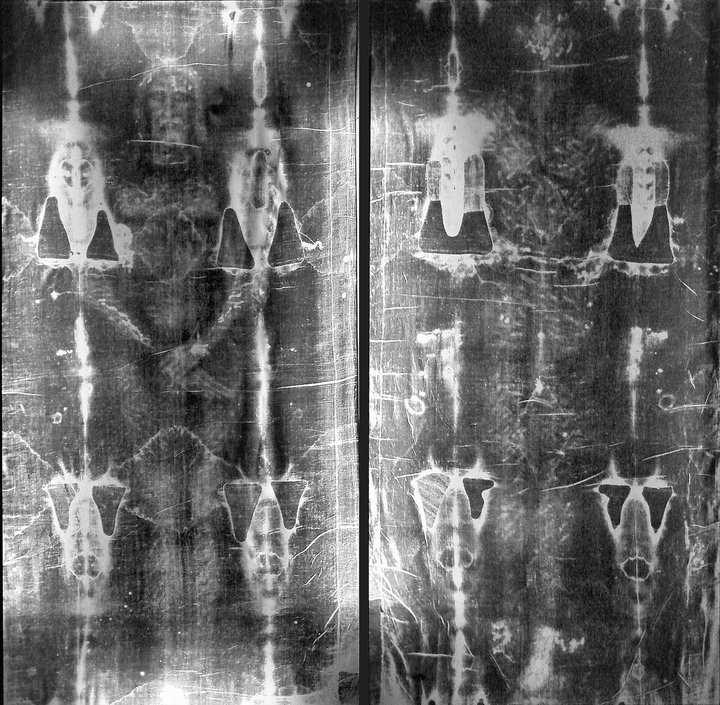
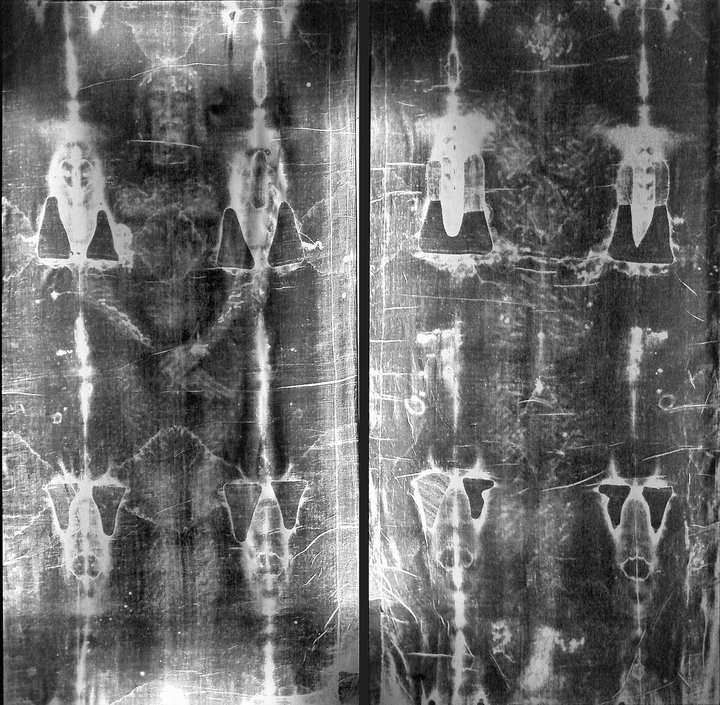
By 1532 the cloth belonged to the House of Savoy and was kept in the Sainte-Chapelle of the castle at Chambéry, in a reliquary of silver. On the night of 4 December a fire started in the chapel. The Shroud was inside the casket. The metal heated until it melted. A drop of molten silver burned through the corner of the folded linen. The cloth was folded in four, so the burn repeated as a line of holes and scorches down the length, mirrored because of the folds. Poor Clare nuns later patched the triangular holes with altar linen. Those patches were removed in the 2002 restoration; the scorch pattern remains.
There are also water stains, large and symmetric, from the water used to kill the fire. They look, on a full photograph of the cloth, like repeating lobes. They are not wounds. They are 1532.
What the fire did not do
The fire is sometimes recruited as an explanation of the image: a scorch from 1532, or a scorch from a clever medieval. The 1532 burns are obvious. They fluoresce under ultraviolet. The body-image does not fluoresce in the same way. STURP used that difference. A chapel fire that ate holes in a folded cloth did not lay a photographic negative of a crucified man onto the flax. It laid burns. You can see them. They are the paler, browner, holed places along the folds, not the face.
The fire does matter for the carbon-14 study. Heat, water, handling, and later repairs all concentrate at corners and edges. The dated sample came from a corner. Whether 1532 chemically altered that corner is part of the quarrel, not a settled lever. This pin is the event itself: a relic that almost died in a chapel in Savoy, and the marks by which you can still read the fold.
From Chambéry to Turin
In 1578 the Savoys brought the Shroud to Turin, partly so that St. Charles Borromeo would not have to cross the Alps in winter to venerate it. It has been in Turin since, except for wartime hiding. The fire of 1532 is why a full-length photograph of the cloth looks ‘damaged’ to a first glance. The damage is a date. The face is another question.
Reading
How to read The fire of 1532
Relics suffer history. This one was in a burning chapel because men kept it as a treasure. The holes are not the Passion. They are the sixteenth century falling on the Passion’s image. A Catholic looking at the burns is looking at how close we came to having nothing to argue about.
Church status
How this sign has been received
Open / under study
The Poor Clares who patched the cloth were doing what religious do: repair, hide, keep. The 2002 restoration, which removed their patches, was a scientific and aesthetic decision under the owners. Neither act defined the Shroud. Both left it still there.
Investigation
What has been examined
Symmetric scorch and hole pattern from a molten drop through a four-fold (and further) folding. Water stains from extinguishing. UV fluorescence of scorches distinct from the body-image. Patches added after 1532, removed 2002.
Sources
- Savoy household accounts of the Chambéry fire, 1532
- STURP ultraviolet photography of scorch vs image
- Reports of the 2002 restoration
For the classroom
The fire of 1532 (4 December 1532, Sainte-Chapelle, Chambéry). Grade in this encyclopedia: Open / under study. The Shroud was folded in a silver reliquary in the Sainte-Chapelle of Chambéry when fire took the chapel. The silver melted. A drop burned through the folds. The scorch marks and the water stains are still the geometry of that night.