The places of His life, in the order the Gospel keeps them. The map, the place, and what happened are together.
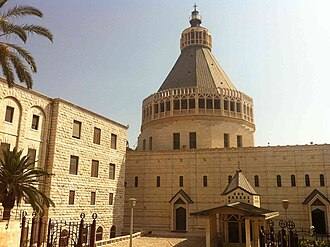
Annunciation
Nazareth
Before the Nativity. The Gospels do not date the day.
The angel Gabriel is sent to a virgin betrothed to a man named Joseph, of the house of David. Her name is Mary. She is not asked to invent a religion. She is asked to consent to the Incarnation. Her answer is the beginning of the way we walk: Behold the handmaid of the Lord; be it done to me according to thy word.
The place the Church honours is the grotto under the Basilica of the Annunciation in Nazareth. The chronology is the Gospel’s, not a modern diary. What is certain is the event the Creed confesses: by the Holy Spirit He was incarnate of the Virgin Mary, and became man.
Mary goes in haste after the Annunciation. Elizabeth is in her sixth month.
Mary greets Elizabeth. The child in Elizabeth’s womb leaps. Elizabeth, filled with the Holy Spirit, cries out the words the Hail Mary still carries: Blessed art thou among women, and blessed is the fruit of thy womb.
The Church of the Visitation at Ain Karim keeps this meeting. The Magnificat is Mary’s answer, not a later hymn fitted to the scene. She speaks of the mercy that scatters the proud and fills the hungry.
In the days of Caesar Augustus, during the census. The year is not printed in the Gospel.
Joseph goes up from Nazareth to the city of David because he is of the house of David. Mary brings forth her firstborn and lays Him in a manger, because there was no room in the inn. Shepherds hear the angels. Later, Magi come and adore.
The Basilica of the Nativity stands over the grotto. The star set into the floor marks the place the Church has kept since the fourth century, when Helena’s age built over the cave. The Creed does not depend on the star in the pavement. It depends on the Child.
Forty days after the Nativity, according to the Law.
Simeon takes the Child in his arms and says he may now depart in peace, because his eyes have seen the salvation prepared before the face of all peoples. He tells Mary that a sword shall pierce her own soul.
Anna, a widow who did not leave the Temple, speaks of Him to those who looked for the redemption of Israel. The Presentation is why the Church blesses candles on 2 February.
After the Magi depart. Herod is still alive. Matthew does not name the town.
An angel tells Joseph to take the Child and His Mother and flee. They remain until Herod’s death. Matthew hears in this the word, Out of Egypt have I called my son.
Later devotion named several resting places. The Gospel does not. This stop is the fact of the flight, not a claim about one chapel.
From the return after Herod until the Baptism. One public hour in the Temple at twelve years.
They go up to Jerusalem every year for the Passover. At twelve He stays in the Temple. After three days they find Him among the doctors. He goes down with them to Nazareth and is subject to them. Mary keeps all these words in her heart.
The hidden years are not a blank the Church is embarrassed by. They are the ordinary life of a Son who is God, under a craftsman and His Mother. The Church of Saint Joseph in Nazareth marks the tradition of that house.
The opening of the public ministry. Luke says it was in the fifteenth year of Tiberius.
Jesus comes from Galilee to the Jordan, to John, to be baptised. The heavens open. The Spirit descends as a dove. A voice says, This is my beloved Son, in whom I am well pleased.
The traditional site is near Bethany beyond the Jordan, on the eastern bank, which pilgrims now visit from the west bank at Qasr al-Yahud and from the Jordanian side. The Gospel event is one. The river has moved its bed. The Church does not pretend the exact stone is certain.
The Spirit leads Him into the desert to be tempted. He is hungry. He refuses to turn stones into bread, to test God, and to take the kingdoms at the price of worship.
The monastery on the Mount of Temptation above Jericho keeps this memory. The forty days are why Lent is forty days, not because a cliff has been measured.
Early in the public ministry, after the calling of the first disciples. John places it before the Passover in Jerusalem.
There is a marriage. The wine fails. Mary says to Him, They have no wine, and to the servants, Whatsoever He shall say to you, do ye. Water becomes wine. John calls it the beginning of His signs, and says the disciples believed in Him.
Kafr Kanna is the village the Latin Church has long visited. Another tradition names Khirbet Qana. The Gospel says Cana of Galilee. It does not settle a modern boundary dispute. The sign is the wine, and Mary’s last recorded words in Scripture: Do whatever He tells you.
The centre of the Galilean preaching, after Nazareth does not receive Him.
He dwells in Capernaum by the sea. He teaches in the synagogue as one having authority. He heals a man with an unclean spirit, and Peter’s mother-in-law, and many after sunset.
The ruins are still there: the synagogue of a later century over the earlier one, and the house tradition identifies as Peter’s, under a modern church. This is His own city in the Gospel’s phrase, and the place from which the lake can be seen as the Apostles saw it.
During the Galilean ministry. Matthew gathers the teaching; he does not give a civil date.
Seeing the crowds, He goes up the mountain and sits. Blessed are the poor in spirit, they that mourn, the meek, they that hunger and thirst after justice, the merciful, the clean of heart, the peacemakers, they that suffer persecution for justice’ sake.
The Mount of Beatitudes is the hill the pilgrims use. The Gospel says a mountain. The Beatitudes do not depend on the octagon of the church. They are the interior of the commandments.
After Peter’s confession, and before the road to Jerusalem. Mark says after six days.
He takes Peter, James, and John. He is transfigured. Moses and Elijah appear. A voice says, This is my beloved Son, in whom I am well pleased: hear ye Him. He tells them to tell the vision to no one until the Son of man is risen.
Mount Tabor is the traditional mountain. Mount Hermon has also been proposed, because it is nearer Caesarea Philippi, where the confession had just been made. The Church’s pilgrimage goes to Tabor. The event is the Father’s voice, not the altitude.
John places the raising of Lazarus shortly before the last Passover.
Lazarus of Bethany is ill, dies, and has been in the tomb four days. Jesus weeps. He cries, Lazarus, come forth. The dead man comes out, bound. Many believe. Others go to the Pharisees, and the council begins to plan His death.
Bethany is on the eastern slope of the Mount of Olives, now al-Eizariya. The tomb shown to pilgrims is the place the Church has visited. John wrote the conversation with Martha — I am the resurrection and the life — before he wrote the miracle.
The night before He suffered. The Synoptics call it the Passover. John places the supper before the feast. The Church has not forced the two calendars into one civil hour.
He takes bread, gives thanks, breaks it, and gives it, saying, This is my body, which is given for you. The cup is the new covenant in His blood. He washes the disciples’ feet.
The Cenacle on Mount Zion is the traditional room. The building now standing is medieval. The Eucharist the Church celebrates does not depend on that masonry. It depends on the words, spoken again by a Priest.
The same night, after the supper, before the arrest.
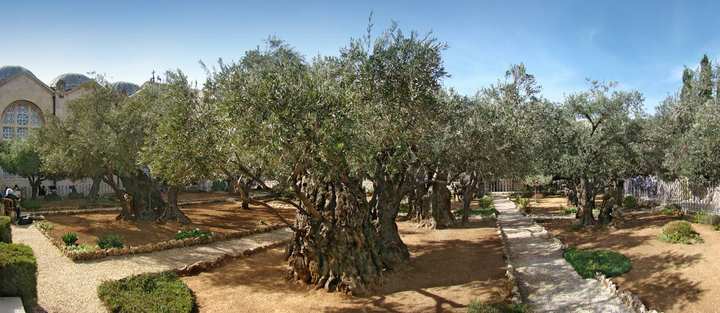
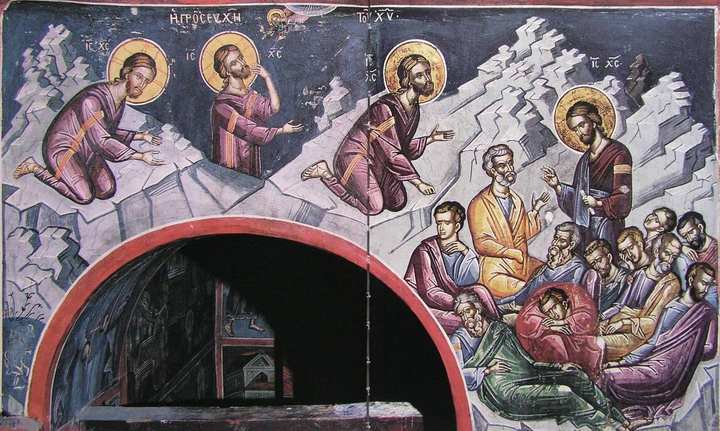
He goes with the disciples to a place called Gethsemane and tells them to sit while He prays. He takes Peter, James, and John farther. My soul is sorrowful even unto death. He falls on His face: My Father, if it be possible, let this chalice pass from me. Nevertheless not as I will, but as thou wilt. They sleep. He prays the same words again. Then Judas comes.
The garden is still there, beside the Church of All Nations. Ancient olive trees stand in the enclosure. No one can prove these are the same trunks. The place is the place. The prayer is the human will of the Son, which Constantinople III refused to erase, obeying the Father.
They lead Him from Caiaphas to the praetorium. Pilate questions Him. He is scourged, crowned with thorns, and brought out: Behold the man. The crowd asks for crucifixion. Pilate washes his hands in Matthew’s account and hands Him over.
The Lithostrotos under the Ecce Homo convent is one candidate for the pavement. Another is the Herodian palace on the western hill. The Gospel is certain about the trial. It is not a surveyor’s note. The Church walks both memories without inventing a certainty the text does not give.
Calvary, now within the Basilica of the Holy Sepulchre
The same Friday, at the ninth hour.
He goes out, bearing His own cross, to the place of the skull. They crucify Him between two others. He gives His Mother to the disciple. He says, It is consummated, and commends His spirit into the Father’s hands.
Calvary is a chapel up a short stair inside the basilica. You can put a hand through the glass to the rock. The sacrifice the Mass makes present is this hour, not a new death.
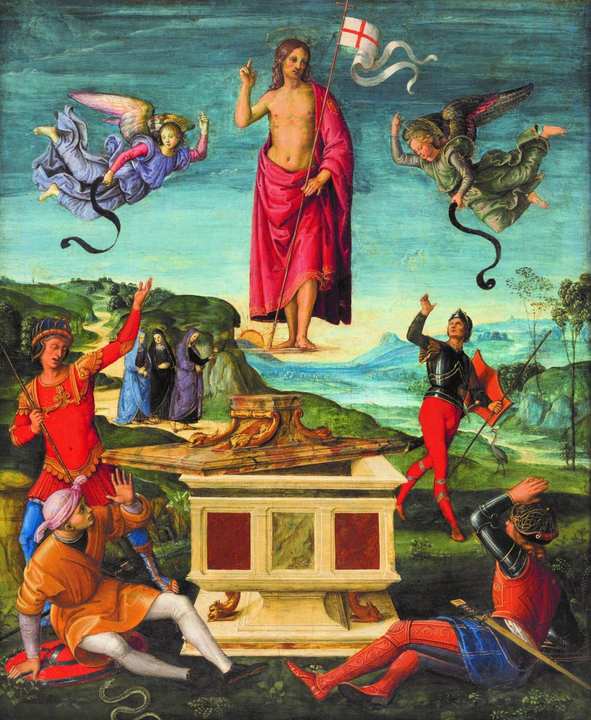
Joseph of Arimathea and Nicodemus lay the body in a new tomb in a garden close to the place of crucifixion, because the sabbath is about to begin. On the first day Mary Magdalene finds the stone taken away. She sees the risen Lord and does not know Him until He says her name.
The edicule stands over the tomb. The church is shared, crowded, and often under repair. The Resurrection is not a mood about an empty room. It is the confession that He is risen, which the Apostles preached before any basilica was built.
On the afternoon of the Resurrection two disciples leave Jerusalem for a village Luke calls Emmaus, about sixty stadia away. One of them is named Cleopas. The other is not named. They are talking about everything that has happened: the death of Jesus, the report of the women, the empty tomb, and their own disappointment. They had hoped he was the one who would redeem Israel. A stranger comes alongside and asks what they are discussing. They are astonished that he seems to be the only man in Jerusalem who does not know.
He tells them they are slow of heart. Beginning with Moses and going through the prophets, he opens the Scriptures that the Christ had to suffer and so enter his glory. They still do not know him. They press him to stay, because the day is far spent. At table he takes bread, blesses it, breaks it, and gives it to them. Their eyes are opened. They know him. He vanishes from their sight. They say to each other that their hearts burned while he talked on the road and opened the Scriptures. They get up at once, in the dark, and go back to Jerusalem, where they find the Eleven saying that the Lord has risen and has appeared to Simon. Then the two tell what happened on the road, and how he was known to them in the breaking of the bread (Luke 24:13–35).
The Church reads this as the shape of the Mass. First the Scriptures are opened. Then the bread is broken. Recognition is given in that order, not as a mood the disciples manufactured. Several villages claim the name Emmaus — Nicopolis, Abu Ghosh, al-Qubeiba among them. Luke’s distance does not, by itself, end the argument of the map. The article of faith does not depend on which lane you photograph. He is risen, and he is known in the breaking of the bread.
Luke, in the Acts, says forty days after the Passion. The Gospel of Luke compresses the same mystery into the day of the Resurrection. The Church keeps both texts and celebrates the Ascension on the fortieth day.
He leads them out toward Bethany. He blesses them. He is taken up, and a cloud receives Him. Two men in white say He will come as they have seen Him go.
The Chapel of the Ascension marks a rock tradition calls the last footprint. The Creed says He ascended into heaven and is seated at the right hand of the Father. The footprint, if it is only a devotion, is not the article. The article is.