The reading
In plain speech
Our Lady of Fátima is the name the Church gives to what three shepherd children said they saw in a pasture in Portugal in 1917.
The bishop of Leiria judged the apparitions worthy of belief in 1930. That is a real judgement of the Church. It is not a new article of the Creed. A Catholic may go to Fátima, pray the Rosary there, and still know that the Gospel came first.
1. Three children, six meetings
Lúcia dos Santos was ten. Francisco Marto was nine. Jacinta Marto was seven. They kept sheep.
They said a lady, brighter than the sun, met them on the 13th of the month from May to October 1917, at the Cova da Iria. Francisco could see her and not hear her. Jacinta could see and hear. Lúcia spoke with her.
2. What she asked
The requests were ordinary and hard. Say the Rosary every day. Offer the sufferings that come. Pray for sinners. Honour her Immaculate Heart. Build a chapel.
She did not ask them to found a new Church. She pointed them back to prayer, penance, and her Son.
3. The sun, as the crowd told it
On 13 October, tens of thousands stood in the rain, including reporters who had come to scoff. Many of them said the sun seemed to spin, throw colour, and plunge, and that their clothes dried.
Not every person in the district saw the same thing. A newspaper is not a laboratory. The reports are still too wide, and too hostile in their authors, to be waved away as a children's story.
4. What this does not prove
The dance of the sun does not prove every later claim people have hung on Fátima. The Church published the third part of the secret in 2000 and read it as a vision of a suffering Church, not as a timetable of the end of the world.
A private revelation, even an approved one, does not add a sentence to the Gospel. If it did, it would have ceased to be private.
5. The one sentence
Fátima is three children, a Rosary, a warning about sin and war, and a crowd that said the sun moved — received by the bishop as worthy of belief, and still not the foundation of the Faith. Jesus Christ is.
The history, name by name, is in the chapters that follow.
Three children, a hollow of pasture, a war
Lúcia de Jesus dos Santos was born on 22 March 1907 in Aljustrel, a hamlet of the parish of Fátima, in the hills of central Portugal. Her father, António, was a small farmer who later drank. Her mother, Maria Rosa, kept the catechism in the house and the rosary in the evening. Francisco Marto was born on 11 June 1908, Jacinta on 11 March 1910. They were Lúcia’s first cousins, children of Manuel Pedro Marto and Olimpia de Jesus. The three of them kept sheep. They were not a literary family. They were not a political family. Portugal in 1910 had overthrown the monarchy and proclaimed a republic that was openly hostile to the Church: religious orders expelled, processions restricted, bishops harassed. In 1914 Europe went to war. Portugal entered in 1916. The boys of the district were already dying in France.
In 1916, the year before the lady, the three children said they were visited three times by an angel who called himself the Angel of Peace. He taught them a prayer of reparation — “My God, I believe, I adore, I hope, and I love You” — and, in the last visit, he held a Host and a chalice and gave them Communion. Lúcia wrote this down years later. The Church, in approving Fátima, approved the 1917 apparitions of Our Lady. The angel of 1916 belongs to Lúcia’s memoirs. It is not a second public revelation. It is how the children themselves accounted for being ready.
The Cova da Iria was a hollow of pasture belonging to Lúcia’s father, a little way from Aljustrel, used for the sheep. There was a small holm oak. There was no shrine. There was no road for crowds.
The six apparitions of 1917
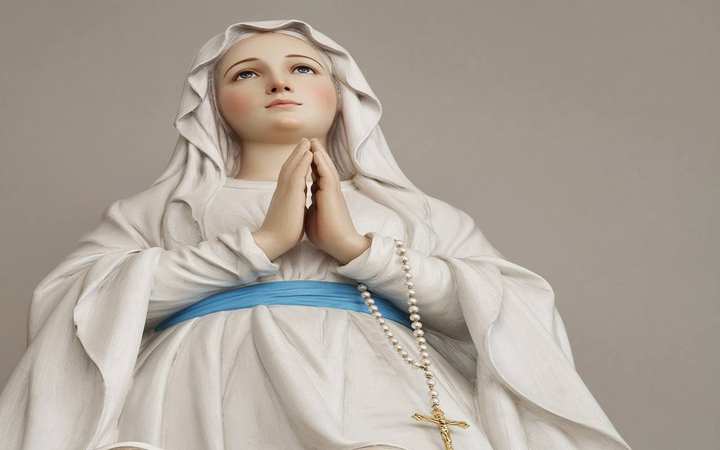
On Sunday 13 May 1917, about noon, after they had eaten their lunch and begun the rosary, a flash of light made them think of lightning, though the sky was clear. A second flash, and a lady was standing on the oak, more brilliant than the sun, dressed in white, a rosary of white beads on a gold chain in her hands, a gold cord at her neck, the face that Lúcia later said was not to be described. She told them not to be afraid. She asked them to come to this place for six months, on the 13th, at this hour. She asked them to say the rosary every day, to obtain peace for the world and the end of the war. She asked if they would offer themselves to God and bear the suffering he would send, in reparation for sin and for the conversion of sinners. They said they would. She said they would have much to suffer, but the grace of God would be their comfort. Francisco, she said, could see her but could not hear her; Jacinta could see and hear; Lúcia could speak with her. Then she rose toward the east and disappeared.
They told. Jacinta told first. Maria Rosa beat Lúcia for lying. The parish priest, Fr. Manuel Marques Ferreira, was cautious. The neighbours were not.
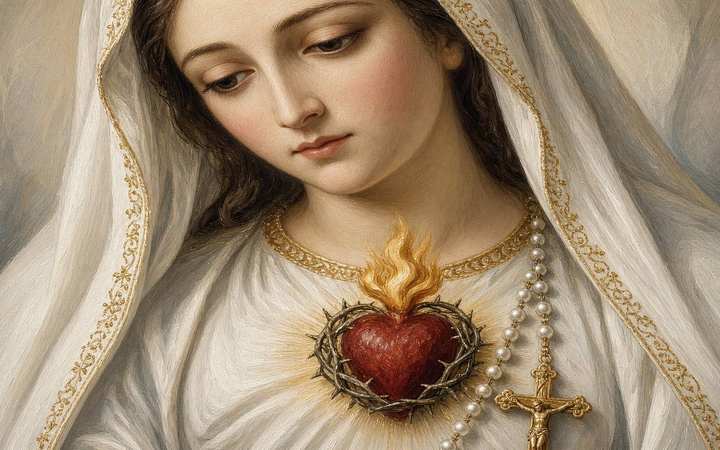
On 13 June, the feast of St. Anthony, a small crowd came. The lady asked again for the rosary every day. She said she would take Francisco and Jacinta soon, and that Lúcia must remain to make her known and loved, and to establish in the world devotion to her Immaculate Heart. Lúcia asked to go to heaven too. The lady said she would, but not yet. She showed them a heart in her open hand, ringed with thorns. The Immaculate Heart, in Catholic speech, is Mary’s inner life: her love for God and for sinners, wounded by sin, offered for them. It is not a second saviour. It is the heart of the woman who stood at the Cross.
On 13 July the crowd was larger. The lady asked again for the rosary, and for them to sacrifice themselves for sinners, and to say when they made a sacrifice: “O Jesus, it is for love of You, for the conversion of sinners, and in reparation for the sins committed against the Immaculate Heart of Mary.” Then she opened her hands, and the children later said they were shown a sea of fire under the earth, and souls in it, and demons. Lúcia wrote that they would have died of fright if the lady had not already told them they were going to heaven. The lady said they had seen hell, where the souls of poor sinners go, and that to save them God wished to establish in the world devotion to her Immaculate Heart. The war would end. If people did not stop offending God, a worse one would begin in the reign of Pius XI. To prevent it she asked for the consecration of Russia to her Immaculate Heart, and for Communion of reparation on the first Saturdays. If her requests were heard, Russia would be converted and there would be peace. If not, Russia would spread her errors through the world, causing wars and persecutions of the Church; the Holy Father would have much to suffer; several nations would be annihilated. In the end her Immaculate Heart would triumph. The Holy Father would consecrate Russia to her. Russia would be converted. A period of peace would be granted to the world. She told them to tell none of this to anyone except Francisco. She promised, in October, a miracle so that all would believe.
That is the second part of what later came to be called the secret of Fátima. The first part was the vision of hell. The third part she showed them the same day, and Lúcia wrote it down in 1944, under obedience, to be read by the Pope. The Holy See published it in 2000. It is a vision, not a timetable: a bishop in white, climbing a mountain toward a cross, shot by soldiers, and around him martyrs, and angels gathering their blood. The Congregation for the Doctrine of the Faith, with Cardinal Ratzinger’s commentary, presented it as a vision of the suffering Church in the twentieth century, including the attempt on John Paul II’s life on 13 May 1981, and not as a film of the world’s end. People have been inventing other third secrets ever since. They are not the text the Church published.
On 13 August the children were not in the Cova. Artur de Oliveira Santos, the administrator of the district of Ourém, a Freemason and a republican official, had them seized and taken to his house, then to the jail. He threatened them with death if they would not recant and tell the secret. He had them put with the ordinary prisoners. They said the rosary with the prisoners. They did not recant. On 15 August they were released. On 19 August the lady appeared to them at Valinhos, a rocky place near Aljustrel, not at the Cova. She asked again for the rosary, for the chapel, for the money left in the Cova to be used for the feast of Our Lady of the Rosary. She said the miracle in October would be less than it would have been, because they had been kept away on the 13th. She told them to pray, pray much, and make sacrifices for sinners, because many souls go to hell because no one prays for them.
On 13 September a crowd of twenty or thirty thousand stood in the Cova. The lady asked again for the rosary, to bring the war to an end. She said in October Our Lord would come, and Our Lady of Sorrows and of Mount Carmel, and St. Joseph with the Child, to bless the world. God was pleased with their sacrifices. The miracle would be in October.
On 13 October the rain had been falling since the night. Estimates of the crowd run from thirty thousand to seventy thousand. They stood in mud. Atheist journalists from the Lisbon paper O Século had come to report a fraud. At noon, by the sun, Lúcia said the lady was coming. The lady told her she was the Lady of the Rosary, that a chapel was to be built here in her honour, that people must continue to say the rosary every day, that the war was ending, that men must not offend God any more, for he was already too much offended. Then Lúcia, Francisco and Jacinta saw, by the sun, St. Joseph with the Child, blessing the world, and Our Lady of Sorrows, and Our Lady of Mount Carmel. The crowd did not see that. The crowd saw the sun.
The rain stopped. The clouds broke. Witnesses — believers, unbelievers, farmers, professors, the reporter Avelino de Almeida of O Século, who published what he had not come to publish — said the sun appeared to spin, to throw colours, to plunge toward the earth, and that the ground and the clothes, soaked a moment before, were dry. Observatory instruments did not record the sun leaving its place. They would not, if the prodigy was in the seeing, given to a wet field in Portugal, and not in the mechanics of the solar system. The Church has never claimed that astronomers should have seen a planet out of orbit. The Church has claimed that a crowd of many kinds of people, in one place, on a day named three months in advance, saw a sign they could not agree how to explain, and that the children, who had already believed, saw something else.
What she asked for, and what the Church did with it
The public message of Fátima is short, and it is not a secret. Say the rosary every day. Offer sacrifices for sinners. Stop offending God. Make reparation to the Immaculate Heart of Mary. Build a chapel. The rest — hell, Russia, the bishop in white — was given to the children to be held, then given to the Popes, then given to the Church. It does not replace the public message. A person who never reads a line about the secrets and says the rosary for the conversion of sinners has done what the lady asked in May.
The First Saturdays are a specific form of that reparation. Lúcia received, later, at Pontevedra in 1925, the request as it is now practised: on the first Saturday of five consecutive months, confession, Communion, a rosary, and fifteen minutes of meditation on the mysteries of the rosary, offered in reparation for sins against the Immaculate Heart. The Church has never made this a commandment. The Church has made it a work.
The consecration of Russia was asked of the Holy Father, in union with the bishops of the world. Popes have made acts of consecration of the world, and of Russia, in several forms. On 25 March 1984 John Paul II, in union with bishops, consecrated the world, with an implicit naming of Russia, before the statue of Our Lady of Fátima. Lúcia said, afterward, that it had been accepted in heaven. On 25 March 2022, in the war that followed Russia’s invasion of Ukraine, Pope Francis consecrated Russia and Ukraine to the Immaculate Heart. The Church does not treat these acts as magic. The Church treats them as the Pope doing what a mother asked, in the form a Pope can do.
Bishop José Alves Correia da Silva of Leiria opened a canonical inquiry in 1922 and declared, on 13 October 1930, that the apparitions of 1917 are worthy of belief. That is a diocesan judgment, which is how apparitions are judged. Popes have gone to Fátima as pilgrims. John Paul II went after 13 May 1981, when Mehmet Ali Ağca shot him in St. Peter’s Square, on the feast of Our Lady of Fátima; he had the bullet set in the crown of her statue. He beatified Francisco and Jacinta on 13 May 2000. Francis canonized them on 13 May 2017. They are saints not because they saw. They are saints because, having seen, they prayed, they offered, they did not recant in a jail, and they died as children who had already given everything they had. Lúcia became a Dorothean sister, then a Carmelite at Coimbra, Sister Maria Lúcia of Jesus and of the Immaculate Heart. She wrote her memoirs under obedience. She died on 13 February 2005. She is buried in the basilica at Fátima, with Francisco and Jacinta. The Church has opened her cause. She has not yet been beatified.
The Cova now
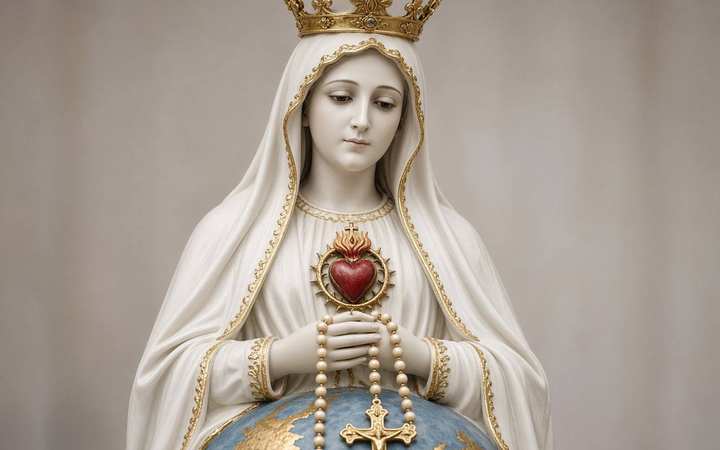
The little oak is gone. A chapel stands on its ground: the Capelinha das Aparições, the Chapel of the Apparitions, a simple porch over the exact place. A statue of the lady, made to Lúcia’s description, stands there. People kneel on the stone, in the rain, at noon, at midnight. On the 12th and 13th of May and of October the square fills until you cannot see the paving. The statue is carried. The rosary is said. The sick are in the front, as at Lourdes, because the lady’s first concern in July was souls in fire, and the conversion of sinners, and not a pretty shrine.
The basilica of Our Lady of the Rosary was built from 1928 and consecrated in 1953. Francisco, Jacinta and Lúcia lie in it. A second, modern church, the Basilica of the Most Holy Trinity, was built for the crowds of the twenty-first century. Between them the Cova is still a hollow. The Way of the Cross goes out to Valinhos, where she came on 19 August when the jail had stolen the 13th. Aljustrel still has the houses. The parish church of Fátima is where the children were baptized.
You go to Fátima to say the rosary on the ground where she asked for it every day, as a work, not as a motto. You go to stand in the Cova on a 13th, or on an ordinary morning when the square is almost empty and the chapel is still the chapel. You go to Valinhos, to Aljustrel, to the tombs. You go to make the First Saturdays if you have been asked in your own conscience to make them. You go because a war was on, and a lady told three children that peace is a fruit of conversion, and the Church, after thirteen years of questions, said they had told the truth.
Fátima is not a second creed. It sits inside the one creed. The rosary is a way of walking through the Gospel with Mary. Penance is the conversion the Gospel already asks. The Immaculate Heart is the heart of the woman at the Cross. The sun over the Cova was for the people who had to walk in the wet. The children had already believed.
Reading
How to read Our Lady of Fátima
Fátima is a wartime apparition. Europe was tearing itself. Mary did not offer a geopolitical plan. She offered the rosary, penance, and a warning that nations can lose their souls. The secrets have generated more noise than light. The Church has published the texts. The work she asked for is public, daily, and small: beads, sacrifice, the conversion of sinners, reparation to a heart that is not a rival of her Son’s.
The sun sign was for the crowd. The children had already believed. That division is the Gospel’s own: some signs are for those who have to walk in the rain.
The chair of Peter
Popes who belong with this sign
Pray this
Prayers that sit with the story
Church status
How this sign has been received
Church-approved
Bishop José Alves Correia da Silva of Leiria declared the apparitions worthy of belief on 13 October 1930. That is a diocesan judgment. Rome has confirmed it by the pilgrimage of Popes, by the beatification and canonization of Francisco and Jacinta, by the publication of the third part of the secret in 2000, and by the feast of Our Lady of Fátima on 13 May. Fully approved. Private revelation is not added to the Creed. A Catholic may go, and the Church says they are justified in believing.
Investigation
What has been examined
The solar event of 13 October 1917 is not recorded on observatory instruments as an astronomical anomaly, which is what one would expect if the sun itself had left its place. It is a mass visual and meteorological phenomenon, attested by many kinds of witnesses, including unbelieving journalists, with expected variation in detail. Explanations offered since then range from retinal afterimage and cloud effects to a genuine prodigy at the level of perception. The Church did not approve Fátima because a physicist signed off on the sun. The Church approved it because of the children, the message, the fruits, and the public sign taken together.
The shrine today
Why pilgrims still go
In 1917, in a hollow of pasture called the Cova da Iria, near the village of Fátima in Portugal, three shepherd children — Lúcia dos Santos, ten, and her cousins Francisco Marto, nine, and Jacinta Marto, seven — saw a lady brighter than the sun, six times, on the 13th of the month from May to October. She asked for the rosary every day, for the conversion of sinners, for devotion to her Immaculate Heart, and that a chapel be built. On 13 July she showed them hell and spoke of war and of Russia. On 13 October, before a crowd of tens of thousands standing in the rain, including reporters who had come to mock, the sun appeared to dance. Francisco and Jacinta died in the influenza. Lúcia lived until 2005 as a nun. The bishop of Leiria declared the apparitions worthy of belief on 13 October 1930.
Fátima — the reasonsSources
- Memoirs of Sister Lúcia of Jesus and of the Immaculate Heart
- Bishop José Alves Correia da Silva of Leiria, pastoral letter of 13 October 1930
- Congregation for the Doctrine of the Faith, The Message of Fatima (26 June 2000), with commentary by Cardinal Joseph Ratzinger
- Sanctuary of Our Lady of the Rosary of Fátima (fatima.pt): the six apparitions; the chapel on the oak’s ground
- Avelino de Almeida, O Século, 15 October 1917
For the classroom
Our Lady of Fátima (1917, Cova da Iria, Fátima). Grade in this encyclopedia: Church-approved. In 1917, in a hollow of pasture called the Cova da Iria, near the village of Fátima in Portugal, three shepherd children — Lúcia dos Santos, ten, and her cousins Francisco Marto, nine, and Jacinta Marto, seven — saw a lady brighter than the sun, six times, on the 13th of the month from May to October. She asked for the rosary every day, for the conversion of sinners, for devotion to her Immaculate Heart, and that a chapel be built. On 13 July she showed them hell and spoke of war and of Russia. On 13 October, before a crowd of tens of thousands standing in the rain, including reporters who had come to mock, the sun appeared to dance. Francisco and Jacinta died in the influenza. Lúcia lived until 2005 as a nun. The bishop of Leiria declared the apparitions worthy of belief on 13 October 1930.