The reading
In plain speech
Lourdes is a cave at the edge of a small town in the Pyrenees, where a fourteen-year-old girl said she saw a young woman in white, eighteen times, in 1858.
The bishop of Tarbes judged those apparitions worthy of belief in 1862. The Church has not said that every claimed cure is a miracle. A Medical Bureau records them. A few dozen have been judged inexplicable. Thousands go home still ill, and still changed.
1. What Bernadette said she was told
The woman asked for prayer, for penance, for a chapel, and for processions. She told the child to drink and wash at a spring that was not there until Bernadette scraped the mud.
On 25 March the woman gave a name the girl had not been taught: “I am the Immaculate Conception.” That is the title Pope Pius IX had defined four years earlier. Bernadette did not understand the words. She carried them to the priest.
2. What a cure at Lourdes is, and is not
A claimed healing is written down, examined by doctors, and only then, sometimes, sent toward a judgement of the Church. “Inexplicable” means the doctors cannot account for it. It does not mean the water is a machine.
Most people who bathe are not cured in their bodies. Lourdes has never pretended otherwise. The sick are put in the front row on purpose.
3. What it does not prove
An approved apparition is not a new Gospel. The Immaculate Conception was already a dogma before the girl heard the name. Lourdes illustrates it. Lourdes did not invent it.
Bernadette herself was not healed. She died at thirty-five, of the illness she had carried for years. If you came for a trick that always works, she is the correction.
4. The one sentence
Lourdes is a working place of prayer, built because a bishop believed a poor girl, and the Faith still rests on Jesus Christ, not on the spring.
The eighteen meetings, and the years after them, are told in full below.
The mill, the jail, and a child who could not yet receive Communion
Marie-Bernarde Soubirous was born on 7 January 1844 at the Moulin de Boly, a water mill on the millstream in Lourdes, a market town of about four thousand people in the French Pyrenees. The river Gave de Pau runs west of the houses. A castle sits on the rock above the town. There was a parish church, a garrison, and not much else. Her father, François Soubirous, was a miller. He was kind, and he was a poor businessman. Her mother, Louise Castérot, came from the family that had held the mill. They were not always poor. The mill failed. Work grew scarce. In 1857 François was accused of stealing a sack of flour from a baker in the town. He spent days in the jail and was released without a conviction that would stand in court. The accusation remained in the street. By the winter of 1857–58 the family of six was living in a single room called the cachot, a former prison cell on the rue des Petits Fossés, lent to them by a cousin, André Sajous. The room was about four metres by four. It was damp and smoky. There was one small window. They slept on the floor.
Bernadette was the eldest surviving child. She was fourteen and small for her age. A cholera epidemic in childhood had left her weak. Asthma never left her. She had been sent out to a farm at Bartrès, a few miles from town, to a woman named Marie Laguës, to mind sheep and to grow stronger. She came home in January 1858 still thin, still behind in her lessons, because she wanted to make her First Communion with the children of the parish. First Communion is the first time a Catholic receives the Eucharist — the consecrated bread which the Church believes is the Body of Christ. In those years a child could not receive it until she knew the catechism, the short book of questions and answers that teaches the faith. Bernadette could not keep it in her head. At home she spoke the Bigourdan dialect of the valley, a form of Gascon Occitan. Her French was poor. The parish priest, Abbé Dominique Peyramale, born in 1811, was a large, impatient, honest man. He did not think she was a mystic. He thought she was a child who needed to learn her prayers. Her confessor was Abbé Pomian.
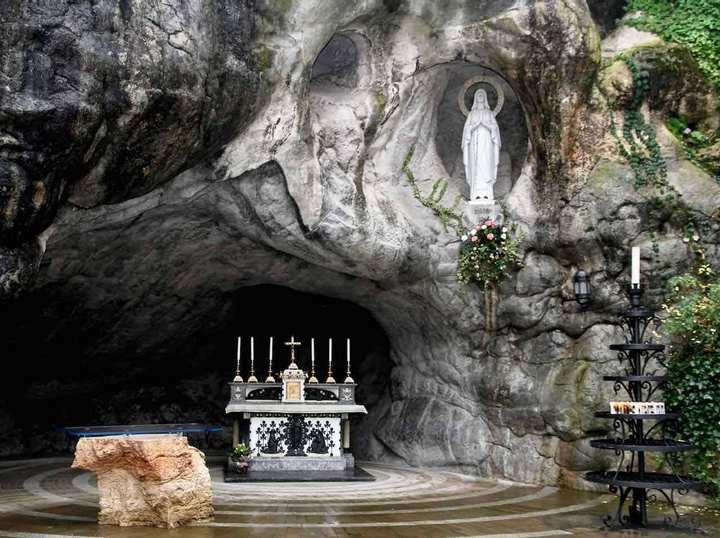
Massabielle — “the old rock” in the local speech — was a cave in a limestone outcrop above the Gave, west of the town, beside the mill canal of Savy. The town dumped refuse there. Pigs rooted in it. No one went there to pray.
On Thursday 11 February 1858, a cold day, less than a week before Ash Wednesday, Bernadette went with her sister Marie, called Toinette, and a friend, Jeanne Abadie, to pick up driftwood and bones for the fire. She lagged because of the cold water she would have to cross to reach the cave. The other two went on. She had begun to take off her stockings when she heard, she said later, a noise like a gust of wind, though the trees did not move.
The eighteen apparitions, from 11 February to 16 July 1858
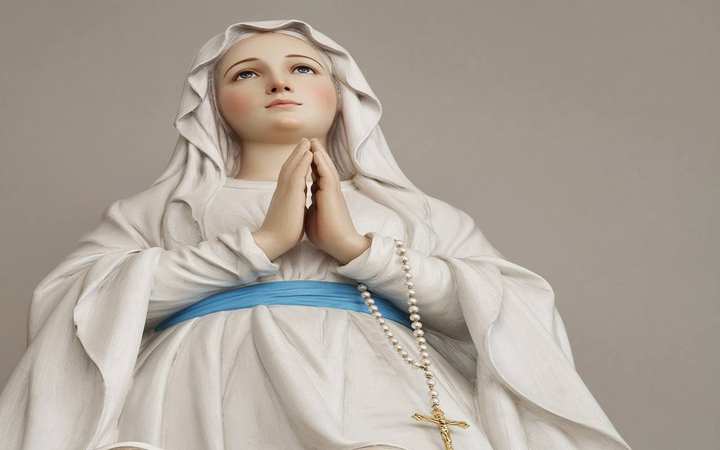
She looked up at the niche in the rock above the cave. A girl was standing there. Bernadette’s word for her was uo petito damizelo — a little young lady — not a matron, and not a queen. A girl of perhaps her own height, in a white dress with a blue sash, a white veil, a yellow rose on each bare foot, and a rosary of white beads on a gold chain hanging from her arm. The face was young. The smile, Bernadette never stopped saying, was not like other smiles. She called her, in the dialect, Aquero: that one. She would not say “the Virgin” until the lady had given her name. People around her tried to put the name in her mouth from the first week. She would not take it.
Bernadette fumbled for her own rosary. She could not make the Sign of the Cross. The lady made it, slowly, and then Bernadette could. They said the rosary together. The lady passed the beads through her fingers but did not move her lips except at the Glory Be, the short prayer that ends each decade: Glory be to the Father, and to the Son, and to the Holy Spirit. When the rosary was finished the lady vanished. Toinette and Jeanne, across the millrace, saw nothing except that Bernadette was on her knees and did not hear them.
Bernadette went home. She did not mean to tell. Toinette got it out of her. Louise slapped her for making up stories and forbade the grotto. The forbidding did not last. The child was already being drawn back.
On Sunday 14 February, after Mass, the children went back with a bottle of holy water from the parish. Holy water is ordinary water that a priest has blessed. If it is the devil, throw it, they had been told. That is ordinary Catholic caution, not a joke. The Church has always taught that not every vision is from God, and that a vision which will not bear a blessing is not to be trusted. The lady appeared. Bernadette threw the water and said, in substance: if you come from God, stay; if not, go. The lady bowed her head and smiled. They said the rosary. On the way home Bernadette was so absorbed that Jeanne Abadie, frightened, threw a stone toward the niche. The lady was gone. A miller who saw the child coming out of the state later called ecstasy said she was light as a feather when they had to move her. Ecstasy, in the language the Church uses for this, does not mean excitement. It means she was taken out of ordinary attention: she did not hear the crowd, did not feel the cold in the same way, and had to be helped when it ended.
On Thursday 18 February two women of the town, Jeanne-Marie Milhet and Antoinette Peyret, took Bernadette back. They brought paper, a pen, and an inkwell. Some of the town thought the figure might be a soul in pain — a dead person who could not rest, and who would write her name and ask for Masses. That is what people did, in those years, when they thought the dead were asking for prayer. Bernadette held out the paper and asked the lady to write her name. The lady said there was no need. Then she spoke, in the dialect, with a courtesy a peasant girl did not expect from a vision: “Would you have the goodness to come here for fifteen days?” In Occitan the sentence is remembered as: Boulet aoue ra gracia de bié aci penden quinze dias? The form is formal. It is the speech of someone asking a favour, not giving an order.
Bernadette said she would have to ask her parents. The lady also said the sentence that is still the hinge of everything that followed: “I do not promise to make you happy in this world, but in the other.”
That sentence is not a riddle, and it is not a slogan. Bernadette was asthmatic. She would remain asthmatic. She would die at thirty-five of tuberculosis of the bone. The lady did not take that back later. The happiness she spoke of is the life of the blessed, which the Creed calls the resurrection of the dead and the life of the world to come. From the third apparition onward, Lourdes is not a promise that no one will be ill.
Bernadette came back. Louise, worn down, came with her on Friday 19 February, with two aunts, and saw nothing. Bernadette brought a lighted candle. Eight people stood in the cold. The lady was silent.
On Saturday 20 February there were about thirty. The lady taught Bernadette a prayer for herself alone. The child never published it. No journalist has ever had it. It is not part of the public message the Church received.
On Sunday 21 February more than a hundred people stood on the bank. The lady’s face was sad. “Pray for sinners,” she said. Afterward the police commissioner, Dominique Jacomet, sent for the child. He sat her down in his office, took notes, tried to catch her in a change of story, and did not. He was not a fool and he was not gentle. He forbade the grotto. François, who had already been in a cell once that year, promised it would stop. It did not. Monday 22 February passed without an apparition.
On Tuesday 23 February about a hundred and fifty people were there, including the tax inspector Jean-Baptiste Estrade, who later wrote what he saw, and officers from the garrison. Estrade had not come as a believer. He came because a public disturbance had begun in a cave. He watched the child’s face, the stillness, the way she did not answer when spoken to. He became, in the years after, one of the principal lay witnesses. On that day the lady gave Bernadette secrets that were for Bernadette alone. She never published them. People have been inventing them ever since. They are not part of the message the Church received, and this archive does not repeat inventions.
On Wednesday 24 February, with about two hundred and fifty watching, the lady said, three times, “Penance. Penance. Penance.” And: “Pray to God for the conversion of sinners.” And: “Kiss the ground for sinners.” Bernadette kissed the mud of Massabielle in front of the town. Some of the town laughed.
Penance, in Catholic speech, is conversion. It is turning the heart toward God, and toward the neighbour one has injured, and accepting the cost of that turning. It is not a performance, and it is not self-hatred. The lady used the word. The place has kept it. The mud was the ground she had been given, and she was told to put her mouth to it for people who would not pray for themselves.
On Thursday 25 February the lady said, “Go and drink at the spring and wash yourself there.” There was no spring. Bernadette went toward the river. The lady told her it was not that water. Bernadette turned back into the grotto and, at a place the lady indicated, dug with her hands in the mud. She made a little hollow. Dirty water came. She threw it away three times. On the fourth she drank. She smeared her face. She ate a scrap of the bitter cress that grew there, because the lady told her to eat of the herb. The crowd, which had come for a marvel, saw a filthy child on her knees and said she was mad.
By evening a trickle was running. By the next day it was a thread of clean water. Within days it was a stream, coming out of the rock. It has been measured ever since. It has not failed. The water of Lourdes is ordinary water. Chemists have said so from the first. It does not contain a secret mineral. What it is for, the lady had already named: drink, wash, penance. The Church would later let the sick bathe in it. The Church has never said the water is a medicine. The water is a sign attached to a request. The request was obedience in a dirty place.
There was no apparition on Friday 26 February. On Saturday 27 February about eight hundred people stood on the bank. Bernadette drank and washed and kissed the ground in silence. On Sunday 28 February there were more than a thousand. Afterward Judge Ribes questioned her. She said the same things she had said to Jacomet.
On Monday 1 March nearly fifteen hundred people were at the grotto. Before dawn a woman named Catherine Latapie had walked from Loubajac with a useless right hand. Eighteen months earlier an accident in a tree had torn the nerves of the arm; two fingers were paralysed, folded into the palm. She put the hand into the spring. The fingers opened. She walked home and that night gave birth to a son. It is the first of the cures the shrine still counts. She did not come as a demonstration. She came because she had heard there was water.
Dr. Pierre-Romain Dozous, a physician of Lourdes who had not come as a believer, began to write the cases down. The same month Louis Bouriette, a quarryman of Lourdes, fifty-four, washed his right eye, blinded twenty years earlier by a mine explosion, and saw. Blaisette Cazenave’s chronic disease of the eyes cleared. Henri Busquet, fifteen, of Nay, had an infected neck that had not yielded to caustic treatment; after the water, it closed. Justin Bouhort, two years old, dying of tuberculosis and paralysed in the legs, was dipped in the cold spring on 2 May and walked. Madeleine Rizan’s paralysis of years ended in October. Marie Moreau’s right eye, nearly blind, saw on 9 November. Those seven were named in 1862, in the same pastoral letter that approved the apparitions. The healings are not a later industry built on top of a vision. They begin in the same fortnight as the vision, while the police are still trying to stop it.
On Tuesday 2 March the lady said: “Go, tell the priests that people are to come here in procession, and that a chapel is to be built here.” Bernadette went to Abbé Peyramale. He received her standing, in his parlour, and was not gentle. If a lady wants a chapel, he said, let her tell us her name. And let her make the rosebush at the grotto flower, in March. Then we will build her chapel.
Peyramale’s hardness was not unbelief in Mary. It was the hardness of a parish priest who had seen fervours come and go, and who would not let a fourteen-year-old with no French and no catechism stampede his church. A chapel, in Catholic life, is not a souvenir stall. It is a place with an altar, and an altar is where the Mass is said. If the lady wanted a chapel, she was asking for the Eucharist in that cave. Peyramale would not build one on a child’s word without a name.
On Wednesday 3 March Bernadette went in the morning. The lady did not appear. She went back in the afternoon and asked the lady her name. The lady smiled and said nothing. On Thursday 4 March the fifteen days ended. A crowd estimated at eight thousand — some who were there said more, some said twenty thousand — had come for a sign: the rosebush, a name, a public wonder. There was no flowering. The lady still did not give her name. Bernadette asked again for the chapel. The lady smiled. The crowd went home disappointed. Peyramale had not been given what he asked. The grotto was, for a fortnight, quieter.
The child kept going when she was drawn to go. The police barricaded the cave. The imperial prosecutor, Vital Dutour, and the prefect of the Hautes-Pyrénées, Baron Massy, wanted the disorder ended. The newspapers of Tarbes and of Paris had begun to write. Lourdes was no longer a private event in a poor family’s week.
25 March 1858 — “I am the Immaculate Conception”
On 25 March 1858, the feast of the Annunciation, Bernadette went to the grotto with a question she had been told to ask. The Annunciation is the day the Church remembers the angel Gabriel’s word to Mary at Nazareth: you will conceive in your womb and bear a son. Bernadette asked the lady her name. She asked four times. The lady did what Bernadette later showed with her own body when she was made to repeat it: she joined her hands at the breast, she raised her eyes, she unfolded her arms, and she said, in the dialect of the valley:
Que soy era Immaculada Councepciou.
“I am the Immaculate Conception.”
Bernadette did not know the words. She had not learnt them in catechism. She repeated them to herself all the way from the river to the parish, for fear of dropping them. She said them to Peyramale. The big priest went still. She said afterward that she was glad: she had done her errand.
She had not said “I am Mary.” She had not said “I am immaculate.” She had said “I am the Immaculate Conception” — the mystery itself, spoken as a name.
Four years earlier, on 8 December 1854, Pope Pius IX had defined, in the bull Ineffabilis Deus, that the Blessed Virgin Mary, from the first instant of her conception, was preserved immune from all stain of original sin, by a unique grace and privilege of God, in view of the merits of Jesus Christ. The title is not a pretty phrase for “Mary was very good.” It is a precise claim about the beginning of her being.
Two things are easily confused here, and they must not be. The Virgin Birth is the teaching that Jesus was conceived in Mary without a human father, by the Holy Spirit. The Immaculate Conception is a different teaching: it is about Mary’s own beginning, not about the beginning of Jesus. It says that when Mary was conceived in the womb of her mother, St. Anne, she was already free of original sin.
Original sin, in Catholic teaching, is not a personal crime the baby committed in the womb. It is the wound inherited from Adam: the human race turned from God at the root, so that every child of Adam begins life already needing a Saviour. The Church does not teach that infants are guilty of a private act. The Church teaches that the whole of us is born in a state of separation that we did not invent and cannot repair by ourselves. Baptism is the ordinary way that wound is healed. Mary needed a Saviour. She was saved more perfectly than we are — not by being pulled out of the pit after she had fallen, but by being kept from falling into it — by the Cross of her Son applied in advance. That is why the Church can call her Immaculate and still call Christ the one Redeemer. The dogma is about Christ before it is about Mary. It says that the flesh the Word took in her womb was prepared, from the first instant of her life, as a dwelling that sin had never entered.
A child who could not recite her catechism had just brought the parish priest the name of that dogma in a language she used for weather and bread. If she was inventing, she had invented the one sentence she was least equipped to invent. Peyramale’s opposition did not vanish in an hour. He was a careful man. He went to the bishop. From that day the story had a centre.
On Wednesday 7 April, during the apparition, the flame of Bernadette’s blessed candle licked her left hand for a quarter of an hour. Dr. Dozous watched. He was close enough to see. When the lady was gone he examined the hand. It was not burned. He put the flame to the hand himself; she said, “You are burning me.” He wrote it down. He later believed.
On 3 June 1858 Bernadette made her First Communion in the parish church. When she was asked which had been more beautiful, the lady or the Host, she would not choose. “The two things go together. They cannot be compared. I was very happy in both.” That answer is the whole of Catholic Marian devotion in one sentence. The apparition does not replace the Mass. The woman in the rock sent the child to the priest, asked for a chapel, and was not in competition with the Body of her Son.
The civil authority closed the grotto with planks and a fence, and fined people who went to the water. The mayor, Anselme Lacadé, had the cave boarded in June. Baron Massy wanted the crowds dispersed. The imperial government, under Napoleon III, treated the affair as a public-order problem in a restive south.
On 16 July, the feast of Our Lady of Mount Carmel, Bernadette felt herself drawn again. She was taken in disguise to the meadow on the far side of the Gave, because she could not reach the cave. It was evening. They lit a candle. She knelt and said the rosary. The lady appeared in the niche as if the fence were not there. She said nothing. Bernadette said afterwards, “I had never seen her so beautiful.” She also said: “I saw neither the barriers nor the Gave. It seemed to me that I was in the grotto, no more distant than the other times. I saw only the Holy Virgin.” That was the eighteenth time, and the last.
Bernadette never saw her again. In October 1858 the Emperor Napoleon III ordered the grotto reopened. The Empress Eugénie had taken an interest; a bottle of the water had been used in the imperial household when the Prince Imperial was ill. The boards came down. The spring was public again.
The child was questioned for the rest of her short life. She did not embroider. When people asked her to describe the face she said she could not, and that the statues were all wrong, and that the one she disliked least was a poor thing compared with the girl in the rock. The marble in the niche today is Joseph-Hugues Fabisch’s statue of 1864, made from Bernadette’s descriptions and then corrected against her disappointment. She looked at it and said it was not the lady. People kneel under it anyway, because this is the rock, and the lady stood in that hollow, and the child knelt on this ground.
The bishop’s yes, 18 January 1862
On 28 July 1858, while the grotto was still a police problem, Bishop Bertrand-Sévère Laurence of Tarbes opened a canonical inquiry. A canonical inquiry, in this matter, is not a scientific laboratory and it is not a rumour mill. It is the Church taking sworn testimony, comparing accounts, asking doctors, asking enemies, and waiting. He took testimony from Bernadette, from her family, from Peyramale, from Estrade, from Dozous, from people who had been at the bank and seen nothing except a child in ecstasy. He waited. He did not hurry to give the newspapers a miracle.
On 18 January 1862 he signed a pastoral letter that is still the Church’s yes: that the Immaculate Mary, Mother of God, truly appeared to Bernadette Soubirous on 11 February 1858 and on the following days, eighteen times in all, in the grotto of Massabielle; that this apparition bears every mark of truth; and that the faithful are justified in believing it as certain. He submitted the judgment to the Pope.
A crypt was begun in the rock above the cave. That was the first chapel. Bernadette was present in 1866 when it was blessed, shortly before she left Lourdes for good. The upper basilica, dedicated to the Immaculate Conception, rose after it and was consecrated in 1876. The Rosary Basilica was built below it at the end of the century, with fifteen mosaic mysteries around the nave, and finished in 1901. In 1958, for the centenary, the underground basilica of St. Pius X was poured in concrete so that tens of thousands could hear Mass out of the rain. It is not a pretty building. It is what happens when a Church that was told to build a chapel runs out of room.
The feast of Our Lady of Lourdes is 11 February. Pius IX, who had defined the dogma the lady named, received the news from the Pyrenees as a confirmation he had not asked for. Pius XI canonized Bernadette on 8 December 1933, the feast of the Immaculate Conception. Popes have come as pilgrims, among them John Paul II, who was dying, Benedict XVI, and Francis.
The cachot is still on the rue des Petits Fossés. The mill is still on the millstream. The river is still loud against the rock. None of that is the apparition. It is what remains of the months in which the apparition happened, and which the Church, after four years of questions, judged to be true.
Private revelation — an apparition, a locution, a later message — is not added to the Creed. The Creed is the public faith: the Trinity, the Incarnation, the Cross, the Resurrection, the Church, the sacraments, the life of the world to come. Lourdes does not replace any of that. It sits inside it. Mary named herself with a dogma the Pope had defined four years earlier, asked for the Mass, and sent a child to a priest. Catholics who go to the Gave go because the Mother spoke, and because the Church, after four years of questions, said the apparitions were worthy of belief.
Reading
How to read Our Lady of Lourdes
The lady did not appear in the parish church. She appeared in a dump, to a child who could not yet receive Communion, in a dialect the bishops did not speak at table, and she sent that child to the priest. The requests were prayer, penance, water, a chapel, and a procession. A chapel means Mass can be said there. A procession means the people of God walk, with the sick among them, toward that altar. She did not found a second religion in a cave. She sent the world back into the one it already had, and she put the sick in the front of it.
The Immaculate Conception, said in a dialect to a child who did not know the words, is not a decoration on the story. It is the story. The woman who appears at Massabielle is the woman Genesis promised, the woman Luke describes as full of grace, the woman the Church had just finished finding words for. She comes as a mother. She does not come as a replacement for her Son. “I do not promise to make you happy in this world, but in the other” is the sentence that keeps Lourdes from becoming a lie. People are still ill at Lourdes. People are still changed at Lourdes. Bernadette is the first of both.
The same mystery
Signs that belong with this one
- The Healings of Lourdes
On 25 February 1858 the lady told Bernadette to drink at the spring and wash. There was no spring. The child dug in the mud. On 1 March Catherine Latapie’s paralysed hand opened in the water. The Church later built a medical office so that no claimed cure would be preached as a miracle until doctors had failed to explain it. Seventy-two cures have been named. The method, the named cases, and the thousands who went home still ill are in that entry.
- The Body of St. Bernadette
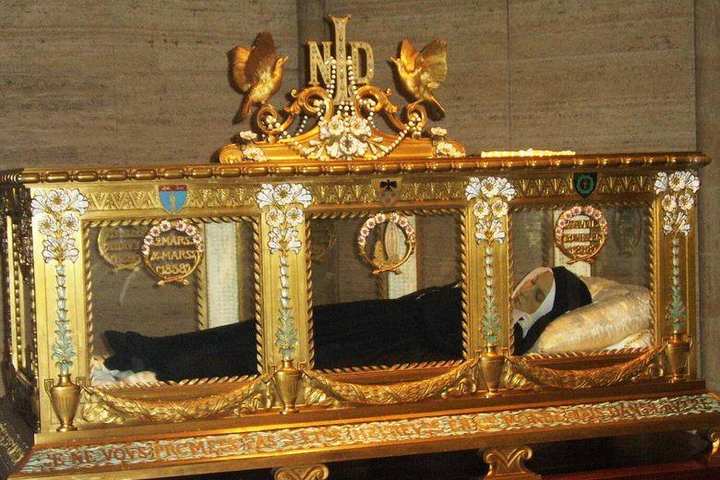
The girl who saw the lady died at thirty-five, still asthmatic, of tuberculosis of the bone, in a convent at Nevers. She had not been healed. For the cause of her beatification the Church opened the coffin in 1909, 1919 and 1925. The doctors found the body intact. A light wax covers the face and hands now, applied in 1925, which the Church does not hide. She lies in the chapel of Saint-Gildard. The years in the convent and the three openings of the coffin are in that entry.
- Our Lady of Fátima
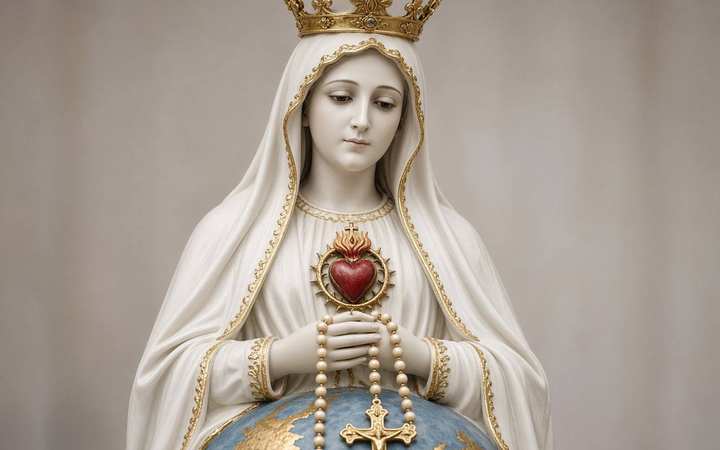
Fátima is the other great approved apparition of the modern West: children, a lady, a public sign, a war. Lourdes is earlier, poorer, and quieter in its words. The rosary and penance do not change their meaning between 1858 and 1917.
The chair of Peter
Popes who belong with this sign
Pray this
Prayers that sit with the story
Church status
How this sign has been received
Church-approved
Bishop Laurence’s letter of 18 January 1862 is a diocesan judgment, which is how apparitions are judged. Rome did not need to re-try the case to put the feast on the universal calendar. The feast of Our Lady of Lourdes is 11 February. This is a fully approved Marian apparition. The Church says the faithful are justified in believing it as certain.
Private revelation does not add a new article to the Creed. A Catholic is required to believe what the Creed says: that Christ is God, that he was born of the Virgin, that he died, that he rose, that he will come again. A Catholic is not required, as a condition of being Catholic, to make a pilgrimage to Lourdes. The Church, having examined the case, says you may believe it as certain, and you may go. Millions have gone. The fruits — conversion, the care of the sick, the seventy-two named cures, the hidden life of the seer — are why the Church has never withdrawn the yes of 1862.
Investigation
What has been examined
The water has been analysed repeatedly. It is drinking water, with the minerals of the local rock. No chemist has found a secret. The shrine does not claim one. The Medical Bureau of Lourdes — the Bureau des Constatations Médicales, founded in 1883, later joined by the International Medical Committee of Lourdes — is the Church’s decision not to be afraid of doctors. A claimed cure is examined first as medicine. Was the diagnosis certain? Was the disease organic, serious, not in the habit of vanishing? Was the change sudden, complete, lasting, without a treatment that would explain it? Physicians of any faith or of none sit on the committee. They do not vote that Mary did it. They vote, when they vote at all, that they have no explanation. Only then does a bishop — usually the bishop of the person’s home diocese, with the bishop of Tarbes and Lourdes in the file — decide whether to speak of a miracle of grace. Of thousands of claims, and of more than seven thousand files the Bureau has been willing to look at, the Church has recognized seventy-two cures as miraculous. The number moves slowly on purpose. The smallness of it is part of the honesty. A shrine that recognized everything would recognize nothing. The cases themselves — Latapie, Traynor, Micheli, Moriau, Raco, and the rest of the seventy-two — are told in the entry on the healings of Lourdes.
The shrine today
Why pilgrims still go
Between 11 February and 16 July 1858, at a limestone cave the town of Lourdes used as a dump, a miller’s daughter named Bernadette Soubirous saw a young woman in white eighteen times. The woman asked for prayer, penance, a spring, a chapel, and a procession. On the feast of the Annunciation she gave a name the child did not know: I am the Immaculate Conception. The spring still runs. The sick still come. That is why this road exists.
Lourdes — the reasonsSources
- Bishop Bertrand-Sévère Laurence, pastoral letter of 18 January 1862
- Depositions of St. Bernadette Soubirous to the canonical commission, 1858–1861
- Jean-Baptiste Estrade, Les apparitions de Lourdes (eyewitness testimony)
- Abbé Dominique Peyramale, parish testimony
- Lourdes Medical Bureau (Bureau des Constatations Médicales); International Medical Committee of Lourdes (CMIL)
- Sanctuary of Our Lady of Lourdes (lourdes-france.org): the eighteen apparitions; the seventy-two recognised cures
- Sisters of Charity of Nevers, Saint-Gildard: life and death of Sister Marie-Bernard
- Canonical exhumation acts, Diocese of Nevers, 1909 (Drs. David and Jourdan), 1919 (Drs. Talon and Comte), 1925
- Pius IX, Ineffabilis Deus, 8 December 1854
- Pius XI, canonization of St. Bernadette, 8 December 1933
For the classroom
Our Lady of Lourdes (1858, Massabielle, Lourdes). Grade in this encyclopedia: Church-approved. Between 11 February and 16 July 1858, in a limestone cave on the edge of Lourdes that the town used as a rubbish dump, a fourteen-year-old miller’s daughter named Bernadette Soubirous saw a young woman in white eighteen times. The woman spoke the dialect of the valley. She asked for prayer, for penance, for a spring of water, for a chapel, and for a procession. On 25 March, the feast of the Annunciation, she gave a name the child had never been taught: “I am the Immaculate Conception.” The bishop of Tarbes judged the apparitions worthy of belief in 1862. The spring still runs. The sick still come. Bernadette died at thirty-five, still ill, in a convent at Nevers.