
The reading
How it began
Late medieval narrative: to save the house of Mary from the fall of Acre, angels lift it from Nazareth to Tersatto, then to Recanati, then to the road of Loreto in 1294. A more earthbound reconstruction notes that a family named Angeli had interests in Epirus, and that stones of Palestinian type sit in an Italian field in the 1290s, when Crusader Palestine is lost.
The day itself
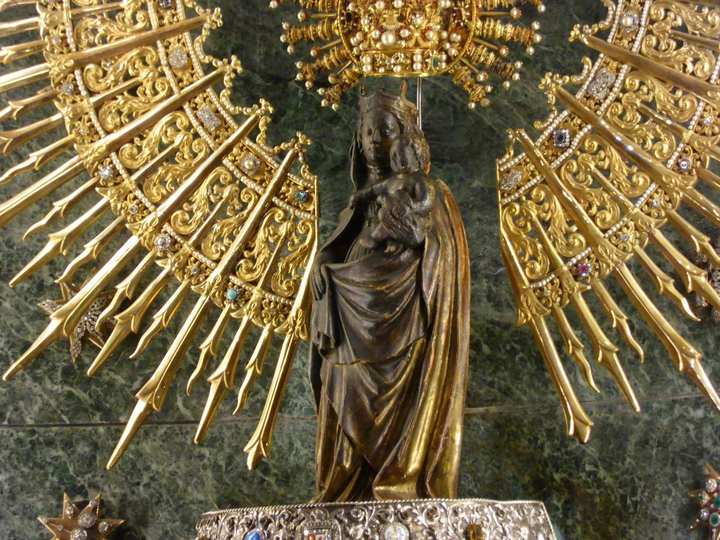
Inside, the walls are plain. A black Madonna (a later statue; a fire in 1921 destroyed the earlier one) presides. Pilgrims include Descartes, Mozart’s family, a procession of popes, and countless women praying for a child. The flying-house image has entered the world’s imagination — even Our Lady of Loreto is patroness of aviators.
What was kept
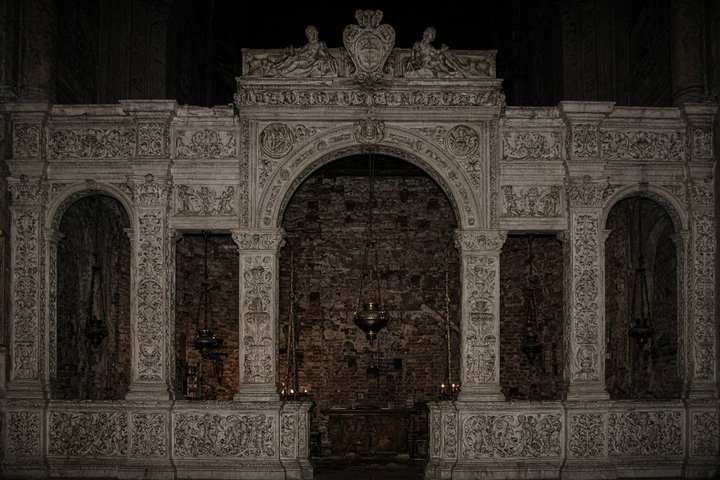
The Holy House is a stone room, about nine metres by four, set inside the marble screen Andrea Sansovino and his successors built in the basilica at Loreto. The stones are a limestone that Italian quarries do not match and that the geology of Nazareth does. Graffiti in the manner of the Nazareth grotto have been argued over by archaeologists who were allowed to look. The late medieval story says angels carried the house from Nazareth to Tersatto in 1291, then across the Adriatic to a wood at Recanati, then to the road where the basilica stands, in 1294. A later historian’s reading notices that the Angeli family, who ruled parts of Epirus, were moving sacred spoil out of the Crusader east as Acre fell, and that “angels” and “Angeli” are the same word in a sermon. Popes from the fifteenth century onward granted the shrine the rank of a pontifical basilica. Pius II, Pius XI, and John XXIII spoke of it as the house of the Holy Family with a warmth that is devotion, not a defined fact of the flight. John Paul II, Benedict XVI, and Francis have prayed there. The Black Madonna above the altar is a twentieth-century figure; fire in 1921 destroyed the earlier statue. Aviators took Our Lady of Loreto as patron because of the flying house, which is a modern consequence of a medieval image. You can stand in the room and not know whether a ship or a miracle brought it. The room is still the size of a kitchen, and that is the scale of the Annunciation the shrine exists to remember.
Reading
How to read The Holy House of Loreto
Whether angels or a ship, the meaning Loreto has actually had is: the Incarnation has an address. A kitchen-sized room is the Church’s way of not letting the Annunciation evaporate into an idea. You can stand in the number of square feet where, the tradition says, the Word became flesh.
The angel story may be how a medieval people said “this arrived against all likelihood.” Catholics are allowed to prefer the modest history and still kneel.
Pray this
Prayers that sit with the story
Church status
How this sign has been received
Long veneration
Loreto is a pontifical shrine, a basilica, a feast on many calendars. John Paul II, Benedict XVI, and Francis have gone as pilgrims. The Holy See has not made “angelic air-transport” an article of faith. Status: venerated house-shrine of the Incarnation.
The shrine today
Why pilgrims still go
A small house of brick, sheathed in marble, which tradition says is the house of Nazareth — brought by angels, or by a medieval rescue, depending on which historian you ask. Popes have gone. The Litany of Loreto was born here. You go because the Incarnation had an address.
Loreto — the reasonsSources
- Pontifical Shrine of Loreto
- Translations of the Holy House, medieval laudi and later studies
For the classroom
The Holy House of Loreto (Tradition: arrived 1294, Loreto). Grade in this encyclopedia: Long veneration. A small stone house, now inside a basilica, claimed to be the house of the Holy Family, carried from Nazareth by angels — or, as later historians prefer, by the princely family of Angeli. Popes have piled privileges on it. Archaeologists argue.