The reading
In plain speech
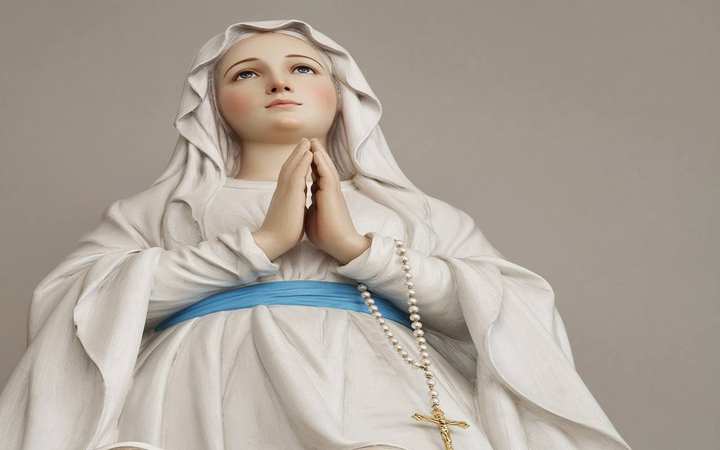
On a wet evening in 1879, at the parish church of Knock in County Mayo, villagers said they saw Our Lady, Saint Joseph, Saint John, and a Lamb on an altar, for about two hours, in silence.
Commissions in 1879 and 1936 found the witnesses trustworthy. The Irish Church receives the apparition. Pope John Paul II came as a pilgrim. An approved apparition is not a new Gospel.
1. What was, and was not, given
No word was spoken. No child was appointed as a founder. There is no secret. The rain did not wet the gable, in their telling. The whole sermon is the Lamb already on the altar.
That is a comfort to people who never hear voices. God may come as a picture, and the picture may be enough.
2. What it does not prove
Witnesses did not agree on every detail, which is what several people do when they look at something hard to describe. Disagreement on the edges is not a reason to invent a speech Our Lady did not give.
Knock does not prove that every silent light on a church wall is heaven. It sends you to Mass, which is where the Lamb already is.
3. The one sentence
Knock is a silent altar on a gable wall, received by the Church, and still not the foundation. Jesus Christ, the Lamb, is.
The older telling follows.
The record
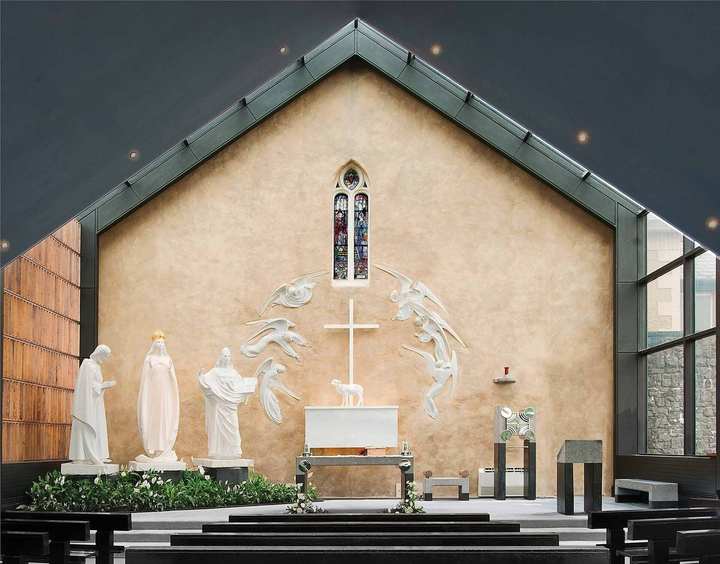
21 August 1879. Ireland is in hunger and eviction. At the south gable of the parish church of Knock, people of various ages see, for about two hours, a tableau in the rain: the Virgin with eyes raised, Joseph inclined toward her, John in a bishop’s mitre as if preaching, an altar, a cross, a Lamb, angels. They do not speak. The ground by the gable is dry.
The record, part 2
No seer is singled out as a founder. There is no secret. Commissions in 1879 and 1936 take depositions. The witnesses do not agree on every detail, which is what several people looking at the same hard-to-describe thing usually do.
The record, part 3
Knock becomes Ireland’s national shrine. John Paul II visits in 1979. Mother Teresa visits. A new airport is built for the pilgrims.
Reading
How to read Our Lady of Knock
Silence is the miracle’s form. In a land of great talkers, Mary says nothing. The Lamb on the altar is the whole sermon: whatever you are suffering, the Mass is already the center of heaven. Joseph is there, the patron of a dying Church’s hidden years. John wears the bishop’s mitre — apostolic authority standing in the rain with the poor.
Knock is a comfort to people who never hear voices. God may come as a picture that will not be photographed, and still be enough.
Pray this
Prayers that sit with the story
Church status
How this sign has been received
Church-approved
The 1879 commission found the witnesses trustworthy. The 1936 commission confirmed. Pope Pius XII blessed the Knock banner. John Paul II raised the shrine to a basilica’s honor by his pilgrimage. Devotion is fully approved; the apparition is received by the Irish Church as authentic.
The shrine today
Why pilgrims still go
On a wet evening in 1879, fifteen people saw Mary, Joseph, St. John, the Lamb, and an altar on the gable of the parish church. No words. Knock is the apparition that does not give messages. It gives a Mass, in silence, in the rain.
Knock — the reasonsSources
- Depositions of 1879, Archdiocese of Tuam
- Knock Shrine archives
- John Paul II, homily at Knock, 30 September 1979
For the classroom
Our Lady of Knock (1879, Knock, County Mayo). Grade in this encyclopedia: Church-approved. On a wet evening, fifteen villagers see Mary, St. Joseph, St. John the Evangelist, and a Lamb on an altar against the parish gable. No word is spoken. The rain does not touch the vision.