The reading
How it began
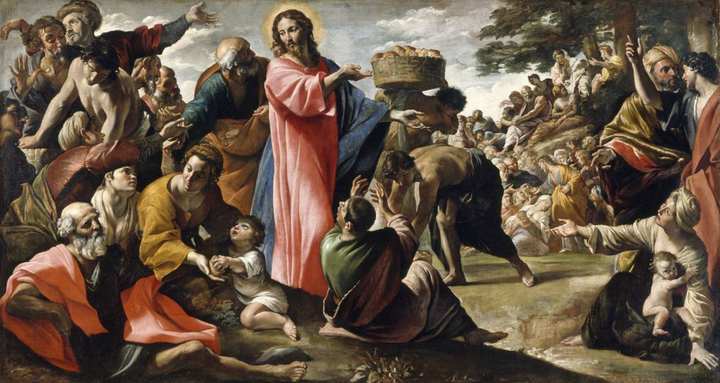
A crowd follows Jesus into a lonely place. Evening comes. The disciples see a logistics problem: send them away to buy food. A boy has five barley loaves and two fish. It is nothing. Jesus takes it, gives thanks, breaks it, and has the disciples distribute it.
The day itself
All eat and are satisfied. Twelve baskets of fragments remain. The number is not accidental in a Jewish story: twelve, like the tribes, like the apostles — enough for Israel.
What was kept
In John, the crowd wants to make him king because he fed them. Jesus withdraws, and the next day he refuses to be a bakery. “You seek me not because you saw signs, but because you ate.” Then he speaks of the bread of life, his flesh for the life of the world.
Reading
How to read The Feeding of the Five Thousand
The miracle is compassion first: he will not send hungry people away empty. It is also a sign of the Messiah’s banquet, the promise that God can feed his people in the wilderness again, as with manna.
John will not let you stop at the picnic. The loaves point to a harder feeding: the Eucharist, in which Christ gives not barley but himself. Catholic reading of later Host-miracles starts here. The scandal is not that bread can bleed. The scandal is already in John 6 — that a man says, “eat my flesh.”
Church status
How this sign has been received
Sacred Scripture
Because all four evangelists tell this sign, the Church has always treated it as a pillar of Jesus’ public life. The liturgy of Corpus Christi and the Mass itself keep returning to the verbs of this scene: took, blessed, broke, gave.
The shrine today
Why pilgrims still go
This is not a later shrine. This is the map of the Gospel. The empty tomb, the lake, the cave at Bethlehem, the stone of the agony. Every other Catholic pilgrimage is an echo of having been here — or of wishing you had.
The Holy Land — the reasonsSources
- Matthew 14; Mark 6; Luke 9; John 6
- Catechism of the Catholic Church 1335, 1373–1381
For the classroom
The Feeding of the Five Thousand (c. AD 31, Near the Sea of Galilee). Grade in this encyclopedia: Sacred Scripture. With five barley loaves and two fish, Jesus feeds a crowd of thousands. It is the only wonder told in all four Gospels — and John uses it to teach the Eucharist.