The reading
In plain speech
Bolsena is a town in Italy where, in 1263, a Priest who doubted the Real Presence is said to have seen the Host bleed onto the corporal at Mass.
Many Catholics receive the story because Pope Urban IV, then nearby at Orvieto, was shown the cloth, and the feast of Corpus Christi was extended to the whole Church. The Church has not defined the stains as an article of faith. The Eucharist is believed because Our Lord said “This is my Body.” A corporal can preach that sentence. It cannot replace it.
1. What is kept
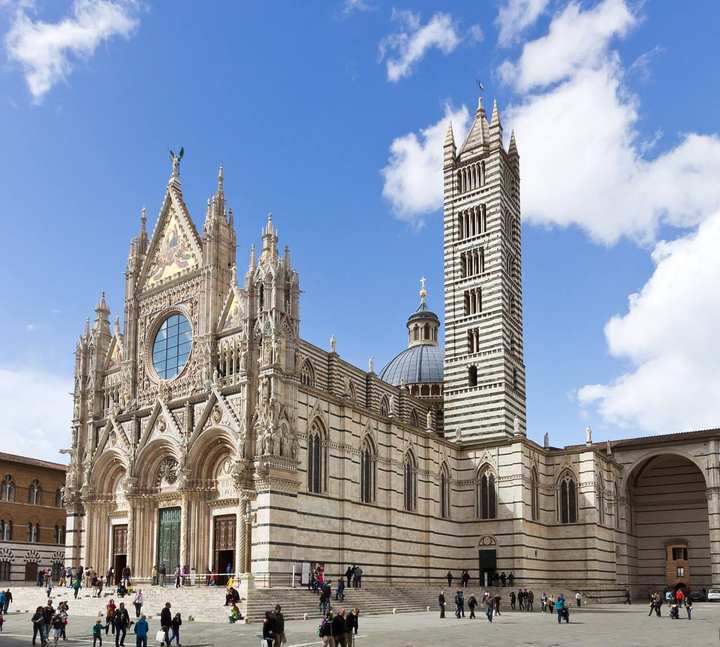
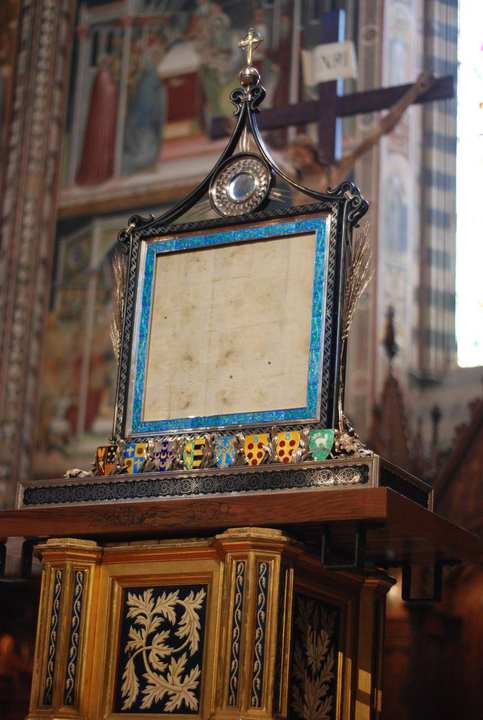
Pilgrims are shown a linen corporal in the cathedral of Orvieto, and marks in the stone at Bolsena. The office written for the feast — Pange lingua, Tantum ergo — is still sung.
Think of the feast as the Church’s answer. Not a laboratory. A Thursday, for the whole world, in honour of a presence that is usually hidden.
2. What it does not prove
A bleeding Host does not mean that an ordinary Mass has failed if the bread still looks like bread. Catholic teaching says the change is real and the appearances stay. Bolsena is the exception people point to, not the rule.
A medieval bull is not a modern forensic file. You may venerate the corporal. You are not obliged to treat every later retelling as a transcript.
3. The one sentence
Bolsena is a doubting Priest, a stained cloth, and a feast the whole Church still keeps — and the Faith still rests on Jesus Christ at the Last Supper, not on the linen.
The older telling follows.
The record
Peter of Prague, a priest on pilgrimage to Rome, stops at Bolsena. He is celebrating Mass at the tomb of St. Christina. He doubts. During the consecration the Host bleeds, staining the corporal (the cloth on which the vessels stand) and the marble.
The record, part 2
The priest, shaken, stops the Mass and goes to nearby Orvieto, where Pope Urban IV is residing. The corporal is brought. In 1264 Urban issues the bull Transiturus, extending the feast of Corpus Christi — already born in Liège through St. Juliana of Cornillon — to the universal Church.
The record, part 3
St. Thomas Aquinas, at Urban’s request, writes the office and hymns still sung: Pange lingua, Tantum ergo, Adoro te devote. The corporal is kept in the cathedral of Orvieto in a reliquary made to be seen.
Reading
How to read Bolsena–Orvieto
Bolsena is a miracle that became a liturgy. The Church’s response was not to build a laboratory. It was to give the whole world a Thursday of public honor for a presence that is usually hidden.
Notice the pattern, almost identical to Lanciano: the doubting priest. Eucharistic miracles in the Catholic memory are often medicines for the celebrant. They are not entertainments for the crowd.
The chair of Peter
Popes who belong with this sign
Pray this
Prayers that sit with the story
Church status
How this sign has been received
Long veneration
The corporal of Bolsena has been venerated for centuries, visited by popes, and bound up with a universal feast. That is as close to “the Church has accepted this” as a medieval Eucharistic sign can come. The stains in the stone at Bolsena are still shown.
The shrine today
Why pilgrims still go
A doubting priest, a bleeding Host, a pope in the next town, and Corpus Christi given to the whole Church. Aquinas wrote the hymns in this air. You go to kneel before the linen, and to hear Tantum ergo in the cathedral that exists because of it.
Orvieto & Bolsena — the reasonsSources
- Urban IV, bull Transiturus de hoc mundo (1264)
- Cathedral of Orvieto, Chapel of the Corporal
- Office of Corpus Christi, attributed to St. Thomas Aquinas
For the classroom
Bolsena–Orvieto (1263, Bolsena, then Orvieto). Grade in this encyclopedia: Long veneration. A Bohemian priest, doubting the Real Presence, sees the Host bleed onto the corporal. Urban IV, then at Orvieto, is shown the linen — and Corpus Christi enters the calendar of the whole Church.