The reading
In plain speech
Cascia keeps a page of a book on which, in 1330, a Host is said to have bled after a Priest of Siena slipped it into his breviary instead of a pyx.
The Augustinians have shown the page for centuries. The Church has not defined it. Irreverence is the plot, not fervour. Christ is not a slip of paper.
1. What is kept
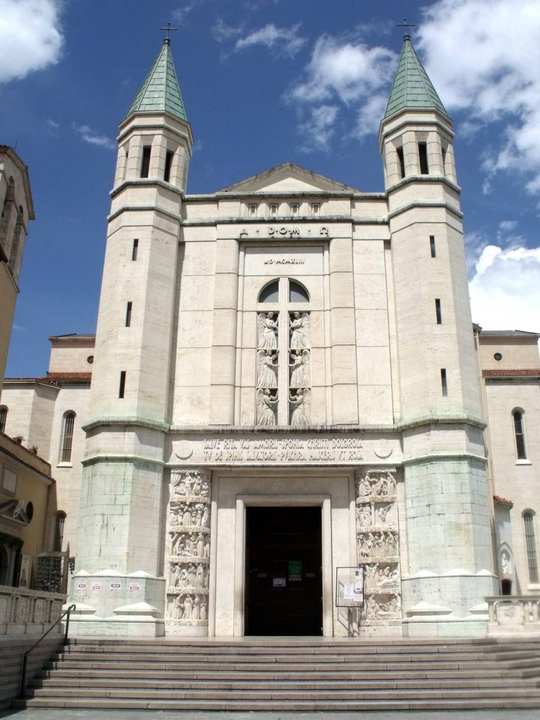
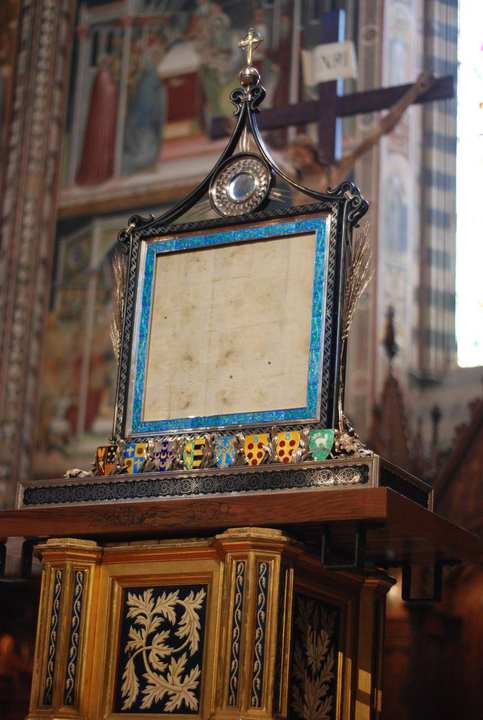
Visitors see a darkened leaf in the Basilica of Saint Rita. People say the blood has formed a face. There is no modern laboratory file of the Lanciano kind. There is a book that was used as a pocket, and a house that stopped treating the Sacrament that way.
2. What it does not prove
A stained page does not prove every later face that someone thinks they see. It does not make the Priest’s fear into a new doctrine.
Faith in the Eucharist does not wait on whether the face is obvious to you.
3. The one sentence
Cascia is a Host that would not stay filed in a book — kept beside Saint Rita, and still not the reason the Church believes. The words of Our Lord are.
The older telling follows.
The record
In 1330 a priest of Siena is called to a dying man. Instead of placing the Host in a pyx, he tucks it between the pages of his breviary. When he opens the book, the Host has melted into blood, soaking two pages.
The record, part 2
Confused and frightened, he goes to the Augustinian Blessed Simon Fidati of Cascia. The page is taken to Cascia. One leaf is later said to have been sent to Perugia and lost; the other remains in the Basilica of St. Rita.
The record, part 3
The blood has formed, people say, a likeness of a face. Visitors are shown a framed, darkened page. St. Rita of Cascia, two centuries later, will pray in that same house — herself a woman of wounds and impossible roses.
Reading
How to read Cascia
Again the pattern is irreverence, not fervor. The Host is treated as a thing that can be filed in a book. The sign is a refusal to be filed. Catholic sacramental theology says Christ is present as long as the appearances of bread remain; here the appearance itself becomes a wound.
Church status
How this sign has been received
Long veneration
The relic has been kept and shown by the Augustinians for centuries, with episcopal approval of the cult. St. John Paul II visited Cascia. There is no separate modern scientific protocol comparable to Lanciano.
Sources
- Basilica of St. Rita, Cascia
- Augustinian tradition of Blessed Simon of Cascia
For the classroom
Cascia (1330, Siena, then Cascia). Grade in this encyclopedia: Long veneration. A priest takes Communion to a sick man, slips the Host unworthily into his breviary, and later finds it bleeding through the pages. The stained leaf is kept by the Augustinians of Cascia.