
The reading
In plain speech
Santarém, in Portugal, keeps a Host that is said to have bled in the thirteenth century after a woman took it from her mouth and carried it to a sorceress.
Catholics have venerated it for centuries. The Church has not made it a dogma. A stolen Host, if the appearances of bread remain, is still Christ. That is why the theft is grave, and why the sign, if it is received, is a mercy that stops a spell.
1. What the town shows
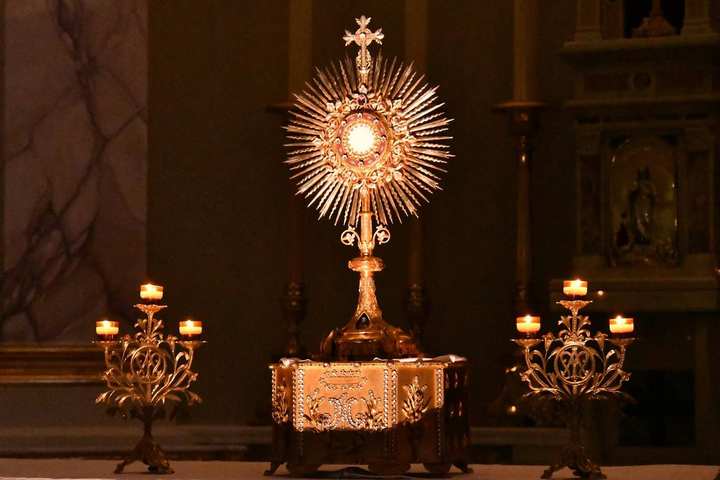
The church is now called the Church of the Holy Miracle. A monstrance and old bloodstained cloths are what pilgrims are shown. The woman’s name is not the point. The return to the Priest is.
2. What it does not prove
It does not prove that magic works, or that every bleeding-Host story in Europe has the same paperwork. It does not add a sentence to the Gospel.
If the relic were lost tomorrow, last Sunday’s Mass would still be the Mass.
3. The one sentence
Santarém is a Host taken for a charm and brought back bleeding — venerated in Portugal, and still not the foundation. Jesus Christ is.
The older telling follows.
The record
The story, as Portugal has told it since the thirteenth century, is not pretty — which is one reason it has the ring of a real sin rather than a pious tale. A wife in Santarém, convinced her husband is unfaithful, is told by a witch that she needs a consecrated Host for a spell.
The record, part 2
She receives Communion, takes the Host from her mouth, and wraps it in a veil. Blood soaks the cloth. Frightened, she hides it in a chest. At night the chest shines. Her husband discovers the truth. In the morning they take the Host to the parish priest.
The record, part 3
The Host is carried in procession to the church of St. Stephen, later renamed the Church of the Holy Miracle. For centuries it has been exposed in a monstrance, the bloodstains still visible on the old corporals.
Reading
How to read Santarém
This is a miracle in the middle of sacrilege. Catholic theology is unsentimental here: the Real Presence does not depend on the holiness of the recipient. That is why a stolen Host is, in Catholic eyes, still Christ — and why the desecration is so grave.
The woman’s name is not the point. The conversion is. The sign does not destroy her. It unmasks the spell and sends her back to the Church she was using as a supply cupboard.
Church status
How this sign has been received
Long veneration
The cult is ancient, confirmed by Portuguese bishops and visited by saints (St. Francis Xavier is said to have visited before sailing). Popes have granted indulgences. It is a national pilgrimage, not a defined dogma.
The shrine today
Why pilgrims still go
A stolen Host, a chest that shone, blood on the corporal — still reserved, still shown. Santarém is Fátima’s Eucharistic sister, an hour away. You go because the same country that saw the sun dance also kept a bleeding Host for eight centuries.
Santarém — the reasonsSources
- Church of the Holy Miracle, Santarém
- Portuguese episcopal notices of the cult
For the classroom
Santarém (c. 1247, Santarém). Grade in this encyclopedia: Long veneration. A woman, desperate to recover her husband’s love, takes a consecrated Host from Mass to a sorceress. The Host bleeds. She hides it, then surrenders it. It is still reserved in Santarém.