The reading
A rock the sea takes back
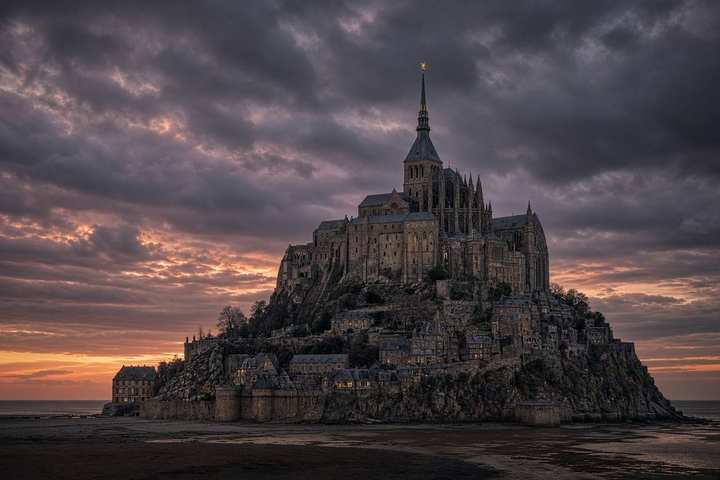
Mont-Saint-Michel is a granite islet off the coast of Avranches, in a bay where the tide runs out for kilometres and returns across sand that has killed the careless. The range of that tide is among the greatest in Europe. The old boast that the water comes in ‘as fast as a galloping horse’ is a proverb, not a measurement; the danger is real enough without it. In the early eighth century this was not yet an abbey. It was a difficult rock, forested, used by hermits, and visible from the bishop’s city of Avranches. The legend begins with a command to build there because Michael had already taken a cave in Italy and wanted a second door.
Aubert, three nights, and a skull
Aubert, bishop of Avranches, is the man the Revelatio names. The year usually given is 708. He dreams that Saint Michael wants a sanctuary on the mount, in the pattern of Gargano. He does not obey the first night, or the second. Prudence, in this kind of story, looks like delay, and the story treats the delay as a fault. On the third night Michael is no longer polite. The legend says the Archangel pressed a finger into the bishop’s skull and left a hole. At Avranches, in the church of Saint-Gervais, a pierced cranium was long venerated as Aubert’s. It suffered in the Revolution; what is discussed now is a skull with an opening that a surgeon would also call a trepanation. Historians are right to say a hole in a bone does not prove an angel’s finger. Pilgrims are right that the abbey was built. The article keeps both sentences. The apparition is legend. The building is a fact you can walk into.
From canons to the Merveille
A small church rose on the summit in the century after Aubert. In 966 Duke Richard I of Normandy replaced the canons with Benedictine monks. An abbot named Maynard is remembered at the head of that community. The Romanesque church climbed the rock in the eleventh century. In 1204, during the war between John of England and Philip Augustus, Breton troops in the French king’s service burned the village on the mount. Philip paid for the rebuilding. Out of that payment came the Gothic rooms still called the Merveille — the cloister in the sky, the refectory, the knights’ hall — stacked on the north face because there was no ground left to spread across. Pilgrims of the later Middle Ages were called miquelots. They came for the Archangel, and they raced the tide on the causeway and the sands. The mount was a fortress as well as a choir. It held out against the English in the Hundred Years’ War. That military fame is true, and it is not the reason the Church keeps the feast.
Prison, statue, and who prays there now
The Revolution emptied the abbey. From 1793 until 1863 the rock was a prison; the wheel that hauled supplies is still shown, and the nickname ‘the Bastille of the sea’ belongs to those decades, not to the Benedictines. Restoration in the later nineteenth century gave the mount back its silhouette. In 1897 Emmanuel Frémiet’s gilded copper Saint Michael was set on the spire: sword raised, the dragon under him, visible from the mainland when the light is kind. UNESCO inscribed the mount in 1979. The monks who pray there now are not the medieval Benedictine community. Since 2001 the Monastic Fraternities of Jerusalem have kept the liturgy in the abbey church, under the diocese of Coutances and Avranches. Mass is real. The shops at the base are also real. Go for the climb and the Office, not for the shops.
Reading
How to read The rock Michael asked for
Mont-Saint-Michel is Gargano said again in French, on a rock the sea tries to take back twice a day. It is a poor symbol for a safe life and a precise symbol for the faith: a place that cannot be held without being given, and a prince who is asked for defence rather than for comfort.
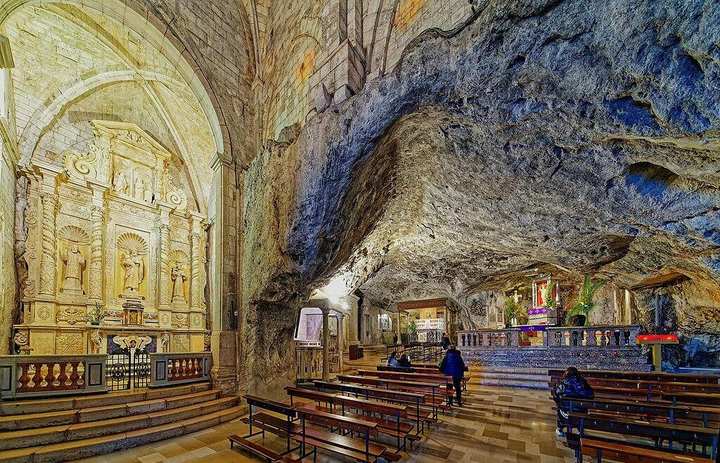
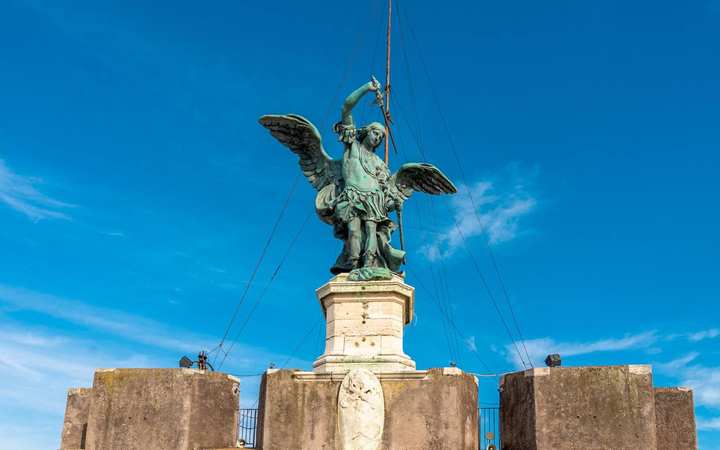
If your map of Saint Michael is only a prayer card, add this silhouette, then the cave, then the castle in Rome, then the prayer of Pope Leo XIII, then — with its label still on it — the Korean letter. That is his range in this encyclopedia: shrine, skyline, papal text, and an unverified mercy. They are not one story.
The same mystery
Signs that belong with this one
- The cave of Saint Michael
Aubert was told to copy Gargano. The French mount is not a rival. It is an answer: the prince wanted more than one door.
Pray this
Prayers that sit with the story
Church status
How this sign has been received
Long veneration
A major pilgrimage of the Latin West, still a place of Mass and the monastic Office. The command to Aubert, and the finger in the skull, are the founding legend. The abbey, the date 966, the Gothic rebuild after 1204, the prison years, Frémiet’s statue, and the community of Jerusalem are history. Status of the apparition: venerated tradition. Status of the rock: go and see.
Sources
- Revelatio ecclesiae sancti Michaelis in Monte Tumba (founding legend of Mont-Saint-Michel)
- Installation of Benedictines by Duke Richard I, 966
- Gothic reconstruction after the fire of 1204; the rooms called the Merveille
- Use of the abbey as a prison, 1793–1863
- Emmanuel Frémiet, gilded Saint Michael, 1897
- UNESCO World Heritage inscription, 1979
- Monastic Fraternities of Jerusalem at the abbey since 2001
For the classroom
The rock Michael asked for (c. 708, Mont-Saint-Michel, Normandy). Grade in this encyclopedia: Long veneration. In the early eighth century Aubert, bishop of Avranches, is said to have been told in sleep, three times, to build a church for Saint Michael on the granite islet in the bay — in imitation of the cave at Monte Sant’Angelo. He delayed. The third time, the legend says, the Archangel’s finger left a hole in his skull. A pierced cranium has long been shown at Avranches. The abbey on the rock is not a legend. It has been a Benedictine house, a prison, a national monument, and, since 2001, a house of the Monastic Fraternities of Jerusalem. The gold Michael on the spire is the work of Emmanuel Frémiet, 1897.