The reading
How it began
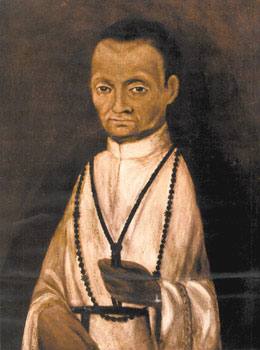
Martín is received as a donado, a servant-brother, because the Order’s rules and the colony’s racism agree that a mixed-race man should not be a priest. He obeys, and then quietly becomes the most famous Dominican in Peru: nursing the plague-stricken, feeding the poor from a convent kitchen that should have emptied, reported in two places at once, light in the cell, a dog, a cat, and a mouse eating from one dish.
The day itself
He is, after death, the unofficial saint of the Americas’ racial wound. John XXIII canonizes him in 1962, during the Second Vatican Council.
Reading
How to read St. Martin de Porres
The miracles are real in the process, and they are also a language: God multiplying a man the colony had subtracted. Bilocation, if granted, is almost too on-the-nose — the man who was not allowed a place being in more places than the allowed.
Pray this
Prayers that sit with the story
Church status
How this sign has been received
Church-approved
Canonized 1962; patron of social justice, of people of mixed race, of barbers and public health. The wonders were part of a very long cause.
Sources
- Process of canonization of St. Martin de Porres
- John XXIII, canonization, 6 May 1962
For the classroom
St. Martin de Porres (Died 1639, Lima). Grade in this encyclopedia: Church-approved. A Dominican brother, son of a Spanish noble and a freed Black woman, barred from full priesthood by race, whose life in Lima was a cascade of healings, bilocation, and a rapport with animals that hagiography cannot quite make ordinary.