The reading
How it began
Around 1651, in a brotherhood of enslaved and free Africans, an image of the Crucified is painted on adobe. The earthquake of 1655 destroys the neighborhood. The wall with the Christ remains. Attempts to erase or move it fail, in the city’s memory, by a holy stubbornness.
The day itself
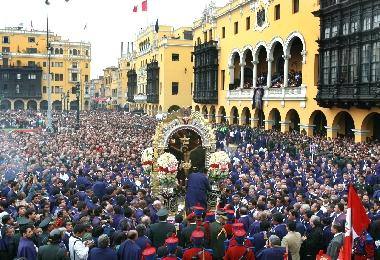
A later earthquake, 1687, again spares the image. A copy is taken in procession. Lima takes the habit of wearing purple in October. The procession of the Lord of Miracles is among the largest Catholic processions on earth.
Reading
How to read The Lord of Miracles
This is a miracle of the oppressed. The Christ who will not fall off an adobe wall is first the Christ of enslaved Africans, then of a whole city. Purple — Lent’s color — in October means: the Passion is not a season. It is a people walking.
Church status
How this sign has been received
Long veneration
The sanctuary of Las Nazarenas, archdiocesan processions, papal greetings. Venerated as Lima’s patronal image. The survival of a wall in earthquakes is the sign; the devotion is the larger fact.
Sources
- Sanctuary of Las Nazarenas, Lima
- Archdiocese of Lima, October triduum
For the classroom
The Lord of Miracles (Painted c. 1651; wonders from 1655, Lima). Grade in this encyclopedia: Long veneration. An Angolan slave paints Christ crucified on a wall in Lima’s Pachacamilla. Earthquakes level the district; the wall stands. A city in purple processes behind the image every October.