
The reading
How it began
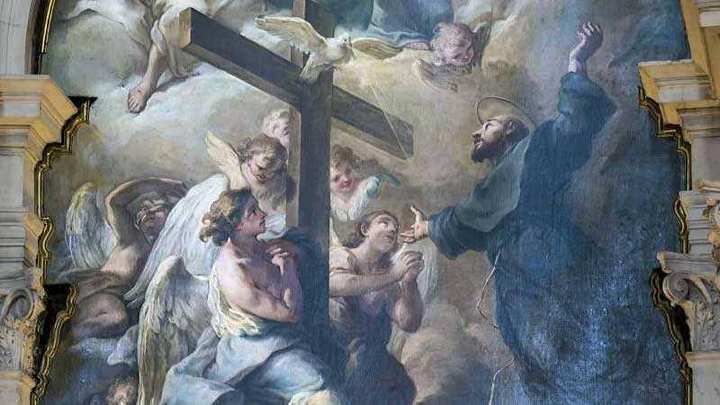
Giuseppe Desa is thought simple. He fails studies, is turned away, finally ordained — legend says — because the examiner asked him the one question he knew. Then the Mass becomes a problem: he is lifted from the floor, from the pulpit, toward a statue, toward a tree. The Inquisition looks at him. He is moved from house to house like a man who is himself a spectacle against his will.
The day itself
The depositions of the canonization process are full of named witnesses, dates, and the irritation of communities that came to see a circus and found a frightened saint.
Reading
How to read St. Joseph of Cupertino
Levitation is, in Catholic mystical theology, an accidental overflow of contemplation — the body lagging behind a soul that has been drawn. It is not a performance art. Joseph’s misery at being watched is part of the evidence. A faker usually manages a better box office manner.
He is the patron of students who struggle, which may be the more used miracle.
Pray this
Prayers that sit with the story
Church status
How this sign has been received
Church-approved
Canonized 1767. The process treated the levitations as morally certain on human testimony. No film, obviously. Status: saint; the flights belong to the genre of well-attested pre-modern prodigy — strong as witness, closed to laboratory.
Sources
- Acts of the canonization of St. Joseph of Cupertino
- Bertolotti and early lives
For the classroom
St. Joseph of Cupertino (Levitations c. 1630–1663, Cupertino, Assisi, Osimo). Grade in this encyclopedia: Church-approved. A Conventual Franciscan of limited academic gifts, whose ecstasies included public levitations so frequent that his superiors hid him. Witnesses include cardinals, a pope’s circle, and annoyed friars.