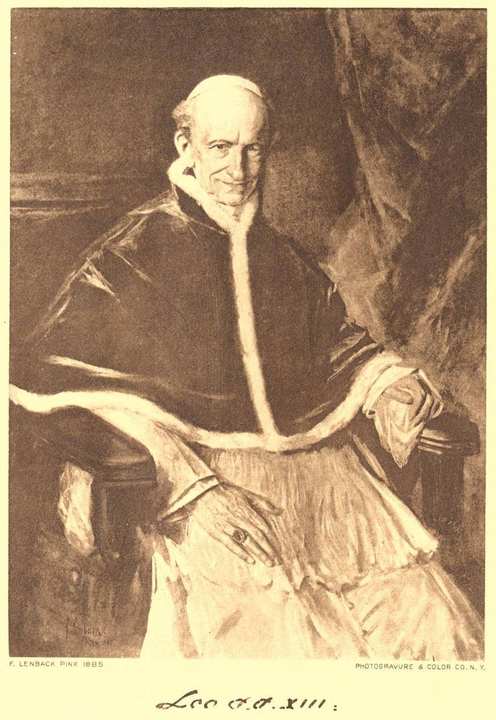
The reading
What the Pope actually commanded
After the loss of the Papal States, Pope Pius IX had ordered prayers at the end of Mass in his own territories: three Hail Marys, the Hail Holy Queen, and a collect for the liberty of the Church. On 6 January 1884 Pope Leo XIII extended those Leonine Prayers to the whole Latin Church. They still did not include Saint Michael. In 1886 he added the short prayer that begins Sancte Michael Archangele, defende nos in proelio. From then until the Instruction Inter oecumenici of 26 September 1964, taking effect on 7 March 1965, a Priest said it with the people after Low Mass. The obligation ended. The prayer was not forbidden. Pope John Paul II asked the Church, on 24 April 1994, not to forget it.
The words he gave the Church
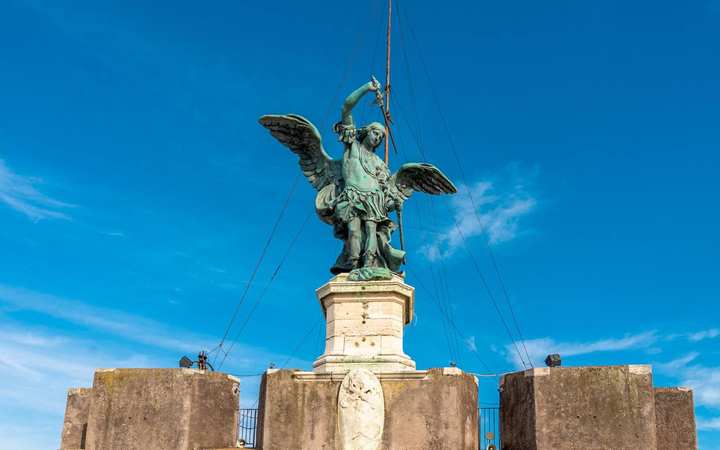
Saint Michael the Archangel, defend us in battle. Be our protection against the wickedness and snares of the devil. May God rebuke him, we humbly pray; and do thou, O Prince of the heavenly host, by the power of God, cast into hell Satan and all the evil spirits who prowl about the world seeking the ruin of souls. Amen. That is the prayer. It is papal. It is public. It is still the right prayer to say. Pope Leo XIII also composed a longer exorcism against Satan and the apostate angels, for the use of a Priest with the Church’s rites, not as a private script to be shouted at a neighbour. The short prayer after Mass and the longer exorcism are not the same text. Devotional websites often glue them together and call the result “what he wrote that morning.”
What his household later said
No bulletin of 1886 describes a vision. The first printed story of one is decades later. A French notice in 1906 speaks of a legion of demons rising over the world while the Pope was at the altar. Father Domenico Pechenino, writing long after, said that Leo stood as if nailed to the floor at the foot of the altar after Mass, his face drained, and then went to his desk and wrote. Cardinal Giovanni Nasalli Rocca, in a Lenten letter of 1946, said he had the account from Monsignor Rinaldo Angeli, the Pope’s private secretary: Leo had truly seen infernal spirits gathering over the city of Rome, and the prayer the Church was told to recite came from that hour. Angeli is the closest witness the story has. He is not a contemporary protocol. He is a secretary’s memory, written down by a Cardinal after both men were looking back.
The conversation that arrived later
The version most people mean is sharper than Angeli’s. Satan boasts that he can destroy the Church. God asks how. Satan asks for time and for power over those who will give themselves to him — seventy-five years, or a hundred, depending on who is telling it. God grants the time. Pope Leo XIII hears it near the tabernacle, collapses or stands white for ten minutes, and writes the prayer before the morning is over. Some tellings date the hour to 13 October 1884, exactly thirty-three years before the miracle of the sun at Fátima. That date is too neat, and it is the wrong year for the prayer: in October 1884 the Leonine Prayers existed and Saint Michael’s prayer did not. Father Bers, a German Priest who hunted the story in 1933 and 1934, said he found the claim everywhere and the proof nowhere. He thought it was spreading because people wanted it, not because a file in the Vatican held it. A Catholic encyclopedia has to be able to say that out loud.
What may still be believed
Believe the prayer. It is his. Believe that he meant the war in the twelfth chapter of the Apocalypse, where Michael and his angels fight the dragon. Pope John Paul II said as much in Saint Peter’s Square: Leo XIII had that picture clearly in mind. Believe, if you judge the secretary credible, that the Pope saw something of the demons over Rome and answered with this text. Do not treat the bargained century, the quoted sentences of Satan, or the Fátima anniversary as the words of a Pope. No decree has defined them. Private revelation, even if a Pope received it, would not bind the Church. This one has not been judged at all. The fruit that was judged is the prayer, and the fruit is still in use.
Reading
How to read The vision of Pope Leo XIII
The Church does not live by a Pope’s unpublished vision. She lives by what he ordered in the light: a prayer after Mass, for a Church that had just lost her lands and was being pressed in Germany and Italy. The vision stories grew because the prayer feels like a man who has seen a fight, not like a committee. That feeling can be right even when the dialogue people attach to it is later embroidery.
Say the prayer. Do not say it as a spell that locks a century, and do not refuse it because a website invented a transcript. Pope Leo XIII’s own battle was plainer. He wrote Rerum novarum for the worker, he defended the liberty of the Holy See, and he put the Archangel’s name back on the lips of every Parish that had just finished Mass.
The same mystery
Signs that belong with this one
- St. Michael in the Korean snow
The same Archangel, a different century, a private letter instead of a papal order. Korea is not evidence for Leo’s vision. Both pages exist because Catholics ask Michael into a fight.
- Michael over the plague
Rome has pictured Michael over the city before. Gregory the Great, Easter 590, a sword going back into the sheath. Leo’s household spoke of spirits over the same city.
The chair of Peter
Popes who belong with this sign
Pray this
Prayers that sit with the story
Church status
How this sign has been received
Unverified
The Prayer to Saint Michael is an authentic composition of Pope Leo XIII, imposed after Low Mass from 1886 until the Leonine Prayers were suppressed in 1965. Pope John Paul II commended it again in 1994. The vision, and especially the dialogue in which Satan is given a century, has no contemporary record and no judgement of the Holy See. Status of the vision in this encyclopedia: unverified. Status of the prayer: papal, and still ours to say.
Sources
- Leo XIII, extension of the Leonine Prayers, 6 January 1884; addition of the Prayer to Saint Michael, 1886
- Instruction Inter oecumenici, 26 September 1964
- John Paul II, Regina Caeli, 24 April 1994
- Cardinal Nasalli Rocca, Lenten letter, 1946, reporting Monsignor Rinaldo Angeli
- Father Bers, investigation published in the 1930s, finding no contemporary proof of the dialogue
- The Roman Ritual: the longer exorcism of Leo XIII, distinct from the short prayer
For the classroom
The vision of Pope Leo XIII (1884–1886, The Vatican). Grade in this encyclopedia: Unverified. Pope Leo XIII ordered the Church to say the Prayer to Saint Michael after Low Mass. Catholics also tell of a vision in which he heard God and the devil, and of a century of license given to Satan. The prayer is certain. The conversation, in the form people now quote, is not.