The reading
How it began
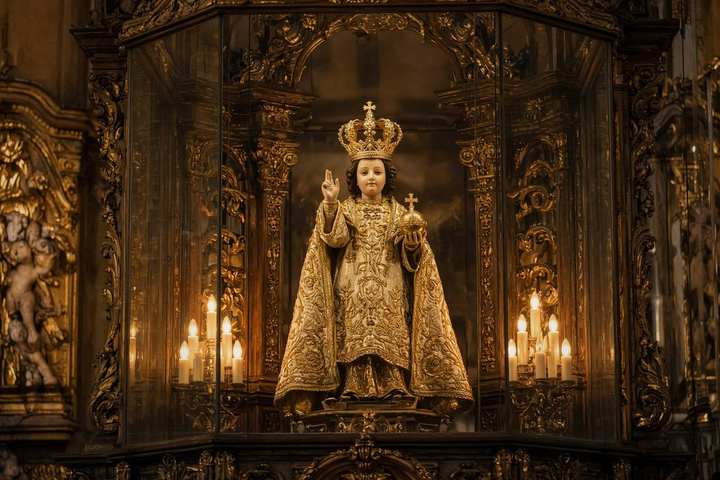
The figure is 47 centimetres: wax over a wooden core, a Spanish Child given in 1628 by Polyxena of Lobkowicz to the Discalced Carmelites of Prague with the sentence the house still repeats: “I give you what I prize most in the world.” In the miseries of the Thirty Years’ War the image was discarded among rubble, then recovered by Fr. Cyril of the Mother of God. Carmelite tradition says the Child spoke: the more he is honoured, the more he will bless. Crowns and capes followed — a wardrobe for every season — not as doll-play, as homage to the Incarnation’s smallness.
The day itself
Popes have granted indulgences. Canonical crowning came in 1741 and later. Benedict XVI and Francis have both honoured the devotion. Copies stand in houses on every continent. The official object is this one: the Infant in Our Lady Victorious, Prague, dressed as a king because the Gospel’s king arrived as a child.
Reading
How to read The Infant Jesus of Prague
The Gospel already contains this: unless you become like children. The Prague Infant is that sentence in wax, for a Europe that had become expert at war. Dressing the Child is not doll-play when it is done as homage to the Incarnation’s smallness.
Pray this
Prayers that sit with the story
Church status
How this sign has been received
Long veneration
Canonical crowning (1741 and later), a pontifical shrine, a feast. Venerated. The interior locutions of Fr. Cyril are pious tradition of the house, not a defined apparition.
The shrine today
Why pilgrims still go
A small crowned Child in a glass case, dressed by Carmelites, loved from Bohemia to every parish that ever put a copy on a side altar. ‘The more you honor me, the more I will bless you.’ People still come to ask for children, for families, for the next month’s rent.
The Infant of Prague — the reasonsSources
- Church of Our Lady Victorious, Prague
- Carmelite chronicles of the Infant
For the classroom
The Infant Jesus of Prague (In Prague from 1628, Our Lady Victorious, Prague). Grade in this encyclopedia: Long veneration. A small Spanish wax-and-wood Child, given to the Discalced Carmelites, dressed in royal robes, famous for favors to the poor and to families. Not a walking statue — a school of spiritual childhood.