The reading
How it began
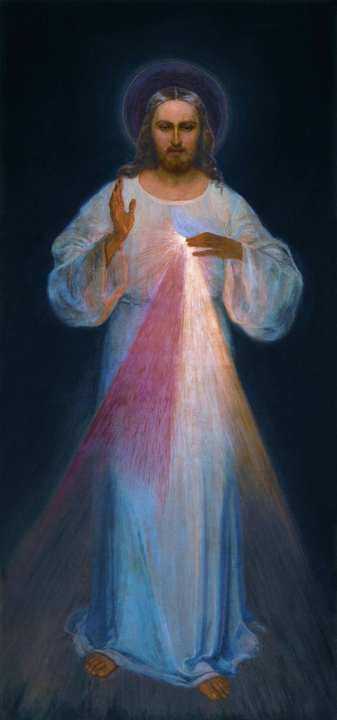
On 22 February 1931, in a convent in Płock, Sr. Faustina sees Jesus as in a painting, rays of white and red streaming from his heart. “Paint an image according to the pattern you see.” She cannot paint. In Vilnius the artist Eugeniusz Kazimirowski, under her unhappy supervision — she cried that it was not as beautiful as the Lord — produces the first image in 1934.
The day itself
The later, sweeter Kowalska image by Adolf Hyła (1943, Kraków) is the one most people know. Faustina’s diary, for a time treated with suspicion in Rome (a bad translation played a part), is rehabilitated. John Paul II, who grew up by her tomb, canonizes her in 2000 and institutes Divine Mercy Sunday for the whole Church.
Reading
How to read The Divine Mercy Image
The rays, Faustina is told, are blood and water from the side on the cross — the sacraments, Baptism and Eucharist, the same stream John saw. The image is a visible Gospel of John 20: the risen one showing his wounds in the upper room on the eighth day.
“Jesus, I trust in You” is not a mood. It is a decision about who gets the last word on a sinner.
The chair of Peter
Popes who belong with this sign
Pray this
Prayers that sit with the story
Church status
How this sign has been received
Church-approved
The devotion, the feast, the saint, and the image are fully approved. The diary is permitted. This is not a semi-tolerated private piety. It is on the universal calendar.
The shrine today
Why pilgrims still go
St. Faustina’s convent, the image of Mercy, the tomb of the apostle of Mercy, and the city of the pope who put her on the universal calendar. Kraków is where the twentieth century’s wounds and the chaplet meet.
Kraków — Divine Mercy — the reasonsSources
- Diary of St. Faustina Kowalska
- John Paul II, canonization homily, 30 April 2000
For the classroom
The Divine Mercy Image (1931 (vision) · 1934 (first painting), Płock, then Vilnius). Grade in this encyclopedia: Church-approved. Jesus appears to St. Faustina Kowalska and asks for an image: one hand raised in blessing, the other touching the heart, two rays — pale and red — and the signature “Jesus, I trust in You.” The devotion was once suppressed, then became a universal feast.