The reading
In plain speech
On 19 September 1846 two children, Maximin Giraud and Mélanie Calvat, said they met a weeping woman on a mountain above La Salette. She spoke of her Son’s name used as a swear-word, and of Sunday spent as a market.
The Bishop of Grenoble approved the apparition in 1851. He did not approve every later page Mélanie published. The public message is the tears and the call to conversion. The darker “secrets” that circulated afterwards are another thing.
1. What it does not prove
A weeping Mother is not a timetable of the end of the world. Private revelation loves a hidden annex. The Church kept the apparition and let some later pages go. That discernment is the lesson.
Holiness here is almost embarrassingly concrete: watch your mouth, keep the Lord’s day, go to Mass.
2. The one sentence
La Salette is a weeping woman on a mountain, approved as an apparition, and still not a new Gospel. Jesus Christ is the Gospel.
The older telling follows.
The record
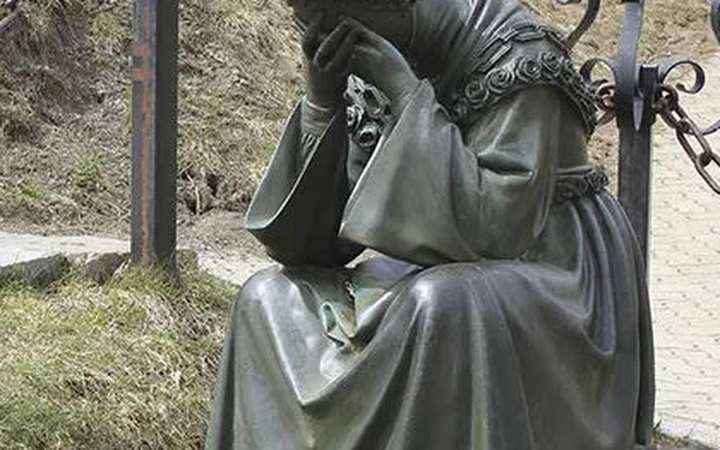
On 19 September 1846, a Saturday, the children see a globe of light, then a woman seated, weeping, in a strange peasant dress covered with roses and a crucifix. She speaks in both French and the local patois, so that each child understands. She complains that people use her Son’s name as a curse, that Sunday is a market, that harvests will fail.
The record, part 2
She gives each child a secret. The secrets later cause trouble: Mélanie’s published “secret” in 1879, full of apocalyptic and anti-clerical heat, is not what the Church approved. The apparition and the public message are one thing; later expansions are another.
The record, part 3
The spring at the apparition site is associated with healings. A religious family, the Missionaries of La Salette, is born from the event.
Reading
How to read Our Lady of La Salette
A weeping Mother is the image. Not a queen giving slogans — a mother grieving a village that has forgotten how to speak of God without swearing. The moral content is almost embarrassingly concrete: watch your mouth; keep the Lord’s day. Holiness as ordinary reverence.
La Salette also teaches discernment about “secrets.” Private revelation loves the hidden annex. The Church keeps the tears and the call to conversion, and lets some later pages go.
Pray this
Prayers that sit with the story
Church status
How this sign has been received
Church-approved
Bishop Philibert de Bruillard of Grenoble approved the apparition in 1851 as “a belief that is sound and not contrary to the faith.” Rome has supported the shrine. The later, darker writings associated with Mélanie have no such approval; some were condemned.
The shrine today
Why pilgrims still go
1846. Two children, a weeping Madonna in the high Alps, a call to conversion that was also a warning. Approved, loved, sometimes argued over. You go because she was in tears, and because mountain silence is a good place to ask why.
La Salette — the reasonsSources
- Pastoral letter of Bishop de Bruillard, 1851
- Sanctuary of Notre-Dame de La Salette
For the classroom
Our Lady of La Salette (1846, La Salette-Fallavaux, Alps). Grade in this encyclopedia: Church-approved. On 19 September 1846, two poor children, Maximin Giraud and Mélanie Calvat, met a woman weeping on a mountain above La Salette. She spoke of people using her Son’s name as a swear-word, and of Sunday being spent as an ordinary market day instead of at Mass. The Bishop of Grenoble approved the apparition in 1851.