
The reading
How it began
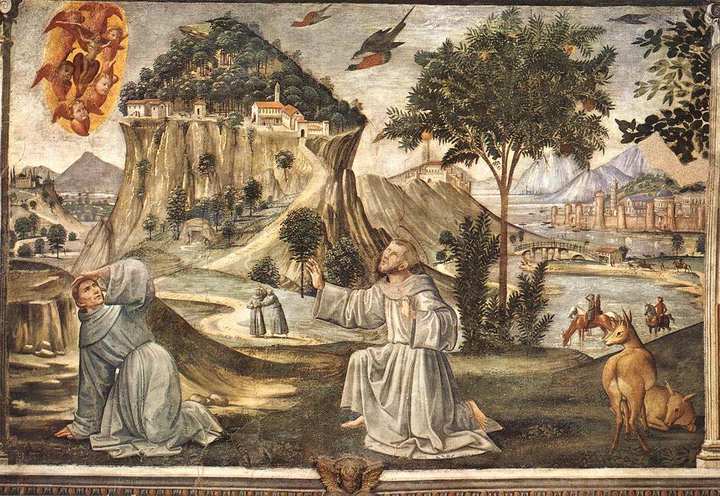
In September 1224 Francis is fasting on La Verna. He prays to feel, as far as possible, the love and the pain of the Passion. A seraph, a six-winged figure crucified, appears. When the vision lifts, his hands, feet, and side are marked with nails and a wound. Brother Leo tends him. The wounds are seen by a few; Francis tries to hide them.
The day itself
Thomas of Celano and St. Bonaventure write the event into the first lives. Pope Alexander IV says he saw the wounds in the dead saint. The Feast of the Stigmata enters Franciscan, then wider, calendars.
Reading
How to read The Stigmata of St. Francis
Francis wanted to be like Christ, not to be famous. The stigmata are a dangerous gift: they can make a man into a relic while he is still walking. Francis answered by staying hidden, by remaining the poverello, by singing. Later stigmatists are judged against that humility.
The seraph is the theological key. This is not a medical accident. In the Franciscan telling, it is an imprint of love. Whether one accepts that telling is a matter of faith in the witnesses, not of a surviving photograph.
The chair of Peter
Popes who belong with this sign
Pray this
Prayers that sit with the story
Church status
How this sign has been received
Church-approved
The Church’s liturgical recognition of the stigmatization, the unanimous early biographies, and the canonization of Francis (1228) make this the founding stigmatic case. Historical reconstruction of a 13th-century body is limited. Catholic memory is not.
The shrine today
Why pilgrims still go
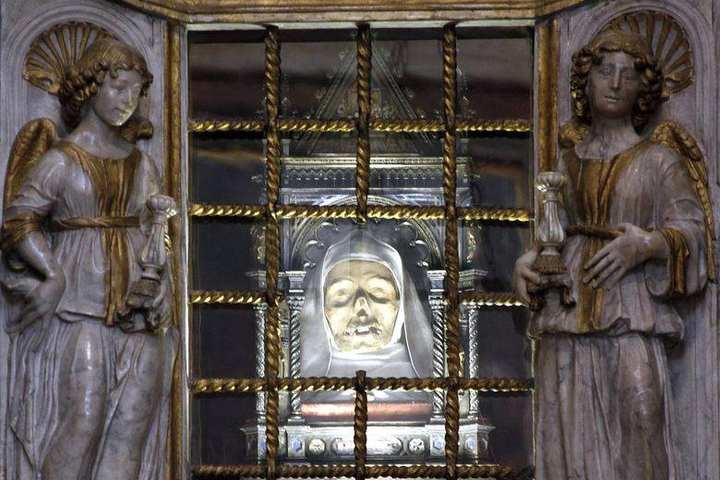
The man who was marked with the wounds, the woman who received the hidden stigmata, the town that still looks like a fresco. Assisi is not a Franciscan souvenir shop, though it contains several. It is the place poverty became a love affair.
Assisi & Siena — the reasonsSources
- Thomas of Celano, First and Second Life of St. Francis
- St. Bonaventure, Major Legend
- Feast of the Stigmata of St. Francis, 17 September
For the classroom
The Stigmata of St. Francis (September 1224, La Verna, Tuscany). Grade in this encyclopedia: Church-approved. Two years before his death, Francis of Assisi receives the wounds of the Crucified on the mountain of La Verna — the first widely attested stigmata in Catholic history, and the pattern for all later ones.