The reading
16:20, Candlemas, a garden at Pantano
Civitavecchia is a working harbour on the Tyrrhenian Sea, about seventy kilometres north-west of Rome. Ferries leave for Sardinia. The Rome–Pisa railway cuts through the town. In 1995 the Pantano district, inland from the docks, was a scatter of small houses, lemon trees, and garden walls. Fabio Gregori, an electrician at the state power station, lived there with his wife, Anna Maria Accorsi, and their children. Jessica was five. Davide was younger. They belonged to the parish of Sant’Agostino. They were not a shrine family. There was no shrine.
2 February is Candlemas — the feast of the Presentation of the Lord, and, in the old calendar, the Purification of Mary. In an Italian Catholic house it is a day for Mass and for blessed candles. That afternoon they were late. Anna Maria had already gone ahead to church. Fabio was in the garden with the children, the younger one in his arms, when Jessica stopped at a little stone niche her father had built against the wall.
The niche held a plaster Madonna. Jessica’s sentence, as she and her father later told it to the diocese, is the sentence the Italian papers printed the next morning: “Papà, papà, la Madonnina piange.” Daddy, the little Madonna is crying. Then, because he did not move fast enough: it is all blood. How can a plaster statue cry?
Fabio’s first act was not to kneel. It was to look at the child’s hands. He thought she had cut herself and smeared the statue. That is the ordinary reaction of a father who works with tools. While he was looking at her hands, he later said, a red liquid began to run from the statue’s left eye, down the white cheek, as far as the heart painted on the breast.
They were going to Mass. They were late. The mother was already in the pew. The afternoon light in February on that coast is low and colourless. Neighbours came because a child was shouting in a garden. Within hours the garden was no longer a garden. By nightfall it was a crowd. By the next day it was a story. By the end of the week it was a national one.
Photographs taken on 2, 3 and 4 February 1995 show the same small white figure in the outdoor niche: a veil, the head bowed, the eyes down, and dark tracks lengthening on the plaster from both eyes. Those pictures are the first documents of the case. They are not a basilica. They are a garden ornament, flash-lit, against rough stone, on a feast day, with a child in the frame.
The object: forty-two centimetres of Croatian plaster
The statue was not carved in Civitavecchia. It was not old. It was not expensive.
On 16 September 1994, Don Pablo Martín Sanguiao, parish priest of Sant’Agostino, was in Medjugorje, the village in Herzegovina where, from 24 June 1981, six young people had said the Virgin appeared to them as Queen of Peace. He bought, in a shop, a plaster figure of that Queen: the standard souvenir type, made by a Croatian artisan named Sthepan Vlaho — head slightly bowed, eyes down, a white veil, a white robe, the hands crossed on the breast. Height: forty-two centimetres. Material: gesso, painted. Cost: the price of a souvenir.
He gave it to the Gregoris. They were his parishioners. Fabio built a niche in the garden and set it there, the way Italian families set a Madonna on a wall — not as a museum piece, as a presence over the door.
Jessica used to touch it. On one of those ordinary days she knocked it down hard enough to chip the veil above the right side of the forehead. That chip, together with small scratches on the bust, later mattered to the police. A substitute statue would not have carried the same wounds. The investigators used those marks to argue that the object they later confiscated was the object from the garden, not a second figure swapped in after the first photographs.
Medjugorje, in 1994, was already thirteen years old as a phenomenon and still without the full approval the Church had given Lourdes. Rome had not crowned it. Rome had not shut it. Pilgrims went. Priests went. They brought home rosaries, water, and small white statues. Civitavecchia is, among other things, what happened when one of those statues came home and, five months later, did something plaster is not supposed to do.
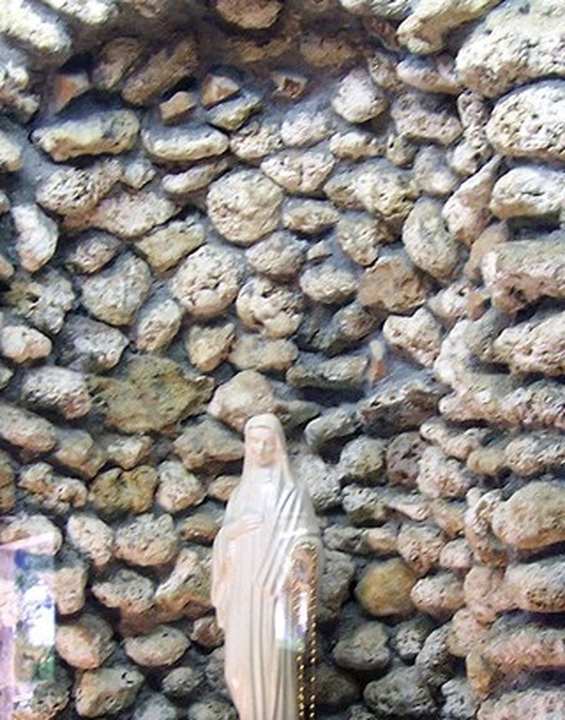
The face on this page is that face. The object in the photographs of February 1995, and the object later placed in a glass case at Sant’Agostino with a gold crown and a rosary, is this plaster Queen of Peace. Later gold, later glass, later candles, are housing. The sign, if it is a sign, is the souvenir.
Fourteen weepings, and a street that had to be barricaded
The diocese of Civitavecchia-Tarquinia was then under Bishop Girolamo Grillo, born in 1930, a man in his sixties, trained, cautious, and not in search of a miracle on his watch. Weeping statues are the most common class of false wonder in the modern Church. Condensation in a hollow head. Paint that runs in heat. A tube. A practical joke. A bishop who blesses the first rumour will spend the rest of his life explaining himself. Grillo’s first instinct was the correct Catholic one: wait, test, do not preach. He thought, he later wrote, that it was a bad joke. Someone had sprayed blood on a statue.
The Italian file counts fourteen weepings between 2 February and 15 March 1995.
The second was on 3 February, at about 18:45, with Don Pablo Martín present. From 4 to 6 February the phenomenon was reported again and again in front of growing numbers of people. The statue, cemented at the base of the niche, was put behind glass. A video camera was set up so that a later investigator could ask whether anyone had approached it with a cloth or a dropper between one weeping and the next.
Some of the later weepings were still in the garden. Some were in the house, after the family brought the object indoors because the street had become unmanageable. Crowds filled Via Pantano. Barriers went up so that people could pass in file. Italian television arrived. So did the curious, the devout, the vendors, and the police.
The police interest was not mystical. A religious object that draws thousands onto a residential street is a public-order problem. A red liquid on a statue, claimed as blood, is also, if it is a trick, fraud, and, if it is human blood placed there by a hand, something a magistrate can open a file on. The Procura did open a file. Investigators would spend months on the question of whether a man had put blood on plaster and let a crowd do the rest.
The statue left the garden because the family could no longer live there. It passed through the parish church. The diocese took it into hiding. Grillo wanted it examined. He did not want a shrine. He wanted a radiologist and a forensic doctor.
10 February, the Gemelli: a scan that found no machine
On 10 February 1995 the statue was taken to the Policlinico Gemelli in Rome, the large Catholic teaching hospital, and put through a CAT scan — a series of X-ray slices that would show a cavity, a tube, or a reservoir if one had been built into the plaster.
The result, as Bishop Grillo later told it, was a short sentence: the figure had no internal cavity of that kind. There was no mechanism. The lacrimation, if it was happening, was not being pumped.
On 28 February 1995 the bishop received the written conclusions of two professors: Angelo Fiori, named by the diocese, and Giancarlo Umani Ronchi, of La Sapienza, named at the family’s request. Their paragraph is the paragraph the case has never escaped.
The traces of apparent blood found on the face and neck of the statue were human blood, male. Macroscopic and radiological examination of the statue showed no anomaly other than those traces. There was no reservoir. There was no tube. There was no pump.
That is what the paper said. What it did not say is whose blood. Male DNA on a statue that has lived in a family house, been handled by a father, a priest, police, a bishop, and a crowd, is a result, not a verdict. The next step in a sealed protocol would have been reference samples from every man who had touched it, under a chain of custody a court could read. The male members of the Gregori family declined DNA tests. They said they would take them if the bishop told them to. He did not order it in those terms. The gap remains in the file. It is not a small gap.
On 6 April 1995 the magistrate seized the statue and ordered further tests. A TAC was repeated. Criminalpol, the scientific police, confirmed that the blood of the tears was human, as the two professors had already said. On 18 April the statue was returned. Subsequent public argument has concerned the number of samples, which laboratory received which vial, contamination, and whether weepings after the statue left the garden were chemically the same as the first. Accusations were made against the family. Accusations were made against the bishop. Accusations were made against the labs. No Italian court has produced a fraud conviction that closes the religious question. No Holy See decree has produced a miracle that closes the scientific one.
15 March, 8:15: a hair-thin thread in a bishop’s hands
By mid-March the statue was no longer in the garden. It was in the bishop’s keeping, locked in a wardrobe in his house. Grillo was still a skeptic. He thought the first stains could have been applied. He was waiting for the story to die.
On the morning of 15 March 1995, at about a quarter past eight, it did not die. His sister asked to pray before the statue. In the room with her were his brother-in-law, a nephew, and a nun. Grillo took the object in his hands.
What he said he saw, and wrote, and never unsay, is this. From the right eye a thread of liquid, at first no thicker than a hair, ran onto the cheek. As it travelled it turned the colour of ruby. His brother-in-law nudged him. He opened his eyes. The thread was there. He had come into the room as a man who thought he was dealing with a hoax. He left it as a man who said he had seen a statue weep.
A bishop of the Catholic Church, in his own house, holding a plaster souvenir from a shop in Bosnia, reporting a weeping under his own eyes, with named witnesses in the room, is not a small sentence in the life of a diocese. It is also not a laboratory. It is a testimony. The Church has always distinguished the two. Testimony can be sincere and wrong. Testimony can be sincere and right. Grillo authorised a chapel. He allowed the statue to be venerated. He said he believed. His successors have spoken with more coldness. That split — a local bishop convinced, the wider Church uncommitted — is still the shape of Civitavecchia.
The fourteenth weeping is the one every later account returns to, because it is the one that happened off the family’s property, in clerical hands, after the object had been taken for tests. If the first days can be told as a household mystery, 15 March is the day the mystery walked into the chancery and would not leave.
A pope’s crown, a glass case, an open file
On the evening of 9 June 1995, Bishop Grillo entered the Apostolic Palace with a bag. Monsignor Stanisław Dziwisz, secretary to John Paul II, received him. The statue was in the bag. After supper they said a Hail Mary together to the Queen of Peace. The pope blessed the figure, a small gold crown, and a rosary. He imposed silence on the bishop, and added, as Grillo later wrote, two sentences: that one day Grillo would tell the world that John Paul II had venerated the Madonna of Civitavecchia, and that the rest was to be put in the hands of Cardinal Ratzinger. The pope did not issue a decree. He did not say the word miracle. He did what popes have often done with a local devotion they will neither crown nor kill: he touched the object and let the local church live with it.
On 17 June 1995 the statuette was set in a glass case in the parish church of Sant’Agostino, in what is now called the Sanctuary of the Madonna delle Lacrime, at Borgo Pantano. It is still there. The crown and the rosary in the photographs of the case are the ones that passed through the pope’s hands. Most of the original blood on the cheeks was gone by then — scraped in the forensic work of the spring. Volunteers used to hand out holy cards printed from the first days, when the tracks were still broad on the plaster.
On 15 March 2005, ten years after the weeping in his hands, Bishop Grillo raised the church to the dignity of a sanctuary, pending a larger temple that has never fully replaced the parish.
Jessica Gregori grew up. She married. The family remained in the story, which is a hard place to remain. In 2024 the garden was in the papers again, for a second, rusting statue and a new claim. That later episode is not this one. This file is 1995: fourteen weepings, a CAT scan, a male blood result, a bishop who changed his mind, a pope who blessed a crown, and a Church that has never closed the case.
The Dicastery for the Doctrine of the Faith has not declared the supernatural. Under the Church’s newer language, used in other modern claims, this is a situation in which a bishop may permit devotion without requiring any Catholic to believe that God did this. Status in this archive: open. Famous. Studied. Contested. Not binding on the faith of anyone who says the Creed.
What is on the table, and what is not
A late-modern weeping statue is a test of two disciplines at once.
Forensic science asks whose blood, collected how, under what chain of custody, and whether the event can be repeated under control. The Civitavecchia file has a scan, a male result, a seizure, a second confirmation by Criminalpol, and a missing comparison with the men of the house. That is more paper than most weeping-statue stories ever produce. It is less paper than a court would want for a conviction, and less paper than a miracle bureau would want for a declaration.
Catholic theology asks a different first question. Even if the weeping is unexplained, what is it for. The Church has never taught that a statue is a god. She has taught that God may use poor things. A plaster souvenir from a shop is as poor a thing as a cave that was a rubbish dump at Lourdes. Poverty of the object is not a disproof. It is the usual pattern.
Male DNA is the detail that will not drop, and should not. If the blood is Christ’s, the tears are a theology: the Mother weeps the Son. If the blood is a man’s, the tears are a warning about how badly a crowd wants a sign. Both readings are possible on the present paper. Faith is not required to choose in advance of a protocol the Church herself has not finished.
The photograph on this page is the Madonnina of Civitavecchia as she stands in her case at Sant’Agostino: the Queen of Peace of Medjugorje, white, small, the head bowed, the gold crown, the rosary. That is the official figure of this case. There is no other.
Reading
How to read The Madonna of Civitavecchia
A late-modern weeping statue is a test of two disciplines at once. Forensic science asks whose blood, collected how, under what chain of custody, and whether the event can be repeated under control. Catholic theology asks a different first question: even if the weeping is unexplained, what is it for. The Church has never taught that a statue is a god. She has taught that God may use poor things. A plaster souvenir from a shop is as poor a thing as a cave that was a rubbish dump at Lourdes. Poverty of the object is not a disproof. It is the usual pattern.
Male DNA is the detail a careful account will not drop. It is also the detail a sermon will rush past. If the blood is Christ’s, the tears are a theology: the Mother weeps the Son. If the blood is a man’s, the tears are a warning about how badly a crowd wants a sign. Both readings are possible on the present paper. Faith is not required to choose in advance of a protocol the Church herself has not finished.
The same mystery
Signs that belong with this one
- Medjugorje
The statue was bought there on 16 September 1994 by the parish priest. Civitavecchia is what happened when a Medjugorje Queen of Peace came home.
- The Weeping Madonna of Syracuse
Another Italian weeping Madonna, 1953: a plaster plaque of the Immaculate Heart, a medical commission, a different object and a different file.
- Our Lady of Akita
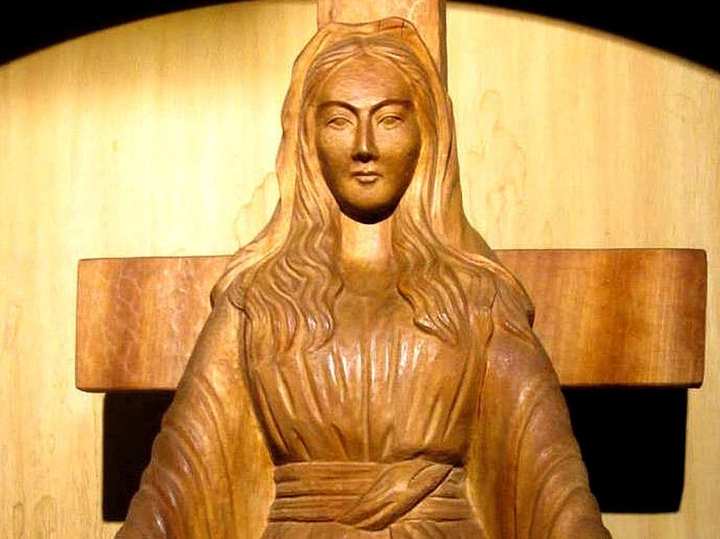
A wooden statue in Japan that wept 101 times, with a bishop’s yes and a longer paper trail than Civitavecchia.
Church status
How this sign has been received
Open / under study
Bishop Girolamo Grillo authorised veneration and said he had seen the weeping with his own eyes on 15 March 1995. A chapel was permitted. On 9 June 1995 John Paul II blessed the statue, a gold crown, and a rosary, and imposed silence, leaving the file with Cardinal Ratzinger. On 15 March 2005 Grillo raised Sant’Agostino to the dignity of a sanctuary. Pilgrims still come. Grillo’s successors in Civitavecchia-Tarquinia have spoken with more reserve. The Dicastery for the Doctrine of the Faith has not issued a decree declaring a miracle. Under the Church’s newer norms, this remains a case in which devotion may exist without a finding of the supernatural. Status: open.
Investigation
What has been examined
A CAT scan at the Policlinico Gemelli on 10 February 1995 found no internal cavity or mechanism. Professors Angelo Fiori and Giancarlo Umani Ronchi reported, on 28 February 1995, that traces on the face and neck were human blood, male, and that radiology showed no internal device. After a judicial seizure on 6 April, Criminalpol confirmed that the blood was human. Male members of the Gregori family declined DNA comparison. Later public argument has concerned the number of samples, the laboratories, contamination, and whether weepings after the statue left the garden were of the same character as the first. No complete, internationally audited paper of the kind STURP produced for the Shroud exists for Civitavecchia. The honest scientific sentence is still: unexplained in the first reports; not replicated under a sealed protocol the whole Church would sign; not dismissed by a court as a proven fraud.
Sources
- Diocese of Civitavecchia-Tarquinia, statements of Bishop Girolamo Grillo, 1995 and after
- Laboratory report of Profs. Angelo Fiori and Giancarlo Umani Ronchi, 28 February 1995, as recorded in the diocesan file
- CAT scan, Policlinico Gemelli, 10 February 1995
- Judicial seizure and Criminalpol confirmation, April 1995
- Photographs of the statue, 2–4 February 1995, garden at Pantano
- Italian press and RAI coverage, February–June 1995
- Audience of Bishop Grillo with John Paul II, 9 June 1995, as later recounted by Grillo
- Parish of Sant’Agostino / Sanctuary of the Madonna delle Lacrime, Civitavecchia, where the statue is reserved
For the classroom
The Madonna of Civitavecchia (2 February 1995, Pantano, Civitavecchia). Grade in this encyclopedia: Open / under study. On 2 February 1995, at about 16:20, in a garden at Pantano on the edge of Civitavecchia, a five-year-old girl named Jessica Gregori stopped in front of a plaster statue forty-two centimetres high and called to her father. Blood, she said, was coming from its eyes. Over the next six weeks the same object was reported to weep fourteen times — in the garden, in the house, and at last in a bishop’s hands. A CAT scan at the Gemelli hospital found no device inside the plaster. Two forensic professors named the first stains as human blood, male. John Paul II later blessed a gold crown and a rosary for the figure. Rome has never declared a miracle. The statue is still in a glass case at Sant’Agostino.