The reading
How it began
Southworth spends years in English prisons and in the plague-wards of Westminster, a priest of the poor. On 28 June 1654 he is hanged, drawn, and quartered. The Spanish ambassador’s wife purchases the remains. At Douai the body is assembled and later found resistant to decay. In 1927 the relics are rediscovered; in 1930 they come to the new cathedral in London — the only English Reformation martyr so entire, so visible, in the Catholic cathedral of the capital.
The day itself
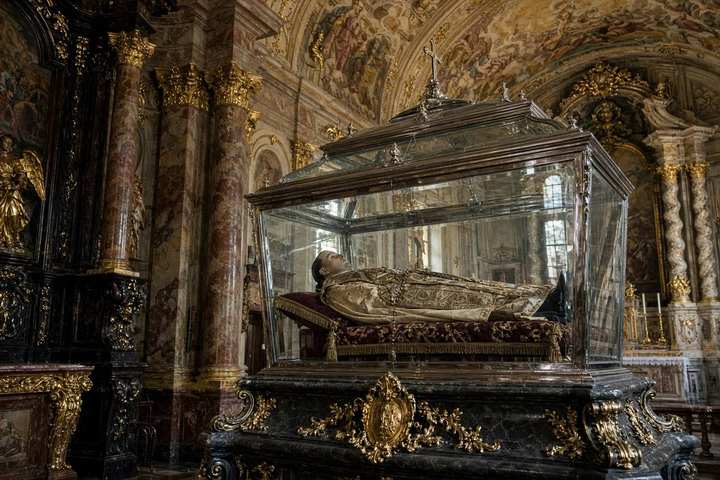
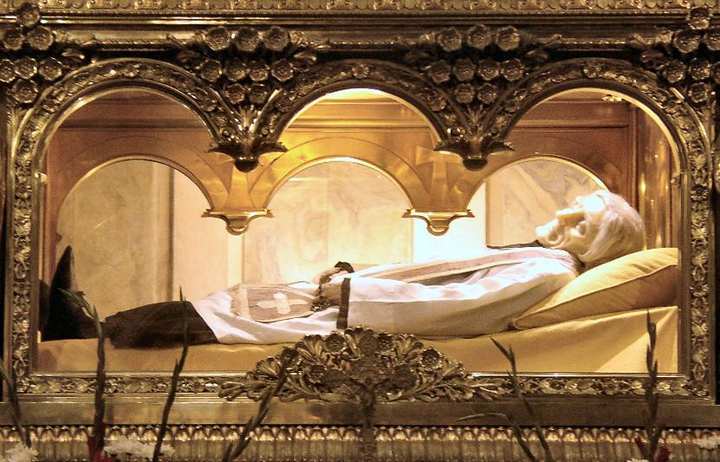
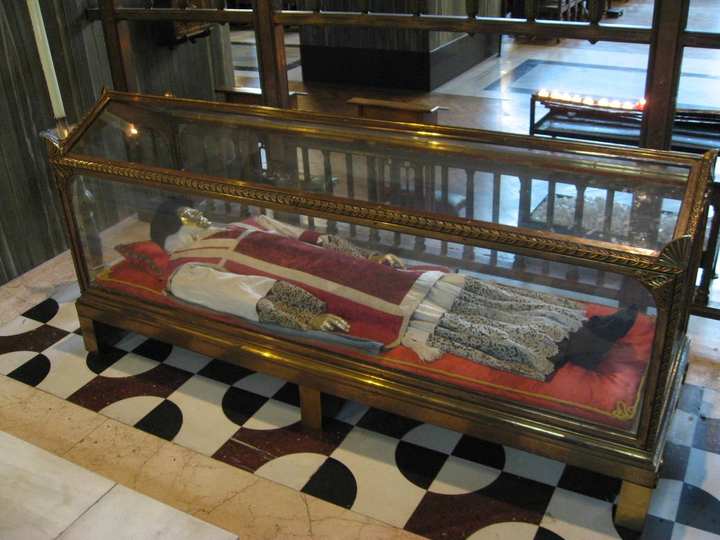
John Southworth was a secular priest of Lancashire, trained at Douai, who worked in London through the plague and through the penal years. He was arrested for the last time in 1654 and sentenced under the statute that made a priest’s presence in England treason. On 28 June he was hanged, drawn, and quartered at Tyburn. The Spanish ambassador’s household bought the quarters from the executioner — a known, grim traffic — and had them embalmed and sent to Douai, where the body was sewn together and buried. When the English College later moved, the lead coffin went with the archives and was mislaid. It was identified again in 1927. In 1930 the relics were brought to Westminster Cathedral and placed in the Chapel of St. George and the English Martyrs, in a glass case in the north aisle, vested as a priest. Paul VI canonized him among the Forty Martyrs of England and Wales on 25 October 1970. He is the only one of those martyrs whose body is still substantially together, and visible, in England.
Reading
How to read St. John Southworth
London has a priest in a glass box who was killed for saying Mass. The incorruption is almost secondary. The city is the point. He is home.
Church status
How this sign has been received
Church-approved
Canonized among the Forty Martyrs of England and Wales, 1970. The exposition in Westminster is with the Archbishop’s authority.
Sources
- Westminster Cathedral, shrine of St. John Southworth
- Douai archives; cause of the Forty Martyrs
For the classroom
St. John Southworth (Martyred 1654, Westminster Cathedral, London). Grade in this encyclopedia: Church-approved. A secular priest, hanged at Tyburn for his office. The body was bought from the executioner, smuggled to Douai, found remarkably preserved, and in 1930 brought to Westminster Cathedral, where he lies in a glass coffin in the north aisle.