The reading
How it began
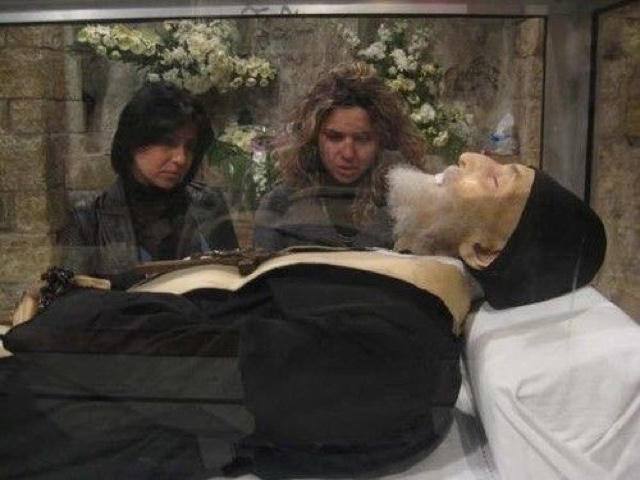
Xavier dies on 3 December 1552, waiting for China. The grave is packed with lime — the opposite of a plan for incorruption. In February 1553 the body is taken up, intact, blood-scented in the reports, and carried to Malacca, then to Goa. Physicians of the Portuguese Estado describe flesh and a flowing blood from a cut in the knee.
The day itself
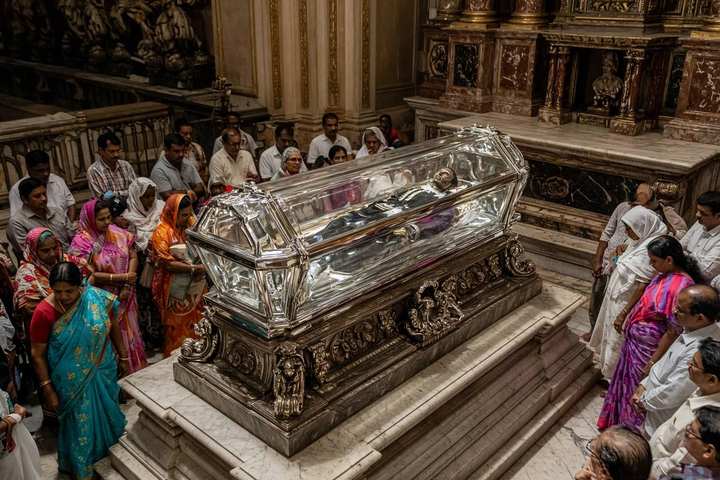
Over four centuries, toes, a hand (in Rome), and other relics have been taken. What remains is a brown, reduced body in a crystal coffin, shown to crowds at the decennial exposition. It is not the sleeping girl of Nevers. It is a missionary who would not stay buried.
What was kept
The first surprise is the lime. Xavier died on Shangchuan on 3 December 1552, within sight of the China he was not allowed to enter. The companions packed the coffin with lime to hasten decay so the bones could be carried later. When the body was raised in February 1553 it was described as fresh. It went to Malacca, then to Goa, where Portuguese physicians wrote of flesh and of blood from a cut below the knee. The right arm was detached in 1614 and sent to the Gesù in Rome; a piece of that arm is at the Jesuit church in Macau; other fragments were taken across the missions. What the Basilica of Bom Jesus shows at the decennial exposition is a darkened, reduced body in a crystal coffin, not the man of 1553. Gregory XV canonized him in 1622 with Ignatius, Teresa, Philip Neri, and Isidore the Farmer. Pius XI named him patron of the missions together with Thérèse of Lisieux.
Reading
How to read The Body of St. Francis Xavier
Lime should have eaten him. The first reports are as close as the sixteenth century gets to a controlled surprise. Later centuries took pieces because they believed it. A Catholic can venerate the relic without needing the present remains to look like 1553.
Pray this
Prayers that sit with the story
Church status
How this sign has been received
Church-approved
Canonized 1622 with Ignatius, Teresa, Philip Neri, and Isidore. Patron of missions. The body is a first-class relic under the Patriarchate of Goa, one of the most visited in Asia.
The shrine today
Why pilgrims still go
The missionary who died waiting for China, packed in lime, found fresh months later. You go to the baroque basilica where Asia still files past his coffin, and to remember that the missions had a body, not only a map.
Old Goa — the reasonsSources
- Early Jesuit letters; Monumenta Xaveriana
- Basilica of Bom Jesus, Goa
For the classroom
The Body of St. Francis Xavier (Died 1552; body in Goa, Basilica of Bom Jesus, Old Goa). Grade in this encyclopedia: Church-approved. The Jesuit missionary dies on Shangchuan Island. Lime is poured in the coffin to speed decay for a later transfer. Months later the body is found fresh. It has lain in Goa for centuries, reduced by relic-taking, still exposed on feast days.