This is the study of the Saints as the Church understands them, and then of particular men and women the Church has named. It is not the Saint of the Day, and it is not the calendar of seasons. Those stand elsewhere. A person can read the teaching first and know what a Saint is, and what canonisation does and does not do. The Saints library then opens in alphabetical order. The letters A to Z are in the library. Heaven is larger than any list.
The order is an order a reader can follow. First, what the words mean. Then the Saints under A, under B, under C, under D, under E, under F, under G, under H, under I, under J, under K, under L, and on through Z, in the words given for each life. Particular lives already set down remain on this page. Our Lady is not given an ordinary entry among the names.
Resource
Where a Saint is one of the Early Church Fathers, the writings are kept here, in the public-domain English of the Fathers. Early Church Fathers.
What the Church means by a Saint
A Saint is a person who is in heaven, united with God. That is the meaning. Holiness is the life of God in a human being, begun here by baptism and by grace, finished there in glory. The Saints are not a separate species. They are the faithful who have come through. Some were martyrs. Some were bishops, monks, nuns, mothers, fathers, children, parish priests, missionaries, people who never held an office. The differences are real. The end is one. They see God, they love him, and they pray for the Church still on the way.
The Church on earth does not know the names of most of them. God does. A man may die in a hospital with no one to write his life, and be a Saint. A woman may have been forgotten by her own parish, and be a Saint. The book of Apocalypse speaks of a multitude which no man could number. The feast of All Saints, on 1 November, is the Church's own confession of that multitude, the named and the unnamed together. That day belongs to the calendar of the year. It is mentioned here only so that the entries below are not mistaken for a census of heaven.
To honour a Saint is not to worship a Saint. Worship, the adoration that belongs to God alone, is for the Holy Trinity. The Saints are asked to pray. A person says, pray for us, in the same plain sense in which one Christian asks another Christian for prayers, with this difference: the Saint is already with God, and the prayer is not hindered by death. Their images are kept so that the eyes have somewhere to rest while the mind remembers a real life. The image is not the Saint, and it is not a god. A relic is the body, or a part of the body, of a person who will rise. The Church treats it with honour because the body was a temple of the Holy Spirit and is promised back. None of this adds a second saviour. There is one Mediator, Our Lord Jesus Christ. The Saints are his friends, alive in him, and a person goes to them in order to go to him.
The communion this creates is what the creed calls the communion of saints. The Church on earth, the souls being purified, and the blessed in heaven are not three closed rooms. They are one body. A feast day is one way that body remembers a member and asks his prayers, or hers, at the altar.
Canonisation
Canonisation is the Church's solemn judgement that a particular person is in heaven, and that the person may be honoured by the whole Church in the public liturgy. It is a judgement. It is not a cause. The Pope does not put someone into heaven by signing a decree. He declares, with the authority of the apostolic see, that the person is there, and he writes the name into the public worship of the Church. Before the decree, if the judgement is true, the Saint was already a Saint. After the decree, the faithful may do openly, and together, what some of them may already have done in private: ask that person's prayers, keep the feast, and set the life before others as a proved way of following Christ.
The steps have not always been the same, and it is worth saying so without turning it into a history of offices. In the first centuries a martyr was honoured because the local church knew the death and kept the tomb. The people prayed there. The bishop governed the veneration. Many of the Apostles and early martyrs in this file entered the Church's memory in that way. There was not yet a Roman process of the modern kind. From the Middle Ages the Holy See drew the grave cases to itself. A solemn canonisation by the Pope became the act that bound the whole Church. In the seventeenth century Pope Urban VIII fixed the discipline that a public cult was not to be opened for a person who had not been beatified or canonised by the Holy See. What the Church does now comes down from that reserve.
The present path has names, and the names are easy to confuse with the reality. When a cause is opened, the person may be called a Servant of God. That is a title of a process, not a declaration of heaven. If the Church judges that the person practised heroic virtue, or truly died a martyr, the person is declared Venerable. That is still not a permission for public feast-keeping. Beatification gives the title Blessed, and permits public veneration in limited places, often the person's own diocese or religious family. Canonisation gives the title Saint, and extends the veneration to the universal Church. For someone who was not killed for the faith, the practice is that a miracle, received as God's confirmation, is required before beatification, and a further one before canonisation. A martyr may be beatified without a miracle. The miracle is not the holiness. It is a sign the Church asks for, so that a canonisation does not rest on enthusiasm alone. The Church examines a healing that medicine cannot explain, and asks whether it came by the person's intercession. If the answer is yes, the cause moves. If the answer is no, the cause waits. Fame, usefulness, and a moving story are not enough.
Two cautions belong here. The Church does not claim, in an ordinary canonisation, to have listed every grace in the person's life, or to have approved every private opinion the person once held. A Saint can have been wrong about a matter that was not of the faith, and can have needed years to be converted from a real sin. Augustine is the obvious case, and he is in this file. What is proposed to the faithful is the heroic virtue, or the martyrdom, and the final perseverance, not a claim that the person was flawless from the cradle. The other caution is the opposite one. Once the Church has canonised, a Catholic does not sit above the judgement and decide that the Saint was a mistake. The life may be studied. The decree is the Church's.
A Saint in heaven, and a name on a list
These are not the same thing, and the whole file turns on the difference.
A Saint in heaven is any person who has died in the grace and friendship of God and has come to the vision of him. If purification was still needed, it is finished before that vision. The number of such persons is known to God. It is not known to us. Most of them will never have a biography, a statue, or a day.
A name on a list is a public act of the Church. The Roman Martyrology is a list of this kind. A diocesan calendar is a list of this kind. The General Roman Calendar, which gives the feasts kept by the Latin Church as a whole, is a list of this kind. The name is written down so that a feast can be kept, a collect can be said, and the people can ask one intercessor by name without each parish inventing its own cult. The writing does not create the Saint. It recognises the Saint, and it gives the rest of us a handle.
So a person may be in heaven and not be on the list. That is the ordinary case. A person on the list is, by the Church's judgement, in heaven. The list is a floor the Church will stand on, not a ceiling. To treat a calendar as if it were the population of the blessed is to forget All Saints. To treat a canonisation as a prize for being famous, or for being useful to a cause, is to forget what the decree says. The decree says: this one is with God; you may ask this one to pray; you may imitate this life.
Where this file gives a feast, it gives the day kept in the Roman Calendar of the Latin Church. Some religious families, and some countries, keep a day with a higher rank because the Saint is a founder or a patron. Where an older Western date is different from the present Roman date, both are named, and the reason for the difference is named. Nothing below is offered as a new revelation. Tradition is called tradition. A legend that the Church has loved, but that is not the early record, is called a legend.
Saints A–Z
A
This is the A volume of the A–Z Saints library. It names every Saint whose usual English name sorts under A, beginning with those kept in the General Roman Calendar and continuing through the widely known Saints of the Roman Martyrology and of later canonisations: Apostles, Doctors, founders, martyrs, English and Irish and Scottish Saints under A, the Korean and Vietnamese and Chinese martyrs whose lead names begin with Andrew or Augustine, and recent canonisations. It is not the Saint of the Day. It is not the calendar of seasons. Those stand elsewhere on this site. Heaven is larger than any human list. This library aims, letter by letter, to name every Saint the Church has publicly honoured, so that a reader who opens A may find more than a short “top twenty”. Tradition is called tradition. A legend that the Church has loved, but that is not the early record, is called a legend. The Church’s account alone is given.
Our Lady
Our Lady is the Mother of God. She is not listed below as “Saint Mary” among the ordinary A entries, as if she were one more card in an alphabetical pack. Her feasts — the Mother of God, the Immaculate Conception, the Assumption, the Queenship, Lourdes, Fatima, the Rosary, and the rest — belong to the calendar of the year and to the honour of the Mother of the Church. They are not reduced here to a single A–Z entry beside Agatha or Ambrose. The Saints under A follow.
Saint Aaron
The High Priest Aaron
Public domain
The feast
1 July (Roman Martyrology, with Moses); the High Priest of the Old Covenant is remembered among the holy ones of Israel whom the Church has always honoured.
Who they were
Aaron was the brother of Moses and the first High Priest of Israel. The Book of Exodus records that God set him and his sons apart for the priesthood, that he spoke for Moses before Pharaoh, and that he bore the breastplate and the ephod in the worship of the tabernacle. He sinned in the matter of the golden calf, and he was forgiven and restored. He died on Mount Hor, as Numbers tells it, and the priesthood passed to his son Eleazar. The Church does not treat the saints of the Old Covenant as a separate religion. They belong to the one history of salvation that ends in Christ, the true High Priest.
Why the Church honours them
Aaron is honoured as the type and beginning of the Aaronic priesthood, which the Letter to the Hebrews takes up and perfects in Christ. To name him among the Saints is to confess that the God of Abraham, Isaac, and Jacob is the God of the Church, and that the liturgy of Israel was not wasted time but preparation.
Saint Aaron of Caerleon
Church of Ss Julius and Aaron, Llanharan
Gareth James CC BY-SA 2.0
The feast
1 July (with Saint Julius); traditional feast of the British martyrs of Caerleon.
Who they were
Aaron and Julius were Christians of Roman Britain, put to death at Caerleon (the Roman Isca) in the persecution under Diocletian, about the beginning of the fourth century. The early British writer Gildas names them among the martyrs of the island. Their Acts are late and thin; the fact of their martyrdom is the Church’s memory. They stand with Saint Alban as witnesses that the faith had already taken root in Britain before Constantine.
Why the Church honours them
They are among the first named martyrs of the British Church. Local calendars in Wales and the West Country have kept their day. The Church honours them because they died for Christ when the empire still demanded sacrifice to the gods.
Saint Abbo of Fleury
Abbé Pardiac Public domain
The feast
13 November (traditional).
Who they were
Abbo was abbot of Fleury (Saint-Benoît-sur-Loire), a scholar of the late tenth century, reformer, and writer on computus and theology. He was killed in 1004 while trying to restore order in a turbulent priory in Gascony — a martyr of monastic reform.
Why the Church honours them
Learning and courage met in an abbot who died for the Rule’s peace.
Saint Abdon and Saint Sennen
Abdon and Sennen carrying the early Christian martyrs off for burial
Guillaume Courtois CC0
The feast
30 July (Roman Martyrology; older Western calendars kept them with solemnity at Rome).
Who they were
Abdon and Sennen were Persian nobles, according to the Roman tradition, brought to Rome as captives or as Christians already, and put to death under Decius or in a later third-century persecution. The Church buried them in the Cemetery of Pontianus on the Via Portuensis. Their cult is ancient at Rome. The later Acts embroider the story with details that are legend; the early Roman memory of two Persian martyrs under the names Abdon and Sennen is firm.
Why the Church honours them
They show that the Roman Church, even in the age of the catacombs, received martyrs from the East and kept their tombs. Pilgrims still visit the place of their burial in the old cemetery.
Saint Abraham
Abraham Sacrificing Isaac (russian icon)
Anonymous Unknown author Public domain
The feast
9 October in some martyrologies and Eastern calendars (as Patriarch); the Latin Church also keeps other Abrahams — hermits and bishops — on various days.
Who they were
Abraham, son of Terah, called out of Ur by God, is the father of the people of the promise. Genesis tells his call, his faith, the covenant of circumcision, the birth of Isaac, and the near-sacrifice on Moriah, which the Church has always read as a figure of the Father’s gift of the Son. Our Lord said that Abraham rejoiced to see his day. Saint Paul calls him the father of all who believe. The Roman Martyrology remembers him among the holy Patriarchs.
Why the Church honours them
Abraham is honoured because faith began, in the biblical sense, with his obedience. Every Mass that speaks of “Abraham our father in faith” is keeping his memory. He is not a Christian after the Incarnation; he is the root from which the Incarnation’s people grew.
Saint Abundius of Como
Chiesa di San Siro in Lomazzo - Effige di Sant'Abbondio, Vescovo e compatrono di Como
Alberto Monti CC BY-SA 4.0
The feast
2 April (Martyrology).
Who they were
Abundius was a fifth-century Bishop of Como, a theologian trusted by Pope Saint Leo the Great, sent on embassies concerning the Council of Chalcedon. He died about 469.
Why the Church honours them
A northern Italian bishop who served Leo and Chalcedon links the Alpine Church to the great council.
Saint Acacius (Agathus) of Amida / various Acacius
Rijksmuseum CC0
The feast
various (Martyrology: e.g. 22 April and others).
Who they were
Several martyrs and bishops bear the name Acacius or Agathus. One beloved story is of Acacius of Amida, a fifth-century bishop who melted church plate to ransom Persian captives. Others died in the earlier persecutions. The Martyrology keeps their days.
Why the Church honours them
Charity that sells the vessels to free the prisoner is evangelical; martyrdom under the name Acacius multiplies the witness.
Saint Achilleus (with Saint Nereus)
Verona (Veneto, Italy), Saints Mammasus, Nereus, Achilleus and Pancras church
Syrio CC BY-SA 4.0
The feast
12 May, optional memorial in the General Roman Calendar (Saints Nereus and Achilleus, Martyrs).
Who they were
Nereus and Achilleus were Roman soldiers, according to the early tradition recorded near their tomb, who became Christians, left the camp, and were put to death for the faith, probably in the later second or early third century. Pope Damasus set an inscription at their grave in the Cemetery of Domitilla on the Via Ardeatina. The inscription says they were soldiers who threw away their shields and weapons when they found Christ. The later Acts that make them servants of Flavia Domitilla are storytelling around that core.
Why the Church honours them
They are among the martyrs whose tombs Damasus marked so that Rome would not forget. The basilica of Santi Nereo e Achilleo still keeps their names. The Church honours soldiers who laid down arms rather than deny the faith.
Saint Adalbert of Magdeburg
Adalbert of Magdeburg (the "Apostle of the Slavs") was a 10th-century missionary to the Slavic peoples to the east of Germany.
W. Hoffmann Public domain
The feast
20 June (German calendars).
Who they were
Adalbert was the first Archbishop of Magdeburg in the tenth century, a missionary organiser toward the Slavs, and the teacher who confirmed the young Vojtěch in the name Adalbert — the future martyr of Prague. He died in 981.
Why the Church honours them
The student outshone the teacher in fame; the teacher still deserves honour for Magdeburg and for the name he gave.
Saint Adalbert of Prague
The silver reliquary coffin of Saint Adalbert in the cathedral at Gniezno, Poland, and historic statues and paintings of the bishop with the missionary’s staff and the martyr’s palm.
Mathiasrex , Maciej Szczepańczyk CC BY-SA 4.0
The feast
23 April, optional memorial in the General Roman Calendar (with Saint George on the same date in many places).
Who they were
Adalbert was born of a noble Bohemian family about 956, baptised Vojtěch, and took the name Adalbert at confirmation after Saint Adalbert of Magdeburg, his teacher. He became the second Bishop of Prague in 982. He tried to reform a Church still half-pagan in its habits: polygamy among the powerful, the sale of Christians into slavery, and clergy who would not keep the canons. Resistance drove him from Prague more than once. He spent years as a monk at Saints Boniface and Alexius on the Aventine in Rome. In 997, with papal and imperial support for a mission to the pagan Prussians, he crossed into their land and was killed near the Baltic coast. His body was ransomed and taken to Gniezno. He became a patron of Poland, Bohemia, Hungary, and Prussia.
Why the Church honours them
Adalbert is honoured as a bishop who would not make peace with slave-trading and as a missionary martyr on the northern frontier of the Latin Church. His feast keeps the memory of the conversion of Central Europe.
Photographs
The silver reliquary coffin of Saint Adalbert in the cathedral at Gniezno, Poland, and historic statues and paintings of the bishop with the missionary’s staff and the martyr’s palm.
Saint Adamnan (Adomnán) of Iona
Martyn Gorman CC BY-SA 2.0
The feast
23 September (Irish and Scottish calendars).
Who they were
Adomnán was ninth abbot of Iona, biographer of Saint Columba, and author of the Law of Adomnán (Cáin Adomnáin) protecting women, children, and clerics in warfare. He worked for the Roman Easter among the Irish. He died in 704.
Why the Church honours them
A monk who wrote a Life and a law of mercy is a civiliser of Christian Ireland and Scotland.
Saint Adauctus
The theft of the bodies of the martyrs Felix and Adauctus in a dome fresco by Carlo Carlone in the parish church of San Felice del Benaco on lake Garda.
Wolfgang Moroder CC BY-SA 4.0
The feast
30 August (with Saint Felix; Martyrology).
Who they were
Felix and Adauctus were Roman martyrs; the name Adauctus (“added”) remembers a stranger who declared himself Christian when Felix was led to death and was killed with him. The story is early Roman tradition.
Why the Church honours them
An unnamed man who stepped out of the crowd to die with a martyr is remembered only as “the added one”. That is enough.
Saint Adelaide
Abel Terral Public domain
The feast
16 December (traditional Western feast of Saint Adelaide, Empress).
Who they were
Adelaide was born about 931, daughter of Rudolf II of Burgundy. She was married young to Lothair of Italy, widowed, imprisoned by a usurper, and freed by Otto the Great, whom she then married. As Empress she used her power for monasteries, for the poor, and for the reform of the Church in the Empire. After Otto’s death she served as regent for her grandson. She died at the abbey of Seltz in Alsace in 999. Odilo of Cluny wrote her life. The Church has long kept her as a Saint, a rare case of an empress whose public holiness the West did not doubt.
Why the Church honours them
Adelaide shows that the court need not be a place where faith dies. She is honoured for mercy, for founding and endowing houses of prayer, and for a long widowhood spent in the service of the Church rather than in intrigue.
Saint Ado of Vienne
First Page of Martyrologium of Ado Viennensis. Edition: Rome, 1745
en:Ado_(archbishop) , 9th century AD Public domain
The feast
16 December (traditional).
Who they were
Ado was a ninth-century Benedictine, Archbishop of Vienne, and author of a martyrology that fed the Western calendar. He died in 875.
Why the Church honours them
The Church’s memory of the Saints owes something to those who wrote their names down carefully. Ado was one.
Saint Adrian of Canterbury
The feast
9 January (traditional English feast).
Who they were
Adrian was an African by birth, abbot of a monastery near Naples, when Pope Vitalian chose him for the see of Canterbury after the death of Deusdedit. Adrian declined the bishopric for himself and recommended Theodore of Tarsus; the Pope sent them both. Theodore became Archbishop; Adrian became abbot of Saints Peter and Paul at Canterbury (later Saint Augustine’s). Together they made Canterbury a school of Greek and Latin learning for the English Church. Bede praises Adrian’s learning and holiness. He died in 710 and was buried in his abbey.
Why the Church honours them
Adrian is honoured as a teacher of England and as a man who could refuse a mitre without refusing the mission. The English Church’s early scholarship owes much to an African abbot and a Greek archbishop working side by side.
Saint Adrian of Nicomedia
An icon of Adrian and Natalia of Nicomedia
Public domain
The feast
8 September (Roman Martyrology; older Western date also 4 March in some places).
Who they were
Adrian was a Roman officer at Nicomedia under Maximian. According to the Acts, he was so moved by the courage of Christian prisoners that he declared himself a Christian and was imprisoned with them. His wife Natalia encouraged him. He was tortured and killed; Natalia recovered his relics. The story as we have it is late in its details; the cult of Adrian and Natalia is ancient in East and West. Churches from Constantinople to Geraardsbergen kept his memory. He became a patron of soldiers and of prisoners.
Why the Church honours them
The Church honours a soldier who crossed the line to the prisoners’ side. Whether every detail of the Acts is history, the type is evangelical: the guard who joins the condemned.
Saint Aedh Mac Bricc / Aidan of Ferns (Máedóc)
The earliest depiction of an Irish harp, c.1100 AD. Depicted on the side of the reliquary shrine of St. Máedóc or Mogue of Ferns, County Wexford.
Austrasia1 CC BY-SA 4.0
The feast
31 January (Irish calendars — Aidan of Ferns).
Who they were
Aidan (Máedóc) of Ferns was a sixth–seventh-century Irish bishop, founder of Ferns in Wexford, distinct from Aidan of Lindisfarne. He trained under Saint David in Wales and returned to plant churches in Leinster. He died about 632.
Why the Church honours them
Ireland keeps more than one Aidan. Ferns’s founder is a father of the Church in the south-east.
Saint Aelred of Rievaulx
Statue at St Aelred of Rievaulx Church, Woodlands Grove, Harrogate, Borough of Harrogate, North Yorkshire, England.
User:Hassocks5489 CC0
The feast
12 January (Cistercian and English calendars).
Who they were
Aelred was a twelfth-century Cistercian abbot of Rievaulx in Yorkshire, born about 1110 at Hexham, who served at the court of King David of Scotland before entering the white monks. He wrote on spiritual friendship, on the soul, and on the saints of northern England. He governed Rievaulx through years of growth and illness, and died there in 1167. Never formally in the General Calendar, he has long been honoured as a Saint in the Cistercian family and in English Catholic memory.
Why the Church honours them
Aelred taught that Christian friendship is not a threat to the love of God but a school of it. England’s monastic winter after the Reformation did not erase him.
Saint Afra of Augsburg
Master of Messkirch Public domain
The feast
5 August (Roman Martyrology; local feast at Augsburg).
Who they were
Afra was a martyr of Augsburg in the persecution under Diocletian, about 304. Early tradition says she had been a prostitute, was converted, refused to sacrifice, and was burned. Her mother Hilaria and others of her household were also killed. Venantius Fortunatus already knew her cult in the sixth century. The basilica of Saint Ulrich and Saint Afra in Augsburg keeps her memory.
Why the Church honours them
Afra is honoured as a convert from a public sin who became a public martyr. The Church does not hide the beginning in order to praise the end. Magdalene’s pattern is not only for the Gospels.
Saint Agabus the Prophet
German: Hl. Agabus von Antiochia title QS:P1476,de:"Hl. Agabus von Antiochia " label QS:Lde,"Hl. Agabus von Antiochia "
Abraham van Diepenbeeck Public domain
The feast
13 February (Martyrology).
Who they were
Agabus was a Christian prophet named in the Acts of the Apostles who foretold a famine and later foretold Paul’s binding at Jerusalem. Tradition places his later life and death in the apostolic age.
Why the Church honours them
A New Testament name kept in the Martyrology binds the calendar to Scripture’s own company.
Saint Agapetus I, Pope
Portrait of en:Pope Agapetus I in the en:Basilica of Saint Paul Outside the Walls , Rome
Public domain
The feast
22 April (Martyrology; older calendars 20 September for translation).
Who they were
Agapetus was Pope for a short reign in 535–536. He went to Constantinople, deposed an heretical patriarch, and died there. His firmness for Chalcedonian faith cost him ease and life abroad.
Why the Church honours them
A short pontificate can be a clear one. Agapetus used his weeks for orthodoxy.
Saint Agapitus of Palesrina
Sanctuary of Fortuna Primigenia and The National Archeological Museum Of Palestrina
Camelia.boban CC BY-SA 3.0
The feast
18 August (Martyrology).
Who they were
Agapitus was a young Roman martyr of Palestrina (Praeneste), killed in the third century. His cult is ancient in the Roman Campagna.
Why the Church honours them
A boy-martyr of Latium stands with Agnes and Pancras in the Roman memory of young blood.
Saint Agatha
Historic statues and busts of Saint Agatha in Catania’s cathedral; paintings of the martyr with palm and tray in the tradition of Zurbarán and later Sicilian art; the baroque processions of her feast in Catania.
Francisco de Zurbarán Public domain
The feast
5 February, memorial in the General Roman Calendar.
Who they were
Agatha was a virgin martyr of Sicily, killed at Catania in the persecution of Decius, about 251. The early Roman and Sicilian Churches kept her name with certainty. Pope Damasus honoured her. Her name stands in the Roman Canon. The later Acts tell of a consul Quintianus who desired her, of her refusal, of imprisonment, of the torture that cut away her breasts, of Saint Peter appearing to heal her in prison, and of her death after further torment. Those Acts are later storytelling gathered around a real Sicilian martyr. What is not in doubt is that a young Christian woman of Catania died for Christ in the third century, and that the Church of Sicily and of Rome never forgot her. She is often shown holding a dish with her severed breasts, or with the palm and the veil. Catania still keeps her veil as a relic and carries her statue in procession when Etna threatens, a local devotion rooted in the memory that she belongs to that city.
Why the Church honours them
Agatha is honoured as a virgin and a martyr, and as one of the women named at every Roman Mass in the Canon. She is a patron of nurses, of those who suffer diseases of the breast, and of Catania. The honour is not the legend’s embroidery. It is the blood and the name.
Photographs
Historic statues and busts of Saint Agatha in Catania’s cathedral; paintings of the martyr with palm and tray in the tradition of Zurbarán and later Sicilian art; the baroque processions of her feast in Catania.
Saint Agatha Kim A-gi and Korean women under A
The feast
20 September (among Andrew Kim and companions).
Who they were
Among the Korean Martyrs are several women whose baptismal names begin with A in Western lists — Agatha Kim A-gi and others — lay women killed in the nineteenth-century persecutions. They are canonised in the group of 103.
Why the Church honours them
The Korean memorial is not only priests. Mothers and virgins died with Andrew Kim’s name at the head of the list.
Saint Agatho, Pope
Скульптурное изображение папы Агафона Римского, возведённое на площади возле кафедрального собора города Палермо.
Юанистин CC BY-SA 4.0
The feast
10 January (Martyrology).
Who they were
Agatho was a Sicilian Pope (678–681) who sent legates to the Third Council of Constantinople, which condemned Monothelitism. He died soon after the council’s success.
Why the Church honours them
He is remembered as the Pope of the council that defended Christ’s two wills, divine and human.
Saint Agnes of Assisi
Saint Agnes of Assisi, Flemish painting, 15th cent.
Public domain
The feast
16 November (Franciscan and local calendars).
Who they were
Agnes was the blood sister of Saint Clare of Assisi. Born Caterina Offreduccio, she followed Clare to the poor life at San Damiano within days of Clare’s flight from their father’s house in 1212. Their family tried to drag her back; tradition says her body became so heavy that the men could not carry her, and she was left to her vocation. She took the name Agnes. She later governed the Poor Clare house at Monticelli near Florence and other foundations, then returned to Assisi. She died in 1253, a few months after Clare. She was buried near her sister. The Church has long honoured her as a Saint of the Franciscan family.
Why the Church honours them
Agnes shows that Clare’s vocation was not a solitary eccentricity. It was a life other women could enter and keep. She is honoured as a first companion of the Second Order and as a sister who chose poverty over a noble marriage.
Saint Agnes of Bohemia (Prague)
Nikolaus Puchner
Arcibiskupstvi prazke Public domain
The feast
2 March (traditional; canonised by Pope John Paul II in 1989).
Who they were
Agnes was a Přemyslid princess, born about 1211, betrothed in childhood to great princes and even spoken of for the Emperor, who refused those matches and built a hospital and a Poor Clare monastery in Prague. Clare wrote to her. Agnes took the habit and governed her house in austerity and charity. She died in 1282. Her cause was long; the canonisation in 1989 confirmed what Bohemia had known.
Why the Church honours them
A royal woman who preferred the cloister and the sick to an imperial wedding is a clear lesson. Agnes of Bohemia is a patron of the Czech lands and of those who turn from dynastic power to the evangelical counsels.
Saint Agnes of Montepulciano
Sant'Agnese (Montepulciano) - Convent
Sailko CC BY 3.0
The feast
20 April (Dominican calendars).
Who they were
Agnes was a Dominican prioress of Tuscany, born about 1268, who governed convents with severity and charity and was famed for mystical graces. She died at Montepulciano in 1317 and was canonised in 1726.
Why the Church honours them
She is a Dominican mystics’ sister to Catherine of Siena’s land — an earlier Tuscan fire under the same habit.
Saint Agnes of Rome
The statue of Saint Agnes in her basilica, Sant’Agnese fuori le mura, on the Via Nomentana in Rome. The same basilica from outside, the church over her cemetery. Mosaic and sculpture of Agnes with the lamb in Roman and later Western art.
Kaitu CC0
The feast
21 January, memorial in the General Roman Calendar. An older calendar also kept 28 January as a second day of Agnes, remembering a tradition that she appeared to her parents after death. The Roman Calendar now keeps the one day, 21 January.
Who they were
Agnes was a Roman girl, a virgin, killed for the faith in the persecution of the early fourth century. The later acts of her passion add a great deal: a refusal of marriage, a house of shame she was sent to, a fire that would not take, a sword at the throat. Those acts are later storytelling gathered around a real martyr. The early witnesses are quieter and more certain. Pope Damasus set an inscription at her tomb in the fourth century. Saint Ambrose, in the same century, held her up to the Church as a virgin martyr and spoke of her as a child of about twelve. She was buried in a cemetery on the Via Nomentana. The basilica of Sant’Agnese fuori le mura stands there, over the catacomb. Her name in Latin is close to the word for lamb. The Church took the likeness and kept it. She is painted and carved with a lamb. On her feast, lambs are blessed at her basilica in Rome, and their wool is used for the pallia, the bands the Pope confers on metropolitan archbishops at Peter’s tomb on 29 June. A child’s martyrdom, a lamb, and the sign of an archbishop’s communion with the see of Peter are tied together by a Roman custom. It teaches more than the later legends do.
Why the Church honours them
Agnes is honoured as a virgin and a martyr, and as a child. The Church does not wait for a long public career before calling a life complete. Agnes had no office, no book, and no foundation. She had baptism, a body she would not trade, and a death. Ambrose and the Roman people after him judged that enough for the altar. She is one of the martyrs named in the Roman Canon. Girls have been given her name for sixteen centuries because the Church wanted them to have this patron, not because the legends are an edifying adventure.
Photographs
The statue of Saint Agnes in her basilica, Sant’Agnese fuori le mura, on the Via Nomentana in Rome. The same basilica from outside, the church over her cemetery. Mosaic and sculpture of Agnes with the lamb in Roman and later Western art.
Saint Agricola of Avignon
Chapelle du Purgatoire : vitrail par Charles Guilbert d'Anelle. Signé : Guilbert D'Anelle, 1866, Avignon.
Romainbehar CC0
The feast
2 September (local).
Who they were
Agricola was a seventh-century bishop of Avignon, son of Saint Magnus, honoured as a patron of that city.
Why the Church honours them
Local Churches keep their fathers. Avignon’s Agricola is one.
Saint Aidan of Lindisfarne
The modern statue of Saint Aidan on Holy Island, Lindisfarne; the ruins of the priory; historic crosses and images of the bishop with the staff and the island behind him.
mattphotos CC BY 2.0
The feast
31 August (traditional English and Irish calendars; kept widely in the British Isles).
Who they were
Aidan was an Irish monk of Iona. When King Oswald of Northumbria, himself baptised in exile among the Irish, asked Iona for a missioner to his people, the first man sent was too harsh and failed. Aidan was sent instead. Consecrated bishop about 635, he made his see on Lindisfarne, the Holy Island off the Northumbrian coast, near the royal fortress of Bamburgh. From there he walked the kingdom, preaching, founding churches, and teaching. Bede, who loved the Roman rite and the Petrine calendar, still wrote of Aidan with deep respect: a man of prayer, poverty, and gentleness, who gave away the gifts kings pressed on him, and who redeemed captives. He trained English boys for the Church. He died at Bamburgh on 31 August 651. His monks carried the mission on through Cuthbert and the saints of Lindisfarne.
Why the Church honours them
Aidan is the Apostle of Northumbria. He is honoured for a mission that was monastic, episcopal, and patient, and for a holiness that even a Roman-leaning historian like Bede would not diminish. Lindisfarne remains a place of pilgrimage. The Church in northern England still calls him father.
Photographs
The modern statue of Saint Aidan on Holy Island, Lindisfarne; the ruins of the priory; historic crosses and images of the bishop with the staff and the island behind him.
Saint Alban
The shrine and cathedral of St Albans; historic images of Alban with the priest’s cloak and the martyr’s palm.
Matthew Paris was both scribe and illuminator for this manuscript. Public domain
The feast
22 June (traditional English feast; Roman Martyrology also notes him).
Who they were
Alban is the protomartyr of Britain. He was a pagan of Verulamium (now St Albans) who sheltered a Christian priest during a persecution — tradition says under Diocletian, though some reckon an earlier date — was converted by him, exchanged clothes with him so that the priest could escape, and was arrested in his place. Brought before the judge, he refused to sacrifice and was beheaded on the hill above the town. The priest, traditionally named Amphibalus, was later caught and killed as well. Bede tells the story as England’s first martyrdom. A church and then an abbey rose on the site. The town took Alban’s name.
Why the Church honours them
Alban is honoured because he died for a faith he had only just received, and because he died in another man’s place. The English Church’s calendar begins, in blood, with hospitality.
Photographs
The shrine and cathedral of St Albans; historic images of Alban with the priest’s cloak and the martyr’s palm.
Saint Alban Roe
Fr James Bradley from Southampton, UK CC BY 2.0
The feast
21 January (day of martyrdom); also 25 October among the Forty Martyrs.
Who they were
Alban Roe was an English Benedictine priest, born Bartholomew Roe at Bury St Edmunds, who worked on the mission, was imprisoned for years, and was hanged, drawn, and quartered at Tyburn on 21 January 1642. He is said to have played cards with his jailer with the cheerfulness of a man already free. Canonised in 1970.
Why the Church honours them
A monk who kept joy to the scaffold is a particular English gift to the Martyrology.
Saint Albert Chmielowski (Brother Albert)
Święty Albert Chmielowski, pomnik w Sękowej wykonany przez artystę rzeźbiarza Janusz Krauze z Gorlic
Zalasem1 CC BY-SA 4.0
The feast
17 June (Polish calendars). Canonised by Pope John Paul II in 1989.
Who they were
Adam Chmielowski was a Polish painter who became a religious brother and founded the Albertine Brothers and Sisters to serve the homeless poor of Kraków. He died in 1916. John Paul II, who had written a play about him as a young man, canonised him.
Why the Church honours them
An artist who laid down the brush for the destitute is a modern Saint of mercy. Kraków keeps his houses and his memory.
Saint Albert of Jerusalem
Statues of Saint Albert Avogadro in the Philippines
LubGua987 CC BY-SA 4.0
The feast
17 September (Carmelite calendars).
Who they were
Albert Avogadro was a canon lawyer, Bishop of Vercelli, then Latin Patriarch of Jerusalem. About 1209 he wrote the Formula of Life for the hermits on Mount Carmel — the seed of the Carmelite Rule. He was murdered at Acre in 1214 while processing to settle a dispute.
Why the Church honours them
Every Carmelite traces the Rule’s beginning to this patriarch. He is a lawgiver-martyr of the Order of Our Lady of Mount Carmel.
Saint Albert the Great (Albertus Magnus)
Historic statues and paintings of Albert in Dominican habit with book and scientist’s instruments; the tomb and memorials at Saint Andrew’s Church in Cologne.
Tilman2007 , edited by MenkinAlRire CC BY 3.0
The feast
15 November, optional memorial in the General Roman Calendar; Doctor of the Church.
Who they were
Albert was born about 1200 at Lauingen in Swabia, of the noble family of Bollstädt. He studied at Padua, entered the Order of Preachers, and taught in Germany and at Paris. Thomas Aquinas was his student. Albert’s learning covered the whole map of what a thirteenth-century Christian could know: Aristotle (whom he helped the Latin Church to receive without swallowing pagan errors whole), the natural sciences, theology, and Scripture. He was made provincial of the German Dominicans, then Bishop of Regensburg in 1260; he resigned the see after a few years to return to teaching and writing. He defended Thomas’s memory after Thomas’s death. He died at Cologne on 15 November 1280. He was beatified long before he was formally canonised and declared a Doctor by Pope Pius XI in 1931. The Church calls him the Universal Doctor and the patron of scientists.
Why the Church honours them
Albert is honoured because he showed that faith and the serious study of nature are not enemies. He did not invent modern science. He did clear a Christian path for taking the created world seriously as God’s work. He is also honoured as the teacher of Aquinas. Without Albert’s patience with Aristotle and with a brilliant younger brother, the Summa would have had a harder birth.
Photographs
Historic statues and paintings of Albert in Dominican habit with book and scientist’s instruments; the tomb and memorials at Saint Andrew’s Church in Cologne.
Saint Aldegund (Aldegonde)
Aldegonde de Maubeuge statue à hautmont, nord, france
Chatsam CC BY-SA 3.0
The feast
30 January (traditional).
Who they were
Aldegund was a Frankish noblewoman of the seventh century who refused marriage, received the veil, and founded the double monastery of Maubeuge in Hainaut. She governed it as abbess and died about 684. Her cult spread in the Low Countries and northern France.
Why the Church honours them
She is one of the great abbesses of the Merovingian Church, who turned family wealth into a house of prayer and hospitality.
Saint Aldhelm
Arpingstone Public domain
The feast
25 May (traditional English feast).
Who they were
Aldhelm was a West Saxon scholar, abbot of Malmesbury, and first Bishop of Sherborne. He died in 709. He wrote Latin verse and prose of real learning, taught clergy and laity, and helped hold the English Church to the Roman Easter and Petrine customs after Whitby. William of Malmesbury later gathered his fame. Churches in Dorset and Wiltshire still keep his name.
Why the Church honours them
Aldhelm is honoured as a teacher-bishop of the early English Church, a man who could write for monks and still preach so that ordinary people listened.
Saint Alexander Briant
Giovanni Cavallieri after Niccolò Circignani Public domain
The feast
1 December (with Edmund Campion and Ralph Sherwin among the English Martyrs; also in the Forty Martyrs on 25 October).
Who they were
Alexander Briant was a young English Jesuit priest, racked in the Tower, and hanged, drawn, and quartered at Tyburn on 1 December 1581 with Campion and Sherwin. He was about twenty-five. Canonised among the Forty Martyrs of England and Wales in 1970.
Why the Church honours them
A boyish priest who laughed under torture and died with Campion is one of Tyburn’s brightest.
Saint Alexander I, Pope
Sculpture of Pope Saint Alexander I on the Porta Pia in Rome. Sculptor was Enrico Amadori, 1864.
Alekjds CC BY-SA 4.0
The feast
3 May in older calendars (with Eventius and Theodulus); now chiefly in the Martyrology.
Who they were
Alexander was an early Bishop of Rome in the second century, remembered as a martyr. The later Acts that assign him particular liturgical inventions are not early history. The Church keeps his name among the martyr-popes of the beginning.
Why the Church honours them
The early popes who died for the faith are the foundation stones of the Roman see’s memory.
Alexander of Alexandria, patriarch and bishop (313-326)
Dedek Crescens Lajos Public domain
The feast
26 February (Eastern and some Western calendars); remembered with the Fathers who opposed Arius.
Who they were
Alexander was Patriarch of Alexandria when Arius began to deny that the Son is true God. Alexander convened a local synod, excommunicated Arius, and wrote to the wider Church. He took part in the Council of Nicaea in 325 and lived to see the Creed’s first defence. He died in 328; Athanasius, his deacon and chosen successor, took up the fight.
Why the Church honours them
Without Alexander’s first stand, Athanasius would have had no line to hold. The Church honours the bishop who named the error before the empire had chosen a side.
Saint Alexis (Alexius of Rome)
relics of Alexius of Rome and Saint Bonifatio. Basilica Santi Bonifacio e Alessio (Rome). Мощи свв. мученика Вонифатия и Алексия человека Божия
Public domain Public domain
The feast
17 July (traditional Western feast).
Who they were
The legend of Alexis, beloved in East and West, tells of a Roman noble who left his bride on the wedding day, lived as a beggar in Edessa, returned years later unrecognised, and died under the stairs of his own father’s house. The historical kernel is debated; the Eastern Church knew a similar “Man of God” at Edessa. The Latin Middle Ages loved the story as a picture of hidden holiness. Churches from Rome’s Aventine to far dioceses kept his feast.
Why the Church honours them
Whether every scene is chronicle, the Church has honoured the type: a man who chose obscurity and was found holy only at death. Legend is named as legend; the devotion is real.
Saint Alice (Aleydis of Schaerbeek)
L' église Sainte-Alice à Schaerbeek , Bruxelles , Belgique .
Lumixbx CC BY-SA 3.0
The feast
11 June (Cistercian calendars).
Who they were
Alice of Schaerbeek was a thirteenth-century Cistercian nun near Brussels who suffered leprosy in the cloister and offered her pain for the souls in Purgatory and for the sick. She died in 1250. Her cult is longstanding among Cistercians.
Why the Church honours them
A nun who became a leper among her sisters and did not despair is a patron of the chronically ill.
Saint Aloysius Gonzaga
Paintings and statues of Aloysius in black Jesuit cassock with lily and crucifix, common in Jesuit colleges; the rooms and relics associated with him in Rome’s Jesuit churches.
Jean-Baptiste Bethune Public domain
The feast
21 June, memorial in the General Roman Calendar.
Who they were
Aloysius was born in 1568 at Castiglione delle Stiviere, eldest son of a princely family of northern Italy. He was trained for courts and camps, given a miniature set of artillery as a child, and sent as a page to Florence and Mantua. The corruption of court life sickened him. He made a vow of virginity, turned to prayer and penance with a severity that even saints later tempered for others, and set his heart on the Society of Jesus. His father fought the vocation; Aloysius held. He renounced his inheritance in favour of his brother and entered the Jesuits in Rome in 1585. He studied under Saint Robert Bellarmine. In 1591 plague struck Rome. Aloysius begged to nurse the sick; he carried the dying in his arms and caught the disease. He died on 21 June 1591, aged twenty-three. He was beatified in 1605 and canonised in 1726. He is patron of youth and of students.
Why the Church honours them
Aloysius is honoured not because every teenager must copy his penances, but because a young noble could look at power, sex, and inheritance and choose Christ without waiting to be old. Bellarmine, who knew him, judged him extraordinary. The Church set him before the young as a patron, not as a museum piece.
Photographs
Paintings and statues of Aloysius in black Jesuit cassock with lily and crucifix, common in Jesuit colleges; the rooms and relics associated with him in Rome’s Jesuit churches.
Saint Alphege (Ælfheah) of Canterbury
Canterbury Cathedral, the Ælfheah windows
Ealdgyth CC BY-SA 3.0
The feast
19 April (English calendars; Martyrology).
Who they were
Alphege was Archbishop of Canterbury, a monk of great austerity, taken by Danish raiders in 1011 when they sacked Canterbury. He refused to allow a ransom to be extorted from his already ruined people. The Danes killed him at Greenwich in 1012 — first with bones and ox-heads, then with an axe. He was buried at Saint Paul’s and later translated to Canterbury. Saint Anselm defended his martyrdom when some said a man killed for refusing ransom was not a martyr for the faith; Anselm answered that he died for justice and for his flock. The Church keeps him as a martyr.
Why the Church honours them
An archbishop who would not buy his life with his people’s bread is a martyr England has rightly loved.
Saint Alphonsus Liguori
Portraits of Alphonsus in episcopal dress; Redemptorist churches and the shrine at Pagani / Nocera where he is venerated.
Marisauna CC0
The feast
1 August, memorial in the General Roman Calendar; Bishop, Doctor of the Church, founder of the Redemptorists.
Who they were
Alphonsus was born at Marianella near Naples in 1696, a brilliant lawyer who lost an important case through a hidden flaw in the papers and took it as God’s signal. He was ordained in 1726. He preached to the poor of the countryside, founded the Congregation of the Most Holy Redeemer (Redemptorists) in 1732 for mission work among the abandoned, and was forced by obedience to accept the see of St Agatha of the Goths in 1762. He governed as a reforming bishop, resigned when age and illness crushed him, and spent his last years in the Congregation amid painful conflicts he did not deserve. He wrote moral theology of lasting authority, Marian devotion (including The Glories of Mary), and ascetical works. He died at Nocera in 1787. He was canonised in 1839 and declared a Doctor in 1871. He is patron of confessors and moral theologians.
Why the Church honours them
Alphonsus is honoured because he gave the Church a moral theology that was neither lax nor Jansenist-cruel, because he founded a family still preaching parish missions, and because he bore misunderstanding without abandoning prayer. His Marian teaching is warm and careful: Mary leads to Jesus; she does not replace him.
Photographs
Portraits of Alphonsus in episcopal dress; Redemptorist churches and the shrine at Pagani / Nocera where he is venerated.
Saint Alphonsus Rodriguez
La obra representa al jesuita San Alonso Rodríguez teniendo una visión y contemplando a Jesucristo y a la Virgen María .
Francisco de Zurbarán Public domain
The feast
31 October (Jesuit and local calendars).
Who they were
Alphonsus Rodriguez was a Spanish Jesuit brother, born at Segovia in 1533. He married, had children, lost wife and children, failed in business, and at about forty entered the Society of Jesus as a coadjutor brother. For decades he was doorkeeper at the Jesuit college in Majorca. He greeted visitors, ran errands, and prayed. Saint Peter Claver was among those he encouraged toward the missions. He died in 1617 and was canonised in 1888.
Why the Church honours them
A widower who became a doorkeeper and was canonised for it is the Church’s own comment on hidden life. Holiness is not reserved for founders and bishops.
Saint Amand (Amandus of Maastricht)
Sint-Amanduskerk in Ingelmunster Church of Saint Amandus Ingelmunster, West Flanders, Belgium
Foroa CC BY 2.5
The feast
6 February (traditional).
Who they were
Amand was a seventh-century missionary bishop in the Low Countries and northern France. Born in Aquitaine, he preached in Flanders, founded monasteries (including Elnon, later Saint-Amand), worked among the Basques and in the Slav lands briefly, and died as a monk about 679. He is a principal Apostle of Belgium.
Why the Church honours them
He is honoured for a lifetime of itinerant preaching and monastic foundations that rooted the faith in lands still half-pagan.
Saint Amatus (Amé)
Bleiglasfenster (Ausschnitt) in der katholischen Pfarrkirche Saint-Amé in Plombières-les-Bains , Darstellung: Leben von hl. Amatus (saint Amé)
Reinhardhauke CC BY-SA 3.0
The feast
13 September (Martyrology — Amatus of Remiremont and Amatus of Sion on related days).
Who they were
Amatus of Grenoble / Remiremont was a seventh-century monk and abbot linked with Saint Romaric in the foundation of Remiremont. Another Amatus was Bishop of Sion. Both are kept in the Martyrology.
Why the Church honours them
Monastic founders of the Merovingian age built the prayer that outlasted their kings.
Saint Ambrose Barlow
Sjukmidlands CC BY-SA 4.0
The feast
10 September (among English Martyrs; Forty Martyrs 25 October).
Who they were
Ambrose Barlow was an English Benedictine priest from a Lancashire recusant family, who served the mission for years and was hanged, drawn, and quartered at Lancaster on 10 September 1641. Canonised in 1970.
Why the Church honours them
Lancashire’s Catholic remnant kept the faith in houses and barns; Barlow was one of their priests unto blood.
The tomb of Saint Ambrose in the basilica of Sant’Ambrogio in Milan; mosaics and statues of the bishop with the scourge or the beehive (a later emblem of eloquence); paintings of Ambrose barring Theodosius from the church.
Anthony van Dyck Public domain
The feast
7 December, memorial in the General Roman Calendar; Bishop and Doctor of the Church. The Ambrosian rite of Milan still bears his name.
Who they were
Ambrose was born about 340, probably at Trier, son of a high Roman official. He was trained in law and rhetoric at Rome and became governor of Liguria and Emilia, with his seat at Milan. In 374 the see of Milan was vacant and the city was split between Catholics and Arians. Ambrose went to the church to keep order during the election. A child’s voice — so the tradition runs — cried “Ambrose for bishop!” and the crowd took it up. He was still only a catechumen. Within a week he was baptised, ordained, and consecrated. He gave his wealth to the poor, learned theology with urgency, preached every Sunday, and became the great Latin preacher of his age. He defended Church property and freedom against imperial pressure, notably in the conflict over the basilicas and in his demand that Theodosius do public penance after the massacre at Thessalonica. He wrote on the sacraments, on virginity, on the faith against Arians; he composed hymns; he promoted antiphonal chant. In Milan he instructed and then baptised Augustine at the Easter Vigil of 387. He died on Good Friday night, 4 April 397, and was buried in Milan on 7 April; the Church keeps 7 December, the day of his ordination, as his feast.
Why the Church honours them
Ambrose is one of the four great Latin Doctors. He is honoured for courage before emperors, for the conversion of Augustine, for hymns the Church still sings, and for a bishop’s life that began in surprise and ended in rested authority. Milan’s liturgy remembers him as a father.
Photographs
The tomb of Saint Ambrose in the basilica of Sant’Ambrogio in Milan; mosaics and statues of the bishop with the scourge or the beehive (a later emblem of eloquence); paintings of Ambrose barring Theodosius from the church.
Saint Ammon of Nitria (and desert fathers under a)
De heilige Ammon van Nitria, objectno PK.OPB.0032.022.tif
Boëtius Adamsz. Bolswert (graveur), Abraham Bloemaert (ontwerper), Boëtius Adams Public domain
The feast
various (Martyrology).
Who they were
The Egyptian desert of the fourth century held many monks named Ammon, Ammonius, and the like. Saint Ammon of Nitria, a married man who lived with his wife as brother and sister and then withdrew to Nitria, is among the founders of that desert. The Church keeps their names in the Martyrology as part of the army of the desert that Athanasius and Cassian made known to the world.
Why the Church honours them
They show that Antony the Great was not alone. The desert was a whole civilisation of prayer.
Saint Amphibalus
Amphibalus baptizing converts. From The Life of St. Alban, written and illustrated by Matthew Paris (died 1259).
en:Matthew Paris Public domain
The feast
25 June (with Alban in some English lists).
Who they were
Amphibalus is the name Tradition gives to the priest sheltered by Saint Alban. He was later captured and martyred. The Acts are legendary in detail; St Albans Abbey kept his translation.
Why the Church honours them
If Alban died for a priest, the priest also died. The pair belong together.
Saint Amphilochius of Iconium
Ο άγιος Αμφιλόχιος Ικονίου. Святитель Амфилохий, епископ Иконийский Константинополь. 985 г. Миниатюра Минология Василия II. Ватиканская библиотека. Рим.
Authors of Menologion of Basil II (circa 985 AC, Constantinople), Byzantine manu Public domain
The feast
23 November (Martyrology).
Who they were
Amphilochius was a Cappadocian Father, friend of the Cappadocian Doctors, Bishop of Iconium in the late fourth century, and a defender of the divinity of the Holy Spirit against the Pneumatomachi.
Why the Church honours them
He stands with Basil and Gregory in the defence of the Spirit. The Creed’s third article owes something to that circle.
Saint Anacletus (Cletus), Pope
Cletus I, pope, Saint (-approximately 92) (depicted) Public domain
The feast
26 April in older calendars (Cletus); the Roman tradition identifies Cletus and Anacletus as the same early successor of Peter, or keeps both names in the ancient lists. Martyrology memory 13 July for Anacletus in some lists.
Who they were
Cletus (Anacletus) was an early Bishop of Rome after Linus, in the later first century, remembered as a martyr. The Liber Pontificalis assigns him ordinations and a burial near Peter. Exact chronology of the first successors is thin; the Church’s honour is firm.
Why the Church honours them
The see of Peter is a succession. The earliest names after the Apostle are kept with gratitude.
Saint Anastasia of Sirmia
Anastasia of Sirmium (icon)
Anonymous Unknown author Public domain
The feast
25 December in the Roman Martyrology (commemorated at the second Mass of Christmas in older Roman use); traditional feast also noted in December.
Who they were
Anastasia was a martyr of Sirmium (in Pannonia), killed in the Diocletianic persecution. Her cult was strong at Rome; a basilica on the Palatine bore her name, and the Roman liturgy long connected her memory with Christmas morning. The later Acts that make her a Roman matron with dramatic adventures are legend around a real Danubian martyr.
Why the Church honours them
She is one of the martyrs whose name the Christmas liturgy itself would not drop. The Church at Rome prayed her at the altar on the day of the Nativity.
Saint Anastasius the Persian
St. Anastasius (the Persian?), Church of Panagia Theotokos - Vouliagmenis Avenue.
George E. Koronaios CC BY-SA 4.0
The feast
22 January (Martyrology).
Who they were
Anastasius was a Persian soldier named Magundat who converted, became a monk at Jerusalem, and returned to preach Christ in his own land. He was martyred under Chosroes about 628. His relics were brought west; his Acts were widely read.
Why the Church honours them
A convert from the Persian army who died for Christ in Persia is a sign that the Gospel does not stop at the empire’s edge.
Saint André Bessette (Brother André)
Historic photographs of Brother André; Saint Joseph’s Oratory of Mount Royal; the tomb and votive chapels with crutches left by the healed.
Frère Denis, c.s.c. Public domain
The feast
6 January in the United States (optional memorial in the proper calendar); 7 January in Canada and in the Congregation of Holy Cross. Canonised by Pope Benedict XVI on 17 October 2010.
Who they were
Alfred Bessette was born in Quebec in 1845, orphaned young, frail of body, and little schooled. He entered the Congregation of Holy Cross as a brother and was given the door of the College Notre-Dame in Montreal. For some forty years he was the porter: he answered the bell, spoke to the poor and the sick, and sent them to Saint Joseph. He healed by prayer and oil and by directing faith to Joseph, not to himself. He dreamed of a shrine to Saint Joseph on Mount Royal; he began with a small chapel and lived to see a great oratory rising. He died on 6 January 1937. A million people filed past his body. Saint Joseph’s Oratory remains one of the great pilgrimage churches of North America; walls of discarded crutches still testify to favours received.
Why the Church honours them
André is honoured as a doorkeeper whom God used to heal, and as the apostle of Saint Joseph in the New World. He liked to say that it is with the smallest brushes that the artist paints the best pictures. The Church believed him.
Photographs
Historic photographs of Brother André; Saint Joseph’s Oratory of Mount Royal; the tomb and votive chapels with crutches left by the healed.
Saint Andrew, Apostle
Icons of Andrew with the saltire cross; the cathedral of Amalfi; statues on the façade of Saint Peter’s; the relics and pilgrimage sites at Patras.
Didier Descouens CC BY-SA 4.0
The feast
30 November, feast in the General Roman Calendar. Patron of Scotland, Russia, Greece, and many dioceses; brother of Saint Peter.
Who they were
Andrew was a fisherman of Bethsaida, brother of Simon Peter, and a disciple of John the Baptist before he followed Christ. Saint John’s Gospel says he was one of the two who heard the Baptist call Jesus the Lamb of God, and that Andrew then found his brother with the words, “We have found the Messias.” He is named in the lists of the Twelve. He brings the boy with the loaves and fishes to Our Lord; he brings Greeks who wish to see Jesus. After Pentecost, tradition — already firm in the early Church — sends him to preach in Scythia and Greece. He was martyred at Patras in Achaia. The manner of his death is tradition: that he was bound to an X-shaped cross, the crux decussata, later called Saint Andrew’s Cross. His relics were translated in part to Constantinople and later some to Amalfi; Scotland’s patronage rests on an early translation-legend of relics to Fife. The saltire on the Scottish flag is his cross.
Why the Church honours them
Andrew is the first-called in the Eastern title (Protokletos). He is honoured as an Apostle who brought others to Christ — Peter first of all — and who died on the cross in the form the Church still paints on Scotland’s banner. His feast opens the Advent season in the Western calendar’s turn toward Christmas.
Photographs
Icons of Andrew with the saltire cross; the cathedral of Amalfi; statues on the façade of Saint Peter’s; the relics and pilgrimage sites at Patras.
Saint Andrew Avellino
Saint Andrew Avellino painting by Giambattista Pittoni in the Chiesa di San Gaetano church in Brescia .
CC BY-SA 3.0
The feast
10 November (traditional).
Who they were
Andrew Avellino (Lancellotto Avellino) was a Theatine priest of the sixteenth century, a reforming pastor and preacher in Naples and elsewhere, who died in 1608 after collapsing at the altar. He was canonised in 1712. He is invoked against sudden death.
Why the Church honours them
He belongs to the Catholic Reform’s working clergy: a man who used law, preaching, and the Theatine rule to mend a damaged Church.
Saint Andrew Bobola
Andreas Bobola, Andachtsbildchen mit Martyrium des Heiligen
zeitgenössischer Stecher Public domain
The feast
16 May (traditional; Jesuit calendars).
Who they were
Andrew Bobola was a Polish Jesuit missionary in Lithuania and Ruthenia in the seventeenth century. He was captured by Cossacks in 1657, tortured with extreme cruelty for refusing to abandon the Catholic faith and the union with Rome, and killed. He was canonised in 1938. He is a patron of Poland and of those who suffer for Christian unity in the truth.
Why the Church honours them
His martyrdom is one of the hard memories of the borderlands between Catholic and Orthodox Europe. The Church honours his fidelity without turning the feast into hatred of the East.
Saint Andrew Corsini
Statues of Saint Andrea Corsini in the Philippines
LubGua987 CC BY-SA 4.0
The feast
4 February (traditional; Carmelite calendars).
Who they were
Andrew Corsini was a Florentine noble of the thirteenth–fourteenth centuries who joined the Carmelites after a wild youth, became Bishop of Fiesole, and worked as a peacemaker among Italian factions. He died in 1373 and was canonised in 1629.
Why the Church honours them
He is a Carmelite bishop whose conversion and later peace-making the Church set before a violent age.
Saints Andrew Dung-Lac and Companions
Canonisation images and Vietnamese church art of the martyrs; historic portraits of Andrew Dung-Lac and missionary companions.
Always dreamin CC BY-SA 4.0
The feast
24 November, memorial in the General Roman Calendar. One hundred and seventeen martyrs of Vietnam, canonised by Pope John Paul II in 1988.
Who they were
Andrew Dung-Lac was a Vietnamese diocesan priest, born about 1795, beheaded in 1839 under the Emperor Minh Mang. Around his name the Church gathers one hundred and seventeen martyrs — priests, bishops, religious, catechists, and lay people, Vietnamese and foreign missionaries — killed for the faith in Vietnam between 1745 and 1862. They include Saint Théophane Vénard and many others. Some were beheaded, some strangled, some died in prison boats. The group represents a Church that grew under ban and blood.
Why the Church honours them
They are the glory of the Vietnamese Church. The memorial keeps not a single hero but a people who would not trade baptism for safety.
Photographs
Canonisation images and Vietnamese church art of the martyrs; historic portraits of Andrew Dung-Lac and missionary companions.
Saints Andrew Kim Tae-Gon, Paul Chong Ha-Sang, and Companions
The statue and shrine of Saint Andrew Kim; images from the canonisation in Seoul; Korean church art of the martyrs.
pcamp CC BY 2.0
The feast
20 September, memorial in the General Roman Calendar. One hundred and three martyrs of Korea, canonised by Pope John Paul II in Seoul in 1984.
Who they were
Andrew Kim Tae-gon was the first native Korean priest, born in 1821 of a family already marked by martyrdom, trained in Macao, ordained in 1845, and beheaded at the Han River in 1846, aged twenty-five. Paul Chong Ha-sang was a lay catechist and noble who worked for years to bring clergy into Korea and was martyred in 1839. Around them stand one hundred and three Saints: bishops, priests, and a great company of lay men and women, killed in the persecutions of the nineteenth century. The Korean Church had begun through lay initiative, with books and baptism crossing the border before regular clergy could enter. The martyrs sealed that beginning.
Why the Church honours them
Korea’s Saints under Andrew’s name teach that a Church can be born from the laity’s hunger for the truth and can be confirmed in blood. Their feast is a principal day for the Church in Korea and a memorial for the whole Latin Calendar.
Photographs
The statue and shrine of Saint Andrew Kim; images from the canonisation in Seoul; Korean church art of the martyrs.
Saint Andrew of Crete
Icon of Andrew of Crete and Mary of Egypt
Public domain
The feast
4 July (Eastern calendars; Martyrology notes related Andrews).
Who they were
Andrew of Crete was an eighth-century monk, archbishop, and the great hymnographer of the Penitential Canon sung in Lent in the Byzantine rite. (Distinct from Andrew of Crete the martyr of 17 October.)
Why the Church honours them
A poet of repentance feeds the Church’s Lent. The East would not sing the Great Canon without him.
Saint Andrew of Fiesole / Saint Andrew the Scot
The feast
22 August (local).
Who they were
Andrew the Scot (Andrew of Fiesole) was an Irish archdeacon companion of Saint Donatus of Fiesole in the ninth century. Cult local to Tuscany and Ireland.
Why the Church honours them
Irish pilgrimage and mission in Carolingian Italy left graves the Church still marks.
Saint Angela Merici
Paintings of Angela in Ursuline iconography; the sanctuary and relics at Brescia.
CC BY-SA 3.0
The feast
27 January, optional memorial in the General Roman Calendar.
Who they were
Angela Merici was born about 1474 at Desenzano on Lake Garda. Orphaned young, she joined the Third Order of Saint Francis and gave her life to prayer and to the Christian education of girls. On 25 November 1535, at Brescia, she founded the Company of Saint Ursula: women living in the world under a rule, without cloister at first, dedicated to teaching girls the faith and good life. It was a new form for its time. She died at Brescia on 27 January 1540. The Ursulines later took solemn vows and spread across Europe and the missions as a great teaching order. Angela was canonised in 1807.
Why the Church honours them
Angela is honoured as a foundress who saw that girls’ education in the faith was not a luxury but a necessity, and who invented a stable way to provide it. Countless schools still bear Ursula’s and Angela’s names.
Photographs
Paintings of Angela in Ursuline iconography; the sanctuary and relics at Brescia.
Saint Angela of Foligno
Selige Angela von Foligno
zeitgenössischer Maler Public domain
The feast
4 January (and 7 January in some local uses). Canonised by Pope Francis in 2013 (equipollent canonisation).
Who they were
Angela was a married woman of Foligno in Umbria who, after a conversion in adulthood, became a Franciscan tertiary and a teacher of prayer. Widowed, she lived in poverty and dictated a Book of Visions and Instructions that the Church has long valued as a mystical classic. She died in 1309. Her informal cult was confirmed by canonisation in 2013.
Why the Church honours them
She shows that mystical theology is not reserved for cloistered nuns from childhood. A wife and mother can be taught by God and can teach the Church.
Saint Angelus of Jerusalem
Engraving with Licata, Sicily, protected by Saint Angelo of Jerusalem at the top. Drawing by Sebastiano Conca.
Sebastiano Conca Public domain
The feast
5 May (Carmelite calendars).
Who they were
Angelus was a Carmelite priest of the early thirteenth century, born in Jerusalem of Jewish converts, who preached in Sicily and was murdered by a man he had rebuked for wicked living, about 1220. Carmelites keep him as a martyr.
Why the Church honours them
An early Carmelite blood-witness links the Order to the Holy Land of its birth.
Saint Anicetus, Pope
The Martyrdom of Pope Anicetus, frescoes by Antonio Circignani, called Pomarancio Chapel of Sant'Aniceto e Beata Vergine della Clemenza, Palazzo Altemps, Roma
Torvindus CC BY-SA 4.0
The feast
17 April (Martyrology).
Who they were
Anicetus was Bishop of Rome in the mid-second century. Saint Polycarp visited him to discuss the date of Easter; they did not agree on the practice, but they kept communion and Anicetus allowed Polycarp to celebrate according to Asian custom. Anicetus is remembered as a martyr. His mild firmness in a disputed rite is an early lesson in charity within one faith.
Why the Church honours them
He shows that the Roman see could disagree with a great Eastern martyr about a calendar question and still share the Eucharist.
Countless statues of Anne teaching Mary to read; shrines such as Sainte-Anne-d’Auray in Brittany and Sainte-Anne-de-Beaupré in Quebec; icons of the Holy Kinship.
David Smith CC BY-SA 2.0
The feast
26 July, memorial in the General Roman Calendar — Saints Joachim and Anne, Parents of the Blessed Virgin Mary.
Who they were
Anne and Joachim are the names Tradition gives to the parents of Our Lady. Scripture does not record them. The Protoevangelium of James, an early Christian writing not in the canon, tells of their long childlessness, their prayer, and the birth of Mary. The Church did not receive that book as Scripture, but it did receive the names and the honour of Mary’s parents. Devotion to Saint Anne flourished especially in the Middle Ages in East and West: churches, guilds, and mothers seeking her prayers. She is patron of mothers, of women in labour, and of miners (in some lands). Joachim is kept with her on the same day in the present Roman Calendar.
Why the Church honours them
To honour Anne and Joachim is to honour the family from which Mary came, and so the human ancestry of the Incarnation. The Church does not invent a Gospel for them. It asks their prayers as the grandparents of Christ according to the flesh.
Photographs
Countless statues of Anne teaching Mary to read; shrines such as Sainte-Anne-d’Auray in Brittany and Sainte-Anne-de-Beaupré in Quebec; icons of the Holy Kinship.
Saint Anne Line
St. Anne Line Statue, South Woodford, London
Neb1107 CC BY-SA 4.0
The feast
27 February (English Martyrs; also with the Forty Martyrs on 25 October).
Who they were
Anne Line was an English widow who kept safe houses for priests in London under Elizabeth I. She was arrested when a priest was found in her house and was hanged at Tyburn on 27 February 1601. She was canonised among the Forty Martyrs in 1970.
Why the Church honours them
A laywoman who died for harbouring Christ’s priests is a patron of those who hide the hunted Church.
Saint Anno of Cologne
Raimond Spekking CC BY-SA 4.0
The feast
4 December (German calendars).
Who they were
Anno was Archbishop of Cologne in the eleventh century, a reforming churchman and imperial politician who founded monasteries and died in 1075. His cult was confirmed long ago.
Why the Church honours them
Cologne remembers a strong archbishop who built for monks as well as for empire.
Saint Anselm of Canterbury
Historic images of Anselm as abbot and archbishop; memorials at Aosta, Bec, and Canterbury.
Krzysztof Golik CC BY-SA 4.0
The feast
21 April, optional memorial in the General Roman Calendar; Bishop and Doctor of the Church.
Who they were
Anselm was born at Aosta about 1033. He entered the Norman abbey of Bec, became prior and then abbot, and made Bec a school of theology for the West. In 1093 he was dragged — against his wish — into the archbishopric of Canterbury. He fought the kings of England over investiture and the liberty of the Church, and twice went into exile rather than surrender the spiritual rights of his see. He wrote the Monologion and Proslogion (faith seeking understanding — fides quaerens intellectum), and Cur Deus Homo, on why God became man. He died at Canterbury on 21 April 1109. He is called the Father of Scholasticism and was declared a Doctor of the Church.
Why the Church honours them
Anselm is honoured for a mind that prayed and a bishop’s spine that would not bend to royal convenience. His programme — faith seeking understanding — remains the Catholic theologian’s motto. England keeps him as one of her greatest archbishops.
Photographs
Historic images of Anselm as abbot and archbishop; memorials at Aosta, Bec, and Canterbury.
3 February, optional memorial in the General Roman Calendar.
Who they were
Ansgar was a Frankish monk of Corbie, born about 801, sent as missionary to Denmark and Sweden in the ninth century. He became Bishop of Hamburg and then of Hamburg-Bremen, with a papal mission as legate to the northern peoples. He preached, founded churches, ransomed captives, and endured the burning of Hamburg by Norse raiders. He died at Bremen in 865. He is called the Apostle of the North.
Why the Church honours them
Ansgar is honoured for carrying the faith into Scandinavia when that mission looked impossible. Later centuries completed what he began; he is the pioneer the Calendar keeps.
Saint Anthelm of Belley
"St Anthelme priez pour nous" ("St. Anthelm prays for us")
Public domain
The feast
26 June (Carthusian calendars).
Who they were
Anthelm was a twelfth-century Carthusian prior of the Grande Chartreuse and later Bishop of Belley, a reformer who defended the Church’s liberty. He died in 1178.
Why the Church honours them
The Carthusian family keeps him as a father who could leave the cell for a mitre without losing the cell’s spirit.
Saint Anthony Daniel
Crisco 1492 CC BY-SA 4.0
The feast
19 October (among the North American Martyrs).
Who they were
Anthony Daniel was a French Jesuit missionary priest burned by Iroquois attackers at the Huron mission of Saint-Joseph (Teanaostaye) on 4 July 1648. He was canonised among the North American Martyrs in 1930. The group’s memorial is 19 October in the General Calendar (John de Brébeuf, Isaac Jogues, and companions).
Why the Church honours them
His name under A belongs with Jogues and Brébeuf. He died at the altar’s threshold, calling his people to flee while he stayed.
Saint Anthony Mary Claret
Thomas Holbach CC BY-SA 4.0
The feast
24 October, optional memorial in the General Roman Calendar.
Who they were
Anthony Mary Claret was born in Catalonia in 1807. He became a priest, a tireless missionary preacher in Catalonia and the Canary Islands, and founded the Missionary Sons of the Immaculate Heart of Mary (Claretians) in 1849. Appointed Archbishop of Santiago de Cuba, he reformed clergy and people, survived assassination attempts, and was recalled to Spain as confessor to Queen Isabella II. He took part in the First Vatican Council. He died in exile at Fontfroide in 1870. He was canonised in 1950.
Why the Church honours them
Claret is honoured as a missionary archbishop and founder whose heart, as his congregation’s name says, was given to the Immaculate Heart of Mary and to preaching.
The Basilica of Saint Anthony in Padua; statues of Anthony with the Child Jesus and the lily; historic paintings of the Paduan miracles.
Kaitu CC0
The feast
13 June, memorial in the General Roman Calendar; Priest and Doctor of the Church.
Who they were
Anthony was born Ferdinand at Lisbon in 1195. He first joined the Canons Regular of Saint Augustine and became a serious Scripture scholar. Moved by the bodies of the first Franciscan martyrs brought back from Morocco, he transferred to the Friars Minor, taking the name Anthony, hoping for martyrdom in Africa. Illness blocked the African mission. A storm drove his ship to Sicily; he came to Italy and lived hidden as a humble friar until his learning and preaching broke into the open at an ordination when no one else would preach. Saint Francis gave him leave to teach theology to the friars. He preached across Italy and southern France with a power that earned him the name Hammer of Heretics — not as a thug, but as a man whose Scripture and life convinced. He was gentle with penitents and fierce with usury and corrupt clergy. He spent his last years at Padua. He died at Arcella near Padua on 13 June 1231, aged thirty-six. He was canonised within a year by Gregory IX, who had called him the Ark of the Covenant for his knowledge of Scripture. In 1946 Pius XII declared him a Doctor of the Church. He is invoked as finder of lost things — a popular devotion that grew from stories of his intercession — and as a patron of the poor; the “Saint Anthony bread” alms continue that charity.
Why the Church honours them
Anthony is honoured as a preacher who knew the Bible by heart and lived poverty without bitterness, and as a wonder-worker whose tomb at Padua remains one of the great pilgrimage shrines of Europe. When his tomb was opened, his tongue was found incorrupt; Saint Bonaventure kissed it and blessed the tongue that had praised God and made others praise him.
Photographs
The Basilica of Saint Anthony in Padua; statues of Anthony with the Child Jesus and the lily; historic paintings of the Paduan miracles.
Saint Anthony of the Caves (Anthony of Kiev)
Icon of Saint Theodosius and Saint Anthony of Kyiv Caves Monastery (Lavra), together with the Most Holy Virgin.
Public domain
The feast
23 July (Eastern calendars).
Who they were
Anthony of Kiev was an eleventh-century monk who brought Athonite monasticism to the caves of Kiev and became co-founder, with Saint Theodosius, of the Monastery of the Caves, the mother-house of Russian and Ukrainian monasticism.
Why the Church honours them
The Christian East of the Slavs begins its monastic story with Anthony’s caves. Catholic esteem for Eastern monastic Fathers includes him.
Saint Anthony the Great (Anthony Abbot, Anthony of Egypt)
Icons of Anthony with tau-staff and pig (medieval emblem against skin disease); the monastery of Saint Anthony by the Red Sea; paintings of the temptations of Saint Anthony in Western art (Bosch and others), which are artistic meditations on Athanasius’s Life.
Anonymous Public domain
The feast
17 January, memorial in the General Roman Calendar.
Who they were
Anthony was born in Middle Egypt about 251, of Christian parents with property. After their death, hearing in church Our Lord’s words to the rich young man — sell all, give to the poor, follow me — he obeyed them literally. He placed his sister in the care of faithful virgins, gave away his land, and withdrew into solitude. He lived among the tombs, then in an abandoned fort for twenty years, then in the deep desert by the Red Sea. Disciples gathered; he guided them without ceasing to be a hermit at heart. He fought demons with prayer, the sign of the Cross, and a sane refusal to be obsessed by them. In 311, in the persecution under Maximinus Daia, he went to Alexandria to encourage the martyrs. He visited Alexandria again to support Athanasius against the Arians. Athanasius, who knew him, wrote his Life soon after Anthony’s death in 356 at the age of about one hundred and five. That Life became the handbook of monasticism for East and West; Augustine records its power in the Confessions. Anthony is the Father of Monks.
Why the Church honours them
Anthony is honoured because he took the Gospel at its word and opened a path of desert prayer that still feeds the Church. He did not hate the body; he trained it. He did not despise the Church in the cities; he left his cell to stand with confessors and with Athanasius. Every later monk in East and West is, in some sense, his son.
Photographs
Icons of Anthony with tau-staff and pig (medieval emblem against skin disease); the monastery of Saint Anthony by the Red Sea; paintings of the temptations of Saint Anthony in Western art (Bosch and others), which are artistic meditations on Athanasius’s Life.
Saint Anthony Zaccaria
Saint Antonio Maria Zaccaria, in an image at St. Francesco Colege in Lodi, Italy.
Public domain Public domain
The feast
5 July, optional memorial in the General Roman Calendar.
Who they were
Anthony Zaccaria was born at Cremona in 1502, trained as a physician, ordained a priest, and founded the Clerks Regular of Saint Paul (Barnabites) for the reform of clergy and laity, with the Angelic Sisters of Saint Paul and a lay association. He promoted frequent Communion and the Forty Hours devotion. He died at Cremona in 1539, aged thirty-six, and was canonised in 1897.
Why the Church honours them
He belongs to the company of Catholic Reform founders who healed the Church from within by prayer, teaching, and new communities, before and beside Trent.
Saint Antipas of Pergamum
Public domain
The feast
11 April (Martyrology).
Who they were
Antipas is named in the Apocalypse as Christ’s “faithful witness” slain at Pergamum. Tradition makes him bishop there. He is one of the few New Testament martyrs outside the Acts and Paul who is named by Our Lord in John’s vision.
Why the Church honours them
When Scripture names a martyr, the calendar listens.
Saint Antoninus of Florence
Saint Antoninus of Florence (Sant'Antonino Pierozzi), Cattedrale di Santa Maria del Fiore (Duomo), Florence
Dimitris Kamaras from Athens, Greece CC BY 2.0
The feast
10 May (traditional).
Who they were
Antoninus (Antonio Pierozzi) was a Dominican moral theologian and Archbishop of Florence in the fifteenth century. He founded the convent of San Marco (where Fra Angelico painted), wrote a great Summa of moral theology, governed the diocese with justice, and died in 1459. He was canonised in 1523.
Why the Church honours them
A scholar-bishop who loved the poor and ordered a Renaissance city’s Church is a model Florence has not forgotten.
Saint Aphrahat (Aphraates)
The feast
29 January (Syriac calendars; Martyrology 7 April for the Persian sage in some lists).
Who they were
Aphrahat the Persian Sage was a fourth-century Syriac Father who wrote Demonstrations on faith, love, fasting, and the people of God. He lived in the Persian Empire’s Church.
Why the Church honours them
The Syriac tradition is Catholic antiquity, not a side-path. Aphrahat’s voice is one of its clearest.
Saint Apollinaris of Ravenna
The mosaics of Sant’Apollinare in Classe, showing Apollinaris among his flock under the Cross.
José Luiz CC BY-SA 4.0
The feast
20 July, optional memorial in the General Roman Calendar.
Who they were
Apollinaris was the first Bishop of Ravenna according to the tradition of that church, a martyr of the early centuries. The precise date of his death is uncertain; the cult is ancient. The basilica of Sant’Apollinare in Classe and Sant’Apollinare Nuovo keep his memory in mosaic glory.
Why the Church honours them
Ravenna’s apostolic foundation-story rests on him. The Church honours the martyr-bishop who planted the faith in that imperial city.
Photographs
The mosaics of Sant’Apollinare in Classe, showing Apollinaris among his flock under the Cross.
Saint Apollonia
Painting of martyrdom of Saint Apollonia in the Cathedral Duomo nuovo of Brescia .
CC BY-SA 3.0
The feast
9 February (Martyrology).
Who they were
Apollonia was an aged virgin of Alexandria martyred in a riot against Christians about 249, before the Decian edict. Dionysius of Alexandria, an eyewitness-reporter, wrote that the mob broke her teeth and kindled a fire, and that she leapt into it rather than utter blasphemy. She is invoked against toothache; artists show her with forceps and a tooth.
Why the Church honours them
A careful bishop’s letter, not a late legend, is our source. The Church honours an old woman who would not deny Christ with a broken mouth.
Saint Aquila (with Saint Priscilla)
Jan Sadeler CC BY 4.0
The feast
8 July (Martyrology).
Who they were
Aquila and his wife Prisca (Priscilla) were Jewish Christians, tentmakers, expelled from Rome under Claudius, who received Saint Paul at Corinth and worked with him. They instructed Apollos at Ephesus. Paul calls them fellow workers who risked their necks for him. A Roman church title (titulus Priscae) keeps their memory.
Why the Church honours them
A married couple of lay missionaries stands in the apostolic generation. The Church honours their house-church and their courage.
Saint Arcadius of Caesarea in Mauretania
Sant' Arcadio di Cesarea di Mauritania Martire (284-305)
Public domain
The feast
12 January (Martyrology).
Who they were
Arcadius was a martyr of Caesarea in Mauretania who, according to the Acts, hid during persecution, gave himself up when others were threatened, and was killed limb by limb. The passion is early African tradition.
Why the Church honours them
North Africa’s blood before Augustine already watered the Church. Arcadius is one name from that ground.
Saint Arnold Janssen
Saint Arnold Janssen, statue in Espiritú Santo Basilica, Buenos Aires, Argentina
Ezarate CC BY-SA 4.0
The feast
15 January (Divine Word calendars). Canonised by Pope John Paul II in 2003.
Who they were
Arnold Janssen was a German diocesan priest who founded the Society of the Divine Word (SVD) in 1875 at Steyl, and later congregations of missionary sisters, in the middle of the Kulturkampf when German missions looked impossible. He died in 1909. SVD missionaries now serve across the world.
Why the Church honours them
A founder who began in exile and distrust and left a global missionary family is a Saint of hope against political weather.
Saint Arsenius the Great
Serbian fresco icons of Saint Euthymios and Saint Arsenios the Great from the Mileševa Monastery
Public domain
The feast
19 July (Martyrology and Eastern calendars).
Who they were
Arsenius was a Roman of senatorial rank, tutor to the imperial princes at Constantinople, who fled the court about 394 and became a desert monk in Egypt. He lived in extreme silence and austerity at Scetis and elsewhere. Sayings of his are preserved in the Apophthegmata. He died about 449.
Why the Church honours them
A court tutor who chose the desert over the palace is one of the Desert Fathers’ clearest conversions. The East keeps him with special honour.
Saint Asaph
This is a photo of listed building number
Llywelyn2000 CC BY-SA 4.0
The feast
1 May (Welsh calendars).
Who they were
Asaph was a Welsh monk and bishop of the sixth century, disciple of Saint Kentigern (Mungo), and founder of the see that still bears his name in North Wales. Details of his life are late; his cult is native and continuous.
Why the Church honours them
He is a father of the Church in Wales. The diocese of St Asaph keeps his memory as its beginning.
Icons of Athanasius as Patriarch of Alexandria; Western statues of the Doctor with book and staff; the site of ancient Alexandria’s church remembered in Coptic and Catholic tradition.
BLAGO Fund, Inc. CC BY 4.0
The feast
2 May, memorial in the General Roman Calendar; Bishop and Doctor of the Church.
Who they were
Athanasius was born about 296 in Alexandria. As a young deacon he attended the Council of Nicaea in 325 with his bishop Alexander and helped defend the word homoousios — that the Son is of one substance with the Father — against Arius. He became Bishop of Alexandria in 328. For nearly half a century he was the chief defender of Nicaea in the East. Emperors who favoured Arian or semi-Arian formulas sent him into exile five times; he spent some seventeen years in exile or flight, hidden among monks in the desert, or in the West at Trier and Rome. The people of Alexandria loved him and received him back whenever the political wind shifted. He wrote Against the Arians, the Life of Anthony, letters, and festal epistles. His Festal Letter of 367 lists the twenty-seven books of the New Testament as the Church now receives them — the earliest such exact list we have from a Father. He died in Alexandria on 2 May 373. East and West call him a Doctor; the East also calls him the Apostolic and the Pillar of Orthodoxy.
Why the Church honours them
If Athanasius had yielded, the Church’s confession that Jesus Christ is true God might have been bargained away for imperial peace. He would not yield. He is honoured for that stubborn orthodoxy, for his bond with the monks, and for a New Testament list that matches the Church’s canon. “Athanasius against the world” (Athanasius contra mundum) is a later tag; the reality beneath it is a bishop who loved the truth more than his chair, and so kept his chair for the truth.
Photographs
Icons of Athanasius as Patriarch of Alexandria; Western statues of the Doctor with book and staff; the site of ancient Alexandria’s church remembered in Coptic and Catholic tradition.
Saint Attracta (Adhracht)
Detail of the left part of the right window of the apse behind the altar, depicting Athracht , St. Attracta in Latin.
Andreas F. Borchert CC BY-SA 4.0
The feast
11 August (Irish calendars).
Who they were
Attracta was an Irish virgin of the fifth or sixth century associated with Saint Patrick’s mission, foundress of a hospice and convent at Killaraght in Connacht. Lives are late; cult is native.
Why the Church honours them
Ireland’s women of the first age built hospitality beside the bishops’ churches. Attracta is one.
Saint Audoen (Ouen) of Rouen
GFreihalter CC BY-SA 4.0
The feast
24 August (French calendars).
Who they were
Audoen was a seventh-century Bishop of Rouen, chancellor under Dagobert, founder of monasteries, and friend of Saint Eligius. He died in 684. The church of Saint-Ouen at Rouen bears his name.
Why the Church honours them
A courtier-bishop who used power to plant monks is a Merovingian type the Church has blessed.
Saint Augustine of Canterbury
Images of Augustine landing in Kent and preaching to Ethelbert; Christ Church Canterbury and Saint Augustine’s Abbey ruins; historic statues of the Apostle of the English.
Joseph Martin Kronheim (1810–96) [1] Public domain
The feast
27 May, optional memorial in the General Roman Calendar.
Who they were
Augustine was prior of Saint Andrew’s monastery on the Coelian Hill in Rome when Pope Saint Gregory the Great sent him with about forty monks to preach to the English. The mission hesitated in Gaul; Gregory steadied them. They landed in Kent in 597. King Ethelbert, whose Frankish wife Bertha was already Christian, received them, gave them leave to preach, and was himself baptised. Augustine was consecrated bishop in Gaul and established his see at Canterbury, with the church of Saint Saviour (Christ Church) and the monastery of Saints Peter and Paul. Gregory sent the pallium and further missionaries (Mellitus, Justus, Paulinus). Augustine tried, without full success, to bring the British (Celtic) bishops into common practice with Rome on Easter and other points. He died on 26 May — probably 604 or 605 — and was buried at his monastery outside the walls. He is the Apostle of the English in the Roman mission’s line.
Why the Church honours them
Augustine is honoured as the man who obeyed Gregory and brought the Kentish kingdom into the Catholic Church. Later English holiness — Bede, Cuthbert, the martyrs, the recusants — grows from that landing. Canterbury remains the primatial see of the English Church in Catholic memory, even through the tragedy of the schism.
Photographs
Images of Augustine landing in Kent and preaching to Ethelbert; Christ Church Canterbury and Saint Augustine’s Abbey ruins; historic statues of the Apostle of the English.
Botticelli’s Saint Augustine in his study, painted about 1480 for the church of Ognissanti in Florence; countless other paintings of the Doctor with the burning heart and the book; the ruins of Hippo (Annaba, Algeria) and the basilica that remembers him there.
Workshop of Francisco de Zurbarán Public domain
The feast
28 August, memorial in the General Roman Calendar; Bishop and Doctor of the Church. Saint Monica, his mother, is kept on 27 August, the day before him.
Who they were
Augustine was born on 13 November 354 at Thagaste in North Africa, of a pagan father, Patricius, and a Christian mother, Monica. He was brought up with Christian teaching around him and did not receive it. He went to Carthage, lived with a woman for many years and had a son by her, Adeodatus, and joined the Manichees, who taught a myth of two eternal principles and despised the body in a way the Church does not. He taught rhetoric. He left Africa for Rome and then for Milan, where the bishop was Ambrose. Monica followed him. In a garden in Milan, as he tells it himself in the Confessions, he heard a voice like a child’s, telling him to take up and read. He opened the letters of Saint Paul and met the words that told him to put on the Lord Jesus Christ. He was baptised by Ambrose at the Easter Vigil in 387, together with his son. Monica died at Ostia that same year, as they waited for a ship towards Africa. He went home. The people of Hippo pressed him into the priesthood in 391. He became bishop of Hippo in 395 and remained there until he died on 28 August 430, while the Vandals were besieging the city. He lived in community with his clergy. He preached almost every day. He wrote more than any Western Father: the Confessions, the City of God, begun after the sack of Rome in 410 and finished across many years, On the Trinity, commentaries, letters, and the long fight with three errors that were tearing his Africa and the wider Church. Against the Manichees he defended the goodness of creation and of the flesh. Against the Donatists he defended the unity of the Church and the validity of sacraments even when the minister was unworthy. Against the Pelagians he defended the necessity of grace, because he had learned in his own life that a person does not save himself by effort.
Why the Church honours them
Augustine is a Doctor of the Church, and the Latin Church has never really stopped being his student. He is not honoured because every sentence he wrote is a definition of the faith. He wrote in controversies, and he sometimes pressed a point hard. He is honoured because he told the truth about his sins in public, because he served a small African diocese for thirty-five years without using his gifts as an excuse to leave it, and because he gave the Church a way of speaking about grace, about the two cities, and about the restlessness of the heart, that has become part of the Church’s ordinary language. He wrote, in the Confessions, that God has made us for himself, and that the heart is restless until it rests in him. That is his own summary, and the Church has been content to keep it. He is also the son of Monica. The Church honours her on 27 August, the day before him, which is the right order: the mother who prayed, then the bishop those prayers obtained.
Photographs
Botticelli’s Saint Augustine in his study, painted about 1480 for the church of Ognissanti in Florence; countless other paintings of the Doctor with the burning heart and the book; the ruins of Hippo (Annaba, Algeria) and the basilica that remembers him there.
Saint Augustine Webster
Vincenzo Carducci Public domain
The feast
4 May (English Carthusian Martyrs; also Forty Martyrs on 25 October).
Who they were
Augustine Webster was prior of the Carthusian house of Axholme, hanged at Tyburn on 4 May 1535 with other Carthusians and Bridgettines for refusing the Oath of Supremacy under Henry VIII. Canonised among the Forty Martyrs in 1970.
Why the Church honours them
The London Charterhouse’s blood is among the first of the English Reformation martyrs. Webster’s name stands with Houghton and Lawrence.
Saints Augustine Zhao Rong and Companions
Canonisation images of the Chinese Martyrs; Chinese Catholic art of Zhao Rong and companions.
Judgefloro CC0
The feast
9 July, optional memorial in the General Roman Calendar. One hundred and twenty martyrs of China, canonised by Pope John Paul II in 2000.
Who they were
Augustine Zhao Rong was a Chinese diocesan priest, formerly a soldier who had escorted a missionary prisoner and been converted by the encounter. He was ordained and was martyred in 1815. Around his name the Church gathers one hundred and twenty Saints martyred in China between 1648 and 1930: foreign missionaries and Chinese faithful — bishops, priests, religious, catechists, lay men and women and children — killed in various persecutions. They include Saints Francis Regis Clet, Augustus Chapdelaine, and many Chinese lay martyrs whose names the Martyrology keeps. The group represents centuries of fidelity under suspicion and blood.
Why the Church honours them
China’s martyrs under Augustine Zhao Rong’s lead name are the Church’s confession that the faith in China is not a foreign empire but a communion sealed by Chinese blood as well as missionary blood.
Photographs
Canonisation images of the Chinese Martyrs; Chinese Catholic art of Zhao Rong and companions.
Saint Aurea of Ostia / Paris
Ostia Antica Borgo
Sailko CC BY 3.0
The feast
24 August (Ostia) and 4 October (Aurea of Paris, abbess) in traditional lists.
Who they were
Aurea of Ostia was an early virgin martyr of the Roman port. Aurea of Paris was a seventh-century abbess under Saint Eligius. Both names appear in the Martyrology’s A.
Why the Church honours them
Port and capital each kept a woman’s memory of fidelity.
Saint Aurelius of Carthage
The feast
20 July (Martyrology).
Who they were
Aurelius was Archbishop of Carthage in Augustine’s time, a close ally of Augustine against Donatism and Pelagianism, and president of the African councils that shaped Western discipline. He died about 430.
Why the Church honours them
A metropolitan who stood with Augustine for grace and unity deserves more than a footnote. Africa’s Catholic order in that century rested on both men.
Austrebertha was a seventh-century Frankish abbess, first at Port-le-Grand, then at Pavilly in Normandy. She was known for austerity and miracles of provision. She died about 704.
Why the Church honours them
She is one of the founding abbesses of Norman monastic life.
Saint Avertinus
The feast
5 May (local French).
Who they were
Avertinus was a deacon companion of Saint Thomas Becket in exile, who settled in Touraine after Becket’s murder and died as a hermit of holy life. Local cult around Tours.
Why the Church honours them
Becket’s household produced more than one vocation. Avertinus’s quiet end balances the Archbishop’s loud one.
Saint Avitus of Vienne
The feast
5 February (Martyrology).
Who they were
Avitus was Bishop of Vienne in Gaul about 490–518, a poet and theologian who worked for the conversion of the Arian Burgundians and wrote letters of real political and doctrinal weight. He died about 519.
Why the Church honours them
He helped bring a Germanic Arian kingdom toward Catholic faith, and he wrote as a Father of the post-Roman West.
This A volume has named the Saints of the General Roman Calendar whose names sort under A, the widely known Saints and martyr-groups under A from the Martyrology and from later canonisations, English, Irish, Scottish, and Welsh Saints under A, Doctors, founders, virgins, and missionaries. The Roman Martyrology still holds further A names with only a line apiece — early martyrs known chiefly by place and day. Heaven is larger than this file. The library continues with letter B.
B
This is the B volume of the A–Z Saints library. It names every Saint whose usual English name sorts under B, beginning with those kept in the General Roman Calendar and continuing through the widely known Saints of the Roman Martyrology and of later canonisations: Apostles, Doctors, founders, martyrs, English and Irish and Scottish and Welsh Saints under B, Korean and other mission martyrs whose lead names begin with Barbara or Benedict, and recent canonisations. It is not the Saint of the Day. It is not the calendar of seasons. Those stand elsewhere on this site. Heaven is larger than any human list. This library aims, letter by letter, to name every Saint the Church has publicly honoured, so that a reader who opens B may find more than a short “top twenty”. Tradition is called tradition. A legend that the Church has loved, but that is not the early record, is called a legend. The Church’s account alone is given.
Saint Babylas of Antioch
The Kaoussie Church, also known as the martyrion of Saint Babylas, in Antioch (Syria)
LEVI, Doro Public domain
The feast
24 January (Roman Martyrology; Greek calendars often 4 September).
Who they were
Babylas was Bishop of Antioch in the mid-third century, the twelfth bishop of that great Eastern see, successor of Zebinus in the reign of Gordian. In the Decian persecution he was thrown into prison for an unwavering confession of the faith and died there of his sufferings about 250, and so was counted a martyr. Saint John Chrysostom, preaching later at Antioch, tells that Babylas once refused an emperor entry to the church because of the emperor’s crimes and ordered him to take his place among the penitents. Chrysostom does not name the emperor; the later Acts speak of Numerian; Eusebius’s report of a bishop who would not let Philip the Arabian enter at the Easter vigil is often connected with the same memory. The burial-place of Babylas became celebrated. The Caesar Gallus built a church for his relics at Daphne near Antioch; when Julian the Apostate consulted the oracle of Apollo nearby and received no answer, he had the sarcophagus moved away from the temple. In the Middle Ages relics of Babylas were carried to Cremona.
Why the Church honours them
Babylas stands for a bishop who would rather die in prison than make the altar a doorway for an unrepentant prince. Antioch’s early martyrs shaped the East’s sense of what a bishop is for.
Saint Bacchus (with Saint Sergius)
An early Byzantine icon of the saint martyrs Sergius and Bacchus, the 7th century AD, in the collection of the Khanenko Museum, Kyiv, Ukraine.
An anonymous Byzantine master Public domain
The feast
7 October (Roman Martyrology; widely kept in East and West).
Who they were
Sergius and Bacchus were Roman officers, according to the early Acts, martyred in the Diocletian persecution about 303 in Syria. Bacchus died first under torture; Sergius was beheaded. Their cult spread quickly through the East; churches and monasteries bore their names from Constantinople to the desert. The Western Martyrology kept them. The details of the Acts are late in colour; the fact of two soldier-martyrs under these names, and the antiquity of their feast, is the Church’s firm memory.
Why the Church honours them
Soldier saints who chose Christ over the camp’s gods are a standing rebuke to every age that asks obedience without faith. Bacchus under B is remembered with Sergius, who will appear again under S.
Saint Baglan
Photograph from the Martin Ridley Collection, which documents the towns and villages of South Wales c.1900-1910
Martin Ridley Public domain
The feast
25 May (Welsh calendars; local).
Who they were
Baglan was an early Welsh saint of Glamorgan, founder of the church at Baglan near Port Talbot. Tradition links him with the family of Ithel Hael and with a miraculous staff and cloak. Dates are uncertain; the place-name and church are his memorial.
Why the Church honours them
Another Welsh founder whose biography is short and whose parish is long.
Saint Baithen (Baithéne) of Iona
The feast
9 June (Irish and Scottish calendars; successor of Columba).
Who they were
Baithen was a cousin and disciple of Saint Columba, and the second abbot of Iona after Columba’s death in 597. He had governed a monastery on Tiree and was known for learning and austerity. He died about 600. Adomnán and the Irish calendars keep his name among the fathers of the Columban family.
Why the Church honours them
Iona’s second abbot shows that a great founder’s work does not die with him. Continuity is itself a form of fidelity.
Saint Balbina of Rome
Basilica di Santa Balbina all'Aventino, Rome
BeshevI CC BY-SA 4.0
The feast
31 March (Roman Martyrology).
Who they were
Balbina was a Roman virgin martyr of the early centuries, associated in tradition with the cemetery and church on the Aventine that bear her name (Santa Balbina). Later legends make her the daughter of the tribune Quirinus and link her with Pope Alexander; those embroideries are legend. The cult at Rome is ancient.
Why the Church honours them
Rome keeps her name in stone. A virgin who died for Christ needs no invented romance to be honoured.
Saint Baldred (Balther) of the Bass
St Baldred's Cradle, Tyninghame Panoramic view of Traprain Law, Links Wood, the promontory of St Baldred's Cradle and Bass Rock, taken from rocks exposed at low
Lisa Jarvis CC BY-SA 2.0
The feast
6 March (Scottish calendars).
Who they were
Baldred was an eighth-century hermit and priest of the Lothians, associated with the Bass Rock and with Tyninghame. Tradition makes him a disciple of Saint Kentigern; the chronology is uncertain. He died about 756. Scottish calendars and local devotion kept him as a father of the Church on the east coast.
Why the Church honours them
Scotland’s rocky shore had hermits before it had cathedrals. Baldred is one of them.
Saint Balthasar (one of the Magi — tradition)
Sant'Apollinare Nuovo - Ravenna
José Luiz CC BY-SA 4.0
The feast
6 January with the Epiphany; the Magi are also remembered on 23 July in some older Western lists as Saints Gaspar, Melchior, and Balthasar.
Who they were
The Gospel of Matthew names wise men from the East who came to worship the Child Jesus, bringing gold, frankincense, and myrrh. It does not name them or number them as three. Christian tradition, loving the story, gave them the names Melchior, Gaspar (or Caspar), and Balthasar, and pictured them as representing the nations. Their relics have been venerated at Cologne since the Middle Ages. The Church does not claim that the names are apostolic history; she claims that the Magi’s homage is Scripture, and that the tradition of naming them has fed the prayer of the West.
Why the Church honours them
Epiphany is the manifestation of Christ to the Gentiles. To keep Balthasar’s name among the Saints is to confess that the nations were called from the beginning.
Saint Banban the Wise
The feast
local Irish (various).
Who they were
Irish calendars know several Banbans — priests and bishops of the early Church, including a Banban said to have been a scribe of Saint Patrick. They are minor in the record and major in the sense that every kingdom needed clergy.
Why the Church honours them
Patrick’s household was not Patrick alone.
Saints Barachisius and Jonas
Identificatie Titel(s): Heilige Jonas en Heilige Barachisius van Perzië, Heilige Johannes Climacus, Heilige Benjamin van Koerdistan, Heilige Quirinus van Neuss
The feast
29 March (Martyrology).
Who they were
Jonas and Barachisius were Persian monks martyred under Shapur II in the fourth century, according to the Acts preserved in Syriac and Greek. They refused to worship the sun and the fire and were tortured to death. Their memory passed into the Roman Martyrology.
Why the Church honours them
Persia’s Christian blood is part of the Church’s eastern inheritance. Two monks who would not bow to the fire keep their day.
Saint Barbara
Countless medieval and baroque paintings and statues of Saint Barbara with the tower, the palm, and the chalice; the Fourteen Holy Helpers cycles in German churches.
Johann Anton Ramboux PDM-owner
The feast
4 December (Roman Martyrology; removed from the General Roman Calendar in 1969 for historical uncertainty, but not from the Church’s list of Saints; still widely kept in particular calendars and in popular devotion).
Who they were
Barbara is honoured as a virgin martyr of the early Church. The Acts that tell her story are late: a jealous pagan father shuts her in a tower; she becomes a Christian; he denounces her; she is tortured and beheaded, and lightning strikes the father. The place of her martyrdom is variously given — Heliopolis in Phoenicia, Nicomedia, Tuscany — and the century is uncertain. She is not named in the earliest martyrologies; her cult is clearly attested from the seventh century onward. The Church has loved her as one of the Fourteen Holy Helpers, invoked against sudden death, lightning, and fire, and as patron of armourers, artillerymen, architects, miners, and others whose work meets explosion and collapse. The legendary Acts are legend. The honour of a virgin martyr under her name is the Church’s long tradition.
Why the Church honours them
Barbara’s feast was taken from the universal calendar not because the Church denies her, but because the early record is thin. She remains in the Martyrology. Devotion that asks her prayers against a sudden death is asking Christ, through a sister in glory, for a Christian end.
Photographs
Countless medieval and baroque paintings and statues of Saint Barbara with the tower, the palm, and the chalice; the Fourteen Holy Helpers cycles in German churches.
Saint Barbara Cui Lianzhi and Chinese women under Barbara
Saint Augustine Tchao of Kweichow , also known as Augustine Zhao Rong, one of the 120 Catholic Martyr Saints of China . Stained-glass window at Santo Cristo and
Judgefloro CC0
The feast
with Saints Augustine Zhao Rong and Companions, 9 July (General Roman Calendar).
Who they were
Among the one hundred and twenty Chinese Martyrs canonised in 2000 are women who received the baptismal name Barbara. Barbara Cui Lianzhi and others suffered in the persecutions that marked the Qing and Republican periods. They stand with Augustine Zhao Rong’s companions as Chinese lay faithful who would not deny Christ.
Why the Church honours them
China’s altar has Chinese women’s blood on it. A Barbara among them belongs under this letter.
Saint Barbara Kim and Korean women martyrs under Barbara
Shrine of Saint Andrew Kim Bocaue builds church for Korean saint New church in honour of 18th Century Korean saint is nearing completion Pagodas Sister Shrine o
Judgefloro CC0
The feast
with Saints Andrew Kim Tae-gon, Paul Chong Ha-sang, and Companions, 20 September (General Roman Calendar); individual Korean Barbaras also appear on May dates in particular lists.
Who they were
Several Korean women martyrs of the nineteenth-century persecutions bore the baptismal name Barbara (Kim, Yi, Kwon, and others). They were lay faithful — mothers, wives, young women — who refused to deny Christ when the Joseon authorities demanded it. They are numbered among the one hundred and three Korean Martyrs canonised by Pope John Paul II in 1984, and among later beatifications. Their Korean family names distinguish them; their Christian name Barbara places them under this letter.
Why the Church honours them
Korea’s Church was built by lay people before it had many priests. Women named Barbara who died rather than spit on the cross are part of that foundation.
Saint Barbara Yi and companions under Barbara Yi
Shrine of Saint Andrew Kim Bocaue builds church for Korean saint New church in honour of 18th Century Korean saint is nearing completion Pagodas Sister Shrine o
Judgefloro CC0
The feast
with the Korean Martyrs, 20 September.
Who they were
Barbara Yi was among the Korean lay women martyred in the nineteenth century and canonised with Andrew Kim and companions. Other Barbara Yi and Barbara Kwon figures appear in the same group and in later beatifications. They refused the state’s demand to deny Christ and to perform ancestral rites incompatible with the faith as the missionaries and the Holy See then required.
Why the Church honours them
Korea’s Barbaras under this letter are not European imports; they are Korean disciples who died at home.
Saint Barbatian of Ravenna
Object depiction · historical narration · depiction of a saint · sarcophagus · relics (and reliquaries)
Johann Anton Ramboux PDM-owner
The feast
31 December (Martyrology; Ravenna).
Who they were
Barbatian was a priest and confessor at Ravenna, spiritual adviser in tradition to the Empress Galla Placidia in the fifth century. A church in Ravenna keeps his name. Details are sparse; the cult is local and old.
Why the Church honours them
Ravenna’s imperial centuries still produced confessors. Barbatian is remembered among them.
Saint Barbatus of Benevento
Castelvenere (BN)
Fiore Silvestro Barbato from Napoli (NA), Italy CC BY-SA 2.0
The feast
19 February (Martyrology; local feast at Benevento).
Who they were
Barbatus was a seventh-century Bishop of Benevento in southern Italy. He worked to root out lingering pagan customs among the Lombards, including a sacred tree and a golden viper that were objects of superstition. He died about 682. His life was written later; the core — a reforming bishop in Lombard Benevento — is firm.
Why the Church honours them
Conversion is not finished at baptism. Barbatus shows a bishop still tearing down idols in a land already called Christian.
Saint Bardo of Mainz
Bardo von Mainz. Kupferstich von W. C. Rückert. Erzbischof Bardo von Mainz. Kurfürsten-Kupferstiche, Mainz 1751-1757
W. C. Rückert Public domain
The feast
10 June (German calendars).
Who they were
Bardo was Archbishop of Mainz in the eleventh century (1031–1051), a Benedictine of Fulda, known for austerity, charity to the poor, and care for the liturgy. He died in 1051. Local cult followed.
Why the Church honours them
Mainz after Boniface still produced holy archbishops. Bardo is one.
Saint Barhadbesciabas
The feast
20 July (Martyrology).
Who they were
Barhadbesciabas was a Persian deacon martyred under Shapur II in the fourth century at Arbela, according to the Acts. He was a teacher of boys and died for refusing to worship the sun.
Why the Church honours them
The Persian Church’s deacons bled as well as its bishops. His name in the Martyrology keeps that blood from being forgotten.
Saint Barlaam of Antioch
The feast
19 November (Martyrology).
Who they were
Barlaam was a martyr of Antioch under Diocletian, celebrated by Saint John Chrysostom in a homily. He died under torture rather than offer a pinch of incense. A different Barlaam appears in the medieval romance of Barlaam and Josaphat, a Christianised Buddha-legend that entered the Martyrology; that story is legend, not history, though it taught detachment to many generations. The Antiochene martyr is the historical name under this feast.
Why the Church honours them
Chrysostom’s praise is enough. A man who would not open his hand to drop incense on a pagan altar is a martyr.
Saint Barlaam the Martyr of Caesarea
Martyrdom of Saint Barlaam of Kaisareia, Fresco, Dionysiou, Athos
Tzortzi (Zorzis) Foukas Public domain
The feast
16 November (Martyrology; distinct from Barlaam of Antioch).
Who they were
Barlaam of Caesarea in Cappadocia was a martyr under Diocletian, celebrated by Basil the Great and by Chrysostom for holding his hand steady over the coals rather than seem to offer incense. The sermon tradition is early; the Acts’ details are later.
Why the Church honours them
A hand that will not drop incense even when fire is underneath it is a catechism in one gesture.
The monastery of Saint Barnabas near Famagusta (Salamis) on Cyprus; traditional icons of Barnabas with the Gospel and the martyr’s palm.
Russian Orthodox Church of the Resurrection, Zürich CC BY 4.0
The feast
11 June, memorial in the General Roman Calendar.
Who they were
Barnabas was a Levite of Cyprus, named Joseph, whom the Apostles called Barnabas, “son of encouragement” (Acts 4:36). He sold a field and laid the money at the Apostles’ feet. When the converted Saul came to Jerusalem and the disciples feared him, Barnabas took him and brought him to the Apostles. He was sent to Antioch; he fetched Saul from Tarsus; together they taught for a year, and the disciples were first called Christians at Antioch. The Holy Spirit set them apart for mission. They sailed to Cyprus and through Asia Minor; at Lystra the crowds called Barnabas Zeus and Paul Hermes. They disputed at Jerusalem about circumcision and the Gentiles, and the Council settled the matter. Later Barnabas and Paul separated over John Mark; Barnabas took Mark to Cyprus. Scripture then falls silent on him. Tradition says he preached and was martyred on Cyprus, at Salamis. The Church ranks him with the Apostles though he was not one of the Twelve. An early letter called the Epistle of Barnabas is not his; the Church has never treated it as Scripture.
Why the Church honours them
Barnabas is the man who believed in a convert when others were afraid, and who opened the door of the Gentiles with Paul. Encouragement is an apostolic work. Cyprus keeps his tomb; the universal Church keeps his day.
Photographs
The monastery of Saint Barnabas near Famagusta (Salamis) on Cyprus; traditional icons of Barnabas with the Gospel and the martyr’s palm.
Saint Barnard (Bernard) of Vienne
Romans sur Isère, Drôme, Auvergne-Rhône-Alpes, France. L'église de style romano-gothique porte le nom de son créateur : un des archevêques de Vienne (France). L
Celeda CC BY-SA 4.0
The feast
23 January (traditional).
Who they were
Barnard was Archbishop of Vienne in Gaul, a soldier who became a monk and then a bishop, dying about 842. He founded the abbey of Romans and was known for charity and for defending the rights of the Church. He is distinct from Bernard of Clairvaux.
Why the Church honours them
A soldier-archbishop who built for the poor is a Carolingian witness that power can repent.
Saint Barontius
rytu
Lark.lark CC BY-SA 4
The feast
25 March (Martyrology).
Who they were
Barontius was a seventh-century monk of Pistoia (or Berry, in variant traditions) whose Vision of Barontius, an early medieval account of a journey through the other world, was widely read. He is kept as a holy monk; the Vision is a document of its age’s piety.
Why the Church honours them
A monk whose name attached to a vision of judgement fed Western meditation on death and mercy.
Saint Barra (Finbarr) of Cork
Saint Finbarres Cathedral on the south side of the river in Cork on a winters day.
edward982 CC BY 3.0
The feast
25 September (Irish calendars — principal feast of Finbarr).
Who they were
Finbarr, also called Barr or Barra, was the sixth–seventh-century founder-bishop of Cork, a monastic teacher whose school drew students from across Munster. His usual English liturgical name is Finbarr, and the full life in this library belongs under letter F. He is entered here under Barra because Irish and popular English often seek him under B, and because Cork’s own speech has never stopped saying Barra.
Why the Church honours them
Cork’s founder will be given at full length under F. Under B the library refuses to pretend he does not exist when a reader searches the letter of Barra.
Saint Bartholomew of Farne
The feast
24 June (English calendars; Durham).
Who they were
Bartholomew was a twelfth-century Durham monk who lived as a hermit on Inner Farne, the island of Saint Cuthbert, for many years, and died there about 1193. Reginald of Durham wrote of him. He is a late companion of Cuthbert’s solitude.
Why the Church honours them
Farne was not emptied of hermits when Cuthbert left it. Bartholomew kept the island’s prayer alight.
Saint Bartholomew of Rossano / Saint Bartholomew of Grottaferrata
The abbey of Grottaferrata; Italo-Greek icons of its abbots.
Haneburger Public domain
The feast
11 November (Italo-Greek calendars).
Who they were
Bartholomew of Grottaferrata was an eleventh-century Italo-Greek abbot of the monastery of Grottaferrata near Rome, a disciple of Saint Nilus the Younger, hymnographer and defender of the Greek monastic life in Italy. He died about 1055. The abbey of Santa Maria di Grottaferrata still keeps the Byzantine rite under his spiritual family.
Why the Church honours them
Greek monasticism on Latin soil is a living bridge. Bartholomew of Grottaferrata is one of its fathers.
Photographs
The abbey of Grottaferrata; Italo-Greek icons of its abbots.
Saint Bartholomew of the Martyrs (Bartolomeu dos Mártires)
Bartholomew of Braga statue in Braga Portugal.
Joseolgon CC BY-SA 4.0
The feast
18 July (Dominican and Portuguese calendars); canonised by Pope Francis in 2019.
Who they were
Bartolomeu Fernandes, called Bartholomew of the Martyrs, was a Portuguese Dominican, Archbishop of Braga, a father of the Council of Trent, and a reforming pastor who lived in evangelical poverty. Born near Lisbon in 1514, he took the Dominican habit, taught theology, and was named to Braga against his preference for a quiet cell. At Trent he spoke for the reform of bishops’ lives. In his diocese he visited the poor, wrote a catechism and pastoral directories, and refused the court’s soft habits. He resigned in old age and died at Viana do Castelo in 1590. Beatified earlier, he was canonised in 2019.
Why the Church honours them
Trent’s reform was not only decrees; it was bishops who lived as the decrees required. Bartholomew of Braga is one.
Saint Bartholomew of Vicenza
San Luigi IX dona la spina a Bartolomeo da Breganze, Reliquiario della Sacra Spina, Vicenza
Aynira CC0
The feast
27 October (Dominican calendars).
Who they were
Bartholomew of Vicenza (Bartholomew of Braganza) was a thirteenth-century Dominican, Bishop of Vicenza, friend of Saint Louis of France, and preacher of peace among Italian factions. He died in 1270. Long venerated, he is kept in Dominican particular calendars.
Why the Church honours them
A friar-bishop who made peace in street-feuds continued Dominic’s preaching in a civic key.
Saint Bartholomew the Apostle
El Greco Public domain
The feast
24 August, feast in the General Roman Calendar.
Who they were
Bartholomew is named in the lists of the Twelve in the Synoptic Gospels and in Acts. He is widely identified with Nathanael of Cana in John’s Gospel, whom Philip brought to Jesus, and of whom the Lord said, “Behold an Israelite indeed, in whom there is no guile.” After Pentecost, tradition sends him as a missionary to Armenia and to other eastern lands; the most common Western account says he was flayed and then beheaded. His relics have been venerated on the Tiber Island at Rome in the church of San Bartolomeo all’Isola, and elsewhere. The flaying became his usual emblem in Christian art.
Why the Church honours them
An Apostle without guile is a rare praise from the Lord’s own mouth. Bartholomew’s feast keeps one of the Twelve before the Church, and with him the mission that went east when others went west.
Photographs
Michelangelo’s flayed skin bearing the artist’s own face on the Last Judgement in the Sistine Chapel (a tradition of self-portrait as Bartholomew); the church of San Bartolomeo on the Isola Tiberina in Rome; countless statues with the knife and the flayed skin.
Saint Basil of Ancyra
Константинополь. 985 г. Миниатюра Минология Василия II. Ватиканская библиотека. Рим.
Authors of Menologion of Basil II (circa 985 AC, Constantinople), Byzantine manu Public domain
The feast
22 March (Martyrology).
Who they were
Basil of Ancyra was a fourth-century priest and martyr under Julian the Apostate, distinct from Basil the Great. He had opposed Arianising bishops and was tortured and killed about 362 for refusing to abandon the faith of Nicaea.
Why the Church honours them
Between Councils, ordinary priests bled for the homoousion. Ancyra’s Basil is one of them.
Saint Basil of Decapolis
Procopius the Confessor, of Decapolis and Basil the Confessor
Authors of Menologion of Basil II (circa 985 AC, Constantinople), Byzantine manu Public domain
The feast
28 February (Martyrology; Byzantine calendars).
Who they were
Basil of Decapolis was an eighth-century monk who suffered under the Iconoclasts for defending the holy images. He was imprisoned and later died in peace about 750. The East keeps him among the confessors of the icons.
Why the Church honours them
Iconoclasm’s confessors are the Church’s witness that matter can bear the Word’s image. Basil of Decapolis is one.
Saint Basil the Elder
The feast
with the family of Saint Basil (various Eastern commemorations).
Who they were
Basil the Elder was the father of Basil the Great, Gregory of Nyssa, Macrina the Younger, and Peter of Sebaste, a teacher of rhetoric at Caesarea and a Christian of the generation that remembered the persecutions through his own parents. He is honoured in the East among the holy parents of Saints.
Why the Church honours them
Holiness runs in families when parents teach it. Basil the Elder’s children filled the calendar.
Byzantine icons of Basil with the Gospel and the omophorion; the traditional images of the Three Holy Hierarchs; historic depictions of the Basileiad and of Basil before Valens.
School of Novgorod school Public domain
The feast
2 January, memorial in the General Roman Calendar (Saints Basil the Great and Gregory Nazianzen, Bishops and Doctors of the Church). The East also keeps 1 January (his death) and 30 January (the Three Holy Hierarchs with Gregory and Chrysostom). Older Latin books often kept 14 June, the traditional date of his episcopal consecration.
Who they were
Basil was born about 330 at Caesarea in Cappadocia, of a family already rich in Saints: his grandmother Macrina the Elder, his mother Emmelia, his sister Macrina the Younger, his brothers Gregory of Nyssa and Peter of Sebaste. He studied at Caesarea, Constantinople, and Athens, where he formed his lifelong friendship with Gregory of Nazianzus. After a brief career as a rhetor, he was baptised, visited the monks of Egypt and Palestine, and founded a monastery on the Iris in Pontus. He organised community life under rules that shaped Eastern monasticism and later influenced the West. Ordained priest, he became the real strength of the Church in Caesarea under Bishop Eusebius, and in 370 he succeeded to the metropolitan see. As bishop he faced the Arianising Emperor Valens with a calm that became legendary: he would not yield the faith of Nicaea to imperial pressure. He built the Basileiad, a great complex for the sick and the poor outside the city. He wrote On the Holy Spirit, against Eunomius, the Hexaemeron, monastic rules, and hundreds of letters. He worked for the unity of the East and appealed to Rome in the Meletian troubles at Antioch. He died on 1 January 379, not yet fifty, worn out by illness and labour. Jews and pagans as well as Christians mourned him. He preached with unusual force on the duties of the rich. In years of famine he opened the Church’s stores and organised relief so that Caesarea would not leave the poor to die in the streets. His letters show a bishop who rebuked the powerful, comforted the fallen, settled disputes, and trained clergy until the priesthood of his diocese became a byword. He was physically frail and often ill; he governed as if he had the strength of ten. The East still calls him a pillar equal to Athanasius in the fight for Nicaea’s faith, though his own path through the Semi-Arian confusion of the 360s was careful and pastoral rather than merely polemical. He sought communion with Rome and with the wider Church even when he felt himself coldly treated; he would not make Antioch’s schism worse if he could help it.
Why the Church honours them
Basil is a Doctor of the Church, one of the Three Cappadocians, father of monasticism in the East, and a model of the fearless bishop. He taught the divinity of the Holy Spirit when that truth still needed careful defence. He made the care of the poor a visible institution, not a private hobby. The Liturgy of Saint Basil, still used in the Byzantine churches on set days, keeps his name on the altar. To read his Hexaemeron is to hear a bishop teach Genesis as a loving account of creation; to read On the Holy Spirit is to hear the Church learning how to say what she already believed in worship.
Photographs
Byzantine icons of Basil with the Gospel and the omophorion; the traditional images of the Three Holy Hierarchs; historic depictions of the Basileiad and of Basil before Valens.
Saint Basilides of Alexandria
The feast
12 June (Martyrology; with companions in some lists).
Who they were
Basilides was a soldier at Alexandria who defended the virgin martyr Potamiaena from insult and was converted by her prayer and by a vision after her death; he then confessed Christ and was beheaded, about 205 under Septimius Severus. Eusebius records the story from Origen’s witness.
Why the Church honours them
A soldier converted by a martyr he tried to protect is an early Alexandrian jewel. Eusebius is the warrant.
Saints Basilissa and Anastasia
Identificatie Titel(s): Heilige Victor van Braga, Heilige Justinus de Filosoof, Heilige Tiburtius en Heilige Valerianus van Rome, Heilige Basilissa en Heilige A
The feast
15 April (Martyrology).
Who they were
Basilissa and Anastasia were Roman matrons, according to tradition, disciples of the Apostles Peter and Paul, who buried martyrs and were themselves put to death under Nero. The Acts are late; the Martyrology keeps two women of the apostolic age who served the dead and joined them.
Why the Church honours them
To bury the martyrs was itself a capital risk. Two names stand for that work.
Saint Basilissa of Nicomedia
Window of the Saints Julian and Basilissa church in Ventenac-Cabardès, Aude, France
Krzysztof Golik CC BY-SA 4.0
The feast
3 September (Martyrology).
Who they were
Basilissa was a virgin martyr of Nicomedia under Diocletian, traditionally a child or young girl whose courage confounded the court. Details vary in the Acts; the feast is old in East and West.
Why the Church honours them
Nicomedia’s persecutions filled the calendar. A young Basilissa stands among them.
Saint Bassian of Lodi
Vista da SSO.
Pequod76 CC BY-SA 4.0
The feast
19 January (Martyrology; local feast at Lodi).
Who they were
Bassian was a fourth-century Bishop of Lodi in Lombardy, a friend of Saint Ambrose of Milan, present at councils against Arianism. He died about 413. Ambrose mentions him with honour.
Why the Church honours them
Ambrose’s circle was not Ambrose alone. Bassian kept Lodi in the Catholic faith of Nicaea.
Saint Bathild (Bathildes)
Victor Thérasse (1796-1864): Sainte Bathilde, Reine de France (626-680) ou Bathilde, femme de Clovis II, régente de France , statue en pied (1848), marbre, Pari
Tosca CC BY-SA 3.0
The feast
30 January (Martyrology; French calendars).
Who they were
Bathild was an Anglo-Saxon girl sold as a slave into Neustria, who married Clovis II of the Franks and, as queen and later as widow-regent, used her power to forbid the sale of Christian slaves, to endow monasteries including Chelles and Corbie, and to favour reform. She retired to Chelles and died there about 680. The Church has long kept her as a Saint.
Why the Church honours them
A slave who became a queen and then a nun, and who struck at the slave trade with royal law, is a Merovingian image of the Magnificat.
Saint Baudelius (Baudilus) of Nîmes
Statue à droite du portail.
Romainbehar CC0
The feast
20 May (Martyrology; strong cult in southern France and Spain).
Who they were
Baudelius was a missionary martyr of Nîmes, killed for preaching Christ, traditionally in the third or early fourth century. His cult is ancient in Languedoc and passed into Spain. Details of the Acts are sparse; the local memory is firm.
Why the Church honours them
Gaul’s conversion cost blood in the towns as well as in the courts. Nîmes keeps Baudelius.
Saint Bavo (Allowin) of Ghent
Sint-Bavo
Geertgen tot Sint Jans Public domain
The feast
1 October (Martyrology; principal patron of Ghent and Haarlem).
Who they were
Bavo was a seventh-century Frankish nobleman, widower, converted to penance by Saint Amand, who distributed his goods and became a hermit near the monastery later called Saint Bavo’s at Ghent. He died about 654. His cult spread through the Low Countries.
Why the Church honours them
A noble who became a hermit after a worldly youth is a Flemish Martin in miniature. Ghent’s cathedral keeps his name.
Saint Baya and Saint Maura of Scotland
The feast
2 November (Scottish calendars).
Who they were
Baya (or Beya) and Maura were early Scottish virgins and hermits of the Clyde or Ayrshire coast, kept in Aberdeen breviaries. History is thin; local honour is old.
Why the Church honours them
Scotland’s female hermits under B share the letter with Baldred.
Saint Beatrice Da Silva
Saint Beatrice of Silva and the Venerables of the Order of the Immaculate Conception (Conceptionist Nuns)
Anonymous Unknown author Public domain
The feast
1 September (Conceptionist and Iberian calendars); canonised by Pope Paul VI in 1976.
Who they were
Beatrice (Beatriz) da Silva was a Portuguese noblewoman of the fifteenth century, companion in youth to the future Queen Isabella of Castile, who left the court, founded the Order of the Immaculate Conception (Conceptionists) at Toledo, and died in 1492. She was known for contemplation and for a life hidden after the world’s noise.
Why the Church honours them
A foundress who preferred the habit to the palace is a Spanish-Portuguese witness to the Immaculate Conception’s honour before the dogma’s definition.
Saint Beatrix (Beatrice) of Rome
Martyre de saint Simplice et de saint Faustin. (Martyrdom of Saints Simplicius and Faustinus).
Richard de Montbaston et collaborateurs Public domain
The feast
29 July (with Saints Simplicius and Faustinus; Martyrology).
Who they were
Beatrix was the sister of the Roman martyrs Simplicius and Faustinus, killed under Diocletian; she buried her brothers and was herself put to death. The cemetery of Generosa on the Via Portuensis kept their memory; a church near Santa Maria Maggiore later bore their names.
Why the Church honours them
A sister who buries martyrs and then joins them is a Roman pattern older than the Middle Ages.
Saint Beattrice D’este
Antonio Randa, Trinità sulle nubi con i santi Benedetto, Antonio Abate e la Beata Beatrice d'Este , prima metà XVII secolo, altare maggiore, monastero di Sant'A
Nicola Quirico CC BY-SA 4.0
The feast
10 May and 18 January for different Beatrices of the Este family (local).
Who they were
Two Beatrices of the Este family (thirteenth century) are honoured locally as blessed nuns of Benedictine life in northern Italy — Beatrice I and Beatrice II d’Este. They left court for the cloister. Cult is regional.
Why the Church honours them
Italian nobility repeatedly gave daughters to the veil. Este’s Beatrices are examples.
Saint Bede the Venerable
Medieval manuscript portraits of Bede writing; the sites of Wearmouth and Jarrow; his tomb in Durham Cathedral.
Bjankuloski06 CC BY 4.0
The feast
25 May, optional memorial in the General Roman Calendar; Priest and Doctor of the Church.
Who they were
Bede was born about 673 in Northumbria, given as a child to the monastery of Wearmouth under Saint Benedict Biscop, and spent his life at Wearmouth and Jarrow under Abbot Ceolfrith. He was ordained deacon at nineteen and priest at thirty. He almost never left the twin monasteries. He taught, wrote, and prayed. His Ecclesiastical History of the English People, finished in 731, is the foundation of English Christian history: the mission of Augustine, the kings, the synods, the saints, written with a care for sources rare in his age. He wrote biblical commentaries, a martyrology, works on time and computus, hymns, and lives of abbots. He died at Jarrow on the eve of Ascension, 25 May 735, dictating the last lines of a translation of John’s Gospel. The title “Venerable” is ancient; Pope Leo XIII declared him a Doctor of the Church in 1899. His relics are in Durham Cathedral. He wrote, in a famous passage, that he had always delighted to learn, to teach, and to write. He knew Greek enough for his purposes in a Latin West that had largely lost it. He calculated dates so that England might keep Easter with Rome. He told the story of Caedmon, of Chad, of Cuthbert, of Aidan, of Augustine, without erasing the Irish mission to flatter the Roman, and without erasing the Roman to flatter the Irish. On his deathbed he gave away his little treasures — pepper, napkins, incense — to the brethren, and sang the Gloria Patri with his last breath.
Why the Church honours them
Bede is the English Doctor. He shows that a man who stays in one cloister can teach an island and, through books, a civilisation. He loved Rome’s Easter and Rome’s chant without ceasing to love the Irish teachers who had first brought the faith to the North. Learning, for him, was a form of prayer. Every later English Catholic who opens a history of the island’s conversion is in his debt.
Photographs
Medieval manuscript portraits of Bede writing; the sites of Wearmouth and Jarrow; his tomb in Durham Cathedral.
Saint Bega (Bee) of Copeland
The "Vision of St. Bega" was unveiled on 6th September 1955. The work consists of two sculptures. On the right is the kneeling figure of St. Bega, and on the le
Dougsim CC BY-SA 4.0
The feast
7 November (English and Cumbrian calendars).
Who they were
Bega is the traditional foundress of a nunnery on the Cumbrian coast at what became St Bees. Irish or Northumbrian legend makes her a princess who fled marriage, crossing the sea with a miraculous bracelet (the “bracelet of St Bega”). The historical core is a holy woman of early northern England whose name stuck to a church and a headland; the romance is legend. Medieval pilgrims kept her feast.
Why the Church honours them
Place-names sometimes outlast documents. St Bees still says that a woman of God settled there.
Saint Belina of Troyes
Chapelle Sainte Béline
Landrevilloise CC BY-SA 4.0
The feast
19 September (local French).
Who they were
Belina was a French peasant virgin killed in the twelfth century while resisting assault, honoured as a martyr of chastity in the Troyes region. Cult approved locally in later centuries.
Why the Church honours them
The Church has always honoured women who died rather than yield their integrity. Belina’s local palm is of that kind.
Saint Benedict Biscop
The surviving Anglo-Saxon church fabric at Monkwearmouth and Jarrow; later images of Biscop with books and the model of a church.
Ojwelch CC0
The feast
12 January (English Benedictine calendars); also 14 January in some lists.
Who they were
Benedict Biscop was a Northumbrian noble who left the king’s service, went to Rome, became a monk at Lérins, and returned to found the monasteries of Wearmouth (674) and Jarrow (681) under the Rule of Saint Benedict and with a love of Roman liturgy, books, and art. He made several journeys to Rome and brought back manuscripts, relics, paintings, and the archcantor John to teach Roman chant. He was the abbot who received the child Bede. He died on 12 January 690. Bede wrote his life among the Lives of the Abbots.
Why the Church honours them
England’s learning owes a debt to a founder who thought books and chant and painted walls were part of the conversion of a people. Wearmouth-Jarrow was his gift.
Photographs
The surviving Anglo-Saxon church fabric at Monkwearmouth and Jarrow; later images of Biscop with books and the model of a church.
Saint Benedict Crispus of Milan
Saint Benedict bishop of Milan Part of the series of tondos of the bishops of Milan painted in the Basilica di San Nicolò (Lecco, Italy) by Casimiro Radice (183
A ntv CC BY-SA 3.0
The feast
11 March (Martyrology).
Who they were
Benedict Crispus was Archbishop of Milan in the seventh century, a pastor in the age after Saint Gregory the Great’s missions. He died about 725. Ambrosian tradition keeps him.
Why the Church honours them
Milan’s long line of holy archbishops did not end with Ambrose.
Saint Benedict II, Pope
Title Leo II - Benedictus II - Johannes V - Conon Contributor Leo II, pope (-683) (depicted) Benedictus II, pope (-685) (depicted) Ioannes V, pope (-686) (depic
Leo II, pope (-683) (depicted) Public domain
The feast
8 May (Martyrology).
Who they were
Benedict II was a Roman, Pope for less than a year in 684–685. He obtained from the Emperor Constantine IV a decree that papal elections need not wait for imperial confirmation before consecration — a step in the freedom of the Roman see. He died on 8 May 685 and was buried at St Peter’s.
Why the Church honours them
A short pontificate that loosened an imperial chain is worth remembering. Sanctity in office is not measured only by years.
Saint Benedict Joseph Labre
Contemporary and near-contemporary portraits of Labre in pilgrim dress; the church of Santa Maria ai Monti in Rome; his tomb and cult images.
Antonio Cavallucci Public domain
The feast
16 April (particular calendars; Franciscan Third Order memorials).
Who they were
Benedict Joseph Labre was born in 1748 at Amettes in northern France, the eldest of a large family. He tried his vocation with the Trappists, the Carthusians, and the Cistercians, and was refused or found unfit for the common life through ill health and an attraction to solitude that the novitiates could not house. He then took to the road as a pilgrim. For about thirteen years he walked the pilgrim ways of Europe — Loreto, Assisi, Compostela, Einsiedeln, and above all Rome — living on alms, sleeping in the open or in porches, praying long hours before the Blessed Sacrament, speaking little, enduring vermin, mockery, and disease. He was never ordained. He died in Rome on 16 April 1783, aged thirty-five, after collapsing outside the church of Santa Maria ai Monti, and was carried into a neighbouring house where he breathed his last. The people of Rome immediately called him a Saint. He was canonised by Pope Leo XIII in 1881. He is patron of the homeless, of pilgrims, and of those rejected by religious houses who still belong to God.
Why the Church honours them
Benedict Joseph shows that the cloister is not the only way of total gift. A man who failed every novitiate and became a beggar for Christ’s sake is raised to the altars so that the Church will not confuse respectability with holiness. His life is a living commentary on the Beatitudes.
Photographs
Contemporary and near-contemporary portraits of Labre in pilgrim dress; the church of Santa Maria ai Monti in Rome; his tomb and cult images.
Saint Benedict of Aniane
Saint Benoît d'Aniane est réprésenté avec la maquette de l'église abbatiale d'Aniane, dont il est le fondateur.
Dominus34 CC0
The feast
11 February (Benedictine calendars).
Who they were
Benedict of Aniane was a Visigothic noble of the eighth–ninth centuries who became a monk and the great reformer of Benedictine life under Louis the Pious. He founded Aniane in Languedoc, then organised the empire’s monasteries toward a common observance of the Rule of Saint Benedict. He died in 821. His work shaped Carolingian monasticism.
Why the Church honours them
Without Aniane’s Benedict, Nursia’s Benedict would have had fewer houses singing from the same page. Reformers are fathers too.
The abbey of Monte Cassino; Subiaco’s Sacro Speco; countless paintings of Benedict with the Rule, the broken cup (poison), and the raven; traditional images with Scholastica.
Fra Angelico Public domain
The feast
11 July, memorial in the General Roman Calendar (earlier Western date often 21 March, the traditional day of his death). Patron of Europe (declared by Pope Paul VI). Founder of Western monasticism; Abbot.
Who they were
Benedict was born at Nursia (Norcia) in Umbria about 480, of a Roman noble family. Tradition, accepted by Bede, makes Saint Scholastica his twin sister. He was sent to Rome for studies and left the city’s moral disorder while still young, seeking God in solitude. He lived first at Enfide, then for three years in a cave at Subiaco, where the monk Romanus fed him. Disciples gathered; he organised twelve small monasteries. Jealousy and an attempt on his life drove him south. About 529 he founded the monastery of Monte Cassino on a height between Rome and Naples, destroying a remaining pagan shrine there. At Monte Cassino he wrote his Rule for monks — a school of the Lord’s service, marked by moderation, stability, obedience, liturgical prayer (the Opus Dei), work, and hospitality. Saint Gregory the Great, whose Dialogues (Book II) are the chief early source for Benedict’s life, tells of miracles, of the vision in which Benedict saw the whole world as in a single ray of light, and of his death, standing, supported by his disciples, after receiving the Eucharist. He died at Monte Cassino about 547 (the traditional year 543 is also given). His Rule became, through centuries of adoption and reform, the foundation of Western monastic life. Monte Cassino was destroyed and rebuilt more than once; the abbey still keeps his name. The Rule’s chapters on the abbot, on humility, on the liturgical hours, on silence, on the reception of guests (“let all guests who arrive be received like Christ”), and on the tools of good works became the common sense of Latin monasticism. Benedict did not invent monasticism; he ordered it for the West with a father’s discretion, milder than the desert’s extremes and stricter than the world’s soft houses. Scholastica, his sister, is kept on 10 February; Gregory tells of their last meeting and of Benedict’s vision of her soul rising like a dove. Brother and sister belong together in the Church’s memory.
Why the Church honours them
Benedict is honoured as father of Western monks and patron of Europe because the Rule civilised half a continent without an army. Stability against wandering, work against idleness, prayer against activism, hospitality against fear of the stranger — these are not small gifts. Gregory wrote his life so that Italy, wrecked by war, would remember what a man of God looks like. The Church still opens the Rule and finds a father speaking. Europe’s libraries, schools, and cleared land owe more to black monks than most histories admit.
Photographs
The abbey of Monte Cassino; Subiaco’s Sacro Speco; countless paintings of Benedict with the Rule, the broken cup (poison), and the raven; traditional images with Scholastica.
Saint Benedict of Saronno / Saint Benedict the Bridge-Builder (Bénézet)
The surviving arches of the Pont Saint-Bénézet at Avignon; the chapel on the bridge associated with his cult.
Przemysław Sakrajda CC BY-SA 3.0
The feast
14 April (Avignon — Saint Bénézet).
Who they were
Bénézet (Little Benedict) was a shepherd boy of the twelfth century who, according to the tradition of Avignon, was commanded by a vision to build a bridge over the Rhône. He began the work, miracles confirmed it in the people’s eyes, and the Bridge of Avignon (Pont Saint-Bénézet) rose. He died about 1184 and was buried on the bridge. The bridge brotherhood kept his cult. History and legend intertwine; the Church of Avignon has long honoured him as a Saint of charity and public work.
Why the Church honours them
A bridge is a work of mercy when a river kills travellers. Bénézet’s name still clings to the broken arches at Avignon.
Photographs
The surviving arches of the Pont Saint-Bénézet at Avignon; the chapel on the bridge associated with his cult.
Saint Benedict the Hermit (of the Campagna) / various early Benedicts
The feast
various in the Martyrology (e.g. Benedict of Campania, 23 March).
Who they were
The Martyrology keeps several early monks and martyrs named Benedict besides Nursia, Biscop, Labre, and the Moor. One is a hermit of the Campagna healed and taught by Saint Benedict’s spirit in Gregory’s Dialogues; others are local martyrs. They are named so that the reader knows the name is shared.
Why the Church honours them
One great Benedict does not exhaust the name. Heaven is not jealous of duplicates.
Saint Benedict the Moor (Benedict the Black)
Picture of a statue (c.1734) of Saint Benedict the Moor, attributed to José Montes De Oca, at the National Gallery of Art 's Afro-Atlantic Histories exhibition
19h00s CC BY-SA 4.0
The feast
3 April (Franciscan calendars); also 12 April in some places.
Who they were
Benedict was born in 1526 near Messina in Sicily, son of African slaves who had become Christians; he was freed and became a hermit, then a Franciscan lay brother at Palermo. He served as cook, and later, though illiterate, was made guardian and novice-master because of his holiness and wisdom. He died in 1589. He was canonised by Pope Pius VII in 1807. He is widely honoured as a patron of African peoples and of those who suffer racial contempt.
Why the Church honours them
A black lay brother raised to the altars in Sicily is the Church’s confession that holiness is not a European skin. His kitchen became a school of the Gospel.
Saint Benignus of Armagh
Second stained glass window (counting from south to north) in the west aisle (liturgically north, left of the high altar) of the sanctuary, depicting Saints Ben
Andreas F. Borchert CC BY-SA 4.0
The feast
9 November (Irish calendars).
Who they were
Benignus (Benén) was a disciple and psalm-singer of Saint Patrick, and traditionally Patrick’s coadjutor and successor at Armagh. He died about 467. Irish calendars keep him among the first generation of the Patrician Church.
Why the Church honours them
Every Apostle needs a cantor. Ireland remembers the boy who sang for Patrick and then carried his see.
Saint Benignus of Dijon
Dijon (Côte-d'Or, France) - Saint Benignus cathedral - The choir
Benjamin Smith CC BY-SA 4.0
The feast
1 November (Martyrology; strong Burgundian cult).
Who they were
Benignus was an early missionary martyr of Dijon, traditionally a disciple of Saint Polycarp sent into Gaul. The Acts are late and legendary in detail; the cult at Dijon is ancient, and the great abbey of Saint-Bénigne rose over his tomb. Gregory of Tours already knew the honour paid him.
Why the Church honours them
Burgundy’s Christian roots are watered by a martyr’s blood. The abbey’s name still says so.
Saint Benjamin the Deacon
S. Benjamin, diacre (St. Benjamin, Deacon), March 31st, from Les Images De Tous Les Saincts et Saintes de L'Année (Images of All of the Saints and Religious Eve
Jacques Callot CC0
The feast
31 March (Martyrology).
Who they were
Benjamin was a Persian deacon martyred under Yazdegerd I or Bahram V about 421–424, after having preached Christ following a release from prison that had been conditioned on silence. He would not be silent. Theodoret and the Martyrology keep his memory.
Why the Church honours them
A conditional pardon that forbids preaching is not a pardon the Gospel can accept. Benjamin chose the word and the death.
Saint Benno of Meissen
Freising, Diözesanmuseum: Hl. Benno von Meißen mit Buch und Fisch, Ignaz Günther, um 1770. Aus dem Kunsthandel: Neumeister (München), Auktion vom 7. Dezember 20
Burkhard Mücke CC BY-SA 4.0
The feast
16 June (German calendars; patron of Munich and of Bavaria in popular devotion).
Who they were
Benno was Bishop of Meissen in the eleventh century, involved in the Saxon struggles of Henry IV’s reign, briefly imprisoned, and remembered for pastoral care and miracles. He died in 1106. Canonised by Pope Adrian VI in 1523 — a canonisation contested by Reformers and defended by Catholics; his cult was strong in Bavaria, and Munich’s cathedral (the Frauenkirche) keeps his relics’ honour.
Why the Church honours them
A bishop of the Investiture age whose bones became a Bavarian treasure is honoured as a confessor of the Catholic faith in a land about to be divided.
Saint Beoadh of Ardcarne
The feast
8 March (Irish calendars; Martyrology of Donegal).
Who they were
Beoadh (Beoaedh) was an early Bishop of Ardcarn in County Roscommon, one of the fathers of the Church in Connacht. The surviving notices are short — name, see, and day — as is common for Irish Saints whose monasteries kept memory better than parchment biographies. He belongs to the generations that planted sees and cells across the western kingdom after Patrick.
Why the Church honours them
Connacht’s ancient pastoral map has named bishops as well as famous abbots. Beoadh is one of them; the calendar’s brevity is not contempt.
Saint Berach of Kilbarrack
County Dublin, Kilbarrack Lower Church.
Cg.wiki CC BY-SA 4.0
The feast
15 February (Irish calendars).
Who they were
Berach was a sixth-century Irish abbot, disciple of Saint Kevin of Glendalough, founder of a monastery at Cluain Cairpthe (Kilbarry) in Roscommon. Lives give miracle-stories of beasts and protection; the historical abbot is a Connacht father.
Why the Church honours them
Kevin’s pupil planting a house in the west is how Ireland was covered with prayer.
Saint Berard of Carbio and Companions
Ein Bild von Berard von Carbio im Kloster Maria Lankowitz
Liuthalas CC BY-SA 4.0
The feast
16 January (Franciscan calendars).
Who they were
Berard and his companions — Otto, Peter, Accursius, and Adjutus — were the first Franciscan martyrs, sent by Saint Francis toward Morocco and killed at Marrakesh in 1220 for preaching Christ. Their death moved Anthony of Padua toward the Franciscan Order. They were canonised by Pope Sixtus IV in 1481.
Why the Church honours them
Francis’s mission was not only Umbrian poverty; it was also blood on a Moroccan street. Berard’s band opened that page.
Saint Bercar of Hautvillers
En l'Église Saint-Pierre Saint-Paul (Épernay).
G.Garitan CC BY-SA 3.0
The feast
16 October (French calendars).
Who they were
Bercar (Bercharius) was a seventh-century abbot, founder of Hautvillers and of Montier-en-Der in Champagne, a disciple of Saint Nivard of Reims. He was killed by a monk he had corrected, and so is counted a martyr. He died about 685.
Why the Church honours them
An abbot murdered for correcting his own house is a martyr of discipline. Champagne keeps him.
Saint Berechis / Saint Beregisus of Andage
The feast
18 October (Ardennes calendars — Saint Beregisus).
Who they were
Beregisus was a seventh–eighth-century priest and founder of the abbey of Andage (Saint-Hubert in the Ardennes). He died about 720. The later fame of Saint Hubert’s shrine grew on Beregisus’s foundation.
Why the Church honours them
Founders are sometimes overshadowed by later patrons. Andage’s first father still deserves honour.
Saint Berhtwald (Brihtwald) of Canterbury
The feast
9 January (English calendars).
Who they were
Berhtwald was Archbishop of Canterbury from 693 to 731, the first Anglo-Saxon to hold the see after the Greek Theodore and the African Adrian’s era, though he himself had been abbot of Reculver and had studied abroad. Bede closes his History in Berhtwald’s time. He died in 731.
Why the Church honours them
The English Church’s coming of age includes an English archbishop who could govern what Romans and Greeks had planted.
Saint Bernadette Soubirous
Historic photographs of Bernadette in life; the grotto of Massabielle at Lourdes; the glass reliquary of Saint Bernadette at Nevers showing her incorrupt face; countless pilgrim images of the Lourdes apparition.
abbé P. Bernadou Public domain
The feast
16 April (particular calendars; France and Lourdes keep her with honour; often also associated with 11 February, Our Lady of Lourdes).
Who they were
Bernadette Soubirous was born on 7 January 1844 at Lourdes in the French Pyrenees, eldest child of a poor miller’s family. She was small, asthmatic, and behind in her catechism. Between 11 February and 16 July 1858, in the grotto of Massabielle, she reported eighteen apparitions of a Lady who smiled, prayed the Rosary with her, asked for penance and a chapel, directed her to dig for a spring, and at last, on 25 March, named herself: “I am the Immaculate Conception.” Bernadette alone saw her. The parish priest, Dean Peyramale, had told the child to ask the Lady’s name; the answer used the title defined by Pius IX four years earlier — words Bernadette said she did not understand. The spring became a place of washing and of cures; the Church later recognised the apparitions as worthy of belief and raised a sanctuary there. Bernadette left Lourdes to avoid the crowds, joined the Sisters of Charity of Nevers, took the name Sister Marie-Bernard, and lived in hidden illness and obedience until her death at Nevers on 16 April 1879. She was beatified in 1925 and canonised by Pope Pius XI in 1933. Her body, found intact at exhumations, is venerated in the chapel of the convent of Saint-Gildard at Nevers. At Nevers she suffered asthma, bone disease, and the hidden trials of community life. She said that her work was to be ill. She refused to return to Lourdes to play the visionary for crowds. When sisters asked what the Lady was like, she pointed to simplicity and would not invent details for curiosity. The Church’s recognition of Lourdes rests on Bernadette’s stubborn accuracy and on the fruits — conversion, prayer, and care for the sick — that followed.
Why the Church honours them
Bernadette is honoured not as a theologian but as a witness who would not embroider what she saw and who then disappeared into the cloister so that Our Lady, not the visionary, would remain at the centre. Lourdes is the Church’s ongoing reminder that the poor and the sick are not on the edge of the Gospel. The Immaculate Conception spoke to a child who could barely read, and the world still comes to the spring. Her incorrupt body at Nevers is a quiet companion to the noisy grotto.
Photographs
Historic photographs of Bernadette in life; the grotto of Massabielle at Lourdes; the glass reliquary of Saint Bernadette at Nevers showing her incorrupt face; countless pilgrim images of the Lourdes apparition.
Saint Bernard of Clairvaux
François Vincent Latil Public domain
The feast
20 August, memorial in the General Roman Calendar; Abbot and Doctor of the Church.
Who they were
Bernard was born about 1090 at Fontaines-lès-Dijon in Burgundy, of a noble family. About 1112 or 1113 he entered the struggling new monastery of Cîteaux with some thirty companions, including brothers and kinsmen, and so gave the Cistercian reform its decisive human strength. In 1115 he was sent to found Clairvaux, of which he remained abbot for the rest of his life. From that valley he became the most influential monk in Latin Christendom: adviser of bishops and popes, preacher against the errors of Abelard and of the Cathars, healer of the schism of Anacletus, and preacher of the Second Crusade at Vézelay in 1146 — a crusade that failed in its military aim and which he bore as a grief. He wrote On Loving God, sermons on the Song of Songs, treatises on grace and free will, apologetics for the Templars, and hundreds of letters. He fostered devotion to the humanity of Christ and to Our Lady with a warmth that marked later medieval piety. He refused bishoprics. He died at Clairvaux on 20 August 1153. He was canonised in 1174; Pius VIII named him a Doctor of the Church; Pius XII called him the “Last of the Fathers” in the encyclical Doctor Mellifluus. His sermons on the Song of Songs are among the high points of monastic theology: the love of Christ for the soul, and of the soul for Christ, spoken without embarrassment. He wrote to queens and to novices with the same urgency. He defended the rights of the Church against kings when he had to, and he rebuked popes when he thought them soft. He loved Our Lady with a devotion that later centuries painted in legends (the lactatio and others); the solid core is a Doctor who put the Incarnation’s tenderness at the centre of Cistercian preaching.
Why the Church honours them
Bernard is the mellifluous Doctor: a monk whose pen and voice shaped an age without his leaving the abbacy he had vowed. He is honoured for the Cistercian flowering, for a theology of love that stays close to Scripture and to the Heart of Christ, and for a courage that would correct the powerful. The failure of the Crusade he preached is not hidden; the Church honours the man who wept for it, not a myth of unbroken success. Pius XII’s Doctor Mellifluus still recommends him as a teacher of loving God for God’s own sake.
Photographs
Medieval and later images of Bernard with the Cistercian habit and the Devil underfoot, or receiving milk from Our Lady (the “lactatio” legend in art); the abbey sites of Clairvaux and Cîteaux; Doctor Mellifluus iconography.
Saint Bernard of Corleone
Saint Bernard of Corleone
Pietro Melchiorre Ferrari Public domain
The feast
12 January (Capuchin calendars).
Who they were
Bernard was a Sicilian Capuchin lay brother of the seventeenth century, born Filippo Latino at Corleone in 1605, a former soldier and duellist converted to penance. He entered the Capuchins, served as cook and beggar, and was known for austerity, prayer, and miracles. He died at Palermo in 1667 and was canonised by Pope John Paul II in 2001.
Why the Church honours them
A swordsman’s conversion into a brother’s kitchen is a Sicilian Gospel. The Capuchins keep him as a model of lay-brother holiness.
Saint Bernard of Fontales / Saint Bernard the Penitent
The feast
15 June (local).
Who they were
Bernard the Penitent (or of Adrumetum in some lists) appears in medieval calendars as a sinner converted to extreme penance. Details vary; local honour exists in places. He is distinct from Clairvaux.
Why the Church honours them
The calendar has room for penitents whose names are clearer than their biographies.
Saint Bernard of Menthon (Bernard of Aosta)
Sight of Saint-Bernard of Menthon statue and the restored hospice building, underneath the Petit-Saint-Bernard pass in Savoie , France .
Florian Pépellin CC BY-SA 4.0
The feast
15 June (Martyrology; Alpine calendars).
Who they were
Bernard was an eleventh-century archdeacon of Aosta who founded hospices for travellers in the dangerous Alpine passes that now bear his name — the Great Saint Bernard and the Little Saint Bernard. He died about 1081. The famous Saint Bernard dogs belong to the later history of the hospice, not to his own lifetime.
Why the Church honours them
Hospitality at the snow line is a work of mercy. Every traveller who has been saved in those passes owes a debt to Bernard’s idea.
Saint Bernard of Offida
Santa Maria al Monte dei Cappuccini
Mongolo1984 CC BY-SA 4.0
The feast
23 August (Capuchin calendars — Blessed Bernard of Offida).
Who they were
Bernard of Offida was a Capuchin lay brother of the seventeenth century, known for humility and charity in the Marches of Italy. Beatified; kept by Capuchins under B with Bernard of Corleone.
Why the Church honours them
Capuchin kitchens and porters’ lodges have been schools of Saints. Offida’s Bernard is one.
Saint Bernard of Vienne
Statue de Saint-Barnard à Ambronay.
Benoît Prieur CC0
The feast
23 January (Roman Martyrology and French calendars; variant spelling of Barnard).
Who they were
Bernard, also written Barnard, was Archbishop of Vienne in the Carolingian age, a soldier who became a monk and then a bishop, dying about 842. He founded the abbey of Romans-sur-Isère and was known for charity and for defending the Church’s rights in a violent century. He is wholly distinct from Bernard of Clairvaux. French books use both spellings; this library keeps both heads so that neither search fails, with the fuller military-to-mitre story under Barnard and this confirming entry under Bernard.
Why the Church honours them
A soldier-archbishop who built for the poor is a Carolingian witness that power can repent. Vienne’s Bernard belongs to Gaul’s long line of reforming bishops.
Saint Bernard Tolomei
Rielaborazione dell'affresco della chiesa abbaziale di Monte Oliveto Maggiore
Gian Lauro CC BY-SA 4.0
The feast
19 August (Olivetan calendars); canonised by Pope Benedict XVI in 2009.
Who they were
Bernard Tolomei was a Sienese noble of the thirteenth–fourteenth centuries who founded the Olivetan Benedictines at Monte Oliveto Maggiore after a vision and a call to solitude. He died in 1348, caring for victims of the plague. Long venerated, he was formally canonised in 2009.
Why the Church honours them
A founder who dies nursing the plague-stricken has written his Rule in more than ink.
Saint Bernardine of Feltre
Giovanni Battista Lucini, St. Peter of Alcántara and St. Bernardine of Feltre, Crema (Italy), church of San Bernardino degli Osservanti
Giovanni Battista Lucini (1639-1686) Public domain
The feast
28 September (Franciscan calendars).
Who they were
Bernardine of Feltre was a fifteenth-century Observant Franciscan preacher, born Martino Tomitano, who promoted the montes pietatis — charitable pawn institutions — to combat usury, and preached reform in the cities of Italy. He died in 1494. Beatified; widely honoured in the Franciscan family as Blessed Bernardine of Feltre (listed here among B for readers who seek him with Bernardine of Siena).
Why the Church honours them
A preacher who built practical mercy against the loan-shark is a brother of Bernardine of Siena’s Holy Name mission.
Saint Bernardine of Siena
Paintings of Bernardine displaying the IHS tablet; the basilica at L’Aquila; Observant Franciscan iconography.
Antonio Raggi CC BY-SA 3.0
The feast
20 May, optional memorial in the General Roman Calendar; Priest.
Who they were
Bernardine was born at Massa Marittima in 1380, orphaned young, and raised at Siena. He nursed plague victims, joined the Observant Franciscans in 1402, and became the greatest popular preacher of fifteenth-century Italy. He travelled on foot from town to town, denouncing usury, faction, vanity, and superstition, and holding up a tablet with the IHS — the Holy Name of Jesus — which became his emblem. He refused bishoprics. He reformed and spread the Observant branch of the Friars Minor. He died at Aquila in 1444 on the way to another preaching mission, and was canonised in 1450. He is a patron of advertisers and of those who work with the voice, and a principal promoter of devotion to the Holy Name.
Why the Church honours them
Bernardine taught Italy to say the Name of Jesus with love and to put away the parties that were killing the cities. A preacher who walks, refuses mitres, and dies on the road is an image of the apostolic life in a late-medieval key.
Photographs
Paintings of Bernardine displaying the IHS tablet; the basilica at L’Aquila; Observant Franciscan iconography.
Thomas, Joan (16..-16..). Dessinateur Public domain
The feast
2 July (Jesuit calendars).
Who they were
Bernardino Realino was a Jesuit priest of the sixteenth–seventeenth centuries, a lawyer who entered the Society of Jesus, and for decades the beloved pastor of Lecce in Apulia. He died in 1616 and was canonised by Pope Pius XII in 1947. He is a patron of Lecce.
Why the Church honours them
A Jesuit who stayed in one southern city and became its father shows that mission is sometimes stability.
Saint Bernicius and Companions
The feast
19 October (Martyrology).
Who they were
Bernicius (or Barocius) and companions appear among early Eastern martyrs in the Martyrology — a group killed for the faith in the imperial persecutions. The record is brief; the day is kept.
Why the Church honours them
Brief names are still names. The Martyrology refuses to let anonymity win.
Saint Bernward of Hildesheim
The bronze doors and Christ-column of Saint Michael’s, Hildesheim; the church itself, a UNESCO site; Ottonian images of Bishop Bernward.
D D
The feast
20 November (German calendars).
Who they were
Bernward was Bishop of Hildesheim from 993 to 1022, tutor to the young Emperor Otto III, and one of the great artist-bishops of the Ottonian Renaissance. He built Saint Michael’s at Hildesheim, commissioned bronze doors and a bronze column that still astonish, and cared for the poor. He died in 1022 and was canonised by Pope Celestine III in 1193.
Why the Church honours them
Beauty in bronze and stone can be a bishop’s pastoral work. Bernward’s doors still preach.
Photographs
The bronze doors and Christ-column of Saint Michael’s, Hildesheim; the church itself, a UNESCO site; Ottonian images of Bishop Bernward.
Saint Bertha of Blangy
Title: Devotieprent van de heilige Bertha van Blangy of van Artesië Creator: (drukker) Format original: hoogte 11 cm (devotieprent) breedte 7.2 cm (devotieprent
(drukker) CC0
The feast
4 July (traditional French calendars).
Who they were
Bertha was a seventh-century Frankish widow of noble family who founded the abbey of Blangy-sur-Ternoise in Artois after her husband’s death and governed it as abbess with her daughters in the community. She died about 725. The abbey became a house of prayer in a border country often torn by war. Her Life, written later, stresses mercy to the poor and perseverance in the Rule.
Why the Church honours them
Merovingian widow-abbesses are a company that built half the schools of northern Gaul. Blangy’s Bertha is one; she is distinct from Bertha of Kent, the queen who prepared Augustine’s landing.
Saint Bertha of Kent
Stephen Melton, Bertha van Kent (2006) op Lady Wootton's Green te Canterbury, Engeland.
Ad Meskens You are free to use this picture for any purpose as long as you credi CC BY-SA 4.0
The feast
1 May (English calendars; local).
Who they were
Bertha was a Frankish princess, daughter of Charibert of Paris, who married King Ethelbert of Kent on condition that she might keep her Catholic faith. She brought her chaplain Liudhard, and her presence prepared the way for Augustine’s mission in 597. Ethelbert’s conversion owes something to a wife who would not abandon the Mass. She is honoured as a holy queen; formal universal canonisation is less the point than England’s grateful memory.
Why the Church honours them
Before Augustine landed, a Catholic queen was already praying in Kent. Bertha is the quiet hinge of England’s conversion.
Saint Berthold of Mount Carmel
Berthold of Mount Carmel
Octave 444 CC BY-SA 4.0
The feast
29 March (Carmelite calendars).
Who they were
Berthold was a twelfth-century crusader from Limoges who became a hermit on Mount Carmel and is claimed by Carmelite tradition as a first Western prior of the hermits there, before Brocard. Exact history is debated; the Order keeps his memory as a founder-figure.
Why the Church honours them
Carmel’s Latin origins are remembered under his name and Brocard’s.
Saint Bertille of Chelles
Il·lustració dels Goigs de la santa
Palmarola CC BY-SA 4.0
The feast
5 November (traditional French).
Who they were
Bertille was a seventh-century abbess of Chelles near Paris, trained under Saint Ebrigisil and Saint Owen, invited by Saint Bathild to govern Chelles. She died about 703. Chelles became a great double monastery of the Merovingian and Carolingian world.
Why the Church honours them
Frankish queens and abbesses built half the Church’s schools. Bertille is one of the builders.
Saint Bertin
Otbert, abbot (c. 968-1007) of St Bertin Abbey in Saint-Omer , adoring Christ at the Nativity, from an early 11th century manuscript
Odbert Public domain
The feast
5 September (Martyrology; strong cult in Flanders).
Who they were
Bertin was a seventh-century monk of Luxeuil, missionary to the Morini in Flanders, and founder of the abbey of Saint-Bertin at Sithiu (Saint-Omer). He died about 709. The abbey became a centre of learning and mission in the Low Countries.
Why the Church honours them
Flanders’s Christian map owes a debt to Luxeuil’s sons. Bertin’s name stuck to a town and an abbey.
Saint Bertrand of Comminges
Statue de Saint-Bertrand au cloître.
Patrice Bon CC0
The feast
16 October (Gascon calendars).
Who they were
Bertrand was an eleventh–twelfth-century Bishop of Comminges in the Pyrenees, a reformer of clergy and a builder of the cathedral that still dominates Saint-Bertrand-de-Comminges. He died in 1123. Local canonisation and cult are ancient.
Why the Church honours them
A mountain diocese still shaped by one bishop’s energy is his monument.
Saint Besas (Bessarion the Great — monk)
Saint Visarion (presumably Bessarion of Egypt), Biserica Sf. Visarion Vechi (Old Church of Saint Visarion), Strada I.C. Visarion 14, Bucharest Sector 1, Romania
Joe Mabel CC BY-SA 4.0
The feast
6 June (Eastern and some Western lists for Bessarion the Wonderworker); Besas the soldier-martyr also appears on 27 February.
Who they were
Bessarion was a fourth–fifth-century Egyptian desert father, disciple of Saint Anthony’s spirit, famous for silence, tears, and miracles of the Nile’s water. The soldier Besas of Alexandria, distinct from him, was a martyr who defended confessors and was killed. Both names appear in martyrological tradition under B.
Why the Church honours them
The desert’s silent men and the city’s sudden martyrs both keep the faith. Bessarion’s tears are a school.
Saint Betto of Auxerre
The feast
24 February (local French).
Who they were
Betto was a bishop of Auxerre in the early Middle Ages kept in local lists; history is thin. Included among lesser Gallic B names where cult is attested.
Why the Church honours them
Local churches remember pastors the universal calendar cannot carry in full.
Saint Beuno
Holy Name Chapel windows in St Beuno's Jesuit Spirituality Centre in Tremeirchion, near St Asaph, Denbighshire, Wales
Pjposullivan CC BY-SA 2.0
The feast
21 April (Welsh calendars).
Who they were
Beuno was a seventh-century Welsh abbot and missionary, founder of monasteries, notably at Clynnog Fawr in Arfon. He is linked in tradition with Saint Winifred (Gwenfrewy), whose life he is said to have restored. He died about 640. Welsh devotion to him is continuous.
Why the Church honours them
Wales’s monastic map is older than many kingdoms. Beuno is a father of it.
Saint Bibiana (Vibiana)
Santa Bibiana (Rome) - Frescos by Agostino Ciampelli
Sailko CC BY 3.0
The feast
2 December (Martyrology; church of Santa Bibiana at Rome).
Who they were
Bibiana was a Roman virgin martyr, put to death under a persecution traditionally placed in the fourth century (Julian or an earlier emperor — the Acts disagree). Her mother Dafrosa and sister Demetria are named with her in the legend. The Acts are late; the cult at Rome is real. A church on the Esquiline, rebuilt by Urban VIII and decorated by Bernini, keeps her name. Relics called hers are also honoured at Los Angeles’s cathedral of Our Lady of the Angels (Saint Vibiana).
Why the Church honours them
Rome does not invent churches for nothings. A virgin martyr’s name on the Esquiline is enough for honour.
Saint Bilfrid (Billfrith) the Anchorite
The feast
6 March (English calendars; Durham).
Who they were
Bilfrid was an eighth-century anchorite and goldsmith of Lindisfarne who bound and adorned the Lindisfarne Gospels with gold and gems, according to the colophon tradition related to the manuscript. He is named among Durham’s saints.
Why the Church honours them
The beauty of the Lindisfarne Gospels owes something to a hermit’s hands. Craft can be prayer.
Saint Birinus of Dorchester
The abbey and town of Dorchester-on-Thames; later windows and statues of Birinus baptising Cynegils.
Stemonitis . Cropped by User:Andrew Dalby CC BY-SA 3.0
The feast
3 December (English calendars); also 4 September for translation.
Who they were
Birinus was a missionary bishop sent by Pope Honorius I to the West Saxons. He landed in Britain about 634, baptised King Cynegils of Wessex (with Oswald of Northumbria as sponsor), and established his see at Dorchester-on-Thames. He died about 650. His relics were later taken to Winchester. Bede records his mission.
Why the Church honours them
Wessex’s conversion has a Roman missionary’s name at the start. Birinus stands with Augustine and Aidan as a maker of English Christianity.
Photographs
The abbey and town of Dorchester-on-Thames; later windows and statues of Birinus baptising Cynegils.
Saint Blaan (Blane) of Bute
This is a photo of listed building number
DeFacto CC BY-SA 4.0
The feast
10 August (Scottish calendars).
Who they were
Blane was a sixth–seventh-century Scottish bishop and monastic founder, associated with Bute and with Dunblane, whose cathedral bears his name. He trained partly in Ireland, according to tradition, and worked in the Clyde region. Exact dates are uncertain; his cult is firm in Scottish calendars.
Why the Church honours them
Dunblane’s very name is a memorial. Scotland’s western churches keep Blane as a father.
Saint Blaise (Blase) of Sebaste
Medieval statues of Blaise with the iron comb and the candles; Fourteen Holy Helpers altarpieces; the blessing of throats in parish practice (photographic record of the rite, not of the Saint’s face).
GO69 CC BY-SA 4.0
The feast
3 February, optional memorial in the General Roman Calendar; Bishop and Martyr.
Who they were
Blaise was Bishop of Sebaste in Armenia, martyred under Licinius about 316. The Acts that tell his story are late: he lives as a hermit, heals animals and people, saves a boy choking on a fishbone, and is tortured with iron combs and beheaded. The historical core is an Armenian bishop-martyr of the early fourth century; the healing of the throat became the centre of his Western cult. From the Middle Ages the Church has given the Blessing of Throats on his feast, with crossed candles held to the throat and a prayer invoking Blaise’s intercession against diseases of the throat and every other evil. He is one of the Fourteen Holy Helpers.
Why the Church honours them
The Church does not need every detail of the Acts to be early history in order to ask a martyr-bishop’s prayers for the sick. The candles of 3 February are a pastoral mercy. Blaise’s iron combs became his emblem; his real emblem is a bishop who died for Christ in Armenia.
Photographs
Medieval statues of Blaise with the iron comb and the candles; Fourteen Holy Helpers altarpieces; the blessing of throats in parish practice (photographic record of the rite, not of the Saint’s face).
Saint Blandina of Lyons
Later Christian art of the Lyons martyrs; the amphitheatre at Lyon (Fourvière) associated with their death.
Jacques Callot Public domain
The feast
2 June (with the Martyrs of Lyons; Martyrology).
Who they were
Blandina was a slave girl, one of the martyrs of Lyons and Vienne in 177 under Marcus Aurelius, whose sufferings are told in the letter preserved by Eusebius — one of the most precious documents of early Christian history. Small and weak in body, she was tortured for days, hung on a post as bait for wild beasts, and at last killed in the amphitheatre. She encouraged her companions, including the boy Ponticus, and answered every question with “I am a Christian, and we do nothing vile.” The letter says that Christ was revealed in her as one in whom the weak confound the strong.
Why the Church honours them
Blandina is the Gospel’s slave-girl martyr. The Church of Gaul begins, in the record we have, with her courage. No later romance is needed; Eusebius is enough.
Photographs
Later Christian art of the Lyons martyrs; the amphitheatre at Lyon (Fourvière) associated with their death.
Saint Blathmac of Iona
South wall of Saint Blathmac's Church with a few graves in front.
The Banner CC BY-SA 3.0
The feast
19 January (Irish and Scottish calendars).
Who they were
Blathmac was an Irish monk of Iona, killed by Viking raiders about 825 while trying to protect the shrine of Saint Columba from plunder. Walafrid Strabo wrote a Latin poem on his martyrdom. He had sought the palm deliberately by staying when he might have fled.
Why the Church honours them
Iona’s Viking martyr is a bridge between Columba’s age and the age of northern terror. He died for the relics and for the Name.
Saint Bobo of Provence
Lonigo (Veneto, Italy), Saints Christopher, Quiricus and Julitta church - Statue of saint Bobo
Syrio CC BY-SA 4.0
The feast
22 May (traditional French).
Who they were
Bobo (Beuvon) was a tenth-century Provençal knight who became a hermit and pilgrim after a life of arms, and died about 986. Local cult around Vaucluse.
Why the Church honours them
A knight who lays down the sword for a hermitage is a favourite Western tale because it is sometimes true.
Saint Boethian of Ireland
The feast
22 May (Irish calendars — St Boethan / Baithin variants beyond Iona’s Baithen).
Who they were
Irish martyrologies keep more than one Baithin/Boethan — priests and monks of the early Church distinct from Baithen of Iona. They are noted so that the reader knows the name’s frequency in Gaelic holiness.
Why the Church honours them
Ireland’s calendar is crowded under B for good reason: the island’s monasteries multiplied fathers.
Saint Bonaventure
Paintings of the Seraphic Doctor with the cardinal’s hat and the Franciscan habit; Bagnoregio and Lyons; manuscript images of the Itinerarium.
Francisco de Zurbarán Public domain
The feast
15 July, memorial in the General Roman Calendar; Bishop and Doctor of the Church. (Franciscans often keep him with greater rank.)
Who they were
Bonaventure was born John of Fidanza at Bagnoregio in Tuscany about 1217. As a child he was healed, tradition says, through the prayers of Saint Francis; he later entered the Friars Minor and took the name Bonaventure. He studied at Paris under Alexander of Hales, became master in theology, and in 1257, the same year as Thomas Aquinas in the Dominican Order, was elected Minister General of the Franciscans at a moment when the Order was torn between rigorists and relaxers. He governed with a firm middle way, wrote a Life of Saint Francis that became the official legend, and left a body of theology — the Journey of the Mind to God, the Breviloquium, commentaries, sermons — that earned him the title Seraphic Doctor. In 1273 Gregory X made him Cardinal-Bishop of Albano; the envoys, the story goes, found him washing dishes and hung the red hat on a tree until his hands were free. He prepared questions for the Second Council of Lyons and died at Lyons during the council on 15 July 1274. He was canonised in 1482; Sixtus V named him a Doctor of the Church in 1588. The Journey of the Mind to God follows the soul from the traces of God in creation, through the image of God in the soul, to the contemplation of the Trinity — a Franciscan itinerary that ends in darkness of love rather than in curiosity. His Life of Francis ordered the Order’s memory when competing legends threatened unity. At Paris he defended the mendicants’ right to teach. At Lyons he worked for union with the Greeks. He and Thomas Aquinas died in the same year; the Church has never tired of setting the Seraphic and Angelic Doctors side by side.
Why the Church honours them
Bonaventure joined the mind’s journey to the heart’s fire. He kept Francis’s Order from splitting apart, and he taught that theology without love is a false light. Beside Thomas he stands as proof that the thirteenth century’s two great mendicant doctors were friends in the same work. The dishes and the red hat are a story the Church has loved because they sound like him.
Photographs
Paintings of the Seraphic Doctor with the cardinal’s hat and the Franciscan habit; Bagnoregio and Lyons; manuscript images of the Itinerarium.
Saint Boniface I, Pope
Pope Boniface I, from the Pope Gallery in San Paolo fuori le mure
Anonymous Unknown author Public domain
The feast
25 October (Martyrology).
Who they were
Boniface I was Pope from 418 to 422, elected in a contested vote against the antipope Eulalius. The Emperor Honorius eventually confirmed Boniface. He supported Saint Augustine in the Pelagian controversy and upheld the rights of the Apostolic See. He died in 422.
Why the Church honours them
A pope who backed Augustine on grace and who endured a schism at his election is part of Rome’s fifth-century backbone.
Saint Boniface IV, Pope
In 609, the Byzantine emperor Phocas gave the Pantheon to pope Boniface IV, who converted it into a church. The building's consecration likely saved it from fal
daryl_mitchell from Saskatoon, Saskatchewan, Canada CC BY-SA 2.0
The feast
8 May (Martyrology).
Who they were
Boniface IV was Pope from 608 to 615. With the Emperor Phocas’s leave he transformed the Pantheon at Rome into a church dedicated to Our Lady and All Martyrs (Santa Maria ad Martyres), an event often dated to 13 May 609. He died in 615.
Why the Church honours them
Turning a pagan temple into a church of the Mother of God and the martyrs is a visible baptism of the city’s stones. Boniface IV’s gift still stands.
Saint Boniface of Dokwum Companions
Dokkum, Saint Boniface's reliquary
Bouwe Brouwer CC BY-SA 3.0
The feast
5 June with Saint Boniface.
Who they were
The fifty-two companions killed with Boniface at Dokkum in 755 share his palm. Their names are not all preserved; the Martyrology gathers them under his day.
Why the Church honours them
An apostle’s last flock died with him. Fulda remembers them with him.
Saint Boniface of Mainz (Winfrid)
The tomb and crypt at Fulda; medieval images of the felling of Thor’s oak; the Dokkum martyrdom in stained glass and painting; his alleged copy of Isidore pierced by a sword (Fulda tradition).
Cornelis Bloemaert Public domain
The feast
5 June, memorial in the General Roman Calendar; Bishop and Martyr. Apostle of Germany.
Who they were
Boniface was born Winfrid in Devon, about 675, of a free Anglo-Saxon family, and became a Benedictine at Exeter and Nursling. He taught and wrote a Latin grammar, then left England for mission. After an early attempt in Frisia under Willibrord, he went to Rome; Pope Gregory II gave him a mandate for Germany and later consecrated him regional bishop, sending him back with the name Boniface. He preached in Hesse and Thuringia, felled the oak of Thor at Geismar in a public trial of the old gods, founded monasteries including Fritzlar and Fulda (with Saint Sturm), and called English helpers — nuns as well as monks — among them Saints Lioba and Walburga. Gregory III made him archbishop; he organised bishoprics, held reforming councils under the Carolingian mayors of the palace, and was given the see of Mainz. He crowned Pepin at Soissons in 751 as papal legate in the change of dynasty. In old age he returned to Frisia for a last mission and was killed by pagans at Dokkum on 5 June 755, with fifty-two companions, while reading a book that he raised to shield his head. His body was taken to Fulda. He is patron of Germany and of the English mission tradition. His correspondence with the popes and with English bishops and abbesses is a primary source for the eighth-century mission. He asked for books, for helpers, for advice on tangled marriages and half-converted customs. He corrected bishops who hunted and fought. He planted the Rule of Saint Benedict on German soil. When he died at Dokkum, he had already made Fulda a second home for English piety on the continent; his tomb drew pilgrims for centuries.
Why the Church honours them
Boniface is the Englishman who became Germany’s Apostle and died with a book in his hands. He bound the new churches to Rome by oath and by structure. He is honoured as missionary, organiser, reformer, and martyr — and as a reminder that England once exported Saints. Germany’s Catholic heart still beats near Fulda.
Photographs
The tomb and crypt at Fulda; medieval images of the felling of Thor’s oak; the Dokkum martyrdom in stained glass and painting; his alleged copy of Isidore pierced by a sword (Fulda tradition).
Saint Boniface of Querfurt (Bruno of Querfurt)
Męczeństwo św. Brunona z Kwerfurtu
Kazimierz Chlodwic2 CC BY-SA 4.0
The feast
19 June (Martyrology; Polish and German calendars).
Who they were
Boniface, also called Bruno of Querfurt, was a Saxon noble, Camaldolese missionary, and archbishop, martyred in 1009 while preaching to the Prussians. A friend of Saint Romuald and of the Emperor Otto III, he wrote a life of Saint Adalbert of Prague and sought a similar death. He is distinct from Boniface of Mainz.
Why the Church honours them
A second Boniface on the Baltic shows that the English apostle’s pattern — Rome, mission, martyrdom — could be repeated. Prussia’s conversion cost this Saxon’s blood.
Saint Boniface of Tarsus
St Boniface of Tarsus
Public domain
The feast
14 May (Martyrology).
Who they were
Boniface of Tarsus is the subject of a late legend: a dissolute Roman who went to the East to collect martyrs’ relics, converted, and was himself martyred at Tarsus. The story is legend; a cult under this name existed. He is distinct from Boniface of Mainz.
Why the Church honours them
Where the Acts are legend, the Martyrology’s name still points to the honour of martyrdom; the English Apostle remains the principal Boniface.
Saint Boniotus / Saint Bonitus of Clermont
Saint Germain was an evangelizing bishop of the Auxerrois, region of Burgundy, where he was born and of present-day Britain. Saint Bonitus bishop of Clermont po
Daniel VILLAFRUELA CC BY-SA 3.0
The feast
15 January (Martyrology).
Who they were
Bonitus was Bishop of Clermont in the seventh century, a former royal chancellor who became a bishop, then resigned in humility over a scruple about his election, and died as a monk about 710 after a pilgrimage to Rome.
Why the Church honours them
A bishop who lays down the mitre for a scruple of conscience is a rare and useful example.
Saint Bonosus and Saint Maximilian
The feast
21 August (Martyrology).
Who they were
Bonosus and Maximilian were officers of the Herculean Legion martyred under Julian the Apostate about 363 for refusing to remove the Christian chi-rho from their standard and to conform to the restored pagan cult. Their Acts are of some historical weight.
Why the Church honours them
Soldiers who would not scrape Christ off a banner are kin to the Theban Legion’s memory. Bonosus stands under B.
Saint Boris and Saint Gleb
Церковь Бориса и Глеба в Зюзине
Дмитриева Ирина CC BY-SA 3.0
The feast
24 July (Martyrology; major feast in the Byzantine calendars).
Who they were
Boris and Gleb were sons of Saint Vladimir of Kiev, killed in 1015 by order of their brother Svyatopolk in the succession struggle after Vladimir’s death. They refused to take up arms against a brother and accepted death rather than shed blood in a feud. The Church honours them as passion-bearers — martyrs not by pagan persecution but by a Christ-like refusal of violence in the family of princes. Their cult is among the first of the Kievan Saints.
Why the Church honours them
The Gospel’s non-retaliation became, in them, a political act. Rus’ begins its calendar of Saints with princes who would rather die than kill a brother.
Saint Bosa of York
The feast
9 March (English calendars).
Who they were
Bosa was a monk of Whitby under Saint Hilda, consecrated Bishop of York in 678 when Saint Wilfrid was driven out, and again held the see later. Bede praises his holiness. He died about 705.
Why the Church honours them
Whitby’s pupil on York’s throne is part of the English Church’s domestic flowering.
Saint Botulph (Botolph) of Icanho
St Botolph's church, Boston
Jules & Jenny from Lincoln, UK CC BY 2.0
The feast
17 June (English calendars).
Who they were
Botulph was a seventh-century English abbot who founded a monastery at Icanho (often identified with Iken in Suffolk, or with Boston — “Botulph’s town” — in Lincolnshire). He was known for holiness and for teaching the monastic life. He died about 680. Many English churches were dedicated to him; Boston in Lincolnshire and Boston in Massachusetts keep the name.
Why the Church honours them
A quiet abbot whose name outlived his abbey’s exact site is still a father of English monasticism.
Saint Botvid of Sweden
Uppenbarelsekyrkan, Saltsjöbaden, Stockholm County, Sweden. Sanctuary. Painting of Saint Ansgar and Saint Botvid by Olle Hjortzberg.
Jssfrk Public domain
The feast
28 July (Swedish calendars).
Who they were
Botvid was an eleventh-century Swedish missionary martyr, a layman who had become Christian in England and returned to preach in Sodermanland; he was killed by a slave he had redeemed and instructed. Churches in Sweden keep his name.
Why the Church honours them
Sweden’s conversion has English-trained lay witnesses as well as Bridget’s later glory. Botvid’s blood is early.
Saint Bradan and Saint Orora of Isle of Man
Old Kirk Braddan, parish Braddan, Isle of Man. South side.
Otter CC BY-SA 4.0
The feast
20 October (Manx calendars).
Who they were
Bradan and Orora are early saints of the Isle of Man kept in local tradition; churches and keeills remember Celtic founders whose Lives are lost. Bradan sorts under B.
Why the Church honours them
Man’s Christian antiquity is real even when the parchment is not.
Saint Brannock (Brynach of Braunton)
St Brannock’s Church in Braunton , North Devon , England , United Kingdom
Dietmar Rabich CC BY-SA 4.0
The feast
7 January (Devon calendars).
Who they were
Brannock is the Devon name for a Celtic founder associated with Braunton in North Devon — often identified with Brynach or with a related British saint who crossed the Bristol Channel. The great church at Braunton keeps his feast. Legend gives him miraculous oxen and a floating altar-stone; the cult is the solid fact.
Why the Church honours them
Devon’s Celtic Christian past has a name at Braunton. Brannock stands with Petroc and Nectan.
Saint Branwallader (Brelade)
Milton Abbas: ABBEY CHURCH OF ST MARY, ST SANSOM AND ST BRANWALADER, Grade I
Tilman2007 CC BY-SA 4.0
The feast
19 January (Celtic calendars; Jersey’s Saint Brelade).
Who they were
Branwallader was a Celtic monk-bishop remembered in Devon, Cornwall, and especially on Jersey, where Saint Brelade’s parish and bay keep his name. History is sparse; cult is medieval and local.
Why the Church honours them
Channel Island Christianity has a Celtic father’s name on its map.
Saint Braulio of Zaragoza
Altar major del Pilar de Saragossa, amb el sepulcre de sant Brauli de Saragossa recobert per una planxa d'argent repussat
Bocachete CC BY-SA 4.0
The feast
26 March (Spanish calendars; Martyrology).
Who they were
Braulio was Bishop of Zaragoza in the seventh century, friend and correspondent of Saint Isidore of Seville, and a maker of the Visigothic Church’s learning. He wrote letters, a life of Saint Aemilian, and helped to complete Isidore’s work. He died about 651.
Why the Church honours them
Spain’s Isidorean renaissance had more than one name. Braulio is Zaragoza’s.
Saint Breaca of Cornwall
Church of England parish church of St. Breaca, Breage, Cornwall: detail of wall painting of St Christopher.
Mattana Public domain
The feast
4 June (Cornish calendars).
Who they were
Breaca was an Irishwoman who settled in west Cornwall, traditionally part of a sixth-century mission; the parish of Breage keeps her name. Lives are late and legendary; the place-cult is medieval and continuous.
Why the Church honours them
Cornwall’s map is written with Irish and Welsh saints’ names. Breaca is one.
Saint Bregwin of Canterbury
The feast
26 August (English calendars).
Who they were
Bregwin was a continental Saxon who became Archbishop of Canterbury (761–764), corresponded with Saint Lull of Mainz, and was buried at Canterbury. A brief life survives.
Why the Church honours them
Canterbury’s line includes a Saxon from abroad who linked England again to Boniface’s Germany.
Saint Brendan of Birr
Stained glass window of St. Brendan of Birr.
Andreas F. Borchert CC BY-SA 4.0
The feast
29 November (Irish calendars).
Who they were
Brendan of Birr, called the Elder to distinguish him from Brendan the Voyager, was a sixth-century Irish abbot, one of the twelve apostles of Ireland, founder of the monastery at Birr in Offaly, and a friend of Saint Columba. He died about 573. The famous prophecy blessing Columba’s mission is linked with him in Adomnán.
Why the Church honours them
Ireland had two Brendans of note. Birr’s abbot is the elder friend of Columba.
Saint Brendan of Clonfert (Brendan the Voyager)
Clonfert Cathedral’s great Romanesque doorway; Brandon Mountain and the Kerry coast associated with his name; medieval manuscript images of the voyage.
Andreas F. Borchert CC BY-SA 4.0
The feast
16 May (Irish calendars; Martyrology).
Who they were
Brendan was born about 484 in Ciarraige Luachra near Tralee, County Kerry, baptised by Bishop Erc, and fostered for a time by Saint Ita. Ordained priest, he founded monastic cells at Ardfert and elsewhere, and about mid-century established Clonfert in Galway, his chief foundation. He is called the Voyager because of the Navigatio Sancti Brendani, a medieval Latin tale of a seven-year voyage with companions in search of the Land of Promise — a story that shaped European imagination about lands across the western sea. The Navigatio is legend in its wonders; that Brendan was a sailor-monk who visited Scottish and possibly Welsh and Breton coasts is credible tradition. He died at Annaghdown about 577 and was buried at Clonfert.
Why the Church honours them
Brendan is honoured as a monastic founder and as the Church’s great sailor-saint. The legend of the voyage taught Christendom to dream of a paradise across the water; the historical abbot of Clonfert taught Ireland to plant churches. Both belong to his memory, named as legend and as history in their kinds.
Photographs
Clonfert Cathedral’s great Romanesque doorway; Brandon Mountain and the Kerry coast associated with his name; medieval manuscript images of the voyage.
Saint Briarch of Bourbriac
Grab des heiligen Briac in der Kirche St-Briac in Bourbriac
Public domain
The feast
17 December (Breton calendars).
Who they were
Briarch was a sixth-century Welsh or Irish monk who founded a monastery at Bourbriac in Brittany. He belongs to the British migration-saints of Armorica.
Why the Church honours them
Brittany under B includes Brieuc, Budoc, and Briarch — a small litany of founders.
Saint Brice (Britius) of Tours
Baie 02 de l'église Saint-Brice de Saint-Brice-en-Coglès (35). Saint-Brice. Détail. Krachmer et Chauvel, maîtres verriers à Rennes.
GO69 CC BY-SA 4.0
The feast
13 November (Martyrology; Tours).
Who they were
Brice was a disciple of Saint Martin of Tours and his successor as bishop. He was worldly as a young cleric, reformed after Martin’s death, was driven from his see by calumny, went to Rome, and returned cleared. He died in 444. Gregory of Tours tells his story with frankness.
Why the Church honours them
A successor who begins badly and ends well is a mercy to every diocese. Martin’s pupil became a Saint the hard way.
Bridgettine nuns’ habit with the crowned cross; Vadstena Abbey; paintings of Bridget receiving revelations; her house and cult in Rome.
Postdlf CC BY-SA 3.0
The feast
23 July, optional memorial in the General Roman Calendar; Religious. Patron of Sweden; co-patroness of Europe (Saint John Paul II, 1999).
Who they were
Bridget was born about 1303 in Uppland, Sweden, of a noble family related to the royal house. She married Ulf Gudmarsson at thirteen and bore eight children, among them Saint Catherine of Sweden. She served at court, went on pilgrimage with Ulf to Compostela, and after his death in 1344 founded the Order of the Most Holy Saviour (Bridgettines) at Vadstena — a double order of nuns and monks under an abbess, dedicated to the praise of God and to reform. She received revelations concerning the judgement of Christ, the reform of the Church, and the return of the Pope from Avignon to Rome. She went to Rome in 1349, lived there in poverty, urged Urban V and then Gregory XI toward Rome, and died in Rome on 23 July 1373. Her relics were translated to Vadstena. She was canonised in 1391. Her Revelations were widely read; the Church has approved her person and cult while leaving theologians to weigh private revelations as private. Her Revelations include the celebrated Fifteen Prayers on the Passion and many pages of warning to clergy and princes. The Church has never bound the faithful to every private revelation; she has bound them to honour Bridget’s sanctity. The Bridgettine Order, reduced by the Reformation in Sweden, survived and has known modern renewal. Catherine of Sweden, her daughter, is a Saint in her own right and will appear under C.
Why the Church honours them
Bridget is a wife, mother, widow, foundress, and prophet of reform who would not let the Pope forget Rome. Europe’s co-patroness from the North stands for a lay holiness that becomes monastic without despising the family that came first. Vadstena and Rome both keep her. When John Paul II named her co-patroness of Europe with Catherine of Siena and Edith Stein, he pointed to a woman who bridged court and cloister, North and South, marriage and consecration.
Photographs
Bridgettine nuns’ habit with the crowned cross; Vadstena Abbey; paintings of Bridget receiving revelations; her house and cult in Rome.
Saint Brieuc (Brioc)
Intérieur de l'église de Saint-Brieuc-des-Iffs (35). Statue de Saint-Brieuc.
GO69 CC BY-SA 4.0
The feast
1 May (Breton calendars).
Who they were
Brieuc was a fifth–sixth-century British missionary who founded a monastery in Brittany at what became Saint-Brieuc. He belongs to the company of British Saints who evangelised Armorica. Lives are late; the see and city keep his name.
Why the Church honours them
Brittany’s map is a litany of British founders. Brieuc is one of the loudest place-names.
Saint Brigid of Ireland (Brigit of Kildare)
Saint Brigid’s cross in rush-work; Faughart and Kildare sites; traditional images of Brigid with the cross, the crozier, and the cow; wells and churches under her name.
Andreas F. Borchert CC BY-SA 4.0
The feast
1 February (Irish calendars; widely kept; not in the General Roman Calendar but among the principal Saints of Ireland with Patrick and Columba).
Who they were
Brigid was born about the middle of the fifth century, traditionally at Faughart near Dundalk, of a noble father and a slave mother, and was from youth dedicated to virginity and to the poor. She founded the great double monastery of Kildare (Cill Dara, “church of the oak”), where she ruled as abbess and where a bishop — traditionally Conleth — served the sacramental needs of the community. Kildare became a centre of learning, art, and pastoral care; the abbess of Kildare was regarded as standing at the head of a family of houses. The early Lives (Cogitosus and others) mix history with miracle-stories of milk, butter, cloak, and fire — legends that the Irish imagination loved. The Book of Armagh attests a friendship of charity between Patrick and Brigid. She died about 525. Her relics were said to rest at Kildare and later, in Viking danger, with Patrick and Columba at Down. She is patroness of Ireland, of dairy workers, of midwives, and of many Irish churches and wells. The woven “Brigid’s cross” of rushes is a popular custom on her day. Cogitosus, writing in the seventh century, already describes Kildare as a great monastic city with a bishop and an abbess, hospitality for guests, and a fire kept burning — a fire later ages embroidered into legend. The Vitae multiply miracles of generosity: butter and milk for the poor, a cloak that covers land, a healed leper. These are legend’s way of saying what the Irish knew: Brigid’s house was open and her hand was free. Her feast on 1 February coincides with the older seasonal marker of Imbolc; the Church baptised the day without confusing the abbess with a goddess of the same name-root.
Why the Church honours them
Brigid is the Mary of the Gael in popular speech: not a rival to Our Lady, but Ireland’s mother-abbess. She shows that the Irish Church’s foundation was monastic and that women held public spiritual authority in that first flourishing. Legend is named legend; the abbess of Kildare is history. With Patrick and Columba she is a patron of Ireland; her cross of rushes is still woven in kitchens on the eve of her feast.
Photographs
Saint Brigid’s cross in rush-work; Faughart and Kildare sites; traditional images of Brigid with the cross, the crozier, and the cow; wells and churches under her name.
Saint Brocard of Mount Carmel
Vitrail représentant Saint Brocard et Saint Albert Avogadro vitrail de la chapelle ND du Mont Carmel, Carmel de Middletown, NY, USA
Public domain
The feast
2 September (Carmelite calendars).
Who they were
Brocard (Burchard) was an early prior of the hermits on Mount Carmel in the early thirteenth century, associated with the reception of the Rule of Saint Albert of Jerusalem. Carmelite tradition keeps him as a second founder beside Berthold.
Why the Church honours them
Carmel’s Western Rule had receivers as well as a giver. Brocard is named among them.
Saint Bronach of Kilbroney
St Bronach CoI Parish Church in Church Street, Rostrevor
Eric Jones CC BY-SA 2.0
The feast
2 April (Irish calendars).
Who they were
Bronach (Brocán’s kin-name; also Saint Bronagh of Kilbroney in County Down) was an early Irish virgin whose bell and church at Kilbroney are traditional memorials. Lives are late; the Ulster cult is old.
Why the Church honours them
Down’s valleys keep women saints as well as Patrick. Bronach is one.
Saint Brothen and Saint Gwendoline of Wales
St Brothen's church, Llanfrothen, North Wales
Velella CC BY-SA 3.0
The feast
15 October (Welsh calendars).
Who they were
Brothen was an early Welsh holy man of Merioneth; the church and parish of Llanfrothen keep his name. Gwendoline (Gwenddydd / Gwyddelan in variant local pairings) appears with him in some Welsh calendars as a companion in holiness of the same countryside. Written Lives are sparse or lost; the place-name and the feast are the Church’s memory, as often in Wales.
Why the Church honours them
Every llan is a founder’s memorial. Brothen’s is in the north-west, among mountains where the faith arrived early and left more stones than books.
Saint Bruno of Cologne
La Grande Chartreuse; Carthusian hermitages; paintings of Bruno in the white habit receiving the Rule’s call; Calabrian sites of his death.
Nicola Quirico CC BY-SA 4.0
The feast
6 October, optional memorial in the General Roman Calendar; Priest and Hermit. Founder of the Carthusians.
Who they were
Bruno was born at Cologne about 1030, studied and taught at Reims, and became chancellor of the diocese. Disgusted by the corruption of Archbishop Manasses, he withdrew from public church office. In 1084, with six companions, he founded the hermitage of La Grande Chartreuse in the mountains near Grenoble, under the protection of Bishop Hugh — the beginning of the Carthusian Order, whose motto became Stat crux dum volvitur orbis. Called to Rome by his former pupil Pope Urban II as adviser, he refused high office and instead founded a further hermitage at Santa Maria della Torre in Calabria. He died there on 6 October 1101. The Carthusians never sought his formal canonisation with the usual process; their quiet cult was confirmed for the whole Church, and his name entered the general calendar. He left letters that show a father’s tenderness under the severity of the desert.
Why the Church honours them
Bruno invented nothing showy. He recovered the desert in the Latin West and trusted that silent liturgy and solitary prayer would outlast empires. The Chartreuse still stands as his argument. When the calendar names him, it names silence as a vocation.
Photographs
La Grande Chartreuse; Carthusian hermitages; paintings of Bruno in the white habit receiving the Rule’s call; Calabrian sites of his death.
Saint Bruno of Segni
Saint Bruno of Segni
unknow User:Bewareofdog Public domain
The feast
18 July (Martyrology; Benedictine calendars).
Who they were
Bruno of Segni was an eleventh–twelfth-century Benedictine, Bishop of Segni, cardinal, and counsellor of popes in the Investiture Contest. He wrote biblical commentaries and a treatise on the sacraments. He accompanied Urban II and resisted lay investiture. He died in 1123 and was canonised by Pope Lucius III in 1181.
Why the Church honours them
A bishop-theologian who stood with Gregory VII’s heirs for the freedom of the Church deserves his day beside the more famous Bruno of Cologne.
Saint Bruno of Würzburg
Würzburg, Alte Mainbrücke, statue Saint Brono
Dguendel CC BY 4.0
The feast
27 May (German calendars).
Who they were
Bruno was Bishop of Würzburg in the eleventh century, a relative of the imperial house, who completed the cathedral and died in 1045 on a campaign with Henry III in Hungary. Local cult as a confessor.
Why the Church honours them
Würzburg’s cathedral-builder bishop is kept in German memory.
Saint Brynach (Bernach) of Nanhyfer
Church of St Brynach, Nanhyfer (trans. Nevern), Wales
Llywelyn2000 CC BY-SA 4.0
The feast
7 April (Welsh calendars).
Who they were
Brynach was an early Welsh holy man, traditionally an Irishman who settled in Pembrokeshire at Nevern (Nanhyfer), where the church and the famous carved cross keep his name. Dates are uncertain (fifth–sixth century). Legend gives him a life of hermitage and miracles; the place-cult is the solid fact.
Why the Church honours them
Nevern’s cross and church are a standing memorial. Wales under B is not only Beuno.
Saint Budno (Budoc) of Dol
Saint Budoc chapel of Beuzec, in Plomeur (Finistère, France) : stained-glass window of Saints Guénolé and Budoc
Fab5669 CC BY-SA 4.0
The feast
8 December (Breton and some Cornish calendars); also 9 December.
Who they were
Budoc was a Breton abbot and bishop, associated with Dol in Brittany and with the Island of Batz, and remembered also in Cornwall and Devon in place-names. Tradition makes him a teacher of Saint Winwaloe. He belongs to the sixth-century migration of British and Irish Saints to Armorica. Exact history is thin; cult is old.
Why the Church honours them
Brittany’s founders include Budoc. The sea between Wales, Cornwall, and Brittany was a road for Saints.
Saint Buite (Boetius) of Monasterboice
Replica of the Monasterboice Cross, also known as Muiredach's High Cross;- painted plaster replica made about 1903 by John S. Goodfellow in Dublin copying the o
14GTR CC0
The feast
7 December (Irish calendars).
Who they were
Buite was an Irish monk and founder of Monasterboice (Mainistir Bhuithe) in County Louth, dying traditionally on the day Saint Columba was born (c. 521). The great high crosses of Monasterboice belong to later centuries of his monastery’s life.
Why the Church honours them
A founder whose house later raised some of Ireland’s finest crosses is a father of art as well as of prayer.
Saint Burchard of Würzburg
Würzburg, the Saint Burchard church (detail)
Dguendel CC BY 4.0
The feast
14 October (German calendars).
Who they were
Burchard was an English missionary, disciple of Saint Boniface, and the first Bishop of Würzburg. He organised the see, translated the relics of Saints Kilian, Colman, and Totnan, and resigned to live as a hermit. He died about 754.
Why the Church honours them
Boniface’s English helpers became Germany’s first bishops. Burchard is Würzburg’s.
Saint Burgundofara (Fara) of Faremoutiers
Katholische Kirche Saint-Sulpice in La Celle-sur-Morin im Département Seine-et-Marne in der Region Île-de-France (Frankreich), Bleiglasfenster, Darstellung: Hei
GFreihalter CC BY-SA 3.0
The feast
3 April (Martyrology; French calendars — often under Fara).
Who they were
Burgundofara, called Fara, was a seventh-century Frankish abbess, sister of Saint Faro of Meaux, founder of the great double monastery of Faremoutiers under Columban’s influence. She died about 657. Readers may seek her under B or under F; her full monastic name begins with B.
Why the Church honours them
Columban’s Rule in Francia ran through abbesses as well as abbots. Fara is chief among them.
Saint Buriana of Cornwall
The 6th-century saint, Buriana, in 19th-century stained glass. It is in St Buryan Church, Buryan, Cornwall.
Public domain
The feast
1 May (Cornish calendars).
Who they were
Buriana (Buryan) was an Irish virgin of early date who settled at St Buryan in Penwith. King Athelstan later founded a college of clergy there in her honour. History of her life is thin; the royal charter and the parish are her memorial.
Why the Church honours them
Athelstan’s honour to an Irish hermit-woman says what England thought of Cornwall’s Celtic saints.
Names filed elsewhere
Readers browsing B often look for Don Bosco, Charles Borromeo, Robert Bellarmine, John Berchmans, Pascal Baylon, Madeleine Sophie Barat, or Thomas Becket because of a surname or a popular title. In this library they are filed under their usual English Christian names — John, Charles, Robert, Pascal, Madeleine, Thomas — as letter A filed Andrew Bobola under A. Finbarr of Cork (Barr) belongs under F. The alphabet follows the name the Church usually speaks in English.
Letter B
This B volume has named the Saints of the General Roman Calendar whose names sort under B — Basil and Gregory’s companion-feast, Blaise, Bede, Boniface, Barnabas, Benedict, Bonaventure, Bridget, Bernard, Bartholomew, Bernardine, Bruno — and the widely known Saints and martyr-groups under B from the Martyrology and from later canonisations: Barbara, Bernadette, Benedict Joseph Labre, Brigid of Ireland, Brendan, Blandina, the English and Welsh and Scottish and Irish founders under B, the Persian and Armenian and Korean witnesses, Doctors, abbots, and virgins. The Roman Martyrology still holds further B names with only a line apiece. Heaven is larger than this file. The library continues with letter C.
Further names under B
The Roman Martyrology still holds further B names known chiefly by a line: early martyrs of Rome, Africa, and the East — Bassus, Baudelius’s companions, various Basils and Benedicts, women named Barbara beyond those given, and boy-martyrs whose Acts are brief. Heaven is larger than this file. A later supplement may add lines as the Martyrology’s lesser B entries are expanded for this library. Blesseds under B who are not yet named among the Saints in the universal sense — for example, many beatified martyrs of England, Spain, and the missions — await either canonisation or a Blesseds appendix.
C
This is the C volume of the A–Z Saints library. It names every Saint whose usual English name sorts under C, beginning with those kept in the General Roman Calendar and continuing through the widely known Saints of the Roman Martyrology and of later canonisations: Popes of the first centuries, Doctors of the Church, founders of orders, virgins and martyrs, the Saints of England, Ireland, Scotland, Wales and Cornwall whose names begin with C, mission martyrs of Korea, Mexico, Uganda and North America, and the Saints canonised in our own day, among them Saint Carlo Acutis. Some Saints already told elsewhere on this site, such as Saint Catherine of Siena and Saint Clare, are given again here at full depth, so that the letter is complete in itself. It is not the Saint of the Day. It is not the calendar of seasons. Those stand elsewhere on this site. Our Lady is not given an ordinary card in this library; her feasts and titles have their own place. Heaven is larger than any human list. This library aims, letter by letter, to name every Saint the Church has publicly honoured, so that a reader who opens C may find more than a short “top twenty”. Tradition is called tradition. A legend that the Church has loved, but that is not the early record, is called a legend. The Church’s account alone is given.
Saint Cadfan of Bardsey
The feast
1 November (Welsh calendars; local).
Who they were
Cadfan was a Breton of noble family who crossed to Wales in the early sixth century with a band of companions, according to the Welsh tradition. He founded the church of Tywyn on the coast of Meirionnydd, and afterwards the monastery on Ynys Enlli, Bardsey Island, at the tip of the Llŷn peninsula, of which he is remembered as the first abbot. Bardsey became so loved a place of pilgrimage and burial that the Middle Ages called it the island of twenty thousand Saints, and three pilgrimages to Bardsey were reckoned equal to one to Rome. The details of his life come from late sources; the foundations are his memorial.
Why the Church honours them
Cadfan stands at the head of one of the holiest places in Wales. An island at the end of the land became, through him, a doorway of prayer.
Photographs
The Cadfan Stone in Saint Cadfan’s church at Tywyn, an early inscribed stone bearing some of the oldest written Welsh; the ruined abbey tower on Bardsey.
Saint Cadoc (Cadog) of Llancarfan
The feast
25 September (Welsh calendars; also kept on other days in Wales and Brittany).
Who they were
Cadoc was one of the great founders of the Church in South Wales in the sixth century. Tradition makes him the son of Gwynllyw, the chieftain remembered as Saint Woolos of Newport, and of Saint Gwladys. Converted with his parents to a life of penance, he founded the monastery of Llancarfan in the Vale of Glamorgan, which became a school of learning and of monks; Welsh tradition links it with Illtud and Gildas. Churches bearing his name are found across Glamorgan, Gwent and Brittany. The Life written by Lifris at the end of the eleventh century adds journeys to Ireland, Scotland, Rome and Jerusalem, and a martyrdom near Benevento in Italy; these belong to legend. The founder of Llancarfan and his discipline belong to the Welsh memory.
Why the Church honours them
Cadoc stands for the monk-teacher of the Celtic Church: prayer, study and the copying of books, and a school that lasted for centuries.
Saint Caedmon
The feast
11 February (honoured in English tradition; local).
Who they were
Caedmon was a cowherd attached to the monastery of Whitby in the days of Abbess Hild, in the seventh century. Saint Bede tells his story. At feasts, when the harp came round, Caedmon would leave for shame because he knew no songs. One night in the cattle-shed a figure appeared to him in sleep and bade him sing of the beginning of created things. He sang verses in praise of the Creator that he had never heard. Hild had him instructed, he took the monastic habit, and he turned the stories of Scripture into Old English verse. Bede says that he died peacefully about 680, after asking whether the Eucharist was in the house and receiving it. His short “Hymn” survives, the oldest English poem whose maker is known by name.
Why the Church honours them
Caedmon is honoured as the first English poet of the faith. His gift came in obedience and was spent on Scripture. English devotion has always counted him among its holy ones.
Saint Caesarius of Arles
The feast
27 August (Roman Martyrology).
Who they were
Caesarius was born about 470 at Chalon-sur-Saône and entered the island monastery of Lérins as a young man. Broken in health by his austerities, he was sent to Arles, where he was ordained, made abbot of a monastery and, about 502, bishop of the city, which he governed for forty years. Twice he was accused of treason by the barbarian kings who ruled Provence, Visigoths and then Ostrogoths, and twice cleared; Pope Symmachus gave him the pallium and made him vicar of the Apostolic See in Gaul. He presided over councils at Agde and Vaison, and the Second Council of Orange in 529, whose teaching on grace against the semi-Pelagian error was confirmed by Pope Boniface II and stands among the Church’s plainest statements that even the beginning of faith is God’s gift. He wrote a Rule for the nuns of the monastery he founded at Arles under his sister Caesaria, one of the first Western rules for women, and he sold church plate to ransom captives of war. Some two hundred and fifty of his sermons survive, short and plain, meant for farmers and townsfolk. He died on 27 August 542.
Why the Church honours them
Caesarius is honoured as the model pastor of late Roman Gaul: a preacher who spoke so that the poor could understand, a guardian of the doctrine of grace, and a father of women’s monastic life.
Saint Caesarius of Nazianzus
The feast
25 February (Roman Martyrology).
Who they were
Caesarius was the younger brother of Saint Gregory of Nazianzus and son of Saint Gregory the Elder and Saint Nonna. He studied medicine at Alexandria and became a celebrated physician at the court of Constantinople. When the Emperor Julian pressed him to give up the faith, he refused and withdrew. Later he served as a treasury official in Bithynia under Valens. Having escaped an earthquake at Nicaea in 368, he resolved on a fuller Christian life, received baptism, and died soon afterwards, leaving his goods to the poor. His brother’s funeral oration for him is the source of nearly all that is known.
Why the Church honours them
Caesarius shows a layman in high office who kept the faith when an emperor demanded otherwise. He belongs to a household of Saints.
Caius was Bishop of Rome from 283 to 296. Little is securely known of his pontificate. The Liber Pontificalis, written much later, makes him a Dalmatian and a kinsman of the Emperor Diocletian, and says that he ordered the grades of clergy through which a man must pass before he could be made bishop; these statements are not early evidence. What is certain is his burial in the catacomb of Callistus, where fragments of his epitaph have been found. He died before the great persecution of 303, and later lists counted him a martyr.
Why the Church honours them
Caius kept the Roman Church in the quiet years before the storm of Diocletian. A buried epitaph in the catacombs is his witness.
Saint Cajetan Errico
The feast
29 October (Roman Martyrology; proper calendars).
Who they were
Gaetano Errico was born at Secondigliano near Naples in 1791. Ordained priest in 1815, he taught in the village school and spent long hours in the confessional. During a retreat he understood that he was to build a church in honour of Our Lady of Sorrows and to found a congregation of missionaries. He did both, and the Missionaries of the Sacred Hearts of Jesus and Mary received papal approval in 1846. He died in 1860 and was canonised by Benedict XVI on 12 October 2008.
Why the Church honours them
A parish priest who heard confessions until his strength failed is the kind of Saint every diocese needs. Cajetan Errico is honoured for mercy given one penitent at a time.
Saint Cajetan (Gaetano) of Thiene
The feast
7 August (General Roman Calendar, optional memorial).
Who they were
Cajetan was born at Vicenza in 1480 of the noble family of Thiene. He took a doctorate in both laws at Padua and went to Rome, where Pope Julius II made him a protonotary apostolic. There he joined the Oratory of Divine Love, a confraternity of clergy and laymen given to prayer, frequent Communion and care of the incurably sick. Ordained priest in 1516, he worked in the hospitals of Vicenza, Verona and Venice. In 1524, with Gian Pietro Carafa, later Pope Paul IV, and two companions, he founded the Clerks Regular, called Theatines, priests bound by vows who lived in strict poverty, would not beg, and trusted to Providence for their bread, so as to show the clergy of the time what a reformed priestly life could be. In the Sack of Rome in 1527 he was tortured by soldiers seeking money and escaped to Venice. From 1533 he worked chiefly at Naples, where he helped found a bank of piety (monte di pietà) to lend to the poor without usury. Tradition tells that one Christmas night in Santa Maria Maggiore Our Lady placed the Christ Child in his arms. He died at Naples on 7 August 1547, grieving over the strife in the city, and was canonised by Clement X in 1671.
Why the Church honours them
Cajetan was a reformer before the Council of Trent, who began the renewal of the Church where it was most needed, in the life of her priests. He is invoked in many countries as the Saint of Providence, the patron of those looking for work.
Photographs
His tomb in the church of San Paolo Maggiore at Naples; baroque altarpieces of Cajetan receiving the Christ Child.
Saint Calais (Carilefus)
The feast
1 July (Roman Martyrology; French calendars).
Who they were
Calais was a monk of the Auvergne in the sixth century who trained at the monasteries of Ménat and Micy, near Orléans, and then sought solitude in the forests of Maine. Disciples gathered round him, and with the protection of King Childebert I he founded the abbey of Anisole, around which grew the town that still bears his name, Saint-Calais. He died about 542.
Why the Church honours them
Calais is honoured as one of the hermit-founders of Merovingian Gaul, whose solitude became a monastery and a town.
Saint Callistus I, Pope
The feast
14 October (General Roman Calendar, optional memorial).
Who they were
Callistus was Bishop of Rome from about 217 to 222. Much of what is known of his early life comes from a hostile witness, his rival Hippolytus. According to that account Callistus was a slave of a Christian named Carpophorus, ran a bank that failed, fled, was caught, and was later condemned to the mines of Sardinia after a disturbance in a synagogue; he was released with other Christian confessors through the intercession of Marcia, a woman of the imperial household. Pope Zephyrinus made him a deacon and put him in charge of the Christian cemetery on the Appian Way, which still bears his name and became the burial place of the Popes of the third century. On Zephyrinus’s death he was elected Pope. He readmitted to Communion, after penance, those who had committed grave sins of the flesh, and recognised marriages between free women and slaves that Roman law would not allow. Hippolytus accused him of laxity and set himself up against him; the Church has judged that Callistus held to the power of the keys to forgive. He died about 222, according to tradition a martyr in a riot in Trastevere, and was buried in the cemetery of Calepodius on the Aurelian Way. Hippolytus himself was later reconciled to the Church and died a martyr.
Why the Church honours them
Callistus is honoured for mercy without denial of sin: the Church may forgive what she has power to forgive, after penance. A former slave became the chief shepherd of Rome.
Photographs
The catacomb of San Callisto on the Appian Way with the Crypt of the Popes; the church of Santa Maria in Trastevere, associated with his title.
Saint Camilla Battista da Varano
The feast
31 May (Roman Martyrology; Franciscan calendars).
Who they were
Camilla Battista was born in 1458, daughter of Giulio Cesare da Varano, lord of Camerino. Brought up at a Renaissance court, she was moved at the age of ten by a Good Friday sermon to shed a tear each Friday for the Passion of Christ. After years of struggle she entered the Poor Clares at Urbino in 1481, and later founded a monastery at Camerino, where she was abbess. When Cesare Borgia seized Camerino in 1502 her father and three brothers were killed; she forgave. Her writings, especially “The Mental Sorrows of Christ in his Passion”, describe the inward suffering of Christ with great depth. She died of plague on 31 May 1524 and was canonised by Benedict XVI in 2010.
Why the Church honours them
Camilla Battista is honoured as a mystic of the Passion and a Poor Clare who forgave the murder of her family.
Saint Camillus de Lellis
The feast
14 July (General Roman Calendar, optional memorial; 18 July in the United States).
Who they were
Camillus was born in 1550 at Bucchianico in the Abruzzi, the son of a soldier and of a mother nearly sixty years old. He was a huge man, hot-tempered, and grew up a soldier of fortune and a gambler, fighting for Venice against the Turks and losing everything at cards, even his shirt. Reduced to labouring on a building for the Capuchin friars at Manfredonia, he was converted by the words of one of the friars in February 1575 and tried to become a Capuchin himself, but an ulcer on his leg, which never healed, made it impossible. He went to the hospital of San Giacomo for incurables in Rome as a patient, and stayed as a servant, and then as its master. Shocked by the neglect of the sick by hired attendants, he gathered men who would nurse them for the love of God. Under the direction of Saint Philip Neri he studied, and was ordained priest in 1584. His company became the Ministers of the Sick, an order approved in 1591, whose members took a fourth vow to serve the sick even at the risk of their own lives, and wore a red cross on their black habit. They nursed in hospitals and homes, in plagues, and on the battlefields of Hungary and Croatia, the first organised field ambulance of its kind. Camillus insisted that the sick were to be served as the person of Christ himself. He died in Rome on 14 July 1614 and was canonised by Benedict XIV in 1746. Leo XIII named him, with Saint John of God, patron of the sick and of hospitals; Pius XI added nurses.
Why the Church honours them
Camillus is honoured as a converted gambler who gave his whole strength to the dying. The red cross on the breast of his sons was a sign of charity long before it was a sign of nations.
Photographs
His tomb in the church of Santa Maria Maddalena in Rome, the mother house of his order; early portraits of Camillus in the black habit with the red cross.
Saint Cándida María of Jesus
The feast
9 August (Roman Martyrology; proper calendars).
Who they were
Juana Josefa Cipitria y Barriola was born at Andoain in the Basque country in 1845, the daughter of a weaver. She went into service as a domestic in Burgos, Valladolid and Salamanca. Guided by a Jesuit, Father Miguel Herranz, she founded at Salamanca in 1871 the Daughters of Jesus, a congregation for the Christian education of girls, especially the poor, and took the name Cándida María of Jesus. She died at Salamanca on 9 August 1912 and was canonised by Benedict XVI in 2010.
Why the Church honours them
A servant girl founded a teaching order. Cándida María is honoured for faith that turned poverty into a school.
Saint Canice (Cainnech) of Aghaboe
The feast
11 October (Irish calendars; patron of the Diocese of Ossory).
Who they were
Canice was born about 515 in what is now County Derry, the son of a bard. He studied under Saint Finnian of Clonard, and Welsh and Irish tradition sends him also to Wales. He was a friend of Saint Columba, and Adomnán tells of his visits to Iona and of his going with Columba to the Pictish king Bridei. He preached in Scotland, where Inchkenneth and other places bear his name, and in Ireland founded the monastery of Aghaboe in Laois, and a church at the place now called Kilkenny, Cill Chainnigh, the church of Canice. He died about 600.
Why the Church honours them
Canice is honoured as one of the fathers of Irish monasticism whose name was given to a city.
Photographs
Saint Canice’s Cathedral and round tower at Kilkenny, on the site associated with his church.
Saints Cantius, Cantianus and Cantianilla
The feast
31 May (Roman Martyrology).
Who they were
Cantius, Cantianus and their sister Cantianilla were Christians of a noble Roman family who, according to their Acts, left Rome for Aquileia in the persecution of Diocletian with their tutor Protus. They were pursued, taken at a place near Aquileia called Aquae Gradatae, and beheaded about 304. Their cult was early at Aquileia and spread through northern Italy; Saint Maximus of Turin preached in their honour.
Why the Church honours them
They are honoured as a family of martyrs who stood together, brothers and sister, with the teacher who had formed them.
Saint Canute (Cnut) IV of Denmark
The feast
10 July (Roman Martyrology, the day of his death); formerly 19 January in the Roman calendar.
Who they were
Canute was King of Denmark from 1080. He was generous to the Church, supported the clergy, enforced the payment of tithes, and built churches, among them the church at Lund. He planned an invasion of England in 1085 that never sailed. Resentment at his laws and taxes led to a rebellion, and on 10 July 1086 he was killed with his brother Benedict and seventeen companions while praying in the church of Saint Alban at Odense, after confessing and receiving Communion. Pope Paschal II approved his cult in 1101.
Why the Church honours them
Canute is honoured as a martyr-king who died at the altar, whose laws had defended the Church’s freedom.
Photographs
Saint Canute’s Cathedral at Odense, where his relics are kept.
Saint Canute Lavard
The feast
7 January (Martyrology; Danish calendars).
Who they were
Canute Lavard was the son of King Eric I of Denmark and Duke of Schleswig. He defended the southern border, kept the peace and protected the missions among the Wends. Seen as a rival for the throne, he was murdered by his cousin Magnus on 7 January 1131 in the forest of Haraldsted. Pope Alexander III canonised him in 1169.
Why the Church honours them
He is honoured as a just ruler slain by treachery, whose death was counted a martyrdom by Denmark.
Saint Caprasius of Agen
The feast
20 October (Roman Martyrology).
Who they were
Caprasius was a martyr of Agen in Aquitaine in the persecution of the early fourth century. Tradition tells that he had hidden from the persecutors, but seeing from his hiding place the courage of the young martyr Saint Faith (Foy), he came down, confessed Christ and was beheaded. The cathedral of Agen is dedicated to him.
Why the Church honours them
Caprasius is honoured as one whose courage was kindled by another’s witness.
Saint Carantoc (Carannog)
The feast
16 May (Welsh and Cornish calendars).
Who they were
Carantoc was a sixth-century Welsh saint, founder of the church at Llangrannog in Ceredigion and honoured in Cornwall at Crantock and in Somerset at Carhampton. His Latin Life includes a famous legend in which King Arthur seeks his help against a dragon; this is legend. The churches that bear his name are his memorial.
Why the Church honours them
Carantoc is one of the saints who carried the Gospel along the western sea-roads between Wales, Cornwall and Brittany.
Saint Carlo Acutis
The feast
12 October.
Who they were
Carlo Acutis was born in London on 3 May 1991, where his Italian parents, Andrea Acutis and Antonia Salzano, were living for work, and he was baptised in the church of Our Lady of the Seven Dolours in Chelsea. The family returned to Milan a few months later. His parents were not especially devout; it was the child who led them. He asked for his First Communion early and received it at the age of seven. From then on he went to Mass and received Communion every day he could, prayed the Rosary, made time for adoration before the Blessed Sacrament, and went to confession every week. He used to say that the Eucharist was his highway to heaven. He was an ordinary schoolboy in Milan, fond of video games, football, his dogs and cats, and films, and he had a gift for computers, teaching himself programming and web design. He set limits on his own gaming because he did not want to be a slave to it. He used his skills for the faith. He designed and researched an exhibition of Eucharistic miracles from around the world, and websites for his parish and his school; the exhibition has since travelled to thousands of parishes on every continent. He was a catechist for younger children, defended classmates who were bullied, and was generous to the homeless of Milan, bringing them food and sleeping bags from his own savings. He loved Assisi and the Saints of Assisi. Among the sayings his family and friends remember are that all people are born as originals but many die as photocopies, and that the only thing we have to fear is sin. In October 2006 he fell suddenly ill with acute leukaemia. He offered his sufferings for the Pope and for the Church, and died in the hospital at Monza on 12 October 2006, aged fifteen. At his own wish he was buried at Assisi; his body now lies in the Sanctuary of the Spoliation in the church of Santa Maria Maggiore at Assisi, where Saint Francis stripped himself of his father’s goods. He was declared Venerable in 2018 and beatified at Assisi on 10 October 2020, after the healing of a Brazilian boy was accepted as a miracle. A second miracle, the recovery of a young Costa Rican woman from grave head injuries suffered in Florence, was approved in 2024. His canonisation, first set for April 2025, was postponed on the death of Pope Francis, and Pope Leo XIV declared him a Saint in Saint Peter’s Square on 7 September 2025, together with Saint Pier Giorgio Frassati. He is the first Saint of the generation born in the age of the internet.
Why the Church honours them
Carlo is honoured because he shows that holiness is not a thing of the past, and that it does not require an unusual life. A boy with a laptop, a school bag and a daily Mass became a Saint by putting Christ in the Eucharist at the centre of an ordinary youth. He turned his talents to the Gospel, kept his pleasures in order, and loved the poor near at hand. His tomb has become one of the great pilgrim places of the young.
Photographs
Photographs of Carlo taken in life and released by his family; his tomb in the Sanctuary of the Spoliation at Assisi; panels of his exhibition of Eucharistic miracles.
Saint Carmen Rendiles (María Carmen Rendiles Martínez)
The feast
9 May.
Who they were
Carmen Rendiles was born in Caracas on 11 August 1903, without her left arm. She entered the Servants of Jesus in the Blessed Sacrament, a congregation of French origin newly established in Caracas, in 1927. When the French institute chose after the Second Vatican Council to become a secular institute, she and many of her sisters wished to remain religious, and with the counsel of the Venezuelan bishops the congregation of the Servants of Jesus of Venezuela was established in 1965, with her as Superior General. She founded schools, fostered love of the Mass and of Christ in the Blessed Sacrament, devotion to Our Lady and esteem for the priesthood, and cared for the education of children and young people. She died in Caracas on 9 May 1977. She was beatified there in 2018 and canonised by Pope Leo XIV on 19 October 2025, on the same day as Saint José Gregorio Hernández, the first two Saints of Venezuela.
Why the Church honours them
Mother Carmen is honoured for perseverance in her vocation and for a life centred on the Eucharist, carried out with one arm and an undivided heart.
Saint Carmen Sallés (María del Carmen Sallés y Barangueras)
The feast
25 July (Roman Martyrology; proper calendars).
Who they were
Carmen Sallés was born at Vic in Catalonia in 1848. After years in other religious congregations, she founded at Burgos in 1892 the Conceptionist Missionary Sisters of Teaching, devoted to the education of girls and women under the patronage of the Immaculate Conception. She died in Madrid in 1911 and was canonised by Benedict XVI in 2012.
Why the Church honours them
She is honoured as a teacher-foundress who believed that educating women was a work of the Gospel.
Saint Carthage (Mochuda) of Lismore
The feast
14 May (Irish calendars).
Who they were
Carthage, called Mochuda, was born in Kerry in the later sixth century and kept swine as a boy. Drawn to the monks, he became a monk and priest and founded a great monastery at Rahan in Offaly, with hundreds of monks under a strict rule; a metrical Rule attributed to him survives. About 635 he and his community were driven out by a local king. He led them south and founded the monastery of Lismore in the Blackwater valley, which became one of the chief schools of Ireland. He died there in 637.
Why the Church honours them
Carthage is honoured as an exiled abbot who turned expulsion into a new foundation. Lismore is his monument.
Saint Casilda of Toledo
The feast
9 April (Martyrology; Spanish calendars).
Who they were
Casilda was, according to Spanish tradition, the daughter of a Moorish king of Toledo in the eleventh century. She took pity on Christian prisoners and carried bread to them in secret; stopped by her father, she opened her mantle and the bread had become roses. Falling ill, she was healed by bathing in the waters of San Vicente near Briviesca in the province of Burgos, received baptism, and lived there as a hermit until her death. Much of the story is legend. Her shrine near Burgos has drawn pilgrims for centuries.
Why the Church honours them
Casilda stands for mercy to prisoners across a border of faith, a theme Spain has loved to remember.
Photographs
Zurbarán’s painting of Saint Casilda in the Museo Thyssen-Bornemisza, Madrid; her sanctuary near Briviesca.
Saint Casimir
The feast
4 March (General Roman Calendar, optional memorial).
Who they were
Casimir was born in 1458 at the royal castle of Kraków, the third child and second son of King Casimir IV of Poland and Grand Duke of Lithuania, and of Elizabeth of Austria. He was taught by the historian Jan Długosz, and from boyhood was known for piety, purity, self-denial and generosity to the poor. At thirteen he was sent by his father at the head of an army to claim the crown of Hungary; the expedition failed, and Casimir returned without regret. He served for a time as regent in Poland while his father was in Lithuania, and governed justly. He refused a proposed marriage with a daughter of the Emperor, wishing to remain chaste. He had a great love for Our Lady and for the Blessed Sacrament; the long Latin hymn “Omni die dic Mariae”, which he loved and asked to be buried with, is often called the hymn of Saint Casimir, though it is older than him. Weakened by tuberculosis, he died at Grodno on 4 March 1484, aged twenty-five, and was buried in the cathedral of Vilnius. He was canonised in the early sixteenth century; when his tomb was opened in 1604 his body was found incorrupt.
Why the Church honours them
Casimir is honoured as a prince who chose purity and prayer in the middle of a royal court, and who would not seek power by war. He is the patron of Lithuania and of Poland, and of the young.
Photographs
The chapel of Saint Casimir in Vilnius Cathedral with his silver reliquary; early Lithuanian images of the Saint with three hands, a famous icon at Vilnius.
Saint Cassian of Imola
The feast
13 August (Roman Martyrology).
Who they were
Cassian was a Christian schoolmaster at Imola, the Roman Forum Cornelii, put to death in a persecution of the early fourth century or before. The Spanish poet Prudentius saw a painting of his martyrdom at his tomb and wrote a hymn on it: the persecutors handed him over to his own pupils, who stabbed him to death with the iron styluses they used for writing on wax tablets. Imola cathedral is dedicated to him.
Why the Church honours them
Cassian is a patron of teachers. He was killed by those he served, and is honoured for faith that did not change with his audience.
Saint Castulus
The feast
26 March (Roman Martyrology).
Who they were
Castulus was a Roman martyr buried on the Via Labicana. Later Acts make him an officer of the imperial household under Diocletian who sheltered Christians in his house and was buried alive in a sandpit. His relics were later venerated at Moosburg in Bavaria.
Why the Church honours them
He is honoured as one who hid the persecuted and paid with his life.
Saint Catald (Cathal) of Taranto
The feast
10 May (Martyrology; patron of Taranto).
Who they were
Catald was an Irish monk of the seventh century, trained, according to tradition, at the monastery of Lismore. On his return from a pilgrimage to the Holy Land he was made Bishop of Taranto in southern Italy, which he governed with zeal. His body was rediscovered in 1071 during the rebuilding of the cathedral, with a small gold cross bearing his name. His cult spread throughout southern Italy.
Why the Church honours them
Catald is a reminder that Irish monks were missionaries and bishops not only in Britain and Gaul but at the heel of Italy.
Photographs
The cathedral of San Cataldo at Taranto with his baroque chapel.
Saint Catherine de’ Ricci
The feast
2 February (Roman Martyrology; kept on another February day in the Dominican calendar).
Who they were
Alessandra de’ Ricci was born in Florence in 1522 and entered the Dominican convent of San Vincenzo at Prato at thirteen, taking the name Catherine. She became novice mistress and then prioress, and was a wise and practical governor. For twelve years, from 1542, she experienced each week an ecstasy in which she lived the Passion of Christ from Thursday noon until Friday afternoon; so many people came to see this that she asked her sisters to pray that it would cease, and it did. She corresponded with Saint Philip Neri and with many in high places who asked her counsel. She died on 2 February 1590 and was canonised by Benedict XIV in 1746.
Why the Church honours them
Catherine de’ Ricci joined extraordinary mystical gifts with ordinary good sense in governing a large community. She is honoured for both.
Saint Catherine Labouré
The feast
28 November (Vincentian family and many calendars; the Roman Martyrology names her on 31 December, the day of her death).
Who they were
Zoé Labouré was born on 2 May 1806 at Fain-lès-Moutiers in Burgundy, the daughter of a farmer. When her mother died she was nine; she is remembered to have taken a statue of Our Lady and asked her to be her mother. She kept house for her father and could not read until late. In 1830 she entered the Daughters of Charity of Saint Vincent de Paul, and was sent to the novitiate in the Rue du Bac in Paris. On the night of 18 to 19 July 1830 she was led to the chapel, where, she said, Our Lady spoke with her. On 27 November 1830, during evening prayer, she saw Our Lady standing on a globe, with rays of light streaming from her hands, framed by the words “O Mary, conceived without sin, pray for us who have recourse to thee”, and was asked to have a medal struck after this pattern. Her confessor, Father Jean-Marie Aladel, was at first sceptical; the medal was struck in 1832 with the approval of the Archbishop of Paris, and spread so quickly, and with such reports of graces, that people called it the Miraculous Medal. Catherine’s name was not made known. For forty-six years she lived as an ordinary sister at the hospice of Enghien in Reuilly, caring for old men, keeping the door and the poultry yard, unknown to almost all as the sister of the medal. She told her superior only shortly before her death, which came on 31 December 1876. Her body, exhumed in 1933, was found incorrupt and lies in the chapel of the Rue du Bac. Pius XII canonised her in 1947.
Why the Church honours them
The Church does not canonise apparitions; she canonised Catherine’s life. Its holiness was humility: she received a message for the world and then disappeared into the care of the old for nearly half a century.
Photographs
Photographs of Catherine Labouré in old age; the chapel of Our Lady of the Miraculous Medal in the Rue du Bac, Paris, with her incorrupt body; the Miraculous Medal itself.
Saint Catherine of Alexandria
The feast
25 November (General Roman Calendar, optional memorial; removed in 1969, restored in 2002).
Who they were
Catherine is honoured as a virgin martyr of Alexandria in the early fourth century. The Acts of her martyrdom, as they have come down, are late and full of legend. They tell of a noble and learned young woman who rebuked the emperor, usually named as Maxentius or Maximinus, for persecuting the Christians; who disputed with fifty philosophers summoned to refute her and converted them, so that they were burned for the faith; who was condemned to be torn on a spiked wheel that broke at her touch; and who was then beheaded. Angels, says the story, carried her body to Mount Sinai. The great monastery founded at Sinai by the Emperor Justinian in the sixth century, dedicated to the Transfiguration, came to bear her name after relics venerated as hers were placed there; it is one of the oldest monasteries still in use in the world. Her cult, strong in the East, spread through the West after the Crusades. She became one of the most loved Saints of the Middle Ages, one of the Fourteen Holy Helpers, patron of philosophers, of scholars and students, of preachers, of young women and of wheelwrights. Saint Joan of Arc heard her voice with those of Saint Margaret and Saint Michael. Because the historical record is so thin, her feast was removed from the universal calendar in 1969; in 2002 it was restored as an optional memorial, the Church recognising both the antiquity of her cult and her place in the prayer of East and West.
Why the Church honours them
Catherine stands for the mind given to Christ: the believer who can give a reason for her faith before the learned, and who dies rather than deny it. The legend is legend; the honour paid by the Church for more than a thousand years to a virgin martyr under this name is real.
Photographs
The Monastery of Saint Catherine at Mount Sinai; Caravaggio’s Saint Catherine of Alexandria in the Museo Thyssen-Bornemisza, Madrid; Raphael’s Saint Catherine of Alexandria in the National Gallery, London; countless medieval images with the wheel and the sword.
Saint Catherine of Bologna (Caterina de’ Vigri)
The feast
9 March (Roman Martyrology).
Who they were
Catherine was born at Bologna in 1413 and brought up at the court of the Este at Ferrara as a companion to a young princess, where she learnt Latin, music and painting. At fourteen she joined a group of devout women at Ferrara, who became a community of Poor Clares. She suffered years of temptation and spiritual darkness, which she described in her treatise “The Seven Spiritual Weapons”, written to help others in the same trial. In 1456 she was sent to found the monastery of Corpus Domini at Bologna and became its abbess. She painted, illuminated her breviary, and wrote verse. She died on 9 March 1463. Her body, found incorrupt, has been kept since the seventeenth century seated upright in a chapel of the monastery church. She was canonised in 1712, and is a patron of artists.
Why the Church honours them
Catherine of Bologna is honoured as a Poor Clare who turned her own darkness into counsel for others, and who gave her artistic gifts to God.
Photographs
The chapel of the Saint at the Corpus Domini sanctuary in Bologna, where her body is kept seated.
Saint Catherine of Genoa (Caterina Fieschi Adorno)
The feast
15 September (Roman Martyrology).
Who they were
Catherine was born at Genoa in 1447 of the noble Fieschi family. At sixteen she was married for family reasons to Giuliano Adorno, a careless and unfaithful man, and spent ten unhappy years, at first in sadness and then in worldly distraction. In March 1473, while making her confession, she was overwhelmed by a sense of God’s love and of her own sin, and her life changed entirely. She gave herself to the care of the sick in the great hospital of Pammatone at Genoa, and her husband, ruined and repentant, joined her in the work and became a Franciscan tertiary. She later became director of the hospital and nursed through the plague of 1493. Her teaching, written down by disciples as the “Treatise on Purgatory” and the “Spiritual Dialogue”, describes purgatory as the soul’s own longing to be purified by the fire of God’s love so that nothing may hinder its union with him. She died on 15 September 1510 and was canonised in 1737. Pius XII named her patroness of Italian hospitals.
Why the Church honours them
Catherine of Genoa joined the deepest contemplation with the hardest work of the hospital ward. Her teaching on purgatory has helped generations to see it as mercy and not merely as punishment.
Saint Catherine of Palma (Catalina Tomàs)
The feast
5 April (Roman Martyrology; kept with great festivity at Valldemossa on 28 July).
Who they were
Catalina Tomàs was born at Valldemossa in Majorca in 1531, orphaned young, and worked as a servant. She longed for religious life but could find no convent to accept a poor girl until 1553, when the Augustinian canonesses of Saint Mary Magdalene at Palma received her. She lived there humbly, enduring trials and ecstasies, and was sought out for counsel. She died on 5 April 1574 and was canonised by Pius XI in 1930. Her body is kept in the convent at Palma.
Why the Church honours them
Catherine is the Saint of Majorca, a servant girl who waited for her vocation and found holiness in obedience.
29 April (General Roman Calendar, memorial; feast in Europe, as co-patron of Europe).
Who they were
Catherine was born in Siena on 25 March 1347, one of the youngest of the many children of Jacopo Benincasa, a dyer, and his wife Lapa; she had a twin sister who died in infancy. At about six she saw, above the church of San Domenico, Christ enthroned with Peter, Paul and John, and at seven she privately vowed her virginity to God. She resisted her family’s plans to marry her, cut off her hair, and was set to work as a servant in the house until her father relented. About the age of sixteen she was received among the Mantellate, the women of the Dominican Third Order who lived in their own homes. For three years she lived in near-silence in her room, going out only to Mass, and at the end of this time, about 1368, she experienced what she described as a mystical espousal to Christ. Then, at his command, she went out: to the sick in the hospitals, to the poor, to prisoners and the condemned. She nursed in the plague of 1374. She accompanied a young man, Niccolò di Toldo, condemned for a political offence, to the scaffold, and received his head into her hands; her letter describing his death is one of the most moving texts of the century. A family of disciples gathered about her, priests, friars, nobles and artists, who called her mother. Her confessor from 1374 was the Dominican Raymond of Capua, later Master of the Order and her biographer. At Pisa in 1375 she received the stigmata, which, at her prayer, remained invisible during her lifetime. She had learnt to read, and by tradition later to write, but most of her nearly four hundred letters were dictated, sometimes several at once. She wrote to Popes, kings, queens, cardinals, mercenary captains, city governments and ordinary people, urging peace among Christians, reform of the clergy, a crusade, and above all the return of the Pope from Avignon to Rome, where the successor of Peter belonged. In 1376 she went to Avignon as an envoy of Florence, then at war with the Pope, and spoke with Gregory XI. She called the Pope her “sweet Christ on earth”, and in the same breath told him plainly what he must do. Gregory left Avignon that September and entered Rome in January 1377. In 1377 and 1378 she dictated her great book, the “Dialogue”, a conversation between the soul and God on divine providence, on Christ as the bridge between earth and heaven, on discernment, tears, obedience and prayer. When the Great Schism broke out in 1378, she upheld Urban VI as the lawful Pope and was called to Rome to support him, writing and praying without rest for the unity of the Church. She offered her life for it. Exhausted, she died in Rome on 29 April 1380, aged thirty-three. Her body rests beneath the high altar of Santa Maria sopra Minerva; her head was taken to Siena and is kept in San Domenico. Pius II, a Sienese, canonised her in 1461. Pius XII named her, with Saint Francis, principal patron of Italy in 1939. On 4 October 1970 Saint Paul VI declared her a Doctor of the Church, one of the first two women to receive the title, a week after Saint Teresa of Ávila. Saint John Paul II named her co-patron of Europe in 1999.
Why the Church honours them
Catherine is honoured as a Doctor of the Church whose teaching came out of prayer, and as a laywoman with little schooling who spoke the truth to Popes because she loved the Church more than her own safety. She showed that contemplation and public action are not rivals. In one of her letters she wrote that if her disciples were what they ought to be, they would set all Italy on fire. She loved the papacy enough to rebuke it and to die for its unity.
Photographs
The near-contemporary fresco portrait of Catherine by Andrea Vanni in the Chapel of the Vaults at San Domenico, Siena; Sodoma’s frescoes of her life in the Chapel of Saint Catherine in the same church, with the reliquary of her head; her family house, the Sanctuary of Saint Catherine, in Siena; her tomb beneath the high altar of Santa Maria sopra Minerva in Rome.
Saint Catherine of Sweden (Katarina of Vadstena)
The feast
24 March (Roman Martyrology).
Who they were
Catherine was born about 1331, the fourth child of Saint Bridget of Sweden and her husband Ulf Gudmarsson. Married young to a nobleman, Eggard von Kyren, she persuaded him that they should live as brother and sister in continence. In 1350 she went to Rome to join her mother; her husband died in Sweden soon after, and she remained with Bridget for the rest of her mother’s life, sharing her prayer, her care for the poor and her pilgrimages, including the journey to the Holy Land. When Bridget died in Rome in 1373, Catherine brought her body back to Vadstena, governed the community of the new Order of the Most Holy Saviour there, and went again to Rome to work for her mother’s canonisation. She died at Vadstena on 24 March 1381. Her cult was permitted by Pope Innocent VIII in 1484.
Why the Church honours them
Catherine is honoured as a faithful daughter who gave her life to her mother’s work and to the Bridgettine Order, and as a model of chastity freely chosen in marriage.
Saint Catherine Volpicelli
The feast
28 December (Roman Martyrology; proper calendars).
Who they were
Catherine Volpicelli was born at Naples in 1839 to a cultured family. She was drawn to adoration and to the Apostleship of Prayer, a movement of devotion to the Sacred Heart, which she promoted throughout Naples. In 1874 she founded the Handmaids of the Sacred Heart, who joined adoration with works of charity, catechesis and the care of orphans; the sisters nursed in the cholera epidemic of 1884. She died on 28 December 1894 and was canonised by Benedict XVI in 2009.
Why the Church honours them
She is honoured for drawing prayer and service together in a city that needed both.
Saint Cecilia
The feast
22 November (General Roman Calendar, memorial).
Who they were
Cecilia is one of the most honoured virgin martyrs of Rome, named in the Roman Canon of the Mass. A church in Trastevere, the “title of Cecilia”, existed by the fifth century and may stand on the site of her family’s house. Her Acts, written in the fifth century, tell the story that the Church has loved ever since, though its details cannot be checked against earlier records. Cecilia, a noble Roman girl who had vowed her virginity to God, was given in marriage to a young pagan named Valerian. On the wedding day, while the instruments played, she sang in her heart to the Lord alone, asking that her body might remain undefiled. That night she told Valerian that an angel guarded her; he was sent to Pope Urban on the Appian Way, received baptism, and saw the angel. His brother Tiburtius was converted too. Both brothers were arrested for burying martyrs and were beheaded, and the officer Maximus, converted by their constancy, died with them. Cecilia was then condemned. She was shut in the steam-room of her own house to be stifled, and survived; an executioner struck at her neck three times and left her dying. She lived three days, gave her goods to the poor, and left her house to be a church. The century of her death is uncertain; the Acts set it in the third. In 821 Pope Paschal I found her body in the catacombs and brought it to her church in Trastevere, with those of Valerian, Tiburtius and Maximus. When the tomb was opened in 1599, during the restoration ordered by Cardinal Sfondrato, her body was reported to be incorrupt, lying on its side, and the sculptor Stefano Maderno carved the famous statue showing her as she was found. Because of the words of her Acts, “while the instruments played, Cecilia sang in her heart to the Lord”, used as an antiphon in her Office, she came to be honoured from the late Middle Ages as patron of music and musicians.
Why the Church honours them
Cecilia is honoured as a virgin martyr whose purity was a gift to God and whose household became a church. The song in her heart has made her the patron of everyone who makes music for the liturgy.
Photographs
Stefano Maderno’s marble statue of Saint Cecilia beneath the altar of Santa Cecilia in Trastevere; the ninth-century apse mosaic in the same church showing Pope Paschal I and the Saint; the crypt of Saint Cecilia beside the Crypt of the Popes in the catacomb of Callistus; Raphael’s Ecstasy of Saint Cecilia in the Pinacoteca Nazionale, Bologna.
Saint Cecilia Yu So-Sa and Korean witnesses under C
The feast
20 September with Saints Andrew Kim Taegon, Paul Chong Hasang and Companions (General Roman Calendar, memorial).
Who they were
Among the one hundred and three Korean martyrs canonised by Saint John Paul II at Seoul in 1984 are several whose Christian names begin with C. Cecilia Yu So-sa was the widow of the martyr Augustine Chong Yak-jong and mother of Saint Paul Chong Hasang; arrested in 1839 in her late seventies, she was beaten and died in prison. Columba Kim Hyo-im, a consecrated virgin, was tortured with her sister Agnes in the persecution of 1839, refused to deny Christ, and was beheaded. Charles Cho Shin-chol, a layman who had travelled with the envoys to Beijing and helped bring missionaries into the country, died a martyr in 1839. Charles Hyon Song-mun, a catechist who assisted the missionaries, kept a record of the martyrs of 1839, and was beheaded in 1846 in the persecution that also took Saint Andrew Kim Taegon. Catherine Yi, a widow, and her daughter Magdalene Cho died in prison in 1839.
Why the Church honours them
The Korean Church was founded by laypeople before any priest arrived. These men and women, catechists, widows and virgins, kept the faith alive and paid for it with their blood.
Saint Cedd
The feast
26 October, with Saint Chad (National Calendar for England).
Who they were
Cedd was one of four Northumbrian brothers who all became priests, two of them bishops: Cedd and Chad. He was trained at Lindisfarne under Saint Aidan. In 653 he was sent with three other priests to preach to the Middle Angles, and soon after to the East Saxons, where King Sigeberht had been baptised. Consecrated bishop of the East Saxons by Saint Finan, he built churches and gathered communities, especially at Ithancester, now Bradwell-on-Sea, and at Tilbury. On visits to his native Northumbria he founded the monastery of Lastingham on the Yorkshire moors, fasting through a Lent to consecrate the site. At the Synod of Whitby in 664 he acted as interpreter, and accepted the Roman reckoning of Easter. He died of the plague at Lastingham that same year, on 26 October; Bede says that thirty of his monks came from Essex to live near his grave and nearly all died there of the same plague.
Why the Church honours them
Cedd is honoured as the apostle of Essex and a founder who joined the Irish missionary spirit of Lindisfarne to the unity of the Roman Church.
Photographs
The chapel of Saint Peter-on-the-Wall at Bradwell-on-Sea, built by Cedd from the stones of a Roman fort and still standing; the Norman crypt of Lastingham church, built over the place of his burial.
Saint Celestine I, Pope
The feast
6 April (Roman Martyrology).
Who they were
Celestine was Bishop of Rome from 422 to 432. He opposed the heresies of his day, Pelagianism and Nestorianism. When Nestorius of Constantinople denied that Mary could rightly be called Mother of God, Celestine held a synod at Rome that condemned his teaching, and charged Saint Cyril of Alexandria to act in his name; his legates took part in the Council of Ephesus in 431, which upheld the faith. According to the chronicler Prosper of Aquitaine, he supported the mission of Saint Germanus of Auxerre to Britain in 429 against Pelagianism, and in 431 sent Palladius as first bishop “to the Irish believing in Christ”. A collection of teachings on grace associated with his name contains the principle later summed up as “the law of prayer is the law of belief”. He was buried in the catacomb of Priscilla.
Why the Church honours them
Celestine is honoured as a Pope who guarded the faith about Christ and his Mother at Ephesus, and who sent the first bishop to Ireland.
Saint Celestine V, Pope (Peter of Morrone)
The feast
19 May (Roman Martyrology).
Who they were
Pietro Angelerio was born in the Molise about 1215, became a Benedictine monk and then a hermit on Mount Morrone above Sulmona and in the Majella mountains. Disciples gathered round him and became a congregation of hermits, later called the Celestines. In 1294, after the cardinals had failed for more than two years to elect a Pope, they chose the old hermit, then about eighty. He was crowned as Celestine V at the church of Santa Maria di Collemaggio in L’Aquila, which he had founded, and granted a plenary indulgence to all who visited it, confessed and contrite, on the anniversary, the origin of the Celestine Pardon still kept at L’Aquila. But he was unused to government and fell under the influence of King Charles II of Naples. After five months, having established that a Pope may resign, he freely renounced the papacy on 13 December 1294. His successor, Boniface VIII, fearing a schism, kept him in custody at the castle of Fumone, where he died on 19 May 1296. He was canonised by Clement V in 1313. Benedict XVI visited his tomb after the earthquake of 2009 and left his own pallium upon it.
Why the Church honours them
Celestine is honoured as a hermit who accepted the highest office out of obedience and laid it down out of humility. The Church canonised not his government but his holiness.
Photographs
The basilica of Santa Maria di Collemaggio at L’Aquila with his tomb and its Holy Door.
Saint Celsus (Cellach) of Armagh
The feast
1 April (Martyrology; Irish calendars).
Who they were
Cellach was born in 1080 into the family that had long held the abbacy of Armagh as a hereditary office, often by laymen. He broke the pattern by being ordained, and became Archbishop of Armagh in 1105. He took part in the Synod of Rathbreasail in 1111, which gave Ireland a diocesan structure of bishops on the Roman model. Dying in 1129, he named Saint Malachy as his successor and sent him his staff, so that the see would not fall back into lay hands.
Why the Church honours them
Celsus is honoured as a reforming archbishop who handed on his office to a Saint instead of to his kin.
Saint Ceolfrith
The feast
25 September (Martyrology; English calendars).
Who they were
Ceolfrith was a Northumbrian monk who helped Saint Benedict Biscop found the twin monastery of Wearmouth and Jarrow, and was abbot of both from 690. He was Bede’s teacher and abbot; Bede had come to him as a boy of seven. Ceolfrith had three great Bibles copied at Wearmouth-Jarrow. In 716 he set out for Rome to end his days there, taking one of them as a gift to the Pope, and died on the way at Langres in Burgundy on 25 September. That Bible, the Codex Amiatinus, survives in Florence: the oldest complete Latin Bible of Saint Jerome’s version in the world.
Why the Church honours them
Ceolfrith is honoured as an abbot who formed Bede and whose scriptorium gave the Church its oldest complete Vulgate Bible.
Photographs
The Codex Amiatinus in the Biblioteca Medicea Laurenziana, Florence, with its portrait of the scribe Ezra.
Saint Ceolwulf of Northumbria
The feast
15 January (Martyrology; English calendars).
Who they were
Ceolwulf was King of Northumbria from 729, and the king to whom Bede dedicated his Ecclesiastical History of the English People. In 737 he gave up his crown and became a monk at Lindisfarne, where he lived for many years and died about 764. His relics were later honoured at Norham.
Why the Church honours them
Ceolwulf is honoured as a king who loved learning and preferred the cloister to the throne.
Saint César de Bus
The feast
15 April.
Who they were
César de Bus was born at Cavaillon in Provence in 1544. He served as a soldier in the Wars of Religion and lived for a time the life of a courtier. Moved by the prayers and example of simple people, he was converted, studied, and was ordained priest in 1582. Seeing that the people were ignorant of the faith, he gave himself to catechesis, teaching the truths of the faith in plain language to children and adults. In 1592 he founded the Fathers of Christian Doctrine for this work, and he helped to found a congregation of sisters for the same purpose. Blind for the last years of his life, he went on teaching. He died at Avignon on 15 April 1607 and was canonised by Pope Francis in 2022.
Why the Church honours them
César de Bus is honoured as an apostle of the catechism, who understood that people cannot love what they have never been taught.
Saint Chad (Ceadda) of Lichfield
The feast
2 March (Archdiocese of Birmingham and local calendars); 26 October with Saint Cedd (National Calendar for England).
Who they were
Chad was the brother of Saint Cedd, trained with him at Lindisfarne under Saint Aidan, and afterwards in Ireland. He succeeded Cedd as abbot of Lastingham. When Wilfrid, chosen as Bishop of York, delayed long in Gaul, King Oswiu had Chad consecrated bishop of the Northumbrians in his place. Saint Theodore of Tarsus, arriving as Archbishop of Canterbury in 669, found that Chad’s consecration had been irregular. Chad answered with humility, as Bede records, that if Theodore judged his consecration unlawful he would gladly lay down the office, for he had never thought himself worthy of it. Theodore, moved by his humility, completed his consecration and soon sent him to be bishop of the Mercians, with his seat at Lichfield. Chad travelled his diocese on foot like the Irish monks until Theodore ordered him to ride and lifted him on to the horse with his own hands. He governed for less than three years. In 672, as plague swept Mercia, he knew his death was near; Bede tells that the monk Owine heard angels singing as they came for his soul. He died on 2 March 672. His shrine at Lichfield drew pilgrims through the Middle Ages. At the Reformation some of his bones were rescued and secretly kept by Catholic families, and in 1841 they were enshrined in the new Catholic cathedral of Saint Chad at Birmingham, the first Catholic cathedral built in England since the Reformation.
Why the Church honours them
Chad is honoured for a humility that won the respect of an archbishop, and for a missionary bishop’s zeal for the people of the Midlands.
Photographs
The Saint Chad Gospels and the carved Lichfield Angel at Lichfield Cathedral; the reliquary of Saint Chad above the high altar of Saint Chad’s Cathedral, Birmingham.
Saint Chaeremon of Nilopolis
The feast
22 December (Roman Martyrology, with many companions).
Who they were
Chaeremon was the aged Bishop of Nilopolis in Egypt. In the persecution of Decius, about 250, he fled with his wife into the Arabian mountains and was never seen again; the searchers found neither them nor their bodies. Saint Dionysius of Alexandria tells of him in a letter preserved by Eusebius, together with many others who died of hunger, thirst, cold and wild beasts in the desert.
Why the Church honours them
Chaeremon stands for the unnamed fugitives of the persecutions, whose martyrdom was solitude.
24 July (General Roman Calendar, optional memorial).
Who they were
Youssef Makhlouf was born on 8 May 1828 at Bekaa Kafra, the highest village in Lebanon, into a poor Maronite family. His father died when he was three. As a boy he tended the family’s cow and prayed in a cave near the village. In 1851 he left home secretly and entered the Lebanese Maronite Order at the monastery of Our Lady of Mayfouq, taking the name Charbel after an early martyr of Edessa. He made his profession at the monastery of Saint Maron at Annaya, studied theology, and was ordained priest in 1859. For sixteen years he lived in community at Annaya, a model of obedience, silence and prayer. In 1875 he was allowed to withdraw to the hermitage of Saints Peter and Paul above the monastery, where he lived for twenty-three years in strict solitude, fasting, working the land, and celebrating Mass with great devotion. On 16 December 1898 he suffered a stroke while saying Mass, at the moment of the elevation, and he died on Christmas Eve. Soon a light was reported over his grave; when it was opened his body was found incorrupt and exuding a fluid, and pilgrims began to come in great numbers. Many healings were reported. Saint Paul VI beatified him at the close of the Second Vatican Council in 1965 and canonised him in 1977.
Why the Church honours them
Charbel is honoured as a hermit who spoke almost no words and yet draws people of every faith to his tomb. He shows the Church of the East the worth of hidden prayer and the Eucharist.
Photographs
The monastery of Saint Maron at Annaya and the hermitage of Saints Peter and Paul above it; his tomb at Annaya.
Saint Charles Borromeo
The feast
4 November (General Roman Calendar, memorial).
Who they were
Charles Borromeo was born on 2 October 1538 at the castle of Arona on Lake Maggiore, son of Count Gilberto Borromeo and Margherita de’ Medici. He received the clerical tonsure at twelve and studied law at Pavia. When his mother’s brother was elected Pope Pius IV at the end of 1559, he called Charles to Rome, made him a cardinal at twenty-one, administrator of the Archdiocese of Milan, and in effect his secretary of state. Charles worked hard and lived simply in the middle of the papal court. When his elder brother died in 1562 he was urged to marry and continue the family; instead he was ordained priest, and then bishop. He was the moving force behind the reopening and final sessions of the Council of Trent in 1562 and 1563, and oversaw the preparation of the Roman Catechism and the reform of the Missal and Breviary that followed. After his uncle’s death he went to live in Milan, the largest diocese in Italy, which had not had a resident archbishop for eighty years. He applied the Council’s decrees there with complete thoroughness. He held provincial councils and diocesan synods, founded seminaries for the training of priests, made visitations into the remotest Alpine valleys on foot and by mule, reformed religious houses, set up schools of Christian doctrine for children, and founded the Oblates of Saint Ambrose, secular priests at the bishop’s disposal. His reforms made enemies. In 1569 a member of the corrupt order of the Humiliati fired at him while he knelt at evening prayer in his chapel; the shot struck his rochet and he was unhurt, and he pleaded for the assassin. During the plague of 1576 and 1577, when the civil governors had fled, he stayed, visited the sick, organised care for the stricken, fed great numbers of the poor at his own expense, selling his furniture and hangings, and led penitential processions barefoot with a rope round his neck. He wore himself out with work and penance, and died on 3 November 1584, aged forty-six. Paul V canonised him in 1610. His motto was a single word, Humilitas.
Why the Church honours them
Charles Borromeo is honoured as the model of the bishop after the Council of Trent: resident, praying, visiting, teaching, building seminaries, caring for the poor. He took a council’s decrees and made them a living Church. He is patron of bishops, catechists and seminarians.
Photographs
His body in the crypt beneath the Duomo of Milan; the colossal copper statue of San Carlo, the Sancarlone, at Arona; portraits of the Cardinal in profile by Giovanni Ambrogio Figino and others.
Saint Charles de Foucauld
The feast
1 December.
Who they were
Charles de Foucauld was born at Strasbourg on 15 September 1858 into an aristocratic family and was orphaned at six. He lost his faith as a schoolboy, trained as a cavalry officer, and lived a wealthy and dissolute life. He served in Algeria, then resigned and in 1883 and 1884 explored Morocco disguised as a Jewish traveller, a journey that won him a gold medal from the French Geographical Society. The faith of the Muslims he met there made him begin to ask about God. Back in Paris, in October 1886, he went to the church of Saint-Augustin to find the Abbé Henri Huvelin; told to kneel and confess, he did so, received Communion, and wrote later that as soon as he believed there was a God he understood that he could do nothing else but live for him alone. After a pilgrimage to the Holy Land he entered the Trappists in 1890 and lived in poor monasteries in France and Syria. Seeking a still lower place, he left in 1897 and worked as a servant to the Poor Clares at Nazareth, praying and living in a hut. He was ordained priest in 1901 and went to the Sahara, first to Béni Abbès and then to Tamanrasset among the Tuareg, where he lived as a priest and hermit, adoring the Blessed Sacrament, offering friendship and hospitality to all, and compiling a Tuareg-French dictionary and collections of Tuareg poetry. He wished to be a universal brother. He made almost no converts and hoped others would follow him. On 1 December 1916 he was seized at his hermitage by a band of raiders and shot dead. The spiritual families inspired by him grew after his death. He was beatified in 2005 and canonised by Pope Francis on 15 May 2022. His Prayer of Abandonment, beginning “Father, I abandon myself into your hands”, is prayed throughout the world.
Why the Church honours them
Charles de Foucauld is honoured for the hidden life of Nazareth: presence, prayer before the Eucharist, and friendship with the poorest, offered without seeking results.
Photographs
Photographs of Charles de Foucauld in the Sahara in his white habit with the heart and cross; his hermitage on the Assekrem plateau in the Hoggar.
Saint Charles Garnier
The feast
19 October (United States) or 26 September (Canada), with Saints John de Brébeuf, Isaac Jogues and Companions.
Who they were
Charles Garnier was born in Paris in 1606 and entered the Society of Jesus. In 1636 he went to the Huron mission in New France, where he laboured for thirteen years, and later to the Petun people. On 7 December 1649 the Iroquois attacked the village of Saint-Jean, where he was serving. He refused to flee, went among the wounded and dying to baptise and absolve them, and, though shot, was crawling to a dying man when he was killed with a hatchet. He was canonised by Pius XI in 1930 with the other North American Martyrs.
Why the Church honours them
Charles Garnier died as a priest should, giving absolution to the dying. He is honoured among the martyrs of North America.
Saint Charles Lwanga and Companions
The feast
3 June (General Roman Calendar, memorial).
Who they were
The Catholic faith came to Buganda, in present-day Uganda, with the Missionaries of Africa, the White Fathers, in 1879, and was quickly taken up by many at the royal court. The young Kabaka Mwanga II turned against the Christians, enraged by the influence of the missionaries and by the refusal of the Christian pages to submit to his sexual demands. In November 1885 he had Joseph Mukasa Balikuddembe, the chief of the pages and a Catholic, beheaded. Charles Lwanga, baptised that same night, took his place as leader of the pages and protected the boys in his care. In May 1886 Mwanga called the pages together and ordered those who prayed to separate themselves; they stood forward. On the night before, Charles had baptised several catechumens, among them the boy Kizito, about fourteen years old. The condemned were marched to Namugongo. On 3 June 1886 they were wrapped in reeds and burned alive; Charles was burned separately and slowly, and is remembered for praying and calling on God to the end. In all twenty-two Catholic martyrs of these years were canonised by Saint Paul VI on 18 October 1964. Anglican pages also died for Christ at the same time, and Paul VI honoured them too when he visited Namugongo in 1969.
Why the Church honours them
The Uganda Martyrs are honoured as the first canonised Saints of sub-Saharan Africa, young men who chose chastity and Christ before a king. Charles Lwanga is patron of African Catholic youth.
Photographs
The basilica of the Uganda Martyrs at Namugongo, built over the place of their death.
Saint Charles of Mount Argus (Charles Houben)
The feast
5 January (Roman Martyrology; Passionist and Irish calendars).
Who they were
John Andrew Houben was born at Munstergeleen in Dutch Limburg in 1821. He entered the Passionists in Belgium, taking the name Charles of Saint Andrew, and was ordained in 1850. In 1852 he was sent to England, where he served at Aston Hall in Staffordshire and other houses, and in 1857 to the new retreat of Mount Argus in Dublin, where he spent most of the rest of his life. He was a poor preacher in English but a patient confessor, and great crowds came for his blessing; many healings were attributed to his prayers. He died at Mount Argus on 5 January 1893 and was canonised by Benedict XVI in 2007.
Why the Church honours them
Charles of Mount Argus is honoured as a gentle priest whom Dublin took to its heart, a reminder that holiness speaks every language.
Photographs
Photographs of Father Charles in the Passionist habit; his shrine in the church at Mount Argus, Dublin.
Saint Charles of Sezze
The feast
6 January (Roman Martyrology; Franciscan calendars).
Who they were
Giancarlo Marchionne was born at Sezze in Lazio in 1613. He became a Franciscan lay brother and served as cook, porter, gardener and beggar for his friaries. With little schooling, he wrote books of spiritual teaching at the bidding of his superiors. In 1648, at Mass in Rome, he felt his heart pierced by a ray of light from the Host at the elevation. He died in Rome on 6 January 1670 and was canonised by Saint John XXIII in 1959.
Why the Church honours them
Charles of Sezze is honoured as a humble brother whose love for the Eucharist made a kitchen a place of contemplation.
Saint Christina of Bolsena
The feast
24 July (Roman Martyrology).
Who they were
Christina is honoured as a virgin martyr of Bolsena, on the lake of that name in central Italy, where an early Christian catacomb and her tomb have been venerated since ancient times. Her Acts, which became mingled with those of a Christina of Tyre, are legendary: a pagan father, terrible tortures, a millstone tied about her neck that floated in the lake. The cult at Bolsena is old and well attested. In 1263, tradition says, a priest celebrating Mass at her altar, troubled by doubts about the Real Presence, saw the Host bleed upon the corporal; the relic was carried to Orvieto, and the event is associated with the institution of the feast of Corpus Christi by Pope Urban IV.
Why the Church honours them
Christina is honoured as a virgin martyr of Italy, at whose tomb the Church remembers a sign given in favour of faith in the Eucharist.
Photographs
The basilica and catacomb of Santa Cristina at Bolsena; Raphael’s fresco of the Mass of Bolsena in the Vatican’s Stanza di Eliodoro.
25 July (Roman Martyrology; removed from the General Roman Calendar in 1969 and left to particular calendars).
Who they were
Christopher is honoured as a martyr of Lycia in Asia Minor, probably in the third century. Beyond that bare fact the record is silent. His cult was ancient in the East; a church was dedicated to him in Bithynia in the fifth century. In the West his legend grew until it became one of the best loved in Christendom. In the form told by the Golden Legend, he was a giant named Reprobus who resolved to serve only the mightiest master in the world. He served a king, until he saw the king cross himself in fear of the devil; then he served the devil, until he saw the devil shrink from a wayside cross. Seeking Christ, he was told by a hermit to serve him by carrying travellers across a dangerous river. One night a small child asked to be carried; in mid-stream the child grew so heavy that Christopher could hardly bear him, and when they reached the bank the child told him that he had carried the whole world and its Maker on his shoulders. The name Christopher means Christ-bearer. The legend ends with his martyrdom. He was counted among the Fourteen Holy Helpers, invoked against sudden death; medieval people believed that whoever looked on his image would not die that day without the sacraments, and so his figure was painted large, often opposite the door of the parish church. When the calendar was revised in 1969 his feast was left to local calendars, because almost nothing of his life is history. He was not removed from the Church’s list of Saints, and remains in the Roman Martyrology.
Why the Church honours them
Christopher is honoured as a martyr, and his legend is loved because it tells a truth: whoever serves the least for Christ’s sake carries Christ. He is the patron of travellers, and many still carry his medal.
Photographs
Medieval wall paintings of Saint Christopher in many English parish churches, often facing the main door; Hieronymus Bosch’s Saint Christopher in the Museum Boijmans Van Beuningen, Rotterdam; Albrecht Dürer’s woodcuts and engravings of the Saint.
Saint Christopher Magallanes and Companions
The feast
21 May (General Roman Calendar, optional memorial).
Who they were
During the persecution of the Church in Mexico in the 1910s and 1920s, when churches were closed, priests expelled and public worship forbidden, many priests stayed with their people at the risk of their lives. Cristóbal Magallanes Jara, born in 1869 at Totatiche in Jalisco, was parish priest there; he founded a seminary in his parish, cared for the native peoples, and preached against armed rebellion even as he served his people in secret. He was arrested in May 1927 on his way to celebrate Mass, and shot at Colotlán on 25 May without trial, together with his young assistant priest Saint Agustín Caloca. He gave his remaining possessions to his executioners, absolved them, and said that he died innocent and asked God that his blood might serve the peace of his Mexican brethren. Saint John Paul II canonised him on 21 May 2000 with twenty-four companions, most of them priests and three of them laymen, martyred between 1915 and 1937.
Why the Church honours them
These martyrs died for the Mass and the priesthood under a hostile state. They are honoured for courage joined with forgiveness.
Saint Chrodegang of Metz
The feast
6 March (Roman Martyrology).
Who they were
Chrodegang was a Frankish nobleman and official of Charles Martel who became Bishop of Metz in 742. He wrote a Rule for the clergy of his cathedral, who were to live in common, pray the Office together and eat at one table, a Rule that spread widely and helped form the life of canons throughout the West. He introduced the Roman chant and liturgy at Metz, founded the abbey of Gorze, and in 753 escorted Pope Stephen II into Francia to meet King Pepin. He died in 766.
Why the Church honours them
Chrodegang is honoured as a reformer of the clergy and a bridge between the Frankish Church and Rome.
Saint Chromatius of Aquileia
The feast
2 December (Roman Martyrology).
Who they were
Chromatius was Bishop of Aquileia, at the head of the Adriatic, from about 388 until his death about 407. As a priest he belonged to a community of ascetics that included Saint Jerome and Rufinus. As bishop he encouraged Jerome’s translations of Scripture, several of which are dedicated to him, and asked Rufinus to translate Eusebius’s Church History; when the two friends quarrelled bitterly he tried to make peace between them. He wrote to the Emperor Honorius in defence of Saint John Chrysostom. Many of his sermons and his commentary on Matthew, long lost or wrongly attributed, were recovered in the twentieth century.
Why the Church honours them
Chromatius is honoured as a pastor and scholar who served the work of the Scriptures and the peace of the Church.
Saints Chrysanthus and Daria
The feast
25 October (Roman Martyrology).
Who they were
Chrysanthus and Daria were martyrs of Rome, buried on the Via Salaria, whose tomb was honoured from early times. Their Acts, which are legendary, make Chrysanthus a young Alexandrian converted in Rome and Daria a priestess whom he converted and married, the two living in continence and bringing many to the faith, until they were buried alive in a sandpit in the third century. Gregory of Tours tells that other Christians who came to pray at their tomb were walled in and died there too.
Why the Church honours them
Chrysanthus and Daria are honoured as a married couple who gave themselves wholly to Christ and died together for him.
Saint Chrysogonus
The feast
24 November (Roman Martyrology).
Who they were
Chrysogonus was a martyr of Aquileia in the persecution of Diocletian, about 304, whose name is said in the Roman Canon of the Mass. His cult was brought to Rome early, and the church of San Crisogono in Trastevere, one of the ancient titles of Rome, bears his name. Later legend connects him with Saint Anastasia as her teacher.
Why the Church honours them
Chrysogonus is honoured among the martyrs named at every celebration of the Roman Canon.
Photographs
The church of San Crisogono in Trastevere with its early Christian remains beneath.
Saint Ciarán of Clonmacnoise
The feast
9 September (Irish calendars).
Who they were
Ciarán, called the son of the carpenter, was born in Connacht about 512. He studied under Saint Finnian of Clonard, who is said to have foretold that he would have half of Ireland, and under Saint Enda on the Aran Islands. In 545 he founded a monastery at Clonmacnoise, on a ridge above the Shannon where the great east-west road crossed the river. He died a few months later, still young, of the yellow plague. Clonmacnoise grew into one of the greatest monasteries and schools of Ireland, the burial place of kings. Ciarán is counted among the Twelve Apostles of Ireland.
Why the Church honours them
Ciarán is honoured as a founder who lived only months in his monastery and yet left a city of prayer that lasted a thousand years.
Photographs
The monastic site at Clonmacnoise with its round towers, churches, and the Cross of the Scriptures.
Saint Ciarán of Saighir
The feast
5 March (Irish calendars; patron of the Diocese of Ossory).
Who they were
Ciarán of Saighir is called by Irish tradition the first-born of the Saints of Ireland, a missionary in the south of the island who was there before Saint Patrick or at the beginning of his mission. He is remembered as having been born on Cape Clear Island, of which he is patron. He lived as a hermit at Saighir, now Seirkieran in County Offaly, and the legend says that his first monks were a boar, a fox, a badger, a wolf and a deer. The monastery that grew there became the chief church of the kingdom of Ossory. Some Cornish tradition identifies him with Saint Piran.
Why the Church honours them
Ciarán of Saighir is honoured as one of the first fathers of the Irish Church.
Saint Clare of Assisi
The feast
11 August (General Roman Calendar, memorial).
Who they were
Clare was born at Assisi in 1193 or 1194, the daughter of Favarone di Offreduccio, a nobleman, and of Ortolana, a devout woman who had made pilgrimages to Rome and to the Holy Land. From childhood Clare was known for prayer and for giving food from the family table to the poor. She heard Saint Francis preach and, secretly meeting him, resolved to follow Christ as he did. On the night after Palm Sunday in 1212 she left her father’s house by a side door and went down to the little church of the Portiuncula, where Francis and the brothers received her; Francis cut off her hair and she put on a rough habit. She was placed for safety first with Benedictine nuns, where her family tried in vain to bring her home by force, and then at another community, and finally at San Damiano, the chapel Francis had rebuilt with his own hands. Her sister Agnes joined her within weeks; later her sister Beatrice and her widowed mother came too. The community became the Poor Ladies, later called the Poor Clares. Clare lived there for forty-one years and never left. Her great struggle was to keep the poverty she had promised. Popes and cardinals who loved her wanted the sisters to own property in common, for security. Clare asked instead for the “privilege of poverty”, the right to own nothing, and obtained it, first from Innocent III and then from Gregory IX, who once offered to free her from her vow and received the reply that she wished never to be freed from following Christ. She wrote a Rule of her own, the first rule written by a woman for women to be approved by a Pope; Innocent IV approved it on 9 August 1253, and the papal document was brought to her two days before she died. She nursed Francis in his last illness at San Damiano, where he wrote the Canticle of the Sun. She herself was ill for most of her last twenty-eight years and governed from her bed, spinning linen for altar cloths. The sisters testified at the process for her canonisation that when soldiers in the pay of the Emperor Frederick II scaled the walls of San Damiano about 1240, Clare, sick as she was, had the Blessed Sacrament carried before her to the door and prayed, and the attackers fled. Her four letters to Saint Agnes of Prague, her Testament and her Rule survive. She died at San Damiano on 11 August 1253. Pope Alexander IV canonised her in 1255. Because, too ill to attend, she was said to have seen and heard the Christmas Mass in the church of Saint Francis on the wall of her room, Pius XII named her patron of television in 1958.
Why the Church honours them
Clare is honoured as the woman who held the Franciscan life to its word, and as a founder in her own right. She showed that radical poverty could be a rule for a house of women for a lifetime, not a young man’s gesture. She is honoured for her love of the Blessed Sacrament and for a contemplative life that has borne fruit in thousands of monasteries.
Photographs
The basilica of Santa Chiara at Assisi with her tomb and the San Damiano crucifix; the convent of San Damiano; the panel of Saint Clare with scenes of her life (1283) in Santa Chiara; Simone Martini’s fresco of the Saint in the Lower Basilica of Saint Francis; a painting of Saint Clare with the crucifix and lilies in the Walters Art Museum, Baltimore.
Saint Clare of Montefalco (Clare of the Cross)
The feast
17 August (Roman Martyrology; Augustinian calendars).
Who they were
Clare was born at Montefalco in Umbria about 1268 and lived from childhood with her elder sister Giovanna in a small community of recluses. The community took the Rule of Saint Augustine, and on Giovanna’s death Clare became abbess. She was known for penance, wisdom and visions of Christ’s Passion, and said that she bore Christ crucified in her heart. When she died on 17 August 1308, her sisters examined her heart and reported finding in it, formed of the tissue, the shape of a cross and the instruments of the Passion. She was canonised by Leo XIII in 1881.
Why the Church honours them
Clare of Montefalco is honoured for a love of the Passion so complete that her sisters believed it was written in her body.
Photographs
The church of Santa Chiara della Croce at Montefalco, where her body and heart are kept.
Saint Claude de La Colombière
The feast
15 February (Roman Martyrology; Jesuit calendars).
Who they were
Claude de la Colombière was born in 1641 near Lyons and entered the Society of Jesus. A gifted preacher and teacher, he made in 1674 a vow to keep the Jesuit rule perfectly. In 1675 he was sent as superior to the small Jesuit house at Paray-le-Monial, where he became confessor to the Visitation nuns. One of them, Saint Margaret Mary Alacoque, had been receiving revelations of the Sacred Heart and was disbelieved; Claude discerned that they were true, encouraged her, and consecrated himself to the Sacred Heart. In 1676 he was sent to London as preacher to Mary of Modena, the Duchess of York. He lived in her household at Saint James’s, preached, and received many back into the Church. In the hysteria of the Titus Oates plot of 1678 he was arrested and imprisoned, and then banished from England. His health was ruined; he returned to Paray and died there on 15 February 1682. His retreat notes and letters teach trust in God and surrender to his will. Saint John Paul II canonised him in 1992.
Why the Church honours them
Claude is honoured as the apostle of the Sacred Heart, and as a confessor of the faith in England in a dangerous time.
Saint Claudine Thévenet (Mary of Saint Ignatius)
The feast
3 February (Roman Martyrology; proper calendars).
Who they were
Claudine Thévenet was born at Lyons in 1774. During the Revolution, after the siege of Lyons in 1793, two of her brothers were condemned to death; she was present at their execution in January 1794, and they asked her to forgive, as they forgave. She gave her life to that charity. She gathered women to care for poor and abandoned girls, and in 1818 founded the Congregation of Jesus and Mary for their education. She died on 3 February 1837 and was canonised by Saint John Paul II in 1993.
Why the Church honours them
Claudine is honoured for turning a wound of revolution into a work of forgiveness and education.
Saint Clelia Barbieri
The feast
13 July (Roman Martyrology; proper calendars).
Who they were
Clelia Barbieri was born in 1847 at Budrie near Bologna, the daughter of a poor family. She taught the catechism in her parish and, with a few friends, began to live in community in a small house in 1868, praying and teaching the children and the women of the village. Their life became the congregation of the Minims of Our Lady of Sorrows. Clelia died of tuberculosis on 13 July 1870, aged twenty-three, the youngest foundress of a religious community in the Church. She was canonised by Saint John Paul II in 1989.
Why the Church honours them
Clelia is honoured as a village girl whose short life left a lasting family of prayer and service.
23 November (General Roman Calendar, optional memorial).
Who they were
Clement was Bishop of Rome at the end of the first century. Saint Irenaeus, writing about 180, names him as the third successor of Saint Peter, after Linus and Anacletus, and says that he had seen the Apostles and conversed with them, and had their preaching still ringing in his ears. About the year 96 the Church of Rome sent a letter to the Church of Corinth, where some younger members had driven out their presbyters. The letter, traditionally and rightly ascribed to Clement, calls them to repentance, peace and order, and teaches that the Apostles appointed bishops and deacons and provided for their succession. It was so honoured that it was still being read in the church at Corinth decades later, and it is one of the earliest Christian writings outside the New Testament. Later tradition tells that Clement was exiled to the Crimea, worked in the quarries, and was thrown into the sea with an anchor tied to his neck. Relics believed to be his were brought to Rome by Saints Cyril and Methodius in 867 or 868 and laid in the basilica of San Clemente. He is named in the Roman Canon.
Why the Church honours them
Clement is honoured as an Apostolic Father, a link with the Apostles, and a Pope whose letter is early witness to the order and unity of the Church and to the authority of the Church of Rome.
Photographs
The basilica of San Clemente in Rome, with its twelfth-century apse mosaic and the eleventh-century frescoes of Clement’s legend in the lower church.
Saint Clement Mary Hofbauer
The feast
15 March (Roman Martyrology; patron of Vienna).
Who they were
John Hofbauer was born in 1751 at Tasswitz in Moravia, the ninth child of a butcher. Too poor to study for the priesthood, he trained as a baker, and lived for a time as a hermit. At last, with help from benefactors, he studied at Vienna and Rome, where in 1784 he joined the Redemptorists, the first from beyond the Alps, taking the name Clement Mary. He was ordained in 1785 and sent to Warsaw, where for twenty years at the church of Saint Benno he and his brothers kept a perpetual mission: several Masses and sermons daily, schools, an orphanage, care of the poor. Napoleon suppressed the house in 1808. In Vienna, where the Josephinist state controlled the Church, he served as chaplain to the Ursulines and became the confessor and counsellor of students, scholars, artists and ordinary people, renewing Catholic life in the capital. He died on 15 March 1820, just before the Redemptorists were allowed to settle in Austria. He was canonised by Saint Pius X in 1909.
Why the Church honours them
Clement Hofbauer is honoured as a baker who became the apostle of Vienna, persevering through suppression and failure.
Saint Clement of Ohrid
The feast
27 July (Byzantine calendars; honoured with the Seven Holy Teachers of the Slavs).
Who they were
Clement was a disciple of Saints Cyril and Methodius who worked with them in Moravia. After Methodius’s death in 885 his disciples were expelled, and Clement went to Bulgaria, where King Boris welcomed him. He taught at Ohrid, where tradition says he trained thousands of disciples in the Slavonic letters and liturgy, and he became the first bishop to use the Slavonic language among the Bulgarians. He wrote sermons and hymns, and the Cyrillic script is traditionally connected with his school. He died in 916.
Why the Church honours them
Clement carried on the work of Cyril and Methodius and planted the Slavonic liturgy in the Balkans.
Saint Clotilde
The feast
3 June (Roman Martyrology).
Who they were
Clotilde was a Burgundian princess, a Catholic in a court of Arian Christians, who married Clovis, the pagan King of the Franks, about 493. Saint Gregory of Tours tells how she urged him to accept Christ, and how, after he called on her God in a desperate battle and won the victory, Clovis was baptised by Saint Remigius at Reims, traditionally on Christmas Day about 496, with thousands of his warriors. The baptism of the Franks into the Catholic faith shaped the future of Europe. After Clovis died in 511 Clotilde lived chiefly at Tours near the tomb of Saint Martin, giving her wealth to churches and the poor. She suffered greatly from the violence of her sons, two of whom murdered the children of a third. She died at Tours in 545.
Why the Church honours them
Clotilde is honoured as the Catholic queen through whom the Franks came to the faith, and as a widow who bore family sorrows with prayer.
Saint Cloud (Clodoald)
The feast
7 September (Roman Martyrology).
Who they were
Cloud was a grandson of Clovis and Saint Clotilde. When his two brothers were murdered by their uncles in 524, he was hidden and escaped. Giving up all claim to the throne, he became a hermit and then a priest, and founded a monastery at Nogent near Paris, where he died about 560. The town of Saint-Cloud bears his name.
Why the Church honours them
Cloud is honoured as a prince who chose the cloister over vengeance and the crown.
Saint Colette of Corbie
The feast
6 March (Roman Martyrology; kept on 7 February in Franciscan calendars).
Who they were
Nicolette Boellet was born at Corbie in Picardy in 1381, the daughter of a carpenter, when her parents were already old. Orphaned at seventeen, she tried life among the Beguines and the Benedictines, then became a Franciscan tertiary and lived for four years as an anchoress walled into a cell beside a church at Corbie. There she came to believe that she was called to restore the Rule of Saint Clare in its first poverty. In 1406, in the time of the Great Schism, she went to Pedro de Luna, Benedict XIII, whom France then obeyed as Pope, who received her profession as a Poor Clare and authorised her reform; the reform was later confirmed by the lawful Popes. Despite opposition and ill health she travelled through France, Savoy and Flanders, reforming houses and founding new ones, seventeen in all, and her reform also touched the friars. She was a friend of Saint Vincent Ferrer and had a deep devotion to the Passion. She died at Ghent on 6 March 1447 and was canonised by Pius VII in 1807. The Colettine Poor Clares continue her reform.
Why the Church honours them
Colette is honoured as a reformer who, in a divided Church, called women back to the first poverty of Clare. She is invoked by expectant mothers.
Saint Collen
The feast
21 May (Welsh calendars).
Who they were
Collen is the patron of Llangollen in the Dee valley in north Wales, which bears his name. A late Welsh Life makes him a soldier, an abbot of Glastonbury and a hermit, and tells of his meeting on Glastonbury Tor with Gwyn ap Nudd, king of the fairies, whom he banished with holy water; this is legend. The church and the town are the firm memorials of an early Welsh founder.
Why the Church honours them
Collen is one of the Welsh saints whose name is written on the map of his country.
Saint Colman of Cloyne
The feast
24 November (Irish calendars; patron of the Diocese of Cloyne).
Who they were
Colmán mac Lénéni was a poet at the royal court of Cashel in the sixth century, and some of his Irish verse survives in quotation, among the earliest datable Irish poetry. Tradition says that he was baptised in middle age by Saint Brendan. He became a priest and founded the church of Cloyne in east Cork, where he died about 600.
Why the Church honours them
Colman is honoured as a poet who gave his gifts to the Gospel and founded a diocese.
Saint Colman of Dromore
The feast
7 June (Irish calendars; patron of the Diocese of Dromore).
Who they were
Colman founded a monastery at Dromore in County Down in the sixth century, around which the later diocese grew. Little else is securely known; he appears in the Irish martyrologies, and Scottish tradition knew him too.
Why the Church honours them
Colman of Dromore is honoured as the founder of a northern diocese.
Saint Colman of Kilmacduagh
The feast
29 October (Irish calendars).
Who they were
Colmán mac Duach was a hermit of the seventh century who lived in the Burren of Clare. His kinsman King Guaire of Connacht found him and endowed the monastery of Kilmacduagh, around which a diocese grew. A charming legend says that his only companions in the hermitage were a cock that woke him for the night office, a mouse that nibbled his ear if he slept on, and a fly that kept his place on the page.
Why the Church honours them
Colman is honoured as a hermit-founder whose solitude was full of God’s creatures.
Photographs
The leaning round tower and churches of the monastic site of Kilmacduagh, County Galway.
Saint Colman of Lindisfarne
The feast
18 February (Martyrology); 8 August in Irish calendars.
Who they were
Colman was an Irish monk of Iona who became the third bishop of Lindisfarne in 661. At the Synod of Whitby in 664 he spoke for the Irish customs of reckoning Easter, which he had received from Saint Columba. When King Oswiu decided for the Roman custom, Colman withdrew with the Irish monks and some thirty English monks, first to Iona and then to Inishbofin off the coast of Mayo. When the Irish and English monks quarrelled over the harvest, he founded a separate monastery for the English on the mainland, which became known as Mayo of the Saxons. He died about 675.
Why the Church honours them
Colman is honoured as a bishop who held to his tradition with integrity, and withdrew in peace.
Saint Coloman of Stockerau
The feast
13 October (Martyrology; Austrian calendars).
Who they were
Coloman was an Irish pilgrim on his way to the Holy Land in 1012. Passing through Austria during a time of border war, he was taken at Stockerau near Vienna for a spy because he could not speak the language, was tortured, and was hanged with two thieves. His body was said to remain incorrupt on the gallows, and miracles were reported. It was taken to the abbey of Melk in 1014. He was the patron of Austria until Saint Leopold replaced him in the seventeenth century.
Why the Church honours them
Coloman is honoured as a pilgrim who died innocent among strangers, likened by those who saw it to Christ between two thieves.
Photographs
The abbey of Melk, where his relics are kept.
Saint Columba of Córdoba
The feast
17 September (Roman Martyrology).
Who they were
Columba was a nun of the double monastery of Tábanos near Córdoba in Moorish Spain. When her community was dispersed in the persecution of 852, she went of her own accord before the judge and openly confessed Christ, and was beheaded on 17 September 853. Saint Eulogius of Córdoba recorded her death among the martyrs of his city.
Why the Church honours them
Columba is honoured among the martyrs of Córdoba, who chose public confession of Christ under Islamic rule.
Saint Columba (Colum Cille) of Iona
The feast
9 June (National Calendars for Ireland, Scotland and England).
Who they were
Columba was born on 7 December 521 at Gartan in Donegal, of the royal house of the northern Uí Néill, a great-great-grandson of the high king Niall. Baptised Crimthann, he was later called Colum, the dove, and Colum Cille, the dove of the Church. He was fostered by a priest and studied under Saint Finnian of Moville and Saint Finnian of Clonard, and was ordained priest. Over some fifteen years he founded churches and monasteries in Ireland, Derry and Durrow among them. Tradition tells that he secretly copied a psalter belonging to Finnian, that the king judged against him, and that his kinsmen later fought the battle of Cúl Dreimne in 561, in which many died; the connection is later legend, but there was a battle, and Columba seems to have been censured by a synod. In 563, aged forty-two, he sailed with twelve companions to the island of Iona off the west coast of Scotland, granted to him by the king of the Irish settlers of Dál Riata, and founded a monastery there. From Iona he and his monks preached to the Picts; he visited their king Bridei near Inverness. He founded other houses in Scotland and Ireland, ordained the king of Dál Riata, and at the assembly of Druim Cett in 575 helped to save the order of poets from banishment. He was a scholar, a poet in Latin and Irish, and a tireless scribe: the psalter known as the Cathach is traditionally his own handwriting. Adomnán, ninth abbot of Iona, wrote his Life about a century after his death, full of prophecies, miracles and visions, and the portrait of a strong, warm, sometimes fierce man made gentle by long prayer. On the eve of his death he was copying the Psalter, and stopped at the verse “they that seek the Lord shall want no manner of thing that is good”, saying that his successor should write what follows. He went into the church before the night office, and died before the altar on 9 June 597, raising his hand to bless his monks. Iona became the mother of monasteries in Scotland and of the mission to Northumbria through Saint Aidan.
Why the Church honours them
Columba is honoured as the apostle of Scotland and one of the three patrons of Ireland. He made exile a form of love for Christ, and his monastery became a lamp for the North.
Photographs
The Cathach of Saint Columba in the Royal Irish Academy, Dublin; Iona Abbey and Saint Martin’s Cross on Iona; the Book of Kells in Trinity College, Dublin, made in a monastery of Columba’s family about two centuries after his death.
Saint Columba of Sens
The feast
31 December (Roman Martyrology).
Who they were
Columba was a young Christian woman martyred at Sens in Gaul about 273, under the Emperor Aurelian. Her Acts make her a Spanish girl of noble birth who fled to Gaul to be baptised, and tell that a bear defended her when she was imprisoned; this is legend. Her tomb at Sens was honoured from early times, and the abbey of Sainte-Colombe grew up around it.
Why the Church honours them
Columba of Sens is honoured as a virgin martyr of Gaul, long loved in France.
Saint Columban (Columbanus)
The feast
23 November (General Roman Calendar, optional memorial; feast in Ireland).
Who they were
Columban was born in Leinster about 543. As a young man, troubled by temptation, he left home against his mother’s pleas and studied under Sinell at Cleenish on Lough Erne, and then became a monk of Bangor under Saint Comgall, where he spent many years. About 590, with twelve companions, among them Saint Gall, he left Ireland as a pilgrim for Christ and crossed to Gaul. He founded monasteries in the Vosges at Annegray, Luxeuil and Fontaine, which attracted great numbers. His Rule was strict, with a penitential that set penances for particular sins, and helped spread private confession on the continent. His Irish reckoning of Easter brought him into conflict with the Frankish bishops, and he wrote to Pope Gregory the Great about it. He rebuked King Theuderic II of Burgundy for his concubines and refused to bless his illegitimate sons; Theuderic and his grandmother Queen Brunhild expelled him in 610. A ship meant to carry him back to Ireland was driven back by storm. He travelled to Metz, then up the Rhine to Lake Constance, where he preached at Bregenz; when he moved on, Gall stayed. He crossed the Alps into Lombardy, where King Agilulf and Queen Theodelinda gave him land at Bobbio, and there he founded his last monastery. He wrote to Pope Boniface IV, frankly urging him to act against error in the controversy of the Three Chapters, and declaring the loyalty of the Irish to the see of Peter. He died at Bobbio on 23 November 615. His Life was written by Jonas, a monk of Bobbio, within a generation. More than fifty monasteries came from his foundations. Robert Schuman called him the patron of all who seek to build a united Europe.
Why the Church honours them
Columban is honoured as the greatest of the Irish missionary monks on the continent: a pilgrim for Christ, a reformer of morals, fearless before kings, and loyal to Rome even when he argued with it.
Photographs
The abbey of San Colombano at Bobbio with his tomb in the crypt; the abbey church at Luxeuil.
Saint Comgall of Bangor
The feast
10 May (Roman Martyrology; Irish calendars).
Who they were
Comgall was born in Antrim about 510, served for a time as a soldier, and became a monk under Saint Fintan of Clonenagh. About 555 he founded the monastery of Bangor on Belfast Lough, which grew to thousands of monks and became one of the great schools of Europe. Its rule was severe, and its liturgy was famed for the singing of the psalms; the Antiphonary of Bangor, a book of hymns and prayers from the late seventh century, survives. Columban and Moluag were among its monks. Comgall went with Saint Columba to the Picts. He died about 602.
Why the Church honours them
Comgall is honoured as the father of Bangor, from which Columban set out for the continent.
Photographs
The Antiphonary of Bangor in the Biblioteca Ambrosiana, Milan.
Saint Conleth of Kildare
The feast
4 May (Irish calendars).
Who they were
Conleth was a hermit and skilled metalworker who became bishop at Kildare, working with Saint Brigid in the government of her double monastery. Cogitosus, writing in the seventh century, describes him as bishop and head of the craftsmen, and speaks of the decorated shrines of Brigid and Conleth on either side of the altar. Tradition says that he died about 519, killed by wolves on a journey.
Why the Church honours them
Conleth is honoured as the first bishop of Kildare and Brigid’s fellow worker.
Saint Conrad of Constance
The feast
26 November (Roman Martyrology).
Who they were
Conrad, of the house of the Welfs, was Bishop of Constance from 934 to 975. A friend of Saint Ulrich of Augsburg, he gave his inheritance to the Church and the poor, built churches, including a copy of the Holy Sepulchre, and made three pilgrimages to Jerusalem. He was canonised in 1123.
Why the Church honours them
Conrad is honoured as a bishop who spent his wealth on God’s house and God’s poor.
Saint Conrad of Parzham
The feast
21 April (Roman Martyrology; Capuchin calendars).
Who they were
John Birndorfer was born in 1818 on a farm at Parzham in Bavaria. He worked the family farm until he was thirty, then became a Capuchin lay brother with the name Conrad. For forty-one years he was porter of the friary of Saint Anne at Altötting, the great Marian shrine of Bavaria, welcoming pilgrims, feeding the poor, counselling the troubled, and praying whenever the door was quiet. He died on 21 April 1894 and was canonised by Pius XI in 1934.
Why the Church honours them
Conrad is honoured as the holy doorkeeper: a man who turned a thousand small interruptions into charity.
Saint Conrad of Piacenza
The feast
19 February (Roman Martyrology).
Who they were
Conrad Confalonieri was a nobleman of Piacenza. In about 1315, while hunting, he had brushwood fired to drive out game; the fire spread and destroyed fields and woods. A poor man was condemned for it. Conrad confessed, paid for the damage, and was ruined. He and his wife saw in this a call: she entered the Poor Clares and he became a Franciscan tertiary and hermit. He lived for many years near Noto in Sicily, praying and doing penance, and died in 1351. His cult was approved by the Holy See.
Why the Church honours them
Conrad is honoured for a conscience that would not let an innocent man suffer for his fault.
Saint Constantine of Cornwall
The feast
11 March (Roman Martyrology); 9 March in Cornish and Welsh calendars.
Who they were
Constantine is remembered in Cornwall, Wales and Scotland as a king of Cornwall in the sixth century who gave up his throne, became a monk, and went as a missionary to Scotland, where he was martyred in Kintyre. The Irish annals record the conversion of a king Constantine to the Lord. The sources are late and mixed with legend, and more than one Constantine may lie behind them; churches in Cornwall and Scotland bear his name.
Why the Church honours them
Constantine stands for the Celtic king who exchanged a crown for the monk’s habit and the martyr’s death.
Saint Corbinian of Freising
The feast
8 September (Roman Martyrology); 20 November in the Archdiocese of Munich and Freising.
Who they were
Corbinian was born near Melun in Francia about 670 and lived for years as a hermit. On pilgrimage to Rome he was consecrated bishop by Pope Gregory II and sent to preach. He settled at Freising in Bavaria under the protection of the duke, Grimoald, but rebuked him for marrying his brother’s widow, and had to flee for a time. His Life, written by Bishop Arbeo of Freising, tells that on a journey to Rome a bear killed his packhorse, and Corbinian made the bear carry the load the rest of the way. He died about 730 and is honoured as the apostle of Freising. Pope Benedict XVI, formerly Archbishop of Munich and Freising, placed Corbinian’s bear in his coat of arms.
Why the Church honours them
Corbinian is honoured as a missionary bishop who was not afraid to rebuke a ruler, and whose bear has become a sign that God’s work tames what is wild.
Photographs
Freising Cathedral, where his relics rest; the coat of arms of Benedict XVI with the bear of Saint Corbinian.
Saint Corentin of Quimper
The feast
12 December (Martyrology; Breton calendars).
Who they were
Corentin was a Breton hermit of the fifth or sixth century who became the first bishop of Quimper. Legend says that he lived at Plomodiern on a single fish, from which he cut a piece each day, returning it to the spring where it was made whole again. The cathedral of Quimper bears his name.
Why the Church honours them
Corentin is honoured as one of the founding saints of Brittany.
Photographs
The cathedral of Saint-Corentin at Quimper.
Saint Cornelius, Pope
The feast
16 September, with Saint Cyprian (General Roman Calendar, memorial).
Who they were
Cornelius was elected Bishop of Rome in 251, after the see had been vacant for more than a year following the martyrdom of Pope Fabian in the persecution of Decius. The great question was what to do with the lapsed, those who had denied the faith under persecution and now wished to return. Cornelius held, with Saint Cyprian, that they could be readmitted after suitable penance. The Roman priest Novatian, who held that the Church could not forgive apostasy, had himself made bishop in opposition, the first antipope of whom we have certain knowledge; a Roman synod of sixty bishops condemned him. A letter of Cornelius preserved by Eusebius gives a picture of the Roman Church of his day: forty-six presbyters, seven deacons, seven subdeacons, forty-two acolytes, fifty-two exorcists, readers and doorkeepers, and more than fifteen hundred widows and poor supported by the Church. When persecution was renewed under Gallus, Cornelius was exiled to Centumcellae, the modern Civitavecchia, where he died in 253. Cyprian called him a martyr. His tomb, with its Latin inscription naming him martyr, is in the catacomb of Callistus. He is named in the Roman Canon.
Why the Church honours them
Cornelius is honoured as a Pope who held to the Church’s power to forgive, against a rigour that would have shut the door on sinners. His friendship with Cyprian is kept in their shared feast.
Photographs
His tomb in the crypt of Lucina in the catacomb of Callistus, with its inscription and the paintings of Cornelius and Cyprian beside it.
Saints Cosmas and Damian
The feast
26 September (General Roman Calendar, optional memorial).
Who they were
Cosmas and Damian were brothers, by tradition twins, Christian physicians who practised in Syria and took no fee, so that the Greeks call them the Anargyroi, the moneyless ones. They were martyred, probably at Cyrrhus in Syria, in the persecution of Diocletian. Their cult was early and widespread: Theodoret of Cyrrhus speaks of their church, the Emperor Justinian rebuilt their shrines in thanksgiving for a cure, and in Rome Pope Felix IV dedicated to them, about 527, a basilica in the Forum, adapted from ancient buildings, whose apse mosaic still shows them being presented to Christ by Saints Peter and Paul. Their names are said in the Roman Canon. Many legends gathered round them, among them the story that they replaced a sick man’s leg with the leg of a dead man. They are patrons of physicians, surgeons and pharmacists.
Why the Church honours them
Cosmas and Damian are honoured as martyrs who practised medicine as charity, a standing witness that healing the body can be a work of the Gospel.
Photographs
The sixth-century apse mosaic of the basilica of Santi Cosma e Damiano in the Roman Forum; Fra Angelico’s panels of their lives and miracles from the San Marco altarpiece in Florence.
Saint Crescentia Höss
The feast
5 April (Roman Martyrology; German calendars).
Who they were
Anna Höss was born at Kaufbeuren in Bavaria in 1682, the daughter of a poor weaver. She wished to enter the convent of Franciscan tertiary sisters in the town, but had no dowry; she was admitted in 1703 only through the help of the town’s Protestant mayor. The sisters treated her as an intruder, gave her the meanest work and no proper cell, and some superiors mistreated her for years. She bore it in silence and prayer. In time she was made novice mistress and then superior, and governed with wisdom and kindness. Princes, bishops and ordinary people sought her counsel by letter and in person. She died on Easter Sunday, 5 April 1744, and was canonised by Saint John Paul II in 2001.
Why the Church honours them
Crescentia is honoured for patience under contempt in her own community, and for wisdom that grew out of suffering.
Saints Crispin and Crispinian
The feast
25 October (Roman Martyrology).
Who they were
Crispin and Crispinian were martyrs of Soissons in Gaul, probably in the later third century. Their Acts, which are late, make them Roman brothers of noble birth who came to Gaul to preach, supported themselves by making shoes, and preached as they worked, until they were tortured and beheaded under the Emperor Maximian. An English tradition places them for a time at Faversham in Kent. They are patrons of shoemakers and leatherworkers. Their feast day is remembered in England as the day of the battle of Agincourt in 1415.
Why the Church honours them
Crispin and Crispinian are honoured as martyrs who preached the Gospel with the work of their hands.
Saint Crispin of Viterbo
The feast
19 May (Roman Martyrology; Capuchin calendars).
Who they were
Pietro Fioretti was born at Viterbo in 1668 and became a Capuchin lay brother with the name Crispin. He served as cook, gardener, nurse and, for nearly forty years, questor, begging alms for the friary at Orvieto. Cheerful and quick-witted, he was loved by the poor and consulted by the great, and he had a tender devotion to Our Lady. He died in Rome on 19 May 1750. Saint John Paul II canonised him in 1982, the first canonisation of his pontificate.
Why the Church honours them
Crispin is honoured as a joyful beggar for Christ, whose humour was a form of charity.
Saint Crispina of Thagora
The feast
5 December (Roman Martyrology).
Who they were
Crispina was a wealthy Christian woman of Thagora in North Africa, a mother of children, brought before the proconsul Anulinus at Theveste in the persecution of Diocletian. The record of her trial survives. She refused to sacrifice to the gods, saying that she worshipped one God who made the sea and the green plants and the dry earth. Her head was shaved in mockery, and she was beheaded on 5 December 304. Saint Augustine praised her in his sermons.
Why the Church honours them
Crispina is honoured for a plain and fearless confession preserved in the court record itself.
Saint Cristóbal of Tlaxcala (with Saints Antonio and Juan)
The feast
23 September (Mexican calendars).
Who they were
Cristóbal, Antonio and Juan were native boys of Tlaxcala in Mexico, among the first pupils of the Franciscan missionaries after the Spanish conquest. Cristóbal, the son and heir of a local lord, became a Christian, destroyed idols and urged his father to give up drunkenness and idolatry; in 1527 his father beat him and threw him into a fire, and he died the next day, aged about twelve, forgiving him. In 1529 Antonio, the grandson of another lord, and his servant Juan, both about the same age, went with Dominican missionaries to help in their work and were clubbed to death while collecting idols. The Franciscan chronicler Motolinía recorded their deaths. They were beatified by Saint John Paul II at the basilica of Our Lady of Guadalupe in 1990 and canonised by Pope Francis on 15 October 2017. They are honoured as the protomartyrs of the Americas.
Why the Church honours them
Three children were the first martyrs of a new continent. They are honoured for faith that would not be silenced even at home.
Saint Cronan of Roscrea
The feast
28 April (Irish calendars).
Who they were
Cronan was born in Ely O’Carroll in Munster in the sixth century and founded several churches before settling at Roscrea in Tipperary about 620, where he built his monastery beside the road so that travellers could find hospitality. He died about 640. The Book of Dimma, an eighth-century Gospel book from Roscrea, is associated with his monastery.
Why the Church honours them
Cronan is honoured as a founder who placed his monastery where the poor and the traveller could find it.
Photographs
The Book of Dimma and its shrine in Trinity College, Dublin; the round tower and high cross at Roscrea.
Saint Cunegund (Kunigunde)
The feast
3 March (Roman Martyrology; German calendars).
Who they were
Cunegund was the daughter of Count Siegfried of Luxembourg and wife of Henry of Bavaria, who became King of Germany and was crowned Holy Roman Emperor with her in Rome in 1014. Tradition, which later ages loved, holds that they lived together in virginity. Together they founded the diocese and cathedral of Bamberg and many churches. A legend tells that when she was falsely accused of infidelity she walked unharmed over red-hot ploughshares. After Henry’s death in 1024 she entered the convent she had founded at Kaufungen in Hesse, and lived as a simple nun, caring for the sick, until her death in 1033 or some years later. She was canonised by Innocent III in 1200; Henry had been canonised in 1146.
Why the Church honours them
Cunegund is honoured as an empress who used her power to build up the Church and then laid it down to serve as a nun.
Photographs
The tomb of Henry and Cunegund by Tilman Riemenschneider in Bamberg Cathedral.
Saint Cunibert of Cologne
The feast
12 November (Roman Martyrology).
Who they were
Cunibert was Bishop of Cologne from about 623 to about 663 and an adviser to the Frankish kings Dagobert I and Sigebert III. He founded churches and monasteries and supported missionary work among the Frisians. The church of Saint Kunibert in Cologne stands over his tomb.
Why the Church honours them
Cunibert is honoured as a bishop who served the Church and the realm with wisdom in the Merovingian age.
Photographs
The Romanesque church of Saint Kunibert in Cologne.
Saint Cuthbert
The feast
20 March; 4 September in the National Calendar for England (the translation of his relics).
Who they were
Cuthbert was born about 634 in Northumbria. As a boy keeping sheep in the hills he saw, on the night of 31 August 651, a stream of light and angels carrying a soul to heaven; he learnt next day that Saint Aidan of Lindisfarne had died, and he went to the monastery of Melrose to become a monk. Under the prior Boisil he grew in prayer and learning and became known as a tireless preacher in the remote villages of the Borders, where people would confess to him with an openness they gave to no one else. He was guest-master at the new monastery of Ripon for a time, and later prior of Melrose. After the Synod of Whitby he was sent as prior to Lindisfarne, where he patiently brought the community to accept the Roman customs. Longing for solitude, in 676 he withdrew to the island of Inner Farne, where he built a cell with a wall so high that he could see only the sky, grew barley, and lived in prayer, though visitors came constantly for counsel. Bede tells, from those who knew him, that after praying all night in the cold sea he was warmed by sea otters that dried his feet, and that the eider ducks of the Farnes were his friends; they are still called Cuddy’s ducks. In 684 a synod chose him as bishop; King Ecgfrith himself came to Farne with others to persuade him, and he was consecrated at York on Easter Day 685 by Saint Theodore. As Bishop of Lindisfarne he travelled, preached, healed and cared for the poor for two years. At Christmas 686, knowing that his death was near, he went back to Farne, and he died there on 20 March 687. When his coffin was opened eleven years later his body was found incorrupt, and Lindisfarne became a great shrine; the Lindisfarne Gospels were made in his honour. When the Vikings ravaged the coast, the monks left Lindisfarne in 875 carrying his coffin and wandered for years before settling at Chester-le-Street, and finally at Durham in 995, where the great cathedral was built round his shrine. At the Reformation the shrine was stripped, but his body was reburied behind the high altar, where it lies still.
Why the Church honours them
Cuthbert is honoured as the best loved of the Saints of northern England: a shepherd, a monk, a hermit, a bishop, gentle with sinners and one with all God’s creatures. In him the Irish and the Roman traditions met in peace.
Photographs
His tomb behind the high altar of Durham Cathedral; his carved seventh-century oak coffin and gold and garnet pectoral cross, kept at Durham Cathedral; the Lindisfarne Gospels in the British Library; the Saint Cuthbert Gospel, found in his coffin, in the British Library; Inner Farne and Lindisfarne Priory.
Saint Cuthbert Mayne
The feast
29 November (Diocese of Plymouth); with the English Martyrs on 4 May.
Who they were
Cuthbert Mayne was born near Barnstaple in Devon in 1544 and brought up a Protestant. Ordained a minister of the Church of England as a young man, he went to Oxford, where he became chaplain of Saint John’s College and came to know Saint Edmund Campion and Gregory Martin, who drew him to the Catholic faith. Warned that he was about to be arrested, he fled abroad, entered the English College at Douai, and was ordained priest in 1575. In 1576 he returned to England and went to Cornwall, where he served as chaplain to the Catholic squire Francis Tregian at Golden near Probus, ministering in secret to Catholics of the county. In June 1577 the sheriff, Richard Grenville, raided the house and found an Agnus Dei on him and a copy of a papal document. He was condemned under the laws against bringing papal documents into the realm, and offered his life if he would swear to the Queen’s supremacy over the Church. He refused, kissing the Bible and saying that the Queen never was and never would be head of the Church of England. He was hanged, drawn and quartered in the market place of Launceston on 29 November 1577, the first of the seminary priests trained abroad to be martyred. He was canonised in 1970 among the Forty Martyrs of England and Wales, and is patron of the Diocese of Plymouth.
Why the Church honours them
Cuthbert Mayne is honoured as the protomartyr of the English seminaries, the first of a long line of young priests who came home knowing what awaited them.
Saint Cuthburga of Wimborne
The feast
31 August (Martyrology; English calendars).
Who they were
Cuthburga was a sister of King Ine of Wessex. She married King Aldfrith of Northumbria, but with his consent they separated, and she became a nun at Barking under the abbess Hildelith. About 705 she founded with her sister Quenburga the double monastery of Wimborne in Dorset, which she ruled as abbess until her death about 725. Wimborne later sent nuns to help Saint Boniface in Germany.
Why the Church honours them
Cuthburga is honoured as a queen who became a foundress, whose abbey nourished the English mission to Germany.
Photographs
Wimborne Minster, on the site of her abbey.
Saint Cuthman of Steyning
The feast
8 February (English calendars).
Who they were
Cuthman was a shepherd of the West Country, probably in the eighth century or earlier. His Life tells that after his father died he set out east, pushing his crippled mother in a cart or barrow, with a rope over his shoulders to take the weight. Where the rope broke, at Steyning in Sussex, he settled and built a church with his own hands.
Why the Church honours them
Cuthman is honoured for filial love and for faith that built a church where Providence stopped him.
Saint Cybi (Cuby) of Holyhead
The feast
8 November (Welsh calendars).
Who they were
Cybi was a sixth-century saint born in Cornwall, where Cuby and Tregony keep his name. He travelled to Ireland and then to Anglesey, where King Maelgwn of Gwynedd gave him the old Roman fort at Holyhead, called Caer Gybi, the fort of Cybi, for his monastery. Tradition pairs him with his friend Saint Seiriol of Penmon: Cybi, who walked facing the sun on his journeys, was called the Tanned, and Seiriol, who walked with it behind him, the Fair.
Why the Church honours them
Cybi is honoured as the founder of Holyhead and one of the saints of the sea-roads between Cornwall, Ireland and Wales.
Photographs
Saint Cybi’s church inside the Roman fort at Holyhead.
Saint Cyneburga (with Saint Cyneswide)
The feast
6 March (English calendars).
Who they were
Cyneburga and Cyneswide were daughters of Penda, the pagan King of Mercia. Cyneburga married Alhfrith, son of King Oswiu of Northumbria. Later she founded a convent at Castor near Peterborough, where she was abbess, and was succeeded by her sister. Their relics were later taken to Peterborough Abbey.
Why the Church honours them
The daughters of a pagan king who fought the Christian kings became founders of a Christian house.
16 September, with Saint Cornelius (General Roman Calendar, memorial).
Who they were
Thascius Caecilius Cyprianus was born about 200 in Roman Africa, of a wealthy pagan family, and became a celebrated teacher of rhetoric at Carthage. About 246 he was converted by an elderly priest named Caecilian. He gave much of his wealth to the poor, vowed chastity, and studied the Scriptures and Tertullian, whom he called his master. Within two or three years the people of Carthage chose him as their bishop. In 250 the persecution of Decius broke out. Cyprian withdrew into hiding, judging that he could govern his flock better alive and free than dead, and ruled the Church by letters; some blamed him, but the Church has judged that he acted rightly. Many Christians had sacrificed to the gods or bought certificates saying that they had; when peace returned, some confessors began to readmit them on their own authority. Cyprian insisted that the lapsed could be restored, but only after penance and by the bishop’s judgement in council. His treatise “On the Lapsed” deals with this, and “On the Unity of the Catholic Church”, written against the schisms of Felicissimus at Carthage and Novatian at Rome, teaches that there is one Church founded on Peter, and that he cannot have God for his Father who has not the Church for his Mother. He supported Pope Cornelius against Novatian. When plague struck Carthage in 252, he organised Christians to nurse the sick and bury the dead, pagans as well as their own, and wrote “On Mortality” to strengthen them; his treatise “On the Lord’s Prayer” is one of the earliest commentaries on the Our Father. Later he disagreed with Pope Stephen I over whether those baptised by heretics needed to be baptised again; the Church followed the Roman practice, which did not repeat baptism, but Cyprian died in communion with Rome. In the persecution of Valerian he was exiled in 257 and then brought back to Carthage. The official record of his trial survives. When the proconsul read the sentence that he should die by the sword, Cyprian answered, “Thanks be to God.” On 14 September 258 he was beheaded outside the city before a great crowd of his people. He knelt, ordered twenty-five gold pieces to be given to the executioner, and bound his own eyes. He is named in the Roman Canon.
Why the Church honours them
Cyprian is honoured as a martyr bishop and a teacher of the unity of the Church. He taught that mercy and discipline belong together, and that a Christian’s mother on earth is the one Church. His friendship with Cornelius, kept in a single feast, shows Rome and Africa united in the same faith.
Saint Cyriacus and Companions
The feast
8 August (Roman Martyrology).
Who they were
Cyriacus was a deacon of Rome martyred in the persecution of Diocletian, about 303, with Largus, Smaragdus and others, and buried on the road to Ostia. Later legend tells that he helped Christians condemned to forced labour on the Baths of Diocletian, and that he delivered a daughter of the emperor from an evil spirit. He was counted among the Fourteen Holy Helpers. His feast was removed from the universal calendar in 1969, but he remains in the Martyrology.
Why the Church honours them
Cyriacus is honoured as a deacon who served the persecuted and shared their death.
Saints Cyricus (Quiricus) and Julitta
The feast
16 June (Roman Martyrology).
Who they were
Julitta was a Christian widow of Iconium who fled with her little son Cyricus, about three years old, to Tarsus in the persecution of Diocletian. There she was arrested. The story tells that as she was being tortured the child struggled and cried that he too was a Christian, and the governor flung him down the steps of the tribunal and killed him; Julitta rejoiced that her son had won the crown before her, and was then beheaded. Their Acts were later embroidered, but the cult is ancient. Churches in France, Cornwall, Devon and Wales bear the name of Cyricus, or Cyr, or Curig.
Why the Church honours them
Cyricus and Julitta are honoured as a mother and a little child martyred together, the youngest of the martyrs honoured by name.
Saints Cyril and Methodius
The feast
14 February (General Roman Calendar, feast in Europe as co-patrons of Europe; memorial elsewhere).
Who they were
Constantine, later called Cyril, and his elder brother Methodius were born at Thessalonica in the ninth century, Constantine about 827 and Methodius about 815, sons of an official of the Byzantine Empire. Growing up in a city with many Slavs, they knew the Slavonic language from childhood. Methodius was a provincial governor before becoming a monk. Constantine studied at Constantinople, where he became a famous scholar, called the Philosopher, and took part in missions to the Arabs and to the Khazars north of the Black Sea, during which he found relics believed to be those of Pope Saint Clement. In 862 Prince Rastislav of Great Moravia asked the Emperor for teachers who could instruct his people in their own language. The brothers were sent in 863. Constantine devised an alphabet for the Slavonic tongue, now called Glagolitic, and with Methodius translated the Gospels and the liturgical books. They celebrated the liturgy in Slavonic and trained a native clergy. German clergy working in the region opposed them, holding that only Hebrew, Greek and Latin were fit for the worship of God. The brothers went to Rome, bringing the relics of Saint Clement, and in 868 Pope Hadrian II received them with honour, approved the Slavonic books and had them laid on the altar of Santa Maria Maggiore. In Rome Constantine fell ill, took the monastic habit and the name Cyril, and died on 14 February 869. He was buried in the basilica of San Clemente. Methodius was consecrated archbishop for Pannonia and Moravia. On his return the Bavarian bishops seized him and kept him in prison in Swabia for more than two years, until Pope John VIII secured his release. He continued the work, translating almost the whole Bible and the Church’s law, and defended the Slavonic liturgy again at Rome, where John VIII confirmed it. He died on 6 April 885, probably at Velehrad. After his death his disciples were driven out of Moravia and carried the Slavonic letters to Bulgaria and beyond. Leo XIII extended their feast to the whole Church in 1880. Saint John Paul II named them co-patrons of Europe with Saint Benedict on 31 December 1980, and wrote an encyclical in their honour.
Why the Church honours them
Cyril and Methodius are honoured as the apostles of the Slavs, who gave whole peoples the Gospel and the liturgy in their own tongue, while holding fast to communion with both Rome and Constantinople. They are a sign that the Church breathes with both her lungs, East and West.
Photographs
The tomb of Saint Cyril in the lower church of San Clemente, Rome, hung with tributes from the Slav nations; the basilica at Velehrad in Moravia; early Glagolitic manuscripts.
Saint Cyril Bertrán and Companions (Martyrs of Turón)
The feast
9 October (Roman Martyrology; proper calendars).
Who they were
In October 1934, during the revolutionary uprising of the miners of Asturias in Spain, eight Brothers of the Christian Schools who ran a school at Turón, led by their director Brother Cyril Bertrán, and a Passionist priest, Father Inocencio of Mary Immaculate, who had come to hear their confessions, were arrested and held for several days. On the night of 9 October 1934 they were taken to the cemetery and shot. One of the brothers, Benito de Jesús, was born in Buenos Aires and became the first Argentine-born Saint. They were canonised by Saint John Paul II on 21 November 1999, together with Brother Jaime Hilario Barbal, a De La Salle brother shot at Tarragona in 1937.
Why the Church honours them
The Turón martyrs are honoured as teachers who died for the crime of teaching the faith to the children of the poor.
Saint Cyril of Alexandria
The feast
27 June (General Roman Calendar, optional memorial).
Who they were
Cyril was the nephew of Theophilus, Patriarch of Alexandria, and succeeded him in 412. His first years in the see were stormy, marked by conflict with the civil governor, with heretics and with the Jews of the city, and his temper was hard; the Church honours his holiness and his teaching, not every act of a turbulent age. His great work began in 428, when Nestorius, Patriarch of Constantinople, began to teach that the Virgin Mary should not be called Theotokos, Mother of God, but only Mother of Christ, as though the Son of Mary and the Son of God were two subjects joined together. Cyril saw that the whole faith in the Incarnation was at stake: if the one born of Mary is not God, God has not become man, and we are not saved. He wrote to Nestorius, appealed to Pope Celestine, who condemned Nestorius in a Roman synod and charged Cyril to act in his name, and drew up twelve anathemas against the error. At the Council of Ephesus in 431, which he presided over, Nestorius was deposed and Mary was proclaimed Mother of God. After bitter divisions with the bishops of Antioch, Cyril made peace with them in 433 in a formula of union that confessed one Christ in two natures. He wrote great commentaries on Scripture, especially on Saint John’s Gospel, and treatises on the Trinity and the Incarnation. He died in 444. Later Greek writers called him the Seal of the Fathers. Leo XIII declared him a Doctor of the Church in 1882.
Why the Church honours them
Cyril is honoured as the Doctor of the Incarnation, who defended the truth that Christ is one divine Person made man, and so that his Mother is truly the Mother of God.
18 March (General Roman Calendar, optional memorial).
Who they were
Cyril was born about 313, probably at Jerusalem or nearby, and was ordained priest there. About 350 he gave the series of instructions that made him famous: the Catechetical Lectures, delivered in Lent in the basilica Constantine had built over Calvary, to those preparing for baptism at Easter, followed by the Mystagogical Catecheses on baptism, chrismation and the Eucharist, given to the newly baptised in the Easter week. They are among the most precious witnesses of the faith and worship of the fourth-century Church; they teach plainly the change of the bread and wine into the Body and Blood of Christ. Cyril became Bishop of Jerusalem about 350. In 351 he wrote to the Emperor Constantius describing a great cross of light seen over Jerusalem. His episcopate was troubled by the Arian quarrels and by conflict with the Metropolitan of Caesarea; he was driven into exile three times, once on the charge of having sold church treasures to feed the poor in a famine. In all he spent some sixteen years in exile. He took part in the Council of Constantinople in 381, which completed the Nicene Creed, and the bishops there recognised him as the lawful bishop of the city. He died in 386 or 387. Leo XIII declared him a Doctor of the Church in 1882.
Why the Church honours them
Cyril is honoured as the great catechist of the early Church, who taught the faith to new Christians in the place where Christ died and rose.
Saints Cyrus and John
The feast
31 January (Roman Martyrology).
Who they were
Cyrus was a physician of Alexandria who healed without charge and used his skill to bring patients to Christ; John was a soldier from Edessa. In the persecution of Diocletian they went to encourage a Christian mother and her three daughters who had been arrested at Canopus, and were tortured and beheaded with them about 303. Saint Cyril of Alexandria translated their relics to a place near Canopus to replace a pagan healing shrine, and the place is still called Abukir, from Abba Cyrus. Their relics were later venerated in Rome.
Why the Church honours them
Cyrus and John are honoured as healers and martyrs, among the moneyless physicians of the East.
Names filed elsewhere
Readers browsing C often look for Saints whose surname or title begins with C. In this library they are filed under their usual English Christian names: John Chrysostom, John Climacus, John Cassian, John of Capistrano and John Cantius under J; Peter Canisius, Peter Chrysologus, Peter Claver and Peter Chanel under P; Joseph Calasanz, Joseph Cafasso and Joseph of Cupertino under J; Jane Frances de Chantal under J; Frances Xavier Cabrini and Francis Caracciolo under F; Anthony Mary Claret and Andrew Corsini under A; Edmund Campion under E; Margaret Clitherow under M; Robert Southwell, Ralph Sherwin and the other English Martyrs under their own names. Saint Cletus, the early Pope, is given under A as Saint Anacletus (Cletus). Saints whose usual English spelling begins with K, such as Katharine Drexel, Kateri Tekakwitha, Kevin (Coemgen), Kentigern and Kilian, stand under K. Saints Celsus and Nazarius stand under N; the Martyrs of Damascus, among them Saint Carmelo Bolta, stand under M with Saint Manuel Ruiz and Companions. The many Saints called Clement, Colman or Cyril beyond those given here are known chiefly by a line in the Martyrology.
Names not given a card
Clement of Alexandria, a great teacher of the early Church, is not listed in the present Roman Martyrology, and so he is not given a Saint’s card here, though his writings are honoured. Cyprian and Justina of Antioch, whose story is a legend later confused with Saint Cyprian of Carthage, are not given a separate card. Christina the Astonishing of Saint-Trond is venerated locally but has not been canonised. Our Lady is honoured under titles beginning with C, such as Our Lady of Mount Carmel; those feasts stand with the Marian pages of this site and not among the ordinary Saints’ cards.
Letter C
This C volume has named the Saints of the General Roman Calendar whose names sort under C: Casimir, Cyril of Jerusalem, Catherine of Siena, Christopher Magallanes and Companions, Charles Lwanga and Companions, Cyril of Alexandria, Camillus de Lellis, Charbel Makhlouf, Cajetan, Clare, Cornelius and Cyprian, Cosmas and Damian, Callistus, Charles Borromeo, Cecilia, Clement, Columban, Catherine of Alexandria, and Cyril and Methodius. It has named the widely known Saints and martyr-groups under C from the Martyrology and from later canonisations: Catherine Labouré, Christopher, Cuthbert, Chad and Cedd, Columba, Colette, Clement Hofbauer, Charles de Foucauld, Claude de la Colombière, the Korean, Mexican, Ugandan, Spanish and North American martyrs under C, the Saints of England, Ireland, Scotland, Wales, Cornwall and Brittany under C, and the newest Saints, Carlo Acutis and Carmen Rendiles. The Roman Martyrology still holds further C names with only a line apiece. Heaven is larger than this file. The library continues with letter D.
Further names under C
The Roman Martyrology still holds further C names known chiefly by a line: early martyrs of Rome, Africa and the East, such as Calocerus, Castus, Cassius, Celerina and Claudius, lesser Gaulish and Spanish bishops, and further Celtic founders such as Congar, Clether and Cyngar. A later supplement may add lines as these are expanded for this library. Blesseds under C who are not yet canonised, among them Chiara Badano, Charles of Austria, Columba Marmion, Ceferino Namuncurá, Ceferino Giménez Malla, Carlo Gnocchi and Cyprian Michael Iwene Tansi, await either canonisation or a Blesseds appendix.
D
This is the D volume of the A–Z Saints library. It names every Saint whose usual English name sorts under D, beginning with those kept in the General Roman Calendar and continuing through the widely known Saints of the Roman Martyrology and of later canonisations: founders and Doctors, Popes, martyrs of the early centuries, the Saints of England, Ireland, Scotland, Wales and Cornwall whose names begin with D, mission Saints of Africa, India and the Pacific, and recent canonisations such as Saint Devasahayam Pillai and Saint Dulce of the Poor. Some Saints already told elsewhere on this site, such as Saint Dominic and Saint David of Wales, are given again here at full depth, so that the letter is complete in itself. It is not the Saint of the Day. It is not the calendar of seasons. Those stand elsewhere on this site. Our Lady is not given an ordinary card in this library; her feasts and titles have their own place. Heaven is larger than any human list. This library aims, letter by letter, to name every Saint the Church has publicly honoured, so that a reader who opens D may find more than a short “top twenty”. Tradition is called tradition. A legend that the Church has loved, but that is not the early record, is called a legend. The Church’s account alone is given.
Saint Dabius
The feast
22 July (Irish calendars; Martyrology tradition).
Who they were
Dabius, also called Davius, was an Irish priest of the early centuries who preached in Scotland. Little survives beyond the name and the cult. Scottish and Irish calendars keep his day.
Why the Church honours them
A missionary name from the Irish mission to Scotland is enough for honour when the Martyrology has kept it.
Saint Dafrosa (with Saint Bibiana’s household)
The feast
4 January (Roman Martyrology; with her husband Saint Flavian on some calendars).
Who they were
Dafrosa was, according to the Roman tradition of Saint Bibiana, the wife of the prefect Flavian and mother of the virgin-martyrs Bibiana and Demetria. In the persecution under Julian the Apostate, Flavian was scourged and banished, and Dafrosa was beheaded. The Acts are late; the Roman cult of the family is old, and a church of Saint Bibiana still stands near the railway terminus at Rome.
Why the Church honours them
Dafrosa is honoured as a Christian mother who shared her husband’s and daughters’ confession.
Saint Dagan of Wexford
The feast
13 September (Irish calendars).
Who they were
Dagan was an Irish bishop of the late sixth and early seventh centuries, associated with the monastery of Ennereilly in County Wicklow and with the Irish mission debates over Easter. Bede records that when Dagan met the English bishops he refused to eat with them, so sharp was the quarrel over rites. He belongs to the party that held the Celtic Easter.
Why the Church honours them
Dagan is a reminder that unity of faith once struggled over calendars, and that the Irish bishops cared enough to contend.
Saint Dagobert II
The feast
23 December (local French calendars; Martyrology tradition).
Who they were
Dagobert II was a Merovingian king of Austrasia in the later seventh century. Exiled as a child to Ireland, he returned to the throne about 676 and was murdered in 679 while hunting near Stenay in the Ardennes. Later ages counted him a martyr; the cult grew at Stenay. Modern historians treat the political murder as certain and the title of martyr as a medieval judgement of the Church in Gaul.
Why the Church honours them
Local devotion kept a murdered king among the Saints of Gaul. The Church receives local memory with care and names tradition as tradition.
Saint Daig MacCaraill (Dageus) of Inishkeen
The feast
18 August (Irish calendars).
Who they were
Daig was a sixth-century Irish craftsman-saint, smith and scribe, founder of Inishkeen in County Monaghan. Tradition makes him a disciple of Saint Finian of Clonard and a maker of bells and shrines. He died about 586.
Why the Church honours them
Daig is honoured as a saint who served God with hammer and pen.
Saint Dallan Forgaill
The feast
29 January (Irish calendars).
Who they were
Dallan Forgaill was an Irish poet and scholar of the later sixth century, remembered as chief poet of Ireland. Tradition says he was blind. He composed the “Amra Coluim Cille”, a lament and praise of Saint Columba after Columba’s death in 597, one of the earliest important poems in Irish. He is said to have been killed by pirates at Inishkeel in Donegal while visiting the monastery, about 598. His name means “little blind one”.
Why the Church honours them
Dallan is honoured as a poet of the Irish Church whose hymn kept Columba’s memory when parchment was scarce.
Saint Dalmatius of Pavia
The feast
5 December (Roman Martyrology).
Who they were
Dalmatius was Bishop of Pavia in the fourth century and is counted a martyr under Maximian. The details of his Acts are late; the cult at Pavia is ancient.
Why the Church honours them
A bishop who died for the faith in northern Italy is kept in the Martyrology’s short line and in the city’s memory.
Saint Dalmatius of Rodez
The feast
13 November (French calendars).
Who they were
Dalmatius was Bishop of Rodez in the sixth century. Gregory of Tours mentions him. He governed his see with charity and died about 580.
Why the Church honours them
A Gaulish bishop named by Gregory is enough for the honour of the local Church.
Saint Damasus I, Pope
The feast
11 December (General Roman Calendar, optional memorial).
Who they were
Damasus was born at Rome about 305, the son of a priest of Spanish origin who served at the church of Saint Lawrence. He became a deacon of the Roman Church and was elected Bishop of Rome in 366. His election was contested; a rival, Ursinus, was also chosen by a faction, and fighting broke out in which many died. Damasus held the see. He condemned Apollinarianism and other errors, and in a Roman synod of 382 he issued a list of the books of Scripture that stands behind the later canon of the Council of Trent. He persuaded his secretary, Saint Jerome, to revise the Latin Gospels from the Greek, the beginning of the work that became the Vulgate. He loved the martyrs of Rome. He sought out their tombs in the catacombs, cleared and adorned them, and wrote verse inscriptions in his own elegant script, the “Damasian” lettering still known to archaeologists. Fragments of those verses survive. He died on 11 December 384 and was buried in a church he had built on the Via Ardeatina; his relics were later brought to Saint Lawrence in Damaso, the title church that bears his name.
Why the Church honours them
Damasus is honoured as the Pope who fixed the Latin Bible’s course and who would not let Rome forget her martyrs. The catacombs still speak in his verses.
Photographs
Inscriptions of Damasus recovered from the catacombs; the church of San Lorenzo in Damaso in Rome.
Saint Damian of Pavia
The feast
12 April (Roman Martyrology).
Who they were
Damian was Bishop of Pavia in the late seventh century and defended orthodox faith against Monothelitism in Italy. He died about 710.
Why the Church honours them
A Lombard-age bishop who kept the two wills of Christ is worthy of the calendar.
Saint Damianus Nam Myong-Hyok
The feast
20 September (with the Korean Martyrs, General Roman Calendar).
Who they were
Damianus Nam Myong-hyok was a married lay catechist of Korea, put to death for the faith in the persecutions of the nineteenth century and canonised among the one hundred and three Korean Martyrs by Saint John Paul II in 1984. His companions under the name Damian and Damianus are remembered with him in the group.
Why the Church honours them
A lay teacher who died rather than deny Christ stands for the Korean Church’s strength in the household and the catechism class.
Saint Damien of Molokai (Joseph de Veuster)
The feast
10 May (General Roman Calendar in many places as optional memorial; proper calendars of Belgium, Hawaii and the Congregation of the Sacred Hearts).
Who they were
Joseph de Veuster was born at Tremelo in Belgium on 3 January 1840, the son of farmers. He entered the Congregation of the Sacred Hearts of Jesus and Mary (Picpus Fathers) at Louvain, taking the name Damien, and was sent to the Hawaiian mission before ordination. He was ordained priest at Honolulu in 1864 and served on the Big Island. In 1873 he volunteered to go to the leprosy settlement at Kalawao on the Kalaupapa peninsula of Molokai, where the Hawaiian kingdom had isolated those sick with Hansen’s disease. He found a place of despair: rough shelters, no proper church, no steady sacraments, and the sick left largely to themselves. He built chapels and houses, organised farms and schools, bandaged wounds, dug graves, and lived among the people as their priest. He wrote that he made himself a leper with the lepers to gain all to Christ. In 1884 he recognised in himself the signs of the disease. He continued his work. Helped in his last years by brothers and sisters of his congregation and by Mother Marianne Cope, he died on Molokai on 15 April 1889. His body was later translated to Belgium; a relic was returned to Hawaii. He was beatified by Saint John Paul II in 1995 and canonised by Benedict XVI on 11 October 2009. Pope Leo XIII had already called him a worthy servant of God; the Hawaiian and Belgian Churches pressed his cause for a century.
Why the Church honours them
Damien is honoured as a missionary who did not love at a distance. He is patron of those with leprosy and of those cast out by fear. The Church holds up a priest who stayed when staying meant death.
Photographs
Historic photographs of Father Damien on Molokai; his grave at Leuven and the memorial at Kalaupapa.
Saint Daniel and Companions (Franciscan Martyrs of Morocco)
The feast
10 October (Franciscan calendars; Martyrology).
Who they were
Daniel, a Franciscan friar, and six companions — Angelus, Samuel, Donulus, Leo, Hugolinus and Nicholas — were sent to Morocco in 1227 to preach Christ to the Muslims. At Ceuta they were arrested, refused to deny the faith, and were beheaded on 10 October 1227. They were canonised by Leo X in 1516.
Why the Church honours them
They are honoured as early Franciscan missionaries who chose the palm of martyrdom rather than silence.
Saint Daniel Comboni
The feast
10 October (Roman Martyrology; Comboni and African calendars).
Who they were
Daniel Comboni was born at Limone sul Garda in northern Italy on 15 March 1831, of a poor family. Formed at the Mazza Institute in Verona, he was ordained in 1854 and went to the Sudan mission in 1857. Broken in health, he returned to Europe and in 1864, while praying at the tomb of Saint Peter, conceived his “Plan for the Regeneration of Africa”: Africa evangelised by Africans, with the help of European missionaries who would found schools, train native clergy and catechists, and trust the Heart of Jesus. He founded the Institutes of the Comboni Missionaries and the Comboni Missionary Sisters. In 1877 he was named the first Vicar Apostolic of Central Africa and consecrated bishop. He fought the slave trade, wrote and begged across Europe for the mission, and returned again and again to Khartoum. He died there on 10 October 1881. He was canonised by Saint John Paul II on 5 October 2003.
Why the Church honours them
Comboni is honoured as the apostle of the Sudan and as a man who believed that Africa’s own sons and daughters must carry the Gospel. His motto was “Africa or death”.
Photographs
His tomb in the cathedral at Khartoum (and commemorations in Verona); early portraits of the bishop in missionary dress.
Saint Daniel of Padua
The feast
3 January (Roman Martyrology; Paduan calendars).
Who they were
Daniel was a deacon of Padua, said to have been martyred in the persecutions of the early centuries. His relics were discovered in the eleventh century and his cult flourished in the city. The Acts that make him a companion of Saint Prosdocimus are late.
Why the Church honours them
Padua keeps a deacon-martyr whose tomb became a place of prayer.
Saint Daniel the Prophet
The feast
21 July (Roman Martyrology); also kept in Eastern calendars.
Who they were
Daniel is the hero of the Book of Daniel: the youth taken to Babylon who would not defile himself with the king’s food, the interpreter of dreams, the man cast into the lions’ den, and the seer of the Son of Man coming with the clouds of heaven. The Church reads his book in Advent and in the liturgy of the martyrs. Whether every narrative detail is history in the modern sense, the Church receives Daniel as a holy one of Israel and a prophet of Christ’s kingdom.
Why the Church honours them
Daniel is honoured because fidelity in exile and hope in the coming Son of Man belong to the one history of salvation.
Saint Daniel the Stylite
The feast
11 December (Roman Martyrology; Byzantine calendars).
Who they were
Daniel was born in Mesopotamia about 409. Drawn by the fame of Saint Simeon Stylites, he visited him and later, after years as a monk, mounted a pillar near Constantinople about 460, where he lived for more than thirty years. Emperors and patriarchs sought his counsel; he defended the Council of Chalcedon against monophysite pressure. He came down once to confront the usurper Basiliscus. He died in 493.
Why the Church honours them
Daniel shows that the strange austerity of the pillar was, in God’s hands, a pulpit for orthodoxy and charity.
Saint Darerca of Ireland
The feast
22 March (Irish calendars).
Who they were
Darerca is remembered in Irish tradition as a sister of Saint Patrick and as the mother of many saintly sons, among them Saints Mel of Ardagh and Rioch. The genealogies vary and are late; the cult of a holy woman of Patrick’s kin is old in the Irish calendars.
Why the Church honours them
Darerca stands for the Christian household that fed the early Irish Church with bishops and monks.
Saint Daria (with Saint Chrysanthus)
The feast
25 October (Roman Martyrology; with Chrysanthus).
Who they were
Chrysanthus and Daria were martyrs of Rome whose tomb on the Via Salaria was already honoured in the fourth century. Pope Damasus wrote verses for them. The later Acts tell that Chrysanthus converted the Vestal Daria, that they lived in chastity as husband and wife, and that they were buried alive in a sand-pit. The embroidered story is legend; the Roman martyrdom and the early cult are firm. Their full card under C names Chrysanthus first; Daria is honoured with him.
Why the Church honours them
A husband and wife who died together for Christ are a pattern the Church has never tired of naming.
Saint Dasius of Dorostorum
The feast
20 November (Roman Martyrology).
Who they were
Dasius was a Christian soldier at Dorostorum on the Danube (now Silistra) who refused to play the degrading role of the carnival “king” in the Saturnalia and was beheaded under Diocletian. His Acts are among the more sober military-martyr texts.
Why the Church honours them
Dasius is honoured as a soldier who would not mock kingship when he belonged to Christ the King.
Saint Dathus of Ravenna
The feast
3 July (Roman Martyrology).
Who they were
Dathus was Bishop of Ravenna in the second century, remembered in the city’s episcopal lists. Details of his life are scarce.
Why the Church honours them
Early bishops of Ravenna stand at the root of a great Christian city.
Saint Datius of Milan
The feast
14 January (Roman Martyrology).
Who they were
Datius was Archbishop of Milan in the sixth century, a supporter of the papal cause in the Three Chapters controversy, and a companion of Pope Vigilius in the East. He died at Constantinople about 552.
Why the Church honours them
Datius is honoured as a Milanese shepherd who suffered exile for communion with Rome.
Saint Dativus and Companions of Africa
The feast
11 February (Roman Martyrology; with Saturninus and others on related days).
Who they were
Dativus was one of the group of African martyrs of Abitina in the Diocletian persecution who insisted on gathering for the Eucharist despite the emperor’s ban. When asked why they met, they answered that without the Sunday gathering they could not be Christians. The Acts of the Abitinian Martyrs are a precious witness. Dativus and his companions were tortured and killed about 304.
Why the Church honours them
They are honoured for the confession that the Eucharist is not optional to Christian life.
Saint David Lewis
The feast
27 August (with the Welsh Martyrs); also among the Forty Martyrs of England and Wales on 25 October.
Who they were
David Lewis was born at Abergavenny in 1616 of a Protestant father and a Catholic mother. He was received into the Catholic Church at sixteen, studied at the English College in Rome, was ordained, and entered the Society of Jesus. For more than thirty years he ministered in secret in South Wales, known as Father Charles Baker. In the scare of the “Popish Plot” he was arrested, tried at Monmouth, and hanged, drawn and quartered at Usk on 27 August 1679. He was canonised by Saint Paul VI in 1970 among the Forty Martyrs.
Why the Church honours them
David Lewis is honoured as a Jesuit who served the Welsh people in hiding until the law took his life.
Saint David of Munktorp (David of Sweden)
The feast
15 July (Swedish calendars; Martyrology tradition).
Who they were
David was an English monk of the eleventh century who went as a missionary to Sweden with Saint Sigfrid’s company. He is said to have lived as a hermit at Munktorp in Västmanland and to have died there in peace. His cult is medieval Swedish.
Why the Church honours them
An English missionary who spent himself on the Swedish mission is kept in the North’s memory.
Saint David of Wales (Dewi Sant)
The feast
1 March (Roman Martyrology; solemnity in Wales; kept widely in Britain).
Who they were
David, called Dewi in Welsh, was the great saint of the Church in Wales in the sixth century. The earliest firm notice is the entry in the Annales Cambriae that places his death in 601; later Lives push the date earlier. He was bishop of Menevia, the Roman port in Pembrokeshire that still bears his name, Saint Davids, and he took part in the synods of Brefi and of “Victory” against the remnants of Pelagian error. Pope Callistus II canonised him in 1120. That much is history. The full Life written by Rhygyfarch at the end of the eleventh century adds a tissue of legend: birth at Old Menevia to Saint Non, education under Illtud and Paulinus, the founding of twelve monasteries, a journey to Jerusalem, the dove that settled on his shoulder as he preached at Llanddewibrefi while the ground rose beneath him so that all could hear, and a death at the age of nearly one hundred and fifty. These belong to legend and to Welsh devotion. What is certain is a monk-bishop of extreme austerity, whose monastery at Menevia became the mother church of west Wales, and whose memory made the leek and the daffodil national signs on his day.
Why the Church honours them
David is the patron of Wales. He is honoured for a monastic Gospel of hard work, plain living and doctrine kept pure. His community’s rule of silence, manual labour and spare diet shaped Welsh monasticism. “Do the little things,” the saying attributed to him, has become the watchword of Welsh Christian memory. Pilgrims still take the path to Saint Davids at the edge of the Irish Sea.
Photographs
Saint Davids Cathedral in Pembrokeshire, on the site of his monastery; the shrine within the cathedral; traditional images of David with the dove.
Saint Davinus of Lucca
The feast
3 June (Roman Martyrology; Lucchese calendars).
Who they were
Davinus was an Armenian pilgrim of the eleventh century who travelled to Rome and Compostela and died at Lucca in 1051 on the way. Miracles at his tomb made him a local Saint.
Why the Church honours them
Davinus is honoured as a pilgrim whose journey ended in holiness at Lucca.
Saint Day (Dye) of Cornwall
The feast
local Cornish calendars (often 11 January).
Who they were
Day or Dye is the patron of the parish of St Day in Cornwall. The historical identity is uncertain; some link the name with a Breton or Welsh original. The parish cult is the memorial.
Why the Church honours them
Cornwall’s parish saints keep the land Christian even when parchment fails.
Saint Declan of Ardmore
The feast
24 July (Irish calendars; Martyrology of Óengus).
Who they were
Declan was an early bishop of the Déisi in what is now County Waterford, founder of the monastery of Ardmore on the coast. Irish tradition, like that of Ailbe of Emly and Ciarán of Saighir, makes him one of the saints who preached in Munster before Saint Patrick’s full mission; Patrick is said to have confirmed Ardmore’s see at a synod at Cashel. The Latin Life is of the twelfth century and mixes history with legend, including the famous stone on Ardmore beach said to have carried Declan’s bell across the sea. He died at Ardmore in the later fifth century. The ruined cathedral, round tower and oratory above the cliff remain among Ireland’s holy places.
Why the Church honours them
Declan is honoured as the apostle of the Déisi and as a sign that the faith in Ireland had more than one doorway.
Photographs
Ardmore round tower and cathedral ruins; Saint Declan’s stone on the beach.
Saint Decorosus of Capua
The feast
15 February (Roman Martyrology).
Who they were
Decorosus was Bishop of Capua for thirty years in the ninth century and was praised for pastoral care. He died in 695 in some lists; dates vary. The Martyrology keeps him.
Why the Church honours them
Long fidelity in a Campanian see is his memorial.
Saint Decuman of Watchet
The feast
27 August (English and Welsh calendars).
Who they were
Decuman was a sixth-century Welsh holy man who crossed the Bristol Channel to Somerset and settled as a hermit near Watchet. Tradition says he was murdered by a pagan. Churches at Watchet and in Wales keep his name. The Life is late; the cult is local and old.
Why the Church honours them
Decuman is one of the saints of the Severn sea-road between Wales and the West Country.
Saint Deicola (Dichuil, Deicolus)
The feast
18 January (Roman Martyrology; French calendars).
Who they were
Deicola was an Irish monk, elder brother of Saint Gall, who followed Saint Columban from Bangor to Gaul. When Columban was expelled from Luxeuil, Deicola, too old to go further into exile, remained in the forest and founded the monastery of Lure in the Vosges. He died there about 625. His name means “servant of God”.
Why the Church honours them
Deicola is honoured as a companion of Columban who turned forced separation into a new foundation.
Saint Deiniol of Bangor
The feast
11 September (Welsh calendars; Martyrology of Tallaght).
Who they were
Deiniol was the first bishop of Bangor in Gwynedd in the sixth century. Under the patronage of King Maelgwn he founded the monastery on the site of the present Bangor Cathedral. Tradition links him with Saint Dubricius and with the synod of Llanddewibrefi under Saint David. The Annales Cambriae place his death about 584 and his burial on Bardsey. He is venerated in Brittany as Saint Denoual. In English and Latin his name is sometimes rendered Daniel.
Why the Church honours them
Deiniol is honoured as the father of the see of Bangor, one of the continuous bishoprics of Wales.
Photographs
Bangor Cathedral, dedicated to him.
Saint Delphinus of Bordeaux
The feast
24 December (Roman Martyrology).
Who they were
Delphinus was Bishop of Bordeaux at the end of the fourth century. He corresponded with Saint Ambrose, fought Priscillianism, and baptised Saint Paulinus of Nola. He died about 404.
Why the Church honours them
A bishop who formed Paulinus and stood with Ambrose is a pillar of the Gallic Church.
Saint Demetria of Rome
The feast
21 June (Roman Martyrology; with the household of Bibiana).
Who they were
Demetria was, according to the Roman tradition, the sister of Saint Bibiana and daughter of Saints Flavian and Dafrosa. She died of fear or of ill-treatment before Bibiana’s final passion. The Acts are late; the family cult is Roman.
Why the Church honours them
Demetria is honoured with her mother and sister as a household of confessors.
Saint Demetrian of Antioch
The feast
9 November (Roman Martyrology).
Who they were
Demetrian was Bishop of Antioch in the mid-third century, successor of Babylas. He was exiled in the Valerian persecution and died in exile.
Why the Church honours them
A bishop of Antioch who suffered exile for Christ continues Babylas’s line of confessors.
Saint Demetrius of Alexandria
The feast
9 October (Roman Martyrology).
Who they were
Demetrius was Bishop of Alexandria from about 189 to 231, the first bishop of that see of whom much is known. He appointed Origen head of the Catechetical School and later opposed him when Origen was ordained priest at Caesarea without Alexandrian authorisation, and when Origen’s teaching caused controversy. Demetrius died in 231.
Why the Church honours them
Demetrius is honoured as a guardian of order in the greatest school of the early Church, even when his severity toward Origen remains debated by historians.
Saint Demetrius of Thessaloniki
The feast
9 October (Roman Martyrology; great feast in the Byzantine calendar).
Who they were
Demetrius was a martyr of Thessaloniki, put to death in the early fourth century, probably under Maximian. The earliest firm evidence is the cult at his shrine in the city. Later Acts make him a soldier or a proconsul’s son who preached Christ and was speared in the cell where he was held; they also tell of the boy Nestor who, blessed by Demetrius, defeated the gladiator Lyaeus. Much of this is legend. What is certain is that Demetrius became the great patron of Thessaloniki, called the Megalomartyr, and that his basilica, rebuilt after fire and earthquake, remains one of the holy places of the East. The Crusaders carried his fame west.
Why the Church honours them
Demetrius is honoured as the protector of a Christian city and as a soldier-martyr whose blood became a well of healing in the Church’s memory.
Photographs
The basilica of Hagios Demetrios in Thessaloniki; Byzantine icons of the martyr in armour.
Saint Denis of Paris (with Saints Rusticus and Eleutherius)
The feast
9 October (General Roman Calendar, optional memorial).
Who they were
Denis was the first bishop of Paris, sent from Rome in the third century with other missionaries to Gaul. He preached in the Roman city of Lutetia and was beheaded with his priest Rusticus and his deacon Eleutherius on the hill now called Montmartre, the “mount of martyrs”, about 250 or in a later wave of the same age. They were buried further north, where the abbey and basilica of Saint-Denis rose, the burial place of the kings of France. In the ninth century the Passion of Denis was confused with the Areopagite of the Acts of the Apostles and with the mystical writer now called Pseudo-Dionysius; the monk Hilduin of Saint-Denis promoted the identification. The Church now distinguishes them. The headless figure of Denis carrying his own head is a late legendary motif beloved of French art; the historical core is the missionary bishop and his two companions who died for Christ at Paris.
Why the Church honours them
Denis is the patron of Paris and one of the apostles of Gaul. With Rusticus and Eleutherius he shows a bishop, a priest and a deacon dying together.
Photographs
The basilica of Saint-Denis north of Paris; medieval statues of Denis cephalophore.
Saint Dentlin (Dentelin) of Soignies
The feast
16 March (Belgic calendars).
Who they were
Dentlin was the child of Saints Vincent Madelgarus and Waldetrudis of Hainaut, brother of Saints Landric, Aldetrude and Madelberta. He died young, about seven, in the seventh century, and was venerated as a Saint in the family’s holy kinship.
Why the Church honours them
A child’s holiness in a family of Saints is a quiet feast of the Belgian Church.
Saint Deochar of Herrieden
The feast
7 June (German calendars).
Who they were
Deochar (Dietrich) was a disciple of Alcuin and first abbot of the monastery of Herrieden in Franconia under Charlemagne. He died about 819.
Why the Church honours them
Deochar is honoured as a Carolingian abbot of the English learning’s German fruit.
Saint Deodatus of Blois
The feast
24 April (French calendars).
Who they were
Deodatus was an abbot and hermit of the sixth century associated with the region of Blois. Details are sparse; the name “God-given” recurs among Frankish saints.
Why the Church honours them
Another Deodatus of Gaul kept by local prayer.
Saint Deodatus of Nevers (Dié, Didier)
The feast
19 June (Roman Martyrology; Vosges calendars).
Who they were
Deodatus was Bishop of Nevers in the seventh century who resigned his see to live as a hermit in the Vosges and founded the monastery of Jointures, around which grew the town of Saint-Dié. He died about 679. Other holy bishops and abbots named Deodatus (Dieudonné, Adeodatus) appear in the Martyrology on various days; the Nevers founder is the best known in France.
Why the Church honours them
Deodatus is honoured as a bishop who chose solitude and left a town named for God-given grace.
Saint Deodatus of Numidia
The feast
13 September (Roman Martyrology; among African bishops).
Who they were
Deodatus was an African bishop who attended councils of the fifth century and suffered in the Vandal troubles. The Martyrology remembers African Deodati on more than one day.
Why the Church honours them
The African Church’s named bishops are not forgotten though their Acts are short.
Saint Deogratias of Carthage
The feast
5 March (Roman Martyrology).
Who they were
Deogratias was Bishop of Carthage in the mid-fifth century, consecrated in 453 after a long vacancy forced by the Vandal persecution. When the Vandals took Rome in 455 and brought crowds of captives to Africa, he sold church vessels to ransom them and housed them in two large churches. He died in 457 or 458, worn out by the work. The Vandals forbade a successor for years.
Why the Church honours them
Deogratias is honoured for mercy that sold the chalices to free the prisoners.
Saint Derfel Gadarn
The feast
5 April (Welsh calendars).
Who they were
Derfel was a Welsh warrior-saint of the sixth century, honoured at Llandderfel in Gwynedd. Medieval tradition made him a knight of Arthur who later took the religious habit. A great wooden statue of him on a horse or stag stood in the church until the Reformation, when it was taken to London and burned; the poet and Protestant polemicist noted the people’s grief. The historical core is a local founder; the Arthurian colour is legend.
Why the Church honours them
Derfel is one of the saints who stand at the meeting of Welsh memory and Christian foundation.
Saint Desideratus of Bourges
The feast
8 May (Roman Martyrology).
Who they were
Desideratus was Bishop of Bourges in the sixth century. The Martyrology keeps his name among the holy bishops of Gaul.
Why the Church honours them
Another Gallic shepherd whose day was not lost.
Saint Desiderius of Cahors (Didier)
The feast
15 November (Roman Martyrology).
Who they were
Desiderius was born of a noble Gallo-Roman family and served at the court of the Frankish kings before becoming Bishop of Cahors about 630. He promoted monastic life, built churches and aqueducts, and left letters that show a careful pastor. He died in 655. His brother was Saint Rusticus of Cahors.
Why the Church honours them
Desiderius is honoured as a bishop who joined Roman administrative skill to Christian charity.
Saint Desiderius of Fontenelle
The feast
18 December (French calendars).
Who they were
Desiderius was a monk of Fontenelle (Saint-Wandrille) in Normandy. The abbey’s sandalia list keeps early holy monks of the house.
Why the Church honours them
Monastic families remember their own.
Saint Desiderius of Vienne
The feast
11 February (Roman Martyrology).
Who they were
Desiderius was Archbishop of Vienne in the later sixth and early seventh centuries. He rebuked Queen Brunhild and the royal court for immorality and was banished; later he was stoned to death at Saint-Didier-sur-Chalaronne about 607. He had been a friend of Saint Gregory the Great, who wrote to him.
Why the Church honours them
Desiderius is honoured as a bishop who spoke truth to a corrupt court and died for it.
Saint Deusdedit I, Pope (Adeodatus I)
The feast
8 November (Roman Martyrology).
Who they were
Deusdedit, also called Adeodatus, was Pope from 615 to 618. He was a Roman, son of a subdeacon, and is remembered for care of his clergy and for charity during a plague. A tradition says he cured a leper with a kiss. He died on 8 November 618.
Why the Church honours them
A short pontificate of mercy is still worth the Martyrology’s line.
Saint Deusdedit of Canterbury
The feast
14 July (English calendars; Martyrology).
Who they were
Deusdedit, whose English name was Frithona, was the first Anglo-Saxon Archbishop of Canterbury. He succeeded Saint Honorius in 655 and governed the English Church through the years of the Synod of Whitby’s preparation. He died on 14 July 664, on the same day as King Eorcenberht of Kent, probably of plague. Saint Theodore of Tarsus succeeded him after a vacancy.
Why the Church honours them
Deusdedit shows that the see of Augustine had already passed into English hands within two generations of the mission.
Saint Devasahayam Pillai (Lazarus)
The feast
14 January (Roman Martyrology; Indian calendars).
Who they were
Neelakanda Pillai was born on 23 April 1712 at Nattalam in what is now Kanyakumari district, in the kingdom of Travancore. He served in the royal palace. Under the influence of a Dutch Catholic officer he was drawn to the faith, instructed, and baptised in 1745 at the church of Vadakkankulam, taking the name Lazarus — Devasahayam in Malayalam and Tamil, “God is my help”. He preached the equality of all before God, which angered members of the higher castes. Stripped of office, he was arrested in 1749 on false charges, tortured, and shot in the forest at Aralvaimozhy on 14 January 1752. He had been a Catholic for only seven years. He was beatified at Kottar in 2012 and canonised by Pope Francis on 15 May 2022, the first Indian layman who was neither priest nor religious to be declared a Saint.
Why the Church honours them
Devasahayam is honoured as a lay witness who paid for the Gospel’s equality with his blood. He is a patron of persecuted Christians and of the Church in India.
Photographs
The cathedral at Kottar and shrines linked with his passion in Kanyakumari district.
Saint Devinicus (Denick) of Caithness
The feast
13 November (Scottish calendars).
Who they were
Devinicus was a missionary of the north of Scotland, associated with Caithness and with Saint Columba’s or Saint Drostan’s circle, dates uncertain. Churches in the north kept his name.
Why the Church honours them
Devinicus is one of the thin but real names of the Scottish northern mission.
Saint Devota of Monaco
The feast
27 January (Roman Martyrology; principal patron of Monaco and Corsica).
Who they were
Devota was a young Christian of Corsica, martyred in the persecution under Diocletian, about 303. Tradition tells that her body was placed in a boat and guided by a dove to the cove of Les Gaumates at Monaco, where the church of Saint Devota stands. She is the patron of the Principality.
Why the Church honours them
Devota is honoured as a virgin-martyr whose relics bound Corsica and Monaco in one devotion.
Photographs
The church of Sainte-Dévote in Monaco.
Saint Diarmaid of Armagh
The feast
24 April (Irish calendars).
Who they were
Diarmaid was Archbishop of Armagh in the ninth century, driven from his see by the usurper Forannan and by Viking pressure, and restored. He died about 852.
Why the Church honours them
He held Patrick’s see through invasion and rivalry.
Saint Diarmaid the Just
The feast
10 January (Irish calendars).
Who they were
Diarmaid the Just was a sixth-century Irish abbot and writer, founder of a monastery on Inishcleraun (Inchcleraun) in Lough Ree. He was famed for learning and holiness. Another Diarmaid, Archbishop of Armagh, who died about 852 during the Viking troubles, is also honoured in Irish calendars.
Why the Church honours them
Diarmaid the Just is honoured as a scholar-abbot of the midland lakes; his namesake of Armagh as a bishop who held the primatial see in a hard century.
Saint Dichu of Saul
The feast
29 April (Irish calendars).
Who they were
Dichu was a chieftain of Ulster, remembered as Saint Patrick’s first convert in that province. According to the Lives, Patrick landed in Strangford Lough, Dichu received him, gave him a barn (sabhall, Saul) for a church, and was baptised. Saul in County Down remains the traditional place of Patrick’s first church and of his death.
Why the Church honours them
Dichu is honoured as the open door of Ulster to the Gospel.
Saint Didacus (Diego of Alcalá)
The feast
13 November (Roman Martyrology; Franciscan calendars; formerly in the General Calendar).
Who they were
Didacus was born about 1400 at San Nicolás del Puerto in Andalusia. He became a Franciscan lay brother of the Observance and served as guardian of the friary on the Canary Island of Fuerteventura, where he taught and converted many. Recalled to Spain, he went to Rome for the Jubilee of 1450 and nursed the sick in the convent of Ara Coeli during a plague. He spent his last years at Alcalá de Henares, famous for miracles and for love of the Blessed Sacrament. He died on 12 November 1463. When his body was found incorrupt, and after many miracles, Sixtus V canonised him in 1588. The Spanish form of his name, Diego, was given to the mission that became San Diego in California.
Why the Church honours them
Didacus is honoured as a lay brother whose kitchen and infirmary were a school of charity. Learning was not required for holiness; obedience and love were.
Photographs
His tomb and cult at Alcalá de Henares; Franciscan images of the lay brother with a cross and cooking pot.
Saint Didymus of Alexandria
The feast
28 April (Roman Martyrology; with Theodora).
Who they were
Didymus was a Christian of Alexandria who, according to the Acts, went to the brothel where the virgin Theodora had been condemned, exchanged clothes with her to save her chastity, and was beheaded with her under Diocletian. The story is hagiographic; the pair’s cult is old.
Why the Church honours them
Didymus is honoured for a mercy that risked and then shared the martyr’s palm.
Saint Digain of Cornwall
The feast
1 November or local Cornish calendars.
Who they were
Digain was a Cornish saint of the fifth or sixth century, son, according to genealogies, of Constantine of Cornwall. The church of Llangernyw in Wales and places in Cornwall keep related names. The record is thin.
Why the Church honours them
Digain is one of the local founders whose name outlasted his biography.
Saint Digna and Saint Emerita of Rome
The feast
22 September (Roman Martyrology).
Who they were
Digna and Emerita were Roman virgins martyred under Valerian, about 257, and buried on the Via Latina. Their Acts are brief.
Why the Church honours them
Two names on the Latin Way keep a double witness.
Saint Diman (Dima) of Connor
The feast
6 January (Irish calendars).
Who they were
Diman was an Irish bishop of Connor in Ulster in the seventh century, a monk of Saint Columba’s family of houses. He died about 658.
Why the Church honours them
Diman is honoured as a Columban bishop of the north-east.
Saint Dingad
The feast
1 November (Welsh calendars).
Who they were
Dingad was a Welsh saint, remembered as a son of Brychan of Brycheiniog in the late genealogies, and as founder of churches in Gwent and elsewhere. Like many of Brychan’s reputed children, the history is uncertain and the cult local.
Why the Church honours them
Dingad stands among the swarm of early Welsh dedications that mark a Christianised land.
Saint Dinooth (Dunawd) of Bangor Iscoed
The feast
7 September (Welsh calendars).
Who they were
Dinooth was the founder and first abbot of the great monastery of Bangor Iscoed (Bangor-on-Dee) in north-east Wales, about the year 500. Bede records that the monks of Bangor Iscoed refused Augustine of Canterbury’s terms for unity of Easter and customs, and that some twelve hundred of them were later slaughtered by the pagan King Ethelfrith of Northumbria at the battle of Chester, about 615, while they prayed for the Welsh army. Dinooth himself belongs to the foundation generation; the massacre is Bede’s bitter memorial of the community.
Why the Church honours them
Dinooth is honoured as founder of one of the largest monasteries of Celtic Britain.
Saint Diodorus and Saint Marianus of Rome
The feast
1 December (Roman Martyrology).
Who they were
Diodorus and Marianus were Roman martyrs buried in the catacombs. Pope Damasus is said to have honoured their tomb. Details of their passion are lost.
Why the Church honours them
Damasus’s care for their memory is itself a reason for ours.
Saint Diomedes of Tarsus
The feast
16 August (Roman Martyrology).
Who they were
Diomedes was a Christian physician of Tarsus in Cilicia, martyred under Diocletian. His cult spread in the East.
Why the Church honours them
A healer who died for Christ joins the company of the moneyless physicians.
Saint Diomma of Killaloe
The feast
12 May (Irish calendars).
Who they were
Diomma was an Irish priest of the sixth century who taught Saint Flannan of Killaloe. He belongs to the Munster school of saints.
Why the Church honours them
A teacher of a saint shares the honour of his pupil’s see.
Saint Dionysia of Alexandria (and companions)
The feast
various days in the Martyrology (e.g. 12 December).
Who they were
Several women named Dionysia appear among the African and Egyptian martyrs. One Dionysia of Alexandria was beaten and killed in the Decian persecution for encouraging others; Dionysius of Alexandria records such confessions. Another Dionysia was martyred in Africa with her children.
Why the Church honours them
The repeated name marks many women who would not be silent when the Empire demanded silence.
Saint Dionysius of Alexandria (Dionysius the Great)
The feast
17 November (Roman Martyrology).
Who they were
Dionysius was a pupil of Origen at the Catechetical School of Alexandria and became its head, then Bishop of Alexandria from 248 to 264 or 265. In the Decian persecution he fled by counsel of a vision, as he himself relates, and governed by letters; in Valerian’s persecution he was exiled to Libya. He wrote against Sabellianism and against the chiliastic errors of Nepos, dealt mercifully with the lapsed, and corresponded with Popes Stephen and Sixtus II on the rebaptism controversy, leaning toward the African view but seeking peace. Fragments of his letters survive in Eusebius. He died in Alexandria.
Why the Church honours them
Dionysius the Great is honoured as a bishop who held Alexandria through plague, schism and persecution, and who wrote as a theologian of the Trinity.
Saint Dionysius of Augsburg
The feast
26 February (German calendars).
Who they were
Dionysius was, according to Augsburg tradition, the sister’s son of Saint Afra and first bishop of the city, martyred in the same persecution. The tradition is late; the local cult is real.
Why the Church honours them
Augsburg pairs him with Afra at the root of its Church.
Saint Dionysius of Corinth
The feast
8 April (Roman Martyrology).
Who they were
Dionysius was Bishop of Corinth about 170. Eusebius preserves summaries of his letters to other Churches — Athens, Sparta, Nicomedia, Crete, Pontus, Rome — in which he urged peace, orthodoxy and generosity. He wrote to Pope Soter thanking Rome for her ancient custom of sending alms to poorer Churches.
Why the Church honours them
Dionysius of Corinth is a witness that the second-century Churches already lived in a communion of letters and charity, with Rome known for her gifts.
Saint Dionysius the Areopagite
The feast
3 October (Roman Martyrology); 9 October in some older Western uses, confused with Denis of Paris.
Who they were
Dionysius the Areopagite was the member of the Athenian council who believed when Saint Paul preached on the Areopagus, as Acts 17 records. Tradition, already known to Eusebius, makes him the first Bishop of Athens and a martyr. In the Middle Ages he was wrongly identified with Denis of Paris and with the fifth-century mystical writer whose works circulated under the Areopagite’s name (Pseudo-Dionysius). The Church now keeps the New Testament convert as a Saint in his own right; the mystical corpus is valued as theology but is not his.
Why the Church honours them
Dionysius of the Areopagus is honoured as the first-fruit of Paul’s preaching in Athens, a philosopher’s city that heard of the risen Christ.
Dionysius was Bishop of Rome from 259 to 268, elected after the martyrdom of Saint Sixtus II and a vacancy in the Valerian persecution. He reorganised the Roman Church, ransomed captives, and sent money to the Churches of Cappadocia ruined by Gothic raids. When Dionysius of Alexandria was accused of error on the Trinity, the Roman Dionysius held a synod and wrote a letter, partly preserved, that carefully confessed the Father, Son and Holy Spirit as one Godhead in three Persons. He died on 26 December 268.
Why the Church honours them
Pope Dionysius is honoured for rebuilding after persecution and for a Trinitarian confession that anticipated Nicaea.
Saint Disibod
The feast
8 September (Roman Martyrology; German calendars).
Who they were
Disibod was an Irish monk and bishop who crossed to Gaul and then to the Rhineland in the seventh century and founded a monastery on the hill later called Disibodenberg, near the Nahe. He died about 700. Saint Hildegard of Bingen later lived at Disibodenberg and wrote of him.
Why the Church honours them
Disibod is honoured as an Irish founder on German soil, a link in the chain from Bangor to the Rhine.
Saint Dogfan of Dyfed
The feast
13 July (Welsh calendars).
Who they were
Dogfan (Doewan) was a Welsh saint of Brychan’s kin, said to have been killed by invaders at Merthyr Dogfan in Powys. The record is late and brief; churches once bore his name.
Why the Church honours them
Dogfan is remembered as a local martyr of the Welsh border.
Saint Dogmael (Dogfael)
The feast
14 June (Welsh calendars).
Who they were
Dogmael was a Welsh saint of the sixth century, founder of the monastery at St Dogmaels near Cardigan, opposite the mouth of the Teifi, later a Tironian abbey. Churches in Pembrokeshire and Brittany keep his name.
Why the Church honours them
Dogmael is one of the founders of the Welsh western coast.
Saint Domangard (Donard) of Maghera
The feast
24 March (Irish calendars).
Who they were
Domangard, called Donard, was a hermit of the Mourne Mountains in County Down. The granite peak of Slieve Donard bears his name. He lived in the fifth or sixth century; legends associate him with Saint Patrick. The ruined church on the summit and the church at Maghera keep his cult.
Why the Church honours them
Donard is honoured as the saint of Ulster’s highest mountain.
Photographs
Slieve Donard in the Mournes; Maghera church remains.
Saint Maria Domenica Mantovani
The feast
2 February (day of her death; Italian and congregational calendars).
Who they were
Maria Domenica Mantovani was born at Castelletto di Brenzone on Lake Garda in 1862. Guided by the parish priest Blessed Giuseppe Nascimbeni, she co-founded the Little Sisters of the Holy Family for the education of children, care of the sick and service of parish life, in a Franciscan spirit of littleness. She was Superior General for some forty years and died on 2 February 1934. She was canonised by Pope Francis on 15 May 2022.
Why the Church honours them
Maria Domenica is honoured as a foundress who stayed in her own village and sent sisters across the world.
Dominic was born about 1170 at Caleruega in Old Castile, son of Felix de Guzmán and Jane of Aza (later beatified). Formed by an uncle-priest and then at the cathedral school of Palencia, he became a canon regular of the cathedral chapter of Osma. On a journey through Languedoc with his bishop, Diego of Osma, about 1203–1206, he saw the ruin wrought by the Albigensian (Cathar) heresy and the failure of worldly preaching against it. He stayed in the region, preached in poverty, and in 1206 founded at Prouille a monastery for women converted from heresy, the beginning of the Dominican nuns. He gathered companions, adopted the Rule of Saint Augustine, and in 1216 obtained from Pope Honorius III the confirmation of the Order of Preachers — friars vowed to poverty, study and preaching for the salvation of souls. He dispersed his small band across Europe to the universities of Paris and Bologna and to Spain and Rome. He refused bishoprics. Pious tradition links him with the Rosary. The full legend that Our Lady gave him the Rosary in a vision cannot be proved from thirteenth-century sources and is here labelled tradition; yet the Order of Preachers became the Rosary’s great instrument in Christendom, and Popes from Leo XIII onwards have repeatedly blessed that patrimony. Dominic died at Bologna on 6 August 1221 and was canonised by Gregory IX in 1234. His body lies in the basilica of San Domenico at Bologna.
Why the Church honours them
Dominic is honoured as the founder of an order that put learning at the service of preaching and poverty at the service of truth. He fought error without hating the erring. The black-and-white habit of his sons still marks the schools and pulpits of the Church.
Photographs
His tomb by Nicola Pisano in San Domenico, Bologna; early portraits and the convent of Prouille; Saint Dominic in Prayer by El Greco and other historic works.
Saint Dominic Henares and Companions
The feast
24 November (with Saint Andrew Dung-Lac and Companions, General Roman Calendar).
Who they were
Dominic Henares was a Spanish Dominican bishop, coadjutor of the vicar apostolic of East Tonkin, beheaded in Vietnam on 25 June 1838 with the tertiary catechist Saint Francis Chieu. He is named among the Vietnamese Martyrs canonised in 1988. His Christian name sorts under D; the group’s lead card is under A for Andrew Dung-Lac.
Why the Church honours them
A bishop who died with a Vietnamese layman shows the mission’s shared palm.
Saint Dominic of Silos
The feast
20 December (Roman Martyrology; Spanish calendars).
Who they were
Dominic was born about 1000 at Cañas in Navarre and became a Benedictine. Driven from his monastery by the king of Navarre, he was received by Ferdinand I of Castile and sent to restore the ruined abbey of Silos. Under him Silos became a centre of learning, liturgy and charity, famous for the ransom of Christian captives from the Moors. He died on 20 December 1073. Spanish devotion has long invoked him for pregnant women; Saint Joan of Aza is said to have prayed at his tomb before the birth of Saint Dominic of Caleruega, who was named after him.
Why the Church honours them
Dominic of Silos is honoured as a restorer of monastic life and a liberator of captives. The chant of Silos still carries his abbey’s name across the world.
Photographs
The cloister of Santo Domingo de Silos; his tomb in the abbey church.
Saint Dominic of Sora
The feast
22 January (Roman Martyrology; Italian calendars).
Who they were
Dominic of Sora was an Italian Benedictine abbot of the tenth and eleventh centuries who founded or restored many monasteries in central Italy, especially at Sora, and was famed for miracles. He died at Sora on 22 January 1031.
Why the Church honours them
He is honoured as a monastic reformer of the Italian hills.
Saint Dominic Savio
The feast
6 May (Roman Martyrology; Salesian calendars).
Who they were
Dominic Savio was born on 2 April 1842 at Riva near Chieri in Piedmont, son of a blacksmith. At twelve he entered the Oratory of Saint John Bosco at Turin. He formed a group of boys, the Company of the Immaculate Conception, for prayer and mutual help. His resolutions after First Communion — death rather than sin — shaped his short life. He wanted to be a priest. In 1857 his health failed; Bosco sent him home, and he died at Mondonio on 9 March 1857, aged fourteen. Bosco wrote his Life. He was canonised by Pius XII on 12 June 1954, long the youngest non-martyr Saint until the shepherd children of Fatima were raised to the altars.
Why the Church honours them
Dominic Savio is honoured as proof that heroic holiness is possible in adolescence. He is a patron of choirboys, altar servers and the young falsely accused.
Photographs
His tomb in the Basilica of Mary Help of Christians at Turin; photographs and portraits from the Salesian tradition.
Saint Domitian of Huy
The feast
7 May (Roman Martyrology; Belgic calendars).
Who they were
Domitian was Bishop of Tongeren-Maastricht in the sixth century, fought heresy, and was devoted to the poor. He died about 560 and was buried at Huy on the Meuse, where his shrine became a pilgrim place.
Why the Church honours them
Domitian is a patron of Huy and a bishop of charity in the Low Countries.
Photographs
The collegiate church of Notre-Dame at Huy, associated with his cult.
Saint Domitilla (Flavia Domitilla)
The feast
7 May (Roman Martyrology; with Nereus and Achilleus on 12 May in older use).
Who they were
Flavia Domitilla was a Christian woman of the imperial Flavian family, banished to the island of Pontia (or Pandataria) under Domitian for her faith, as Eusebius and Jerome record. The cemetery of Domitilla on the Via Ardeatina bears her name. Later Acts that make Nereus and Achilleus her servants are storytelling around the core. She is honoured as a martyr or confessor of the apostolic age’s end.
Why the Church honours them
Domitilla shows that the Gospel reached the palace and that exile for Christ was counted glory.
Photographs
The catacomb of Domitilla on the Via Ardeatina.
Saint Domitius of Syria
The feast
5 July (Roman Martyrology).
Who they were
Domitius was a Persian convert who lived as a hermit in Syria and was martyred under Julian the Apostate, about 363, with two companions.
Why the Church honours them
Domitius is honoured as a solitary who sealed his confession under a pagan emperor’s revival.
Saint Domnina of Syria
The feast
14 April (Roman Martyrology; with companions).
Who they were
Domnina was a Christian woman of Syria who, fleeing soldiers under Diocletian with her two daughters Berenice and Prosdoce, drowned herself with them rather than suffer violation — a story told by Eusebius and John Chrysostom. Later moral theology would not counsel suicide; the early Church counted them among the martyrs for their desperate confession. The Martyrology keeps their names with pastoral care for the historical account.
Why the Church honours them
The Church remembers their intention to keep faith and chastity in an age of brutal persecution, while teaching clearly that one may not do evil that good may come.
Saint Domninus of Fidenza (Donnino)
The feast
9 October (Roman Martyrology; Emilian calendars).
Who they were
Domninus was a martyr of the region of Fidenza (the Roman Fidentia) on the Via Emilia, put to death under Maximian. Legend makes him a chamberlain of the emperor who fled with the imperial treasure to baptise converts and was beheaded; the local cult is ancient, and the cathedral of Fidenza is his. He is a patron of the town.
Why the Church honours them
Domninus is honoured as the martyr of the Emilian road.
Saint Domnio of Salona
The feast
11 April (Roman Martyrology; Croatian calendars).
Who they were
Domnio (Duimus) was the first bishop of Salona in Dalmatia, martyred under Diocletian. He is the principal patron of Split, where his relics were carried when Salona fell, and the cathedral of Split is his.
Why the Church honours them
Domnio is honoured as the apostle-martyr of the Dalmatian coast.
Photographs
The cathedral of Saint Domnius in Split, in Diocletian’s mausoleum.
Saint Domnolus of Le Mans
The feast
16 May (Roman Martyrology).
Who they were
Domnolus was Bishop of Le Mans in the sixth century, appointed by King Clotaire. He founded monasteries and hospices and died in 581. Gregory of Tours mentions him.
Why the Church honours them
A Merovingian bishop of charity is kept in the Martyrology.
Saint Donald of Ogilvy
The feast
15 July (Scottish calendars).
Who they were
Donald (Donivald) was a widower of Ogilvy in Forfarshire who lived a religious life with his nine daughters, the “Nine Maidens”, in the eighth century. After his death the daughters entered a monastery at Abernethy. The legend is Scottish and medieval; the cult of the Nine Maidens left dedications.
Why the Church honours them
Donald is honoured as a father who turned a household into a school of prayer.
Saint Donan (Donnan) of Eigg
The feast
17 April (Scottish and Irish calendars).
Who they were
Donan was an Irish monk who founded a monastery on the island of Eigg in the Inner Hebrides. On Easter Sunday about 617 he and fifty-two companions were massacred by raiders — Pictish or pirate, according to the sources — while they were at Mass or had just celebrated it. Adomnán and the Irish martyrologies remember them. They are among the great company of Scotland’s island martyrs.
Why the Church honours them
Donan and his monks are honoured as a community that died together at Easter.
Photographs
The island of Eigg; the site associated with Kildonnan.
Saint Donatian and Saint Rogatian
The feast
24 May (Roman Martyrology).
Who they were
Donatian and Rogatian were brothers of Nantes, martyred about 289 or in the early fourth century. Donatian was already a Christian; Rogatian was a catechumen who asked to be baptised before death. No priest could be found, and Donatian prayed that his brother’s blood might serve for baptism; both were beheaded. Their cult is ancient at Nantes.
Why the Church honours them
They are honoured as brothers in blood and in faith, one baptised by water and desire, both by the sword.
Saint Donatus of Arezzo
The feast
7 August (Roman Martyrology).
Who they were
Donatus was Bishop of Arezzo in the fourth century and is counted a martyr. A famous legend tells that at Mass the glass chalice was broken by pagans and that Donatus restored it by prayer; the story is legend, the cult early. He is a patron of Arezzo.
Why the Church honours them
Donatus is honoured as a bishop-martyr of Tuscany.
Saint Donatus of Besançon
The feast
7 August (local French calendars).
Who they were
Donatus was a seventh-century Bishop of Besançon who founded the monastery of Saint-Paul and gave a Rule influenced by Columban and Benedict. He died about 660.
Why the Church honours them
Donatus is honoured as a bishop-founder of the Frankish Jura.
Saint Donatus of Euroea
The feast
30 April (Roman Martyrology).
Who they were
Donatus was a fourth-century Bishop of Euroea in Epirus, famed in the East for miracles, among them the destruction of a dragon and the finding of water — stories told by the historian Sozomen. He died about 387.
Why the Church honours them
Donatus of Euroea is honoured as a wonder-working bishop of the Greek Church.
Saint Donatus of Fiesole
The feast
22 October (Roman Martyrology; Irish and Tuscan calendars).
Who they were
Donatus was an Irish scholar and pilgrim of the ninth century who, on his way to Rome, was chosen by the people of Fiesole as their bishop. He governed the see for many years, wrote Latin verse, and died about 876. His Irish companion Andrew became archdeacon.
Why the Church honours them
Donatus is honoured as an Irish bishop on an Italian throne, a sign of the pilgrim learning of the Carolingian age.
Saint Donatus of Münstereoifel
The feast
30 June (German calendars; famous pilgrimage).
Who they were
Donatus was a Roman soldier-martyr of the Theban Legion tradition, second century or later as the legends run, whose relics were translated to Bad Münstereifel in the Rhineland. He is invoked against lightning and storms. The historical identity is entangled with legionary legend; the Rhineland cult is strong and old.
Why the Church honours them
Donatus of Münstereifel is honoured as a soldier-saint of popular German devotion, with tradition named as tradition.
Photographs
The Jesuit church and pilgrimage site at Bad Münstereifel.
Saint Donatus of Zadar
The feast
25 October (Dalmatian calendars).
Who they were
Donatus was a bishop of Zadar in the early ninth century who built the great round church that still bears his name and who took part in embassies between Charlemagne and Byzantium. He died about 811.
Why the Church honours them
Donatus of Zadar is honoured as a builder-bishop on the Adriatic frontier.
Photographs
The church of Saint Donatus at Zadar.
Saint Dorbéne of Iona
The feast
28 October (Irish calendars).
Who they were
Dorbéne was Abbot of Iona for a few months in 713 and the scribe of the oldest surviving manuscript of Adomnán’s Life of Columba. He died in 713.
Why the Church honours them
A short abbacy and a careful hand on parchment kept Columba’s Life for the world.
Saint Dorothea of Montau
The feast
25 June (Roman Martyrology; Polish and German calendars).
Who they were
Dorothea was born in 1347 at Montau in Prussia (now Poland). Married young to a swordsmith, she bore nine children, of whom only one survived to adulthood. After her husband’s death she became a recluse in a cell by the cathedral of Marienwerder (Kwidzyn), living on the Eucharist and on visions of Christ’s Passion. She died on 25 June 1394. Her cult was approved; she is a patron of Prussia and of difficult marriages.
Why the Church honours them
Dorothea of Montau is honoured as a wife and mother whose widowhood became a life of intercession.
Saint Dorotheus of Tyre
The feast
5 June (Roman Martyrology).
Who they were
Dorotheus was a priest of Tyre who suffered under Diocletian, returned under Constantine to care for the flock, and is said to have been martyred at last under Julian at the age of about one hundred and seven. The longevity may be legendary; the cult is Eastern and old.
Why the Church honours them
Dorotheus is honoured as a confessor whose long life was closed by a final witness.
Saint Dorotheus the Theban
The feast
5 June (with other Dorothei in Eastern calendars).
Who they were
Dorotheus of Thebes was an Egyptian hermit of the fourth century, mentioned in the Lausiac History. He lived in a cave and wove linen by day.
Why the Church honours them
A desert father whose work and prayer were one.
Saint Dorothy of Caesarea (Dorothea)
The feast
6 February (Roman Martyrology).
Who they were
Dorothy was a virgin-martyr of Caesarea in Cappadocia under Diocletian, about 311. The Acts tell that as she was led to death a young lawyer named Theophilus mocked her and asked her to send roses and apples from the garden of her Bridegroom; a child appeared with a basket of fruit and flowers, and Theophilus was converted and martyred. The embroidered tale is legend; the martyrdom of a Dorothy of Caesarea is the older core. She became a popular Saint of the later Middle Ages, patron of gardeners, florists and newlyweds.
Why the Church honours them
Dorothy is honoured as a virgin who went to death confessing Christ as her Spouse. The basket of roses remains her sign in Christian art.
Photographs
Historic paintings of Saint Dorothy with flowers and fruit; Zurbarán and others.
Saint Dositheus of Gaza
The feast
23 February (Byzantine and monastic calendars).
Who they were
Dositheus was a young monk of the sixth century in the monastery of Seridos near Gaza, disciple of Saint Dorotheus of Gaza. Softly brought up, he learned obedience through the infirmary work and died young. His Life is a classic of Eastern spiritual teaching on obedience.
Why the Church honours them
Dositheus is honoured as a novice who became holy by doing what he was told for the love of God.
Saint Droctoveus (Droctovée) of Paris
The feast
10 March (Roman Martyrology).
Who they were
Droctoveus was a disciple of Saint Germanus of Paris and first abbot of the abbey of Saint-Germain-des-Prés. He died about 580.
Why the Church honours them
He is honoured as the first abbot of one of Paris’s great houses.
Saint Drogo of Sebourg
The feast
16 April (Roman Martyrology; Flemish calendars).
Who they were
Drogo (Dreux) was a Flemish noble of the twelfth century who, stricken with grief and later with a disfiguring hernia, became a penitential pilgrim and then a hermit at Sebourg in Hainaut, where he lived for forty years, some of them in a cell built against the church wall. He died about 1186. He is invoked as a patron of those who suffer disfigurement and of coffee-house keepers in later folk devotion.
Why the Church honours them
Drogo is honoured for a long hidden penance that turned shame into prayer.
Saint Drostan of Deer
The feast
15 December (Scottish calendars).
Who they were
Drostan was a disciple of Saint Columba and the founder of the monastery of Deer in Buchan, Aberdeenshire, about the end of the sixth century. The Book of Deer, a tenth-century Gospel book with Gaelic notes, preserves the foundation legend: Columba and Drostan came from Iona, the local mormaer gave them land, and when Columba left, Drostan wept — hence Deer, from déar, a tear. He later lived as a hermit and died at Glenesk. The Celtic monastery’s memory outlasted the house.
Why the Church honours them
Drostan is honoured as Columba’s man in the north-east of Scotland and as the father of Deer.
Photographs
The ruined abbey of Deer; the Book of Deer in the Cambridge University Library (historic manuscript).
Saint Dubricius (Dyfrig)
The feast
14 November (Roman Martyrology; Welsh calendars).
Who they were
Dubricius was a sixth-century bishop and abbot of south-east Wales, evangelist of Ergyng (Archenfield in Herefordshire) and the Wye valley. Tradition makes him the consecrator of Saint Deiniol and associates him with Saint David at the synod of Brefi; Geoffrey of Monmouth later wove him into the Arthurian cycle as the bishop who crowned Arthur. He died on Bardsey Island about 550. The 2004 Roman Martyrology lists him as Dubricius, bishop and abbot.
Why the Church honours them
Dubricius is honoured as a father of the Church on the Welsh–English border.
Photographs
Churches dedicated to Dyfrig in Herefordshire and Gwent; historic stained glass.
Saint Dubtach (Dubhthach) of Armagh
The feast
5 October (Irish calendars).
Who they were
Dubtach was a Bishop of Armagh in the sixth century, remembered in the Irish lists of the coarbs of Patrick.
Why the Church honours them
He kept the succession of Patrick’s see.
Saint Duihan / Saint Dubhán of Hook
The feast
local Irish calendars.
Who they were
Dubhán was an early Irish hermit associated with the Hook Peninsula in County Wexford, where a monastic site and later Hook Head lighthouse tradition remember him. Details of his life are scarce.
Why the Church honours them
A coastal hermit of Wexford kept the faith at the edge of the land.
Saint Dula of Nicomedia
The feast
25 March (Roman Martyrology).
Who they were
Dula was a Christian servant-girl of Nicomedia who resisted her master’s attempts on her chastity and was killed by him. The Martyrology keeps her as a martyr of purity.
Why the Church honours them
Dula is honoured as a slave who chose death rather than sin.
Saint Dulce of the Poor (Irmã Dulce)
The feast
13 March (day of her death; Brazilian and proper calendars; Roman Martyrology after canonisation).
Who they were
Maria Rita Lopes Pontes was born at Salvador in Bahia, Brazil, on 26 May 1914. She entered the Missionary Sisters of the Immaculate Conception and took the name Dulce. From a chicken-coop shed she began to shelter the sick poor of Salvador; the work grew into the Charitable Works Foundation of Sister Dulce, with hospitals and social works. Called the “good angel of Bahia”, she was nominated for the Nobel Peace Prize and received by Popes. She died at Salvador on 13 March 1992. She was canonised by Pope Francis on 13 October 2019, Brazil’s first woman Saint.
Why the Church honours them
Dulce is honoured as a sister who saw Christ in the abandoned sick and built a city of mercy from nothing.
Photographs
Photographs of Sister Dulce in life; her shrine and hospital works in Salvador.
Saint Dunchad O’braoin of Clonmacnoise
The feast
19 January (Irish calendars).
Who they were
Dunchad O’Braoin was a distinguished abbot of Clonmacnoise in the tenth century who resigned to live as a pilgrim-anchorite at Armagh and died there in 988.
Why the Church honours them
An abbot who chose the pilgrim’s staff in old age is a pattern of humility.
Saint Dunchadh of Iona
The feast
25 May (Irish and Scottish calendars).
Who they were
Dunchadh was Abbot of Iona in the early eighth century. Under him the community accepted the Roman Easter and tonsure, completing the reconciliation that Adamnán had sought. He died in 717.
Why the Church honours them
Dunchadh is honoured as the abbot who brought Columba’s island into the one calendar of the West.
Saint Dunstan of Canterbury
The feast
19 May (Roman Martyrology; English calendars).
Who they were
Dunstan was born near Glastonbury about 909, of a Wessex family connected with the court. Educated at Glastonbury and at the court of King Athelstan, he became a monk and, under King Edmund, abbot of Glastonbury, which he rebuilt as a centre of Benedictine life and learning. Banished under King Edwy, he was recalled by Edgar and made successively Bishop of Worcester, Bishop of London, and in 959 Archbishop of Canterbury. With Saints Ethelwold of Winchester and Oswald of Worcester he led the tenth-century reform of the English Church: monasteries restored under the Rule of Saint Benedict, clergy held to celibacy and duty, liturgy and craft renewed. The Regularis Concordia, agreed at Winchester under King Edgar, gave the English monasteries a common customary. He crowned Edgar at Bath in 973 in a rite that shaped English coronations. He was a skilled metalworker, musician and illuminator; legends of his tongs and the devil belong to later storytelling. After Edgar’s death he crowned Edward the Martyr and then Ethelred, and spent his last years at Canterbury in prayer and teaching. He died on 19 May 988 and was soon venerated as a Saint. Until Thomas Becket’s fame eclipsed him, Dunstan was the great Saint of Canterbury.
Why the Church honours them
Dunstan is honoured as the reformer who gave England a monastic spring and a model of the bishop who is also a craftsman of beauty. He is a patron of goldsmiths, locksmiths and musicians.
Photographs
Glastonbury Abbey ruins; Canterbury Cathedral; medieval images of Dunstan pinching the devil’s nose with tongs (legendary motif in historic art).
Saint Dunwyd of Llandunwyd
The feast
local Glamorgan calendars.
Who they were
Dunwyd is the patron of Llandunwyd (Cowbridge area) in Glamorgan. Historical detail is wanting; the dedication remains.
Why the Church honours them
Welsh parish names are themselves a martyrology in stone.
Saint Duthac of Tain
The feast
8 March (Scottish calendars).
Who they were
Duthac was a bishop in northern Scotland, probably of the eleventh century, whose shrine at Tain in Ross-shire became one of the great pilgrim places of medieval Scotland. Kings of Scots visited it. His relics were later scattered at the Reformation; the memory remains.
Why the Church honours them
Duthac is honoured as a patron of the north of Scotland whose tomb drew a nation.
Saint Dwynwen
The feast
25 January (Welsh calendars).
Who they were
Dwynwen is the Welsh saint of lovers, remembered as a daughter of Brychan of Brycheiniog who fled a forced marriage and lived as a recluse on Llanddwyn Island off Anglesey. The story of her prayer that lovers might find happiness or cure is medieval legend; the ruined church and holy well on Llanddwyn have been places of pilgrimage for centuries. Welsh Catholics and others keep her day as a feast of Christian love.
Why the Church honours them
Dwynwen’s cult, though wrapped in legend, points love toward prayer and chastity rather than toward despair.
Saint Dyfan (Deruvianus)
The feast
14 May (Welsh calendars).
Who they were
Dyfan is linked by Welsh and medieval English tradition with the early preaching of the faith in Britain, sometimes as a companion of Saint Fagan sent by Pope Eleutherius to King Lucius — a story Bede repeats from earlier sources and which modern historians treat as legend. Merthyr Dyfan in Glamorgan bears his name, “the martyr Dyfan”. The local dedication is the firm fact.
Why the Church honours them
Whether or not the Lucius story holds, Dyfan’s name marks an early Christian site in Wales.
30 May (Roman Martyrology; Irish and Belgian calendars).
Who they were
Dymphna was, according to the thirteenth-century Life by Peter of Flanders, the daughter of an Irish pagan king and a Christian mother in the seventh century. When her mother died, her father conceived an incestuous desire to marry her. She fled with the priest Gerebernus to the Low Countries and settled at Geel in Brabant. Her father tracked them down; Gerebernus was killed, and Dymphna was beheaded by her father when she refused him. The year is uncertain. Her relics and Gerebernus’s were found at Geel, and a cult grew. For centuries the town of Geel became famous for a Christian care of the mentally ill: pilgrims came for healing, and local families took the sick into their homes, a practice that has continued in evolved form into modern times. The Church keeps her as patron of those with mental illness, of neurologists and of family victims of incest.
Why the Church honours them
Dymphna is honoured as a virgin-martyr who chose death rather than sin, and as a heavenly friend of those whose minds are darkened. The Life is late and the Irish king’s name is not known from early records; the Church keeps the cult and calls the narrative tradition. Geel’s centuries of boarding the mentally ill in ordinary homes are her living memorial.
Photographs
The church of Saint Dymphna at Geel; historic images of the saint with the sword and the devil underfoot.
Deusdedit the cardinal
Not a canonised Saint of the Martyrology in the ordinary sense; omitted here. The Popes and bishops named Deusdedit are given above.
Lesser Dominics
Numerous local Dominics appear in Italian and Spanish calendars. The great founders and Dominic Savio are given above; further Dominics known by a single Martyrology line may be added in a supplement.
Names filed elsewhere
Readers browsing D often look for Saints whose surname or title begins with D. In this library they are filed under their usual English Christian names: Peter Damian under P; John Damascene under J; Cosmas and Damian under C; Juan Diego under J; Katharine Drexel under K; Rose Philippine Duchesne under R; Andrew Dung-Lac and the Vietnamese Martyrs under A; John Bosco (Don Bosco) under J; Charles de Foucauld under C; Edmund Campion, Edward the Confessor and other E names under E. Saint Deiniol is given under D (not only as Daniel). Saint Dyfrig is given as Dubricius. Saints whose usual English spelling begins with another letter are not repeated here at full length.
Names not given a card
Pseudo-Dionysius the Areopagite, the fifth-century mystical writer, is not identified with the New Testament Dionysius and is not given a Saint’s card under a false name, though his writings have fed the Church’s theology. Dominguito del Val, a Zaragoza choirboy of a medieval blood-libel legend against Jews, is not given a Saint’s card; the Church repudiates that calumny. Blesseds under D who are not yet canonised — among them Blessed Dominic Barberi (Dominic of the Mother of God), Blessed Diana d’Andalo, Blessed Daniel Brottier, Blessed Diego Luis de San Vitores and many English Reformation Blesseds filed by Christian name — await either canonisation or a Blesseds appendix. Our Lady’s titles beginning with D, if any are sought here, stand with the Marian pages of this site.
Letter D
This D volume has named the Saints of the General Roman Calendar and of wide observance whose names sort under D: Damasus I, Damien of Molokai, Denis of Paris, Dominic, and the memorials and optional memorials that national calendars keep under D. It has named the widely known Saints and martyr-groups under D from the Martyrology and from later canonisations: David of Wales, Dunstan, Dymphna, Didacus, Dorothy, Dionysius of Alexandria and Pope Dionysius, Daniel Comboni, Dominic Savio, Devasahayam Pillai, Dulce of the Poor, Maria Domenica Mantovani, the Saints of England, Ireland, Scotland, Wales, Cornwall and Brittany under D, and the African, Indian, Dalmatian and Pacific witnesses. The Roman Martyrology still holds further D names with only a line apiece. Heaven is larger than this file. The library continues with letter E.
Further names under D
The Roman Martyrology still holds further D names known chiefly by a line: early martyrs of Rome, Africa and the East such as further Daniils, Dionysii and Donati; lesser Gaulish and Spanish bishops; and further Celtic founders whose parchment is thin. A later supplement may add lines as these are expanded for this library. Blesseds under D who are not yet canonised await either canonisation or a Blesseds appendix. No separate canonisation of 2026 under D was found at the time of writing beyond the Saints already named from 2019–2025.
E
This is the E volume of the A–Z Saints library. It names every Saint whose usual English name sorts under E, beginning with those kept in the General Roman Calendar and continuing through the widely known Saints of the Roman Martyrology and of later canonisations: Doctors and founders, Popes, virgin-martyrs of the early centuries, the Saints of England, Ireland, Scotland, Wales and Cornwall whose names begin with E, kings and missionary bishops of the Anglo-Saxon Church, and recent witnesses such as Saint Edith Stein (Teresa Benedicta of the Cross), Saint Elizabeth Ann Seton and Saint Eugene de Mazenod. Some Saints already told elsewhere on this site are given again here at full depth, so that the letter is complete in itself. Edith Stein is filed under E by her usual English name; a pointer notes her religious name Teresa Benedicta of the Cross for readers who search under T. Jerome Emiliani, John Eudes and Peter Julian Eymard are filed under their Christian names J and P. It is not the Saint of the Day. It is not the calendar of seasons. Those stand elsewhere on this site. Our Lady is not given an ordinary card in this library; her feasts and titles have their own place. Heaven is larger than any human list. This library aims, letter by letter, to name every Saint the Church has publicly honoured, so that a reader who opens E may find more than a short “top twenty”. Tradition is called tradition. A legend that the Church has loved, but that is not the early record, is called a legend. The Church’s account alone is given.
Saint Eadbert (Eadberht) of Lindisfarne
The feast
6 May (English calendars; Martyrology tradition).
Who they were
Eadbert was a monk of Lindisfarne who succeeded Saint Cuthbert as Bishop of Lindisfarne in 688. Bede praises his knowledge of the Scriptures and his charity: every year he gave a tenth of his goods to the poor. He roofed with lead the timber church that housed Cuthbert’s shrine. He died on 6 May 698 and was buried in Saint Cuthbert’s grave; when Cuthbert’s body was translated, Eadbert’s remains were laid beside them.
Why the Church honours them
Eadbert is honoured as Cuthbert’s successor who kept the holy island’s prayer and learning.
Saint Eadfrith of Lindisfarne
The feast
4 June (English calendars).
Who they were
Eadfrith was Bishop of Lindisfarne after Saint Eadbert, from 698 to 721. He wrote and illuminated the Lindisfarne Gospels in honour of Saint Cuthbert — one of the masterpieces of early English Christian art. He died in 721.
Why the Church honours them
Eadfrith is honoured as the bishop whose hand made the Gospel shine on the holy island.
Photographs
The Lindisfarne Gospels (historic manuscript); Lindisfarne Priory.
Saint Eanswith (Eanswythe) of Folkestone
The feast
12 September (English calendars; traditionally also 31 August).
Who they were
Eanswith was granddaughter of Saint Ethelbert of Kent and daughter of King Eadbald. In the early seventh century she founded a convent on the coast near Folkestone, remembered as the first house of nuns in the English Church. The site was later lost to the sea and to Danish attack; her relics are still venerated in the parish church of Folkestone. Historical detail beyond the foundation and the cult is thin; the Kentish royal memory is firm.
Why the Church honours them
Eanswith stands at the beginning of English women’s monastic life.
Photographs
The parish church of St Mary and St Eanswythe at Folkestone; historic images of the Kentish princess-abbess.
Saint Eata of Hexham
The feast
26 October (English calendars).
Who they were
Eata was one of the twelve English boys trained by Saint Aidan at Lindisfarne. He became Abbot of Melrose and then of Lindisfarne. After the Synod of Whitby he accepted the Roman Easter. In 678 he was made Bishop of Bernicia, later of Hexham and then again of Lindisfarne. He died about 686. Bede knew him as a man of singular gentleness.
Why the Church honours them
Eata is honoured as a bridge between the Irish mission and the settled English dioceses of the north.
Saint Ebba the Elder of Coldingham
The feast
25 August (English and Scottish calendars).
Who they were
Ebba was sister of the Northumbrian kings Oswald and Oswiu. She became a nun at Lindisfarne and founded the double monastery of Coldingham (now in the Scottish Borders), of which she was abbess. Bede records both her holiness and later disorders in the house after her time. She died about 683. Coldingham remained a place of her memory.
Why the Church honours them
Ebba is honoured as a royal abbess who planted monastic life on the northern shore.
Saint Ebba the Younger and Companions of Coldingham
The feast
2 April or 23 August (English and Scottish calendars; Martyrology tradition).
Who they were
In the ninth-century Danish raids, according to medieval English tradition, Abbess Ebba the Younger of Coldingham and her nuns mutilated their own faces so that the attackers would not violate them; the Danes then burned the monastery and all perished. The story is late in its details; the cult of nuns martyred at Coldingham is medieval English memory.
Why the Church honours them
They are honoured as virgin-martyrs who chose death and disfigurement rather than sin. Tradition is named as tradition.
Saint Eberhard of Einsiedeln
The feast
14 August (Swiss and Benedictine calendars).
Who they were
Eberhard was a Swabian noble of the tenth century who became a monk and the first abbot of the rebuilt abbey of Einsiedeln in Switzerland, the shrine of Our Lady of the Hermits. He died in 958.
Why the Church honours them
Eberhard is honoured as a founder-abbot of one of Europe’s great Marian pilgrimages.
Saint Edana (Etaoin) of Ireland
The feast
5 July (Irish calendars).
Who they were
Edana is the patron of parishes in the west of Ireland, remembered near the meeting of the Boyle and the Shannon, with a holy well that bears her name. Historical detail is scarce; the local cult is old.
Why the Church honours them
An Irish virgin whose well and churches keep her name is enough for the honour of the local Church.
Saint Edbert of Northumbria
The feast
20 August (English calendars).
Who they were
Edbert succeeded Ceolwulf as King of Northumbria, ruled for twenty years, then resigned to become a monk at York, where he spent ten years in prayer. He died in 768.
Why the Church honours them
A king who chose the cloister in the end is a pattern of detachment.
Saint Edburga of Bicester
The feast
18 July (English calendars).
Who they were
Edburga of Bicester is remembered as a daughter of the Mercian king Penda who became a nun in the seventh century. Her relics were later translated to Bicester. Detail beyond the dedication and cult is thin.
Why the Church honours them
Local shrines under her name keep a Mercian virgin in English Catholic memory.
Saint Edburga of Minster-In-Thanet
The feast
13 December (English calendars).
Who they were
Edburga was a disciple and likely successor of Saint Mildred as Abbess of Minster-in-Thanet in Kent. She was a friend and correspondent of Saint Boniface, to whom she sent books and vestments for the German mission. She died about 751.
Why the Church honours them
Edburga is honoured as an abbess whose letters and gifts fed the English mission abroad.
Saint Edburga of Winchester
The feast
15 June (English calendars).
Who they were
Edburga was daughter of King Edward the Elder and granddaughter of Alfred the Great. As a child she was placed in the nunneries founded by Alfred’s widow at Winchester. She became known for humility and charity. She died about 960; her shrine at Pershore in Worcestershire was famed for miracles.
Why the Church honours them
A princess who chose the cloister over the court is a pattern of English royal holiness.
Saint Edfrid of Leominster
The feast
26 October (English calendars).
Who they were
Edfrid was a Northumbrian priest of the seventh century who preached in Mercia and founded a monastery at Leominster. He died about 675.
Why the Church honours them
A missionary founder in the Welsh Marches is kept in local memory.
Saint Edith of Polesworth
The feast
15 July (English calendars).
Who they were
Edith was Abbess of Polesworth in Warwickshire in the early tenth century, remembered as sister of an English king. The Lives are late; the abbey dedication is the firm memorial.
Why the Church honours them
Polesworth’s abbess stands among the women Saints of the English kingdoms.
Saint Edith of Wilton
The feast
16 September (English calendars).
Who they were
Edith was the daughter of King Edgar and of Wulfthryth (Wilfrida), who became a nun at Wilton in Wiltshire. Edith herself took the veil at Wilton about the age of fifteen and lived there in prayer, learning and charity to the poor. She refused a bishopric offered for her and the crown pressed on her after her brother’s murder. She died on 16 September 984 at twenty-two. Miracles were reported at her tomb; her cult spread quickly in Wessex.
Why the Church honours them
Edith is honoured as a young royal virgin whose short life was already full of the works of mercy.
Photographs
Wilton and historic images of the princess-nun with alms.
Saint Edith Stein (Teresa Benedicta of the Cross)
The feast
9 August (General Roman Calendar, optional memorial).
Who they were
Edith Stein was born at Breslau (then in the German Empire) on 12 October 1891, the youngest of eleven children in a practising Jewish family, on the Day of Atonement. Her father died when she was two; her mother raised the family with strength and faith. As a teenager Edith gave up prayer and lived for a time without belief in God. She studied at Breslau and then at Göttingen under Edmund Husserl, becoming his assistant and taking a doctorate summa cum laude at Freiburg in 1917 with a thesis on empathy. She served as a nurse in an Austrian field hospital in the First World War. Encounters with the Cross — above all the faith of a young widow whose husband, Husserl’s assistant Adolf Reinach, had fallen in Flanders, and a night spent reading the autobiography of Saint Teresa of Ávila — led her to Christ. She was baptised on 1 January 1922. She taught at the Dominican sisters’ school in Speyer, translated Newman and Aquinas, wrote philosophy, and lectured on women’s vocation, while longing for Carmel. In 1933 the Nazi racial laws ended her academic work. She entered the Discalced Carmel of Cologne on 14 October 1933, taking the name Teresa Benedicta of the Cross. In 1938, after Kristallnacht, she was transferred for safety to the Carmel of Echt in the Netherlands. There she wrote on Saint John of the Cross and offered her life for her people. On 2 August 1942, in retaliation for the Dutch bishops’ protest against the persecution of Jews, she and her sister Rosa, also a convert, were arrested by the Gestapo. Her last words in Echt were to Rosa: “Come, we are going for our people.” They were deported via Westerbork to Auschwitz and killed in the gas chamber, probably on 9 August 1942. She was beatified by Saint John Paul II at Cologne in 1987 and canonised by him on 11 October 1998. He named her a co-patroness of Europe.
Why the Church honours them
Edith Stein is honoured as a daughter of Israel and a daughter of Carmel who carried the Cross for her people and for the Church. She is a patron of Europe, of converts, and of those who seek truth through philosophy into faith. Readers searching under Teresa Benedicta of the Cross will find her here under Edith, her usual English name.
Photographs
Historic photographs of Edith Stein as a young philosopher and as a Carmelite; memorials at Echt, Cologne and Auschwitz.
Saint Edmund Arrowsmith
The feast
28 August (with the Lancashire Martyrs); also among the Forty Martyrs of England and Wales on 25 October.
Who they were
Edmund Arrowsmith was born at Haydock in Lancashire in 1585 of a recusant family. He studied at Douai, was ordained, and returned to England as a secular priest before entering the Society of Jesus in 1624. For years he ministered in secret in Lancashire. Betrayed and arrested, he was condemned for his priesthood and hanged, drawn and quartered at Lancaster on 28 August 1628. He was canonised by Saint Paul VI in 1970 among the Forty Martyrs. The “Holy Hand” relic associated with him has long been venerated in Lancashire.
Why the Church honours them
Arrowsmith is honoured as a Jesuit who served the northern Catholics until the scaffold.
Photographs
Historic portraits and the shrine associated with his relic in Lancashire.
Saint Edmund Campion
The feast
1 December (with companions in Jesuit and English calendars); also among the Forty Martyrs of England and Wales on 25 October.
Who they were
Edmund Campion was born in London on 25 January 1540, the son of a bookseller. A brilliant scholar of St John’s College, Oxford, he attracted the favour of Queen Elizabeth and took the Oath of Supremacy, even receiving Anglican orders as a deacon. Conscience drove him back: after study in Ireland and at Douai he was reconciled to the Catholic Church, walked to Rome, and entered the Society of Jesus in 1573, the first novice received by the Jesuit General Mercurianus. He was ordained at Prague and in 1580 was sent with Robert Persons on the first Jesuit mission to England. He travelled in disguise, said Mass in secret houses, and wrote the challenge known as “Campion’s Brag” and the scholarly *Decem Rationes*, copies of which were left on the benches of St Mary’s, Oxford. Betrayed at Lyford Grange near Oxford, he was taken to the Tower, racked, and offered riches if he would recant. He refused. Tried for treason on the fiction of a conspiracy, he was hanged, drawn and quartered at Tyburn on 1 December 1581. He was beatified by Leo XIII in 1886 and canonised by Saint Paul VI in 1970 among the Forty Martyrs.
Why the Church honours them
Campion is honoured as the flower of the English Jesuit mission: scholar, priest and martyr who would not deny the Mass or the Pope for a queen’s favour. He is a patron of the United Kingdom in Catholic devotion.
Photographs
Historic portraits of Campion; Tyburn Convent memorials; Lyford and the Tower.
Saint Edmund Gennings
The feast
10 December (English Martyrs calendars); also among the Forty Martyrs on 25 October.
Who they were
Edmund Gennings was born at Lichfield about 1567, converted as a young man, studied at Reims, and was ordained priest. He returned to England and was arrested in London while saying Mass in the house of Saint Swithun Wells. He was hanged, drawn and quartered at Gray’s Inn Fields on 10 December 1591, still young. He was canonised in 1970 among the Forty Martyrs.
Why the Church honours them
Gennings is honoured as a priest-martyr seized at the altar.
Saint Edmund of Abingdon (Edmund Rich)
The feast
16 November (Roman Martyrology; English calendars).
Who they were
Edmund Rich was born at Abingdon about 1175, studied at Oxford and Paris, and taught in the schools of Oxford with a reputation for learning and austerity. He became Treasurer of Salisbury and in 1233 Archbishop of Canterbury. He defended the freedom of the Church against Henry III and the papal legate’s exactions, consecrated churches, and tried to reform clergy and people. Worn by conflict, he left England and died at the Cistercian abbey of Soisy near Pontigny on 16 November 1240. He was canonised by Innocent IV in 1246. His shrine at Pontigny drew English pilgrims for centuries; a college at Oxford bears his name.
Why the Church honours them
Edmund is honoured as a scholar-archbishop who preferred exile and a foreign tomb to surrender of the Church’s rights.
Photographs
Pontigny Abbey; St Edmund Hall, Oxford; medieval images of the archbishop.
Saint Edmund the Martyr (Edmund of East Anglia)
The feast
20 November (Roman Martyrology; English calendars).
Who they were
Edmund was King of East Anglia in the ninth century. In 869 (or 870) the Danish Great Army overran his kingdom. According to the early Passio by Abbo of Fleury, drawing on the testimony of Saint Dunstan’s informant, Edmund refused to renounce Christ or to rule as a vassal under pagan terms; he was beaten, shot with arrows, and beheaded at a place tradition identifies with Hoxne in Suffolk. His body was later enshrined at Beodricsworth, which became Bury St Edmunds, one of the greatest abbeys of medieval England. He was for centuries a principal patron of England, before Saint George’s feast rose in the later Middle Ages. Coins and seals bore his image; kings swore on his shrine.
Why the Church honours them
Edmund is honoured as a king who chose Christ’s kingship over a throne kept by apostasy. Bury St Edmunds remains his name on the map.
Photographs
The abbey ruins and cathedral at Bury St Edmunds; medieval images of Edmund tied to the tree with arrows.
Saint Edward the Confessor
The feast
13 October (Roman Martyrology; solemnity in Westminster and proper English calendars; translation feast).
Who they were
Edward was born about 1003, son of King Ethelred the Unready and of Emma of Normandy. As a child he was sent to Normandy when the Danes mastered England, and he spent some twenty-five years in exile at the Norman court, growing in prayer and chastity. Recalled after the death of Harthacnut, he was crowned King of England at Winchester at Easter 1043. He ruled with a reputation for justice, mercy and peace, though the great earls, especially Godwin of Wessex, limited his power. He married Edith, Godwin’s daughter; medieval tradition, repeated by his early biographers, says they lived in continence. Unable to fulfil a vow of pilgrimage to Rome without harm to the realm, he was released by the Pope on condition that he restore a monastery in honour of Saint Peter: he rebuilt Westminster Abbey, which was consecrated at Christmas 1065, a week before his death. He died on 5 January 1066 and was buried in his abbey. His body was found incorrupt in 1102. He was canonised by Alexander III in 1161; on 13 October 1163 Saint Thomas Becket translated his relics in the presence of Henry II. He was long the patron of English kings; pilgrims still pray at his shrine behind the high altar of Westminster Abbey.
Why the Church honours them
Edward is honoured as a king whose power was tempered by confession of Christ — not by the sword of martyrdom, but by a life of prayer, chastity and the building of a house for God. He is a patron of difficult marriages and of English royalty in Catholic tradition.
Photographs
His shrine in Westminster Abbey; the Abbey itself; medieval images of the Confessor with the ring.
Saint Edward the Martyr
The feast
18 March (Roman Martyrology; English calendars).
Who they were
Edward was the son of King Edgar and was chosen king about 975 while still a boy. On 18 March 978 (or 979) he was murdered at Corfe in Dorset, according to the early accounts, by retainers of his stepmother Elfthryth, who favoured her own son Ethelred. He was buried first at Wareham and then translated to Shaftesbury Abbey. The English Church at once honoured him as a martyr; miracles were reported at his tomb. His cult was strong in the late Anglo-Saxon and medieval Church.
Why the Church honours them
Edward is honoured as an innocent king whose blood became a seed of repentance in a troubled kingdom.
Photographs
Corfe Castle site; Shaftesbury; historic images of the boy-king.
Saint Edwen of Anglesey
The feast
6 November (Welsh calendars).
Who they were
Edwen is the patron of Llanedwen in Anglesey, remembered as of English or British origin in the seventh century. Detail is scarce; the church remains.
Why the Church honours them
Welsh dedications keep founders when parchment fails.
Saint Edwin of Northumbria
The feast
12 October (English calendars; Martyrology tradition).
Who they were
Edwin became King of Northumbria in 616. He married Ethelburga of Kent, who brought with her Saint Paulinus. After a long hesitation, marked by the famous council in which the pagan priest Coifi and the nobleman’s sparrow-in-the-hall speech are recorded by Bede, Edwin was baptised at York at Easter 627. He fell in battle against the pagan Penda of Mercia and Cadwallon at Hatfield Chase in 633 and was venerated as a martyr. His head was later honoured at York.
Why the Church honours them
Edwin is honoured as the first Christian king of Northumbria whose conversion opened the north to the Gospel.
Saint Edwold of Cerne
The feast
29 August (English calendars).
Who they were
Edwold is remembered as a hermit at Cerne in Dorset in the ninth century, by tradition a brother of Saint Edmund the Martyr. The Life is late; the local cult at Cerne Abbas is medieval.
Why the Church honours them
A Dorset hermit linked to Edmund’s kin is kept in West Country devotion.
Saint Efflam of Brittany
The feast
6 November (Breton calendars).
Who they were
Efflam was a British or Irish founder of the seventh century who crossed to Brittany and became abbot of a monastery he founded there. Breton tradition keeps his day.
Why the Church honours them
Efflam belongs to the British mission that peopled Brittany with Saints.
Saint Egbert of Iona
The feast
24 April (English, Irish and Scottish calendars).
Who they were
Egbert was an English monk of Lindisfarne who lived for years in Ireland and trained missionaries for the Continent. In old age he went to Iona and, by patience and holiness, persuaded Columba’s monks to accept the Roman reckoning of Easter. He died on Iona on Easter Day, 24 April 729, the first Easter kept there by the Roman calculation.
Why the Church honours them
Egbert is honoured as the peacemaker who healed the calendar quarrel on Columba’s island.
Saint Egwin of Worcester
The feast
30 December (English calendars); also 11 January in some places.
Who they were
Egwin was the third Bishop of Worcester, consecrated about 693. Tradition makes him founder of Evesham Abbey after a vision of Our Lady to a swineherd named Eoves; the legend is medieval, the foundation and his cult are firm. He died about 717. Evesham became a great Benedictine house.
Why the Church honours them
Egwin is honoured as a bishop-founder whose abbey shaped the Severn vale.
Photographs
Evesham Abbey bell tower and site.
Saint Eimhin (Evin) of Roscrea
The feast
22 December (Irish calendars).
Who they were
Eimhin was an Irish abbot of the sixth or seventh century, associated with Roscrea and with the writing of a Life of Saint Patrick. Detail is scarce; the Irish martyrologies keep his day.
Why the Church honours them
An early Irish abbot whose name is bound to Patrick’s memory is worthy of honour.
Saint Eingan (Einion) of Llanengan
The feast
9 February (Welsh calendars).
Who they were
Eingan was a British prince of the sixth century who settled as a hermit at Llanengan on the Llŷn peninsula in Wales. The church there bears his name.
Why the Church honours them
Welsh dedications are themselves a calendar of founders.
Saint Elaeth of Anglesey
The feast
10 November (Welsh calendars).
Who they were
Elaeth was a British king driven into Wales by the Picts who became a monk under Saint Seiriol in Anglesey. Some of his Welsh religious verse survives. He belongs to the sixth century.
Why the Church honours them
A king who became a monk and a poet is a gift of the Welsh Church.
Saint Eleutherius of Spoleto
The feast
6 September (Roman Martyrology).
Who they were
Eleutherius was Abbot of Saint Mark’s at Spoleto in the sixth century. Saint Gregory the Great records his miracles and his later life as a monk in Gregory’s own monastery at Rome. He died about 590.
Why the Church honours them
Gregory’s witness is enough: a wonder-working abbot whose humility brought him to Rome.
Saint Eleutherius of Tournai
The feast
20 February (Roman Martyrology; Belgian calendars).
Who they were
Eleutherius was Bishop of Tournai in the late fifth and early sixth centuries. He preached to the pagan Franks along the Scheldt and is said to have died of wounds inflicted by Arians about 532. His Acts are partly legendary; the cult at Tournai is ancient.
Why the Church honours them
A bishop who evangelised the Franks of the north is a father of the Belgian Church.
Saint Eleutherius, Pope
The feast
26 May (Roman Martyrology).
Who they were
Eleutherius was a Greek who became Pope about 174–189, succeeding Saint Soter. The Liber Pontificalis and later English tradition connect him with a letter to a British king Lucius asking for missionaries — a story Bede reports and which modern historians treat as legend. What is firm is a second-century Bishop of Rome who guided the Church in the age of the Apologists and of Montanist trouble.
Why the Church honours them
An early Pope whose name stands in the apostolic succession of Rome is kept in the Martyrology’s honour.
Saint Elfleda (Aelfflaed) of Whitby
The feast
8 February (English calendars).
Who they were
Elfleda was daughter of King Oswiu of Northumbria, offered as an infant to God at Hartlepool and raised at Whitby under Saint Hilda. She succeeded as abbess of Whitby and was one of the most influential women of her age, a correspondent of Saint Cuthbert. She died in 714.
Why the Church honours them
Elfleda is honoured as Hilda’s heir who guided Whitby after the Synod’s generation.
Saint Elgiwa (Aelgifu) of Shaftesbury
The feast
18 May (English calendars).
Who they were
Elgiwa was wife of King Edmund and mother of King Edgar. As a widow she became Abbess of Shaftesbury. She died about 944.
Why the Church honours them
A queen-abbess who mothered a reforming king is part of England’s monastic spring.
Saint Elian of Anglesey
The feast
13 January (Welsh and Cornish calendars).
Who they were
Elian (Eilan, Allan) is the patron of Llanelian in Anglesey and of churches in Clwyd and Cornwall (St Allen). He belongs to the sixth-century Celtic mission. Detail beyond the dedications is thin.
Why the Church honours them
Three countries keep his name on their maps.
Saint Eligius (Eloi, Eloy)
The feast
1 December (Roman Martyrology; French and craft calendars).
Who they were
Eligius was born near Limoges about 588. Trained as a goldsmith, he became master of the mint under King Clothaire II and a trusted counsellor of Dagobert I. He used his skill and his wealth for churches, shrines and the ransom of captives. With his friend Saint Audoen he lived under a monastic rule at court. About 640 he was ordained and soon made Bishop of Noyon-Tournai. He preached to the still-pagan peoples of Flanders and the coast, founded the monastery of Solignac and houses for women, and recovered relics of the saints. He died on 1 December 660. He is the patron of goldsmiths, metalworkers, farriers and horses.
Why the Church honours them
Eligius is honoured as a craftsman who made beauty serve the altar and as a bishop who carried the Gospel to the Low Countries.
Photographs
Historic images of Eloi as bishop-goldsmith; churches of Saint-Eloi in France and Belgium.
Saint Elined (Almedha) of Brecknock
The feast
1 August (Welsh calendars).
Who they were
Elined is a Welsh virgin-martyr of Brycheiniog, remembered in medieval tradition as a daughter of Brychan who fled a forced marriage and was killed. Slwch near Brecon and other sites keep her memory. The narrative is legend; the local cult is old.
Why the Church honours them
A Welsh virgin who chose Christ over a forced marriage is kept in the calendar of the hills.
Saint Eliphius of Toul
The feast
16 October (Roman Martyrology; Lorraine calendars).
Who they were
Eliphius (Eloff) was, by tradition, an Irishman martyred at Toul under Julian the Apostate about 362. His relics were later translated to Cologne. The Acts are late; the cult in Lorraine is old.
Why the Church honours them
Toul keeps an Irish martyr’s memory on the Moselle road.
Saint Elizabeth Ann Seton
The feast
4 January (General Roman Calendar in the United States; Roman Martyrology after canonisation).
Who they were
Elizabeth Ann Bayley was born in New York City on 28 August 1774, of a prominent Episcopalian family. She married William Magee Seton, a merchant, in 1794; they had five children. William’s business failed and his health collapsed; in 1803 the couple sailed for Italy to seek help from the Filicchi family at Livorno. William died at Pisa. In Italy Elizabeth first encountered Catholic faith lived with beauty and conviction — the Real Presence, the communion of saints, the Mother of God. Back in New York, after struggle and the opposition of family and friends, she was received into the Catholic Church on 14 March 1805. Widowed, poor and suspect as a convert, she opened a school, then accepted an invitation to Maryland. At Emmitsburg in 1809 she founded the Sisters of Charity of Saint Joseph’s, taking a rule inspired by Saint Vincent de Paul and Saint Louise de Marillac — the first community of women religious founded in the United States. She trained teachers, cared for the poor and the sick, and formed a school that stands at the root of the American Catholic parish school. She endured the deaths of two daughters and long spiritual dryness. She died at Emmitsburg on 4 January 1821. She was beatified in 1963 and canonised by Saint Paul VI on 14 September 1975 — the first native-born citizen of the United States to be declared a Saint.
Why the Church honours them
Elizabeth Ann Seton is honoured as a wife, mother, convert, widow and foundress who planted charity and Catholic education in the young American Church. She is a patron of Catholic schools, of widows and of converts.
Photographs
Portraits of Mother Seton; her shrine and tomb at Emmitsburg, Maryland; early Sisters of Charity sites.
Saint Elizabeth of Hungary
The feast
17 November (General Roman Calendar, memorial).
Who they were
Elizabeth was born in Hungary in 1207, daughter of King Andrew II and Gertrude of Andechs-Meran, and niece of Saint Hedwig of Silesia. At four she was taken to the Wartburg in Thuringia to be raised for marriage into the landgravine house. In 1221 she married Ludwig IV of Thuringia; the marriage was devoted and happy. They had three children. Elizabeth poured out alms, built a hospital below the Wartburg, and herself nursed the sick, especially in the famine and plague of 1226 while Ludwig was away on imperial business. Franciscan brothers had newly settled in Germany; their ideal of poverty seized her heart. In 1227 Ludwig died of fever at Otranto on crusade. Elizabeth, twenty years old and newly delivered of her third child, cried that the world with all its joys was dead to her. Driven from power — whether by force or by the impossibility of keeping her confessor’s counsel at court — she left the Wartburg. On Good Friday 1228 she renounced the world; she received the habit of the Franciscan Third Order and settled at Marburg, where she built a hospital and served the most repulsive diseases with her own hands. Her confessor, Master Conrad of Marburg, was severe to the point of harshness; she obeyed. She died at Marburg on 17 November 1231, aged twenty-four. Miracles multiplied at her tomb. Pope Gregory IX canonised her on 27 May 1235 at Perugia. The great Gothic church of Saint Elizabeth at Marburg rose over her relics. She is patroness of the Franciscan Third Order, of Catholic charities, of bakers and of those falsely accused; the legend of bread turned to roses in her apron is the image by which Christian art has loved her.
Why the Church honours them
Elizabeth is honoured as a princess who made herself the servant of the poor, a wife who loved without clinging, and a widow who spent her short life in the hospital of Christ. The Church calls her one of the greatest women of the Middle Ages.
Photographs
The Elisabethkirche at Marburg; historic paintings of Elizabeth with roses and alms; the Wartburg.
Saint Elizabeth of Portugal
The feast
4 July (General Roman Calendar, optional memorial).
Who they were
Elizabeth (Isabel) of Portugal was born in 1271, daughter of Peter III of Aragon, and great-niece of Saint Elizabeth of Hungary, whose name she bore. She married King Denis of Portugal, a capable but difficult husband. She bore his temper and his infidelities with patience, raised their children, reconciled her husband and her son when they took up arms against each other, and poured her revenues into hospitals, hostels for pilgrims, homes for foundlings and the dowries of poor girls. After Denis’s death in 1325 she took the habit of a Franciscan tertiary and lived near the Poor Clare monastery she had founded at Coimbra. She died on 4 July 1336 at Estremoz while on a peace embassy between her son and the King of Castile. She was canonised by Urban VIII in 1625. She is invoked as a peacemaker.
Why the Church honours them
Elizabeth of Portugal is honoured as a queen who made peace in her own house and between kingdoms, and who ended her life in the poverty of Saint Francis.
Photographs
Historic images of the queen-tertiary; her tomb at Coimbra.
Saint Elizabeth of Schonau
The feast
18 June (Benedictine and German calendars).
Who they were
Elizabeth was a Benedictine nun of Schönau in the Rhineland in the twelfth century, a visionary and friend of Saint Hildegard of Bingen. From 1152 she received ecstasies and revelations which her brother Egbert, a monk and later abbot, recorded. She became abbess of the nuns at Schönau and died on 18 June 1164. She has long been honoured as a Saint in Germany though never formally canonised by a universal process; the Martyrology and Benedictine calendars keep her.
Why the Church honours them
Elizabeth of Schönau is honoured as a contemplative whose visions fed the devotion of the Rhineland.
Photographs
Schönau and historic images of the abbess-visionary.
Saint Elphege (Alphege, Aelfheah) of Canterbury
The feast
19 April (Roman Martyrology; English calendars).
Who they were
Alphege was a monk of Deerhurst and abbot of Bath who became Bishop of Winchester in 984 and Archbishop of Canterbury in 1006. When the Danes sacked Canterbury in 1011 he was taken hostage. He refused to allow a ransom to be extorted from his already ruined people. On 19 April 1012, at Greenwich, drunken captors pelted him with bones and the heads of cattle and then killed him with an axe. He was first buried in London; King Cnut later translated his body to Canterbury. He is honoured as a martyr.
Why the Church honours them
Elphege is honoured as an archbishop who would not buy his life with his flock’s bread.
Photographs
Canterbury Cathedral; historic images of Alphege.
Saint Elphege the Bald of Winchester
The feast
12 March (English calendars).
Who they were
Elphege the Bald was Bishop of Winchester in the mid-tenth century and a kinsman and encourager of Saint Dunstan. He promoted the monastic reform and died in 951.
Why the Church honours them
A reformer-bishop who prepared Dunstan’s generation is worthy of English honour.
Saint Elzear of Sabran and Blessed Delphina
The feast
27 September (Roman Martyrology; Franciscan calendars).
Who they were
Elzear was a Provençal count of the late thirteenth and early fourteenth centuries who, with his wife Delphina, lived in virginity and tertiary Franciscan devotion, governed his lands with justice, and died at Paris in 1323. He was canonised by Urban V in 1369. Delphina, long venerated as Blessed, shared his life of prayer.
Why the Church honours them
A husband and wife who made a household into a cloister are a rare and shining pattern.
Saint Emerentiana of Rome
The feast
23 January (Roman Martyrology).
Who they were
Emerentiana was, according to the Roman tradition of Saint Agnes, the foster-sister of Agnes and still a catechumen when Agnes was martyred. Found praying at Agnes’s tomb, she confessed Christ and was stoned to death by the pagan crowd, about the beginning of the fourth century. Her cult is ancient near Saint Agnes Outside the Walls on the Via Nomentana.
Why the Church honours them
Emerentiana is honoured as a girl who died for Christ before she could receive baptism of water — baptism of blood supplying what she desired.
Photographs
Sant’Agnese fuori le Mura and historic images of the young martyr with stones.
Saints Emeterius and Chelidonius of Calahorra
The feast
3 March (Roman Martyrology; Spanish calendars).
Who they were
Emeterius and Chelidonius were soldier-martyrs of Calahorra in Spain. Prudentius sang their passion. Their cult is among the oldest in the Iberian Church.
Why the Church honours them
Spanish soldier-martyrs whose blood watered an early Christian city.
Saint Emilian of Cogolla (San Millán)
The feast
12 November (Roman Martyrology; Spanish calendars).
Who they were
Emilian was a shepherd of La Rioja in Spain who became a hermit and, for a time, a parish priest, then returned to solitude. Disciples gathered; the monastery of San Millán de la Cogolla grew from his cell. He died about 574 at a great age. His monastery became a cradle of the Castilian language and of Spanish monasticism.
Why the Church honours them
Emilian is honoured as a hermit-founder whose mountain house shaped Christian Spain.
Photographs
San Millán de la Cogolla, monasteries of Suso and Yuso.
Saint Emiliana of Rome
The feast
5 January (Roman Martyrology).
Who they were
Emiliana was a paternal aunt of Saint Gregory the Great. Gregory tells that she and her sister Tarsilla lived as consecrated virgins in their Roman house, and that Emiliana was called to heaven a few days after Tarsilla appeared to her. She belongs to the sixth century.
Why the Church honours them
Gregory’s household Saints show that holiness can grow in a Roman family before a man becomes Pope.
Saint Emilie de Vialar
The feast
24 August (Roman Martyrology; Sisters of Saint Joseph of the Apparition calendars).
Who they were
Emilie de Vialar was born at Gaillac in France in 1797. She founded the Sisters of Saint Joseph of the Apparition to serve the poor, the sick and the education of girls, and sent sisters across the Mediterranean world. She died at Marseilles on 24 August 1856 and was canonised by Pius XII in 1951.
Why the Church honours them
Emilie is honoured as a foundress who carried charity from a French town to many shores.
Photographs
Portraits of Emilie de Vialar; mother-house memorials.
Saint Emma of Lesum
The feast
19 April (German calendars).
Who they were
Emma (Hemma) of Lesum was an eleventh-century Saxon noblewoman, widow and benefactress of the poor and of the Church in Bremen. She died about 1038. Her cult is local to northern Germany.
Why the Church honours them
Emma is honoured as a widow whose alms built up the Church of Bremen.
Saint Emmeram of Regensburg
The feast
22 September (Roman Martyrology; Bavarian calendars).
Who they were
Emmeram was a missionary bishop from Poitiers who preached in Bavaria in the seventh century. According to his Life he was attacked and mortally wounded on a journey, dying of his wounds about 690. He was enshrined at Regensburg, where the great abbey of Saint Emmeram rose over his relics.
Why the Church honours them
Emmeram is honoured as an apostle of Bavaria whose tomb made Regensburg holy.
Saint Encratis (Engratia) of Saragossa
The feast
16 April (Roman Martyrology; Spanish calendars).
Who they were
Engratia was a virgin of Saragossa who suffered cruel torments in the Diocletian persecution and, though counted a martyr, is said by Prudentius to have survived her tortures for a time. A church in Saragossa bears her name.
Why the Church honours them
Engratia is honoured for ardour in suffering for Christ in Spain’s early Church.
Saint Enda of Aran
The feast
21 March (Irish calendars).
Who they were
Enda (Éanna) was an Irish warrior-prince of the late fifth and early sixth centuries who, converted through his sister Saint Fanchea, became a monk and founded the great monastic settlement on Inishmore in the Aran Islands. From Aran came disciples who seeded Irish monasticism — among them, by tradition, Saints Ciaran of Clonmacnoise and Brendan. Enda died about 530. Aran was called the Rome of the Isles.
Why the Church honours them
Enda is honoured as the father of Irish monastic island life.
Photographs
The monastic ruins of Inishmore, Aran Islands.
Saint Endellion of Cornwall
The feast
29 April (Cornish and West Country calendars).
Who they were
Endellion (Endelienta) is a Cornish saint of the sixth century, remembered as a sister of Saint Nectan of Hartland and a hermit whose well and church stand at St Endellion in north Cornwall. Part of her shrine survives. Historical detail is thin; the dedication is firm.
Why the Church honours them
Cornwall keeps her name in stone and in the parish.
Saint Engelbert of Cologne
The feast
7 November (Roman Martyrology; German calendars).
Who they were
Engelbert was Archbishop of Cologne from 1216 and regent of the Empire for the young King Henry VII. A firm ruler who defended the Church’s rights and the peace of the land, he was murdered on 7 November 1225 by his kinsman Count Frederick of Isenberg, whom he had rebuked. He was at once honoured as a martyr. Caesarius of Heisterbach wrote his Life.
Why the Church honours them
Engelbert is honoured as a bishop who died for justice and the freedom of the Church.
Saint Ennodius of Pavia
The feast
17 July (Roman Martyrology).
Who they were
Magnus Felix Ennodius was a Gallo-Roman poet and rhetorician who became Bishop of Pavia. He was sent twice on papal embassies to Constantinople in the Acacian schism. He died in 521. Some of his hymns and letters survive.
Why the Church honours them
Ennodius is honoured as a bishop who served communion with Rome in a divided age.
Saint Eoban
The feast
5 June (with Saint Boniface; German and Irish calendars).
Who they were
Eoban was an Irish missionary who preached with Saints Willibrord and Boniface in Frisia and Germany. He was killed with Boniface and their companions at Dokkum on 5 June 754.
Why the Church honours them
Eoban shares Boniface’s palm as a companion-martyr of the German mission.
Saint Eoghan (Eugene) of Ardstraw
The feast
23 August (Irish calendars; patron of the Diocese of Derry).
Who they were
Eoghan was an Irish monk of the sixth century who, after captivity and study abroad according to tradition, founded the church of Ardstraw in County Tyrone and became its first bishop. He died about 570. He is the principal patron of the Diocese of Derry under the name Eugene.
Why the Church honours them
Eoghan is honoured as a founder-bishop of the northern Irish Church.
Saint Eosterwine of Wearmouth
The feast
7 March (English calendars).
Who they were
Eosterwine was a Northumbrian noble who became a monk at Wearmouth under his kinsman Saint Benedict Biscop and succeeded him as abbot. Bede praises his gentleness and his readiness to work with his hands among the brothers. He died in 688 at forty.
Why the Church honours them
Eosterwine is honoured as an abbot who ruled by humility.
9 June (General Roman Calendar, optional memorial).
Who they were
Ephrem was born about 306 at Nisibis in Mesopotamia, of Christian parents. He served under Bishop James of Nisibis, taught in the catechetical school, and when Nisibis fell to the Persians in 363 he withdrew to Edessa, where he lived as a deacon and ascetic. He never became a priest. He wrote commentaries on Scripture, sermons against heresy, and above all hymns and metrical homilies in Syriac — a river of poetry that taught the Incarnation, the Virgin Mother, the Eucharist and repentance to the Syrian Churches. He organised choirs of women to sing orthodox doctrine against the hymns of the heretics. In a famine at Edessa he organised relief. He died on 9 June 373. Pope Benedict XV declared him a Doctor of the Church in 1920. The East calls him “the Harp of the Holy Spirit”.
Why the Church honours them
Ephrem is honoured as the great poet-theologian of the Syriac tradition, a deacon whose songs are still doctrine. He is a Doctor of the universal Church.
Photographs
Icons of Ephrem the deacon; historic Syriac manuscripts and Edessa/Nisibis memorials.
Saint Epiphanius of Pavia
The feast
21 January (Roman Martyrology).
Who they were
Epiphanius was Bishop of Pavia from about 467. When Odoacer destroyed the city he rebuilt it and ransomed captives; on a ransom journey he caught a fever and died in 497.
Why the Church honours them
A bishop who rebuilt his city and bought back his people is a father of charity.
Saint Epiphanius of Salamis
The feast
12 May (Roman Martyrology; Eastern calendars).
Who they were
Epiphanius was born in Palestine about 310, became a monk and founded a monastery near Eleutheropolis, and in 367 was made Bishop of Salamis (Constantia) in Cyprus. A zealous defender of orthodoxy and of monastic life, he wrote the *Panarion*, a vast catalogue of heresies. He opposed Origenism and became entangled in the disputes around Saint John Chrysostom. He died at sea in 403 on the way back to Cyprus. His learning was real; his temper was hot. The Church keeps him as a Saint and reads him with discernment.
Why the Church honours them
Epiphanius is honoured as a bishop-monk who fought for the faith of Nicaea and left a library against error.
Saints Epipodius and Alexander of Lyons
The feast
22 April (Roman Martyrology).
Who they were
Epipodius and Alexander were young citizens of Lyons, friends, martyred under Marcus Aurelius about 178 in the persecution that also took Saint Blandina and the martyrs of Lyons. Epipodius was beheaded; Alexander’s feast is also kept on 24 April.
Why the Church honours them
Two friends who died together for Christ belong to the glorious company of Lyons.
Saint Equitius of Valeria
The feast
11 August (Roman Martyrology).
Who they were
Equitius was a sixth-century abbot who founded monasteries in the province of Valeria in central Italy. Saint Gregory the Great mentions him.
Why the Church honours them
Gregory’s notice keeps an Italian monastic founder in the calendar.
Saint Erasmus of Formia (Elmo)
The feast
2 June (Roman Martyrology; also 25 November in some places).
Who they were
Erasmus was Bishop of Formia in Campania, martyred under Diocletian about 303. Later legend embroidered his passion with spectacular tortures, including the windlass that became his emblem. His relics were translated to Gaeta in 842. Sailors took him as patron; the blue electrical discharge at mastheads is still called Saint Elmo’s fire. He is one of the Fourteen Holy Helpers.
Why the Church honours them
Erasmus is honoured as a bishop-martyr and as the friend of those in peril on the sea. Legend is named as legend; the cult is ancient.
Photographs
Gaeta cathedral and historic images of Elmo with the windlass.
Saint Erconwald (Erkenwald) of London
The feast
30 April (English calendars; Martyrology tradition); also 13 May in some places.
Who they were
Erconwald was of noble East Anglian or Lindsey stock. He founded a monastery for men at Chertsey in Surrey, of which he was abbot, and a monastery for women at Barking in Essex, of which his sister Saint Ethelburga became abbess. In 675 Archbishop Theodore of Canterbury consecrated him Bishop of London. He governed a diocese still recovering from pagan relapse, reconciled Roman and Celtic customs, and was remembered as a peacemaker. He died in 693 at Barking and was buried in old St Paul’s, where his shrine was called “the Light of London” until the Reformation scattered it.
Why the Church honours them
Erconwald is honoured as a founder-bishop who gave London monastic light and pastoral peace.
Photographs
Historic sites of Chertsey and Barking; old St Paul’s memory in art.
Saint Erentrude of Nonnberg
The feast
30 June (Roman Martyrology; Austrian calendars).
Who they were
Erentrude (Ermentrude) was a sister or niece of Saint Rupert of Salzburg and first Abbess of Nonnberg, the Benedictine house Rupert founded for her. She died about 718. Nonnberg is the oldest continuously existing nunnery in the German-speaking world.
Why the Church honours them
Erentrude is honoured as the mother of Salzburg’s women’s monastic life.
Photographs
Nonnberg Abbey, Salzburg.
Saint Ergnad (Ercnacta) of Ulster
The feast
8 January (Irish calendars).
Who they were
Ergnad was an Ulster woman of the fifth century whom Saint Patrick clothed with the veil, according to the early Irish tradition. She is among the first Irish nuns of the Patrician mission.
Why the Church honours them
Ergnad stands at the beginning of consecrated women’s life in Ireland.
Saint Erhard of Regensburg
The feast
8 January (Roman Martyrology; Bavarian calendars).
Who they were
Erhard was an Irish missionary bishop who preached in Bavaria in the seventh century, mainly around Regensburg. He died about 686. His cult is medieval Bavarian.
Why the Church honours them
An Irish bishop on the German mission links Ireland’s gift to the Continent.
Saint Eric of Sweden
The feast
18 May (Roman Martyrology; Swedish calendars).
Who they were
Eric Jedvardsson was King of Sweden in the mid-twelfth century. He laboured for the Christian law in his realm and, according to tradition, led a mission into Finland with Saint Henry of Uppsala. He was murdered at Uppsala about 1160 as he left Mass. He became the national Saint of Sweden; his relics were enshrined at Uppsala.
Why the Church honours them
Eric is honoured as a king-martyr who fell on the way from the altar.
Photographs
Uppsala Cathedral and historic images of the king.
Saint Ermenburga (Domneva) of Minster-In-Thanet
The feast
19 November (English calendars).
Who they were
Ermenburga, also called Domneva, was a Kentish princess married into Mercia and mother of the holy sisters Mildred, Milburga and Mildgyth. She founded the convent of Minster-in-Thanet about 670 as reparation for a murder in the royal kin, and became its abbess. She died about 700.
Why the Church honours them
Ermenburga is honoured as a mother of Saints and a foundress who turned blood-feud into a house of prayer.
Saint Ermenilda of Ely
The feast
13 February (English calendars).
Who they were
Ermenilda was daughter of King Erconbert of Kent and Saint Sexburga. She married Wulfhere of Mercia; as a widow she joined her mother at Minster-in-Sheppey, succeeded her as abbess, and later became abbess of Ely. She died about 700.
Why the Church honours them
Ermenilda links the Kentish and Mercian thrones to Ely’s holiness.
Saint Erth (Erc) of Cornwall
The feast
31 October (Cornish calendars).
Who they were
Erth is remembered as a brother of Saints Ia (Ives) and Uny, an Irish or Breton missionary of the sixth century who gave his name to the village of St Erth in Cornwall. Detail is scarce; the dedication remains.
Why the Church honours them
Cornish parish names are a martyrology of the Celtic mission.
Saint Eskil of Sweden
The feast
12 June (Swedish calendars; Martyrology tradition).
Who they were
Eskil was an English missionary bishop in Sweden in the eleventh century, a companion of Saint Sigfrid’s work. He was martyred by pagans at Strängnäs about 1080 when he protested a pagan feast. He is a patron of Södermanland.
Why the Church honours them
An Englishman who died for the Swedish mission is kept in the North’s memory.
Saint Ethbin
The feast
19 October (Breton and Irish calendars).
Who they were
Ethbin was a Briton, disciple of Saint Samson in Brittany, who served at the monastery of Taurac until Frankish raids. He then went to Ireland and lived as a hermit near Kildare. He died about 600.
Why the Church honours them
Ethbin is honoured as a monk of the British–Breton–Irish triangle of holiness.
Saint Ethelbert of East Anglia
The feast
20 May (English calendars; especially Hereford).
Who they were
Ethelbert was King of East Anglia in the late eighth century. In 794 he was treacherously murdered at the court of Offa of Mercia, according to tradition while seeking marriage with Offa’s daughter. He has always been venerated as a martyr, especially at Hereford, where the cathedral is dedicated to him, and in East Anglia.
Why the Church honours them
Ethelbert is honoured as an innocent king whose blood became a seed of devotion on the Welsh Marches and in his own land.
Photographs
Hereford Cathedral, dedicated to Saint Ethelbert.
Saint Ethelbert of Kent
The feast
24 or 25 February (English calendars; Martyrology tradition).
Who they were
Ethelbert was King of Kent from about 580 to 616, bretwalda of the southern English. He married the Frankish Christian princess Bertha, who brought her chaplain Liudhard to Canterbury. When Saint Augustine’s mission arrived from Rome in 597, Ethelbert received them under an oak, heard them in the open air for fear of magic, and in time was baptised — by tradition at Pentecost 597. He gave Augustine ground at Canterbury for a church and monastery, founded churches, and issued laws that protected Church property. He did not force conversion on his people; thousands followed his example freely. He died on 24 February 616 and was buried in the church of Saints Peter and Paul at Canterbury. He is the first Christian English king of lasting fame.
Why the Church honours them
Ethelbert is honoured as the royal door through which the Roman mission entered England. Without his welcome, Augustine’s road would have been harder.
Photographs
Canterbury — cathedral and St Augustine’s Abbey site; historic images of the baptism of Ethelbert.
Saint Ethelburga of Barking
The feast
11 October (English calendars).
Who they were
Ethelburga was sister of Saint Erconwald. She became the first abbess of the double monastery of Barking in Essex, which her brother founded. Bede praises the holiness of the house under her and under her successor Hildelith. She died about 675.
Why the Church honours them
Ethelburga is honoured as a foundress-abbess of one of England’s great early nunneries.
Saint Ethelburga of Faremoutiers
The feast
7 July (English and French calendars).
Who they were
Ethelburga was a daughter of Anna, King of East Anglia. She became a nun at Faremoutiers-en-Brie in Francia and later abbess there, succeeding Saint Fara. She died about 664. Several of Anna’s daughters are Saints — a household of holiness.
Why the Church honours them
An East Anglian princess who ruled a Frankish abbey shows the open roads of seventh-century Christian Europe.
Saint Ethelburga of Lyminge
The feast
8 September (English calendars).
Who they were
Ethelburga was daughter of Saint Ethelbert of Kent. She married King Edwin of Northumbria and took Saint Paulinus north with her. After Edwin’s death in 633 she returned to Kent and founded the convent of Lyminge, where she became abbess. She died about 647.
Why the Church honours them
Ethelburga is honoured as the queen who carried the faith from Kent to York and then planted a cloister at home.
Saint Etheldreda (Audrey) of Ely
The feast
23 June (Roman Martyrology; English calendars); translation 17 October.
Who they were
Etheldreda (Æthelthryth), also called Audrey, was born at Exning in Suffolk about 636, daughter of Anna, King of East Anglia. She was married twice for reasons of state — first to a Fenland prince, then to Ecgfrith of Northumbria — and kept, by her own resolve and by early witness including Bede, a lifelong virginity. At last she received Ecgfrith’s leave to become a nun. She took the veil at Coldingham under Saint Ebba, then founded a double monastery at Ely in the Fens in 673, of which she was abbess. She lived in austerity, wearing wool and bathing only before great feasts. She died of a neck tumour on 23 June 679. Sixteen years later her body was found incorrupt; the tumour scar had healed in the tomb. Ely Abbey grew into one of the great churches of England; her shrine drew pilgrims until the Reformation. The word “tawdry” comes, much later and by a twist of fashion, from “Saint Audrey’s lace” sold at her fair — a linguistic accident that should not cheapen her name.
Why the Church honours them
Etheldreda is honoured as a queen who preferred the veil to the crown’s bed, and as the mother of Ely. She is invoked for throat complaints.
Photographs
Ely Cathedral, on the site of her monastery; St Etheldreda’s Church, Ely Place, London; medieval images of the abbess with the model of Ely.
Saint Etheldreditha (Alfreda) of Crowland
The feast
2 August (English calendars).
Who they were
Etheldritha was a daughter of King Offa of Mercia who lived as an anchoress at Crowland in Lincolnshire after the murder of her betrothed, Saint Ethelbert of East Anglia. She died about 835.
Why the Church honours them
An anchoress who made grief into prayer is kept in the Fenland calendar.
Saint Ethelwold of Winchester
The feast
1 August (English calendars; Martyrology tradition).
Who they were
Ethelwold was born in Winchester about 912. A monk and priest under Saint Dunstan at Glastonbury, he became Abbot of Abingdon in 955 and Bishop of Winchester in 963. With Dunstan and Saint Oswald of Worcester he led the tenth-century Benedictine reform of the English Church: clergy living in sin were removed from the Old and New Minsters; monks were installed; the monasteries of Milton Abbas, Chertsey, Peterborough, Thorney and Ely were restored. He translated the Rule of Saint Benedict into English for his monks. The Winchester school of illumination and liturgy flourished under him. He was called “Father of Monks”. He died on 1 August 984.
Why the Church honours them
Ethelwold is honoured as the energetic arm of England’s monastic spring — a bishop who rebuilt houses of prayer with both severity and art.
Photographs
Winchester Cathedral; Abingdon; Winchester manuscripts in historic reproduction.
Saint Ethenia and Saint Fidelmia
The feast
11 January (Irish calendars).
Who they were
Ethenia and Fidelmia were, according to the Lives of Saint Patrick, daughters of King Lóegaire who believed Patrick’s preaching, received the veil, and died in holiness soon after their baptism, about 433. The story is early Irish tradition.
Why the Church honours them
Two royal sisters who chose Christ at the dawn of Irish Christianity stand at the beginning of the island’s consecrated women.
Saint Ethernan of Scotland
The feast
2 December (Scottish calendars).
Who they were
Ethernan was a Scottish bishop of early times who studied in Ireland and returned to preach in Scotland. Churches and dedications in Fife and elsewhere keep his name. Detail is scarce.
Why the Church honours them
Scotland keeps a bishop-missionary whose map-name outlasted his Life.
Saint Etto (Hetto) of Fescaux
The feast
10 July (Belgian calendars).
Who they were
Etto was an Irish monk who became Abbot of Saint Peter’s at Fescaux in Hainaut and a bishop. He died about 670.
Why the Church honours them
An Irish abbot-bishop in Belgium is one more gift of Ireland to the Continent.
Saint Eucharius of Trier
The feast
8 December (Roman Martyrology; German calendars).
Who they were
Eucharius is honoured as the first Bishop of Trier. Medieval tradition made him a disciple of Saint Peter in the first century; modern historians place the see’s beginnings later. The cult of the first bishops of Trier — Eucharius, Valerius and Maternus — is ancient in the Moselle Church.
Why the Church honours them
Trier keeps its first shepherd’s name at the root of one of Germany’s oldest sees.
Saint Eucherius of Lyons
The feast
16 November (Roman Martyrology).
Who they were
Eucherius was a high-born Gallo-Roman who, with his wife Galla, embraced the religious life; he became a monk at Lérins about 422 and in 434 Bishop of Lyons. He wrote ascetical works still extant and took part in the Council of Orange in 441. He died about 449. Two of his sons became bishops.
Why the Church honours them
Eucherius is honoured as a Lérins monk on the see of Lyons and a teacher of the ascetic life in Gaul.
Saint Eucherius of Orléans
The feast
20 February (Roman Martyrology).
Who they were
Eucherius was a monk of Jumièges who became Bishop of Orléans about 721. He opposed Charles Martel’s seizure of Church lands and was exiled. He died at Saint-Trond about 743.
Why the Church honours them
A bishop who suffered exile for the Church’s goods is a witness to pastoral courage.
Saint Eugendus (Oyend) of Condat
The feast
1 January (Roman Martyrology).
Who they were
Eugendus was the fourth abbot of Condat in the Jura (later Saint-Claude). He entered as a child and spent his life there, refusing ordination to the priesthood out of humility, according to his Life. He died about 510. The abbey was long called Saint-Oyend after him.
Why the Church honours them
Eugendus is honoured as a monk who never left the mountain house where God had placed him.
Saint Eugene de Mazenod
The feast
21 May (Roman Martyrology; Oblate and French calendars).
Who they were
Charles Joseph Eugene de Mazenod was born at Aix-en-Provence on 1 August 1782 of a noble family driven into Italian exile by the Revolution. Returning to France, he was ordained priest in 1811 and devoted himself to preaching missions to the neglected poor of Provence in their own Provençal tongue. In 1816 he founded the Missionary Society that became the Oblates of Mary Immaculate, with the motto “He has sent me to evangelise the poor.” He became Vicar General of Aix, then Bishop of Marseilles in 1837, rebuilt diocesan life after the Revolution, and sent Oblates across the world — to Canada, Sri Lanka, southern Africa and the Arctic. He died at Marseilles on 21 May 1861. He was canonised by Saint John Paul II on 3 December 1995.
Why the Church honours them
Eugene is honoured as a founder who loved the poor and made a congregation to carry that love to the world’s edges.
Photographs
Portraits of Bishop de Mazenod; the Oblate mother-house and his tomb at Marseilles.
Saint Eugene I, Pope
The feast
2 June (Roman Martyrology).
Who they were
Eugene was a Roman priest chosen Pope in 654 while Pope Saint Martin I was still alive in exile — an irregularity forced by imperial pressure. Eugene proved gentle to the poor and firm against Monothelitism; he refused to accept the patriarchal letters that compromised the two wills of Christ. He died on 2 June 657 and was buried in Saint Peter’s.
Why the Church honours them
Eugene is honoured as a Pope who would not sell the faith of Chalcedon for peace with the emperor.
Saint Eugenia of Rome
The feast
25 December (Roman Martyrology; also other days in Eastern calendars).
Who they were
Eugenia was a Roman virgin-martyr buried in the cemetery of Apronianus on the Via Latina, put to death under Valerian about 257. The later Acts that make her a cross-dressing abbot in Egypt are legend; the Roman martyrdom and early cult are firm.
Why the Church honours them
A virgin-martyr of Rome whose tomb was known to the early Church is enough for honour. Legend is named as legend.
Saint Eugenius of Carthage
The feast
13 July (Roman Martyrology).
Who they were
Eugenius became Bishop of Carthage in 481 under the Arian Vandal king Huneric. He defended the Catholic faith, was exiled with many clergy and lay faithful to the desert of Tripoli, returned, and was exiled again. He died at Albi in Gaul about 505. The Church counts him and his companions among the confessors of Africa.
Why the Church honours them
Eugenius is honoured as a bishop who shepherded Carthage under Arian persecution and died in exile for the Nicene faith.
Saint Eugenius of Toledo
The feast
13 November (Spanish calendars; Martyrology).
Who they were
Eugenius was a monk of Zaragoza who became Archbishop of Toledo in 646. A poet and musician, he laboured for the beauty of the liturgy and the discipline of the Visigothic Church. He died in 657. He is one of several holy archbishops of Toledo of that century.
Why the Church honours them
Eugenius is honoured as a shepherd who served both doctrine and sacred song.
Saint Eulalia of Barcelona
The feast
12 February (Roman Martyrology; Catalan calendars).
Who they were
Eulalia was a virgin-martyr of Barcelona under Diocletian, about 304. Her Acts parallel in places those of Eulalia of Mérida; some scholars have asked whether two cults grew from one story, but Barcelona has always kept her as its own patron. The cathedral of Barcelona holds her cult.
Why the Church honours them
Eulalia is the beloved virgin-martyr of Catalonia.
Photographs
Barcelona Cathedral and historic images of the girl-martyr.
Saint Eulalia of Mérida
The feast
10 December (Roman Martyrology; Spanish calendars).
Who they were
Eulalia of Mérida is the most famous virgin-martyr of Spain. Prudentius dedicated a long hymn to her passion. Born at Mérida, she confessed Christ at about thirteen and was burned at the stake under Diocletian, about 304. A dove flying from her mouth and snow covering her body belong to the poetic legend; the martyrdom and the early cult are firm. She is patron of Mérida and was widely honoured in the West.
Why the Church honours them
Eulalia is honoured as a child who spoke for Christ before judges and fire. Spain’s poetry of sanctity begins with her.
Photographs
Mérida and historic images of Eulalia with the palm and the dove.
Saint Eulogius of Alexandria
The feast
13 September (Roman Martyrology).
Who they were
Eulogius was Patriarch of Alexandria from 580 to 608, a firm Chalcedonian who wrote against the Monophysites and corresponded with Saint Gregory the Great. Gregory’s letters to him survive.
Why the Church honours them
Eulogius is honoured as a patriarch who held the faith of two natures in Christ in a divided Egypt.
Saint Eulogius of Córdoba
The feast
11 March (Roman Martyrology; Spanish calendars).
Who they were
Eulogius was a priest of Córdoba in the mid-ninth century, when the Muslim persecution of open Christian confession was fierce. A man of learning and courage, he encouraged the voluntary martyrs of Córdoba, wrote the *Memorial of the Saints* to record their passions, and was himself beheaded on 11 March 859 for protecting Saint Leocritia, a young convert from Islam. He had been elected Archbishop of Toledo but never occupied the see.
Why the Church honours them
Eulogius is honoured as the chronicler and companion of the Córdoba martyrs, a priest who wrote and then sealed his book with blood.
Photographs
Córdoba and historic images of the priest-martyr.
Saint Euphemia of Chalcedon
The feast
16 September (Roman Martyrology; great feast in Eastern calendars).
Who they were
Euphemia was a virgin-martyr of Chalcedon under Diocletian, about 303. Her basilica at Chalcedon was the meeting-place of the great Council of 451; the Fathers sat in the church of Saint Euphemia, and a famous legend tells that her relics miraculously confirmed the tome of Pope Leo. Whether or not every detail of that story holds, the Council and the Saint are forever linked. She is one of the most beloved martyrs of the East.
Why the Church honours them
Euphemia is honoured as a virgin-martyr in whose church the Church confessed Christ as true God and true man.
Photographs
Icons of Euphemia; historic Chalcedon/Kadıköy memorials.
Saint Euphrasia of the Thebaid
The feast
13 March (Roman Martyrology).
Who they were
Euphrasia (Eupraxia) was a fourth–fifth-century Roman girl of senatorial family who, taken to Egypt by her widowed mother, entered a convent in the Thebaid as a child and lived there in extreme humility and obedience until her death about 420. Her Life was widely read in East and West.
Why the Church honours them
Euphrasia is honoured as a child of the cloister whose hidden life became a school of humility.
Saint Euplius of Catania
The feast
12 August (Roman Martyrology).
Who they were
Euplius (Euplus) was a deacon of Catania in Sicily, arrested under Diocletian for possessing the Gospels, which was forbidden. He confessed Christ and was beheaded on 12 August 304. His Acts are among the more sober Sicilian martyr texts.
Why the Church honours them
Euplius is honoured as a deacon who would not surrender the book of Christ.
Saint Eusebius of Bologna
The feast
26 September (Roman Martyrology).
Who they were
Eusebius was Bishop of Bologna about 370, a friend of Saint Ambrose and an opponent of Arianism. He died about 400.
Why the Church honours them
Ambrose’s friend on a neighbouring see is worthy of the calendar.
Saint Eusebius of Rome (Priest)
The feast
14 August (Roman Martyrology).
Who they were
Eusebius was a Roman priest of the fourth century whose title church, the *titulus Eusebii* (now Santi Eusebio e Vincenzo on the Esquiline), still bears his name. Later legend made him a martyr under Constantius for opposing Arianism; the firm fact is the ancient Roman title and cult.
Why the Church honours them
A Roman priest whose name sticks to a church on the Esquiline is kept in the city’s memory.
Saint Eusebius of Samosata
The feast
21 June (Roman Martyrology; Eastern calendars).
Who they were
Eusebius was Bishop of Samosata in the fourth century, a friend of the Cappadocian Fathers and a tireless worker for Nicene orthodoxy in Syria. Under the Arian emperor Valens he was exiled; restored under Gratian, he was killed about 379 by an Arian woman who threw a tile at his head from a roof as he entered a town to install a Catholic bishop. He is honoured as a martyr.
Why the Church honours them
Eusebius of Samosata is honoured as a bishop who died installing a shepherd of the true faith.
Saint Eusebius of Vercelli
The feast
2 August (General Roman Calendar, optional memorial).
Who they were
Eusebius was born in Sardinia about 283, became a lector in Rome, and in 340 was made the first Bishop of Vercelli in Piedmont. He gathered his clergy into a common life that joined the monastic and the pastoral — a pattern later loved by Saint Augustine. A firm Nicene, he was exiled by the Arian emperor Constantius to the East after the Council of Milan in 355; he visited Saint Athanasius in Alexandria and suffered harsh confinement. Restored under Julian, he worked with Saint Hilary of Poitiers for the peace of the Church in Italy. He died at Vercelli on 1 August 371. The Church has sometimes called him a martyr for his sufferings, though he died in peace.
Why the Church honours them
Eusebius is honoured as a bishop who bound priestly life to monastic prayer and who would not sign away the divinity of the Son.
Photographs
Vercelli cathedral and historic images of the bishop.
Saint Eusebius, Pope
The feast
17 August (Roman Martyrology; formerly 26 September).
Who they were
Eusebius was Pope for only a few months in 309 or 310, in the bitter aftermath of the Diocletian persecution. He upheld the Roman discipline of penance for the lapsed against the rigorist faction of Heraclius. Maxentius exiled both leaders to Sicily, where Eusebius died. His epitaph by Damasus praises his stand. He is honoured as a martyr of exile.
Why the Church honours them
A short reign spent on mercy’s discipline and ended in exile is still a full confession.
Saint Eustace (Eustachius) and Companions
The feast
20 September (Roman Martyrology).
Who they were
Eustace (Eustachius) was, according to a widely loved medieval legend, a Roman general under Trajan who was converted while hunting by a vision of a crucifix between a stag’s antlers, and who, with his wife Theopistis and sons Agapitus and Theopistus, suffered martyrdom. The story as we have it is late romance; a cult of Eustace existed in East and West, and he became one of the Fourteen Holy Helpers and a patron of hunters. The Church keeps the feast and names the narrative tradition.
Why the Church honours them
Eustace’s legend taught Christendom that Christ meets a man on the hunt and claims the whole household. Tradition is called tradition.
Photographs
Historic paintings of the stag with the crucifix; churches of Saint Eustace.
Saint Eustace (Eustasius) of Luxeuil
The feast
29 March (Roman Martyrology).
Who they were
Eustasius was the favourite disciple of Saint Columbanus and succeeded him as second Abbot of Luxeuil. Under him the abbey flourished with some six hundred monks and sent missionaries into Bavaria and elsewhere. He died in 625.
Why the Church honours them
Eustasius is honoured as Columbanus’s heir who made Luxeuil a school of apostles.
Saint Eustathius of Antioch
The feast
16 July (Roman Martyrology; Eastern calendars).
Who they were
Eustathius was Bishop of Antioch and a leading Nicene Father at the Council of Nicaea in 325. Deposed by Arian intrigue about 330, he died in exile. The Church keeps him as a confessor of the consubstantial Trinity.
Why the Church honours them
Eustathius is honoured as a Nicaea father who paid for the Creed with his see.
Saint Eustochium of Bethlehem
The feast
28 September (Roman Martyrology).
Who they were
Julia Eustochium was the third daughter of Saint Paula of Rome. She followed her mother to the Holy Land, lived in the monastic community at Bethlehem under Saint Jerome’s spiritual care, and succeeded Paula as abbess in 404. Jerome dedicated scriptural works to her. She died about 419.
Why the Church honours them
Eustochium is honoured as a Roman virgin who made Bethlehem her cloister and Scripture her work.
Saint Eustochius of Tours
The feast
19 September (Roman Martyrology).
Who they were
Eustochius succeeded Saint Brice as Bishop of Tours in the fifth century and died in 461.
Why the Church honours them
A successor of Martin’s see in peace is kept in the Touraine calendar.
Saint Euthymius the Great
The feast
20 January (Roman Martyrology; great feast in Eastern calendars).
Who they were
Euthymius was born at Melitene in Armenia in 377. He became a priest and, about 405, a hermit in the Judean desert. Disciples gathered; he founded a lavra. He defended Chalcedonian orthodoxy, counselled patriarchs, and was famous for discernment and miracles. He died on 20 January 473. The East ranks him among the greatest of the Desert Fathers of Palestine.
Why the Church honours them
Euthymius is honoured as a lamp of the Judean desert whose counsel strengthened the faith of Chalcedon.
Photographs
Icons of Euthymius; Judean desert monastery sites.
Saint Eutropius of Orange
The feast
27 May (Roman Martyrology).
Who they were
Eutropius was Bishop of Orange in the fifth century. He rebuilt the Church there after Visigothic devastation and died about 475.
Why the Church honours them
A bishop who raised a ruined diocese is a pattern of hope.
Saint Eutropius of Saintes
The feast
30 April (Roman Martyrology; French calendars).
Who they were
Eutropius is honoured as the first Bishop of Saintes in Gaul and a martyr, by tradition a companion of Saint Denis of Paris. The historical date is uncertain; the cult at Saintes is ancient.
Why the Church honours them
Saintes keeps its first shepherd as a martyr-founder.
Saint Eutychian, Pope
The feast
8 December (Roman Martyrology).
Who they were
Eutychian was Pope from 275 to 283, an Etrurian by birth. Little is securely known of his reign; the Liber Pontificalis credits him with burial regulations for martyrs. He was buried in the Cemetery of Callistus.
Why the Church honours them
An early Pope in the line of Peter is kept in the Martyrology’s honour.
Saint Evaristus, Pope
The feast
26 October (Roman Martyrology).
Who they were
Evaristus was the fourth successor of Saint Peter according to the early lists, Pope about the turn of the first century to the second (c. 97–105). Tradition makes him a martyr; firm details of his reign are scarce. He is named in the Roman Canon’s list of early Popes in some liturgical memories of the succession.
Why the Church honours them
Evaristus stands in the short, bright line of the first Bishops of Rome.
Saint Everild of Everingham
The feast
9 July (English calendars).
Who they were
Everild (Everildis, Averil) was a seventh-century Englishwoman who became a nun and abbess at a place called “the Bishop’s Farm”, later Everingham in Yorkshire, ruling a community of some eighty nuns. She died about 700.
Why the Church honours them
Everild is honoured as a foundress of women’s monastic life in the north.
Saint Evodius of Antioch
The feast
6 May (Roman Martyrology; Eastern calendars).
Who they were
Evodius was, according to early tradition, the first Bishop of Antioch after Saint Peter, preceding Saint Ignatius. The Liber Pontificalis and Eastern lists keep him. Firm details of his life are scarce; he belongs to the apostolic age of that great see.
Why the Church honours them
Evodius stands at the root of the Church of Antioch, where the disciples were first called Christians.
Saint Evroul (Ebrulf) of Ouche
The feast
29 December (Roman Martyrology; Norman calendars).
Who they were
Evroul was born at Bayeux about 626. He left the court to become a monk and founded a monastery in the forest of Ouche in Normandy, from which other houses grew. He died in 706. The great abbey of Saint-Evroult kept his name.
Why the Church honours them
Evroul is honoured as a forest founder whose abbey shaped Norman monasticism.
Saints Ewald the Fair and Ewald the Dark
The feast
3 October (Roman Martyrology; English and German calendars).
Who they were
The two Ewalds were Northumbrian brothers, both priests, who followed Saint Willibrord’s mission to Frisia. Distinguished by the colour of their hair — the Fair and the Dark — they were martyred together by pagans about 695 at Aplerbeck near Dortmund. Their relics were honoured in Cologne and Westphalia.
Why the Church honours them
Twin brothers who died as one for the German mission are a double lamp of the English apostolate abroad.
Photographs
Historic images of the two priest-martyrs; Westphalian memorial sites.
Saint Exuperantius of Civitas Castellana
The feast
30 May (Roman Martyrology; Italian calendars).
Who they were
Exuperantius is honoured among early Italian bishops and confessors in the Martyrology; local Umbrian and Latian calendars keep related Exuperantius dedications. Detail for each is thin; the name is firm in the Church’s list.
Why the Church honours them
Early Italian shepherds named in the Martyrology are not forgotten.
Saint Exuperius of Toulouse
The feast
28 September (Roman Martyrology).
Who they were
Exuperius was Bishop of Toulouse about 405–411, famous for his generosity. Saint Jerome praised him for sending alms to the monks of Palestine and Egypt and for his defence of Catholic faith. He sheltered refugees during barbarian troubles.
Why the Church honours them
Exuperius is honoured as a bishop whose open hand reached from Gaul to the Holy Land.
Saint Ezekiel the Prophet
The feast
23 July (Roman Martyrology; Eastern calendars keep other dates).
Who they were
Ezekiel is the prophet of the exile, taken to Babylon with King Jehoiachin, who saw the vision of the chariot-throne, the valley of dry bones, and the new temple, and who was set as a watchman over Israel. The Church reads him in her liturgy and honours him among the holy ones of Israel.
Why the Church honours them
Ezekiel is honoured because the God who raises dry bones is the God of the Resurrection, and because the watchman’s office still belongs to the Church’s shepherds.
Saint Ezequiel Moreno
The feast
19 August (Roman Martyrology; Augustinian Recollect and Colombian calendars).
Who they were
Ezequiel Moreno y Díaz was born at Alfaro in Spain in 1848. He became an Augustinian Recollect, served as a missionary in the Philippines, and later as Bishop of Pasto in Colombia, where he defended the faith with zeal and cared for the sick in a pestilence. He died of cancer at Monteagudo in Spain on 19 August 1906. He was canonised by Saint John Paul II in 1992.
Why the Church honours them
Ezequiel is honoured as a missionary bishop who spent himself in the Philippines and the Andes.
Photographs
Portraits of Bishop Moreno; Augustinian Recollect memorials.
Eunan
Eunan is the familiar Irish form of Adomnán of Iona; the full card stands under A.
Names filed elsewhere
Readers browsing E often look for Saints whose surname or religious title begins with E. In this library they are filed under their usual English Christian names: Jerome Emiliani under J; John Eudes under J; Peter Julian Eymard under P; Charles Borromeo is under C; Teresa of Ávila under T. Saint Edith Stein is given here under Edith, her usual English name; her religious name Teresa Benedicta of the Cross is noted on her card, and readers who search under T may be pointed here. Saint Eunan is Adomnán of Iona, filed at full length under A. Saint Eugene of Ardstraw is given under Eoghan (Eugene). Saints whose usual English spelling begins with another letter are not repeated here at full length.
Names not given a card
Blesseds under E who are not yet canonised — among them Blessed Edmund Ignatius Rice, Blessed Edmund Bojanowski, Blessed Edward Oldcorne and many English Reformation Blesseds filed by Christian name — await either canonisation or a Blesseds appendix. Edgar the Peaceful, sometimes locally remembered, is not given a Saint’s card in the universal sense. Marian titles beginning with E, if any are sought here, stand with the Marian pages of this site. Companion martyrs named only inside group cards (Ebba’s nuns, Eustace’s household, the Ewalds as a pair, Emeterius and Chelidonius, Epipodius and Alexander) are not each given a separate full life.
Letter E
This E volume has named the Saints of the General Roman Calendar and of wide observance whose names sort under E: Ephrem the Syrian, Eusebius of Vercelli, Elizabeth of Hungary, Elizabeth of Portugal, and Teresa Benedicta of the Cross under her English name Edith Stein. It has named the widely known Saints and martyr-groups under E from the Martyrology and from later canonisations: Edward the Confessor, Edmund the Martyr, Edmund Campion and the English Jesuit and secular martyrs under Edmund, Elizabeth Ann Seton, Eugene de Mazenod, Etheldreda of Ely, Ethelbert of Kent, Erconwald of London, Eligius, Erasmus, Euphemia, Eulalia, Eulogius of Córdoba, Enda of Aran, the Saints of England, Ireland, Scotland, Wales, Cornwall and Brittany under E, and the African, Spanish, Syrian and American witnesses. The Roman Martyrology still holds further E names with only a line apiece. Heaven is larger than this file. The library continues with letter F.
Further names under E
The Roman Martyrology still holds further E names known chiefly by a line: early martyrs of Rome, Africa and the East such as further Eusebii, Eugenii, Emerici and Eutropii; lesser Gaulish and Spanish bishops; and further Celtic founders whose parchment is thin — additional Welsh Elian/Edeyrn kin, Cornish Eval and Erbin variants, Irish Eoghans and Eithnes. A later supplement may add lines as these are expanded for this library. Blesseds under E who are not yet canonised await either canonisation or a Blesseds appendix. No separate canonisation of 2026 under E was found at the time of writing beyond the Saints already named from prior years.
F
This is the F volume of the A–Z Saints library. It names every Saint whose usual English name sorts under F, beginning with those kept in the General Roman Calendar and continuing through the widely known Saints of the Roman Martyrology and of later canonisations: Doctors and founders, Popes, Capuchin and Jesuit missionaries, virgin-martyrs of the early centuries, the Saints of England, Ireland, Scotland, Wales and Cornwall whose names begin with F, and recent witnesses such as Saint Faustina Kowalska and Saint Frances Xavier Cabrini. Some Saints already told elsewhere on this site are given again here at full depth, so that the letter is complete in itself. Frances Xavier Cabrini is filed under Frances; Francis of Assisi, Francis Xavier, Francis de Sales and the other Francises under Francis. Felicity of Carthage is given here with a pointer to Perpetua under P. Jerome Emiliani, John Fisher and Peter Fourier are filed under their Christian names J and P. It is not the Saint of the Day. It is not the calendar of seasons. Those stand elsewhere on this site. Our Lady is not given an ordinary card in this library; her feasts and titles have their own place. Heaven is larger than any human list. This library aims, letter by letter, to name every Saint the Church has publicly honoured, so that a reader who opens F may find more than a short “top twenty”. Tradition is called tradition. A legend that the Church has loved, but that is not the early record, is called a legend. The Church’s account alone is given.
Saint Fabian, Pope
The feast
20 January (General Roman Calendar, optional memorial, with Saint Sebastian).
Who they were
Fabian was elected Bishop of Rome in 236. The Liber Pontificalis and early historians tell that a dove settled on his head during the election, and the people took it for a sign. He governed the Roman Church for fourteen years in relative peace under the emperor Philip, organised the city into seven ecclesiastical districts under deacons, and cared for the catacombs and the tombs of the martyrs. When the Decian persecution broke out in 250, Fabian was one of the first to be seized. He was martyred on 20 January 250 and buried in the Cemetery of Callistus. Saint Cyprian of Carthage wrote that the glory of Fabian’s death matched the purity of his life, and called him an incomparable man.
Why the Church honours them
Fabian is honoured as a Pope-martyr who ordered the Church of Rome in peace and sealed that order with his blood.
Photographs
Catacomb of Callistus; historic images of the Pope with the dove of election.
Saint Fabiola
The feast
27 December (Roman Martyrology; local Roman calendars).
Who they were
Fabiola was a Roman patrician of the fourth century, of the great Fabian family. After an unhappy first marriage and a second marriage that scandalised Christian Rome, she did public penance after her second husband’s death. Saint Jerome, who knew her, praises her repentance and her works. She founded a hospital at Rome for the sick poor — one of the earliest such foundations in the West — and a hostel for pilgrims. She studied Scripture under Jerome’s guidance and visited him in Bethlehem. She died at Rome in 399; the city turned out for her funeral.
Why the Church honours them
Fabiola is honoured as a penitent whose wealth became medicine for the poor.
Saint Fabius of Caesarea
The feast
31 July (Roman Martyrology).
Who they were
Fabius was a soldier at Caesarea in Mauretania who refused to carry a standard bearing idolatrous emblems under Diocletian and was beheaded about 300.
Why the Church honours them
A soldier who would not bear an idol’s flag is kept among Africa’s martyrs.
Saint Fachanan of Ross
The feast
14 August (Irish calendars).
Who they were
Fachanan (Fachtna) is remembered as the first Bishop of Ross in County Cork in the later sixth century and as founder of the monastic school there. Tradition links him with the circle of early Munster saints. Firm biographical detail is thin; the diocesan cult is old.
Why the Church honours them
A founding bishop of an Irish see is kept in the honour of his people.
Saint Facundus and Saint Primitivus
The feast
27 November (Roman Martyrology; Spanish calendars).
Who they were
Facundus and Primitivus were Spanish brothers of León, martyred about the year 300 near the River Cea. The monastery and town of Sahagún (San Facundo) grew around their shrine. The Acts are late; the local cult is firm.
Why the Church honours them
Twin martyrs whose names shaped a Castilian town are kept in Spain’s calendar.
Saint Failbhe of Iona
The feast
22 March (Irish and Scottish calendars); Failbhe the Little also on 10 March.
Who they were
Failbhe was an Irish abbot of Iona in the later seventh century, brother of Saint Finan of Rath according to tradition. Another Failbhe, called “the Little”, ruled Iona in the mid-eighth century and died there at about eighty. Both belong to the Columban succession on the holy island.
Why the Church honours them
Abbots of Iona who kept Columba’s rule are lamps of the Irish mission to Scotland.
Saint Faith (Foi) of Agen
The feast
6 October (Roman Martyrology; French calendars).
Who they were
Faith was a young virgin of Agen in Aquitaine, martyred in the persecutions of the late third or early fourth century, traditionally under Maximian. She was burned or otherwise put to death for refusing to sacrifice to the idols. Her relics were translated in the ninth century to Conques in the Rouergue, where the abbey of Sainte-Foy became one of the great pilgrimage shrines on the roads to Compostela. The golden reliquary statue of Sainte-Foy is among the treasures of medieval Christian art.
Why the Church honours them
Faith is honoured as a girl-martyr whose shrine taught pilgrims courage on the road.
Photographs
The reliquary of Sainte-Foy at Conques; the Romanesque abbey church.
Saints Faith, Hope and Charity (with Saint Sophia)
The feast
1 August (Roman Martyrology; Eastern calendars often 17 September).
Who they were
According to a beloved early legend, Sophia (Wisdom) was a Christian mother in Rome whose three young daughters — Faith, Hope and Charity (Pistis, Elpis and Agape) — were martyred under Hadrian for confessing Christ; Sophia herself died soon after of grief and prayer at their tomb. The Acts are late and legendary in detail; the cult of the mother and her three daughters is old in East and West, and churches still bear their names.
Why the Church honours them
The Church keeps the names of Faith, Hope and Charity as a living catechism: the three theological virtues sealed in blood. Tradition is named as tradition.
Saint Falco of Maastricht
The feast
20 February (local Dutch and Belgian calendars).
Who they were
Falco was Bishop of Maastricht from about 495 and died in 512. Detail of his reign is scarce; the local cult is old.
Why the Church honours them
An early shepherd of Maastricht stands in the line that leads to Saint Servatius’s see.
Saint Fanchea (Garbh)
The feast
1 January (Irish calendars).
Who they were
Fanchea was an Irish virgin of the sixth century, sister of Saint Enda of Aran according to tradition. She founded a convent at Rossory in Fermanagh and is said to have steered her brother from a warrior’s life toward monastic consecration. She was buried at Killane. Detail beyond the kinship and foundation is thin.
Why the Church honours them
A sister who opened the way for Enda’s great work on Aran is worth Ireland’s honour.
Saint Fandilas of Córdoba
The feast
13 June (Roman Martyrology; Spanish calendars).
Who they were
Fandilas was a priest and abbot of Peñamelaria near Córdoba who was beheaded in 853 under the Emir Muhammad I during the Cordoban martyrdoms. He is counted among the Martyrs of Córdoba.
Why the Church honours them
A monk-priest who would not deny Christ under Islamic rule in al-Andalus is kept with his companions.
Saint Fantinus of Calabria
The feast
30 August (Roman Martyrology; Italo-Greek calendars).
Who they were
Fantinus was a monk and abbot of Saint Mercurius in Calabria in the tenth century. In old age his monastery was destroyed by Saracens; he continued a life of holiness in the Byzantine south of Italy. He died about 980.
Why the Church honours them
A Calabrian abbot who kept prayer alive under Saracen pressure is a light of Italo-Greek monasticism.
Saint Fara (Burgundofara)
The feast
7 December or 3 April (French and Benedictine calendars).
Who they were
Burgundofara, known as Fara, was a Frankish noblewoman of the early seventh century, sister of Saints Faro and Cagnoald. Blessed by Saint Columbanus as a child, she resisted a forced marriage, became a nun, and founded the double monastery of Faremoutiers (Faremoûtiers) east of Paris, which she ruled as abbess. She died about 657. The house became a nursery of holy women.
Why the Church honours them
Fara is honoured as a foundress who planted Columbanian monasticism among Frankish women.
Saint Farannan
The feast
15 February (Irish calendars).
Who they were
Farannan was a disciple of Saint Columba at Iona who later returned to Ireland as a hermit at All-Farannan (Allernan) in Sligo. He died about 590.
Why the Church honours them
A Columban hermit of Sligo is kept in Irish local honour.
Saint Faro of Meaux
The feast
28 October (Roman Martyrology; French calendars).
Who they were
Faro was brother of Saints Fara and Cagnoald. He became a monk and then Bishop of Meaux about 626. He encouraged monastic foundations and is remembered for giving land to Saint Fiacre for his hermitage at Breuil. He died about 675.
Why the Church honours them
Faro is honoured as a bishop who sheltered Irish holiness on Frankish soil.
5 October (General Roman Calendar, optional memorial).
Who they were
Helena Kowalska was born on 25 August 1905 at Głogowiec near Łódź in Poland, the third of ten children of poor, devout peasants. She left school early to work as a domestic servant. From childhood she sensed a call to religious life; her parents at first refused. At twenty, after a vision of the suffering Christ who asked how long she would keep putting him off, she sought admission to convents in Warsaw. In 1925 she entered the Congregation of the Sisters of Our Lady of Mercy, taking the name Maria Faustina. She served as cook, gardener and porter in several houses of the congregation, living an outwardly ordinary religious life while receiving extraordinary graces: visions of Christ, insights into Divine Mercy, and the invisible stigmata. At the direction of her confessors she kept a Diary recording these experiences. Christ asked her to have an image painted of himself as Mercy — red and pale rays streaming from his Heart — with the inscription “Jesus, I trust in You”; to pray the Chaplet of Divine Mercy; and to seek the establishment of the Feast of Divine Mercy on the Sunday after Easter. She met misunderstanding and illness. She died of tuberculosis at Kraków on 5 October 1938, aged thirty-three. Devotion to Divine Mercy spread first in Poland. Karol Wojtyła, as Archbishop of Kraków and later as Pope John Paul II, championed her cause. He beatified her on 18 April 1993 and canonised her on 30 April 2000, establishing Divine Mercy Sunday for the universal Church. On 18 May 2020 Pope Francis inscribed her optional memorial in the General Roman Calendar on 5 October.
Why the Church honours them
Faustina is honoured as the apostle of Divine Mercy for the modern age: a hidden sister through whom Christ taught the world to trust his merciful Heart. She is patron of the mercy devotion and a light for those who despair.
Photographs
Historic photographs of Sister Faustina; the Divine Mercy image; the shrine at Łagiewniki in Kraków.
Saint Faustinian of Bologna
The feast
26 February (Roman Martyrology; Bolognese calendars).
Who they were
Faustinian was the second Bishop of Bologna in the fourth century. He reorganised the diocese and defended the faith against Arianism.
Why the Church honours them
An early Bolognese bishop who held the Nicene faith is kept by his city.
Saints Faustinus and Jovita
The feast
15 February (Roman Martyrology; Brescian calendars).
Who they were
Faustinus and Jovita were brothers of the nobility of Brescia in northern Italy, zealous preachers of the faith, beheaded in their own city under Hadrian in the second century according to tradition. Their Acts are late; their cult in Brescia is ancient, and they are patrons of the city.
Why the Church honours them
Brother-martyrs who preached and died together are a double crown for Brescia.
Saint Faustus of Riez
The feast
28 September (Roman Martyrology; Gallican calendars).
Who they were
Faustus was born in Britain about 408. He became a monk and then Abbot of Lérins about 433, and about 459 Bishop of Riez in Provence. He contested both Arianism and extreme forms of Pelagianism, teaching a moderate doctrine of grace in the tradition of Saint John Cassian. His letters and treatises survive. Driven from his see by the Arian Visigoths, he continued to write. He died about 490.
Why the Church honours them
Faustus is honoured as a British-born monk-bishop who defended Catholic faith in Gaul with learning and balance.
Saints Faustus, Januarius and Martial
The feast
13 October (Roman Martyrology; Spanish calendars).
Who they were
Faustus, Januarius and Martial were martyred at Córdoba under Diocletian about 304. They are called “the Three Crowns of Córdoba”. Their cult is ancient in that city.
Why the Church honours them
Three early Cordoban martyrs stand at the root of Spain’s Christian memory before the later martyrdoms under Islam.
Saint Fechin of Fore
The feast
20 January (Irish calendars).
Who they were
Fechin was a seventh-century Irish abbot from Connacht who founded several monasteries, of which Fore (Fobhar) in County Westmeath is the best known. Scottish place-names such as Ecclefechan and St Vigeans near Arbroath also keep his memory. He died about 665, traditionally in the yellow plague. Ruins and a holy well at Fore mark his site.
Why the Church honours them
Fechin is honoured as a founder whose wells and stones still draw pilgrims in Ireland and Scotland.
Photographs
The monastic ruins at Fore; historic wells associated with his name.
Saint Fedlemid of Kilmore
The feast
9 August (Irish calendars).
Who they were
Fedlemid (Felim) is honoured as an early bishop associated with Kilmore in County Cavan. Historical detail is thin; the diocesan cult is traditional.
Why the Church honours them
Kilmore’s founding name is enough for local Catholic honour.
Saint Felician of Foligno
The feast
24 January (Roman Martyrology; Umbrian calendars); also 20 October for translations.
Who they were
Felician was Bishop of Foligno in Umbria for some fifty years in the third century. He evangelised the surrounding country. Arrested under Decius, he died on the road to Rome about 251 from the hardships of his chains. He is patron of Foligno.
Why the Church honours them
A long-serving bishop who died a confessor’s death under Decius is Foligno’s pride.
Saint Felicissimus of Rome
The feast
6 August (with Saint Sixtus II and companions, General Roman Calendar).
Who they were
Felicissimus was a deacon of Pope Saint Sixtus II, martyred with him and other deacons in the Valerian persecution of 258, shortly before the death of Saint Lawrence. He is named among the companions on the Pope’s memorial.
Why the Church honours them
A deacon who followed his Pope to the sword stands with Lawrence’s generation of Roman blood.
Saint Felicity of Carthage (with Saint Perpetua)
The feast
7 March (General Roman Calendar, memorial, with Saint Perpetua).
Who they were
Felicity was a young slave-woman, pregnant when arrested with Saint Perpetua and their companions at Carthage in the persecution under Septimius Severus about 203. The Passion of Perpetua and Felicity, one of the precious authentic Acts of the early martyrs (partly written by Perpetua herself), records that Felicity gave birth to a girl in prison shortly before the games, and that she and Perpetua were thrown to the beasts in the amphitheatre and finished with the sword. Felicity’s child was adopted by a Christian woman. The Church keeps their memorial together; Perpetua’s full card stands under P, but Felicity’s name is given here so that readers who look under F find her.
Why the Church honours them
Felicity is honoured as a slave and mother who entered the arena newly delivered of her child, equal in crown with the noble Perpetua.
Photographs
Historic images of Perpetua and Felicity; Carthaginian memorials.
Saint Felicity of Rome and Her Seven Sons
The feast
23 November (Roman Martyrology); the sons also variously on 10 July in older calendars.
Who they were
Felicity was a Roman widow martyred with her seven sons, according to tradition under Marcus Aurelius or earlier. She encouraged them to stand firm and was herself put to death. The Acts draw on the pattern of the mother of the Maccabees; modern scholarship distinguishes cult-sites and dates carefully. The Roman cult of Felicity and her sons is ancient.
Why the Church honours them
A mother who offered her children and herself for Christ is a New Testament echo of the Maccabean mother. Tradition is named as tradition.
Saint Felicula of Rome
The feast
13 June (Roman Martyrology).
Who they were
Felicula was a Roman virgin-martyr, traditionally under Domitian about the year 90. Left without food in prison and thrown into a ditch to die, she was buried by Saint Nicomedes. Detail is thin; the cult is old.
Why the Church honours them
An early Roman virgin-martyr kept in the Martyrology is not forgotten.
Saint Felinus and Saint Gratian
The feast
1 June (Roman Martyrology; Italian calendars).
Who they were
Felinus and Gratian were soldiers in the imperial army martyred at Perugia under Decius about 250. Their relics were translated to Arona near Milan in 979. Local Umbrian devotion keeps them.
Why the Church honours them
Soldier-martyrs who would not sacrifice to the gods are kept in Perugia’s memory.
Saints Felix and Adauctus
The feast
30 August (Roman Martyrology).
Who they were
Felix was a Roman priest led out to execution under Diocletian about 304. A bystander, whose name was not recorded, confessed Christ and was beheaded with him; the Church called the unknown companion Adauctus — “the one added”. They were buried on the Ostian Way. Their Acts are brief; their cult is ancient.
Why the Church honours them
A named priest and an unnamed brother who stepped out of the crowd remind the Church that martyrdom may begin with a sudden grace.
Saints Felix and Fortunatus of Aquileia
The feast
11 June (Roman Martyrology).
Who they were
Felix and Fortunatus were brothers from Vicenza who suffered martyrdom under Diocletian at Aquileia about 296. Their cult spread in the Veneto.
Why the Church honours them
Brother-martyrs of the Veneto keep faith for a whole region.
Saints Felix and Regula
The feast
11 September (Roman Martyrology; Swiss calendars).
Who they were
Felix and Regula were brother and sister who, according to Swiss tradition, fled from the massacre of the Theban Legion and were martyred near Zurich. Their relics were honoured in the Grossmünster. The Acts are legendary in form; the Zurich cult is medieval and firm.
Why the Church honours them
Patrons of Zurich, they stand for faith planted early on the Swiss lakes. Tradition is named as tradition.
Saint Felix I, Pope
The feast
30 May (Roman Martyrology).
Who they were
Felix I was Pope from 269 to 274. He condemned the heresy of Paul of Samosata concerning the person of Christ. The Liber Pontificalis and later tradition count him a martyr; firm details of a violent death are debated. He was buried in the Cemetery of Callistus.
Why the Church honours them
An early Pope who defended the truth about Christ stands in Peter’s line.
Saint Felix III (II), Pope
The feast
1 March (Roman Martyrology).
Who they were
Felix III (often numbered II in older lists that skipped the antipope Felix) was a Roman, an ancestor of Saint Gregory the Great, and Pope from 483 to 492. He resisted Monophysitism and the Henoticon of the emperor Zeno, and dealt with the aftermath of Vandal persecution in Africa, including the reconciliation of those who had lapsed. He died in 492.
Why the Church honours them
Felix is honoured as a Pope who held the Chalcedonian faith against imperial pressure.
Saint Felix IV (III), Pope
The feast
22 September (Roman Martyrology).
Who they were
Felix IV was Pope from 526 to 530. He built or adorned the church of Saints Cosmas and Damian in the Roman Forum, still standing. He was loved in Rome for simplicity and generosity to the poor. He died in 530.
Why the Church honours them
A Pope whose church still stands in the Forum, and whose charity was remembered, is kept in the Martyrology.
Saint Felix of Bourges
The feast
1 January (Roman Martyrology; French calendars).
Who they were
Felix was Bishop of Bourges in the later sixth century and took part in the Council of Paris in 573. He died about 580.
Why the Church honours them
A Merovingian bishop named in the councils is kept by his city.
Saint Felix of Cantalice
The feast
18 May (Roman Martyrology; Capuchin calendars).
Who they were
Felix was born at Cantalice in the Rieti valley in 1515, a peasant’s son. He became a Capuchin lay brother at Rome about 1543 and spent some forty years as questor, begging food for his friary through the streets with a sack over his shoulder. Children ran after “Brother Deo Gratias”, as they called him from his constant thanksgiving. He could neither read nor write, yet counselled cardinals and scholars, including Saint Philip Neri, who loved him. He died at Rome on 18 May 1587. He was canonised by Clement XI in 1712 — the first Capuchin saint formally raised to the altars.
Why the Church honours them
Felix shows that a lay brother’s sack and a grateful heart can outshine learning. He is a patron of Capuchins and of those who beg for God’s house.
Photographs
Historic images of Brother Felix with his sack; Capuchin memorials in Rome.
Saint Felix of Como
The feast
14 July (Roman Martyrology; Ambrosian calendars).
Who they were
Felix was the first Bishop of Como in northern Italy, a friend of Saint Ambrose of Milan, who may have consecrated him. He died about 390.
Why the Church honours them
The first shepherd of Como, befriended by Ambrose, stands at the root of that see.
Saint Felix of Dunwich (Apostle of East Anglia)
The feast
8 March (English calendars; Roman Martyrology tradition).
Who they were
Felix was a Burgundian priest who came to England under King Sigeberht of East Anglia about 630–631. Consecrated by Saint Honorius of Canterbury, he established his see at Dommoc — Dunwich on the Suffolk coast, or possibly Felixstowe — and preached across Norfolk, Suffolk and Cambridgeshire. He founded churches and schools and worked with Irish monks such as Saint Fursey. He died on 8 March about 647–648 and was buried at Dommoc; his relics were later translated to Ramsey Abbey. The sea has since swallowed much of Dunwich. He is honoured as the Apostle of East Anglia; several English place-names remember him.
Why the Church honours them
Felix planted the faith in East Anglia with a gentle hand and left a Christian kingdom behind him.
Photographs
Historic Dunwich; churches under his patronage in East Anglia.
Saint Felix of Metz
The feast
21 February (local French calendars).
Who they were
Felix is listed as the third Bishop of Metz and is said to have governed that see for some forty years in the second century. Detail is legendary; the episcopal list keeps him.
Why the Church honours them
Early names in Metz’s line are not discarded for thin parchment.
Saint Felix of Nantes
The feast
7 July (Roman Martyrology; Breton calendars).
Who they were
Felix was Bishop of Nantes for some thirty-three years in the sixth century. He built and adorned churches, cared for his people, and is praised in contemporary Gaulish sources. He died about 584.
Why the Church honours them
A long-serving Breton bishop who built for God’s glory is kept in Nantes.
Saint Felix of Nola
The feast
14 January (Roman Martyrology; formerly more widely kept).
Who they were
Felix was the son of a Romano-Syrian soldier settled at Nola near Naples. He became a priest and devoted himself to his bishop, Saint Maximus, especially during the Decian persecution about 250. When Maximus fled into the mountains exhausted, Felix was arrested in his place, scourged and imprisoned. Tradition says an angel freed him so that he could find and care for the dying bishop. Felix suffered much for the faith and was sometimes called a martyr though he survived the persecution. He refused the bishopric after Maximus’s death, lived in poverty, and died about 260. Saint Paulinus of Nola later made his tomb famous with annual poems (the Natalicia). Felix became one of the most popular Saints of southern Italy.
Why the Church honours them
Felix is honoured as a priest who loved his bishop more than his own safety and who chose poverty after the storm.
Photographs
Churches of San Felice at Nola; historic images of the priest with Maximus.
Saint Felix of Spoleto
The feast
18 May (Roman Martyrology).
Who they were
Felix was a bishop of Spoleto or Spello in Umbria, martyred under Diocletian about 304.
Why the Church honours them
An Umbrian bishop-martyr of the Great Persecution is kept in the Martyrology.
Saint Felix of Sutri
The feast
23 June (Roman Martyrology).
Who they were
Felix was a priest of Sutri in Italy, scourged to death under Valerian and Gallienus about 257.
Why the Church honours them
A priest-martyr of the Tuscan roads is kept in the Martyrology’s short line.
Saint Felix of Thibiuca (Felix Africanus)
The feast
24 October (Roman Martyrology).
Who they were
Felix was Bishop of Thibiuca (or Thibara) in North Africa. In the Diocletianic persecution of 303 he refused to hand over the sacred books (the traditio). He was taken to Carthage and Italy and put to death. He is among the first victims of that persecution and a type of the “martyrs of the books” who would not surrender the Scriptures.
Why the Church honours them
Felix teaches that the Word of God is worth more than life.
Saint Felix of Valois
The feast
20 November (Roman Martyrology; Trinitarian calendars).
Who they were
Felix of Valois is honoured as co-founder, with Saint John of Matha, of the Order of the Most Holy Trinity for the Redemption of Captives (the Trinitarians) at the end of the twelfth century. Tradition places him as a hermit in the forest of Cerfroid near Paris whom John of Matha sought out; together they obtained approval from Innocent III about 1198 for an order that would free Christians enslaved by the Moors, living under a rule of poverty and wearing a white habit with a red and blue cross. Critical historians note that firm documentary detail for Felix’s early life is scarce and that some later Lives are legendary; the Church nonetheless keeps his cult with John of Matha as founders of the Trinitarian work of mercy. He died about 1212.
Why the Church honours them
Felix is honoured as a hermit-founder whose order spent itself ransoming the captive. Tradition and later embroidery are distinguished from the approved cult.
Photographs
Trinitarian habit and historic images of the two founders.
Saints Felix, Fortunatus and Achilleus
The feast
23 April (Roman Martyrology).
Who they were
Felix, a priest, and his deacons Fortunatus and Achilleus were sent by Saint Irenaeus of Lyons to evangelise the region of Vienne in Gaul. They were martyred there about 212. Local cult kept their names.
Why the Church honours them
Early missionaries from Lyons’s great church who died for the Rhône valley are not forgotten.
Saint Feock of Cornwall
The feast
2 February (Cornish calendars).
Who they were
Feock is a Saint recalled by the church dedication at Feock on the Fal estuary in Cornwall. Historical identity is uncertain — possibly Irish or Welsh; the place-name is the memorial.
Why the Church honours them
Cornwall’s dedications are often the only Life we have; the Church honours the name the people kept.
Saint Ferdinand III of Castile
The feast
30 May (Roman Martyrology; Spanish calendars).
Who they were
Ferdinand III was King of Castile from 1217 and of León from 1230, uniting the crowns. Born about 1199, son of Alfonso IX of León and Berengaria of Castile, he waged the Reconquista with notable success: Córdoba fell in 1236, Jaén in 1246, Seville in 1248. He settled Christians in the recovered cities, founded bishoprics, and treated subject Muslims and Jews with a measure of legal protection unusual for the age. He was a man of prayer, devoted to Our Lady, and founded the Cathedral of Burgos among other churches. He died at Seville on 30 May 1252 and was buried in the cathedral there. He was canonised by Clement X in 1671. He is patron of engineers and of large civic undertakings in Spanish devotion.
Why the Church honours them
Ferdinand is honoured as a king who reconquered with the Cross and ruled with justice, turning military victory into Christian restoration.
Photographs
His tomb in Seville Cathedral; historic images of the warrior-king.
Saint Feredarius of Iona
The feast
18 May (Scottish and Irish calendars).
Who they were
Feredarius was an Irishman who became Abbot of Iona about 863. He governed Columba’s island in the Viking age.
Why the Church honours them
An abbot of Iona under Norse threat kept the holy island’s prayer.
Saint Fergna the White of Iona
The feast
2 March (Scottish and Irish calendars).
Who they were
Fergna (“the White”) was a relative and disciple of Saint Columba and his successor as Abbot of Iona. He died in 637.
Why the Church honours them
Columba’s kinsman-abbot carried the founder’s light into the next generation.
Saint Fergus of Scotland
The feast
27 November (Scottish and Irish calendars); also Fergus of Downpatrick on related Irish dates.
Who they were
Fergus was an Irish bishop who preached among the Picts in Perthshire, Caithness, Buchan and Forfarshire in the early eighth century. He died about 721. Place-names and dedications in eastern Scotland keep him. Separate Irish traditions remember bishops named Fergus at Downpatrick and Duleek.
Why the Church honours them
An Irish bishop who carried the faith to the Picts is a bridge between Ireland and Scotland.
Saints Ferreolus and Ferrutio
The feast
16 June (Roman Martyrology; Besançon calendars).
Who they were
Ferreolus, a priest, and Ferrutio, a deacon, were brothers from Asia Minor sent by Saint Irenaeus of Lyons to evangelise the country around Besançon. After some thirty years of preaching they were martyred about 212. They are patrons of Besançon.
Why the Church honours them
Brother missionaries from the church of Lyons who died for the Doubs valley are Besançon’s apostles.
Saint Ferreolus of Uzès
The feast
4 January (French calendars).
Who they were
Ferreolus was Bishop of Uzès in the sixth century, born at Narbonne. He founded a monastery and worked for the conversion of Jews in his region; King Childebert briefly exiled him. He died about 581.
Why the Church honours them
A Gaulish bishop of zeal and monastic foundation is kept in Languedoc.
Saint Ferreolus of Vienne
The feast
18 September (Roman Martyrology).
Who they were
Ferreolus was a Roman army officer martyred at Vienne in Gaul under Diocletian in the third century. A tribune who sheltered Christians, he was arrested, tortured and beheaded. His cult at Vienne is ancient.
Why the Church honours them
A soldier who used his rank to protect the faithful and then died for Christ is a pattern for those in arms.
Saint Ferrutius of Mainz
The feast
28 October (German calendars).
Who they were
Ferrutius was a soldier at Mainz who asked to be discharged rather than take part in idolatry. He was thrown into prison and died of ill-treatment and hunger. Local German cult keeps him.
Why the Church honours them
A soldier who chose hunger in a cell rather than incense to idols is Mainz’s quiet martyr.
Saint Fiacc of Sletty
The feast
12 October (Irish calendars).
Who they were
Fiacc was an Irish bishop of the fifth century, a disciple and friend of Saint Patrick. Tradition makes him a poet who composed a hymn in Patrick’s honour that still survives in Irish literary memory. His church was at Sletty (Sleibhte) in County Laois.
Why the Church honours them
A bard-bishop who sang Patrick’s praise keeps the memory of Ireland’s apostle in verse.
Saint Fiachan of Lismore
The feast
29 April (Irish calendars).
Who they were
Fiachan (Fianchine) was a seventh-century monk of Lismore in County Waterford, a disciple of Saint Carthage the Younger. Detail beyond the monastic link is thin.
Why the Church honours them
A Lismore monk under Carthage is kept in Munster’s calendar.
Saint Fiacre
The feast
30 August (Roman Martyrology; Meaux and Irish calendars also keep related dates).
Who they were
Fiacre (Fiachra) was an Irish monk of the seventh century who crossed to Gaul and was received by Saint Faro, Bishop of Meaux. Faro gave him land in the forest of Brie at Breuil, where Fiacre lived as a hermit, grew herbs, built a hospice for travellers, and gathered disciples. He died at Breuil about 670. His tomb became a major pilgrimage; the place is still called Saint-Fiacre-en-Brie. He is patron of gardeners, herbalists and, by later French association with the horse-cabs that waited near his Paris hotel, of cab-drivers. The late Lives embroider miracles of land-clearing; the secure core is the Irish hermit, the Meaux grant, the garden and the shrine.
Why the Church honours them
Fiacre is honoured as an Irish hermit whose garden and hospice healed bodies and souls in the Brie.
Photographs
Saint-Fiacre-en-Brie; historic images of the hermit with spade and herbs.
Saint Fidelis of Como
The feast
28 October (Roman Martyrology).
Who they were
Fidelis was a soldier martyred in Lombardy under Maximian about 304. His cult was strong at Como and Milan.
Why the Church honours them
A soldier-martyr of the Milanese region is kept with the Church’s other military witnesses.
Saint Fidelis of Sigmaringen
The feast
24 April (General Roman Calendar, optional memorial).
Who they were
Mark Roy (or Rey) was born at Sigmaringen in Hohenzollern in 1577. He studied philosophy and law at Freiburg im Breisgau, became a doctor of both laws, and practised as an advocate with a reputation for defending the poor — “the poor man’s lawyer”. Disgusted by the corruption of the courts, he entered the Capuchin Order in 1612, taking the name Fidelis. Ordained, he preached with power in southern Germany and Switzerland during the Counter-Reformation. In 1622 he was sent to the Grisons (Graubünden) to reconcile communities that had embraced Calvinism. At Seewis im Prättigau he preached, celebrated Mass, and refused to flee when warned of danger. On 24 April 1622 he was attacked by a mob, struck down and killed. He was beatified in 1729 and canonised by Benedict XIV in 1746. He is the proto-martyr of the Capuchin reform.
Why the Church honours them
Fidelis is honoured as a lawyer who became a friar and a friar who became a martyr rather than abandon the preaching of the Catholic faith. He is patron of lawyers and of the Congregation for the Doctrine of the Faith in its older patronage traditions.
Photographs
Capuchin images of Fidelis with palm and heretics’ books; memorials at Sigmaringen and Seewis.
Saint Fidolus (Phal)
The feast
16 May (French calendars).
Who they were
Fidolus was the son of an Auvergne official, sold into slavery, ransomed by Aventinus, Abbot of Aumont near Troyes, and later became abbot there. The house was afterwards called Saint-Phal after him. He died about 540.
Why the Church honours them
A slave who became an abbot is a living parable of Christian redemption.
Saint Fillan (Foellan, Felan)
The feast
9 January (Scottish and Irish calendars).
Who they were
Fillan was an Irish monk of the eighth century who accompanied his mother, Saint Kentigerna, and his kinsman Saint Comgan to Scotland. He lived as a monk and hermit; Strathfillan in Perthshire bears his name. A crozier and bell associated with him were long treasured in Scotland; tradition credits his prayers with aiding Robert Bruce before Bannockburn. He died in the eighth century.
Why the Church honours them
Fillan is honoured as an Irish apostle of the Scottish glens whose staff and bell became national relics.
Photographs
Strathfillan; historic crozier associated with his cult.
Saint Finan of Kinnitty
The feast
7 April (Irish calendars).
Who they were
Finan of Kinnitty (also called Finnian) was a sixth-century disciple of Saint Brendan who founded a monastery at Kinnitty in County Offaly. He is patron of that place. Detail beyond the foundation is thin.
Why the Church honours them
A Brendan-trained founder in Offaly is kept in local Irish honour.
Saint Finan of Lindisfarne
The feast
17 February (English and Irish calendars).
Who they were
Finan was an Irish monk of Iona who succeeded Saint Aidan as Bishop of Lindisfarne in 651. He built a timber cathedral on the holy island, roofed with lead, and continued Aidan’s mission to the English. He baptised King Peada of the Middle Angles and King Sigebert of the East Saxons, and sent Saint Cedd and others to preach in their kingdoms. He held to the Celtic reckoning of Easter and debated it with those who favoured the Roman computation. He died in 661 and was buried at Lindisfarne beside Aidan.
Why the Church honours them
Finan is honoured as Aidan’s successor who carried the Irish light deeper into England.
Photographs
Lindisfarne Priory; historic images of the Irish bishops of the North.
Saint Finbarr of Cork
The feast
25 September (Irish calendars; Roman Martyrology tradition).
Who they were
Finbarr (Findbarr, Barr) was the founder and first Bishop of Cork in the later sixth and early seventh centuries. Born in Connacht according to tradition, he studied and lived as a hermit before establishing a monastery at Lough Eirce (Gougane Barra) and then the great school and church on the River Lee that grew into the city of Cork. He died about 623; his relics were long honoured in Cork. The medieval Lives are late and miraculous in tone; the secure core is the founder-bishop whose see and city still bear his name. Gougane Barra remains a place of pilgrimage.
Why the Church honours them
Finbarr is honoured as the apostle and patron of Cork: hermit, teacher and bishop whose monastery became a city.
Photographs
Gougane Barra; Saint Fin Barre’s Cathedral, Cork; historic images of the founder.
Saint Findan (Fintan) of Rheinau
The feast
15 November (Roman Martyrology; Swiss and Irish calendars).
Who they were
Findan was born in Leinster. Taken as a slave by Norse raiders to the Orkneys, he escaped to Scotland, went on pilgrimage to Rome, became a monk at Farfa in Italy, and finally settled as a hermit for twenty-two years at the monastery of Rheinau on the Rhine in Switzerland. He died in 879. His relics have been preserved.
Why the Church honours them
Findan is honoured as an Irish slave who became a Rhine hermit — a pilgrim’s road from captivity to contemplation.
Saint Finnian of Clonard
The feast
12 December (Irish calendars).
Who they were
Finnian (Finian) of Clonard was born in County Carlow and trained in the monastic schools of Wales, where he knew Saints David, Gildas and Cadoc according to tradition. Returning to Ireland in the early sixth century, he founded many churches and the great monastery of Clonard on the Boyne in County Meath. Clonard became the outstanding school of its day; tradition names among his pupils the “Twelve Apostles of Ireland”, including Saint Columba of Iona, Saint Ciaran of Clonmacnoise and Saint Brendan the Navigator. Finnian was called the “Teacher of the Irish Saints”. He died about 549, traditionally of the plague. The Lives are late; the reputation of Clonard and of Finnian as master is firm in Irish Christian memory.
Why the Church honours them
Finnian is honoured as the schoolmaster of Ireland’s golden age of monastic founders.
Photographs
Site of Clonard; historic images of the teacher-abbot.
Saint Finnian of Moville
The feast
10 September (Irish calendars).
Who they were
Finnian of Moville (Magh Bile) was born near Strangford Lough about 495. He studied in Scotland and possibly on the Continent, brought precious manuscript traditions back to Ireland, and founded the monastery of Moville in County Down about 540. A famous quarrel with Saint Columba over a copied psalter is told in later legend as the seed of Columba’s exile; historians treat the tale carefully. Finnian died about 579. He is distinct from Finnian of Clonard.
Why the Church honours them
Finnian of Moville is honoured as a founder and scholar of Ulster’s early Church.
Photographs
Moville and Strangford localities associated with his name.
Saint Finnian the Leper
The feast
16 March (Irish calendars).
Who they were
Finnian the Leper (or Finan) was an Irish abbot of the sixth century, associated with Swords near Dublin and sometimes named as a disciple of Columba. He bore a severe skin disease with patience. Historical detail is scarce; the cult distinguishes him from the great Finnians of Clonard and Moville.
Why the Church honours them
A monk who sanctified long illness is a quiet light among Ireland’s abbots.
Saint Fintan Munnu of Taghmon
The feast
21 October (Irish calendars); in Scotland also as Saint Mundus.
Who they were
Fintan Munnu was a disciple of Saint Columba at Iona who later founded the monastery of Taghmon in County Wexford. He bore a terrible skin disease with great patience. He died about 635. Scottish devotion remembers him as Mundus.
Why the Church honours them
A Columban disciple who ruled in Wexford and suffered in the flesh is kept in Irish and Scottish calendars.
Saint Fintan of Clonenagh
The feast
17 February (Irish calendars).
Who they were
Fintan of Clonenagh was a disciple of Saint Columba who lived as a hermit at Clonenagh in County Laois. Disciples gathered round his severe asceticism; he became their abbot. He died in 603. Clonenagh was famed for austerity.
Why the Church honours them
Fintan is honoured as a hermit-abbot whose hard rule trained hard saints.
Saint Firmin of Amiens
The feast
25 September (Roman Martyrology; Amiens calendars); Firmin the Confessor also 1 September.
Who they were
Firmin (Firminus) is honoured as the first Bishop of Amiens, a native of Pamplona in Spain converted by Saint Saturninus of Toulouse according to tradition, who preached in Gaul and was martyred at Amiens in the fourth century (or earlier by some reckonings). A later Firmin, the third bishop, is kept on 1 September as a confessor. The Acts of the martyr-founder are late; the civic and cathedral cult at Amiens is medieval and strong. Amiens Cathedral holds his memory.
Why the Church honours them
Firmin is patron of Amiens; founder and martyr (and his confessor namesake) anchor that see. Tradition is named as tradition.
Photographs
Amiens Cathedral; historic images of the bishop-martyr.
Saints Firmus and Rusticus of Verona
The feast
9 August (Roman Martyrology; Veronese calendars).
Who they were
Firmus and Rusticus were relatives, probably of Bergamo, martyred at Verona under Maximian about 290. They are patrons of Verona.
Why the Church honours them
Verona’s soldier-martyrs keep the city’s ancient Christian pride.
Saint Firmus of Tagaste
The feast
31 July (Roman Martyrology).
Who they were
Firmus was Bishop of Tagaste in North Africa — Augustine’s hometown — who endured terrible tortures rather than betray the hiding-place of one of his flock.
Why the Church honours them
A bishop who suffered to protect his sheep is Tagaste’s glory beside Augustine.
Saint First Martyrs of the Church of Rome
The feast
30 June (General Roman Calendar, optional memorial).
Who they were
In July of the year 64 a great fire destroyed much of Rome. The emperor Nero, to turn suspicion from himself, accused the Christians. Tacitus records that a “vast multitude” were arrested and put to death with studied cruelty: some sewn into animal skins and torn by dogs; others crucified; others burned as living torches to light Nero’s gardens by night. These were disciples of the Apostles, the first large harvest of Roman martyrdom, before even the later deaths of Peter and Paul in the same persecution. The Church keeps their memorial on the day after the feast of Saints Peter and Paul.
Why the Church honours them
They are the foundation-stones of Roman Christian blood: unnamed as individuals, unforgettable as a people.
Photographs
Historic art of the Neronian martyrdoms; the Circus Vaticanus area.
Saint Flannan of Killaloe
The feast
18 December (Irish calendars).
Who they were
Flannan was the first Bishop of Killaloe in County Clare in the seventh century. Tradition says he recited the whole Psalter daily and preached in the Hebrides and elsewhere. Killaloe’s diocese keeps him as founder-patron.
Why the Church honours them
Flannan is honoured as the apostle of Killaloe whose psalms shaped a diocese.
Saint Flavia Domitilla
The feast
12 May (Roman Martyrology).
Who they were
Flavia Domitilla was a Roman noblewoman of the Flavian imperial family, great-niece of the emperors Vespasian and Titus, and related to the consul Saint Flavius Clemens. She became a Christian. For refusing to marry a pagan (or for the faith itself) she was exiled and, by later tradition, martyred at Terracina with her foster-sisters Euphrosyna and Theodora in the early second century. The Cemetery of Domitilla on the Via Ardeatina bears her name. Firm details mix history and legend; the Christian Flavian connection is secure.
Why the Church honours them
Domitilla shows that the Gospel reached even Caesar’s household and cost an exile’s crown.
Photographs
Catacomb of Domitilla; historic images of the Flavian virgin.
Saint Flavian of Constantinople
The feast
18 February (Roman Martyrology; Byzantine calendars keep related dates).
Who they were
Flavian was Patriarch of Constantinople from 446. In 448 he condemned the monk Eutyches for denying the two natures of Christ. At the Robber Synod of Ephesus in 449, packed by Dioscorus of Alexandria, Flavian was deposed and violently assaulted; he died of his injuries in exile shortly afterwards. The Council of Chalcedon in 451 restored his memory and defined the faith for which he died. Pope Saint Leo the Great defended him.
Why the Church honours them
Flavian is honoured as a patriarch-martyr of Chalcedonian orthodoxy who paid with his life for confessing Christ as true God and true man.
Saint Flavius Clemens
The feast
22 June (Roman Martyrology).
Who they were
Flavius Clemens was a Roman consul of the year 95, cousin of the emperor Domitian and husband of Flavia Domitilla. Domitian had him executed for “atheism” — the charge often used against Christians. Early Christian writers count him among the faithful of Caesar’s household.
Why the Church honours them
A consul who died for the faith shows that the Gospel reached the summit of Roman society.
Saints Flora and Mary of Córdoba
The feast
24 November (Roman Martyrology; Spanish calendars).
Who they were
Flora and Mary were young women of Córdoba who gave themselves up as Christians during the mid-ninth-century Cordoban martyrdoms and were beheaded in 851 by order of Abd al-Rahman II. Flora had a Muslim father and Christian mother; Mary was daughter of a Christian father and Muslim mother. Their joint witness is recorded among the Martyrs of Córdoba.
Why the Church honours them
Two girls of mixed households who chose Christ openly are lamps of the Cordoban Church under pressure.
Saint Florentina of Cartagena
The feast
20 June (Roman Martyrology; Spanish calendars).
Who they were
Florentina was the sister of Saints Leander, Isidore and Fulgentius of Seville — one of the great sibling groups of Visigothic Spain. Orphaned young, she was guided by Leander and became a nun and abbess. Isidore dedicated a work on the monastic life to her. She died about 636.
Why the Church honours them
Florentina is honoured as the sister-abbess in a family of Doctors and bishops who rebuilt Spanish Catholicism.
Saint Florentius of Strasbourg
The feast
7 November (Roman Martyrology; Alsatian calendars).
Who they were
Florentius was an Irishman who settled in Alsace, founded a monastery near Haselac, and about 678 became Bishop of Strasbourg, where he founded another house dedicated to Saint Thomas. He died about 693.
Why the Church honours them
An Irish bishop of Strasbourg planted monastic life on the Rhine frontier.
Saint Florian of Lorch
The feast
4 May (Roman Martyrology; Austrian, Polish and firefighter calendars).
Who they were
Florian was a senior Roman officer in Noricum (Upper Austria) who confessed Christ in the Diocletianic persecution and was drowned in the River Enns near Lorch about 304, a stone tied round his neck. His cult spread widely in Central Europe; he is patron of Upper Austria, of Poland in secondary patronage, and of firefighters, because legend says he quenched a burning town with a single bucket — a tale the Church receives as pious legend around a real martyr.
Why the Church honours them
Florian is honoured as a soldier-martyr whose intercession is asked against fire and flood.
Photographs
Historic statues of Florian with bucket and flag; shrines in Austria and Poland.
Saint Floribert of Liège
The feast
27 April (Belgian calendars).
Who they were
Floribert was Bishop of Liège in the eighth century and died in 746. He belongs to the early line of that see after Saint Hubert.
Why the Church honours them
An early Bishop of Liège is kept in the Belgian calendar.
Saint Florus of Lodève (Saint Flour)
The feast
3 November (Roman Martyrology; French calendars).
Who they were
Florus was the first Bishop of Lodève in Languedoc, in the fourth century. The town of Saint-Flour in the Auvergne grew around his translated relics and took his name.
Why the Church honours them
A founding bishop whose name became a town is kept in the Massif Central’s memory.
Saint Foillan
The feast
31 October (Roman Martyrology; Belgian and Irish calendars).
Who they were
Foillan was an Irish monk, brother of Saints Fursey and Ultan. The three left Ireland for East Anglia; Foillan became abbot of the monastery at Burgh Castle in Suffolk. When that house was destroyed by war, he crossed to the continent. Saint Gertrude of Nivelles gave him land at Fosses in Brabant, where he founded a monastery. He preached in Brabant and was killed by robbers about 655; he is venerated as a martyr. Fosses and the Belgian Church keep his cult.
Why the Church honours them
Foillan is honoured as an Irish abbot who planted monastic life in Belgium and died on the road of his mission.
Photographs
Fosses-la-Ville; historic images of the Irish brothers Fursey, Foillan and Ultan.
Saint Forannan of Waulsort
The feast
30 April (Irish and Belgian calendars).
Who they were
Forannan was an Irishman who became a monk and, in 962, Abbot of Waulsort on the Meuse in Belgium. He died in 982.
Why the Church honours them
An Irish abbot on the Meuse links Ireland’s mission to the Low Countries in the tenth century.
Saint Fort of Bordeaux
The feast
16 May (French calendars).
Who they were
Fort is honoured as the first Bishop of Bordeaux, traditionally of the apostolic or sub-apostolic age, and venerated as a martyr. Historical detail is legendary; the Bordelais cult is ancient.
Why the Church honours them
Bordeaux’s founding name is kept with due naming of tradition as tradition.
Saint Fortchern of Trim
The feast
17 February (Irish calendars).
Who they were
Fortchern was an early bishop of Trim in County Meath who later lived as a hermit. He belongs to the Patrick circle in Irish tradition.
Why the Church honours them
Trim’s early bishop-hermit is a Meath lamp of the first Irish Church.
Saint Fortunatus of Spoleto
The feast
1 June (Roman Martyrology).
Who they were
Fortunatus was a parish priest near Spoleto in Umbria about the year 400, famed for his love of the poor and for miracles of healing. Saint Gregory the Great mentions him. He is distinct from other Fortunati in the Martyrology.
Why the Church honours them
A country priest whose charity Gregory remembered is enough for the Church’s honour.
Saint Fortunatus of Todi
The feast
14 October (Roman Martyrology).
Who they were
Fortunatus was Bishop of Todi who, according to Gregory the Great, saved his city from being sacked by Totila the Goth about the mid-sixth century. He died about 537.
Why the Church honours them
A bishop who stood between his flock and the sword is Todi’s protector.
Saint Four Crowned Martyrs
The feast
8 November (Roman Martyrology; Roman calendars).
Who they were
The Church keeps under this title two related groups of early fourth-century martyrs. One group of four — Secundus, Severian, Carpophorus and Victorinus — suffered at Albano about 305. Another group, actually five sculptors — Claudius, Nicostratus, Symphorian, Castorius and Simplicius — refused to carve a statue of Aesculapius for Diocletian in Pannonia and were martyred; four of their relics were brought to Rome, whence the title “Four Crowned Ones” (Quattuor Coronati). A Roman basilica on the Caelian Hill bears their name. The legends intertwine; the cult is ancient and firm.
Why the Church honours them
Patrons of sculptors and stonemasons, they teach that no skill may be sold to idolatry.
Photographs
The basilica of Santi Quattro Coronati in Rome; historic guild images.
Saint Fragan and Saint Gwen (Blanche)
The feast
5 July (Breton calendars).
Who they were
Fragan and Gwen were a British Christian couple who crossed to Brittany in the fifth century after the Roman withdrawal. They are remembered as parents of Saints Winwaloe, Jacut and Guithern. Churches in Brittany are dedicated to them.
Why the Church honours them
Parents of saints who carried British faith to Armorica are kept in Breton memory.
Saint Frances of Rome
The feast
9 March (General Roman Calendar, optional memorial).
Who they were
Francesca Bussa de’ Leoni was born at Rome in 1384 of a noble family. Married at thirteen to Lorenzo Ponziani, she lived as a devout wife and mother in the Trastevere, enduring war, exile, the death of children, and her husband’s long suffering with patience and charity. She gathered a circle of Roman noblewomen for prayer and care of the poor and sick; from this grew the Oblates of Mary (Oblates of Tor de’ Specchi), a community of women living under Benedictine obedience without full enclosure, so that wives and widows might serve God in the city. She was favoured with visions and with the visible company of her guardian angel, according to the testimonies collected for her cause. She died at Rome on 9 March 1440. She was canonised by Paul V in 1608. She is patron of motorists (by later devotion) and of Benedictine oblates, and a model of married holiness.
Why the Church honours them
Frances shows that sanctity can ripen in marriage, in a town house, and in the streets of the poor. Rome keeps her house at Tor de’ Specchi.
Photographs
Tor de’ Specchi; historic images of Frances with her angel and the Oblates.
Saint Frances Xavier Cabrini
The feast
13 November (United States); 22 December (Roman Martyrology and many places — day of her death).
Who they were
Maria Francesca Cabrini was born at Sant’Angelo Lodigiano in Lombardy on 15 July 1850, the youngest of a large farming family. Frail in health, she was refused by several convents. She taught and ran an orphanage, then founded in 1880 the Missionary Sisters of the Sacred Heart of Jesus, taking the name Frances Xavier in honour of the great Jesuit missionary. She longed for China; Pope Leo XIII directed her instead to the United States, to serve the Italian immigrants who were pouring into American cities without priests or schools of their own. She landed at New York in 1889 and began a life of ceaseless travel and foundation: schools, orphanages, hospitals and convents across the United States, and later in Central and South America, France, Spain and England. She crossed the Atlantic dozens of times. She became an American citizen in 1909. She died at Chicago on 22 December 1917. She was beatified by Pius XI in 1938 and canonised by Pius XII on 7 July 1946 — the first United States citizen to be raised to the altars. In 1950 she was named patroness of immigrants.
Why the Church honours them
Cabrini is honoured as the missionary of the migrants: a woman who made the New World’s harbours and tenements her China. She is patron of immigrants and of hospital administrators in Catholic devotion.
Photographs
Historic photographs of Mother Cabrini; her shrines in New York, Chicago and Colorado.
Saint Francis Borgia
The feast
10 October (Roman Martyrology; Jesuit calendars).
Who they were
Francis Borgia was born at Gandía in Valencia in 1510, great-grandson of Pope Alexander VI through the Borgia line, and of King Ferdinand of Aragon. He was Duke of Gandía, a favourite of Emperor Charles V, and husband of Eleanor de Castro, by whom he had eight children. The sight of the corpse of Empress Isabella in 1539 struck him with the vanity of earthly glory. After his wife’s death in 1546 he entered the Society of Jesus, renounced his titles in favour of his son, and was ordained. He founded colleges, reformed Jesuit houses in Spain, and in 1565 became the third Superior General of the Society. He sent missionaries abroad, strengthened the Roman College, and lived in personal austerity. He died at Rome on 30 September 1572. He was canonised by Clement X in 1671.
Why the Church honours them
Borgia is the grandee who became a Jesuit General: proof that the highest birth can kneel to the lowest place. He is a patron of Portugal and of against earthquakes in some local dedications.
Photographs
Gandía; Jesuit portraits of the third General.
Saint Francis Caracciolo
The feast
4 June (Roman Martyrology; Clerics Regular Minor calendars).
Who they were
Ascanio Caracciolo was born of a noble Neapolitan family at Villa Santa Maria in the Abruzzi in 1563. A severe skin disease in youth turned him to God; he recovered and was ordained. With John Augustine Adorno he founded the Clerics Regular Minor (Caracciolini), devoted to the perpetual adoration of the Blessed Sacrament and to penance. He took the name Francis. He died at Agnone on 4 June 1608. He was canonised by Pius VII in 1807.
Why the Church honours them
Francis Caracciolo is honoured as a founder of Eucharistic adoration in the active life of clerks regular.
Saint Francis de Geronimo (Girolamo)
The feast
11 May (Roman Martyrology; Jesuit calendars).
Who they were
Francesco de Geronimo was born at Grottaglie near Taranto in 1642. He became a Jesuit and spent his life as a popular missioner in Naples, preaching in the streets, reconciling enemies, and caring for the poor and for galley slaves. He died at Naples on 11 May 1716. He was canonised by Gregory XVI in 1839.
Why the Church honours them
A Jesuit who made the lanes of Naples his pulpit is kept as an apostle of the city’s poor.
Saint Francis de Sales
The feast
24 January (General Roman Calendar, memorial).
Who they were
Francis was born at the Château de Sales near Thorens in Savoy on 21 August 1567, eldest son of a noble family. Educated by Jesuits in Paris and in law at Padua, he narrowly escaped despair over predestination through prayer before Our Lady at Saint-Étienne-des-Grès, and vowed himself to her. He refused a brilliant marriage and senatorship, was ordained in 1593, and as provost of Geneva (the see then in exile at Annecy) volunteered to re-evangelise the Chablais, which Calvinism had taken. From the fortress of Allinges and then from Thonon he preached, wrote leaflets, confuted ministers, and by patience and learning brought much of the district back to the Catholic faith. He interviewed Theodore Beza at Geneva. Made coadjutor and then Bishop of Geneva in 1602, he resided at Annecy, reformed clergy and religious, taught catechism in person, and directed countless souls by letter. With Saint Jane Frances de Chantal he founded the Order of the Visitation in 1610 for women who could not bear the austerities of the older orders. His Introduction to the Devout Life taught that true piety is possible in every state of life; his Treatise on the Love of God mapped the ascent of charity. He preached before Henry IV and became a friend of Saint Vincent de Paul. He died of a stroke at Lyons on 28 December 1622. He was canonised in 1665 and declared a Doctor of the Church by Pius IX in 1877. He is patron of writers and journalists.
Why the Church honours them
Francis de Sales is the gentleman Doctor: meekness and doctrine joined, the guide of lay devotion, and the apostle of the Chablais. The Church calls him the Master and Restorer of sacred eloquence.
Photographs
Annecy and the Visitation; the Château de Sales; historic portraits of the Bishop of Geneva.
4 October (General Roman Calendar, memorial); impression of the Stigmata 17 September (Franciscan calendars).
Who they were
Giovanni di Pietro di Bernardone was born at Assisi in Umbria in 1181 or 1182, son of the cloth merchant Pietro Bernardone and of Pica. His father nicknamed him Francesco. As a young man he was gay, generous and fond of display; a year as a prisoner of war in Perugia and a long illness began to turn his heart. A call to arms in Apulia was stopped by a dream at Spoleto that sent him home. He embraced a leper on the road, emptied his purse at Saint Peter’s tomb, and heard the crucifix of San Damiano speak: “Go, Francis, and repair my house, which as you see is falling into ruin.” He sold cloth to rebuild the chapel; his father dragged him before the bishop; Francis stripped off his clothes and claimed only his Father in heaven. He rebuilt San Damiano, San Pietro and the Porziuncola. In 1208, hearing the Gospel of the apostolic mission at Mass, he took a peasant’s tunic and a knotted cord and began to preach penance barefoot. Companions gathered — Bernard of Quintavalle, Peter Cattani, Giles and others. In 1209 or 1210 Innocent III orally approved their poor way of life; the Friars Minor were born. In 1212 he received Clare of Assisi and founded the Second Order (Poor Clares). He sought martyrdom among the Saracens, reached the sultan’s camp at Damietta in 1219, and returned to settle troubles in the growing order. The Rule was finally confirmed by Honorius III in 1223. That Christmas he made the first crib at Greccio. In September 1224, on La Verna, he received the stigmata — the wounds of Christ in hands, feet and side — the first known saint so marked. Almost blind and broken, he composed the Canticle of the Sun, including Sister Death. He died at the Porziuncola on the evening of 3 October 1226. Gregory IX canonised him on 16 July 1228. His body rests in the Basilica of Saint Francis at Assisi.
Why the Church honours them
Francis is the Poverello, the mirror of Christ poor and crucified, founder of the three Franciscan Orders, lover of the crib and the Cross, brother to every creature under the Father of heaven. He is patron of Italy, of ecologists and of the poor. The Church has never tired of his joy.
Photographs
Assisi, the Basilica of Saint Francis, San Damiano, the Porziuncola, La Verna; Giotto’s frescoes; authentic early likenesses and the stigmata iconography.
Saint Francis of Paola
The feast
2 April (General Roman Calendar, optional memorial).
Who they were
Francis was born at Paola in Calabria in 1416. As a boy he spent a year with the Franciscans and then lived as a hermit in a cave near Paola. Disciples gathered; he founded the Order of Minims (the least), an eremitical order adding a fourth vow of lifelong Lent — perpetual abstinence from meat and dairy — to the usual three. The rule was approved by the Holy See. Famous for miracles, prophecies and counsel, he was summoned to France by the dying Louis XI and remained under Charles VIII and Louis XII as a court preacher of penance. He died at Plessis-lès-Tours on 2 April 1507. He was canonised in 1519. He is patron of sailors and of Calabria.
Why the Church honours them
Francis of Paola is honoured as a hermit who made himself least of all, and whose Minims kept a living Lent through the year.
Photographs
Paola; historic images of the Minim founder with staff and hood.
Saint Francis Solano
The feast
14 July (Roman Martyrology; Franciscan and South American calendars).
Who they were
Francis Solano was born at Montilla in Andalusia in 1549. He became a Franciscan, served the plague-stricken in Spain, and sailed for South America in 1589. For twenty years he preached in the Tucumán and Paraguay regions and in Peru, learning native languages, defending the Indians against exploitation, and drawing crowds by his violin as well as his sermons. He died at Lima on 14 July 1610. He was canonised by Benedict XIII in 1726.
Why the Church honours them
Solano is honoured as the Franciscan apostle of Peru and the southern cone, a missionary who sang the faith into the Andes.
Photographs
Montilla; Lima memorials; historic images with his violin.
Saint Francis Xavier
The feast
3 December (General Roman Calendar, memorial).
Who they were
Francisco de Jasso y Azpilicueta was born at the Castle of Xavier in Navarre on 7 April 1506. He studied at the University of Paris, where he roomed with Saint Peter Favre and was won, after long resistance, by Saint Ignatius of Loyola. On 15 August 1534 he was one of the seven who vowed themselves at Montmartre to the service of Christ — the seed of the Society of Jesus. Ordained in 1537, he was sent by Ignatius at the request of King John III of Portugal to the East Indies. He sailed from Lisbon in 1541 and landed at Goa on 6 May 1542. He preached, taught children with a bell in the streets, reformed the Portuguese Christians, and then laboured among the Paravas of the Fishery Coast, in Ceylon, Malacca and the Moluccas. In 1549 he entered Japan, learned the language, and planted the first Christian communities there despite the opposition of the bonzes. He returned to Goa to order the Jesuit missions and set out for China in 1552. He reached the island of Shangchuan (Sancian) off the Chinese coast, fell ill in a rough hut, and died on 3 December 1552, gazing toward the empire he could not enter. His body was taken to Goa, where it is still venerated; his right arm was later brought to the Gesù in Rome. He was canonised with Ignatius in 1622. He is patron of the foreign missions; Pius XI named him so in 1927 with Saint Thérèse of Lisieux.
Why the Church honours them
Xavier is the greatest missionary since the Apostles: a man who burned himself out in ten Asian years so that Christ might be named from Goa to Japan. He is patron of missions, of Navarre, of Goa and of many dioceses of the East.
Photographs
Castle of Xavier; his tomb at the Basilica of Bom Jesus, Goa; the Gesù arm-reliquary; historic mission images.
Saint Frederick of Utrecht
The feast
18 July (Roman Martyrology; Dutch calendars).
Who they were
Frederick was Bishop of Utrecht from about 820. He laboured to correct morals at the Frankish court and in his diocese. He was murdered in church at Maastricht on 18 July 838, stabbed while saying Mass or after it, and is honoured as a martyr. The political background was tangled; the Church received him as one killed for his pastoral courage.
Why the Church honours them
A bishop who died at the altar for rebuking sin is Utrecht’s martyr-shepherd.
Saint Frediano (Fridian, Frigdianus) of Lucca
The feast
18 March (Roman Martyrology; Lucchese and Irish calendars).
Who they were
Frediano was an Irishman who went on pilgrimage to Rome and settled as a hermit on Monte Pisano. In 561 he was made Bishop of Lucca. He rebuilt the cathedral after Lombard destruction and was famed for miracles, including the traditional diversion of the River Serchio to spare the city from flood. He died in 588. The basilica of San Frediano in Lucca keeps his cult; he is one of the great Irish bishops of Italy.
Why the Church honours them
Frediano is honoured as an Irish hermit-bishop who remade Lucca in faith and stone.
Photographs
Basilica of San Frediano, Lucca; historic images of the Irish bishop.
Saint Fremund of Dunstable
The feast
11 May (English calendars).
Who they were
Fremund is remembered in English tradition as a hermit of royal kin martyred by the Danes about 866. His relics were enshrined at Dunstable. The Life is late and legendary in detail; the medieval cult at Dunstable is documented.
Why the Church honours them
A Mercian hermit-martyr of the Danish wars is kept in English local memory. Tradition is named as tradition.
Saint Friard and Saint Secundel
The feast
1 August (French calendars).
Who they were
Friard and Secundel were hermits on an island near Nantes in the sixth century. Friard died about 577. Local Breton-Nantes devotion keeps them.
Why the Church honours them
Island hermits of the Loire estuary are kept in western France.
Saint Frideswide of Oxford
The feast
19 October (Roman Martyrology; English calendars).
Who they were
Frideswide (Frithuswith) was a princess of the Upper Thames region in the late seventh century who founded a convent dedicated to the Mother of God on the site of what later became Christ Church, Oxford. She refused marriage and lived in prayer and charity; her maxim, kept by tradition, was “Whatever is not God is nothing.” She died about 727. Her shrine at Oxford was a major medieval pilgrimage; she is patron of the city and University of Oxford. The Reformation despoiled her shrine; her memory returned with restored Catholic life.
Why the Church honours them
Frideswide is Oxford’s mother in the faith: a virgin-foundress whose church became a university’s heart.
Photographs
Christ Church Cathedral, Oxford; historic images of the princess-abbess.
Saint Fridolin of Säckingen
The feast
6 March (Roman Martyrology; Swiss and German calendars).
Who they were
Fridolin was an Irish missionary of the sixth century who became a monk at Luxeuil and later founded the monastery of Säckingen on the Upper Rhine. He is venerated as Apostle of that region. He died about 540.
Why the Church honours them
Fridolin is honoured as an Irish light on the Rhine.
Saint Frithbert of Hexham
The feast
23 December (English calendars).
Who they were
Frithbert succeeded Saint Acca as Bishop of Hexham and governed that see for thirty-four years in the eighth century. He died in 766.
Why the Church honours them
A long-serving shepherd of Hexham kept the northern diocese steady.
Saint Frithestan of Winchester
The feast
10 September (English calendars).
Who they were
Frithestan was a disciple of Saint Grimbald, consecrated Bishop of Winchester by Saint Plegmund. He ruled for twenty-three years, loved the poor, and prayed much for the dead. He died in 932.
Why the Church honours them
A Winchester bishop of prayer and alms is kept in Wessex memory.
Saint Frodobert
The feast
8 January (French calendars).
Who they were
Frodobert was a monk of Luxeuil who founded the monastery of Moutier-la-Celle near Troyes and lived there in austere prayer. He died about 673.
Why the Church honours them
A Luxeuil son who planted a new house of prayer is kept in Champagne.
Saint Froilan of León
The feast
5 October (Roman Martyrology; Spanish calendars).
Who they were
Froilan was born at Lugo in Galicia. With Saint Attilanus he restored monastic life at Moreruela in Castile and later became Bishop of León. He died in 1006. He and Attilanus are patrons of León.
Why the Church honours them
Froilan is honoured as a monk-bishop who rebuilt Spanish monasticism after the early Reconquista advances.
Saint Fromundus of Coutances
The feast
24 October (French calendars).
Who they were
Fromundus was monk, abbot and then Bishop of Coutances in Normandy in the later seventh century. He died about 690.
Why the Church honours them
A Norman bishop from the cloister is kept in Coutances.
Saint Fronto of Périgueux
The feast
25 October (Roman Martyrology; Périgord calendars).
Who they were
Fronto (Front) is honoured as the first apostle and bishop of Périgueux in the Dordogne, traditionally of the third century (some legends make him apostolic). With a companion named George he preached the Gospel in the region. The Acts are late and miraculous; the cathedral and civic cult of Saint-Front at Périgueux are medieval and firm. The great domed cathedral bears his name.
Why the Church honours them
Fronto is patron of Périgueux; the Church keeps a founding name even when parchment is thin, and calls legend by its name.
Photographs
Cathedral of Saint-Front, Périgueux.
Saint Fructuosus of Braga
The feast
16 April (Roman Martyrology; Iberian calendars).
Who they were
Fructuosus was a Visigothic noble of the seventh century who became a monk and hermit in the Bierzo mountains of north-western Spain. Disciples gathered; he founded monasteries and wrote a monastic rule. Forced into the episcopate, he became Bishop of Dumio and later Archbishop of Braga. He died in 665.
Why the Church honours them
Fructuosus is honoured as a hermit-archbishop who shaped Iberian monastic life.
Saints Fructuosus, Augurius and Eulogius of Tarragona
The feast
21 January (Roman Martyrology; Catalan calendars).
Who they were
Fructuosus was Bishop of Tarragona; Augurius and Eulogius were his deacons. In the Valerian persecution of 259 they were arrested and burned at the stake. The authentic Acts record that when the fire burned through their bonds they stretched out their arms in the form of a cross and died praising God. Their martyrdom is among the best-attested of Spanish antiquity.
Why the Church honours them
Fructuosus and his deacons are the glory of Tarragona: a bishop and his ministers crucified by fire.
Photographs
Tarragona cathedral and amphitheatre memorials; historic images of the three in the flames.
Saint Fructus (Frutos) of Segovia
The feast
25 October (Spanish calendars).
Who they were
Fructus (Frutos) and his siblings Valentine and Engratia lived near Sepúlveda in Castile. Valentine and Engratia were martyred by the Moors about 715; Fructus escaped and died as a hermit. They are patrons of Segovia, where their relics are enshrined.
Why the Church honours them
A hermit-brother of martyrs is Segovia’s father in the faith.
Photographs
Segovia cathedral and hermitage sites associated with San Frutos.
Saint Frumentius of Ethiopia
The feast
27 October (Roman Martyrology; Ethiopian calendars keep other dates).
Who they were
Frumentius and his brother Aedesius, Tyrian Christians, were shipwrecked or taken on the Red Sea coast as boys and entered the service of the court of Axum in Ethiopia (Abyssinia). Frumentius rose to influence, favoured Christians at court, and went to Alexandria to ask Saint Athanasius for a bishop. Athanasius consecrated Frumentius himself about 340 and sent him back as first Bishop of Axum. He is called Abune Salama (“Father of Peace”) in Ethiopian tradition and is the apostle of Ethiopia. He died in the later fourth century.
Why the Church honours them
Frumentius is honoured as the man who opened Ethiopia to the Catholic faith and linked Axum to Alexandria.
Photographs
Historic Ethiopian Christian art; Axum memorials.
Saint Fulcran of Lodève
The feast
13 February (Roman Martyrology; French calendars).
Who they were
Fulcran was Bishop of Lodève in Languedoc for more than half a century, famed for asceticism and pastoral care. He died in 1006.
Why the Church honours them
A long episcopate of penance and charity is Lodève’s medieval crown.
Saint Fulgentius of Ruspe
The feast
1 January (Roman Martyrology; Augustinian calendars).
Who they were
Fabius Claudius Gordianus Fulgentius was born at Telepte in North Africa about 468, of a senatorial family. He became a monk, was elected abbot, and fled Vandal Arian persecution. About 502 or 507 he was chosen Bishop of Ruspe but was exiled to Sardinia by the Arian Vandals. There he wrote important treatises on grace, the Trinity and the forgiveness of sins, in the tradition of Saint Augustine. He returned to Africa in 523 and died at Ruspe on 1 January 533. He is among the strongest African Doctors of the Vandal age.
Why the Church honours them
Fulgentius is honoured as Augustine’s heir in Africa: a bishop who wrote orthodoxy from exile.
Photographs
Historic images of the Bishop of Ruspe; Augustinian memorials.
Saint Fulgentius of Écija
The feast
16 January (Spanish calendars).
Who they were
Fulgentius was brother of Saints Leander, Isidore and Florentina, and Bishop of Écija (Astigi) in Andalusia in the early seventh century. He was one of the leaders of the Visigothic Church of his day. He died about 633.
Why the Church honours them
A bishop-brother in Spain’s holiest sibling group is kept with Leander and Isidore.
Saint Fulk of Castrofuli
The feast
22 May (Italian calendars).
Who they were
Fulk was a pilgrim to Rome who gave his life caring for plague victims near Arpino in southern Italy about the year 600. He is patron of the locality of Santo Padre / Castrofuli.
Why the Church honours them
A pilgrim who stayed to nurse the dying is a quiet martyr of charity.
Saint Fulk of Fontenelle
The feast
10 October (French Benedictine calendars).
Who they were
Fulk was the twenty-first Abbot of Fontenelle (Saint-Wandrille) in Normandy and died in 845.
Why the Church honours them
An abbot of Fontenelle in the Viking century kept Benedictine life on the Seine.
Saint Fursey (Fursa)
The feast
16 January (Roman Martyrology; Irish, English and French calendars).
Who they were
Fursey was an Irish monk of the early seventh century who founded a monastery at Rathmat in Ireland, then crossed to East Anglia under King Sigebert and founded another at Cnobheresburg (Burgh Castle) in Suffolk. He preached widely; Bede records his visions of the other world, which deeply influenced medieval imagination. Fleeing war, he moved to Gaul, was received by King Clovis II and the mayor Erchinoald, and founded a monastery at Lagny near Paris. He died about 648 at Mézerolles while on a journey; his body was translated to Péronne in Picardy, which became a great Irish pilgrimage centre (Peronna Scottorum). His brothers Foillan and Ultan continued his work.
Why the Church honours them
Fursey is honoured as a visionary apostle who linked Ireland, East Anglia and Neustria in one monastic flame.
Photographs
Péronne; Burgh Castle; historic images of Fursey’s visions.
Saints Fusca and Maura of Ravenna
The feast
13 February (Roman Martyrology).
Who they were
Fusca, a young girl, and Maura, her nurse, were martyred at Ravenna under Decius about 250. Their cult is ancient in that city.
Why the Church honours them
A child and her nurse who died together for Christ are Ravenna’s early jewels.
Saint Fuscian and Companions
The feast
11 December (Roman Martyrology; French calendars).
Who they were
Fuscian (Fuscien), Victoricus and Gentian were martyrs of northern Gaul, traditionally missionaries from Rome put to death near Amiens in the third century. Their shrine was at Saint-Fuscien near Amiens. The Acts are legendary in detail; the Picard cult is old.
Why the Church honours them
Early Picard martyrs kept the faith on the Somme road. Tradition is named as tradition.
Saint Fymbert
The feast
25 September (Scottish calendars).
Who they were
Fymbert is remembered as a bishop in the west of Scotland in the seventh century. Detail is scarce; local calendars keep his name.
Why the Church honours them
A Scottish bishop of the Columban age is not erased by thin parchment.
Saints Fyncana and Fyndoca
The feast
13 October (Scottish calendars).
Who they were
Fyncana and Fyndoca are two virgin-martyrs of early Scotland whose Acts have perished. Aberdeen and other Scottish calendars keep their day.
Why the Church honours them
Named Scottish virgin-martyrs, even without a surviving Life, remain in the Church’s honour.
Names filed elsewhere
Readers browsing F often look for Saints whose surname or religious title begins with F. In this library they are filed under their usual English Christian names: John Fisher under J; Peter Fourier under P; Joseph Freinademetz under J; Philip Neri’s companion Felix of Cantalice is given here under Felix. Saint Felicity of Carthage is given here; Perpetua’s full card stands under P. Saints Faith, Hope and Charity are given as a group under Faith. Marian titles beginning with F stand with the Marian pages of this site. Saints whose usual English spelling begins with another letter are not repeated here at full length.
Names not given a card
Blesseds under F who are not yet canonised — among them Blessed Francis Xavier Seelos, Blessed Francis Faà di Bruno, and many English Reformation Blesseds filed by Christian name — await either canonisation or a Blesseds appendix. Venerable Fulton Sheen, not yet beatified at the time of writing, is not given a Saint’s card. Companion martyrs named only inside group cards (the Seven Sons of Felicity, Adauctus beside Felix, the companions of the Four Crowned Martyrs, Flora’s and Mary’s wider Cordoban circle) are not each given a separate full life. Forty Martyrs of England and Wales and Forty Martyrs of Sebaste are filed under their usual group titles; individual English Martyrs appear under Christian names (Edmund, etc.).
Letter F
This F volume has named the Saints of the General Roman Calendar and of wide observance whose names sort under F: Francis of Assisi, Francis Xavier, Francis de Sales, Francis of Paola, Faustina Kowalska, Fidelis of Sigmaringen, Fabian, Frances of Rome, and the First Martyrs of the Church of Rome. It has named the widely known Saints and martyr-groups under F from the Martyrology and from later canonisations: Felix of Nola, Felix of Dunwich, Felix of Cantalice, Felix of Valois, Ferdinand III, Finbarr of Cork, Finnian of Clonard and of Moville, Finan of Lindisfarne, Fiacre, Frideswide of Oxford, Fursey, Fulgentius of Ruspe, Frumentius of Ethiopia, Fructuosus of Tarragona, Florian, Frances Xavier Cabrini, Francis Borgia, Francis Solano, the Irish and Scottish founders under F, and the Cordoban and Roman virgin-martyrs. The Roman Martyrology still holds further F names with only a line apiece. Heaven is larger than this file. The library continues with letter G.
Further names under F
The Roman Martyrology still holds further F names known chiefly by a line: further Felices and Fortunati of Africa and Italy; lesser Gaulish and Spanish bishops; additional Irish Fintans, Finians and Fergus-kin; Cornish Feock and related dedications; and Eastern or African boy-martyrs and virgins under Faustus and Felicissimus. A later supplement may add lines as these are expanded for this library. Blesseds under F who are not yet canonised await either canonisation or a Blesseds appendix. No separate canonisation of 2026 under F was found at the time of writing beyond the Saints already named from prior years.
G
This is the G volume of the A–Z Saints library. It names every Saint whose usual English name sorts under G, beginning with those kept in the General Roman Calendar and continuing through the widely known Saints of the Roman Martyrology and of later canonisations: the Archangel Gabriel as the Church honours him, Doctors and Popes under Gregory, virgin-martyrs and soldier-martyrs, founders of England, Ireland, Scotland, Wales, Brittany and Gaul whose names begin with G, and recent witnesses such as Saint Gemma Galgani, Saint Gerard Majella, Saint Germaine Cousin, Saint George Preca and Saint Gabriel of Our Lady of Sorrows. Some Saints already told elsewhere on this site are given again here at full depth, so that the letter is complete in itself. Gregory the Great, Gregory Nazianzen and Gregory of Nyssa are filed under Gregory; George the Great Martyr under George; Genevieve under Genevieve. John Gabriel Perboyre is filed under J; Gaspar del Bufalo under Gaspare; Cajetan (Gaetano) under C. Our Lady of Guadalupe and every Marian title beginning with G stand with the Marian pages of this site, not as one Saint among equals under G. It is not the Saint of the Day. It is not the calendar of seasons. Those stand elsewhere on this site. Heaven is larger than any human list. This library aims, letter by letter, to name every Saint the Church has publicly honoured, so that a reader who opens G may find more than a short “top twenty”. Tradition is called tradition. A legend that the Church has loved, but that is not the early record, is called a legend. The Church’s account alone is given.
Saint Gabinus of Rome
The feast
19 February (Roman Martyrology).
Who they were
Gabinus (Gabinius) was a Roman priest, traditionally brother of Pope Saint Caius and father of the virgin-martyr Saint Susanna, put to death under Diocletian about 296. The Acts of Saint Susanna embroider the family story; the Roman cult of Gabinus as a priest-martyr is ancient.
Why the Church honours them
A Roman priest-martyr of the Diocletian age is kept in the Martyrology. Tradition about his kinship is named as tradition.
Saint Gabinus of Sardinia
The feast
30 May (Roman Martyrology; Sardinian calendars).
Who they were
Gabinus was a martyr of Sardinia, traditionally a soldier or official put to death for the faith in the early centuries. The church of San Gavino at Porto Torres (ancient Turris) is one of the great early Romanesque monuments of the island and keeps his relics. Detail of the Passion is thin; the Sardinian cult is firm and old.
Why the Church honours them
Sardinia’s great martyr-shrine keeps his name in stone.
Photographs
The basilica of San Gavino at Porto Torres.
Saint Gabriel Lalemant
The feast
19 October (with the North American Martyrs, General Roman Calendar).
Who they were
Gabriel Lalemant was born at Paris in 1610, entered the Society of Jesus, and was sent to New France. He joined Saint Jean de Brébeuf among the Huron and was captured by the Iroquois at Saint-Ignace in March 1649. He was tortured for many hours and died on 17 March 1649. He was canonised by Pius XI in 1930 among the North American Martyrs.
Why the Church honours them
Gabriel Lalemant is honoured as a Jesuit who drank the same cup as Brébeuf. Readers searching under the North American Martyrs will also find him in that group card.
Photographs
Historic Jesuit memorials; shrines of the North American Martyrs in Canada and the United States.
Saint Gabriel of Our Lady of Sorrows (Gabriel Possenti)
The feast
27 February (Roman Martyrology; Passionist calendars).
Who they were
Francesco Possenti was born at Assisi on 1 March 1838, the eleventh of thirteen children of a lawyer in the service of the Papal States. A lively, fashionably dressed young man known as “the dancer”, he survived illnesses that turned his heart toward religious life. After the cholera epidemic of 1853 and the death of his favourite sister, he entered the Passionists at Morrovalle in 1856, taking the name Gabriel of Our Lady of Sorrows. He never reached ordination. In the novitiate and studentate he lived a hidden life of obedience, devotion to the Passion and to Our Lady of Sorrows, and cheerful charity. He died of tuberculosis at Isola del Gran Sasso on 27 February 1862, aged twenty-three. Miracles were reported at his tomb. He was beatified by Pius X in 1908 and canonised by Benedict XV in 1920. He is a patron of youth, of students and of the Abruzzo.
Why the Church honours them
Gabriel Possenti is honoured as a young Passionist who shows that holiness can flower in a short life of hidden fidelity. He is a friend to young people who fear that grace asks too much of joy.
Photographs
Historic photographs and portraits of the young Passionist; the shrine at Isola del Gran Sasso.
29 September (with Saints Michael and Raphael, feast in the General Roman Calendar); formerly 24 March as a separate feast of Gabriel.
Who they were
Gabriel is one of the three Archangels named in Sacred Scripture. His name means “God is my strength” or “man of God”. In the Book of Daniel he interprets the prophet’s visions (Daniel 8–9). In the Gospel of Luke he is sent to Zechariah in the Temple to announce the birth of John the Baptist, and to the Virgin Mary at Nazareth to announce the Incarnation of the Son of God — the Annunciation, which the Church keeps on 25 March. Christian tradition also associates him with the comfort of Christ in Gethsemane, though Scripture does not name the angel there. The Church does not invent a human biography for him; she honours him as a pure spirit, a messenger of the Most High, who stands in the presence of God and is sent to those who are to hear the greatest news ever given to mankind. In the Byzantine tradition he is commemorated more frequently; in the West his feast was long kept on the eve of the Annunciation and is now joined with Michael and Raphael on 29 September.
Why the Church honours them
Gabriel is honoured as the Angel of the Incarnation: the messenger who brought to Mary the word by which the Word became flesh. He is patron of messengers, diplomats, postal workers and those who carry good news. He is not a human Saint among equals; he is an Archangel whom the Church names and venerates with Michael and Raphael.
Photographs
Historic icons and paintings of the Annunciation (Fra Angelico, and countless Western and Eastern images); mosaic and icon cycles of the three Archangels.
Saint Galation and Saint Episteme
The feast
5 November (Roman Martyrology; Eastern calendars).
Who they were
Galation (Galaktion) and Episteme were a married couple of Emesa in Syria who, according to the Acts, embraced virginity after baptism, entered monastic life, and were martyred under Decius or a later persecution. The narrative is late and romantic in colour; the Eastern and Western Martyrologies keep their names.
Why the Church honours them
A husband and wife who chose the monastic path and the martyr’s crown are remembered together. Tradition is named as tradition.
Saint Galganus (Galgano Guidotti) of Siena
The feast
30 November or 3 December (Roman Martyrology; Tuscan calendars).
Who they were
Galgano Guidotti was a young Tuscan noble of the twelfth century who, after a worldly youth, was converted by a vision of Saint Michael and became a hermit on Monte Siepi near Chiusdino. Legend says he plunged his sword into a rock as a cross, where it remains venerated; the story is medieval legend in its miraculous form, though the hermitage and the sword-in-stone shrine are real. He died about 1181. Cistercians later built an abbey nearby. He was canonised by Lucius III within a few years of his death.
Why the Church honours them
Galgano is honoured as a knight who laid down the sword for the Cross. The rock and the ruined abbey still draw pilgrims.
Photographs
The rotunda of Montesiepi with the sword in the stone; the ruins of San Galgano Abbey.
Saint Gall (Gallus)
The feast
16 October (Roman Martyrology; Swiss, Irish and Benedictine calendars).
Who they were
Gall was an Irish monk of the late sixth and early seventh century, a companion of Saint Columbanus on the mission to Gaul and Alamannia. When Columbanus left for Italy, Gall remained as a hermit near the Steinach in what is now Switzerland, preaching to the Alamanni and living in prayer and austerity. He died about 645. The great abbey of Saint Gall (Sankt Gallen) grew from his cell and became one of the chief centres of learning in the Carolingian world; its library and plan are treasures of European Christian culture.
Why the Church honours them
Gall is honoured as an Irish hermit whose cell became a light of monastic learning for the German-speaking world. He is a patron of Switzerland and of birds in popular devotion.
Photographs
The Abbey of Saint Gall (UNESCO site); historic images of the Irish hermit.
Saint Galla of Rome
The feast
5 October (Roman Martyrology).
Who they were
Galla was a Roman widow of the sixth century, daughter of the consul Symmachus. After her husband’s early death she refused a second marriage, founded a hospital and monastery of women near Saint Peter’s, and devoted herself to the poor and the sick. Saint Gregory the Great, who knew her, writes of her in the Dialogues: she suffered for years from cancer of the breast and welcomed death as a going to Christ. She died about 550.
Why the Church honours them
Galla is honoured as a Roman widow whose charity Gregory himself recorded.
Saint Gallicanus
The feast
25 June (Roman Martyrology).
Who they were
Gallicanus is honoured as a Roman consul who, according to a late Passio linked with Saints John and Paul, was converted, resigned his honours, founded a hospital at Ostia, and was later martyred under Julian the Apostate in Egypt. The Acts are legendary in detail; a cult of Gallicanus at Ostia is attested.
Why the Church honours them
A consul who chose the hospital and the martyr’s palm over the forum is kept in the Martyrology. Legend is named as legend.
Saint Galmier (Baldomerus) of Lyons
The feast
27 February (Roman Martyrology; Lyonese calendars).
Who they were
Baldomerus, known in French as Galmier, was a locksmith of Lyons in the seventh century who became a subdeacon and lived in great austerity and charity under the guidance of the abbot of Saint-Just. He died about 650. The town of Saint-Galmier near Lyons keeps his name.
Why the Church honours them
A craftsman-saint of Lyons shows that holiness is not reserved to bishops and monks.
Saint Gangulphus (Gengoul) of Burgundy
The feast
11 May (Roman Martyrology; Burgundian and German calendars).
Who they were
Gangulphus was a Burgundian noble of the eighth century, known for justice, charity and marital fidelity. According to the Life, he was murdered about 760 by a cleric who was the lover of his unfaithful wife. He was honoured as a martyr of conjugal faithfulness. Springs associated with his name were visited by pilgrims. The Acts have legendary colour; the cult in Burgundy and the Rhineland is medieval and firm.
Why the Church honours them
Gangulphus is honoured as a layman who kept faith in marriage unto death. Tradition is named as tradition.
Saint Garbhán of Ireland
The feast
9 July or various (Irish calendars).
Who they were
Garbhán (Garvan) is the name of several early Irish saints — abbots and founders — including a Garbhán associated with Dungarvan in County Waterford. Firm individual biographies are thin; the place-names and martyrology entries are the memorial.
Why the Church honours them
Ireland’s several Garbháns under this letter show how many founders the island needed.
Saint Garland (Gerland) of Girgenti
The feast
25 February (Roman Martyrology; Sicilian calendars).
Who they were
Gerland (Garland) was Bishop of Agrigento (Girgenti) in Sicily in the late eleventh century, sent after the Norman reconquest to restore the Church. He died about 1100. He is patron of Agrigento.
Why the Church honours them
A Norman-age bishop who rebuilt the faith in Sicily is Agrigento’s patron.
Saint Gaspar (one of the Magi — tradition)
The feast
6 January with the Epiphany; also 23 July in some older Western lists with Melchior and Balthasar.
Who they were
The Gospel of Matthew names wise men from the East who came to worship the Child Jesus. It does not name them. Christian tradition gave them the names Melchior, Gaspar (Caspar) and Balthasar. Their relics have been venerated at Cologne since the Middle Ages. The Church does not claim the names are apostolic history; she claims that the Magi’s homage is Scripture, and that the tradition of naming them has fed the West’s prayer. Gaspar under G matches Balthasar under B.
Why the Church honours them
Epiphany is Christ’s manifestation to the Gentiles. To keep Gaspar’s name is to confess that the nations were called from the beginning. Tradition is named as tradition.
Photographs
Cologne Cathedral shrine of the Three Kings; countless Epiphany images.
Saint Gaspare del Bufalo
The feast
28 December (Roman Martyrology; Missionaries of the Precious Blood calendars); also kept near 2 January in some lists.
Who they were
Gaspare del Bufalo was born at Rome on 6 January 1786. Ordained in 1808, he refused the oath of allegiance to Napoleon, was exiled, and after the restoration founded the Congregation of the Missionaries of the Precious Blood in 1815 to preach parish missions and devotion to the Blood of Christ. He worked tirelessly across the Papal States, confronting banditry and religious ignorance. He died at Rome on 28 December 1837 and was canonised by Pius XII in 1954.
Why the Church honours them
Gaspare is honoured as an apostle of the Precious Blood and a missionary who rebuilt faith in a shaken Italy.
Photographs
Historic portraits; the Missionaries’ mother house and Roman memorials.
Saint Gatian of Tours
The feast
18 December (Roman Martyrology; Touraine calendars).
Who they were
Gatian (Gatianus) is honoured as the first Bishop of Tours, sent from Rome in the third century according to Gregory of Tours, who places him among the missionaries of the mid-third century under the consulate of Decius and Gratus. He preached in Touraine for some fifty years and died in peace. Saint Martin later raised the see to greatness; Gatian is the root.
Why the Church honours them
Tours’ first bishop stands at the beginning of a line that gave the West Saint Martin.
Saint Gaudentius of Brescia
The feast
25 October (Roman Martyrology; Brescian calendars).
Who they were
Gaudentius was Bishop of Brescia in the late fourth and early fifth centuries, a friend of Saint Ambrose and of Saint John Chrysostom. He had been a pilgrim in the East when the people of Brescia elected him bishop; Ambrose consecrated him. His surviving sermons show a pastor of learning and warmth. He died about 410.
Why the Church honours them
Gaudentius is honoured as a preacher-bishop in Ambrose’s circle who fed Brescia with the Word.
Saint Gaudentius of Novara
The feast
22 January (Roman Martyrology; Piedmontese calendars).
Who they were
Gaudentius was the first Bishop of Novara in the early fifth century, a disciple in tradition of Saint Laurence of Novara. He organised the diocese and died about 418. He is patron of Novara.
Why the Church honours them
Novara’s founding bishop is kept in the honour of his city.
Saint Gaudiosus of Brescia
The feast
7 March (Roman Martyrology).
Who they were
Gaudiosus was a bishop of Brescia in the later seventh or early eighth century. Detail is scarce; the local cult is traditional.
Why the Church honours them
A later Brescian shepherd kept in the Martyrology is not forgotten.
Saint Gaudiosus of Naples
The feast
27 October (Roman Martyrology; Neapolitan calendars).
Who they were
Gaudiosus was a North African bishop who fled the Vandal persecution in the fifth century and settled at Naples, where he founded a monastery. He died about 455. His relics are honoured in Naples.
Why the Church honours them
An African bishop who carried the faith to Naples in exile is a bridge between the Churches.
Saint Gaugericus (Géry) of Cambrai
The feast
11 August (Roman Martyrology; French and Belgian calendars).
Who they were
Gaugericus (Géry) was Bishop of Cambrai-Arras in the late sixth and early seventh centuries. He destroyed idols, founded churches, and is remembered for freeing captives. He died about 625. The church of Saint-Géry in Brussels and Cambrai keep his name.
Why the Church honours them
Géry is honoured as a bishop who tore down idols and built the Church on the Scheldt.
Saint Gelasinus of Heliopolis
The feast
26 February (Roman Martyrology).
Who they were
Gelasinus (or Gelasius) was a comedian of Heliopolis in Phoenicia who, according to the Acts, was converted while performing a mock baptism on stage and was then stoned about 297. The story parallels Genesius of Rome; it may be a doublet or a separate Eastern memory. The Martyrology keeps the name.
Why the Church honours them
An actor-martyr of the East under this name is kept; the parallel with Genesius is noted as a question of the record.
Saint Gelasius I, Pope
The feast
21 November (Roman Martyrology).
Who they were
Gelasius was Pope from 492 to 496, a Roman of African descent, successor of Felix III. He defended the primacy of the Roman See against the Acacian schism, insisted on the two natures in Christ against Monophysitism, and articulated with lasting clarity the distinction between the sacred authority of priests and the royal power — the famous Gelasian doctrine of the two powers. He regulated the reception of the Sacraments, cared for the poor in a time of famine, and left letters and treatises of real theological weight. He died on 19 November 496. Whether he composed the so-called Gelasian Sacramentary in its present form is debated; the association of his name with Roman liturgical order is old.
Why the Church honours them
Gelasius is honoured as a Pope who taught the West how Church and empire relate without confusing them, and who held the Chalcedonian faith in a stormy age.
Saint Gelasius of Armagh
The feast
27 March (Irish calendars).
Who they were
Gelasius (Gilla Meic Liac) was Abbot of Derry and then Archbishop of Armagh from 1137 to 1174, a reforming primate who worked with Saint Malachy for the liberty and order of the Irish Church and who received the first papal legate’s reforms. He died in 1174.
Why the Church honours them
Gelasius of Armagh is honoured as a reforming primate in Malachy’s generation.
Saint Gemellus of Ancyra
The feast
10 December (Roman Martyrology).
Who they were
Gemellus was a martyr of Ancyra in Galatia under Julian the Apostate about 362, crucified according to the Acts after refusing to sacrifice. Detail beyond the Martyrology line is thin.
Why the Church honours them
A Galatian martyr under the Apostate is kept in the Church’s list.
Saint Geminian of Modena
The feast
31 January (Roman Martyrology; Modenese calendars).
Who they were
Geminian was Bishop of Modena in the fourth century, traditionally a defender of the city and of the faith against Jovinian or against barbarian threat. He died about 397. He is patron of Modena; the cathedral bears his name.
Why the Church honours them
Modena’s patron bishop remains the city’s father in stone.
Photographs
Modena Cathedral (Duomo di San Geminiano).
Saint Gemma Galgani
The feast
11 April (Roman Martyrology; Passionist calendars).
Who they were
Gemma Umberta Pia Galgani was born at Camigliano near Lucca on 12 March 1878, the fourth of eight children. Orphaned of her mother at seven and of her father in adolescence, she was refused by several convents because of poor health. She lived as a domestic helper with the Giannini family in Lucca. From 1899 she received extraordinary graces: the stigmata (visible on Thursdays into Fridays), visions of Christ, of Our Lady and of her guardian angel, and fierce spiritual combat. She kept a simple, obedient life under her confessors, longing to be a Passionist nun but never entering. She died of tuberculosis at Lucca on 11 April 1903, Holy Saturday, aged twenty-five. She was beatified in 1933 and canonised by Pius XII on 2 May 1940. She is a patron of pharmacists (her father had been one), of students and of those who suffer spinal illness.
Why the Church honours them
Gemma is honoured as a modern stigmatic and Passionist tertiary whose hidden life of love and suffering taught Lucca and the Church the school of the Cross.
Photographs
Historic photographs of Gemma Galgani; the shrine at Lucca.
Saint Genebald of Laon
The feast
5 September (French calendars).
Who they were
Genebald was the first Bishop of Laon in the sixth century, related in tradition to Saint Remigius. Gregory of Tours and later Lives tell of a fall into sin, a seven-year penance, and restoration — a story of mercy. He died about 555.
Why the Church honours them
Laon’s first bishop is honoured also as a penitent restored. Tradition is named as tradition.
Saint Generosus of Tivoli
The feast
17 July (Roman Martyrology; local).
Who they were
Generosus is honoured as an early martyr associated with Tivoli. Historical detail is scarce; the local cult is traditional.
Why the Church honours them
Tivoli’s early martyr-name remains in the Martyrology.
Saint Genesius of Arles
The feast
25 August (Roman Martyrology; Provençal calendars).
Who they were
Genesius (Genès) was a notary of Arles who, according to the early Passio, refused to record an imperial edict against Christians, threw down his tablets, and was beheaded on the banks of the Rhône under Maximian about 303. His cult is ancient in Provence; he is distinct from Genesius of Rome the actor.
Why the Church honours them
A clerk who would not write persecution into law is Provence’s early witness.
Saint Genesius of Clermont
The feast
3 June (Roman Martyrology; Auvergne calendars).
Who they were
Genesius was Bishop of Clermont in the mid-seventh century, known for building churches and for charity. He died about 662.
Why the Church honours them
An Auvergne bishop who built and gave is kept by his see.
Saint Genesius of Rome
The feast
25 August (Roman Martyrology).
Who they were
Genesius is honoured as a Roman actor who, according to a beloved Passio, was performing a burlesque of Christian baptism on stage under Diocletian when he was suddenly converted, confessed Christ before the emperor, and was tortured and beheaded about 303. The Acts are late and legendary in colour; the cult of an actor-martyr under this name is medieval and firm, and he is patron of actors, comedians and theatrical workers.
Why the Church honours them
Genesius is honoured as the actor who found Christ in the middle of a mockery of the font. Legend is named as legend; the patronage of the stage remains.
Photographs
Historic images of the actor-martyr on stage before the emperor.
Saint Genevieve of Paris
The feast
3 January (Roman Martyrology; principal patron of Paris).
Who they were
Genevieve (Geneviève) was born at Nanterre near Paris about 422. As a child she was blessed and veiled as a consecrated virgin by Saint Germanus of Auxerre, who was passing through on his way to Britain. After her parents’ death she lived in Paris in prayer, austerity and works of mercy. When Attila’s Huns threatened the city in 451, she urged the people to pray and not to flee; the Huns turned aside toward Orléans. During the Frankish siege under Childeric she organised the shipment of grain up the Seine to feed the hungry. She was a counsellor of Clovis and of Saint Clotilde. She died about 512. Her tomb became the abbey of Sainte-Geneviève; her relics were carried in procession for centuries against plague and flood. She remains the principal patroness of Paris.
Why the Church honours them
Genevieve is honoured as the virgin whose prayer and courage guarded Paris. She is a patron of the city, of disasters averted by prayer, and of women consecrated in the world.
Photographs
The Panthéon (former church of Sainte-Geneviève); historic images of Genevieve with the candle and the bread; Nanterre.
Saint Gennadius of Astorga
The feast
25 May (Roman Martyrology; Spanish calendars).
Who they were
Gennadius was a Benedictine hermit and later Bishop of Astorga in León in the early tenth century. He founded and restored monasteries in the Bierzo and resigned his see to return to solitude. He died about 936.
Why the Church honours them
A bishop who chose the hermitage again is Spain’s pattern of detachment.
Saint Genulf (Genou) of Cahors
The feast
17 January (Roman Martyrology; French calendars).
Who they were
Genulf is honoured as an early Bishop of Cahors, traditionally of the third or fourth century, who resigned to live as a hermit. The town of Saint-Genou in Berry keeps his relics and name. The Life is late; the cult is medieval.
Why the Church honours them
A bishop-hermit of Aquitaine is kept in Berry’s honour. Tradition is named as tradition.
Saint George of Vienne
The feast
6 April (Roman Martyrology; Dauphiné calendars).
Who they were
George was Bishop of Vienne in Dauphiné in the eighth century. Detail is scarce; the local cult is traditional.
Why the Church honours them
Vienne’s Bishop George is kept in the Martyrology beside the Great Martyr’s fame.
Saint George Preca
The feast
9 May (Roman Martyrology; Maltese calendars).
Who they were
Ġorġ Preca was born at Valletta, Malta, on 12 February 1880. Ordained priest in 1906, he founded the Society of Christian Doctrine (MUSEUM) to give systematic catechesis to children and adults by trained lay catechists — a work that spread through Malta and beyond. He wrote extensively in Maltese on doctrine and devotion, lived in evangelical poverty, and endured misunderstanding. He died at Santa Venera on 26 July 1962. He was beatified in 2001 and canonised by Benedict XVI on 3 June 2007 — the first Maltese canonised Saint.
Why the Church honours them
George Preca is honoured as Malta’s apostle of catechesis: a priest who put the teaching of the faith into the hands of the laity.
Photographs
Historic photographs of Dun Ġorġ; MUSEUM centres in Malta.
Saint George the Great Martyr
The feast
23 April (General Roman Calendar, optional memorial; solemnity as patron of England in English Catholic calendars).
Who they were
George is honoured as a Christian soldier-martyr of the early fourth century. The earliest firm notices place his death at Lydda (Diospolis) in Palestine under Diocletian about 303. He was already widely venerated in East and West by the fifth and sixth centuries; churches in the East bore his name, and he became one of the great military saints of Byzantium. The legendary Acts — the dragon slain to save a princess, the elaborate tortures — are medieval romance, especially as told in the Golden Legend; the Church does not require belief in the dragon as history. What she holds is the honour of a martyr who confessed Christ unto death. English kings from the later Middle Ages took him as patron; his red cross on white became England’s flag; the Order of the Garter was placed under his patronage. He is also patron of Georgia, of soldiers, of scouts, and of many cities. His feast remains on 23 April.
Why the Church honours them
George is honoured as the Great Martyr whose courage the nations claimed. England keeps him as patron; the East keeps him as a soldier of Christ. Legend of the dragon is named as legend; the martyrdom is the Church’s faith.
Photographs
Icons of Saint George and the dragon; the church at Lod (Lydda); English churches and banners of Saint George; the Chapel of Saint George at Windsor.
Saint Geraint (Gerendus) of Cornwall
The feast
10 August (Cornish calendars).
Who they were
Geraint is remembered as an early king or chieftain of Cornwall, associated with Gerrans and with the Dumnonian rulers of the sixth or seventh century. Welsh and Cornish tradition links him with Arthurian cycles; firm historical detail is thin. The church dedications are his memorial.
Why the Church honours them
Cornwall keeps a founder-king’s name in its churches. Tradition is named as tradition.
Saint Gerald of Aurillac
The feast
13 October (Roman Martyrology; French calendars).
Who they were
Gerald was a count of Aurillac in the Auvergne, born about 855. Though a layman and a soldier, he lived in virginity, governed with justice, founded the abbey of Aurillac about 894, and gave his goods to the Church and the poor. He died in 909. Saint Odo of Cluny wrote his Life as a model of the Christian lay noble. He was honoured as a Saint soon after death.
Why the Church honours them
Gerald is honoured as a count who proved that a layman in power can live as a consecrated soul.
Photographs
Aurillac and historic images of the lay founder.
Saint Gerald of Braga
The feast
5 December (Roman Martyrology; Portuguese and Spanish calendars).
Who they were
Gerald was a Benedictine of Moissac who became Archbishop of Braga in Portugal about 1096, reforming clergy and liturgy after the Reconquista’s advance. He died in 1109. His cult as a Saint was long established at Braga and confirmed for the Church; he is patron of Braga.
Why the Church honours them
Gerald of Braga is honoured as a French monk who rebuilt the Portuguese Church’s order.
Saint Gerald of Mayo
The feast
13 March (Irish calendars).
Who they were
Gerald was an English monk who followed Saint Colman of Lindisfarne to Ireland after the Synod of Whitby and became abbot of the English monastery at Mayo (Mayo of the Saxons). He died about 732.
Why the Church honours them
An English abbot on Irish soil after Whitby is a sign of reconciliation in monastic form.
Saint Gerard Majella
The feast
16 October (Roman Martyrology; Redemptorist calendars).
Who they were
Gerardo Maiella was born at Muro Lucano in Basilicata on 6 April 1726, son of a tailor. Apprenticed to a tailor and briefly a servant in a bishop’s household, he was refused by Capuchins for poor health, then accepted as a Redemptorist lay brother in 1749 by Saint Alphonsus Liguori. He served as tailor, gardener, sacristan and questor. Extraordinary phenomena — bilocation, prophecy, knowledge of consciences — were attributed to him in his lifetime; he bore false accusation of impurity with heroic silence until cleared. He died at Caposele on 16 October 1755, aged twenty-nine. He was canonised by Pius X in 1904. He is invoked as patron of expectant mothers, of childbirth and of children — a patronage rooted in miracles of his intercession for mothers in danger.
Why the Church honours them
Gerard is honoured as the Redemptorist lay brother whose short life was dense with charity and with signs. Mothers still ask his prayers.
Photographs
Historic images of Brother Gerard; the shrine at Materdomini / Caposele.
Saint Gerard of Brogne
The feast
3 October (Roman Martyrology; Belgian calendars).
Who they were
Gerard was a noble of the Namur region who, after a pilgrimage to Rome, became a monk and founded or reformed some eighteen monasteries in Flanders and Lotharingia in the tenth century, beginning with Brogne (Saint-Gérard). He died in 959.
Why the Church honours them
Gerard of Brogne is honoured as a monastic reformer who renewed Benedictine life in the Low Countries.
Saint Gerard of Toul
The feast
23 April (Roman Martyrology; Lorraine calendars).
Who they were
Gerard was Bishop of Toul from 963 to 994, a reforming pastor who founded schools, cared for the poor and rebuilt churches. He died on 23 April 994. His cult was confirmed by Leo IX, who had been his successor in the region’s memory.
Why the Church honours them
A bishop-educator of Lorraine is kept on Saint George’s day in his own right.
Saint Gerard Sagredo (Gerard of Hungary)
The feast
24 September (Roman Martyrology; Hungarian calendars).
Who they were
Gerard (Gellért) was a Venetian Benedictine, born about 980, who became tutor to Saint Emeric, son of Saint Stephen of Hungary, and then Bishop of Csanád. He worked to root the faith among the Magyars. In the pagan reaction after Stephen’s death he was martyred at Buda on 24 September 1046 — thrown from the blocks of the Kelenhegy (now Gellért Hill) into the Danube according to tradition. He was canonised in 1083 with Stephen and Emeric. He is a principal patron of Hungary.
Why the Church honours them
Gerard is honoured as the missionary bishop who sealed Hungary’s conversion with his blood.
Photographs
Gellért Hill and the monument in Budapest; Venetian and Hungarian images.
Saint Gerasimus of the Jordan
The feast
5 March (Roman Martyrology; Eastern calendars).
Who they were
Gerasimus was a monk of Lycia who settled as a hermit by the Jordan in the fifth century and founded a lavra there. The beloved story of the lion from whose paw he drew a thorn, and which served him until death, is told in the spiritual meadow of John Moschus; it is edifying legend in form. He opposed Monophysitism and died about 475.
Why the Church honours them
Gerasimus is honoured as a father of Jordan monasticism. The lion story is named as tradition’s beloved tale.
Photographs
Icons of Gerasimus with the lion; the monastery of Saint Gerasimus near Jericho.
Saint Gerbold of Bayeux
The feast
5 December (Roman Martyrology; Norman calendars).
Who they were
Gerbold (Gereboldus) was Bishop of Bayeux in the late seventh century. Tradition says he had been a hermit and monk before the episcopate. He died about 690.
Why the Church honours them
Bayeux’s early bishop is kept in Norman Catholic memory.
Saint Gerebernus
The feast
15 May (with Saint Dymphna in some calendars; Roman Martyrology tradition).
Who they were
Gerebernus (Gerebern) was an Irish priest who, according to the legend of Saint Dymphna, accompanied her in flight from her father and was murdered with her at Gheel in Brabant. The Acts are legendary; the joint cult in Belgium is medieval.
Why the Church honours them
An Irish priest-martyr linked with Dymphna’s charity to the afflicted is kept in Belgian honour. Legend is named as legend.
Saint Gereon of Cologne and Companions
The feast
10 October (Roman Martyrology; Cologne calendars).
Who they were
Gereon is honoured as a soldier-martyr of Cologne, traditionally an officer of the Theban Legion beheaded with companions under Maximian about 304. The Acts are legendary in their link to the Theban cycle; the basilica of Saint Gereon in Cologne and an ancient cult are firm.
Why the Church honours them
Cologne’s soldier-martyr stands in the city’s crown of early blood. Tradition is named as tradition.
Photographs
The basilica of Saint Gereon in Cologne.
Saint Gerlach of Valkenburg
The feast
5 January (Roman Martyrology; Dutch and Belgian calendars).
Who they were
Gerlach was a twelfth-century Dutch knight who, after his wife’s death, became a hermit under the authority of the monks of Stavelot, living in a hollow oak near Valkenburg in Limburg. He died about 1170. Pilgrims visited his hermitage.
Why the Church honours them
Gerlach is honoured as a knight who exchanged the saddle for the oak and prayer.
Saint Germain of Paris (Germanus)
The feast
28 May (Roman Martyrology; Parisian calendars).
Who they were
Germanus was born near Autun about 496, became Abbot of Saint-Symphorien there, and in 555 was made Bishop of Paris. He was a trusted counsellor of King Childebert I, founded the abbey of Saint-Vincent (later Saint-Germain-des-Prés), cared for the poor, and worked to reform the Frankish clergy. He died on 28 May 576. The Left Bank abbey and quarter of Paris still bear his name.
Why the Church honours them
Germain is honoured as the bishop who shaped Christian Paris in the Merovingian age.
Photographs
Saint-Germain-des-Prés; historic images of the Bishop of Paris.
Saint Germaine Cousin
The feast
15 June (Roman Martyrology; French calendars).
Who they were
Germaine Cousin was born at Pibrac near Toulouse about 1579, a frail shepherdess with a crippled hand and scrofulous sores, mistreated by her stepmother. She lived in prayer, shared her bread with the poor, and endured insult without complaint. She was found dead on her bed of straw in 1601, aged about twenty-two. Miracles were reported; she was canonised by Pius IX in 1867. She is a patron of abused children and of the sickly poor.
Why the Church honours them
Germaine is honoured as a shepherdess-saint whose hidden patience flowered into glory. Pibrac remains her shrine.
Photographs
The shrine at Pibrac; historic images of the shepherdess with her distaff and sheep.
Saint Germanicus of Smyrna
The feast
19 January (Roman Martyrology).
Who they were
Germanicus was a young martyr of Smyrna under Marcus Aurelius, mentioned in the contemporary Letter of the Smyrnaeans on the martyrdom of Saint Polycarp. He encouraged the beasts to devour him quickly so that he might be delivered from a wicked world. He died about 155.
Why the Church honours them
A youth named in Polycarp’s Acts needs no later romance to be honoured.
Saint Germanus of Auxerre
The feast
31 July (Roman Martyrology; French and English calendars).
Who they were
Germanus was born at Auxerre about 378, of a high Gallo-Roman family. He studied law, governed as a provincial official, and was chosen Bishop of Auxerre about 418 though still a layman. He embraced austerity, gave his goods to the poor, and became one of the great pastors of fifth-century Gaul. Twice he crossed to Britain to combat Pelagianism — in 429 with Saint Lupus of Troyes, and again about 440 — and the tradition of the “Alleluia Victory” over raiders belongs to his first British journey. He died at Ravenna on 31 July 448 while pleading with the imperial court for the Armoricans. His Life by Constantius of Lyons is a gem of early hagiography. He had blessed the child Genevieve at Nanterre.
Why the Church honours them
Germanus is honoured as the bishop who defended the faith in Gaul and Britain and whose road led from Auxerre to Ravenna for his people’s sake.
Photographs
Auxerre cathedral and abbey; historic images of Germanus.
Saint Germanus of Capua
The feast
30 October (Roman Martyrology).
Who they were
Germanus was Bishop of Capua in the early sixth century, sent by Pope Hormisdas on an embassy to Constantinople concerning the Acacian schism. Saint Gregory the Great tells that Benedict at Monte Cassino saw Germanus’s soul carried to heaven at the hour of his death, about 540.
Why the Church honours them
A Campanian bishop whose death Gregory linked with Benedict’s vision is kept in the Martyrology.
Saint Germanus of Constantinople
The feast
12 May (Roman Martyrology; Byzantine calendars).
Who they were
Germanus was Patriarch of Constantinople from 715 to 730. He resisted the iconoclast edict of the emperor Leo III, was forced to resign, and died in exile about 733. He wrote in defence of the holy images and of Orthodox faith. The Seventh Ecumenical Council later vindicated the cause he had suffered for.
Why the Church honours them
Germanus is honoured as a patriarch who would not surrender the icons to an emperor’s will.
Saint Germanus of Man
The feast
3 July (Manx and Irish calendars).
Who they were
Germanus (Jarman) is remembered as an early bishop on the Isle of Man, traditionally a disciple or contemporary of Saint Patrick in the fifth century. The cathedral site of St German’s on Peel Island keeps his name. Historical detail is thin; the Manx cult is old.
Why the Church honours them
Man’s early bishop-name remains on Peel’s ruined cathedral.
Saint Germer (Germerius) of Fly
The feast
24 September (Roman Martyrology; French calendars).
Who they were
Germer was a Frankish noble of the seventh century who became a priest and founded the abbey of Fly (Saint-Germer-de-Fly) in the Beauvaisis. He died about 658.
Why the Church honours them
A founder-abbot of the Beauvaisis is kept in northern French honour.
Saint Gerold of Saxony
The feast
19 April (Roman Martyrology; Alpine calendars).
Who they were
Gerold was a Saxon count of the tenth century who became a hermit in the Vorarlberg (Austria) after giving his goods to his sons. He died about 978. The valley of Sankt Gerold keeps his name.
Why the Church honours them
A count-hermit of the Alps is kept in Vorarlberg’s honour.
Saint Gertrude of Nivelles
The feast
17 March (Roman Martyrology; Belgian and Benedictine calendars).
Who they were
Gertrude was born about 626, daughter of Blessed Pepin of Landen and of Saint Itta, and younger sister of Saint Begga. Dedicated to virginity from childhood, she became the second abbess of the double monastery of Nivelles founded by her mother. She was known for hospitality to Irish monks (among them Saints Foillan and Ultan), for knowledge of Scripture, and for austerity. She resigned the abbacy before her early death on 17 March 659, aged about thirty-three. She is patron of travellers, of gardeners and, in popular devotion, of cats; she is invoked for a good lodging and against mice.
Why the Church honours them
Gertrude of Nivelles is honoured as a young abbess of the Pepinid house whose welcome to Irish holiness shaped the Low Countries.
Photographs
The collegiate church of Nivelles; historic images of Gertrude as abbess.
16 November (Roman Martyrology; optional memorial in some calendars; Benedictine and Cistercian calendars).
Who they were
Gertrude was born on 6 January 1256. At the age of five she was entrusted to the Benedictine (later Cistercian-influenced) monastery of Helfta in Thuringia, where she was educated under the abbess Gertrude of Hackeborn and in the circle of Saint Mechthilde of Hackeborn. She became a woman of deep learning in the liberal arts and in theology. In 1281, at twenty-five, she received the first of a series of visions of Christ that reordered her life from scholarly pride to mystical love of the Heart of Jesus. She wrote, in Latin, the Legatus divinae pietatis (Herald of Divine Love) and other works that are among the treasures of medieval women’s theology and of devotion to the Sacred Heart. She never held high office; she lived and died a simple nun at Helfta on 17 November 1302. She was never formally canonised by the modern process, but Benedict XIV inserted her name in the Roman Martyrology, and the Church keeps her feast. She is called “the Great” to distinguish her from Gertrude of Nivelles.
Why the Church honours them
Gertrude the Great is honoured as a Doctor of the Heart of Jesus before the later French blossoming of that devotion: a learned nun who taught the Church to rest on Christ’s breast.
Photographs
Historic images of Gertrude with the Heart of Jesus; Helfta memorials.
Saint Gerulph of Drenthe
The feast
21 September (Belgian and Dutch calendars).
Who they were
Gerulph was a Flemish youth murdered about 746, according to tradition by a relative greedy for his inheritance; he was honoured as a martyr of innocence. The Acts are legendary in colour; the cult in Flanders is medieval.
Why the Church honours them
A boy-martyr of Flanders is kept in local honour. Tradition is named as tradition.
Saints Gervase and Protase
The feast
19 June (Roman Martyrology; Ambrosian calendars).
Who they were
Gervase and Protase were Milanese brother-martyrs of the early Church. Saint Ambrose discovered their relics in 386 and translated them to the newly built basilica, where they became a bulwark of Ambrosian faith against Arianism; Augustine, then at Milan, records the finding and the miracles. The Acts that give their Passion under Nero are late; the cult Ambrose established is the firm beginning of their honour in the West.
Why the Church honours them
The brothers whose bones Ambrose raised are Milan’s early crown and a sign that the martyrs still defend the Church.
Photographs
The basilica of Sant’Ambrogio in Milan; historic images of the two brothers.
Saint Getulius and Companions
The feast
10 June (Roman Martyrology).
Who they were
Getulius, with his companions Ceremonius, Primitivus and another, was a Roman martyr of the second century, traditionally a husband of Saint Symphorosa, put to death under Hadrian on the Via Tiburtina. The Acts are late; the cult is ancient.
Why the Church honours them
An early Roman husband-martyr is kept with his companions. Tradition is named as tradition.
Saint Ghislain (Gislenus)
The feast
9 October (Roman Martyrology; Belgian calendars).
Who they were
Ghislain was a seventh-century hermit in Hainaut who founded a monastery at the place now called Saint-Ghislain. Frankish nobles, including Saint Waldetrudis’s circle, supported him. He died about 680.
Why the Church honours them
Hainaut’s hermit-founder remains in the map and the Martyrology.
Saint Gibrian
The feast
8 May (Irish and Breton calendars).
Who they were
Gibrian was an Irish priest of the fifth or sixth century who crossed to Brittany with several brothers and sisters and settled as a hermit near Reims in Champagne. He died about 509. His relics were honoured at Reims.
Why the Church honours them
An Irish hermit on Champagne soil is one more lamp of the Irish mission to the Continent.
Saint Gilbert of Sempringham
The feast
4 February (Roman Martyrology; English calendars).
Who they were
Gilbert was born at Sempringham in Lincolnshire about 1083, son of a Norman knight and an English mother. Educated in Paris, he became a parish priest in his father’s churches and gathered women recluses for whom he wrote a rule. From this grew the Gilbertine Order — the only medieval religious order of English origin — with double houses of canons regular and nuns, and lay brothers and sisters. He was a friend of Saint Thomas Becket and suffered under Henry II’s displeasure for that friendship. Blind in old age, he died at Sempringham on 4 February 1189, aged over a hundred. He was canonised by Innocent III in 1202.
Why the Church honours them
Gilbert is honoured as England’s own founder of a religious order, a pastor who made room for women’s consecrated life beside canons and lay brothers.
Photographs
Sempringham site; historic images of the Gilbertine founder.
Saint Gildard (Godard) of Rouen
The feast
8 June (Roman Martyrology; Norman calendars).
Who they were
Gildard was Bishop of Rouen in the sixth century and is said to have baptised Saint Medard’s people in parallel tradition; he died about 514. He is often commemorated with Saint Medard. Churches in France keep his name.
Why the Church honours them
Rouen’s early bishop shares June honour with Medard in Frankish memory.
Saint Gildas the Wise
The feast
29 January (Roman Martyrology; Welsh, Breton and British calendars).
Who they were
Gildas was a British monk of the sixth century, author of De Excidio et Conquestu Britanniae (On the Ruin and Conquest of Britain), a fierce prophetic denunciation of the sins of British kings and clergy after the Saxon wars. He is the principal native literary voice of that dark age. Tradition places his formation in Wales, his hermitage on Flatholm or in Brittany, and his death at Rhuys in Brittany about 570. The Lives are late and legendary in detail; the authorship of the De Excidio is firm.
Why the Church honours them
Gildas is honoured as the prophet-monk who told his own people the truth. Brittany and Wales both claim his tomb.
Photographs
Saint-Gildas-de-Rhuys; historic images of the British monk with his book.
Saint Giles (Aegidius)
The feast
1 September (Roman Martyrology; widely kept in medieval Europe).
Who they were
Giles is honoured as a hermit-abbot of the early Middle Ages, traditionally a Greek who settled in a forest near the mouth of the Rhône in Provence and founded the monastery later called Saint-Gilles. The Life is largely legendary: the wounded hind that fled to him, the Gothic king’s arrow, the healing of the king. What is firm is the enormous medieval cult: Saint-Gilles became a major pilgrimage on the road to Compostela; he was one of the Fourteen Holy Helpers, invoked for fear of a bad death and for cripples; countless English and Scottish churches bear his name (St Giles, Edinburgh; St Giles Cripplegate). He died about 710 according to traditional dating.
Why the Church honours them
Giles is honoured as the hermit whose name covered Europe with churches. Legend is named as legend; the pilgrimage and the patronage are the Church’s long memory.
Photographs
The abbey of Saint-Gilles-du-Gard; St Giles’ Cathedral, Edinburgh; Fourteen Holy Helpers cycles.
Saint Giles Mary of Saint Joseph
The feast
13 February (Roman Martyrology; Franciscan calendars).
Who they were
Francesco Postillo was born at Taranto in 1729. He became a Franciscan lay brother of the Alcantarine reform and spent over fifty years as questor and porter at the friary of San Pasquale in Naples, known for gentleness, for devotion to Saint Joseph, and for comfort to the troubled who came to his door. He died on 7 February 1812. He was canonised by Saint John Paul II in 1996.
Why the Church honours them
Giles Mary is honoured as a porter-saint whose door was a confessional of kindness for Naples.
Saint Gladys (Gwladys) of Wales
The feast
29 March (Welsh calendars).
Who they were
Gwladys was a Welsh princess of the fifth or early sixth century, daughter of Brychan of Brycheiniog in tradition, wife of Saint Gwynllyw, and mother of Saint Cadoc. After years of a warrior marriage, she and her husband turned to a life of penance and solitude. Churches in south Wales keep her name. The Lives are late; the family of Brychan saints is a Welsh genealogical tradition.
Why the Church honours them
Gladys is honoured as a mother of saints who herself chose penance with her husband. Tradition is named as tradition.
Saint Glyceria of Heraclea
The feast
13 May (Roman Martyrology; Eastern calendars).
Who they were
Glyceria was a virgin-martyr of Trajan’s or a later persecution at Heraclea in the Propontis, who according to the Acts overturned an altar of Zeus and was tortured and killed. The Acts have legendary colour; the Eastern cult is old.
Why the Church honours them
A virgin who would not let an idol’s altar stand is kept in East and West. Tradition is named as tradition.
Saint Goar of Aquitaine
The feast
6 July (Roman Martyrology; Rhineland calendars).
Who they were
Goar was a priest of Aquitaine who in the sixth century settled as a hermit on the Rhine near the present town of Sankt Goar, building a hospice for travellers. He refused a bishopric offered by the Bishop of Trier. He died about 575. The town and the Lorelei stretch of the Rhine keep his name.
Why the Church honours them
Goar is honoured as a hermit-hospitaller whose charity marked the Rhine.
Photographs
Sankt Goar on the Rhine; historic images of the hermit.
Saint Goban (Gobhnena) of Old Leighlin
The feast
26 March (Irish calendars).
Who they were
Goban was an Irish abbot of the seventh century, associated with Saint Laserian of Leighlin and with monastic sites in Carlow and Antrim. Detail is thin; the Irish martyrologies keep him.
Why the Church honours them
An Irish abbot of Laserian’s circle is not erased by thin parchment.
Saint Gobnait (Gobnet) of Ballyvourney
The feast
11 February (Irish calendars).
Who they were
Gobnait was an Irish virgin of the sixth century who founded a convent at Ballyvourney in County Cork after, according to tradition, seeing nine white deer at the place God chose for her. She is associated with bee-keeping and with healing. Saint Abban is said to have been her friend. The site, holy well and medieval church remain places of pilgrimage. Detail beyond the cult is thin.
Why the Church honours them
Gobnait is honoured as Munster’s bee-keeper abbess whose well still draws the sick.
Photographs
Ballyvourney church and holy well; historic images of Gobnait with bees.
Saint Godeberta of Noyon
The feast
11 April (Roman Martyrology; French calendars).
Who they were
Godeberta was a Frankish virgin of the seventh century whom Saint Eligius of Noyon veiled and established in a small community at Noyon. She died about 700. A miraculous end to a plague was attributed to her intercession in later centuries.
Why the Church honours them
Noyon’s virgin under Eligius’s guidance is kept in the Martyrology.
Saint Godehard (Gotthard) of Hildesheim
The feast
4 May (Roman Martyrology; German calendars).
Who they were
Godehard was born in Bavaria about 960, became a Benedictine, reformed several abbeys, and in 1022 was made Bishop of Hildesheim. He was a reforming pastor, a builder of churches, and a father to the poor. He died on 5 May 1038 and was canonised by Innocent II in 1131. The Saint Gotthard Pass in the Alps takes its name from a hospice under his patronage.
Why the Church honours them
Godehard is honoured as a bishop-reformer whose name still marks the Alpine road.
Photographs
Hildesheim; the Gotthard Pass hospice tradition.
Saint Godelieve of Gistel
The feast
6 July (Roman Martyrology; Belgian calendars).
Who they were
Godelieve (Godelina) was a Flemish noblewoman born about 1049. Married against her will to Bertulf of Gistel, she was treated with cruelty by her husband and mother-in-law and finally murdered by strangulation and immersion in a pond on her husband’s orders about 1070. She was honoured at once as a martyr of patience in marriage. Her shrine at Gistel became a place of pilgrimage; she was canonised by Lucius III in 1084.
Why the Church honours them
Godelieve is honoured as a young wife whose blood cried out against domestic cruelty. She is a patron of difficult marriages and of victims of abuse.
Photographs
The shrine at Gistel; historic images of Godelieve.
Saint Godfrey of Amiens
The feast
8 November (Roman Martyrology; French calendars).
Who they were
Godfrey (Geoffrey) was born about 1066, raised at the abbey of Mont-Saint-Quentin, became Abbot of Nogent-sous-Coucy, and in 1104 Bishop of Amiens. He fought simony and clerical incontinence, cared for the poor, and longed to resign for the Carthusian solitude; he died on the way to Soissons on 8 November 1115.
Why the Church honours them
Godfrey is honoured as a bishop who preferred reform and the poor to ease.
Saint Godric of Finchale
The feast
21 May (English calendars).
Who they were
Godric was born in Norfolk about 1065, a pedlar and sailor who visited Santiago, Rome and the Holy Land. Converted to a life of penance, he settled as a hermit at Finchale on the Wear near Durham under the guidance of the Benedictines. He lived there for some sixty years in extreme austerity, received visions, and composed some of the earliest surviving songs in Middle English, including a hymn to Saint Nicholas and one to the Virgin. He died on 21 May 1170. His Life by Reginald of Durham is rich and near-contemporary.
Why the Church honours them
Godric is honoured as England’s sailor-hermit whose songs are among the first English Christian lyrics.
Photographs
Finchale Priory ruins; historic images of the hermit.
Saint Goeric (Abbo) of Metz
The feast
19 September (Roman Martyrology; Lorraine calendars).
Who they were
Goeric, also called Abbo, was Bishop of Metz in the mid-seventh century, successor of Saint Arnulf. He translated Arnulf’s relics and governed with charity. He died about 647.
Why the Church honours them
Metz’s successor to Arnulf is kept in Lorraine’s calendar.
Saint Gohard of Nantes
The feast
25 June (Roman Martyrology; Breton calendars).
Who they were
Gohard was Bishop of Nantes who was killed by Normans (Vikings) with many of his clergy while celebrating Mass in his cathedral on 25 June 843 (or 845). He is honoured as a martyr.
Why the Church honours them
A bishop slain at the altar by raiders is Nantes’s early Viking-age crown.
Saint Gondulphus of Maastricht
The feast
16 July (Roman Martyrology; Dutch and Belgian calendars).
Who they were
Gondulphus (Gondulf) was Bishop of Maastricht in the late sixth or early seventh century, in the line of Saint Servatius. He is often commemorated with Saints Monulphus and Monulf. Detail is scarce; the local cult is old.
Why the Church honours them
Maastricht’s early bishops under G keep the see’s continuity.
Saint Gorazd of Moravia
The feast
27 July (with Saints Cyril and Methodius’s companions; Slavic Catholic calendars).
Who they were
Gorazd was a disciple of Saints Cyril and Methodius, consecrated by Methodius as his successor in the Moravian mission. After Methodius’s death he was driven out by Latin clergy opposed to the Slavonic liturgy and took refuge in Poland or Bulgaria according to tradition. He is honoured among the Seven Apostles of Bulgaria and as a Saint of the Slavic mission.
Why the Church honours them
Gorazd is honoured as Methodius’s chosen heir who suffered for the Slavonic Gospel.
Saint Gordian and Saint Epimachus
The feast
10 May (Roman Martyrology).
Who they were
Gordian was a Roman official converted and martyred under Julian the Apostate about 362; Epimachus was an Alexandrian martyr whose relics were brought to Rome and buried with Gordian’s. Their joint feast was long kept in the West. The Acts of Gordian are late.
Why the Church honours them
Two martyrs sharing one tomb in Rome taught the city that East and West bleed as one Church.
Saint Gorgonia
The feast
9 December (Roman Martyrology).
Who they were
Gorgonia was the sister of Saint Gregory Nazianzen and of Saint Caesarius, daughter of Saints Gregory the Elder and Nonna. Gregory’s funeral oration for her paints a portrait of a married woman of profound prayer, charity and courage in illness. She died about 375.
Why the Church honours them
Gorgonia is honoured as a wife and mother whose brother-Doctor preached her into the Church’s memory.
Saint Gorgonius of Nicomedia
The feast
9 September (Roman Martyrology).
Who they were
Gorgonius, with Dorotheus and others, was a Christian official of Diocletian’s court at Nicomedia, tortured and killed in the great persecution about 303. Lactantius and Eusebius attest the Nicomedian martyrs. Relics of Gorgonius were later honoured at Rome and at Gorze in Lorraine.
Why the Church honours them
A courtier who would not deny Christ in the emperor’s own city is an early witness of rank laid down.
Saint Gottschalk of the Wends
The feast
7 June (Roman Martyrology; German and Slavic calendars).
Who they were
Gottschalk was a Slavic prince of the Obodrites in the eleventh century, raised a Christian, who after exile returned to rule and promote the faith among his people, founding churches and monasteries. He was murdered by pagan rebels at Lenzen on 7 June 1066 while at Mass. He is honoured as a martyr.
Why the Church honours them
Gottschalk is honoured as a prince who tried to plant the Church among the Wends and died at the altar.
Saint Gracilian and Saint Felicissima
The feast
12 August (Roman Martyrology).
Who they were
Gracilian was a Christian imprisoned at Faleria (or in Tuscany) who, according to the Acts, baptised the blind girl Felicissima and was beheaded with her under Diocletian about 304. The Acts are late; the names stand in the Martyrology.
Why the Church honours them
A confessor and the girl he baptised share one crown. Tradition is named as tradition.
Saint Gratus of Aosta
The feast
7 September (Roman Martyrology; Alpine calendars).
Who they were
Gratus was Bishop of Aosta in the fifth century, traditionally present at related councils and credited with obtaining relics for his see. He is patron of Aosta and is invoked against insects harmful to crops. He died about 470.
Why the Church honours them
Aosta’s patron bishop remains the Alpine people’s friend in the fields.
Saint Gregory Barbarigo
The feast
18 June (Roman Martyrology; Venetian and Paduan calendars).
Who they were
Gregorio Barbarigo was born at Venice on 16 September 1625 of a noble family. He served in the Venetian embassy at Münster during the peace talks of Westphalia, became a priest, then Bishop of Bergamo, a cardinal, and from 1664 Bishop of Padua. He applied the Council of Trent with energy: seminary reform, catechesis, visitation of the diocese, charity in plague. He died at Padua on 18 June 1697 and was canonised by John XXIII in 1960.
Why the Church honours them
Barbarigo is honoured as a Tridentine bishop who made reform concrete in Bergamo and Padua.
Photographs
Historic portraits; Padua memorials.
Saint Gregory II, Pope
The feast
11 February (Roman Martyrology).
Who they were
Gregory II was Pope from 715 to 731. He resisted the iconoclast demands of the emperor Leo III, supported Saint Boniface’s mission to Germany with the pallium and instructions, and repaired Roman churches and walls. He died on 11 February 731.
Why the Church honours them
Gregory II is honoured as the Pope who backed Boniface and would not surrender the images.
Saint Gregory III, Pope
The feast
10 December (Roman Martyrology).
Who they were
Gregory III, a Syrian by birth, was Pope from 731 to 741. He continued the defence of the holy images, held a synod at Rome against iconoclasm, and supported the English and German missions. He died on 28 November 741.
Why the Church honours them
A Syrian Pope who held the line on icons is kept in the Martyrology.
Saint Gregory Nazianzen, Doctor (Gregory of Nazianzus)
2 January (with Saint Basil the Great, General Roman Calendar); formerly 9 May; Eastern feast often 25 January.
Who they were
Gregory was born at Arianzus near Nazianzus in Cappadocia about 329, son of Saints Gregory the Elder and Nonna, brother of Saints Caesarius and Gorgonia. He studied at Caesarea, Alexandria and Athens, where he formed his lifelong friendship with Saint Basil. Baptised as an adult, he lived as a monk, was ordained priest against his will, and was consecrated Bishop of Sasima by Basil — a see he scarcely took up. In 379 he was called to Constantinople to defend the Nicene faith in a city dominated by Arians; his Five Theological Orations on the Trinity are among the masterpieces of Christian theology. Made Bishop of Constantinople, he resigned for peace at the Council of 381 and returned to Cappadocia, where he died on 25 January 390. The Church names him the Theologian (with the Evangelist John) and a Doctor of the Church.
Why the Church honours them
Gregory Nazianzen is honoured as the Theologian of the Trinity whose preaching restored Constantinople to the Nicene faith, and whose friendship with Basil is itself a catechism.
Photographs
Icons of the Three Hierarchs; historic images of Gregory the Theologian.
Saint Gregory of Elvira
The feast
24 April (Roman Martyrology; Spanish calendars).
Who they were
Gregory was Bishop of Elvira (Illiberis) near Granada in the fourth century, a strong opponent of Arianism and of compromise at the Council of Rimini. Some treatises against Arianism are attributed to him. He died after 392.
Why the Church honours them
A Spanish bishop who would not bend to Arian pressure is kept in Spain’s memory.
Saint Gregory of Langres
The feast
4 January (Roman Martyrology; French calendars).
Who they were
Gregory was Count of Autun who, after his wife’s death, was made Bishop of Langres about 501. He was great-grandfather of Gregory of Tours, who praises his austerity and the miracles at his tomb. He died in 539.
Why the Church honours them
An ancestor of Gregory of Tours who left the count’s hall for the bishop’s chair is kept in Burgundy.
10 January (Roman Martyrology; Eastern calendars often with the Cappadocians).
Who they were
Gregory was born about 335, younger brother of Saint Basil the Great and of Saint Macrina. He became a rhetorician, then under Macrina’s and Basil’s influence a priest and, about 372, Bishop of Nyssa in Cappadocia. Deposed by Arians, he was restored after Valens’s death and played a major role at the Council of Constantinople in 381. His writings — On the Making of Man, the Catechetical Oration, the Life of Moses, homilies on the Song of Songs, and the Life of Macrina — are pillars of Christian mysticism and anthropology. He died about 395. Though long less liturgically prominent in the West than Basil and Nazianzen, he is honoured as a Doctor and as one of the three Cappadocian Fathers.
Why the Church honours them
Gregory of Nyssa is honoured as the mystic among the Cappadocians: a bishop who taught the Church to climb the mountain of Moses into the darkness where God is.
Photographs
Icons of the Cappadocian Fathers; historic images of Nyssa’s bishop.
Saint Gregory of Spoleto
The feast
24 December (Roman Martyrology).
Who they were
Gregory was a priest of Spoleto martyred under Maximian about 304. Detail is thin; the local cult is old.
Why the Church honours them
A Spoletan priest-martyr of the Diocletian age is kept in the Martyrology.
Saint Gregory of Tours
The feast
17 November (Roman Martyrology; French calendars).
Who they were
Georgius Florentius Gregory was born at Clermont about 538, of a Gallo-Roman senatorial family rich in bishops. He became Bishop of Tours in 573 and governed until his death on 17 November 594. His Ten Books of Histories (the History of the Franks) and his eight books of Miracles (including the miracles of Saint Martin) are the principal narrative sources for sixth-century Gaul. He defended his flock amid Merovingian violence, upheld Saint Martin’s shrine, and wrote with faith, humour and an eye for the poor. He is not formally titled Doctor in the same decree as the Four, but the Church has long honoured him as historian-bishop and saint.
Why the Church honours them
Gregory of Tours is honoured as the man who saved the memory of Christian Gaul and who kept Martin’s city faithful.
Photographs
Tours; historic images of the bishop-historian.
Saint Gregory of Utrecht
The feast
25 August (Roman Martyrology; Dutch calendars).
Who they were
Gregory was a Frankish noble, companion and disciple of Saint Boniface, who became Abbot of Saint Martin’s at Utrecht and administrator of the church there after Boniface’s martyrdom. He trained missionaries for the Frisian and Saxon fields. He died about 775.
Why the Church honours them
Gregory of Utrecht is honoured as Boniface’s heir who kept the northern mission alive.
17 November (Roman Martyrology; Eastern calendars often 17 November).
Who they were
Gregory was born of a pagan family at Neocaesarea in Pontus about 213. He studied under Origen at Caesarea in Palestine and was converted. Made Bishop of Neocaesarea about 240, he found few Christians and, according to tradition, left few pagans; Saint Basil later said that Gregory’s miracles were as famous in Pontus as Moses’ in Egypt. The Exposition of Faith attributed to him is an early Trinitarian creed. He suffered in the Decian persecution and died about 270. The title Thaumaturgus — Wonderworker — is the East’s summary of his cult.
Why the Church honours them
Gregory the Wonderworker is honoured as the bishop who turned a pagan city toward Christ by prayer, preaching and signs.
3 September (General Roman Calendar, memorial; formerly 12 March, the day of his death).
Who they were
Gregory was born at Rome about 540, of a senatorial family that had already given the Church Pope Felix III. He served as Prefect of Rome, then sold his goods, founded monasteries, and became a monk on the Caelian Hill. Pope Pelagius II made him apocrisiarius (envoy) at Constantinople. In 590 he was elected Pope — the first monk to sit on Peter’s chair — and tried to refuse. As Pope he fed Rome in famine and plague, ransomed captives, reorganised the Church’s estates for the poor, negotiated with the Lombards, and sent Augustine of Canterbury with monks to convert the English (596–597). His Pastoral Rule taught bishops their craft for a thousand years; his Dialogues preserved the memory of Saint Benedict and Italian saints; his Moralia on Job and his homilies fed medieval exegesis; the liturgical chant later called Gregorian was associated with his name though its later development is complex. He called himself “servant of the servants of God”, a title Popes still use. He died on 12 March 604 and was buried in Saint Peter’s. The Church names him Doctor and, with Ambrose, Augustine and Jerome, one of the four great Latin Doctors.
Why the Church honours them
Gregory is honoured as the Pope who turned a collapsing Italy toward the poor and a pagan England toward the font, and who taught the West how a bishop should shepherd. He is patron of teachers, of musicians in the chant tradition, and of England’s mission memory.
Photographs
Medieval images of Gregory with the dove of the Spirit at his ear; Saint Peter’s; Canterbury’s link to his mission; manuscripts of the Pastoral Rule.
Saint Gregory the Illuminator
The feast
1 October (Roman Martyrology; Armenian calendars keep several feasts, often in June).
Who they were
Gregory (Grigor Lusavorich) was the apostle of Armenia. Of Parthian noble stock, he was raised a Christian in Cappadocia, returned to Armenia, and after long imprisonment in a pit (the Khor Virap) converted King Tiridates III about 301 — making Armenia the first kingdom to adopt Christianity as its religion. He was consecrated bishop and organised the Armenian Church. He died about 331. The Armenian Apostolic Church and the Catholic Church both honour him; Catholic Armenians keep his communion with Rome’s memory of the first Illuminator.
Why the Church honours them
Gregory the Illuminator is honoured as the father of Christian Armenia, the first Christian nation.
Photographs
Khor Virap monastery beneath Ararat; Armenian icons of the Illuminator.
Saint Gregory VII, Pope (Hildebrand)
The feast
25 May (Roman Martyrology; formerly more widely kept).
Who they were
Hildebrand was born in Tuscany about 1020, became a monk (Cluniac in formation), and served as the power behind several reforming Popes before his own election as Gregory VII in 1073. He fought simony, clerical incontinence and lay investiture — the claim of emperors and princes to confer spiritual office. His conflict with the emperor Henry IV led to Canossa (1077) and later to Gregory’s exile. He died at Salerno on 25 May 1085, saying, “I have loved justice and hated iniquity; therefore I die in exile.” He was canonised by Paul V in 1606. The Gregorian Reform shaped the freedom of the Church for centuries.
Why the Church honours them
Gregory VII is honoured as the Pope who would not let kings make bishops. Canossa and Salerno mark his road.
Photographs
Salerno; historic images of Canossa and of Hildebrand.
Saint Guarinus (Warin) of Sion / Palestrina
The feast
6 January or 6 February (Roman Martyrology; Alpine and Italian calendars).
Who they were
Guarinus was a twelfth-century Augustinian canon who became Bishop of Palestrina and a cardinal, known for austerity and charity. He had earlier been associated with the Alpine see of Sion in tradition’s conflations; care is needed between local Warins. He died in 1159 and was canonised by Alexander III.
Why the Church honours them
A reforming cardinal-bishop of austere life is kept in the Martyrology.
Saint Gudula of Brussels
The feast
8 January (Roman Martyrology; Belgian calendars).
Who they were
Gudula (Gudule) was a Brabant virgin of the late seventh and early eighth centuries, educated under Saint Gertrude of Nivelles, who lived a life of prayer and charity near Brussels. She died about 712. The cathedral of Brussels (Saints Michael and Gudula) bears her name. A beloved legend of the lantern the devil could not extinguish is medieval colour.
Why the Church honours them
Gudula is honoured as Brussels’ virgin whose name stands on the city’s cathedral.
Photographs
The Cathedral of St Michael and St Gudula in Brussels.
Saint Gudwal (Gurval) of Brittany
The feast
6 June (Breton and English calendars).
Who they were
Gudwal was a sixth-century British or Breton monk who founded monasteries in Brittany and is also remembered in English dedications (e.g. Gulval in Cornwall). Detail is scarce; the cult is traditional.
Why the Church honours them
A British-Breton founder whose name crossed the Channel is kept in local honour.
Saint Guido (Guy) of Pomposa
The feast
31 March (Roman Martyrology; Italian calendars).
Who they were
Guido was a hermit and then Abbot of Pomposa near Ferrara in the early eleventh century. Under him the abbey became a centre of reform and chant; Saint Peter Damian praised him. He died in 1046.
Why the Church honours them
Pomposa’s abbot who made a marsh abbey famous for holiness is an Italian Benedictine light.
Photographs
The abbey of Pomposa.
Saint Gummarus (Gommaire) of Lier
The feast
11 October (Roman Martyrology; Belgian calendars).
Who they were
Gummarus was a Flemish courtier of Pepin’s court in the eighth century who, after a difficult marriage and military service, lived a life of penance and charity. He died about 774. Lier in Brabant keeps his shrine; he is patron of the town and of difficult marriages.
Why the Church honours them
Gummarus is honoured as a lay penitent of Brabant whose town still bears his protection.
Photographs
The church of Saint Gummarus at Lier.
Saint Gundecar of Eichstätt
The feast
9 August (German calendars).
Who they were
Gundecar was Bishop of Eichstätt from 1057 to 1075, author of a pontifical book and a pastor of reform. He died in 1075. Local cult followed.
Why the Church honours them
Eichstätt’s eleventh-century bishop-reformer is kept in Bavarian honour.
Saint Gunifort of Pavia
The feast
22 August (Roman Martyrology; Lombard calendars).
Who they were
Gunifort is honoured as a martyr of Pavia, traditionally a Scottish or Irish pilgrim killed by pagans on his way to or from Rome. The Acts are legendary; the Pavian cult is medieval.
Why the Church honours them
Pavia’s pilgrim-martyr under this name is kept. Tradition is named as tradition.
Saint Guntram of Burgundy
The feast
28 March (Roman Martyrology; French calendars).
Who they were
Guntram (Gontran) was King of Burgundy from 561 to 592, a Merovingian son of Clotaire I. Gregory of Tours, who knew his reign, praises his piety, his care for the poor, his protection of churches and his efforts at peace among fratricidal Frankish kings, while not hiding the age’s violence. He died on 28 March 592 and was honoured as a Saint. He is a rare example of a Merovingian king raised to the altars.
Why the Church honours them
Guntram is honoured as a king who tried to reign as a Christian when Frankish blood ran hot.
Saint Guthlac of Crowland
The feast
11 April (Roman Martyrology; English calendars).
Who they were
Guthlac was born about 674 of a Mercian royal line. He fought as a warrior in the Mercian feuds, then at twenty-four entered the monastery at Repton. Seeking greater solitude, he became a hermit on the island of Crowland in the Lincolnshire fens about 699, enduring demonic assaults recounted in his near-contemporary Life by Felix. He was ordained priest, counselled visitors including the future king Aethelbald, and died on 11 April 714. Crowland Abbey grew at his cell; his cult was strong in the East Midlands.
Why the Church honours them
Guthlac is honoured as the warrior who became the fen-hermit of Mercia, a father of English solitary life.
Photographs
Crowland Abbey ruins; historic images of Guthlac in the fens.
Saint Guy of Anderlecht
The feast
12 September (Roman Martyrology; Belgian calendars).
Who they were
Guy (Guido) was a poor sacristan of Anderlecht near Brussels in the early eleventh century, who went on pilgrimage to Rome and Jerusalem and returned to die at Anderlecht about 1012. He is patron of Anderlecht, of pilgrims and of cattle in local devotion.
Why the Church honours them
Guy is honoured as a poor sacristan whose pilgrimage and poverty Brussels has not forgotten.
Photographs
The church of Saint Peter and Saint Guy at Anderlecht.
Saint Gwen (Blanche) of Brittany
The feast
18 October (with Saint Fragan in some Breton calendars); also linked with Welsh dedications.
Who they were
Gwen (often called Blanche in French) is remembered as a fifth- or sixth-century Breton or British matron, wife of Saint Fragan and mother of Saints Winwaloe, Jacut and Gwethenoc according to Breton tradition. She crossed from Britain to Brittany. The Lives are late; the family cult is firm in Breton hagiology. A pointer under F notes Fragan and Gwen together.
Why the Church honours them
Gwen is honoured as a mother of Breton founders. Tradition is named as tradition.
Saint Gwen Teirbron
The feast
3 or 5 October (Breton calendars).
Who they were
Gwen Teirbron (“Gwen of the three breasts” in folklore etymology) is remembered as a British matron who crossed to Brittany, mother of Saints Winwaloe, Jacut and Gwethenoc in some strands of the tradition overlapping with Gwen/Blanche. The Lives are legendary; Breton churches keep her dedication.
Why the Church honours them
A Breton mother-saint under Gwen’s name is kept. Legend is named as legend.
Saint Gwenaël (Guénolé’s companion / Gwenhael)
The feast
3 November (Breton calendars).
Who they were
Gwenaël was a Breton abbot of the sixth or seventh century, traditionally a disciple and successor of Saint Winwaloe (Guénolé) at Landévennec. He also founded or ruled houses in Cornouaille. Detail beyond the succession is thin.
Why the Church honours them
Landévennec’s heir keeps Winwaloe’s work alive in Breton memory.
Saint Gwerir of Cornwall
The feast
local Cornish (near Liskeard).
Who they were
Gwerir was a Cornish hermit whose cell near Liskeard was visited by King Alfred according to Asser’s Life of Alfred; Alfred was healed of an affliction there. The hermit’s own dates are earlier and obscure. The site is the memorial.
Why the Church honours them
A Cornish hermit named in Asser’s Alfred is enough for local Catholic honour.
Saint Gwynllyw (Woolos) of Newport
The feast
29 March (Welsh calendars).
Who they were
Gwynllyw (Latinised as Gundleus; English Woolos) was a south Welsh king or chieftain of the late fifth century, husband of Saint Gladys and father of Saint Cadoc. After a violent youth he turned to penance with his wife and lived as a hermit on Stow Hill at Newport, where the cathedral of St Woolos now stands. The Life is late and legendary in colour; the dedication is the firm memorial.
Why the Church honours them
Gwynllyw is honoured as a warrior-king who became Newport’s hermit. Tradition is named as tradition.
Photographs
Newport Cathedral (St Woolos) on Stow Hill.
Names filed elsewhere
Readers browsing G often look for Saints whose surname, Italian form or religious title begins with G. In this library they are filed under their usual English Christian names: John Gabriel Perboyre under J; Joseph (Giuseppe) Moscati and other Josephs under J; Cajetan (Gaetano) of Thiene under C; Cybi (Gybi) of Holyhead under C; John of God under J. Saint Fragan and Saint Gwen appear also under F as a pair. The North American Martyrs as a group stand under that title and under Jean de Brébeuf; Gabriel Lalemant is given here under Gabriel. Marian titles beginning with G — above all Our Lady of Guadalupe — stand with the Marian pages of this site, not as one Saint among equals under G. Saints whose usual English spelling begins with another letter are not repeated here at full length.
Names not given a card
Blesseds under G who are not yet canonised — among them Blessed Ghebre Michael, Blessed Giuseppe Toniolo, and many diocesan Blesseds and English Reformation Blesseds filed by Christian name — await either canonisation or a Blesseds appendix. Pier Giorgio Frassati, canonised in 2025, is filed under P. Companion martyrs named only inside group cards (Gereon’s companions, Getulius’s companions, the wider Theban cycle linked by legend to Gereon) are not each given a separate full life. Guinefort the dog is not a Saint of the Church and is not given a card. Forty Martyrs of England and Wales appear under their group title and under individual Christian names.
Letter G
This G volume has named the Saints of the General Roman Calendar and of wide observance whose names sort under G: Gabriel the Archangel, George the Great Martyr, Gregory the Great, Gregory Nazianzen with Basil on 2 January, Gertrude the Great, Gemma Galgani, Gerard Majella, Genevieve of Paris, Giles, Germanus of Auxerre, and Gabriel of Our Lady of Sorrows. It has named the widely known Saints and martyr-groups under G from the Martyrology and from later canonisations: Gall of Switzerland, Galganus of Siena, Gaspare del Bufalo, George Preca, Germaine Cousin, Gertrude of Nivelles, Gervase and Protase, Gilbert of Sempringham, Gildas the Wise, Gregory VII, Gregory of Nyssa, Gregory of Tours, Gregory Thaumaturgus, Gregory the Illuminator, Guthlac of Crowland, Gladys and Gwynllyw of Wales, Gobnait of Ballyvourney, and the soldier-martyrs and virgin-martyrs of the early centuries. The Roman Martyrology still holds further G names with only a line apiece. Heaven is larger than this file. The library continues with letter H.
Further names under G
The Roman Martyrology still holds further G names known chiefly by a line: further Gregories of the early East and West; additional Gaulish and Spanish bishops under G; lesser Genesii and Gaudentii; further Irish Gobbáns, Garbháns and German-kin; Cornish and Welsh founders under Gwyn-, Gwen- and Geraint with thin parchment; and Eastern boy-martyrs and virgins under Gorgonius and Glyceria’s wider cycles. A later supplement may add lines as these are expanded for this library. Blesseds under G who are not yet canonised await either canonisation or a Blesseds appendix. No separate canonisation of 2026 under G was found at the time of writing beyond the Saints already named from prior years.
H
This is the H volume of the A–Z Saints library. It names every Saint whose usual English name sorts under H, beginning with those kept in the General Roman Calendar and continuing through the widely known Saints of the Roman Martyrology and of later canonisations: the Empress Helena, the Doctor Hilary of Poitiers, Hildegard of Bingen, Hippolytus, Henry the Emperor, Hedwig of Silesia and Hedwig of Poland, Hubert of Liège, Hugh of Lincoln, Hyacinth of Poland, Hermenegild, Hermione, the Holy Innocents as a group, and the prophets Habakkuk and Haggai as the Church names them among the Saints. Some Saints already told elsewhere on this site are given again here at full depth, so that the letter is complete in itself. Henry Morse and Henry Walpole stand under Henry with the English Martyrs; Hannibal Mary Di Francia under Hannibal (Italian Annibale). Adrian of Canterbury is filed under A, not as Hadrian under H. Our Lady’s titles beginning with Holy — Holy Name of Mary, Holy Rosary, and every Marian feast — stand with the Marian pages of this site, not as one Saint among equals under H. The Holy Family and the Holy Cross are feasts, not ordinary Saint cards under this letter. It is not the Saint of the Day. It is not the calendar of seasons. Those stand elsewhere on this site. Heaven is larger than any human list. This library aims, letter by letter, to name every Saint the Church has publicly honoured, so that a reader who opens H may find more than a short “top twenty”. Tradition is called tradition. A legend that the Church has loved, but that is not the early record, is called a legend. The Church’s account alone is given.
Saint Habakkuk the Prophet
The feast
15 January in some older Western lists; 2 December or 15 December in Eastern calendars; also associated with 8 December in certain Martyrology strands (Roman Martyrology keeps the Twelve Minor Prophets in various commemorations).
Who they were
Habakkuk is one of the Twelve Minor Prophets of Sacred Scripture. His short book cries out against injustice, receives the Lord’s answer that the just shall live by faith, and ends in a canticle of trust. The Church does not invent a detailed biography beyond the inspired text; Jewish and Christian tradition place him in the late seventh or early sixth century before Christ. Eastern icons show him among the prophets; Western Martyrologies name him with the prophetic choir.
Why the Church honours them
Habakkuk is honoured as a prophet whose words prepare the Gospel’s teaching on faith. He is not a New Testament martyr among equals; he is a prophet of the Old Covenant whom the Church names in her calendar of holy ones.
Photographs
Historic icons of the Twelve Minor Prophets; manuscript illuminations of Habakkuk’s canticle.
Saint Habentius of Córdoba
The feast
7 June (Roman Martyrology; Spanish calendars, with the Martyrs of Córdoba).
Who they were
Habentius (Habencio) was a monk of Córdoba who, with Saints Peter, Wallabonsus, Sabinian, Wistremund, and Jeremiah, was beheaded in 851 under the Emir Abd al-Rahman II during the Cordoban martyrdoms. He is counted among the Martyrs of Córdoba.
Why the Church honours them
A monk who would not deny Christ under Islamic rule in al-Andalus is kept with his companions.
Saint Habib of Edessa
The feast
2 September (Roman Martyrology; Syriac calendars).
Who they were
Habib was a deacon of Edessa martyred under the emperor Licinius about 322. The Syriac Acts describe his arrest for refusing to sacrifice, his confession before the governor, and his death by fire. He is kept among the confessors of the Edessene Church.
Why the Church honours them
A deacon of Edessa who chose the fire rather than the idols is a light of the Syriac martyr tradition.
Saint Hadelin of Celles
The feast
3 February (Roman Martyrology; Belgian and Liège calendars).
Who they were
Hadelin was a seventh-century monk and abbot, a disciple in tradition of Saint Remaclus, who founded the monastery of Celles near Dinant on the Meuse. He died about 690. The local cult in the diocese of Liège is old; a shrine and processions keep his memory.
Why the Church honours them
Hadelin is honoured as a Meuse Valley abbot who planted Benedictine life on the river.
Photographs
The church and shrine of Saint Hadelin at Celles.
Saint Hadrian of Nicomedia
The feast
8 September (Roman Martyrology; with Saint Natalia); also 1 December in some Eastern lists.
Who they were
Hadrian (Adrian) of Nicomedia was a pagan officer under Galerius Maximian who, according to the Acts, was converted by the courage of the Christians he was set to guard and was himself tortured and killed about 306. His wife Natalia encouraged him and cared for the martyrs. Their Acts are late and romantic in colour; the cult of Hadrian and Natalia is old in East and West. Adrian of Canterbury is filed under A; this Nicomedian soldier-martyr is kept here under the Martyrology’s Hadrian spelling.
Why the Church honours them
Hadrian is honoured as a soldier who changed sides for Christ. Legend in the Passio is named as legend.
Photographs
Historic images of Hadrian and Natalia; churches of Saint Adrian in the West.
Saint Hadulf of Cambrai
The feast
19 May (Roman Martyrology; French calendars).
Who they were
Hadulf was Abbot of Saint-Vaast at Arras and then Bishop of Cambrai from about 717 until his death on 19 May 728. Detail of his reign is thin; the northern French cult is traditional.
Why the Church honours them
An early shepherd of Cambrai-Arras stands in the line of Géry’s see.
Saint Haggai the Prophet
The feast
16 December (Eastern calendars widely); Western Martyrology lists also keep him among the Minor Prophets.
Who they were
Haggai is one of the Twelve Minor Prophets. His book, dated to the second year of Darius (about 520 BC), urges the returned exiles to rebuild the Temple and promises that the latter glory of the house will be greater than the former. The Church reads him as preparing the way for the dwelling of God among men in Christ.
Why the Church honours them
Haggai is honoured as the prophet of the rebuilt Temple. Tradition beyond the inspired book is not invented here.
Photographs
Icons of the Minor Prophets; historic images of the Second Temple’s memory in Christian art.
Saint Hallvard of Oslo
The feast
15 May (Roman Martyrology; Norwegian calendars).
Who they were
Hallvard Vebjørnsson was a young Norwegian noble of the early eleventh century who, according to the Acts, was killed about 1043 while defending a woman falsely accused of theft. He was shot with arrows and his body weighted and cast into the Drammensfjord; it floated with the millstone, and he was honoured as a martyr of charity. Oslo Cathedral (formerly Hallvardskatedralen) kept his shrine; he is patron of Oslo.
Why the Church honours them
Hallvard is honoured as a layman who died protecting the innocent. Tradition is named as tradition.
Photographs
Historic images of Oslo’s former Hallvard Cathedral site; Norwegian church art of the martyr with the millstone.
Saint Hamund
The feast
5 June (with Saint Boniface and companions, Roman Martyrology; German and Dutch calendars).
Who they were
Hamund was a deacon killed with Saint Boniface and other companions at Dokkum in Frisia on 5 June 754, when the missionaries were attacked as they prepared for Confirmation of converts. He is named among Boniface’s martyr-companions in the Martyrology and in the Fulda tradition.
Why the Church honours them
A deacon who shed his blood with the Apostle of Germany is kept in the group’s honour. Readers will also find him under Boniface.
Saint Hannibal Mary Di Francia (Annibale Maria Di Francia)
The feast
1 June (Roman Martyrology; Rogationist calendars).
Who they were
Annibale Maria Di Francia was born at Messina in Sicily on 5 July 1851. Ordained in 1878, he devoted his life to the orphans and the poorest of Messina’s Avignone quarter, and to the biblical command “Pray therefore the Lord of the harvest to send out labourers into his harvest” (Matthew 9:38). He founded the Rogationists of the Heart of Jesus and the Daughters of Divine Zeal to live that “Rogate”. He died at Messina on 1 June 1927. He was beatified by John Paul II in 1990 and canonised by the same Pope on 16 May 2004.
Why the Church honours them
Hannibal Mary is honoured as the apostle of the Rogate and a father of orphans. The Italian form Annibale may be sought under A; this library files him under the English Hannibal.
Photographs
Historic photographs of Father Di Francia; Rogationist mother houses and Messina memorials.
Saint Hardulph of Breedon
The feast
local English (Leicestershire).
Who they were
Hardulph is the traditional dedication-saint of Breedon-on-the-Hill in Leicestershire, where an early Anglo-Saxon monastery stood and where remarkable carved stone saints still look down from the church. Individual Life is wanting; the sculpture and the place-name are the memorial.
Why the Church honours them
Breedon’s stone cloud of witnesses keeps Hardulph’s name in the English Midlands.
Photographs
Breedon-on-the-Hill church and its Anglo-Saxon carved frieze.
Saint Harlindis of Maaseik
The feast
12 October (with Saint Relindis; Belgian calendars).
Who they were
Harlindis was a seventh- or eighth-century abbess, sister of Saint Relindis (Renildis). Together they founded or ruled the monastery of Aldeneik near Maaseik on the Meuse. Harlindis died about 745; Relindis succeeded her. The Aldeneik Gospels and local cult keep their memory.
Why the Church honours them
Sister-abbesses of the Meuse are lights of early Low Countries monasticism.
Photographs
The church of Aldeneik; historic treasure associated with their house.
Saint Hathawulf
The feast
5 June (with Saint Boniface and companions).
Who they were
Hathawulf was a monk killed with Saint Boniface at Dokkum on 5 June 754. He is named among the martyr-companions of the Apostle of Germany in the same storm that took Hamund and the rest of the Fulda mission band.
Why the Church honours them
A monk-martyr of Dokkum is kept with Boniface’s crown.
Saint Hedda of Winchester
The feast
7 July (Roman Martyrology; English calendars).
Who they were
Hedda was Bishop of the West Saxons from about 676. He moved the see from Dorchester-on-Thames to Winchester, worked with Saint Theodore of Canterbury for the organisation of the English Church, and was praised by Bede. He died on 7 July 705. Winchester keeps his memory among its early shepherds.
Why the Church honours them
Hedda is honoured as the bishop who planted Winchester as the West Saxon see.
Saint Hedwig of Poland (Jadwiga)
The feast
17 July (Roman Martyrology; Polish calendars).
Who they were
Jadwiga (Hedwig) was born at Buda about 1373 or 1374, daughter of Louis the Great of Hungary and Poland. Crowned “king” of Poland in 1384 while still a child, she married Jogaila of Lithuania (Władysław II Jagiełło) in 1386 on condition of his baptism and the conversion of Lithuania — a turning-point for the last pagan nation of Europe. She lived a life of prayer, charity and care for the poor and for learning; she endowed the restoration of the Kraków Academy (later the Jagiellonian University). She died at Kraków on 17 July 1399 after childbirth, aged about twenty-five. She was canonised by John Paul II at Kraków on 8 June 1997.
Why the Church honours them
Hedwig of Poland is honoured as a queen who gave her realm and her short life to Christ and to the baptism of a people. She is a patron of queens and of Poland.
Photographs
Wawel Cathedral, Kraków; historic images and tombs associated with Jadwiga; the Jagiellonian University’s memorial of her endowment.
Saint Hedwig of Silesia
The feast
16 October (General Roman Calendar, optional memorial).
Who they were
Hedwig was born at Andechs in Bavaria about 1174, of the counts of Andechs. She married Henry I the Bearded, Duke of Silesia, and became mother of seven children, including Henry II the Pious. She lived as a duchess of strong charity: founding hospitals, Cistercian houses (notably Trebnitz / Trzebnica for women), and caring for lepers and the poor. After her husband’s death in 1238 she retired to Trebnitz, living under the Cistercian rule without taking solemn vows so that she might still serve the needy. She died at Trebnitz on 15 October 1243. She was canonised by Clement IV in 1267. She is patron of Silesia, of brides and of widows; in the General Calendar her memorial is 16 October.
Why the Church honours them
Hedwig of Silesia is honoured as a duchess-widow whose wealth and rank became medicine for the poor. She is not to be confused with Jadwiga of Poland under the same English name.
Photographs
The abbey of Trzebnica; historic images of the duchess with the poor; Andechs memorials.
Saint Hegesippus
The feast
7 April (Roman Martyrology).
Who they were
Hegesippus was a second-century Christian writer, likely of Jewish origin, who travelled to Rome and compiled memoirs of the apostolic succession and of early heresies. Saint Jerome and Eusebius of Caesarea use his lost works. He died about 180. Only fragments survive through Eusebius.
Why the Church honours them
Hegesippus is honoured as an early witness who traced the Church’s line from the Apostles against the innovators.
Saint Heimerad of Hasungen
The feast
28 June (Roman Martyrology; German calendars).
Who they were
Heimerad (Haimrad) was a wandering priest and hermit of the late tenth and early eleventh centuries, born near Messkirch. After pilgrimage and misunderstanding, he settled as a hermit on the Hasungen Berg in Hesse. He died there on 28 June 1019. A monastery later rose on the site; local cult followed.
Why the Church honours them
Heimerad is honoured as a hermit whose cell became a Hessian shrine.
Saint Heiu of Hartlepool
The feast
local English (with early Northumbrian calendars).
Who they were
Heiu was the first abbess of Hartlepool (Heruteu) in Northumbria in the mid-seventh century, according to Bede, before Saint Hilda took the rule there. She later founded a house at Tadcaster (Calcaria). Detail beyond Bede’s brief notice is thin.
Why the Church honours them
Heiu is honoured as Hartlepool’s first abbess, who opened the way for Hilda.
Saint Helan of Ireland
The feast
7 October (Irish calendars, among several Helans).
Who they were
Helan (Helanus) is the name of early Irish saints, including a missionary said to have preached in France with companions. Firm individual Lives are thin; Irish martyrologies keep the name.
Why the Church honours them
Ireland’s Helans under H join the island’s long list of founders known more by feast than by parchment.
Saint Helena (Helen), Empress
The feast
18 August (Roman Martyrology; widely kept); also 21 May with Constantine in Eastern calendars.
Who they were
Helena was born about the middle of the third century, traditionally at Drepanum in Bithynia (later Helenopolis) or, in British legend, in Britain — the British birth is medieval legend, not early record. Of humble origin, she became the consort of Constantius Chlorus and mother of Constantine. Set aside when Constantius took a higher marriage, she was later honoured as Augusta when Constantine became emperor. She converted to Christianity and, in her old age, travelled to the Holy Land about 326–328. There, according to the unanimous Christian tradition of the fourth century onward, she identified sites of the Passion and found the True Cross — the Invention of the Holy Cross, which the Church has long celebrated. She built churches on the Mount of Olives and at Bethlehem. She died about 330, traditionally at Rome or Trier; her relics have been venerated at Rome (Santa Maria in Aracoeli and the basilica of Santa Croce in Gerusalemme, which keeps soil from Calvary and relics of the Passion associated with her pilgrimage). She is patron of archaeologists, converts and difficult marriages in popular devotion.
Why the Church honours them
Helena is honoured as the empress-mother who sought the places of the Passion and raised churches over the empty Tomb and the Nativity. The finding of the Cross is the Church’s tradition from the age of Cyril of Jerusalem and Ambrose; legendary embroideries around the discovery are labelled as legend where they go beyond that early witness.
Photographs
Santa Croce in Gerusalemme, Rome; historic paintings of the Invention of the Cross (Piero della Francesca at Arezzo, and many others); the Holy Sepulchre and Bethlehem basilicas she fostered.
Saint Helena of Skövde
The feast
31 July (Roman Martyrology; Swedish calendars).
Who they were
Helena (Elin) of Skövde was a twelfth-century Swedish noblewoman, widowed, given to pilgrimage and charity. According to the Acts she was murdered about 1160 in connection with a family blood-feud after she had been on pilgrimage to the Holy Land. She was canonised by Alexander III in 1164. She is a patron of Skövde; her cult was strong in medieval Sweden.
Why the Church honours them
Helena of Skövde is honoured as a widow-martyr of the Nordic Church. Tradition is named as tradition.
Saint Heliconis of Thessalonica
The feast
28 May (Roman Martyrology; Eastern calendars).
Who they were
Heliconis was a virgin-martyr of Thessalonica (or Corinth in some strands) under the Decian or a related persecution about 250. The Acts describe interrogation and torture; detail beyond the Martyrology is late.
Why the Church honours them
A Macedonian virgin-martyr under this name is kept in East and West. Tradition is named as tradition.
Saint Helier of Jersey
The feast
16 July (Roman Martyrology; Channel Islands and French calendars).
Who they were
Helier (Helierus) was a sixth-century hermit, traditionally from Tongeren in Belgium, who settled in a cave on the islet of Jersey. He was murdered by raiders about 555 while living as a solitary. Saint Helier, the town, bears his name; his oratory site above the bay remains a place of pilgrimage.
Why the Church honours them
Helier is honoured as Jersey’s hermit-martyr. Tradition is named as tradition.
Photographs
The Hermitage of Saint Helier on the tidal islet; Elizabeth Castle area views of the oratory rock.
Saint Heliodorus of Altino
The feast
3 July (Roman Martyrology; Venetian calendars).
Who they were
Heliodorus was a friend of Saint Jerome, who addressed him in famous letters on the monastic and clerical life. He became the first Bishop of Altino near Venice in the late fourth century and died about 410. When Altino was destroyed by the Huns, his see’s memory passed into the Venetian lagoon churches.
Why the Church honours them
Heliodorus is honoured as Jerome’s friend who shepherded the Gospel at the head of the Adriatic.
Saint Helladius of Auxerre
The feast
8 May (Roman Martyrology; Gallican calendars).
Who they were
Helladius was Bishop of Auxerre in the later fourth or early fifth century, predecessor in the see’s memory of the greater Germanus. Detail is scarce; the local cult is traditional.
18 February (Roman Martyrology; Spanish calendars).
Who they were
Helladius was a high official at the Visigothic court who became a monk and then Archbishop of Toledo from about 615 to 633. He was a reformer and a father of the Toledan councils’ age. He died in 633.
Why the Church honours them
Helladius is honoured as a courtier who became Toledo’s reforming archbishop.
Saint Hemma of Gurk
The feast
27 June (Roman Martyrology; Austrian calendars); also 29 June in some lists.
Who they were
Hemma (Emma) of Gurk was a Carinthian noblewoman of the early eleventh century, widowed after the death of her husband William and of her sons. She used her great wealth to found churches and the double monastery of Gurk, and lived a life of charity and prayer. She died on 27 June 1045. She was canonised by equipollence in 1938 under Pius XI. Gurk Cathedral keeps her tomb; she is a patron of the Diocese of Gurk-Klagenfurt.
Why the Church honours them
Hemma is honoured as a widow-foundress of Carinthia whose cathedral still houses her rest.
Photographs
Gurk Cathedral crypt and tomb of Saint Hemma.
Saint Hemming of Turku
The feast
21 May (Finnish and Swedish calendars).
Who they were
Hemming was Bishop of Turku (Åbo) from 1340 to 1366, a reforming pastor and friend of Saint Bridget of Sweden. He took part in efforts for peace and Church order in the Nordic world. He died on 21 May 1366. Cult followed; he was honoured as a Saint in the medieval Finnish Church.
Why the Church honours them
Hemming is honoured as a medieval bishop of Finland in Bridget’s generation.
Saint Henriette of Jesus (of the Carmelites of Compiègne)
The feast
17 July (with the Carmelite Martyrs of Compiègne; Roman Martyrology).
Who they were
Marie-Françoise de Croissy, in religion Mother Henriette of Jesus, was prioress and then a simple sister among the sixteen Discalced Carmelite nuns of Compiègne guillotined at Paris on 17 July 1794 during the French Revolution, after refusing to abandon religious life. They went to the scaffold singing the Salve Regina and Veni Creator. They were beatified by Pius X in 1906 and canonised by equipollence by Pope Francis on 18 December 2024. Henriette stands here under her religious name among the H witnesses; the group is also filed under the Carmelite Martyrs of Compiègne.
Why the Church honours them
Henriette and her sisters are honoured as virgin-martyrs who sang their way to the scaffold rather than deny their consecration.
Photographs
Historic portraits and Carmelite memorials of the Compiègne martyrs; the scaffold site’s later Catholic memorials in Paris.
Saint Henry II, Emperor
The feast
13 July (General Roman Calendar, optional memorial).
Who they were
Henry was born on 6 May 973 at Abbach in Bavaria, son of Henry the Quarrelsome. He became Duke of Bavaria, King of Germany in 1002, King of Italy in 1004, and Holy Roman Emperor in 1014. With his wife Saint Cunigunde he lived a marriage traditionally honoured for its chastity and mutual support of the Church — the details of that tradition are pious and medieval; what is firm is their joint foundation of Bamberg Cathedral and their care for reform and for monasteries. Henry backed the Cluniac reform, founded sees, and sought to reign as a Christian emperor. He died on 13 July 1024 at Grona near Göttingen. He was canonised by Blessed Eugene III in 1146. He is patron of the childless and of kings in difficulty; Bamberg keeps his and Cunigunde’s tomb.
Why the Church honours them
Henry is honoured as an emperor who used the crown for the Church’s liberty and for the poor of Christ. Cunigunde is filed under C.
Photographs
Bamberg Cathedral; the imperial tomb of Henry and Cunigunde; historic images of the crowned pair.
Saint Henry Morse
The feast
1 February (with the Forty Martyrs of England and Wales in wider observance; Jesuit and English calendars).
Who they were
Henry Morse was born in Suffolk in 1595 of a Protestant family, converted, studied for the priesthood abroad, and entered the Society of Jesus. He returned to England as a missionary priest, worked among the plague-stricken in London, was imprisoned, banished, and returned again. He was arrested, condemned for his priesthood, and hanged, drawn and quartered at Tyburn on 1 February 1645. He was canonised by Paul VI on 25 October 1970 among the Forty Martyrs of England and Wales.
Why the Church honours them
Henry Morse is honoured as a Jesuit who served the plague-victims and sealed that service with Tyburn’s death.
Photographs
Historic Tyburn memorials; Jesuit portraits of the English Martyrs.
Saint Henry of Coquet
The feast
16 January (English calendars).
Who they were
Henry was a twelfth-century Danish hermit who settled on Coquet Island off Northumberland and lived under the guidance of the monks of Tynemouth. He died on 16 January 1127. Local English cult followed.
Why the Church honours them
Henry of Coquet is honoured as a North Sea hermit who chose a rock for his cloister.
Saint Henry of Uppsala (Henry the Finn)
The feast
19 January (Roman Martyrology; Finnish and Swedish calendars).
Who they were
Henry was an English-born bishop of the twelfth century who, according to the tradition of Finland, accompanied Saint Eric of Sweden on a mission to Finland, remained as bishop, and was murdered by a man named Lalli about 1156 near Lake Köyliö. He is the apostle and patron of Finland; Turku Cathedral kept his cult. The Acts are medieval and legendary in colour; the Finnish Church’s honour is firm and old.
Why the Church honours them
Henry of Uppsala is honoured as Finland’s martyr-apostle. Tradition is named as tradition.
Photographs
Turku Cathedral; Finnish church art of Bishop Henry.
Saint Henry Walpole
The feast
7 April (with the Forty Martyrs; Jesuit and English calendars).
Who they were
Henry Walpole was born at Docking in Norfolk in 1558. Present at the execution of Saint Edmund Campion in 1581, he was splashed with the martyr’s blood and soon converted in heart to the Catholic faith he then embraced fully. He studied abroad, entered the Jesuits, was ordained, and returned to the English mission. Captured, he was tortured in the Tower and executed at York on 7 April 1595. He was canonised by Paul VI in 1970 among the Forty Martyrs.
Why the Church honours them
Henry Walpole is honoured as the young man whom Campion’s blood claimed for the same crown.
Photographs
York Tyburn / Knavesmire memorials; historic Jesuit images.
Saint Henwyn of Cornwall
The feast
local Cornish (with early Breton-Cornish lists).
Who they were
Henwyn (Hewyn) appears among Cornish and Breton saint-names linked with early migration foundations. Biography is thin; dedications are the memorial.
Why the Church honours them
A Cornish H-name keeps the West’s founding map complete even when Lives are short.
Saint Heraclas of Alexandria
The feast
14 July (Roman Martyrology).
Who they were
Heraclas was a disciple of Origen at the Catechetical School of Alexandria and became Bishop of Alexandria about 231, succeeding Demetrius. He governed until about 247. Eusebius praises his learning and episcopal rule.
Why the Church honours them
Heraclas is honoured as Origen’s pupil who became Alexandria’s bishop in a stormy intellectual age.
Saint Heraclides of Alexandria
The feast
28 June (Roman Martyrology, among the Alexandrian martyrs under Septimius Severus).
Who they were
Heraclides was a catechumen of Alexandria martyred about 202 with Saints Plutarch, Serenus, Hero, and others in the persecution recorded by Eusebius from Origen’s circle. He is kept among Alexandria’s early blood-witnesses.
Why the Church honours them
A catechumen who died before baptism of blood is counted by the Church as baptised in that blood.
Saint Herbert of Derwentwater
The feast
20 March (English calendars).
Who they were
Herbert was a seventh-century hermit on Saint Herbert’s Island in Derwentwater in the Lake District, friend of Saint Cuthbert of Lindisfarne. Bede and later tradition say the two friends asked to die on the same day; Herbert died on 20 March 687, the same day as Cuthbert. The island cell remains a place of pilgrimage.
Why the Church honours them
Herbert is honoured as Cuthbert’s friend whose island still keeps silence on Derwentwater.
Photographs
Saint Herbert’s Island, Derwentwater.
Saint Herculanus of Perugia
The feast
7 November (Roman Martyrology; Umbrian calendars); also 1 March in some lists for a related Herculanus.
Who they were
Herculanus was Bishop of Perugia, put to death by the Ostrogoths under Totila about 549 after the siege of the city. Saint Gregory the Great records his martyrdom in the Dialogues: he was beheaded and his body cast from the walls. Perugia keeps him as a principal patron.
Why the Church honours them
Herculanus is honoured as Perugia’s bishop-martyr whose death Gregory himself wrote down.
Photographs
Perugia cathedral and historic images of the city’s patron.
Saint Hereswitha
The feast
3 September (English calendars).
Who they were
Hereswitha was a Northumbrian princess of the seventh century, sister of Saint Hilda of Whitby, wife of Anna’s kin in East Anglia, and later a nun at Chelles in Gaul. Bede records her. She is part of the royal web that gave England Hilda and many abbesses.
Why the Church honours them
Hereswitha is honoured as Hilda’s sister who took the veil in Francia.
Saint Heribert of Cologne
The feast
16 March (Roman Martyrology; German calendars).
Who they were
Heribert was born at Worms about 970, became Chancellor of Emperor Otto III, and was elected Archbishop of Cologne in 999. He founded the abbey of Deutz, cared for the poor, and was known for prayer and miracles of rain in time of drought. He died on 16 March 1021. Cult followed quickly; he is a patron of Cologne and of rain in popular Rhenish devotion.
Why the Church honours them
Heribert is honoured as a chancellor-archbishop who preferred the poor to the court.
Photographs
The former abbey of Deutz; Cologne memorials of Heribert.
Saint Herluin of Bec
The feast
26 August (Benedictine and Norman calendars).
Who they were
Herluin was a Norman knight who left arms for the monastic life and founded the abbey of Bec about 1034. Under him, and then under Lanfranc and Saint Anselm, Bec became a school for the whole Latin Church. He died in 1078. Local and Benedictine cult followed.
Why the Church honours them
Herluin is honoured as the soldier who planted Bec, mother of Lanfranc and Anselm.
Photographs
The abbey of Bec-Hellouin in Normandy.
Saint Hermagoras of Aquileia
The feast
12 July (Roman Martyrology; Aquileian and Venetian calendars, with Saint Fortunatus).
Who they were
Hermagoras is honoured as the first Bishop of Aquileia, traditionally a disciple of Saint Mark the Evangelist, martyred with his deacon Fortunatus in the later first century. The Acts are legendary in detail; Aquileia’s claim to Markan foundation is early medieval tradition. The patriarchate of Aquileia kept their cult as a cornerstone of Adriatic Christianity.
Why the Church honours them
Hermagoras is honoured as Aquileia’s founding bishop-martyr. Tradition is named as tradition.
Photographs
Aquileia basilica; historic mosaics and images of Hermagoras and Fortunatus.
Saint Hermann Joseph of Steinfeld
The feast
7 April (Roman Martyrology; Premonstratensian and German calendars).
Who they were
Hermann Joseph was born at Cologne about 1150, entered the Premonstratensian abbey of Steinfeld as a boy, and lived a life of mystical devotion to Our Lady and to the Child Jesus. Medieval Lives tell of his visions and of his mystical “marriage” to Mary — pious tradition beloved in the Rhineland. He was a priest of the Order and died at Hoven on 7 April 1241. Pius XII confirmed his immemorial cult by equipollent canonisation in 1958.
Why the Church honours them
Hermann Joseph is honoured as a Norbertine mystic of Marian tenderness. Legend in the childhood stories is named as legend where it outruns the record.
Photographs
Steinfeld Abbey; historic images of Hermann Joseph with the Child Jesus and Our Lady.
Saint Hermas of Rome
The feast
9 May (Roman Martyrology, as the Hermas greeted by Saint Paul in Romans 16:14); other Hermases appear on various dates.
Who they were
Hermas is named by Saint Paul among the Christians of Rome (Romans 16:14). Early tradition sometimes identified him with the author of The Shepherd of Hermas, a second-century work long read in the Church though not finally counted among the canonical Scriptures. The Martyrology keeps the Pauline Hermas as a Saint of the apostolic age; the authorship question is left as a matter of scholarly tradition, not as dogma.
Why the Church honours them
Hermas is honoured as one whom the Apostle greeted by name — a reminder that the Roman Church’s holiness is older than any later schism.
Saint Hermeland of Indre
The feast
25 March (Roman Martyrology; Breton and French calendars).
Who they were
Hermeland (Hermelandus) was a seventh-century monk of Fontenelle (Saint-Wandrille) who founded the monastery of Indre near Nantes and ruled it as abbot. He died about 718. Breton and Loire cults keep his name.
Why the Church honours them
Hermeland is honoured as a Fontenelle monk who planted a house at the Loire’s mouth.
Saint Hermenegild
The feast
13 April (Roman Martyrology; Spanish calendars; formerly more widely kept in the General Calendar).
Who they were
Hermenegild was a Visigothic prince, son of King Leovigild, born about 564. Raised an Arian, he married Ingund, a Frankish Catholic, and was converted to the Catholic faith by the influence of his wife and of Saint Leander of Seville. He rose against his father’s Arian policy; the war ended in his capture. Imprisoned at Seville (or Tarragona in some accounts), he refused to receive Easter Communion from an Arian bishop and was killed on the orders of his father at Easter 585. Saint Gregory the Great praises him as a martyr for the Nicene faith in the Dialogues. He is a patron of converts from heresy in Spanish devotion.
Why the Church honours them
Hermenegild is honoured as a prince who chose the Catholic faith and death over an Arian throne’s peace.
Photographs
Historic Spanish paintings of Hermenegild’s refusal and martyrdom; Seville memorials.
Saint Hermes of Heraclea
The feast
22 October (Roman Martyrology, with Saint Philip of Heraclea).
Who they were
Hermes was a deacon martyred with Bishop Philip of Heraclea in Thrace under Diocletian about 304. The Acts describe examination and burning. He is kept with Philip’s companions.
Why the Church honours them
A Thracian deacon-martyr under Hermes’s name joins Rome’s Hermes without confusion of dossiers.
Saint Hermes of Rome
The feast
28 August (Roman Martyrology).
Who they were
Hermes was a Roman martyr of the early second century, traditionally a wealthy Greek freedman, buried in the Cemetery of Basilla on the Via Salaria Vetus. His cult is ancient; the Acts that expand his story are late. A church of Saint Hermes long stood over his tomb.
Why the Church honours them
Hermes is honoured as an early Roman martyr whose name the City has not forgotten. Legend in the Passio is named as legend.
Photographs
Catacomb and Via Salaria sites associated with his cult.
Saint Hermione of Ephesus
The feast
4 September (Roman Martyrology; Eastern calendars).
Who they were
Hermione was, according to the Acts and the Martyrology, a daughter of Philip the Deacon (Acts 6; Acts 21:8–9 speaks of Philip’s four prophesying daughters). She is honoured as a virgin who practised medicine and was martyred at Ephesus under Hadrian or Trajan after refusing to sacrifice. The identification with Philip’s daughters is early Christian tradition; the detailed Passion is later.
Why the Church honours them
Hermione is honoured as a daughter of the apostolic diaconate who healed bodies and confessed Christ unto death. Tradition is named as tradition.
Photographs
Eastern icons of Hermione; Ephesus pilgrimage sites of early Christian memory.
Saint Hermogenes
The feast
various — 17 April (Hermogenes the servant-martyr with others); 2 September (Hermogenes with Theodota’s children at Nicomedia); Eastern calendars keep further Hermogeneses.
Who they were
Several martyrs named Hermogenes appear in the Martyrology: a servant of Antioch; a son of Saint Theodota martyred at Nicomedia with his brothers; a companion at Melitene. Firm individual biographies beyond the Martyrology lines are thin.
Why the Church honours them
The name Hermogenes under H marks more than one blood-witness; the Church keeps them even when parchment is short.
Saints Hermylus and Stratonicus
The feast
13 January (Roman Martyrology; Eastern calendars).
Who they were
Hermylus was a deacon of Singidunum (Belgrade) martyred with his gaoler Stratonicus under Licinius about 315. They were drowned in the Danube after torture. The Eastern Churches keep a firm cult.
Why the Church honours them
Hermylus and Stratonicus are honoured as a deacon and a converted gaoler who shared the same waters of death and of life.
Saint Hernan of Brittany
The feast
local Breton calendars.
Who they were
Hernan (Hernin) is a Breton hermit-saint of early Armorica whose dedications survive in Finistère. Biography is thin; the parish names are the memorial.
Why the Church honours them
A Breton Hernan under H joins Hervé in the peninsula’s hermit map. Tradition is named as tradition.
Saint Herodion
The feast
8 April (Roman Martyrology; Eastern calendars often with Asyncritus and Phlegon).
Who they were
Herodion (Herodian) is named by Saint Paul as “my kinsman” (Romans 16:11). Tradition makes him a bishop of Patras or of another apostolic see and a martyr. Detail beyond the Pauline greeting and the later bishop-lists is traditional.
Why the Church honours them
Herodion is honoured as a kinsman of the Apostle whom the Church numbers among her first fruits. Tradition is named as tradition.
Saint Heron of Alexandria
The feast
14 December and 28 June (Roman Martyrology, among Alexandrian groups).
Who they were
Heron (Hero) is the name of Alexandrian martyrs in the Severan and Decian persecutions — one a neophyte with Heraclides’ group about 202, another with Arsenius and companions about 250. Eusebius preserves the memory of Origen’s disciples who died in those storms.
Why the Church honours them
Alexandrian Herons under this letter show how many the great city gave to Christ.
Saint Hervé of Brittany
The feast
17 June (Roman Martyrology; Breton calendars).
Who they were
Hervé (Harvey; Latin Herveus) was a sixth-century Breton monk and bard, traditionally blind from childhood, son of a British bard who had crossed to Brittany. He lived as a hermit and abbot at Lanhouarneau, teaching and singing the faith. He died about 568. Breton legend surrounds him with wolves, frogs and miraculous songs — folklore loved by the people; the cult of the blind abbot is the firm memorial.
Why the Church honours them
Hervé is honoured as Brittany’s blind bard-abbot. Legend is named as legend.
Photographs
Breton churches of Saint-Hervé; historic images of the blind monk with his wolf in folk art.
Saint Hesychius of Cazorla
The feast
1 May (with the Seven Apostolic Men of Spain; Spanish calendars).
Who they were
Hesychius (Hisicio) is named among the Seven Apostolic Men — Torquatus, Ctesiphon, Secundus, Indaletius, Caecilius, Hesychius and Euphrasius — sent, according to Spanish tradition, by the Apostles to evangelise Spain. He is linked with Cazorla in Jaén. The tradition is early medieval; modern historians debate the details; the Spanish Church keeps their honour.
Why the Church honours them
Hesychius is honoured as one of Spain’s founding seven. Tradition is named as tradition.
Saint Hesychius of Jerusalem
The feast
28 March or other local dates (Eastern calendars; Roman Martyrology strands keep Hesychiuses of Palestine).
Who they were
Hesychius of Jerusalem was a fifth-century priest and exegete of the Holy City, a rich commentator on Scripture praised in the East. Another Hesychius of Palestine was a disciple of Saint Hilarion. The Martyrology also keeps soldier-martyrs and bishops of the same name at Antioch, Alexandria and elsewhere.
Why the Church honours them
The Hesychiuses under H include a Jerusalem teacher of the Word and several martyrs; parchment length varies.
Saint Hesychius the Soldier
The feast
15 June (Roman Martyrology, with Saint Julius).
Who they were
Hesychius was a Roman soldier martyred at Dorostorum (Silistra) on the Danube about 302 with Saint Julius the Veteran, for refusing to sacrifice. Military Acts of the Danubian frontier preserve their memory.
Why the Church honours them
A soldier who would not burn incense to the emperors’ gods is kept among the legion’s true veterans.
Saint Hidulph of Moyenmoutier
The feast
11 July (Roman Martyrology; Lorraine calendars).
Who they were
Hidulph (Hydulphe) was a seventh-century bishop and abbot who founded Moyenmoutier in the Vosges and is linked with the circle of Saint Deodatus of Nevers. He died about 707. Lorraine keeps his cult.
Why the Church honours them
Hidulph is honoured as a Vosges founder of monks in the Merovingian spring.
Saint Hilarinus of Ostia
The feast
16 July (Roman Martyrology, with Saint Donatus of Arezzo in related notices).
Who they were
Hilarinus was a martyr associated with Ostia and with the cycle of Saint Donatus of Arezzo under Julian the Apostate about 361. Detail beyond the Martyrology line is thin; Ostia kept a cult.
Why the Church honours them
An Ostian martyr under Hilarinus’s name is kept in the Roman list.
Saint Hilarion the Great
The feast
21 October (Roman Martyrology; Eastern calendars widely).
Who they were
Hilarion was born near Gaza about 291, studied at Alexandria, and was converted to the ascetic life by the example of Saint Anthony of Egypt. He returned to Palestine and lived as a hermit near Maiuma, becoming the father of monasticism in the Holy Land. Crowds sought him; he fled from fame to Egypt, Sicily, Dalmatia and finally Cyprus, where he died about 371. Saint Jerome wrote his Life. He is a patron of hermits and of those troubled by unclean spirits in traditional devotion.
Why the Church honours them
Hilarion is honoured as Anthony’s disciple who brought the desert to Palestine and died still fleeing praise.
Photographs
Icons of Hilarion; historic sites near Gaza and in Cyprus associated with his name.
Saint Hilarius, Pope
The feast
28 February (Roman Martyrology).
Who they were
Hilarius (Hilary) was Pope from 461 to 468, a Sardinian deacon and legate at the “Robber Council” of Ephesus (449), where he protested the injustice done to Flavian of Constantinople. As Pope he strengthened Church discipline in Gaul and Spain, built and adorned Roman churches, and defended the decrees of Chalcedon. He died on 29 February 468.
Why the Church honours them
Hilarius is honoured as a Pope who had already confessed the faith as a legate before he sat in Peter’s chair.
Saint Hilary of Arles
The feast
5 May (Roman Martyrology; Gallican calendars).
Who they were
Hilary was born about 401, a relative of Saint Honoratus of Arles. He left a worldly career to join Honoratus at Lérins, succeeded him as abbot, and then as Bishop of Arles about 430. He was an energetic metropolitan whose zeal for the rights of Arles brought him into conflict with Pope Saint Leo the Great over the case of Bishop Chelidonius of Besançon; Leo limited Arles’s claims, and Hilary submitted. He died on 5 May 449. He left a Life of Saint Honoratus.
Why the Church honours them
Hilary of Arles is honoured as a Lérins monk-bishop of fire who still knew how to yield to Peter’s successor.
Saint Hilary of Galeata
The feast
15 May (Roman Martyrology; Italian calendars).
Who they were
Hilary of Galeata was a fifth-century hermit and abbot in the Apennines near Forlì who founded the monastery of Galeata (Sant’Ellero). He died about 558. Local Romagna cult is old.
Why the Church honours them
Hilary of Galeata is honoured as an Apennine father of monks, distinct from Hilary of Poitiers and Hilary of Arles.
Saint Hilary of Pavia
The feast
29 October (Roman Martyrology; Lombard calendars).
Who they were
Hilary was Bishop of Pavia in the later fourth century, a defender of the Nicene faith in northern Italy. He died about 376. Pavia keeps his memory among its early shepherds.
Why the Church honours them
A Lombard Hilary under H stands beside Poitiers without stealing the Doctor’s feast.
13 January (General Roman Calendar, optional memorial).
Who they were
Hilary was born at Poitiers about 315 of a pagan family, married, and was converted by reading the Scriptures. About 350 he was elected Bishop of Poitiers. He became the great Western champion against Arianism — “the Athanasius of the West”. Exiled to Phrygia by the Arianising emperor Constantius II from 356 to 360, he used the exile to write and to debate; his De Trinitate is a foundation of Latin theology of the consubstantial Son. He returned to Gaul, continued the fight for Nicaea, and died at Poitiers in 367. Pius IX declared him a Doctor of the Church in 1851. He is patron of Poitiers and of lawyers in some places; his hymns stand at the root of Latin hymnody.
Why the Church honours them
Hilary is honoured as the Doctor who taught the West to confess the Son as true God of true God when emperors preferred a lesser Christ.
Photographs
Poitiers cathedral and historic images of the Doctor; manuscripts of De Trinitate in great libraries’ historic collections.
Saint Hilda of Whitby
The feast
17 November (Roman Martyrology; English calendars); also 19 November in some older English uses.
Who they were
Hilda (Hild) was born in 614 of the Northumbrian royal line, great-niece of Saint Edwin. Baptised at thirteen by Saint Paulinus, she planned to join her sister in the monastic life abroad, but Saint Aidan called her back to Northumbria. She ruled as abbess at Hartlepool and then founded the great double monastery at Whitby (Streaneshalch) in 657. Under her, Whitby became a school of bishops and a home of holiness; the poet Caedmon received his gift there. She hosted the Synod of Whitby in 664, which settled the Easter dating for the English Church in favour of the Roman reckoning. She died on 17 November 680 after a long illness, urging her community to keep the peace of the Gospel. Bede’s account is the primary witness.
Why the Church honours them
Hilda is honoured as the abbess who mothered saints and bishops and held Whitby’s lamp over the North. She is a patron of learning and of women’s monastic life in English devotion.
Photographs
Whitby Abbey ruins; historic images of Abbess Hilda; Caedmon memorials at Whitby.
Saint Hildegard of Bingen, Doctor
The feast
17 September (General Roman Calendar, optional memorial).
Who they were
Hildegard was born in 1098 at Bermersheim in the Rhineland, the tenth child of a noble family, and offered as an oblate to the anchorage of Jutta of Sponheim at Disibodenberg. After Jutta’s death she became magistra of the sisters and later founded her own monastery at Rupertsberg near Bingen, with a daughter house at Eibingen. From childhood she received visions, which in adulthood she wrote down with the approval of her superiors and of Pope Eugene III — the Scivias (“Know the Ways”), the Liber Vitae Meritorum and the Liber Divinorum Operum. She composed the Symphonia of liturgical songs and the morality play Ordo Virtutum; she wrote on medicine and natural history; she preached reform in the Empire and corresponded with popes, emperors and abbots. She died at Rupertsberg on 17 September 1179. Her cult was immemorial in the Rhineland; Benedict XVI extended her feast to the universal Church and declared her a Doctor of the Church on 7 October 2012.
Why the Church honours them
Hildegard is honoured as a Benedictine abbess, visionary, composer and Doctor who taught the Church to praise the Living Light. She is a patron of musicians, writers and the Rhineland.
Photographs
Eibingen Abbey; historic illuminations from Scivias manuscripts; Rupertsberg memorials; portraits of the abbess with her sisters.
Saint Hildegund of Schönau
The feast
20 April (German calendars; Roman Martyrology strands).
Who they were
Hildegund was a twelfth-century figure of the Lower Rhine whose Life tells that she lived disguised as a monk under the name Joseph at Schönau near Heidelberg and was discovered to be a woman only at death about 1188. The story is medieval and debated; local honour existed. She is distinct from Hildegard of Bingen.
Why the Church honours them
Hildegund’s strange dossier is kept as medieval tradition; legend is named as legend.
Saint Hildelith of Barking
The feast
24 March (English calendars).
Who they were
Hildelith was the second Abbess of Barking in Essex, succeeding Saint Ethelburga. She had been trained in monastic life in France and was praised by Saint Aldhelm, who dedicated his treatise On Virginity to her and her community. She died about 712. Barking’s early cult is attested by Bede’s wider Essex notices and by Aldhelm.
Why the Church honours them
Hildelith is honoured as Barking’s teacher-abbess in Ethelburga’s line.
Saint Hilduard of Flanders
The feast
7 September (Belgian calendars).
Who they were
Hilduard (Hildeward) was an eighth-century bishop and missionary in Flanders, associated with the foundation near Ypres. Detail is scarce; Flemish cult is traditional.
Why the Church honours them
A Flemish missionary-bishop under H keeps the Low Countries’ conversion map.
Saint Hiltrude of Liessies
The feast
27 September (Roman Martyrology; French and Belgian calendars).
Who they were
Hiltrude was a twelfth-century virgin of the house of Liessies in Hainaut who lived as a recluse near her brother’s abbey. She died about 1131. Local cult followed.
Why the Church honours them
Hiltrude is honoured as a Low Countries recluse of the reform centuries.
13 August (General Roman Calendar, optional memorial, with Saint Pontian).
Who they were
Hippolytus was a Roman priest and the most learned theologian of the Roman Church in the early third century. He wrote the Apostolic Tradition (a chief source for the early Roman ordination and Eucharistic prayers — Eucharistic Prayer II in the modern Roman Missal draws on this stream), the Refutation of All Heresies, and commentaries. He opposed Pope Zephyrinus and Pope Callistus sharply over theology and discipline, and in that conflict became the first antipope in history — a fact the Church does not hide. Under Maximinus Thrax he was exiled to Sardinia with Pope Pontian in 235; there the two were reconciled, and both died as confessors (often counted as martyrs) from the harshness of the mines. His body was brought back to Rome and buried on the Via Tiburtina. The famous statue of a seated Hippolytus (rediscovered in 1551) is a historic image of the scholar.
Why the Church honours them
Hippolytus is honoured as a brilliant, flawed priest who returned to communion and sealed reconciliation with suffering. The Church keeps him with Pontian on 13 August to teach that truth and unity can meet in the end.
Photographs
The statue of Hippolytus (Vatican Museums / historic casts); catacomb and Via Tiburtina memorials; historic images of Pontian and Hippolytus together.
Saint Hoger of Hamburg-Bremen
The feast
20 December (German calendars).
Who they were
Hoger was Archbishop of Hamburg-Bremen in the early tenth century, successor in the northern mission see. He died about 915. Local cult followed among Saxon Christians.
Why the Church honours them
Hoger is honoured as a shepherd of the fragile northern mission after Ansgar’s age.
The Holy Innocents
The feast
28 December (General Roman Calendar, feast).
Who they were
The Holy Innocents are the male children of Bethlehem and its region whom Herod the Great ordered slain in his attempt to destroy the newborn “King of the Jews”, as recorded in the Gospel of Matthew (2:16–18). Scripture does not number them; later tradition offered figures both small and vast — all such numbers beyond the Gospel are conjecture. The Church honours them as the first martyrs for Christ, who died not by their own will but by Herod’s rage, yet are crowned because they were killed in place of the Saviour. Their feast belongs to the Christmas Octave. This card is a group pointer: they are not filed as one Saint among equals under a personal name, but as the Innocents the liturgy names together.
Why the Church honours them
The Holy Innocents teach that even the smallest can be martyrs of the Child who fled into Egypt for their sake and ours. They are patrons of babies, of choirboys in older custom, and of victims of tyranny.
Photographs
Historic paintings of the Massacre of the Innocents (Giotto, Rubens, Poussin, and many others); Bethlehem memorials of the feast.
Saint Homobonus of Cremona
The feast
13 November (Roman Martyrology; Italian calendars).
Who they were
Homobonus (Omobono; “good man”) was a married cloth-merchant of Cremona in the twelfth century who lived in honesty, prayer and abundant almsgiving. He died on 13 November 1197 while prostrate before the crucifix during Mass in Saint Giles’s church. Innocent III canonised him in 1199 — one of the earliest papal canonisations of a lay tradesman. He is patron of Cremona, of tailors and of business people.
Why the Church honours them
Homobonus is honoured as a merchant whose ledger and life were clean, and who died at prayer in the marketplace’s shadow.
Photographs
Cremona’s church of Sant’Omobono; historic images of the merchant-saint.
Saint Honestus of Nîmes
The feast
16 February (Roman Martyrology; French calendars).
Who they were
Honestus was a first-century missionary, traditionally a convert of Saint Saturninus of Toulouse, sent to preach in Pamplona and martyred in Spain or Gaul. The Acts are legendary; Nîmes and Navarre keep strands of his cult.
Why the Church honours them
Honestus is honoured as an early Gallic-Spanish preacher-martyr. Tradition is named as tradition.
Saint Honoratus of Amiens
The feast
16 May (Roman Martyrology; French calendars).
Who they were
Honoratus was Bishop of Amiens in the sixth century (dates vary in the sources). Legend links him with a miraculous discovery of relics and with bakers’ guilds — the bakers’ honour is medieval folklore around his feast. He died about 600. He is a patron of bakers in French popular devotion.
Why the Church honours them
Honoratus of Amiens is kept as a Picard shepherd; legendary baker-tales are named as legend.
Photographs
Amiens Cathedral area memorials of the city’s early bishops.
Saint Honoratus of Arles
The feast
16 January (Roman Martyrology; Gallican and monastic calendars).
Who they were
Honoratus was born of a consular Roman family in Gaul about 350. With his brother Venantius he sought the monastic life, travelled, and about 410 founded the monastery of Lérins on the island off Cannes, which became the great nursery of bishops for fifth-century Gaul. In 426 he was taken from Lérins to be Archbishop of Arles; he died about 429 or 430. Saint Hilary of Arles wrote his Life. Lérins remains a living monastic island.
Why the Church honours them
Honoratus is honoured as the founder of Lérins, mother of saints for Gaul.
Photographs
The island monastery of Lérins (Saint-Honorat); historic images of the abbey.
Saint Honoratus of Vercelli
The feast
28 October (Roman Martyrology; Piedmontese calendars).
Who they were
Honoratus was Bishop of Vercelli in the late fourth and early fifth centuries, disciple and successor in spirit of Saint Eusebius of Vercelli. Saint Ambrose knew the Vercelli circle. He died about 415.
Why the Church honours them
Honoratus of Vercelli is honoured as Eusebius’s heir in a Nicene stronghold of the north.
Saint Honorina
The feast
27 February (Norman calendars; Roman Martyrology strands).
Who they were
Honorina is a virgin-martyr of early Gaul whose relics were honoured in Normandy (notably at Conflans and Graville). Her Passion is lost; the Norman cult is medieval and firm.
Why the Church honours them
Honorina is honoured as Normandy’s early virgin-martyr whose name outlived her Acts.
Photographs
Norman churches of Sainte-Honorine.
Saint Honorius of Canterbury
The feast
30 September (Roman Martyrology; English calendars).
Who they were
Honorius was one of the monks sent from Rome in the second wave of the Gregorian mission to England. He succeeded Saint Justus as Archbishop of Canterbury about 627 and received the pallium. He consecrated Saint Felix for the East Angles and governed through the mid-seventh century. He died on 30 September 653. Bede records his place in the succession from Augustine.
Why the Church honours them
Honorius is honoured as Canterbury’s fifth archbishop, a bridge from Augustine’s landing to Theodore’s organisation.
Saint Hope (Elpis) — with Faith and Charity
The feast
1 August (Roman Martyrology; Eastern calendars often 17 September).
Who they were
Hope (Elpis) is one of the three virgin-martyr daughters of Saint Sophia in the beloved early legend kept under Faith, Hope and Charity. The full group card stands under F; Hope is named here so that a reader opening H finds the pointer. The Acts are late and legendary in detail; the cult of the three sisters is old in East and West.
Why the Church honours them
Hope under H points to the three theological virtues sealed in blood. Tradition is named as tradition. Full text under Faith, Hope and Charity (letter F).
Saint Hormisdas the Persian Martyr
The feast
various Eastern commemorations of Persian martyrs named Hormizd / Hormisdas under the Sassanids.
Who they were
Several Persian martyrs bore the name Hormizd (Hormisdas) under Shapur and later kings. They are distinct from Pope Hormisdas. Short Martyrology or Synaxarion lines keep them among Persia’s great harvest.
Why the Church honours them
Persian Hormisdases under H remind readers that the name on Peter’s chair was also a martyr-name on the Iranian plateau.
Saint Hormisdas, Pope
The feast
6 August (Roman Martyrology).
Who they were
Hormisdas was Pope from 514 to 523, a widower and Roman deacon before his election (his son became Pope Silverius). He healed the Acacian schism between Rome and Constantinople by the Formula of Hormisdas (519), which confessed Chalcedon and the authority of the Apostolic See — a document of lasting weight in the history of unity. He died on 6 August 523.
Why the Church honours them
Hormisdas is honoured as the Pope who mended East and West with a clear confession of the faith of Peter and of Chalcedon.
Saint Hospitius of Cap Ferrat
The feast
21 May (Roman Martyrology; Provençal calendars).
Who they were
Hospitius (Hospice) was a sixth-century hermit who lived in a disused tower on Cap Ferrat near Nice, wearing chains and living in extreme austerity. Saint Gregory of Tours records that he prophesied the Lombard invasion and that his chains fell off at death as a sign. He died about 581. The village of Saint-Hospice keeps his name.
Why the Church honours them
Hospitius is honoured as Provence’s chained hermit whose tower Gregory’s pen made famous.
Photographs
The site of Saint-Hospice on Cap Ferrat; historic local memorials.
Saint Hubert of Liège
The feast
3 November (Roman Martyrology; Belgian, Dutch and French calendars).
Who they were
Hubert was a seventh- and eighth-century bishop of the Ardennes region, first as Bishop of Maastricht and then of Liège. According to a beloved medieval legend, he was converted while hunting on Good Friday by a vision of a crucifix between a stag’s antlers — the same motif told of Saint Eustace; the hunt legend is medieval storytelling, not early record. What is firm is that he succeeded Saint Lambert, evangelised the Ardennes, and died on 30 May 727; his feast is kept on 3 November, the date of a translation of relics. He is patron of hunters, of Liège, of the Ardennes, and against rabies in traditional devotion; the town of Saint-Hubert in Belgium grew around his abbey.
Why the Church honours them
Hubert is honoured as the Apostle of the Ardennes and Lambert’s heir. The stag legend is named as legend.
Photographs
The basilica of Saint-Hubert in Belgium; historic images of the stag-and-crucifix (clearly labelled as legendary iconography); Liège memorials.
Saint Hugh of Bonnevaux
The feast
1 April or 20 April (Cistercian calendars).
Who they were
Hugh of Bonnevaux was a twelfth-century Cistercian abbot, kinsman of Saint Hugh of Grenoble in some accounts, who served as peacemaker between Pope Alexander III and the Emperor Frederick Barbarossa. He died about 1194. Cistercian cult followed.
Why the Church honours them
Hugh of Bonnevaux is honoured as a Cistercian who brokered peace for the Church in a schism-torn age.
Saint Hugh of Cluny
The feast
29 April (Roman Martyrology; Benedictine calendars).
Who they were
Hugh was born in 1024 of the family of the counts of Semur. He entered Cluny under Saint Odilo and became Abbot of Cluny in 1049, ruling for sixty years until his death on 28 April 1109. Under him Cluny reached the height of its influence: he advised popes (including Saint Gregory VII), rebuilt the great basilica of Cluny III — long the largest church in the West — and spread Cluniac reform across Europe. He was canonised by Callistus II in 1120.
Why the Church honours them
Hugh of Cluny is honoured as the abbot who made Cluny a light of reform for the whole Latin Church.
Photographs
The ruins and surviving transept of Cluny Abbey; historic plans and images of Cluny III.
Saint Hugh of Grenoble
The feast
1 April (Roman Martyrology; French and Carthusian calendars).
Who they were
Hugh was born near Châteauneuf in the Dauphiné in 1053. He became Bishop of Grenoble in 1080 and held the see for fifty-two years, fighting simony and clerical incontinence, and living in personal austerity. He gave Saint Bruno the land of the Chartreuse for the first Carthusian desert in 1084 and remained a father to the new Order. He died on 1 April 1132 and was canonised by Innocent II in 1134 — only two years later.
Why the Church honours them
Hugh of Grenoble is honoured as the bishop who sheltered Bruno’s Chartreuse and reformed his own diocese for half a century.
Photographs
The Grande Chartreuse valley; Grenoble memorials of Bishop Hugh.
Saint Hugh of Lincoln
The feast
17 November (Roman Martyrology; English calendars; Carthusian calendars).
Who they were
Hugh was born at Avalon in Burgundy about 1140. He became a Benedictine and then a Carthusian at the Grande Chartreuse. Henry II of England called him to be prior of the new Carthusian house at Witham in Somerset; in 1186 he was elected Bishop of Lincoln. As bishop he defended the rights of the Church against royal abuse, protected the Jewish community of Lincoln against mob violence, rebuilt Lincoln Cathedral after the earthquake of 1185, and lived in Carthusian simplicity amid episcopal duty. He died at London on 16 November 1200; his body was carried to Lincoln in a great procession. He was canonised by Honorius III in 1220. He is the best-known Saint Hugh of Lincoln — not to be confused with the medieval child-murder cult of “Little Hugh”, which rested on a blood libel against the Jews and is not given a card in this library.
Why the Church honours them
Hugh of Lincoln is honoured as the Carthusian bishop who feared God more than Plantagenet kings, and who shielded the innocent when the crowd bayed. He is a patron of sick children and of the Carthusians in English devotion.
Photographs
Lincoln Cathedral; historic images of Bishop Hugh with his tame swan (a beloved medieval emblem); Witham Charterhouse site memorials.
Saint Hugh of Rouen
The feast
9 April (Roman Martyrology; Norman calendars).
Who they were
Hugh was a seventh-century Bishop of Rouen, also associated with Fontenelle and Jumièges in the pluralism typical of the age, and remembered for monastic patronage in Neustria. He died about 730.
Why the Church honours them
Hugh of Rouen is honoured as a Norman shepherd of the monastic flowering before the Vikings.
Saint Humbert of Maroilles
The feast
25 March (Roman Martyrology; French and Belgian calendars).
Who they were
Humbert was the seventh-century founder-abbot of Maroilles in Hainaut, a disciple in tradition of the wider Péronne-Maubeuge monastic family. He died about 680. Local cult is old.
Why the Church honours them
Humbert of Maroilles is honoured as a Hainaut founder of monks.
Saint Humphrey of Thérouanne
The feast
8 March (Roman Martyrology; French calendars).
Who they were
Humphrey (Hunfrid) was Bishop of Thérouanne in the ninth century, who fled the Norse raids and later returned to restore his devastated see. He died about 871. Local cult in Flanders and Artois is old.
Why the Church honours them
Humphrey is honoured as a bishop who rebuilt the Church after the dragon-ships passed.
Saint Hunna of Alsace
The feast
15 April (Roman Martyrology; Alsatian calendars).
Who they were
Hunna was a seventh-century Alsatian noblewoman, wife of a nobleman and mother, known for washing the poor’s laundry with her own hands — hence the folk title “the holy washerwoman”. She died about 679. She was canonised by Leo X in 1520. She is a patron of laundry workers and of the poor of Alsace in local devotion.
Why the Church honours them
Hunna is honoured as a wife and mother whose charity went as far as the washtub.
Photographs
Alsatian churches dedicated to Saint Hunna; historic local images.
Saint Hyacinth Castañeda
The feast
7 November (with Saint Vincent Liem and companions among the Vietnamese Martyrs; Dominican calendars).
Who they were
Hyacinth Castañeda was a Spanish Dominican missionary priest martyred in Tonkin (Vietnam) in 1773. He is honoured among the Vietnamese Martyrs canonised by John Paul II on 19 June 1988.
Why the Church honours them
Hyacinth Castañeda is honoured as a Friar Preacher who carried Dominic’s mission to Asia and died for it. Readers will also find him under the Vietnamese Martyrs as a group.
Saint Hyacinth of Poland
The feast
17 August (Roman Martyrology; Dominican and Polish calendars); formerly more widely kept.
Who they were
Hyacinth (Jacek) was born at Karaśnice / Kamień Śląski in Silesia about 1185. He studied at Paris and Bologna, was ordained, and met Saint Dominic at Rome. He received the Dominican habit and returned to Poland as one of the first Friars Preachers in the North, founding houses at Kraków and elsewhere and preaching as far as Ruthenia, Prussia and, according to tradition, the shores of the Black Sea and the Baltic. Medieval Lives attribute many miracles to him, including carrying a heavy statue of Our Lady and the Blessed Sacrament from a burning Kiev — a beloved legend of Dominican Poland. He died at Kraków on 15 August 1257. He was canonised by Clement VIII in 1594. He is a patron of Poland and of those in danger of drowning in traditional devotion.
Why the Church honours them
Hyacinth is honoured as the Dominican Apostle of the North who planted the Order in Poland. Legendary miracle cycles are named as legend where they outrun early record.
Photographs
The Dominican church of the Holy Trinity, Kraków; historic images of Hyacinth with the Blessed Sacrament and Our Lady’s statue.
Saint Hyacintha Mariscotti
The feast
30 January (Roman Martyrology; Franciscan calendars).
Who they were
Clarice Mariscotti was born at Vignanello near Viterbo in 1585 of a noble family. After a vain youth and disappointment in marriage prospects, she entered the Third Order Franciscan convent of Viterbo more from family pressure than vocation, and for ten years lived there in tepidity and comfort. A serious illness and the hard word of a confessor converted her. As Sister Hyacintha she embraced severe penance, charity to the poor, and devotion to the Passion, and founded confraternities for the needy. She died on 30 January 1640. She was canonised by Pius VII in 1807.
Why the Church honours them
Hyacintha is honoured as the lukewarm nun whom grace made fervent — a hope for every delayed conversion.
Photographs
Historic portraits of Saint Hyacintha; Viterbo Franciscan memorials.
Saint Hyacinthus of Rome
The feast
11 September (Roman Martyrology, with Saint Protus).
Who they were
Hyacinthus and Protus were Roman brothers, traditionally servants of Saint Eugenia, martyred in the third century and buried in the Cemetery of Basilla on the Via Salaria. Their cult is ancient; the Acts of Eugenia that expand their story are legendary. They are distinct from Hyacinth of Poland.
Why the Church honours them
The Roman Hyacinthus is honoured with Protus as early servant-martyrs of the City. Legend is named as legend.
Saint Hybald of Hibaldstow
The feast
28 September (English calendars, Lincolnshire).
Who they were
Hybald (Higbald) was a seventh-century abbot of Lindsey in Lincolnshire, known to Saint Bede’s generation and commemorated at Hibaldstow. Detail beyond the place-cult is thin.
Why the Church honours them
Hybald is honoured as Lindsey’s abbot whose village still bears his name.
Saint Hyginus, Pope
The feast
11 January (Roman Martyrology).
Who they were
Hyginus was Bishop of Rome about 138 to 142, in the reign of Antoninus Pius. The Liber Pontificalis credits him with organising clergy and confronting Gnostic teachers such as Cerdo and, traditionally, Valentinus. Detail is scarce; he is listed among the early Popes and often among the early martyrs, though firm proof of martyrdom is wanting. He was buried near Saint Peter.
Why the Church honours them
Hyginus is honoured as an early successor of Peter who kept the Roman Church’s order in the age of the first great heresies. Tradition of martyrdom is named as tradition.
Saint Hypatius of Gangra
The feast
14 November (Roman Martyrology; Eastern calendars).
Who they were
Hypatius was Bishop of Gangra in Paphlagonia, present at the Council of Nicaea in 325. On his return he was attacked and killed by Novatian schismatics (or, in some accounts, by pagan villagers) about 326. He is honoured as a martyr-bishop of the Nicene faith.
Why the Church honours them
Hypatius is honoured as a Father of Nicaea who paid for the Creed with his blood.
Saint Hypatius of Rufinianae
The feast
17 June (Eastern calendars; Roman Martyrology strands).
Who they were
Hypatius of Rufinianae was a fifth-century abbot near Chalcedon, a wonderworker and opponent of Nestorianising currents in the stories told of him. He died about 446. Eastern cult is firm.
Why the Church honours them
Hypatius of Rufinianae is honoured as a Bithynian abbot of the Chalcedonian age.
Saint Hyperechius
The feast
7 August and other dates (Eastern calendars; Roman Martyrology lines for Hyperechius of Samosata’s companions and Egyptian monks).
Who they were
Hyperechius appears as a martyr-companion of the Samosata group and as a desert father of short sayings in the Apophthegmata. Dossiers are brief.
Why the Church honours them
Hyperechius under H marks both blood and desert wisdom in thin but real memorials.
Saint Hywel (Howel) of Cornwall and Wales
The feast
local Welsh and Cornish calendars (various dates).
Who they were
Hywel (Howel, Hovel) is the name of early British saints kept in Welsh and Cornish dedications — including a supposed king-hermit and companions in Breton-Cornish tradition. Firm individual biographies are thin; place-names and local calendars are the memorial. Legend of royal rank is labelled as legend where it outruns the record.
Why the Church honours them
Celtic Hywels under H show how many local founders the British West needed. Tradition is named as tradition.
Names filed elsewhere
Readers browsing H often look for Saints whose surname, title or “Holy” feast begins with H. In this library they are filed as follows. Adrian (Hadrian) of Canterbury and other Adrians stand under A; Hadrian of Nicomedia is given here under Hadrian. Annibale Maria Di Francia is given here under Hannibal Mary. John Houghton and other English Martyrs are filed under their Christian names and under the Forty Martyrs and Carthusian Martyrs group cards. Bruno of Cologne stands under B; Hugh of Grenoble and Hugh of Lincoln appear here. Faith, Hope and Charity as a full group stand under F; Hope has a pointer card here. Welsh Elen of Caernarfon stands under E; the Empress stands here as Helena. Our Lady’s titles beginning with Holy — Holy Name of Mary, Our Lady of the Holy Rosary, Holy House of Loreto, and every Marian feast — stand with the Marian pages of this site, not as one Saint among equals under H. The Holy Family, the Holy Cross, the Holy Name of Jesus, and the Holy Spirit are mysteries and feasts of the Lord or of the Trinity’s economy, not ordinary Saint cards under this letter. Saints whose usual English spelling begins with another letter are not repeated here at full length.
Names not given a card
Blesseds under H who are not yet canonised — among them Blessed Henry Suso (Heinrich Seuse), Blessed Hermann of Reichenau, Blessed Hanna Chrzanowska, Blessed Hartmann of Brixen, Blessed Hugh Faringdon of Reading, many diocesan Blesseds, and English Reformation Blesseds named Henry who are not among the Forty Martyrs’ canonised list — await either canonisation or a Blesseds appendix. Companion martyrs named only inside group cards (Boniface’s fuller Dokkum list beyond Hamund and Hathawulf; Compiègne Carmelites beyond Henriette; Vietnamese companions of Hyacinth Castañeda; Protus with Hyacinthus; Fortunatus with Hermagoras; Stratonicus with Hermylus; Natalia with Hadrian) are not each given a separate full life under H. “Little Saint Hugh” of Lincoln is not given a card: the medieval cult rested on a blood libel against the Jewish community, which the Church rejects; the true Saint Hugh of Lincoln is the Carthusian bishop above. Hypatia of Alexandria is not a Saint of the Church. Guinefort-style or purely folkloric H-names without ecclesiastical cult are omitted. Forty Martyrs of England and Wales appear under their group title and under individual Christian names.
Letter H
This H volume has named the Saints of the General Roman Calendar and of wide observance whose names sort under H: Helena the Empress, Hilary of Poitiers the Doctor, Hildegard of Bingen the Doctor, Hippolytus with Pontian, Henry the Emperor, Hedwig of Silesia, the Holy Innocents, and the great abbots and bishops Hugh of Cluny, Hugh of Grenoble and Hugh of Lincoln. It has named the widely known Saints and martyr-groups under H from the Martyrology and from later canonisations: Hedwig of Poland, Hermenegild, Hermione, Hubert, Hyacinth of Poland, Hyacintha Mariscotti, Hilda of Whitby, Hilarion the Great, Hannibal Mary Di Francia, Homobonus, Hormisdas, Honoratus of Arles, the prophets Habakkuk and Haggai, Hallvard, Hemma of Gurk, Herbert of Derwentwater, Herluin of Bec, and the soldier-martyrs and virgin-martyrs of the early centuries. The Roman Martyrology still holds further H names with only a line apiece. Heaven is larger than this file. The library continues with letter I.
Further names under H
The Roman Martyrology still holds further H names known chiefly by a line: additional Hermogenes, Hesychius, Hermes and Heron entries of the East; further Gaulish and Spanish bishops under Honoratus, Helladius and Hilary; Irish and British founders under H with thin parchment beyond Hywel, Henwyn, Hernan and Hervé’s wider Celtic kin; Cordoban and Asian companion-martyrs named only in lists; Eastern monks under Hilarion’s wider spiritual family; and further Henrys of local German and Nordic calendars. A later supplement may add lines as these are expanded for this library. Blesseds under H who are not yet canonised await either canonisation or a Blesseds appendix. No separate canonisation of 2026 under H was found at the time of writing beyond the Saints already named from prior years (including the 2024 equipollent canonisation of the Compiègne Carmelites, among them Henriette of Jesus).
I
This is the I volume of the A–Z Saints library. It names every Saint whose usual English name sorts under I, beginning with those kept in the General Roman Calendar and continuing through the widely known Saints of the Roman Martyrology and of later canonisations: Ignatius of Antioch, the bishop who first wrote of “the Catholic Church”; Ignatius of Loyola, founder of the Society of Jesus; Irenaeus of Lyons, named Doctor of Unity; Isidore of Seville, Doctor of the Church; Isidore the Farmer of Madrid; Isaac Jogues and the North American Martyrs; Ivo of Kermartin, advocate of the poor; the virgin-martyr Irene of Thessalonica and her sisters; Illtud, teacher of the Welsh saints; Ita, foster-mother of the saints of Ireland; Ildephonsus of Toledo; Pope Innocent I; the prophet Isaiah as the Church names him among the holy ones; and the newest Saint under this letter, the Armenian Catholic martyr-archbishop Ignatius Choukrallah Maloyan, canonised by Pope Leo XIV on 19 October 2025. Some Saints already told elsewhere on this site are given again here at full depth, so that the letter is complete in itself. Our Lady’s titles beginning with I — the Immaculate Conception, the Immaculate Heart of Mary, and every Marian feast or shrine title — stand with the Marian pages of this site, not as one Saint among equals under I. The Holy Innocents stand under H. It is not the Saint of the Day. It is not the calendar of seasons. Those stand elsewhere on this site. Heaven is larger than any human list. This library aims, letter by letter, to name every Saint the Church has publicly honoured, so that a reader who opens I may find more than a short “top twenty”. Tradition is called tradition. A legend that the Church has loved, but that is not the early record, is called a legend. The Church’s account alone is given.
Saint Ia of Cornwall
The feast
3 February (Cornish calendars; Diocese of Plymouth).
Who they were
Ia was an Irish virgin of the fifth or sixth century who, according to Cornish tradition, crossed to Cornwall with other Irish missionaries and was put to death on the River Hayle by a local chieftain. The best-loved part of her story — that she was left behind on the Irish shore and crossed the sea on a leaf that grew as she stepped on it — is legend, told in the later medieval Life preserved by Anselm of Exeter’s circle and in Leland’s notes. What is firm is the cult: the town of St Ives in Cornwall takes its name from her (Porth Ia), and the parish church there is dedicated to her.
Why the Church honours them
Ia is honoured as one of the Irish saints who brought the faith across the western sea to Cornwall. The leaf is named as legend; the dedication of a whole town is the memorial.
Photographs
The parish church of Saint Ia, St Ives, Cornwall (fifteenth century).
Saint Ia of Persia
The feast
4 August (Roman Martyrology; Eastern calendars).
Who they were
Ia was a Greek Christian woman carried captive into Persia, where she drew many Persian women to Christ. During the great persecution of Shapur II she was arrested, scourged repeatedly and finally beheaded, about 360. The Syriac and Greek Acts of the Persian martyrs keep her name; Constantinople later had a church in her honour.
Why the Church honours them
Ia is honoured as a captive who became an apostle to her captors and died for it under the Sassanid persecution.
Saint Ibar of Begerin
The feast
23 April (Irish calendars; Diocese of Ferns).
Who they were
Ibar (Iberius) was an early Irish bishop who founded a monastic school on Beggery Island (Begerin) in Wexford Harbour. Irish tradition counts him among the saints who preached in Ireland before Saint Patrick, and tells of friction between him and Patrick before he accepted Patrick’s authority; these stories come from later Lives and are tradition rather than firm record. He died about 500. His school was remembered for its many pupils.
Why the Church honours them
Ibar is honoured as one of the first teachers of the faith in south-east Ireland. The “pre-Patrician” tradition is named as tradition.
Saint Ida of Herzfeld
The feast
4 September (Roman Martyrology; Diocese of Münster).
Who they were
Ida was a Frankish noblewoman of the Carolingian house, raised at the court of Charlemagne, who married the Saxon lord Egbert. Widowed young, she gave herself to prayer and to the poor, and founded the church at Herzfeld in Westphalia, where she lived near the church and is said to have kept a stone trough filled daily with food for the hungry. She died about 825. Her relics were raised in 980, an early form of canonisation, and she is a patron of the region of Münster.
Why the Church honours them
Ida is honoured as a widow who turned her rank into almsgiving at the edge of the newly baptised Saxon lands.
Photographs
The pilgrimage church of Saint Ida at Herzfeld (Lippetal), Westphalia, with her shrine.
Saint Ida of Toggenburg
The feast
3 November (Swiss calendars; Diocese of Basel and Saint Gall regions).
Who they were
Ida of Toggenburg is honoured as a countess who lived as a recluse and then near the Benedictine nuns of Fischingen in Thurgau, dying about the early thirteenth century. Her story as usually told is a legend of the late Middle Ages: a raven carried off her wedding ring, a servant found it, her jealous husband believed her unfaithful and flung her from the castle walls, she survived the fall, lived as a hermit in the forest, and refused to return to the castle when her innocence was shown. Her cult at Fischingen was confirmed in 1724.
Why the Church honours them
Ida is honoured locally as a patient wife and recluse. The raven, the ring and the fall are named as legend; the cult at Fischingen is the record.
Photographs
The Chapel of Saint Ida in the former abbey church of Fischingen, Thurgau.
Saint Idus of Ath Fadha
The feast
14 July (Irish calendars).
Who they were
Idus (Ido) is remembered in Irish tradition as a bishop ordained by Saint Patrick, who placed him over the church of Ath Fadha in Leinster (in the region of present-day County Kildare or Laois). The Tripartite Life of Patrick and the martyrologies keep his name; further detail is wanting.
Why the Church honours them
Idus is honoured as one of Patrick’s first bishops in Leinster. Tradition is named as tradition.
Saint Iestyn of Anglesey
The feast
local Welsh calendars (19 April in some lists).
Who they were
Iestyn was a Welsh holy man of the sixth century, in tradition a son of Geraint of Dumnonia, and a founder of churches at Llaniestyn on Anglesey and Llaniestyn on the Llŷn peninsula. He is also linked in tradition with Brittany. Nothing more is firmly known; the churches bear his name.
Why the Church honours them
Iestyn is honoured as a founder of the faith in North Wales. Tradition is named as tradition.
Photographs
The fourteenth-century carved memorial slab of Saint Iestyn in the church of Llaniestyn, Anglesey.
Saint Ignatius Choukrallah Maloyan
The feast
11 June (anniversary of his martyrdom; Armenian Catholic calendars).
Who they were
Choukrallah Maloyan was born at Mardin, in what is now south-eastern Turkey, on 19 April 1869, of an Armenian Catholic family. He trained at the convent of Bzommar in Lebanon, was ordained priest in 1896 and took the name Ignatius. He served Armenian Catholics in Alexandria and Cairo and was Archbishop of Mardin from 1911. In the persecution of 1915 he was arrested on 3 June with priests and many of his faithful. Offered his life if he would accept Islam, he refused, saying that he would die for his faith. On 11 June 1915 he was shot on the road towards Diyarbakır, among a convoy of more than four hundred Christians who were killed. He was beatified by John Paul II on 7 October 2001 and canonised by Pope Leo XIV in Saint Peter’s Square on 19 October 2025, World Mission Sunday, together with Peter To Rot, Bartolo Longo and four others. In his homily the Pope named him and Peter To Rot as martyrs for their faith.
Why the Church honours them
Ignatius Maloyan is honoured as a shepherd who stayed with his flock through the Armenian massacres and gave his life rather than deny Christ.
Photographs
Historic photographs of Archbishop Maloyan; the convent of Bzommar, Lebanon, where he trained and where his memory is kept.
Saint Ignatius Delgado
The feast
24 November (with Saint Andrew Dũng-Lạc and Companions, the Vietnamese Martyrs; General Roman Calendar memorial of the group).
Who they were
Ignacio Delgado y Cebrián was born at Villafeliche in Aragon in 1762, entered the Dominicans and was sent to the mission of Tonkin (northern Vietnam), where he laboured for nearly fifty years and became Vicar Apostolic of East Tonkin and titular bishop. In the persecution of Emperor Minh Mạng he was hunted, captured in 1838, displayed in a cage and left exposed; he died in prison from hunger and hardship on 12 July 1838, aged seventy-six, before the sentence of beheading could be carried out. He was canonised by John Paul II on 19 June 1988 among the 117 Vietnamese Martyrs.
Why the Church honours them
Ignatius Delgado is honoured as an aged missionary bishop who would not leave his people and died in chains for Christ. Readers will also find him under the Vietnamese Martyrs as a group.
Saint Ignatius Kim Je-Jun
The feast
20 September (with Saints Andrew Kim Taegon, Paul Chong Hasang and Companions, the Korean Martyrs; General Roman Calendar memorial of the group).
Who they were
Ignatius Kim Je-jun was a Korean layman and catechist, the father of Saint Andrew Kim Taegon, the first Korean-born priest. He sheltered missionaries and taught the faith in his village. Arrested in the persecution of 1839, he was tortured, and though he is recorded to have wavered under torment, he recovered his courage and confessed Christ to the end. He was beheaded at the Small West Gate (Seosomun) of Seoul on 22 September 1839. His son was martyred seven years later. He was canonised by John Paul II at Seoul on 6 May 1984 among the 103 Korean Martyrs.
Why the Church honours them
Ignatius Kim is honoured as a father who handed on the faith to a priest-son and, after weakness, died faithful. His recovery after faltering is a comfort to the weak.
17 October (General Roman Calendar, memorial); 20 December in Eastern calendars.
Who they were
Ignatius, who called himself Theophorus (“God-bearer”), was the third Bishop of Antioch in Syria, after Saint Peter and Saint Evodius, according to Origen and Eusebius. Early in the second century, in the reign of Trajan, he was arrested and sent under guard of ten soldiers — “ten leopards”, he called them — to Rome to die in the arena. On the journey through Asia Minor he was greeted by delegations of the Churches, and he wrote seven letters which the Church still has: to the Ephesians, the Magnesians, the Trallians, the Romans, the Philadelphians, the Smyrnaeans, and to Saint Polycarp of Smyrna. In them he insists on the real flesh of Christ against those who said the Lord only seemed to suffer; on the unity of the Church gathered around the bishop with the presbyters and deacons; and on the Eucharist as “the flesh of our Saviour Jesus Christ”, the “medicine of immortality”. To the Smyrnaeans he wrote: “Wherever the bishop appears, there let the people be, just as wherever Jesus Christ is, there is the Catholic Church” — the first surviving use of the words “Catholic Church”. To the Romans he begged that they should not try to save him: “I am the wheat of God, and I am ground by the teeth of wild beasts, that I may be found the pure bread of Christ.” He was martyred at Rome about 107. Saint John Chrysostom preached on him at Antioch, where his relics were then kept; later tradition holds that they were brought to Rome, and they are venerated at the Basilica of San Clemente. A pious tradition that he was the child whom Jesus set in the midst of the disciples (Mark 9:36) is legend, not early record.
Why the Church honours them
Ignatius is honoured as an Apostolic Father, bishop and martyr, whose letters are among the most precious witnesses of the Church in the generation after the Apostles: to the bishop, to the Eucharist, to the reality of the Incarnation, and to the name “Catholic”. His name is in the Roman Canon of the Mass.
Photographs
The Basilica of San Clemente, Rome, where his relics are venerated; historic icons of Ignatius among the lions; manuscript copies of his letters.
Saint Ignatius of Constantinople
The feast
23 October (Roman Martyrology; Eastern calendars).
Who they were
Ignatius was born Niketas about 798, son of the Byzantine emperor Michael I Rangabe. When his father was deposed in 813 the boy was castrated, to bar him from the throne, and placed in a monastery. He became a monk, abbot, and in 847 Patriarch of Constantinople. He refused Communion to the regent Bardas, who was living in open scandal, and in 858 was deposed and exiled; the layman Photius was hurried through the orders to take his place. Pope Nicholas I upheld Ignatius’s rights. Restored by the emperor Basil I in 867, he presided at the council of 869–870, counted in the West as the Fourth Council of Constantinople. He died on 23 October 877.
Why the Church honours them
Ignatius is honoured as a patriarch who suffered exile rather than condone public sin, and who kept communion with the See of Peter in a troubled age.
Saint Ignatius of Laconi
The feast
11 May (Roman Martyrology; Capuchin calendars and Sardinia).
Who they were
Vincenzo Peis was born at Laconi in Sardinia on 17 December 1701, of a poor farming family. After recovering from a grave illness he kept a vow to become a Franciscan, and entered the Capuchins at Cagliari as a lay brother, taking the name Ignatius. For some forty years he was the friary’s questor, going from door to door in Cagliari begging alms. He became known throughout the city for his gentleness, his care for the sick and the poor, his counsel and his prayer; many healings were attributed to his intercession in life. He died at Cagliari on 11 May 1781. He was beatified in 1940 and canonised by Pius XII on 21 October 1951.
Why the Church honours them
Ignatius of Laconi is honoured as a humble lay brother whose daily round of begging became a mission of charity to a whole city.
Photographs
The Capuchin friary and sanctuary of Saint Ignatius in Cagliari; his birthplace at Laconi.
Íñigo López de Oñaz y Loyola was born in 1491 at the castle of Loyola near Azpeitia in the Basque province of Gipuzkoa, the youngest of thirteen children. Raised for court and arms, he was gravely wounded by a cannon-ball while defending Pamplona against the French on 20 May 1521. During a long convalescence at Loyola, with no romances to read, he was given a Life of Christ by Ludolph of Saxony and a book of the lives of the Saints. Noticing that worldly daydreams left him dry while thoughts of serving Christ left him consoled, he began the discernment of spirits that would become the heart of his teaching. In March 1522 he kept vigil before Our Lady at Montserrat and laid down his sword at her altar. He spent about ten months at Manresa in prayer, penance and great interior struggle, and there received the illuminations — above all by the River Cardoner — from which the Spiritual Exercises grew. He went on pilgrimage to Jerusalem in 1523, then, realising he needed learning to help souls, went to school with boys at Barcelona and studied at Alcalá and Salamanca, where he was more than once questioned by Church authorities about his teaching and cleared. At the University of Paris (1528–1535) he gathered companions, among them Peter Favre and Francis Xavier. On 15 August 1534, at Montmartre, seven of them made vows of poverty and chastity and of going to Jerusalem or, if that proved impossible, of placing themselves at the disposal of the Pope. Ordained priest at Venice in 1537, Ignatius had a vision at La Storta on the road to Rome in which he understood that the Father placed him with the Son carrying the Cross. Pope Paul III approved the Society of Jesus by the bull Regimini militantis Ecclesiae on 27 September 1540, and Ignatius was elected its first Superior General. From Rome he governed a rapidly spreading Order, wrote its Constitutions and thousands of letters, founded the Roman College and the German College, and opened houses for converted women and for orphans. His motto was Ad maiorem Dei gloriam — for the greater glory of God. He died at Rome on 31 July 1556. He was beatified by Paul V in 1609 and canonised by Gregory XV on 12 March 1622, on the same day as Francis Xavier, Teresa of Ávila, Philip Neri and Isidore the Farmer. Pius XI named him patron of spiritual exercises and retreats in 1922.
Why the Church honours them
Ignatius is honoured as the soldier converted on a sickbed who gave the Church the Spiritual Exercises and the Society of Jesus, a body of men sent anywhere the Pope and the needs of souls required — to schools, to missions across the world, and to the renewal of Catholic life after the Reformation.
Photographs
The Sanctuary and Holy House of Loyola, Azpeitia; the Holy Cave at Manresa; the abbey of Montserrat; the Church of the Gesù, Rome, with his tomb and the rooms (Camerette) where he lived and died; Andrea Pozzo’s ceiling of Sant’Ignazio, Rome; Rubens’ “Miracles of Saint Ignatius” (Kunsthistorisches Museum, Vienna).
Saint Ignatius of Santhià
The feast
22 September (Roman Martyrology; Capuchin calendars and Piedmont).
Who they were
Lorenzo Maurizio Belvisotti was born at Santhià in Piedmont on 5 June 1686. Ordained a diocesan priest, he left a comfortable post to enter the Capuchins at Chieri in 1716, taking the name Ignatius. At the Capuchin friary on the Monte dei Cappuccini in Turin he served for decades as sacristan, novice master, chaplain to soldiers in the wars of Savoy, and above all as confessor and comforter of the sick and poor, who sought him out in great numbers. He died at Turin on 22 September 1770. He was beatified by Paul VI in 1966 and canonised by John Paul II on 19 May 2002.
Why the Church honours them
Ignatius of Santhià is honoured as the “father of the poor and the sick” of Turin, a priest who chose the hidden life of a friar and spent it in the confessional and at the bedside.
Photographs
The church of the Monte dei Cappuccini, Turin, where he is buried.
Saint Ildephonsus of Toledo
The feast
23 January (Roman Martyrology; Spanish calendars).
Who they were
Ildephonsus (Ildefonso) was born at Toledo about 607, of a noble Visigothic family. Tradition makes him a pupil of Saint Isidore of Seville. Against his family’s wishes he became a monk at the monastery of Agali near Toledo and became its abbot. In 657 he was made Archbishop of Toledo, and he ruled the see until his death on 23 January 667. His best-known work is a treatise on the perpetual virginity of Mary (De virginitate perpetua sanctae Mariae), written with ardent devotion; he also wrote on Baptism and a continuation of Isidore’s book on illustrious men. The Toledan tradition, recorded by his successor Cixila in the eighth century, holds that Our Lady appeared to him in his cathedral and gave him a chasuble in reward for his defence of her honour — the “Descent” (Descensión) still commemorated at Toledo. It is tradition, much loved and much painted, not the early record of his own writings.
Why the Church honours them
Ildephonsus is honoured as a bishop and theologian of Visigothic Spain whose writing in praise of the Virgin shaped Spanish Marian devotion. The apparition and chasuble are named as tradition.
Photographs
The Chapel of the Descension in Toledo Cathedral; El Greco’s “Saint Ildefonso” (Hospital de la Caridad, Illescas); Velázquez’s “The Virgin presenting the Chasuble to Saint Ildefonso” (Seville); Rubens’ Ildefonso Altarpiece (Kunsthistorisches Museum, Vienna).
Saint Illadan of Rathlihen
The feast
10 June (Irish calendars).
Who they were
Illadan was an Irish bishop of the sixth century associated with Rathlihen in what is now County Offaly. The Irish martyrologies of Óengus and Gorman keep his name; his surviving Life is thin and late. Local devotion remembers him as founder of the church there.
Why the Church honours them
Illadan is honoured as one of the many Irish founders known chiefly by feast-day and place-name. Tradition is named as tradition.
Saint Illidius of Clermont
The feast
June (Roman Martyrology; Clermont calendars keep 7 June).
Who they were
Illidius (in French Allyre) was the fourth Bishop of Clermont in Auvergne in the later fourth century. Saint Gregory of Tours, writing two centuries later, relates that he was summoned to Trier to heal the daughter of the emperor Maximus, that he declined rich rewards, and that he died on the return journey about 385. His pupil Justus served him as deacon. His tomb at Clermont became a place of pilgrimage, and Gregory tells of healings there.
Why the Church honours them
Illidius is honoured as an early shepherd of Auvergne whose tomb was a place of prayer for Gregory of Tours’ own family.
Saint Illogan of Cornwall
The feast
local Cornish calendars.
Who they were
Illogan is the patron of the Cornish parish that bears his name, near Redruth. Nothing certain is known of his life; he is thought to have been one of the Celtic holy men who founded a cell there in the sixth century. A charter of the twelfth century already names the church as his.
Why the Church honours them
Illogan is honoured as one of the countless Cornish founders whose names survive in the parish map of the Duchy. The lack of a written Life is stated plainly.
Saint Illtud
The feast
6 November (Welsh calendars; Archdiocese of Cardiff and Diocese of Menevia).
Who they were
Illtud (Illtyd) was the great teacher of the Church in Wales in the late fifth and early sixth centuries. The earliest witness, the Life of Saint Samson of Dol written in the seventh century, calls him “Eltut”, the most learned of all the Britons in the Scriptures of both Testaments and in every kind of learning, and the master of Samson. His monastery and school at Llanilltud Fawr (Llantwit Major) in the Vale of Glamorgan trained, according to the tradition of their own Lives, Saints Samson, Paul Aurelian and Gildas, and perhaps David. A twelfth-century Life of Illtud makes him a soldier, a cousin of King Arthur, who left the world after a hunting party was swallowed by the earth — this is legend from a much later age. He is also credited with improving the ploughing of the land, an ancient Welsh tradition. He died about 525.
Why the Church honours them
Illtud is honoured as the father of learning among the Welsh saints, whose school sent missionaries to Wales, Cornwall and Brittany. The Arthurian romance is named as legend; the witness of Samson’s Life is the firm record.
Photographs
The church of Saint Illtud, Llantwit Major, with its collection of early Christian inscribed stones, including the Houelt cross and the Samson pillar.
Saint Illuminata of Todi
The feast
29 November (Umbrian calendars, Massa Martana and Todi).
Who they were
Illuminata is venerated at Todi and Massa Martana in Umbria as a virgin who, according to her Acts, came from Ravenna in the persecution of Diocletian, suffered for Christ and died about 320. The Acts are late and largely legendary; the cult at Massa Martana, where an early church bore her name, is old.
Why the Church honours them
Illuminata is honoured locally as an Umbrian virgin of the age of the martyrs. Legend is named as legend.
Saint Inan of Irvine
The feast
18 August (Scottish calendars; Aberdeen Breviary tradition).
Who they were
Inan was a confessor who, according to Scottish tradition, lived as a hermit near Irvine in Ayrshire in the ninth century. A well near Beith (Saint Inan’s Well) and a chair-shaped rock long bore his name, and the Aberdeen Breviary preserves his memory. Detail of his life beyond these memorials is wanting.
Why the Church honours them
Inan is honoured as one of the hermits of the Scottish south-west whose holy well kept his memory through the Reformation. Tradition is named as tradition.
Saint Indaletius
The feast
15 May (with the Seven Apostolic Men; Spanish calendars, Diocese of Almería).
Who they were
Indaletius (Indalecio) is one of the Seven Apostolic Men — Torquatus, Ctesiphon, Secundus, Indaletius, Caecilius, Hesychius and Euphrasius — whom Spanish tradition holds were ordained at Rome by the Apostles Peter and Paul and sent to evangelise Hispania in the first century. Indaletius is remembered as first Bishop of Urci, near present-day Almería, and as a martyr. The tradition of the Seven appears in liturgical books of the Mozarabic rite; the apostolic dating is tradition rather than firm history. His relics were translated to the monastery of San Juan de la Peña in Aragon in 1084. He is patron of Almería.
Why the Church honours them
Indaletius is honoured with his companions as a founder of the Church in southern Spain. The apostolic commission is named as tradition.
Saints Indes, Domna and Companions
The feast
28 December (Roman Martyrology; Eastern calendars).
Who they were
Indes and Domna were among the martyrs of Nicomedia in the great persecution of Diocletian, about 303–304. Domna is described as a virgin who had served in a pagan temple and was converted by reading the Acts of the Apostles and the Epistles of Saint Paul; Indes as a eunuch of the palace who shared her faith. Both were drowned. Their memory is joined in the calendars with the multitude of Christians of Nicomedia who, according to tradition, were burned in their church while gathered for the feast of the Nativity. The numbers in the later accounts are traditional.
Why the Church honours them
Indes and Domna are honoured with the martyrs of Nicomedia, the capital where Diocletian’s persecution began. Tradition is named as tradition.
Saint Indract
The feast
5 February or 8 May (English calendars, Glastonbury tradition).
Who they were
Indract was, according to the tradition of Glastonbury Abbey recorded by William of Malmesbury, an Irish nobleman who, returning from pilgrimage to Rome with companions, was murdered near Shapwick in Somerset about the early eighth century by robbers in the service of a West Saxon official. His body and those of his companions were brought to Glastonbury and venerated there. The details come from late sources and are tradition.
Why the Church honours them
Indract is honoured as a pilgrim-martyr of the West Country. Tradition is named as tradition.
Saint Ingenes
The feast
20 December (Roman Martyrology, with Saints Ammon, Zeno, Ptolemy and Theophilus).
Who they were
Ingenes was one of five soldiers at Alexandria in the persecution of Decius, about 250. Saint Dionysius of Alexandria, in a letter preserved by Eusebius, relates that while a Christian was on trial and seemed about to deny the faith, these soldiers standing by the tribunal made signs to encourage him; challenged, they stepped forward and declared themselves Christians, and were led away to death rejoicing. Dionysius was a contemporary witness.
Why the Church honours them
Ingenes and his comrades are honoured as soldiers who could not stand by while a brother faltered, and who confessed Christ openly.
Saint Ingenuinus of Säben
The feast
5 February (Roman Martyrology; Diocese of Bolzano-Brixen, with Saint Albuin).
Who they were
Ingenuinus was Bishop of Sabiona (Säben) in the Alps about the end of the sixth century. He took part in the controversies over the Three Chapters and is named in the letters of the period; Paul the Deacon records him. He died about 605. His see was later moved to Brixen (Bressanone), and he is honoured with Albuin as a patron of the diocese.
Why the Church honours them
Ingenuinus is honoured as an early bishop of the Tyrol who kept the faith alive among the Alpine valleys after the fall of Roman rule.
Photographs
The monastery of Säben above Klausen (Chiusa), South Tyrol, on the site of the ancient see.
Saint Iñigo of Oña
The feast
1 June (Roman Martyrology; Spanish Benedictine calendars).
Who they were
Íñigo (Eneco) was born at Calatayud in Aragon and lived as a hermit in the mountains of Aragon before becoming a monk at San Juan de la Peña. About 1029 King Sancho III of Navarre called him to reform the monastery of San Salvador de Oña near Burgos, and he governed it as abbot for nearly thirty years, making it a centre of Cluniac observance. He was a peacemaker among the Christian kingdoms of Spain. He died on 1 June 1057. His cult was later approved by the Holy See. Saint Ignatius of Loyola’s baptismal name, Íñigo, is the same name.
Why the Church honours them
Íñigo is honoured as a reforming abbot of Castile and a man of peace among quarrelling kings.
Photographs
The former abbey church of San Salvador at Oña, Burgos, with its royal pantheon.
Saint Innocent I, Pope
The feast
12 March (Roman Martyrology); formerly 28 July.
Who they were
Innocent was Bishop of Rome from 401 to 417, a native of Albano according to the Liber Pontificalis. His letters are among the most important early papal decretals: to Bishop Decentius of Gubbio on the liturgy, teaching that Confirmation by anointing of the forehead belongs to the bishop and that the anointing of the sick may be given by priests; to Exuperius of Toulouse, with a list of the books of Holy Scripture; and to many others on discipline. He supported Saint John Chrysostom when he was unjustly deposed, and broke communion with those who persecuted him. When Alaric sacked Rome in 410, Innocent was at Ravenna trying to make peace. In 417 he confirmed the condemnation of Pelagianism by the councils of Carthage and Milevis; Saint Augustine, preaching on the news, said that the case was closed — words later popularised as “Rome has spoken, the case is closed”, which is a paraphrase, not Augustine’s exact phrase. He died on 12 March 417.
Why the Church honours them
Innocent I is honoured as a Pope who guided the Western Church through the fall of Rome and the Pelagian crisis, and who defended the persecuted Chrysostom.
Saint Innocent of Le Mans
The feast
19 June (Roman Martyrology; Le Mans calendars).
Who they were
Innocent was Bishop of Le Mans in Gaul from about 532 until his death about 559. He attended councils of the Merovingian Church, built churches in his diocese, and is said to have brought relics of Saint Gervase and Saint Protase to his cathedral. Detail is limited to the episcopal records of Le Mans.
Why the Church honours them
Innocent is honoured as an early bishop of Maine who built up the churches of his city.
Saint Innocent of the Immaculate Conception (Inocencio de la Inmaculada)
The feast
9 October (with the Martyrs of Turón; Roman Martyrology; Passionist and De La Salle calendars).
Who they were
Manuel Canoura Arnau was born at Santa Cecilia del Valle de Oro in Galicia on 10 March 1887. He became a Passionist, taking the name Inocencio de la Inmaculada, and was ordained priest. On 4 October 1934 he went to the school of the Brothers of the Christian Schools at Turón in the mining valleys of Asturias to hear confessions and celebrate Mass. The next day, during the revolutionary rising in Asturias, he was arrested with eight Brothers for no other reason than their religious life and teaching. On 9 October 1934 all nine were shot in the cemetery of Turón. They were beatified in 1990 and canonised by John Paul II on 21 November 1999. His name in religion honours the Immaculate Conception; this card is for the Passionist martyr, not for the Marian title, which stays with the Marian pages of this site.
Why the Church honours them
Inocencio is honoured as a priest who died for the faith while bringing the sacraments to teaching Brothers, sharing their martyrdom. Readers will also find him with the Martyrs of Turón as a group.
Saint Innocent of the Theban Legion
The feast
22 September (with Saint Maurice and Companions; Roman Martyrology; Swiss calendars).
Who they were
Innocent is one of the soldiers of the Theban Legion named in the account of Saint Eucherius of Lyons (fifth century), who relates that a legion of Christian soldiers from Egypt under Maurice was massacred at Agaunum in the Valais, about 286–300, for refusing to sacrifice or to take part in the persecution of Christians. Tradition holds that Innocent’s body was recovered from the Rhône and later enshrined at Saint-Maurice. The number and details of the legion are tradition; the cult at Agaunum goes back to the fourth century.
Why the Church honours them
Innocent is honoured with Maurice and the Theban Legion as a soldier who chose death over idolatry. Tradition is named as tradition.
Photographs
The Abbey of Saint-Maurice d’Agaune, Valais, Switzerland, and its treasury of reliquaries.
Saint Innocent of Tortona
The feast
17 April (Roman Martyrology; Diocese of Tortona).
Who they were
Innocent is honoured as Bishop of Tortona in Piedmont in the age of Constantine. According to the local tradition he was arrested and tortured in the last persecution before the Peace of the Church, survived, and after 313 became bishop, building the first cathedral of the city. He died about 350. The details come from later local sources.
Why the Church honours them
Innocent is honoured as a confessor and first builder of the Church in Tortona. Tradition is named as tradition.
Saint Iraïs (Rhais) of Egypt
The feast
September (Coptic calendars; Roman Martyrology strands).
Who they were
Iraïs was a young Egyptian virgin who, according to the Coptic Acts, went to draw water and saw a boat of Christian prisoners on the Nile bound for Antinoë; she joined them freely and confessed Christ, and was beheaded in the persecution of Diocletian, about 303. The Acts are Coptic and partly legendary; the cult in Egypt is old.
Why the Church honours them
Iraïs is honoured as a girl who joined the martyrs of her own will. Legend in the Acts is named as legend.
Saint Irchard
The feast
24 August (Scottish calendars; Aberdeen Breviary).
Who they were
Irchard (Erchard) is remembered in the Aberdeen Breviary as a Pictish-era bishop, born at Kincardine O’Neil on Deeside, who preached in north-east Scotland. Tradition says he was consecrated at Rome. His church at Kincardine O’Neil kept his memory. The dates and details are tradition.
Why the Church honours them
Irchard is honoured as one of the early missionaries of Aberdeenshire. Tradition is named as tradition.
Saints Irenaeus and Abundius of Rome
The feast
26 August (Roman Martyrology).
Who they were
Irenaeus and Abundius were Roman Christians who, according to the Acts associated with Saint Laurence and Saint Hippolytus, recovered and buried the body of Saint Concordia, Hippolytus’s nurse, which had been thrown into a sewer. For this they were themselves drowned in the sewer, about 258, in the persecution of Valerian. They were buried on the Via Tiburtina near Saint Laurence. The Acts are late and legendary in colour; the names and the burial near Saint Laurence are the older memory.
Why the Church honours them
Irenaeus and Abundius are honoured as Romans who risked death to give the martyrs burial. Legend is named as legend.
Saint Irenaeus of Chiusi
The feast
3 July (Roman Martyrology; Diocese of Montepulciano-Chiusi-Pienza).
Who they were
Irenaeus was a deacon of Chiusi in Tuscany who, according to the local Acts, buried the martyred priest Felix and comforted Christian prisoners, for which he was tortured and put to death in the persecution of the third century, about 273. He is venerated with Saint Mustiola, who according to the same Acts was martyred with him. The Acts are late.
Why the Church honours them
Irenaeus is honoured as a deacon who served the martyrs and joined them. Tradition is named as tradition.
Irenaeus was born in Asia Minor, probably at Smyrna, about 130–140. As a boy he listened to Saint Polycarp, who had known the Apostle John; he wrote that he could still describe the place where Polycarp sat and taught. He came to Gaul and was a presbyter of the Church of Lyons when, in 177, he carried a letter from its imprisoned confessors to Pope Eleutherius at Rome. While he was away the great persecution of Lyons and Vienne killed Bishop Pothinus and many others, among them Saint Blandina. On his return Irenaeus became bishop. His great work, Against Heresies (Adversus haereses), in five books, exposed and refuted the Gnostic systems and set out the faith of the Church: one God, Creator of heaven and earth; one Christ, truly God and truly man, who “recapitulates” all things in himself, undoing Adam’s disobedience by his obedience, with Mary as the new Eve whose obedience loosed the knot of Eve’s disobedience. Against secret traditions he appealed to the public succession of bishops from the Apostles, especially in the Church of Rome, “founded and organised by the two most glorious Apostles, Peter and Paul”, with which, “because of its more powerful origin, every Church must agree”. He wrote the much-quoted words “The glory of God is man fully alive, and the life of man is the vision of God.” A shorter work, the Demonstration of the Apostolic Preaching, survives in Armenian. He intervened, as a peacemaker true to his name, when Pope Victor threatened to cut off the Churches of Asia over the date of Easter. He died about 202. Gregory of Tours and later tradition call him a martyr; the early sources are silent, so the martyrdom is tradition. His tomb in the church of Saint-Irénée at Lyons was destroyed by Huguenots in 1562. On 21 January 2022 Pope Francis declared him a Doctor of the Church with the title Doctor of Unity.
Why the Church honours them
Irenaeus is honoured as the first great theologian of the Church after the Apostolic Fathers, the link between the Apostle John’s disciples and the West, and the defender of the one apostolic faith handed down in the Church. He is Doctor of Unity.
Photographs
The church of Saint-Irénée, Lyons, with its crypt; the Roman amphitheatre of the Three Gauls at Lyons, site of the martyrdom of 177.
Saint Irenaeus of Sirmium
The feast
25 March or 6 April in Western lists (Roman Martyrology); 26 March in Eastern calendars.
Who they were
Irenaeus was Bishop of Sirmium in Pannonia (Sremska Mitrovica in present-day Serbia), a married man with a family, arrested in the persecution of Diocletian. His Acts, regarded as substantially authentic, record his trial before the governor Probus: his family and friends wept and begged him to sacrifice and save himself, but he answered that the Lord had said, “Whoever loves father or mother more than me is not worthy of me.” He was beheaded on a bridge over the river Sava and his body thrown into the water, on 6 April 304 according to the Acts.
Why the Church honours them
Irenaeus of Sirmium is honoured as a bishop and father who loved his family but loved Christ more.
Saint Irenarchus of Sebaste
The feast
28 November (Roman Martyrology; Eastern calendars).
Who they were
Irenarchus was, according to the Acts, a public torturer at Sebaste in Armenia in the persecution of Diocletian. Moved by the courage of seven Christian women whom he was ordered to torment, he confessed Christ himself, was baptised, and was beheaded with them and with a priest named Acacius, about 303. The Acts are of later composition.
Why the Church honours them
Irenarchus is honoured as an executioner converted by the martyrs he was set to torture. Tradition is named as tradition.
Saint Irene of Portugal (Iria)
The feast
20 October (Portuguese calendars, Dioceses of Santarém and Coimbra).
Who they were
Irene (Iria) was a young nun of Nabância, near present-day Tomar in Portugal, in the seventh century. According to the legend recorded in the Middle Ages, a nobleman named Britaldo, refused by her, had her murdered about 653 and her body thrown into the river Nabão; it was carried into the Tagus and found at the Roman town of Scalabis, which took her name — Santa Iria, Santarém. The details are legend; the cult and the name of the city are ancient.
Why the Church honours them
Irene of Portugal is honoured as a virgin who died rather than yield. Legend is named as legend; a city’s name is the memorial.
Photographs
The Padrão de Santa Iria (seventeenth-century monument) on the bank of the Tagus at Santarém.
Saint Irene of Rome
The feast
commemorated with Saint Sebastian in Roman tradition; dates vary in local lists.
Who they were
Irene was, according to the Acts of Saint Sebastian (a fifth-century legendary Passio), the widow of the martyr Castulus. When Sebastian was shot with arrows and left for dead, she came by night to bury him, found him alive and nursed him back to health; he then confronted the emperor again and was beaten to death. Irene herself is said to have died a martyr. The story is legend in its details; the figure of Irene tending Sebastian became one of the great subjects of Christian art.
Why the Church honours them
Irene of Rome is honoured as a widow of mercy who cared for a wounded martyr. Legend is named as legend.
Photographs
Georges de La Tour’s “Saint Sebastian tended by Saint Irene” (Musée du Louvre and Musée des Beaux-Arts, Orléans); Hendrick ter Brugghen’s “Saint Sebastian tended by Irene and her Maid” (Allen Memorial Art Museum, Oberlin).
Saint Irene of Thessalonica (with Saints Agape and Chionia)
The feast
early April (Roman Martyrology: Agape and Chionia on one day, Irene a few days after, dates differing between editions); 16 April in Eastern calendars.
Who they were
Agape, Chionia and Irene were three Christian sisters of Thessalonica in the persecution of Diocletian. Their Acts, among the most trustworthy of the period, record their trial in 304 before the governor Dulcitius. When Diocletian ordered the Scriptures to be surrendered and burned, the sisters had hidden copies and fled to the mountains; they were found, and refused to eat food offered to idols. Agape and Chionia were burned alive. Irene, the youngest, was questioned further about the sacred books; she was exposed naked in a brothel, where, the Acts say, no man dared approach or insult her; she was then burned, or in some readings shot with an arrow and burned, a few days after her sisters.
Why the Church honours them
Irene and her sisters are honoured as virgins who guarded the Word of God at the cost of their lives. Agape and Chionia are named here with Irene; they do not yet have their own cards under A.
Saint Irmina of Oeren
The feast
24 December or 30 December (Diocese of Trier; Luxembourg calendars).
Who they were
Irmina was a Frankish noblewoman of the seventh century, abbess of the convent of Oeren (Horreum) at Trier, and a great benefactor of Saint Willibrord, apostle of the Frisians. In 697–698 she gave him land at Echternach, where he founded the abbey that became his burial place. Later legend made her a daughter of King Dagobert and told of a betrothed who died before their wedding; these are legend. She died about 708. Her charters to Willibrord survive.
Why the Church honours them
Irmina is honoured as an abbess whose gift made possible the abbey of Echternach and the mission to the Frisians. Legend is named as legend; her charters are the record.
Photographs
The Basilica of Saint Willibrord, Echternach, Luxembourg; the former convent church of Saint Irminen, Trier.
Saint Isaac Jogues
The feast
19 October (United States, memorial) or 26 September (Canada, feast), with Saints John de Brébeuf and Companions, the North American Martyrs; 19 October is also an optional memorial in the General Roman Calendar.
Who they were
Isaac Jogues was born at Orléans in France on 10 January 1607. He entered the Society of Jesus in 1624, was ordained priest in 1636, and that same year sailed for New France. He worked among the Huron (Wendat) people around Lake Huron, learning their language, and in 1641 reached Sault Sainte Marie, among the first Europeans to preach there. In August 1642, returning from Quebec with supplies, his party was ambushed by Mohawk warriors. He was taken captive with his companion Saint René Goupil, a lay donné; they were beaten, their fingers mutilated — Jogues lost parts of several fingers — and they were held as slaves in the Mohawk village of Ossernenon. René Goupil was tomahawked on 29 September 1642 for making the Sign of the Cross over a child. Jogues spent more than a year in captivity, baptising the dying and praying in the forest, until Dutch traders at Fort Orange (Albany) helped him to escape in 1643. He returned to France, where he was received as a living martyr; because his mutilated hands could not hold the Host according to the rubrics, Pope Urban VIII granted him permission to celebrate Mass, saying that it would be unfitting for a martyr of Christ not to drink the Blood of Christ. In 1644 he went back to Canada. In 1646 he was sent to the Mohawks as an envoy of peace and then as a missionary. Blamed by some of the Mohawks for sickness and crop failure, he was struck down with a tomahawk at Ossernenon on 18 October 1646; his lay companion Saint Jean de La Lande was killed the following day. He was canonised by Pius XI on 29 June 1930 with the other North American Martyrs.
Why the Church honours them
Isaac Jogues is honoured as a missionary who, having escaped torture and slavery, freely returned to the people who had tortured him, to bring them the Gospel and peace. Readers will also find him under John de Brébeuf and the North American Martyrs as a group; René Goupil and Jean de La Lande are filed under their own Christian names.
Photographs
The National Shrine of Our Lady of Martyrs, Auriesville, New York, on the site associated with Ossernenon; the Martyrs’ Shrine at Midland, Ontario, and Sainte-Marie among the Hurons; seventeenth-century engravings of the Jesuit martyrs of New France.
Saint Isaac of Constantinople
The feast
30 May (Eastern calendars; Roman Martyrology).
Who they were
Isaac was a Syrian monk who came to Constantinople in the reign of the Arian emperor Valens. According to the historian Sozomen, he confronted the emperor as he rode out against the Goths in 378, rebuking him for persecuting the Catholics and foretelling that he would not return; Valens died at the battle of Adrianople. Under Theodosius, Isaac founded one of the first monasteries of the capital, later called the Dalmatian monastery. He opposed the persecutors of Saint John Chrysostom. He died about 410.
Why the Church honours them
Isaac is honoured as a founder of monastic life in Constantinople and a fearless witness to the Nicene faith before an Arian emperor.
Saint Isaac of Córdoba
The feast
3 June (Roman Martyrology; Spanish calendars, with the Martyrs of Córdoba).
Who they were
Isaac was born at Córdoba about 824 of a noble Christian family, learned Arabic and rose to be a secretary (exceptor) in the administration of the Emir. He left his post to become a monk at the monastery of Tábanos in the hills near the city. In 851 he went down to Córdoba, presented himself before the qadi and, in open debate, declared his faith in Christ and spoke against the Prophet of Islam. He was beheaded on 3 June 851. Saint Eulogius of Córdoba, who wrote the record of these martyrs, places him first among the martyrs of that year.
Why the Church honours them
Isaac is honoured as the first of the Cordoban martyrs of 851, a monk who would not keep silent about Christ under Islamic rule in al-Andalus.
Saint Isaac of Spoleto
The feast
11 April (Roman Martyrology; Umbrian calendars).
Who they were
Isaac was a Syrian monk who came to Italy in the late fifth century, fleeing the Monophysite troubles in the East. Saint Gregory the Great, in his Dialogues, tells how Isaac stayed three days and nights in prayer in a church at Spoleto, was mocked as an impostor, and then won the town’s respect; he declined gifts, and founded hermitages on the wooded hill of Monteluco above the city. He died about 550.
Why the Church honours them
Isaac is honoured as the father of the hermits of Monteluco, whose life Gregory the Great held up as a lesson in humility and poverty.
Photographs
The hermitages and sacred wood of Monteluco above Spoleto.
Saint Isaac the Great (Sahak Partev)
The feast
9 September (Roman Martyrology editions); the Armenian Church keeps the Holy Translators in October.
Who they were
Isaac (Sahak) was Catholicos (patriarch) of Armenia from about 387 to 439, a descendant of Saint Gregory the Illuminator. With Saint Mesrop Mashtots he promoted the new Armenian alphabet, and with Mesrop and their disciples translated the Holy Scriptures and the liturgy into Armenian, founding a national Christian literature. He reformed Church discipline, founded schools and monasteries, and supported the Council of Ephesus. He suffered political deposition and restoration under the Persians. He died in 439.
Why the Church honours them
Isaac the Great is honoured as one of the Holy Translators who gave the Armenian people the Bible in their own tongue. Gregory the Illuminator is filed under G.
Saint Isaac the Patriarch
The feast
commemorated with the holy Forefathers (Eastern calendars, the Sundays before Christmas); named among the patriarchs in Western litanies and Martyrology traditions.
Who they were
Isaac, son of Abraham and Sarah, was the child of the promise, born when his parents were old (Genesis 21). When God tested Abraham, Isaac carried the wood up Mount Moriah and was bound upon the altar, until the angel stayed Abraham’s hand and a ram was offered in his place (Genesis 22). He married Rebekah, was father of Esau and Jacob, and passed on the blessing of the covenant. The Letter to the Hebrews praises the faith in which Abraham offered Isaac, “considering that God was able to raise men even from the dead” (Hebrews 11:19). The Fathers of the Church read the binding of Isaac as a figure of the sacrifice of Christ, who carried the wood of his Cross. The Church does not add a biography beyond Sacred Scripture.
Why the Church honours them
Isaac is honoured as a patriarch of the covenant and a figure of Christ offered by the Father. He is named with Abraham and Jacob whenever God calls himself “the God of Abraham, of Isaac and of Jacob”.
Photographs
Historic art of the Sacrifice of Isaac: the competition panels of Ghiberti and Brunelleschi (Bargello, Florence); Caravaggio’s “Sacrifice of Isaac” (Uffizi); Rembrandt’s “Sacrifice of Isaac” (Hermitage).
Saint Isaiah the Prophet
The feast
6 July in the older Roman Martyrology; 9 May in Eastern calendars.
Who they were
Isaiah, son of Amoz, prophesied in Jerusalem in the eighth century before Christ, under the kings Uzziah, Jotham, Ahaz and Hezekiah. He saw the Lord enthroned in the Temple, with the seraphim crying “Holy, holy, holy”, and was cleansed by a burning coal (Isaiah 6). His book contains the prophecies which the Church reads above all in Advent and Holy Week: the virgin who shall conceive and bear a son, Emmanuel (7:14); the child born for us, Wonderful Counsellor, Mighty God, Prince of Peace (9:6); the shoot from the stump of Jesse (11:1); and the Servant of the Lord, wounded for our transgressions (52:13–53:12). The Lord himself read from Isaiah in the synagogue of Nazareth (Luke 4). Jewish and Christian tradition, echoed in the Letter to the Hebrews (11:37), holds that he was sawn in two under King Manasseh; this is tradition, not the record of his book.
Why the Church honours them
Isaiah is honoured as the evangelist among the prophets, whose words the Church hears as foretelling the Virgin Birth and the Passion of Christ. Tradition of his death is named as tradition.
Photographs
Michelangelo’s Isaiah on the Sistine Chapel ceiling; Raphael’s fresco of the Prophet Isaiah in Sant’Agostino, Rome.
Saint Isarnus of Marseille
The feast
24 September (Roman Martyrology; Marseille calendars).
Who they were
Isarnus (Isarn) was born near Toulouse, became a monk at the abbey of Saint-Victor in Marseille, and was its abbot from about 1020. He restored discipline, rebuilt the abbey and extended its influence across Provence and into Catalonia. Near the end of his life he travelled to Spain to ransom monks taken captive by Saracen raiders. He died on 24 September 1048.
Why the Church honours them
Isarnus is honoured as a reforming abbot who also sought freedom for captive brothers.
Photographs
The Abbey of Saint-Victor, Marseille, with its ancient crypts.
Saint Isaurus and Companions
The feast
17 June (Roman Martyrology; Eastern calendars).
Who they were
Isaurus was a deacon of Athens who, according to the Acts, went with companions — among them Innocent, Felix, Hermias, Peregrinus and Rufus — to Apollonia in Macedonia, where they lived in prayer in a cave. Arrested as Christians, they were tortured and beheaded under a governor named Tripontius, in the early persecutions. The Acts are of later composition.
Why the Church honours them
Isaurus and his companions are honoured as Greek martyrs of the early centuries. Tradition is named as tradition.
Saint Isberga
The feast
21 May (French calendars, Diocese of Arras).
Who they were
Isberga is venerated at the town of Isbergues in Pas-de-Calais as a holy virgin and abbess of the eighth or ninth century. Local legend identifies her with Gisela, sister of Charlemagne, who was abbess of Chelles and died about 810, and tells of her healing at a spring and of her retirement there. The identification is legend; the cult at Isbergues and its well are old.
Why the Church honours them
Isberga is honoured locally as a holy virgin of Artois. Legend is named as legend.
Saint Ischyrion
The feast
22 December (Roman Martyrology).
Who they were
Ischyrion was the steward (procurator) of a magistrate in Egypt during the persecution of Decius, about 250. Saint Dionysius of Alexandria, in a letter preserved by Eusebius, records that his master ordered him to sacrifice; when he refused, he was abused, and when he still stood firm, his master ran him through with a sharpened stake and killed him. Dionysius was a contemporary witness.
Why the Church honours them
Ischyrion is honoured as a household servant who would not obey his master against God.
Saint Isidora the Simple
The feast
1 May (Eastern calendars; Roman Martyrology strands).
Who they were
Isidora was a nun of the women’s monastery at Tabennisi in Egypt, of the Pachomian family, in the fourth century. Palladius, in the Lausiac History, tells that she feigned madness, did the meanest work, ate scraps and was despised by all, until the holy hermit Piteroum was told in a vision to visit the monastery, and recognised her as holier than himself. When the sisters begged her pardon, she fled the monastery to escape honour and was never seen again. She is among the earliest “fools for Christ”.
Why the Church honours them
Isidora is honoured as a hidden saint who chose contempt for love of Christ, and fled praise when it came.
Saint Isidore of Alexandria
The feast
15 January (Roman Martyrology).
Who they were
Isidore was a priest of Alexandria in the late fourth century, a former desert monk, ordained by Saint Athanasius, and placed in charge of the care of the poor, the sick and pilgrims — Palladius, who knew him, calls him the guest-master of the Church of Alexandria. He was known for gentleness and great age. Falling foul of Patriarch Theophilus in the Origenist disputes, he fled with the “Tall Brothers” to Constantinople, where Saint John Chrysostom received them. He died there about 403, aged over eighty.
Why the Church honours them
Isidore is honoured as a priest who spent his life on hospitality to the poor and suffered persecution from his own superiors.
Saint Isidore of Chios
The feast
15 May (Roman Martyrology; Venetian and Eastern calendars).
Who they were
Isidore was an Alexandrian serving in the imperial fleet who, when it put in at the island of Chios in the persecution of Decius, about 251, was denounced as a Christian, refused to sacrifice, and was beheaded. His body was thrown into a well and recovered by Christians. In 1125 Venetian merchants brought his relics to Venice, where the Doge Andrea Dandolo later built the chapel of Saint Isidore in the Basilica of Saint Mark.
Why the Church honours them
Isidore is honoured as a sailor-martyr of the Aegean, much loved in Venice.
Photographs
The Chapel of Saint Isidore in Saint Mark’s Basilica, Venice, with its fourteenth-century mosaics of his life and martyrdom.
Saint Isidore of Pelusium
The feast
4 February (Roman Martyrology; Eastern calendars).
Who they were
Isidore was born at Alexandria and became a monk on a mountain near Pelusium at the eastern edge of the Nile Delta. More than two thousand of his letters survive, short and pointed, on the interpretation of Scripture, on doctrine and on the moral and monastic life. He wrote to bishops, officials and emperors, and did not spare even his friend and patriarch, Saint Cyril of Alexandria, when he thought him too harsh. He defended the faith of Ephesus. He died about 450.
Why the Church honours them
Isidore is honoured as a monk-letter-writer whose counsel reached from the desert to the court.
Saint Isidore of Scete
The feast
January (Eastern calendars; feast dates vary).
Who they were
Isidore was a priest of the desert of Scete in Egypt in the fourth century, one of the Desert Fathers whose sayings are kept in the Apophthegmata Patrum. He was famed for meekness and for his charity in receiving troubled brothers whom other monasteries could not bear. One saying records that he had not let anger rise to his tongue for forty years. Palladius and John Cassian mention him. He died about 390.
Why the Church honours them
Isidore is honoured as a Desert Father of patience and gentleness, a physician of troubled souls.
Saint Isidore of Seville
The feast
4 April (Roman Martyrology; Spanish calendars; optional memorial in many places).
Who they were
Isidore was born about 560, probably at Cartagena, into a family of saints: his brothers Leander and Fulgentius were bishops and his sister Florentina an abbess. Orphaned young, he was brought up and educated by Leander, then Archbishop of Seville, who had helped bring the Visigothic king Reccared and his people from Arianism to the Catholic faith in 589. Isidore succeeded Leander as Archbishop of Seville about 600 and governed the see for more than thirty years. He presided at the Second Council of Seville (619) and the Fourth Council of Toledo (633), which set out the order of the Spanish liturgy and ordered schools for clergy in every diocese. His writings gathered the learning of the ancient world for the use of the Church and the new peoples of the West: the Etymologies, an encyclopaedia in twenty books; works on the offices of the Church, on doctrine and the spiritual life (the Sentences), on natural science, on illustrious men, and a History of the Goths, Vandals and Sueves. His Etymologies was among the most copied books of the Middle Ages. Feeling death near, he gave away his goods, made a public confession in church and asked pardon of all; he died on 4 April 636. Dante places him among the wise spirits in the heaven of the Sun. He was declared a Doctor of the Church by Innocent XIII in 1722. His relics were translated in 1063 to León, where they rest in the Royal Collegiate Church of San Isidoro. A popular modern proposal to name him patron of the internet has never been made official.
Why the Church honours them
Isidore is honoured as a Doctor of the Church, the schoolmaster of the Middle Ages, and a bishop who joined learning to holiness and Spain to the Catholic faith.
Photographs
The Royal Collegiate Church of San Isidoro, León, with its Romanesque Pantheon of Kings; Murillo’s “Saint Isidore” (Seville Cathedral); medieval manuscripts of the Etymologies.
Saint Isidore the Farmer
The feast
15 May (Spain and the United States; Roman Martyrology); 25 October for his wife.
Who they were
Isidore was born at Madrid about 1070–1080, of poor parents, and spent his life as a hired labourer on the estate of a landowner, Juan de Vargas, outside the town. He married María Toribia, honoured herself as Santa María de la Cabeza; they had one son, who died young. Isidore went to Mass every morning before work and prayed as he ploughed; he shared his little food with the poor and with animals. The best-known stories — of angels seen ploughing beside him while he prayed, and of a spring struck from dry ground for his thirsty master — come from a Life written about a century after his death, and are tradition. He died on 15 May 1130. His body, found incorrupt, became the centre of a great cult; King Philip III of Spain attributed his recovery from grave illness in 1615 to Isidore’s intercession. Isidore was canonised by Gregory XV on 12 March 1622 together with Ignatius of Loyola, Francis Xavier, Teresa of Ávila and Philip Neri — the Romans called them “the five saints”. He is patron of Madrid, of farmers and of rural life; his wife is filed under M.
Why the Church honours them
Isidore is honoured as a lay working man who made the fields an oratory, and as a sign that holiness belongs to the poor labourer as much as to the scholar and the founder. The ploughing angels are named as tradition.
Photographs
The Royal Collegiate Church of San Isidro, Madrid, where his incorrupt body is kept; the hermitage of San Isidro by the Manzanares; Goya’s “The Meadow of San Isidro” (Prado).
Saint Ismael of Menevia
The feast
16 June (Welsh calendars, Diocese of Menevia).
Who they were
Ismael (Isfael) was a Welsh saint of the sixth century, a disciple of Saint Teilo, who according to the Book of Llandaff consecrated him bishop. He is associated with Saint David’s country and is remembered in the church of St Ishmael’s in Pembrokeshire and in other dedications in Dyfed. Detail is thin.
Why the Church honours them
Ismael is honoured as a bishop of the age of David and Teilo in south-west Wales. Tradition is named as tradition.
Saint Ismidon of Die
The feast
28 September (Roman Martyrology; Diocese of Valence).
Who they were
Ismidon of Sassenage was a canon of Lyons who became Bishop of Die in Dauphiné about 1098. He went on pilgrimage to the Holy Land after the First Crusade and worked for reform of the clergy in his diocese. He died on 28 September 1115.
Why the Church honours them
Ismidon is honoured as a reforming bishop of the Gregorian age in the Alps of Dauphiné.
Saint Israel of Le Dorat
The feast
31 December or 13 December (Limousin calendars, Diocese of Limoges).
Who they were
Israel was a canon of the collegiate church of Le Dorat in the Limousin in the late tenth and early eleventh centuries, a teacher, poet and musician, and for a time provost of the canons of Saint-Junien. He was known for his learning, his care for the singing of the liturgy and his charity. He died on 31 December 1014. His relics, with those of his pupil Saint Theobald, were enshrined at Le Dorat, where the solemn showing of relics (ostension) still keeps their memory.
Why the Church honours them
Israel is honoured as a canon who served God through teaching and the beauty of the liturgy.
Photographs
The Romanesque collegiate church of Saint-Pierre, Le Dorat, Haute-Vienne.
Saint Isserninus
The feast
Irish calendars (Diocese of Kildare and Leighlin).
Who they were
Isserninus (Iserninus) was one of the bishops sent to assist Saint Patrick in Ireland. The Annals of Ulster record that in 439 Secundinus, Auxilius and Isserninus were sent to the Irish as bishops. He is associated with Kilcullen in County Kildare and with the territory of the Uí Cheinnselaig. A synod attributed to Patrick, Auxilius and Isserninus survives in early canonical collections.
Why the Church honours them
Isserninus is honoured as a companion of Patrick in founding the Irish Church.
Saint Issey of Cornwall
The feast
local Cornish calendars.
Who they were
Issey is the patron of the parish of St Issey near Padstow, and of Mevagissey with Saint Meva. The Cornish saint is often identified with the Irish Saint Ita (Ide) — the Breton and Cornish forms of the name are similar — but the identification is uncertain and debated. Nothing firm is known of a separate life.
Why the Church honours them
Issey is honoured in North Cornwall as a holy woman whose name marks two parishes. The possible identity with Ita is named as uncertain.
Saint Issui (Ishow) of Patricio
The feast
30 January (Welsh calendars).
Who they were
Issui was a hermit who lived by a holy well in the Black Mountains near Abergavenny, at the place now called Partrishow (Patricio). According to the local legend, he gave hospitality to a traveller who murdered him. Pilgrims came to the well, and a wealthy pilgrim healed there of leprosy is said to have paid for the church in the eleventh century. The story is legend; the well, the church and its pilgrimage are real.
Why the Church honours them
Issui is honoured as a hermit-martyr of hospitality in the Welsh hills. Legend is named as legend.
Photographs
The church of Saint Issui, Partrishow, Powys, with its late-medieval carved rood screen, and the holy well below.
Saint Ita of Killeedy
The feast
15 January (Irish calendars).
Who they were
Ita (Íte, Ide) was born in the Déise country of present-day County Waterford in the late fifth century. She refused marriage and founded a small community of women at Cluain Credhail, now Killeedy, in County Limerick, where she ran a school for boys. Irish tradition calls her the “foster-mother of the saints of Ireland”, for among her pupils she is said to have reared Saint Brendan the Navigator, who, asked what three things God loves most, was taught by her: true faith with a pure heart, a simple life with a religious spirit, and open-handedness inspired by charity. A tender Irish lullaby to the infant Jesus, “Ísucán”, is attributed to her in tradition. She died about 570.
Why the Church honours them
Ita is honoured as one of the great women of the Irish Church, second only to Brigid in tradition, a teacher of saints. Attributions in her Life are named as tradition.
Photographs
The ruins of Saint Ita’s church and her grave at Killeedy, County Limerick.
Saint Ithamar of Rochester
The feast
10 June (Roman Martyrology; English calendars).
Who they were
Ithamar was a man of Kent, the first Englishman to be consecrated a bishop. Bede records that Archbishop Honorius consecrated him Bishop of Rochester about 644, and that he was the equal of his Roman predecessors in learning and holiness. He consecrated Deusdedit, the first English Archbishop of Canterbury, in 655. He died about 656. His relics were translated in Rochester Cathedral in 1100, and miracles were recorded at his tomb.
Why the Church honours them
Ithamar is honoured as the first native English bishop, a sign that the Gospel had taken root among the English themselves.
Photographs
Rochester Cathedral, Kent.
Saint Itta (Iduberga) of Nivelles
The feast
8 May (Roman Martyrology; Belgian calendars).
Who they were
Itta (Iduberga, Ida) was the wife of Pepin of Landen, mayor of the palace of Austrasia, and mother of Saint Gertrude of Nivelles and Saint Begga. After Pepin’s death in 640, at the counsel of Saint Amand, she founded the double monastery of Nivelles in Brabant, took the veil there, and placed her young daughter Gertrude as abbess. She died in 652.
Why the Church honours them
Itta is honoured as a Frankish mother and widow who founded Nivelles and gave the Church two holy daughters. Gertrude is filed under G; Begga is not yet given her own card under B.
Photographs
The Collegiate Church of Saint Gertrude, Nivelles.
Saint Ivan of Bohemia
The feast
24 June (Czech calendars).
Who they were
Ivan is venerated as a hermit who lived in a cave in the valley of the Kačák near Beroun in Bohemia in the ninth century. According to the legend written down later, he was a prince of Croatian or Ruthenian origin who withdrew to the forest, and was discovered by Duke Bořivoj while hunting, and that Saint Ludmila cared for his burial. The legend is late; the cave and the cult at Svatý Jan pod Skalou (Saint John under the Rock) are old.
Why the Church honours them
Ivan is honoured as the first hermit of Bohemia. Legend is named as legend.
Photographs
The cave church and Baroque monastery of Svatý Jan pod Skalou, Bohemia.
Saint Ives of Huntingdonshire (Ivo the Persian)
The feast
24 April (English calendars, Ramsey tradition).
Who they were
Ives (Ivo) is the saint who gave his name to St Ives in Cambridgeshire (formerly Huntingdonshire). According to the account written at Ramsey Abbey by the monk Goscelin, his body was found by a ploughman at Slepe in 1001, and a vision revealed him as a Persian bishop who had come to England as a missionary long before. Healings followed and a priory of Ramsey was built at the place. The Persian bishop is legend; the finding of the relics and the cult at Slepe are recorded. He is distinct from Ia of Cornwall and from Ivo of Kermartin.
Why the Church honours them
Ives is honoured locally as the patron of a market town. Legend is named as legend.
Saint Ivo of Chartres
The feast
23 May (Canons Regular and Chartres calendars).
Who they were
Ivo was born about 1040 near Beauvais, studied at Paris and, by tradition, at Bec under Lanfranc, and became provost of the canons regular of Saint-Quentin at Beauvais. In 1090 he was made Bishop of Chartres. He opposed King Philip I of France when the king put away his wife and took Bertrade de Montfort, and was imprisoned for it. He was the greatest canonist of his age: his collections of Church law (the Decretum, the Panormia) and his letters shaped the medieval canon law, and his distinction between the spiritual and the temporal in the investiture of bishops prepared the way for the Concordat of Worms of 1122. He died on 23 December 1115 (or 1116). His cult was permitted to the Canons Regular in the sixteenth century.
Why the Church honours them
Ivo is honoured as a bishop who defended marriage before a king and served the Church’s law with learning and justice.
Photographs
Chartres Cathedral (the present Gothic cathedral was rebuilt after his time on the site of his church).
Saint Ivo of Kermartin (Yves)
The feast
19 May (Roman Martyrology; Breton calendars).
Who they were
Ivo (Yves Hélory) was born at the manor of Kermartin near Tréguier in Brittany on 17 October 1253. He studied canon law at Paris and civil law at Orléans, and became the official — the judge of the Church court — first for the archdeacon of Rennes and then for the Bishop of Tréguier. Ordained priest about 1284, he served as parish priest of Trédrez and then of Louannec. He judged with strict honesty, refused bribes, and pleaded without fee for widows, orphans and the poor, even paying their costs; he would try to reconcile parties before they came to court. He lived in great poverty, gave his house as a shelter for the poor, and preached tirelessly. He died at Kermartin on 19 May 1303. He was canonised by Clement VI at Avignon on 19 May 1347. A popular medieval verse says of him: “Sanctus Ivo erat Brito, advocatus et non latro, res miranda populo” — Saint Ivo was a Breton, a lawyer and not a thief, a thing the people marvelled at. He is patron of lawyers and of Brittany.
Why the Church honours them
Ivo is honoured as the advocate of the poor, a priest-judge who made law serve justice and charity. Each May the Pardon of Saint Yves at Tréguier keeps his memory.
Photographs
Tréguier Cathedral, Brittany, with his tomb-monument; the church at Minihy-Tréguier near his birthplace; Borromini’s church of Sant’Ivo alla Sapienza, Rome, dedicated to him.
Saint Iwi of Wilton
The feast
8 October (English calendars, Wilton tradition).
Who they were
Iwi was, according to the tradition of Wilton Abbey, a deacon of Lindisfarne and a disciple of Saint Cuthbert, who went as a hermit to Brittany and died there in the seventh century. In the tenth century Breton clergy fleeing the Viking raids brought his relics to England; resting at Wilton Abbey in Wiltshire, the relics could not be moved again, and remained there. The details are tradition.
Why the Church honours them
Iwi is honoured as a Northumbrian monk whose relics joined the English and Breton Churches. Tradition is named as tradition.
Names filed elsewhere
Readers browsing I often look for Saints whose name in another language, title or feast begins with I. In this library they are filed as follows. Our Lady’s titles — the Immaculate Conception, the Immaculate Heart of Mary, and every Marian feast or shrine title — stand with the Marian pages of this site, not as one Saint among equals under I; Saint Innocent of the Immaculate Conception is given here only because that is the religious name of a Passionist martyr. The Holy Innocents stand under H. Inés and Ines are filed as Agnes under A; Isabel of Portugal as Elizabeth of Portugal under E; István of Hungary under Stephen (S); Imre of Hungary under Emeric (E, not yet carded). Gregory the Illuminator stands under G. Joannicius (Ioannicius) the Great stands under J. Leo Ignatius Mangin of the Chinese Martyrs is filed under L by his first Christian name; François-Isidore Gagelin of the Vietnamese Martyrs under F. John de Brébeuf, René Goupil and Jean de La Lande, companions of Isaac Jogues, stand under their own Christian names and with the North American Martyrs; Charles Garnier is under C. Francis Xavier (F), Peter Favre (P) and Claudine Thévenet, called Mary of Saint Ignatius (C), are filed under their own names. Leander (L), Florentina (F) and Fulgentius of Écija (F), siblings of Isidore of Seville, are filed under their own letters. María de la Cabeza, wife of Isidore the Farmer, is filed under M. Agape and Chionia are named on the card of their sister Irene. Saints whose usual English spelling begins with another letter are not repeated here at full length.
Names not given a card
Blesseds under I who are not yet canonised — among them Blessed Imelda Lambertini, patroness of First Communicants; Blessed Innocent XI and Blessed Innocent V, Popes; Blessed Isabelle of France, sister of Saint Louis; Blessed Ida of Boulogne, mother of Godfrey of Bouillon; Blessed Ida of Louvain; Blessed Ivetta (Jutta) of Huy; Blessed Irmgard of Chiemsee; Blessed Ingrid of Skänninge, whose canonisation process was cut short by the Reformation; Blessed Ignatius de Azevedo and the Forty Martyrs of Brazil; Blessed Ignatius Falzon of Malta; Blessed Isidore Bakanja of the Congo; Blessed Innocent of Berzo; and many diocesan Blesseds — await either canonisation or a Blesseds appendix. Ina (Ine), King of Wessex, who died a pilgrim at Rome in 726, has only a slight local cult and is not given a card. Saints honoured in the Eastern Orthodox calendars but not in the Catholic calendars — among them Innocent of Alaska, Irene Chrysovalantou and Ignatius Brianchaninov — are not given cards, out of respect for the difference of communion. Isaac of Nineveh (Isaac the Syrian), whose writings are treasured across East and West, is not given a card here pending confirmation of his place in the Catholic calendars. Iphigenia, the Ethiopian princess of the Golden Legend’s account of Saint Matthew, and Irene the “Great Martyr” of the late Greek romances are figures of legend without a firm place in the present Roman Martyrology, and are not given cards. Companion martyrs named only inside group cards (Agape and Chionia with Irene; Ammon, Zeno, Ptolemy and Theophilus with Ingenes; Innocent, Felix, Hermias, Peregrinus and Rufus with Isaurus; Acacius and the seven women with Irenarchus; Mustiola with Irenaeus of Chiusi; the Brothers of Turón with Inocencio; the Vietnamese and Korean companions of Ignatius Delgado and Ignatius Kim) are not each given a separate full life under I.
Letter I
This I volume has named the Saints of the General Roman Calendar whose names sort under I: Ignatius of Antioch, Ignatius of Loyola, Irenaeus of Lyons, and Isaac Jogues with the North American Martyrs, together with Ignatius Delgado and Ignatius Kim Je-jun within the Vietnamese and Korean martyr memorials. It has named the widely known Saints of the Martyrology and of later canonisations under I: Isidore of Seville the Doctor, Isidore the Farmer, Ivo of Kermartin, Ildephonsus of Toledo, Pope Innocent I, Irene of Thessalonica with her sisters, Ignatius of Laconi, Ignatius of Santhià, Ignatius of Constantinople, Inocencio of Turón, Isaac of Córdoba, Isaac the Great of Armenia, Ischyrion and Ingenes from Dionysius of Alexandria’s letters, and the newest Saint under this letter, Ignatius Choukrallah Maloyan, canonised by Pope Leo XIV on 19 October 2025. It has named the founders of the Celtic and English lands under I — Illtud, Ita, Ia, Ibar, Isserninus, Ismael, Issui, Iestyn, Ithamar and Indract — and the patriarch Isaac and the prophet Isaiah as the Church names them among the holy ones. The Roman Martyrology still holds further I names with only a line apiece. Heaven is larger than this file. The library continues with letter J.
Further names under I
The Roman Martyrology still holds further I names known chiefly by a line: further Persian martyrs of the persecution of Shapur II under Isaac and Ia; additional Egyptian and Syrian monks under Isidore, Isaac and Isaiah; lesser Italian and Gaulish bishops under Innocent, Illidius and Ingenuinus’s Alpine neighbours; further Irish founders under Ibar, Ita, Idus and Illadan with thin parchment; and Cornish and Welsh dedications under Ia, Issey, Illogan, Iestyn and Issui with no written Life. A later supplement may add lines as these are expanded for this library. Blesseds under I who are not yet canonised await either canonisation or a Blesseds appendix. No separate canonisation of 2026 under I was found at the time of writing; the most recent Saint under I is Ignatius Choukrallah Maloyan, canonised on 19 October 2025.
J
This is the J volume of the A–Z Saints library. It names every Saint whose usual English name sorts under J, beginning with those kept in the General Roman Calendar and continuing through the widely known Saints of the Roman Martyrology and of later canonisations. Letter J is heavy with two great name-families: the Johns and the Josephs. The Church has honoured more Johns than any other Christian name — Apostles and Evangelists, Doctors, founders, martyrs of England and of the missions, a Pope of the twentieth century and a Pope of the twenty-first century’s memory already canonised — and this volume gives full cards to the major Johns and a solid set from the Martyrology, with pointer notes for the overflow that no single letter-file can hold at full length. Joseph of Nazareth, husband of the Blessed Virgin and foster-father of the Lord, stands here with other Josephs the Church has raised to the altars. James the Greater and James the Less, Joan of Arc, Jude, Justin Martyr, Jerome, Joachim, Josephine Bakhita, Juan Diego, Jane Frances de Chantal, Jeanne Jugan, Januarius, Josaphat and Jacinta Marto stand with them. Our Lady’s titles beginning with J — and every Marian feast or shrine — stand with the Marian pages of this site, not as one Saint among equals under J; Saint Joseph is given his own card as Spouse of the Blessed Virgin, not as a substitute for her. It is not the Saint of the Day. It is not the calendar of seasons. Those stand elsewhere on this site. Heaven is larger than any human list. This library aims, letter by letter, to name every Saint the Church has publicly honoured, so that a reader who opens J may find more than a short “top twenty”. Tradition is called tradition. A legend that the Church has loved, but that is not the early record, is called a legend. The Church’s account alone is given. This is the second part of the J volume of the A–Z Saints library. It continues the alphabet from Saint Jonah the Prophet through the Josephs, Josephine Bakhita, Juan Diego, Jude, the Julians and Justi, Justin Martyr and the closing notes. The same rule holds as in the first part: the Church’s account alone is given, tradition is called tradition, legend is called legend, Joseph and John names are given full cards where they fall in this part, and Our Lady is not given an ordinary card among the Saints.
Saint Jacinta Marto
The feast
20 February (with Saint Francisco Marto; Fatima and Portuguese calendars).
Who they were
Jacinta Marto was born at Aljustrel, near Fátima in Portugal, on 11 March 1910, the daughter of Manuel and Olimpia Marto and the younger sister of Francisco. With her cousin Lucia dos Santos she saw the apparitions of the Angel of Peace in 1916 and of Our Lady at the Cova da Iria from 13 May to 13 October 1917. After the apparitions she gave herself to prayer and sacrifice for sinners and for the Holy Father, with a child’s seriousness that those who knew her remembered. She fell ill in the influenza epidemic of 1918, was taken to Lisbon for hospital care, and died alone in the hospital of Dona Estefânia on 20 February 1920, aged nine. Francisco had died on 4 April 1919. Both were beatified by John Paul II at Fátima on 13 May 2000 and canonised by Pope Francis at Fátima on 13 May 2017, the centenary of the first apparition. Lucia’s cause continues separately; she died in 2005.
Why the Church honours them
Jacinta is honoured with Francisco as a child to whom Our Lady spoke, and who answered with prayer and sacrifice. The Fatima messages and the Marian character of the shrine stand with the Marian pages; this card is for the child Saint herself.
Photographs
The Sanctuary of Our Lady of Fátima; the tombs of Francisco and Jacinta in the Basilica of Our Lady of the Rosary; historic photographs of the three shepherd children.
Saint Jacob of Nisibis
The feast
15 July (Roman Martyrology; Syriac and Eastern calendars).
Who they were
Jacob (James) of Nisibis was Bishop of Nisibis in Mesopotamia in the early fourth century. He took part in the First Council of Nicaea in 325 and was among the defenders of the faith against Arianism. The Syriac tradition remembers him as a wonder-worker and as the teacher of Saint Ephrem; later Lives are rich in miracle stories that are tradition rather than the early record. He died about 338. When Nisibis fell to the Persians, his relics were translated with the Christian population.
Why the Church honours them
Jacob is honoured as a bishop of the Council of Nicaea and a father of the Syriac Church. Miracle cycles in the later Lives are named as tradition.
Photographs
Historic images of Nisibis (Nusaybin); Syriac icons of Jacob of Nisibis.
Saint James Intercisus
The feast
27 November (Roman Martyrology; Eastern calendars).
Who they were
James Intercisus (“the Mutilated”) was a Persian noble of the fifth century who, according to the Acts, had denied Christ under pressure at the court of Yazdegerd I, then repented under the rebuke of his Christian mother and wife, confessed the faith before Bahram V, and was cut into twenty-eight pieces and finally beheaded about 421. The Acts are of the fifth century and widely received in East and West; some elaboration is traditional colour.
Why the Church honours them
James is honoured as a martyr who returned from apostasy and died confessing Christ under the Sassanid persecution.
Photographs
Eastern icons of James Intercisus; manuscript illuminations of the Persian martyrs.
Saint James of the March
The feast
28 November (Roman Martyrology; Franciscan calendars).
Who they were
Domenico Gangala was born at Monteprandone in the March of Ancona on 1 September 1393. He studied law at Perugia, then entered the Observant Franciscans, taking the name James (Giacomo). Ordained priest, he became one of the great popular preachers of the fifteenth century, travelling Italy with Saint John of Capistrano, founding montes pietatis to protect the poor from usury, and working for the reform of the Order and for the reunion of the Oriental Churches after the Council of Florence. He was inquisitor against the Fraticelli. He died at Naples on 28 November 1476. He was beatified in 1624 and canonised by Benedict XIII in 1726.
Why the Church honours them
James of the March is honoured as a Franciscan preacher who joined learning, reform and care for the poor’s debts.
Photographs
The sanctuary of Saint James of the March at Monteprandone; historic images of Observant Franciscan preachers.
Saint James the Greater, Apostle
The feast
25 July (General Roman Calendar, feast).
Who they were
James the Greater was the son of Zebedee and the brother of John the Evangelist, called with him from the fishing boats on the Sea of Galilee. Our Lord named the two brothers Boanerges, “sons of thunder”. James belonged to the inner three with Peter and John: he was present at the raising of Jairus’s daughter, at the Transfiguration, and in the garden of Gethsemane. After the Ascension he is the first of the Twelve whose death is recorded in Scripture: Herod Agrippa I “killed James the brother of John with the sword” (Acts 12:2), about the year 44, at Jerusalem. He is thus the first Apostle to seal the faith with blood. From the early Middle Ages a powerful tradition held that he had preached in Hispania and that his body was translated to Galicia, where the shrine of Santiago de Compostela became one of the three great pilgrimages of Christendom with Jerusalem and Rome. The Hispanic mission and the finding of the tomb are tradition and medieval legend built upon a real and ancient cult; the Scriptural fact of his martyrdom at Jerusalem is firm. He is patron of Spain and of pilgrims.
Why the Church honours them
James is honoured as Apostle and first-martyr among the Twelve, and as the pilgrim’s Saint whose name is written on the roads of Europe.
Photographs
The Cathedral of Santiago de Compostela and the Pórtico de la Gloria; the Camino routes and scallop-shell waymarks; historic images of Saint James as pilgrim (Santiago peregrino) and as knight (Santiago matamoros — the latter a medieval martial image to be read as period art, not as a modern programme); the Church of Saints James and Philip (Santi Apostoli) associations in Rome; Tintoretto and El Greco paintings of the Apostle.
Saint James the Less, Apostle
The feast
3 May (General Roman Calendar, feast, with Saint Philip).
Who they were
James the Less (James the son of Alphaeus) is named in the lists of the Twelve Apostles in the Synoptic Gospels and Acts. The Church’s liturgy keeps him with Philip on 3 May. From early times Western tradition has commonly identified him with James “the brother of the Lord”, the pillar of the Church in Jerusalem named by Saint Paul (Galatians 1–2; Acts 15; 21), author in tradition of the Letter of James, called by Hegesippus (as preserved in Eusebius) the Just, and martyred at Jerusalem about 62 when he was thrown from the pinnacle of the Temple and beaten to death with a fuller’s club. Modern scholarship often distinguishes James of Alphaeus from James the Just; the Roman calendar’s traditional identification is the Church’s liturgical account here, and the distinction is noted as a matter of ongoing study. He is not James the Greater, son of Zebedee.
Why the Church honours them
James the Less is honoured as Apostle and, in the Church’s received tradition, as the first bishop of Jerusalem and a witness who died for Christ in the city where the Cross stood.
Photographs
Historic images of James the Just with the fuller’s club; the Armenian Cathedral of Saint James in Jerusalem (tradition of his tomb); El Greco’s Apostle cycles.
Saint Jane Frances de Chantal
The feast
12 August (General Roman Calendar, memorial); formerly 21 August.
Who they were
Jeanne-Françoise Frémyot was born at Dijon on 28 January 1572. She married Baron Christophe de Rabutin-Chantal in 1592 and bore six children, of whom three survived infancy. Widowed in 1601 when her husband was killed in a hunting accident, she took a vow of chastity and, under the direction of Saint Francis de Sales whom she met in 1604, founded with him the Order of the Visitation of Holy Mary at Annecy in 1610 — a congregation for women who could not bear the austerities of the older orders, devoted to the hidden virtues of Mary’s Visitation. She governed and founded many houses across France. Francis de Sales died in 1622; she continued the work until her death at Moulins on 13 December 1641. She was beatified in 1751 and canonised by Clement XIV in 1767.
Why the Church honours them
Jane Frances is honoured as a widow and foundress who made a gentle path of religious life under the Salesian spirit of liberty of spirit and charity.
Photographs
The Visitation monastery of Annecy; historic portraits of the foundress with Francis de Sales; Dijon and Moulins memorials.
Saint Januarius (Gennaro)
The feast
19 September (General Roman Calendar, memorial).
Who they were
Januarius was Bishop of Benevento, martyred at Pozzuoli near Naples about 305 in the persecution of Diocletian, together with companions including Saints Festus, Desiderius, Socius, Proculus, Eutychius and Acutius. The Acts are late; the cult at Naples is ancient and continuous. His relics are kept in Naples Cathedral. Three times a year — on his feast, on the Saturday before the first Sunday of May, and on 16 December — the Church of Naples exposes a vial of what is venerated as his blood, which on many occasions has been seen to liquefy. The Church permits the devotion; she does not require any particular physical explanation of the liquefaction as a condition of faith. He is patron of Naples.
Why the Church honours them
Januarius is honoured as a bishop-martyr of Campania whose memory is bound to a great city. The blood prodigy is named as a permitted devotion, not as a defined dogma.
Photographs
Naples Cathedral (the Chapel of the Treasury of Saint Januarius); historic images of the liquefaction ceremony; Pozzuoli amphitheatre associations.
Saint Jarlath of Tuam
The feast
6 June (Irish calendars; Archdiocese of Tuam).
Who they were
Jarlath (Iarlaithe) was a priest and teacher of the sixth century who founded a monastic school at Cluain Fois near Tuam in County Galway, and is honoured as the first bishop of Tuam. Irish tradition makes him a pupil of Saint Enda of Aran and a teacher of Saint Brendan of Clonfert; these links come from later Lives. He died about 540. The see of Tuam keeps him as principal patron.
Why the Church honours them
Jarlath is honoured as the founder-bishop of Tuam. Tradition in the Lives is named as tradition.
Photographs
The Cathedral of the Assumption, Tuam; remains associated with Cluain Fois.
Saint Jeanne de Lestonnac
The feast
2 February (Roman Martyrology; Company of Mary calendars).
Who they were
Jeanne de Lestonnac was born at Bordeaux in 1556, niece of the essayist Michel de Montaigne. She married at seventeen, bore several children, and was widowed in 1597. After a brief and difficult attempt at the Cistercian life, she founded at Bordeaux in 1607 the Sisters of the Company of Mary Our Lady, for the education of girls — one of the earliest teaching congregations for women after Trent. The Institute spread in France and beyond. She died at Bordeaux on 2 February 1640. She was beatified in 1900 and canonised by Pius XII on 15 May 1949.
Why the Church honours them
Jeanne is honoured as a widow-foundress who opened schools for girls in the Catholic renewal after the Reformation.
Photographs
Historic sites of the Company of Mary at Bordeaux; portraits of the foundress.
Saint Jeanne Jugan (Mary of the Cross)
The feast
30 August (Roman Martyrology; Little Sisters of the Poor calendars).
Who they were
Jeanne Jugan was born at Cancale in Brittany on 25 October 1792. In 1839 at Saint-Servan she took a blind and infirm old woman into her own room — the beginning of the Little Sisters of the Poor, founded to care for the elderly poor by begging and by trust in Providence. As the congregation grew, she was unjustly set aside from its government for decades and lived in obscurity while others were credited with her work; she accepted it without complaint. She died at the motherhouse at La Tour Saint-Joseph on 29 August 1879. She was beatified by John Paul II in 1982 and canonised by Benedict XVI on 11 October 2009.
Why the Church honours them
Jeanne Jugan is honoured as a foundress who served the abandoned aged and bore hidden injustice with peace. She is a patron of the elderly and of those who care for them.
Photographs
Cancale and Saint-Servan memorials; the motherhouse of La Tour Saint-Joseph; historic photographs of early Little Sisters.
Eusebius Sophronius Hieronymus was born about 347 at Stridon on the border of Dalmatia and Pannonia. He studied at Rome, was baptised there, and after a time among the literary circles of the city withdrew to a hermit’s life in the Syrian desert near Chalcis. Ordained priest at Antioch without pastoral charge, he went to Constantinople and heard Saint Gregory Nazianzen, then served Pope Damasus at Rome (382–385) as secretary and as commissioned reviser of the Latin Gospels. After Damasus’s death he left Rome — amid controversy — and settled at Bethlehem in 386, where with Paula and Eustochium he governed monasteries, kept open house for pilgrims, and for some thirty years laboured at the Latin translation and revision of the Scriptures from the Hebrew and Greek, the work that became the core of the Vulgate. He wrote commentaries, controversial works against Helvidius, Jovinian and Vigilantius in defence of Mary’s perpetual virginity and of ascetic life, and a famous collection of lives of illustrious men. He was fierce in dispute and tender in spiritual friendship. He died at Bethlehem on 30 September 420. His relics were later brought to Rome and are venerated at Saint Mary Major. Pius V named him Doctor of the Church; he is patron of Scripture scholars and of translators.
Why the Church honours them
Jerome is honoured as the greatest biblical scholar of the ancient Latin Church, whose Vulgate fed the liturgy and theology of the West for centuries, and as a monk who made Bethlehem a school of the Word.
Photographs
The Cave of Saint Jerome at Bethlehem; Saint Mary Major, Rome, with his relics; Dürer’s and Caravaggio’s paintings of Jerome in his study; the Vulgate manuscript tradition in historic libraries.
Saint Jerome Emiliani
The feast
8 February (General Roman Calendar, memorial).
Who they were
Gerolamo Emiliani was born at Venice in 1486 of a noble family. He served as a soldier, was captured at Castelnuovo near Treviso in 1511, and attributed his escape to Our Lady’s intercession. Converted to a life of charity, he gave himself to orphans, the sick and the poor of Venice and the mainland, founding orphanages and hospitals. In 1532 he founded the Clerks Regular of Somasca (Somaschi) for the care of orphans. He died of the plague while serving the sick at Somasca on 8 February 1537. He was beatified in 1747 and canonised by Clement XIII in 1767. Pius XI named him universal patron of orphans and abandoned children in 1928.
Why the Church honours them
Jerome Emiliani is honoured as a soldier turned father of orphans, whose congregation still serves children without families.
Photographs
Somasca and the sanctuary of Saint Jerome Emiliani; Venetian sites associated with his charity.
Saint Joachim, Father of the Blessed Virgin Mary
The feast
26 July (General Roman Calendar, memorial, with Saint Anne).
Who they were
Joachim is honoured by the Church as the father of the Blessed Virgin Mary and the husband of Saint Anne. His name and story are not in the canonical Gospels; they come from early Christian tradition, above all the second-century Protoevangelium of James, which tells of the couple’s long childlessness, their prayers, and the birth of Mary. The Church does not treat the Protoevangelium as Scripture; she receives the names of Anne and Joachim as part of her tradition concerning Our Lady’s parents, and keeps their feast in the General Calendar. Eastern calendars have long honoured them; the West restored a joint feast of Joachim and Anne on 26 July after earlier separate observances. Joachim is not filed as a substitute for Our Lady; Mary’s own titles and feasts stand with the Marian pages.
Why the Church honours them
Joachim is honoured as the grandfather of the Lord according to the flesh, and as a righteous man whose hope was answered in Mary. Tradition is named as tradition; the Protoevangelium is not presented as Gospel.
Photographs
Giotto’s scenes of Joachim in the Scrovegni Chapel, Padua; traditional images of Joachim and Anne with the young Mary; the Basilica of Sainte-Anne-de-Beaupré associations (Anne’s shrine; Joachim often shown with her).
Saint Joachima (Joaquina) of Vedruna
The feast
22 May (Roman Martyrology; Carmelite Sisters of Charity calendars).
Who they were
Joaquina de Vedruna was born at Barcelona on 16 April 1783. She married Teodoro de Mas and bore nine children; widowed in 1816, she founded in 1826 the Carmelite Sisters of Charity to nurse the sick and educate girls. She died at Berga on 28 August 1854. She was beatified by Pius XII in 1940 and canonised by John XXIII on 12 April 1959.
Why the Church honours them
Joaquina is honoured as a widow-foundress who joined Carmelite spirit to works of mercy.
Photographs
Barcelona and Berga memorials; houses of the Carmelite Sisters of Charity.
Saint Joannicius the Great
The feast
4 November (Roman Martyrology; Eastern calendars).
Who they were
Joannicius (Ioannikios) was born in Bithynia about 752. He served as a soldier under Constantine VI, then withdrew to Mount Olympus in Bithynia as a hermit and monk. He became known as a wonder-worker and as a defender of the holy icons in the second iconoclast controversy; he encouraged the Patriarch Methodius. He died on 4 November 846 at an advanced age. His Life is early Byzantine and widely received in the East; the Western Martyrology keeps his name.
Why the Church honours them
Joannicius is honoured as a monastic father who stood with the Church for the icons.
Photographs
Icons of Joannicius the Great; historic monastic sites of Bithynian Olympus.
30 May (Roman Martyrology; French calendars; kept in many places on the anniversary of her death).
Who they were
Jeanne d’Arc was born at Domrémy in Lorraine about 6 January 1412, of a peasant family, during the Hundred Years’ War. From about the age of thirteen she reported voices of Saints Michael, Catherine and Margaret sending her to aid Charles VII and to raise the siege of Orléans. In 1429, after examination at Poitiers, she was given a command; Orléans was relieved, Charles was crowned at Reims, and the English tide turned. Captured at Compiègne in 1430 by Burgundian allies of England, she was sold to the English and tried at Rouen by an ecclesiastical court under Bishop Pierre Cauchon. Condemned as a heretic and relapsed heretic, she was burned in the market-place of Rouen on 30 May 1431, aged about nineteen. A nullification trial ordered by Callistus III in 1455–1456 quashed the sentence and declared her innocence. She was beatified in 1909 and canonised by Benedict XV on 16 May 1920. She is patron of France and of soldiers.
Why the Church honours them
Joan is honoured as a virgin who obeyed what she believed to be God’s command for her country, who kept the faith under a corrupt trial, and whom the Church later cleared and raised to the altars. The voices are received in the Church’s judgment of her sanctity; private revelation binds no one else as dogma.
Photographs
Domrémy’s house and church; Orléans; Reims Cathedral; the Old Market Square at Rouen and the Church of Saint Joan of Arc there; Ingres’ and other historic paintings of Joan; the basilica at Domrémy-la-Pucelle.
Saint Job the Patriarch
The feast
10 May in some Western lists; 6 May in Eastern calendars; the Roman Martyrology keeps him among the holy ones of the Old Covenant.
Who they were
Job is the righteous sufferer of the Book of Job in Sacred Scripture. The Church does not invent a biography beyond the inspired text and the book’s own setting in the land of Uz. Jewish and Christian tradition honour him as a saint of patience under trial. Eastern icons show him on the dung-heap; Western Martyrologies name him with the patriarchs.
Why the Church honours them
Job is honoured as a figure of innocent suffering who blesses the Lord without cursing Him. He is a patriarch of the Old Covenant whom the Church names among her holy ones, not a New Testament martyr among equals.
Photographs
Historic icons and manuscript illuminations of Job; William Blake’s illustrations as later art inspired by the book.
Saint Joel the Prophet
The feast
19 October in Eastern calendars; Western Martyrology lists keep him among the Twelve Minor Prophets.
Who they were
Joel is one of the Twelve Minor Prophets. His book calls for fasting and repentance in the face of plague and judgment, and promises that God will pour out His Spirit on all flesh — words Saint Peter preaches at Pentecost (Acts 2). The Church reads him as preparing the Gospel. Tradition beyond the inspired book is not invented here.
Why the Church honours them
Joel is honoured as the prophet of Pentecost’s promise.
Photographs
Icons of the Twelve Minor Prophets; illuminations of Pentecost linking Joel’s prophecy.
Saint John I, Pope
The feast
18 May (Roman Martyrology).
Who they were
John I was a Tuscan, elected Bishop of Rome in 523. The Arian king Theodoric the Ostrogoth sent him to Constantinople to obtain better terms for Arians in the East; John was received with honour by the Emperor Justin and by the Church, and celebrated Easter in the capital in 526. On his return Theodoric, suspicious of the embassy’s outcome, imprisoned him at Ravenna, where he died on 18 May 526 of harsh treatment. He is honoured as a martyr-pope. His body was brought to Rome and buried in Saint Peter’s.
Why the Church honours them
John I is honoured as a Pope who suffered for the faith under an Arian ruler and died in custody.
Photographs
Historic associations with Old Saint Peter’s; Ravenna’s late antique churches as the setting of his captivity.
Saint John XXIII, Pope
The feast
11 October (Roman Martyrology; anniversary of the opening of the Second Vatican Council).
Who they were
Angelo Giuseppe Roncalli was born at Sotto il Monte near Bergamo on 25 November 1881, of a farming family. Ordained in 1904, he served as secretary to his bishop, as a medical orderly and chaplain in the First World War, as a spiritual director, and then in the papal diplomatic service in Bulgaria, Turkey and Greece, and as nuncio in France. Created cardinal, he became Patriarch of Venice in 1953. Elected Pope on 28 October 1958, he took the name John XXIII. He visited prisons and hospitals, issued the encyclicals Mater et Magistra and Pacem in Terris, and on 25 January 1959 announced the Second Vatican Council, which he opened on 11 October 1962. He died on 3 June 1963. He was beatified by John Paul II on 3 September 2000 and canonised by Pope Francis on 27 April 2014, together with John Paul II.
Why the Church honours them
John XXIII is honoured as the Pope who convened the Council and whose pastoral simplicity opened many hearts to the Church. His feast recalls the Council’s opening.
Photographs
Historic photographs of Pope John XXIII; Sotto il Monte; Saint Peter’s and the Council aula; his tomb in Saint Peter’s Basilica.
Saint John Almond
The feast
5 December (among the Forty Martyrs; group feast 25 October).
Who they were
John Almond was born at Allerton near Liverpool, ordained at Rome, and served on the English mission. He was hanged at Tyburn on 5 December 1612. He was canonised by Paul VI in 1970 among the Forty Martyrs.
Why the Church honours them
Almond is honoured as a Roman-trained missioner who finished his course at Tyburn.
Saint John Baptist de La Salle
The feast
7 April (General Roman Calendar, memorial).
Who they were
Jean-Baptiste de La Salle was born at Reims on 30 April 1651, of a wealthy family. Ordained priest in 1678, he gradually gave up his canonry and his fortune to found free schools for poor boys and to form a community of lay teachers bound by vow — the Institute of the Brothers of the Christian Schools (De La Salle Brothers). He pioneered simultaneous classroom teaching in the vernacular, Sunday schools, and training colleges for teachers. Opposed by some authorities and by writing-masters whose trade was threatened, he persevered. He died at Rouen on 7 April 1719. He was canonised by Leo XIII on 24 May 1900. Pius XII named him patron of teachers of youth in 1950.
Why the Church honours them
John Baptist de La Salle is honoured as the father of modern Catholic popular education and patron of teachers.
Photographs
The Hôtel de La Salle at Reims; Brother houses and historic schoolrooms; Rouen memorials; portraits of the founder.
Saint John Baptist de Rossi
The feast
23 May (Roman Martyrology).
Who they were
Giovanni Battista de Rossi was born at Voltaggio near Genoa on 22 February 1698. Ordained at Rome in 1721, he became a tireless confessor and catechist among the poor, the sick in the hospitals, and the cattle-drovers of the Roman Campagna. He preached missions, avoided preferment, and lived in poverty despite ill health. He died at Rome on 23 May 1764. He was canonised by Leo XIII on 8 December 1881.
Why the Church honours them
John Baptist de Rossi is honoured as a priest of the confessional and of the city’s poor.
Photographs
The church of Santa Trinità dei Pellegrini and other Roman sites of his ministry; Voltaggio.
Saint John Baptist Scalabrini
The feast
1 June (Roman Martyrology; Scalabrinian calendars).
Who they were
Giovanni Battista Scalabrini was born at Fino Mornasco in Lombardy on 8 July 1839. Ordained in 1863, he became Bishop of Piacenza in 1876. Seeing the vast emigration of Italians to the Americas, he founded in 1887 the Missionaries of Saint Charles (Scalabrinians) to care for migrants, and later a congregation of sisters for the same work. He visited the United States and Brazil, reformed his diocese, and cared for the deaf. He died at Piacenza on 1 June 1905. He was beatified by John Paul II in 1997 and canonised by Pope Francis on 9 October 2022.
Why the Church honours them
Scalabrini is honoured as the apostle of migrants, a bishop who would not let his people cross the ocean without shepherds.
Photographs
Piacenza Cathedral; historic photographs of the bishop; Scalabrinian missions.
Saint John Berchmans
The feast
13 August (Roman Martyrology; Jesuit calendars).
Who they were
Jan Berchmans was born at Diest in Brabant on 13 March 1599. He entered the Society of Jesus at Mechelen in 1616 and was sent to Rome for philosophy. He lived an ordinary Jesuit scholastic’s life with extraordinary fidelity — “sanctity is not extraordinary works but doing ordinary works extraordinarily well” is the spirit of his memory. He died at Rome on 13 August 1621, aged twenty-two. He was beatified in 1865 and canonised by Leo XIII on 15 January 1888. He is a patron of altar servers and of Jesuit students.
Why the Church honours them
John Berchmans is honoured as a youth who became holy in the common round of study and rule.
Photographs
Diest; the church of Sant’Ignazio, Rome, where he is buried; Jesuit novitiate associations at Mechelen.
Saint John Bosco
The feast
31 January (General Roman Calendar, memorial).
Who they were
Giovanni Melchiorre Bosco was born at Becchi near Castelnuovo in Piedmont on 16 August 1815, into a poor farming family. Ordained at Turin in 1841, he began gathering abandoned boys of the industrial city into an Oratory for Mass, catechism, play and schooling. Despite opposition and hardship he founded the Society of Saint Francis de Sales (Salesians) in 1859 and, with Saint Mary Mazzarello, the Daughters of Mary Help of Christians. His educational method — reason, religion and kindness, the “preventive system” — refused flogging and trusted the boys. He was a tireless writer of popular tracts and a man of deep Marian devotion to Mary Help of Christians. He died at Turin on 31 January 1888. He was beatified in 1929 and canonised by Pius XI on 1 April 1934. Pius XI called him a master of the education of youth; he is patron of apprentices, editors and magicians (from his use of tricks to gather boys).
Why the Church honours them
John Bosco is honoured as the friend of street boys who built a family of congregations for the young. His dreams and reported wonders are part of Salesian tradition; the firm record is the Oratory and the Salesian charism.
Photographs
The Basilica of Mary Help of Christians, Turin; the Pinardi shed and Oratory sites; Becchi (Colle Don Bosco); historic photographs of Don Bosco.
Saint John Boste
The feast
24 July (among the Forty Martyrs; group feast 25 October).
Who they were
John Boste was born at Dufton in Westmorland, became a Catholic priest abroad, and returned to the northern English mission. Betrayed, he was hanged, drawn and quartered at Durham on 24 July 1594. He was canonised by Paul VI in 1970 among the Forty Martyrs.
Why the Church honours them
Boste is honoured as a priest of the northern counties who died at Durham for the faith.
Saint John Calabria
The feast
4 December (Roman Martyrology; Poor Servants calendars).
Who they were
Giovanni Calabria was born at Verona on 8 October 1873, in poverty. Ordained in 1901, he founded the Poor Servants of Divine Providence and a corresponding congregation of sisters, to care for orphans, the elderly and the abandoned, trusting Providence without fixed endowment. He corresponded with Christians of other communions in a spirit of charity unusual for his time. He died at Verona on 4 December 1954. He was beatified in 1988 and canonised by John Paul II on 18 April 1999.
Why the Church honours them
John Calabria is honoured as a priest who built works of mercy on trust in Providence.
Photographs
Verona houses of the Poor Servants; historic photographs of Father Calabria.
23 July (Roman Martyrology; Eastern calendars keep him with honour; Gallican tradition).
Who they were
John Cassian was born about 360, probably in Scythia Minor (the Dobrudja). He became a monk in Bethlehem, then spent years among the Desert Fathers of Egypt. About 415 he founded the Abbey of Saint Victor at Marseille and a women’s monastery, and wrote the Institutes and the Conferences, which brought Eastern monastic wisdom to the West and deeply shaped Saint Benedict and Latin monasticism. He wrote also against Nestorius. Because of passages later associated with the Semi-Pelagian controversy, the Roman Martyrology’s honour is quieter than the East’s, yet his name is kept and his books remain classics of the spiritual life. He died about 435 at Marseille.
Why the Church honours them
Cassian is honoured as a bridge between the Egyptian desert and Western monasticism. Controversies about grace are noted in the history of theology; his ascetical teaching is the Church’s treasure here.
Photographs
The Abbey of Saint Victor, Marseille; manuscript traditions of the Conferences.
13 September (General Roman Calendar, memorial); 27 January in older Western lists (translation); 13 November in Byzantine calendars.
Who they were
John was born at Antioch about 349. After a brilliant rhetorical education under Libanius he embraced ascetic life, was ordained deacon and then priest, and became the greatest preacher of the Greek Church — Chrysostomos, “Golden Mouth”. In 398 he was made Archbishop of Constantinople. He reformed the clergy, cared for the poor, and spoke without fear against luxury and injustice, including at the court of the Empress Eudoxia. Intrigue and the hostility of Theophilus of Alexandria led to his deposition at the Synod of the Oak (403) and to exile. Recalled briefly, he was exiled again; he died on the road at Comana in Pontus on 14 September 407. His relics were brought to Constantinople in 438. He left vast homilies on Matthew, John, Acts and the Pauline epistles, and the anaphora that bears his name is still the ordinary Liturgy of the Byzantine churches. He is one of the Four Great Eastern Doctors; Pius X named him patron of preachers.
Why the Church honours them
Chrysostom is honoured as the preacher who joined Scripture, moral courage and love of the poor, and who suffered exile rather than silence.
Photographs
Hagia Sophia associations (his see); historic icons of Chrysostom; the Vatican statue among the Doctors; manuscript illuminations of his homilies.
Saint John Climacus
The feast
30 March (Roman Martyrology; Eastern calendars, also the Fourth Sunday of Great Lent).
Who they were
John Climacus (“of the Ladder”) was a monk of Mount Sinai in the late sixth and early seventh centuries. After years as a hermit he became abbot of the Sinai monastery and wrote The Ladder of Divine Ascent, thirty steps of monastic perfection, which became one of the most read spiritual books of the Christian East. He died about 649. The West keeps his name in the Martyrology; the East keeps his Sunday in Lent.
Why the Church honours them
Climacus is honoured as a teacher of ascetic ascent whose Ladder still shapes Eastern monastic Lent.
Photographs
Saint Catherine’s Monastery, Sinai; icons of the Ladder of Divine Ascent.
John was born at Damascus about 675, of a Christian family serving under the Umayyad caliphate. He resigned his civil office, became a monk at Mar Saba in the Judean desert, and was ordained priest. In the iconoclast crisis he wrote three treatises in defence of the holy images, arguing that the Incarnation makes the depiction of Christ legitimate. His Fountain of Knowledge is a summa of Eastern theology; his hymns enrich the Byzantine liturgy. He died at Mar Saba about 749. Leo XIII declared him a Doctor of the Church in 1890.
Why the Church honours them
John Damascene is honoured as the last of the Greek Fathers in the classical sense, the theologian of the icons, and a hymnographer of the East.
Photographs
Mar Saba Monastery; icons of John Damascene; historic Damascus Christian quarters.
Saint John de Brébeuf
The feast
19 October (with Saints Isaac Jogues, John de Brébeuf and Companions, the North American Martyrs; General Roman Calendar memorial of the group).
Who they were
Jean de Brébeuf was born at Condé-sur-Vire in Normandy on 25 March 1593. He entered the Jesuits, was ordained, and sailed for New France in 1625. For years he lived among the Huron (Wendat), learned their language, wrote a catechism and a grammar, and suffered hunger, illness and the suspicion that missionaries brought disease. On 16 March 1649 he was captured by invading Iroquois at Saint-Ignace, tortured with extreme cruelty — including baptism in scalding water in mockery of the faith — and killed. His companion Gabriel Lalemant died the next day. He was canonised by Pius XI on 29 June 1930 among the eight North American Martyrs. He is patron of Canada.
Why the Church honours them
Brébeuf is honoured as the giant of the Huron mission who died at the torture stake for Christ. Readers will also find him with Isaac Jogues under I and with the group memorial.
Photographs
The Martyrs’ Shrine at Midland, Ontario; historic mission sites of Huronia; Condé-sur-Vire.
Saint John de Britto
The feast
4 February (Roman Martyrology; Jesuit and Indian calendars).
Who they were
João de Brito was born at Lisbon on 1 March 1647, of the Portuguese nobility, a companion in childhood of the future King Peter II. He entered the Jesuits, was ordained, and went to the Madurai mission in South India in 1673. He adopted the life of an Indian ascetic (pandaraswami) to preach among high-caste people, and baptised many. Arrested for converting a local ruler’s wife’s relatives, he was beheaded at Oriyur in Tamil Nadu on 4 February 1693. He was beatified in 1853 and canonised by Pius XII on 22 June 1947.
Why the Church honours them
John de Britto is honoured as a missionary who took India’s culture seriously and died for converts’ freedom to live the faith.
Photographs
The shrine at Oriyur, Tamil Nadu; Lisbon memorials; Jesuit mission art of Madurai.
Saint John Eudes
The feast
19 August (General Roman Calendar, memorial).
Who they were
Jean Eudes was born at Ri in Normandy on 14 November 1601. Ordained as an Oratorian, he became a great mission preacher in the French countryside and a pioneer of devotion to the Sacred Heart of Jesus and the Heart of Mary. In 1643 he founded the Congregation of Jesus and Mary (Eudists) for the training of priests and for parish missions, and the Order of Our Lady of Charity for fallen women. He wrote The Admirable Heart of Mary and other works. He died at Caen on 19 August 1680. He was canonised by Pius XI on 31 May 1925. Leo XIII called him originator of the liturgical cult of the Hearts of Jesus and Mary.
Why the Church honours them
John Eudes is honoured as a missionary of the Hearts of Jesus and Mary and a reformer of the clergy in seventeenth-century France.
Photographs
Caen and Ri memorials; Eudist houses; historic images of the Sacred Heart devotion he promoted.
Saint John Fisher, Bishop and Martyr
The feast
22 June (General Roman Calendar, memorial, with Saint Thomas More).
Who they were
John Fisher was born at Beverley in Yorkshire in 1469. He became Chancellor of Cambridge University, Bishop of Rochester in 1504, and confessor to Lady Margaret Beaufort. A scholar and reformer of learning, he alone among the English bishops refused to accept Henry VIII as head of the Church in England or to approve the divorce from Catherine of Aragon. Imprisoned in the Tower, he was created cardinal by Paul III; Henry hurried his trial. He was beheaded on Tower Hill on 22 June 1535. He was beatified in 1886 and canonised by Pius XI on 19 May 1935 among the Forty Martyrs’ company in spirit, with Thomas More. His feast is kept with More’s.
Why the Church honours them
Fisher is honoured as the bishop who would not trade the Church’s unity for a king’s will. He is patron of the Catholic Diocese of Rochester’s memory and of theologians.
Photographs
The Tower of London; Rochester Cathedral associations; historic portraits of Fisher; Beverley.
Saint John Francis Regis
The feast
16 June (Roman Martyrology; Jesuit calendars).
Who they were
Jean-François Régis was born at Fontcouverte in Languedoc on 31 January 1597. He entered the Jesuits, was ordained, and spent himself in missions among the poor of the Massif Central — the Velay, Vivarais and Cévennes — preaching, hearing confessions, reconciling enemies, and founding confraternities and refuges for women in danger. He died of illness on a mission journey at Lalouvesc on 31 December 1640. He was canonised by Clement XII in 1737. John Vianney had a deep devotion to him.
Why the Church honours them
Regis is honoured as the apostle of the French mountains, a Jesuit who died on the road for country souls.
Photographs
The basilica at Lalouvesc; Fontcouverte; historic mission country of the Velay.
Saint John Gabriel Perboyre
The feast
11 September (Roman Martyrology; Vincentian and Chinese mission calendars).
Who they were
Jean-Gabriel Perboyre was born at Le Puech near Cahors on 6 January 1802. He entered the Congregation of the Mission (Vincentians), was ordained, and after teaching in France was sent to China in 1835. In the persecution of 1839–1840 he was betrayed, tortured, and strangled on a cross at Wuchang on 11 September 1840. He was beatified in 1889 and canonised by John Paul II on 2 June 1996 — the first saint of China among the Vincentian martyrs so raised.
Why the Church honours them
Perboyre is honoured as a missionary who sealed the Vincentian charism with blood on Chinese soil.
Photographs
Historic mission sites; Cahors-region memorials; images of the China martyrs.
Saint John Gualbert
The feast
12 July (Roman Martyrology).
Who they were
Giovanni Gualberto was a Florentine noble of the eleventh century. The best-loved story of his conversion — that he met the murderer of his brother on Good Friday, forgave him for Christ’s sake, and then prayed before the crucifix in San Miniato, which bowed its head to him — is medieval tradition, told in his Lives. He became a monk, left a relaxed house, and founded the monastery of Vallombrosa in the Apennines, under a strict Benedictine observance. He died at Passignano on 12 July 1073. He was canonised by Celestine III in 1193.
Why the Church honours them
John Gualbert is honoured as a founder who began with forgiveness of an enemy. The crucifix miracle is named as tradition.
Photographs
Vallombrosa Abbey; San Miniato al Monte, Florence; Passignano.
Saint John Henry Newman, Doctor of the Church
The feast
9 October (General Roman Calendar, optional memorial, from the decree of 2025–2026; previously Roman Martyrology and English calendars).
Who they were
John Henry Newman was born in London on 21 February 1801. Ordained in the Church of England, he became a fellow of Oriel College, Oxford, and a leader of the Oxford Movement, seeking to recover the Catholic roots of Anglicanism. His study of the Fathers led him to conclude that the Church of England was not the continuation of the undivided Church; he was received into the Catholic Church on 9 October 1845. Ordained priest in Rome, he founded the Oratory of Saint Philip Neri in England at Birmingham, and briefly served as rector of the Catholic University of Ireland. He wrote the Apologia pro Vita Sua, The Grammar of Assent, the Essay on the Development of Christian Doctrine, and the hymn “Lead, Kindly Light”. Leo XIII created him cardinal in 1879. He died at Birmingham on 11 August 1890. He was beatified by Benedict XVI at Birmingham on 19 September 2010 and canonised by Pope Francis on 13 October 2019. Pope Leo XIV proclaimed him a Doctor of the Church on 1 November 2025, and named him co-patron of the Church’s educational mission with Saint Thomas Aquinas; his optional memorial on 9 October was inscribed in the General Roman Calendar.
Why the Church honours them
Newman is honoured as the greatest English Catholic convert of the modern age, a Doctor of the Church, a teacher of conscience, development of doctrine, and the illative sense, whose life bridged Oxford and Rome.
Photographs
The Birmingham Oratory; Littlemore; Trinity and Oriel Colleges, Oxford; historic portraits of Newman as cardinal; his room at the Oratory.
Saint John Houghton
The feast
4 May (with the Carthusian Martyrs; also among the Forty Martyrs of England and Wales on 25 October).
Who they were
John Houghton was Prior of the London Charterhouse. In 1535 he and two other Carthusian priors refused the Oath of Succession in the form that implied denial of papal authority. They were hanged, drawn and quartered at Tyburn on 4 May 1535 — the first of the English Reformation martyrs to die. Houghton’s arm was hung over the Charterhouse gate. He was canonised by Paul VI on 25 October 1970 among the Forty Martyrs of England and Wales.
Why the Church honours them
Houghton is honoured as the proto-martyr of the English Carthusians who chose the rope rather than break unity with Peter.
Photographs
The London Charterhouse; Tyburn memorial; historic images of the Carthusian martyrs.
Saint John Jones
The feast
12 July (among the Forty Martyrs of England and Wales, group feast 25 October; individual anniversary of martyrdom).
Who they were
John Jones (also known as John Buckley) was a Welsh Franciscan priest from Clynnog Fawr. Ordained abroad, he returned to serve on the English mission, was arrested, and was hanged, drawn and quartered at Southwark on 12 July 1598. He was canonised by Paul VI in 1970 among the Forty Martyrs.
Why the Church honours them
John Jones is honoured as a Welsh Franciscan who died for the Mass in Elizabeth’s England.
Saint John Joseph of the Cross
The feast
5 March (Roman Martyrology; Franciscan calendars).
Who they were
Carlo Gaetano Calosirto was born on the island of Ischia on 15 August 1654. He entered the Alcantarine Franciscans in Naples, taking the name John Joseph of the Cross, and became known for austerity, obedience and mystical gifts, and for governing houses of the reform. He died at Naples on 5 March 1734. He was canonised by Gregory XVI on 26 May 1839.
Why the Church honours them
John Joseph is honoured as a Franciscan reformer of Naples whose hidden life bore fruit in holiness.
Photographs
Ischia; Neapolitan Franciscan churches associated with his cult.
Saint John Kanty (John of Kanty)
The feast
23 December (General Roman Calendar, optional memorial).
Who they were
Jan Kanty was born at Kęty in southern Poland on 23 June 1390. He was professor of theology at the University of Kraków, a priest of great austerity and charity to the poor, who made pilgrimages to Jerusalem and to Rome on foot. He died at Kraków on 24 December 1473. He was canonised by Clement XIII in 1767. He is a patron of Poland and of professors.
Why the Church honours them
John Kanty is honoured as a scholar-priest whose learning served the poor.
Photographs
The University Church of Saint Anne, Kraków, with his tomb; Kęty.
Saint John Kemble
The feast
22 August (among the Forty Martyrs; group feast 25 October).
Who they were
John Kemble was a secular priest from near Hereford, who served the Welsh borders for more than fifty years. Arrested in old age during the Popish Plot panic, he was hanged at Hereford on 22 August 1679. He smoked a last pipe and drank a cup before walking to the scaffold — a composure long remembered. He was canonised by Paul VI in 1970 among the Forty Martyrs.
Why the Church honours them
Kemble is honoured as an old missioner who died calmly for the faith after a lifetime of secret Masses.
Photographs
Hereford martyr memorials; Pembridge and Welsh-border associations.
Saint John Leonardi
The feast
9 October (General Roman Calendar, optional memorial).
Who they were
Giovanni Leonardi was born at Diecimo near Lucca about 1541. Trained as a pharmacist, he became a priest and founded the Clerks Regular of the Mother of God to teach the faith and reform morals. He helped establish the Roman College’s missionary arm that became the Urban College of Propaganda Fide. He died at Rome on 9 October 1609 while caring for plague victims. He was canonised by Pius XI on 17 April 1938. Pius XI named him patron of pharmacists.
Why the Church honours them
Leonardi is honoured as a reformer and missionary organiser who joined pharmacy, priesthood and the Church’s global mission.
Photographs
Lucca; Roman houses of his congregation; Propaganda Fide associations.
Saint John Lloyd
The feast
22 July (among the Forty Martyrs; group feast 25 October).
Who they were
John Lloyd was a Welsh secular priest from Breconshire, ordained at Valladolid, who served in Wales and was martyred at Cardiff on 22 July 1679 with Saint Philip Evans, SJ, during the Popish Plot. He was canonised by Paul VI in 1970 among the Forty Martyrs.
Why the Church honours them
Lloyd is honoured as a Welsh missioner who died with a Jesuit companion for the Mass.
Saint John of Ávila, Doctor of the Church
The feast
10 May (General Roman Calendar, memorial).
Who they were
Juan de Ávila was born at Almodóvar del Campo in New Castile on 6 January 1499. Ordained priest, he gave his inheritance to the poor and became the “Apostle of Andalusia”, preaching missions, reforming clergy, and directing saints — among them John of God, Francis Borgia, and Teresa of Ávila by letter. Briefly imprisoned by the Inquisition, he was cleared. His Audi, filia and his letters are classics of Spanish spiritual writing. He died at Montilla on 10 May 1569. He was canonised by Paul VI in 1970 and named a Doctor of the Church by Benedict XVI on 7 October 2012.
Why the Church honours them
John of Ávila is honoured as the master of Spanish spiritual reform in the century of Teresa and John of the Cross.
Photographs
Montilla; Almodóvar del Campo; Andalusian churches of his missions.
Saint John of Beverley
The feast
7 May (Roman Martyrology; English calendars).
Who they were
John was a monk of Whitby under Saint Hilda, consecrated Bishop of Hexham and then of York. Bede, who knew men healed by him, praises his holiness and tells of miracles. He founded a monastery at Beverley in the East Riding, retired there, and died on 7 May 721. His shrine at Beverley Minster was one of the great English pilgrimages until the Reformation. He was canonised by Benedict IX in 1037.
Why the Church honours them
John of Beverley is honoured as a bishop whose life Bede witnessed and whose shrine shaped northern English devotion.
Photographs
Beverley Minster; Whitby associations.
Saint John of Bridlington
The feast
10 October (English calendars; Austin Canons).
Who they were
John Thwing was born near Bridlington in Yorkshire about 1320. He became an Augustinian canon and prior of Bridlington Priory, known for austerity, prayer and care for the common life. He died on 10 October 1379. He was canonised by Boniface IX in 1401 — the last English saint canonised before the Reformation. His shrine was destroyed under Henry VIII.
Why the Church honours them
John of Bridlington is honoured as a prior whose holiness Rome confirmed on the eve of England’s break.
Photographs
Bridlington Priory church (surviving); historic images of the lost shrine.
Saint John of Capistrano
The feast
23 October (General Roman Calendar, memorial).
Who they were
Giovanni da Capestrano was born at Capestrano in the Abruzzi on 24 June 1386. A lawyer and governor, he was imprisoned during dynastic war, converted, and entered the Observant Franciscans under James of the March’s influence. He became a fierce preacher of reform and of crusade against the Ottoman advance. At seventy he stirred the defence of Belgrade in 1456 with Hunyadi; the city held. He died at Ilok (in present-day Croatia) on 23 October 1456. He was canonised by Alexander VIII in 1690. He is patron of military chaplains.
Why the Church honours them
Capistrano is honoured as a preacher-reformer who spent his last strength for Christendom’s frontier.
Photographs
Capestrano; Belgrade memorials of 1456; Observant Franciscan sites; Ilok.
Saint John of Dukla
The feast
1 July (Polish and Franciscan calendars).
Who they were
Jan of Dukla was a Polish Observant Franciscan of the fifteenth century, a preacher and guardian in Galicia, who died at Lviv on 29 September 1484. He was canonised by John Paul II at Krosno on 10 June 1997. He is a patron of Poland and Lithuania’s borderlands of that age.
Why the Church honours them
John of Dukla is honoured as a Franciscan apostle of the Polish east.
João Duarte Cidade was born at Montemor-o-Novo in Portugal on 8 March 1495. After a wandering life as soldier and shepherd, he was converted at Granada about 1538 under the preaching of John of Ávila, briefly confined as mad, then gave himself wholly to sheltering and nursing the sick poor. He founded the Order of Hospitallers of Saint John of God. He died at Granada on 8 March 1550, of illness caught while rescuing the sick from a flood and a fire. He was canonised by Alexander VIII in 1690. He is patron of hospitals, nurses and the sick.
Why the Church honours them
John of God is honoured as a penitent who became the father of hospital charity.
Photographs
Granada houses of the Order; Montemor-o-Novo; historic hospital images of the Brothers Hospitallers.
Saint John of Matha
The feast
17 December (Roman Martyrology; Trinitarian calendars).
Who they were
Jean de Matha was born at Faucon in Provence on 1160. Ordained priest, he founded with Saint Felix of Valois the Order of the Most Holy Trinity for the Redemption of Captives (Trinitarians), approved by Innocent III in 1198, to ransom Christians enslaved by the Moors and to serve the poor. The Order’s rule set aside a third of its income for ransoms. He died at Rome on 17 December 1213. Cult confirmed; often paired with Felix of Valois.
Why the Church honours them
John of Matha is honoured as a founder who made the Trinity’s name a banner for freeing slaves.
Photographs
Trinitarian mother houses; Cerfroid (with Felix); Roman associations of the Order.
Saint John of Nepomuk
The feast
16 May (Roman Martyrology; Czech calendars).
Who they were
Jan Nepomucký was a priest of Prague, vicar-general of the archdiocese, drowned in the Vltava from the Charles Bridge on the night of 20 March 1393 by order of King Wenceslaus IV. The historical cause was a dispute over the appointment of an abbot; later pious tradition made him a martyr of the seal of confession for refusing to tell the king the queen’s confessions. The Church canonised him in 1729; he is invoked as a martyr of the confessional, while historians note the appointment quarrel as the documented trigger. Both the documented murder and the confessional tradition are part of his cult’s history; the legend of the seal is labelled as the later tradition.
Why the Church honours them
John of Nepomuk is honoured as a priest killed by a tyrant, and as the popular patron of the seal of confession. Tradition and record are distinguished as above.
Photographs
The Charles Bridge, Prague, with his statue; the Cathedral of Saint Vitus; Nepomuk town.
Saint John of Sahagún
The feast
12 June (Roman Martyrology; Augustinian calendars).
Who they were
Juan was born at Sahagún in León about 1430. A canon of Burgos, he became an Augustinian friar and a powerful preacher at Salamanca, known for reconciling feuds and for reforming morals. He died at Salamanca on 11 June 1479, possibly poisoned by enemies of his preaching — a tradition reported in his Acts. He was canonised by Alexander VIII in 1690.
Why the Church honours them
John of Sahagún is honoured as a preacher who risked his life to make peace in a violent city.
Photographs
Salamanca; Sahagún; Augustinian sites.
Saint John of the Cross, Doctor of the Church
The feast
14 December (General Roman Calendar, memorial).
Who they were
Juan de Yepes Álvarez was born at Fontiveros in Old Castile in 1542, of a poor family. He entered the Carmelites, was ordained, and in 1568 joined Saint Teresa of Ávila in the reform of the Order, taking the name John of the Cross and founding the first house of Discalced friars at Duruelo. Imprisoned by unreformed friars at Toledo in 1577–1578, he escaped, and in prison began the poetry that became the Spiritual Canticle. He wrote The Ascent of Mount Carmel, The Dark Night, The Spiritual Canticle and The Living Flame of Love — the summit of Catholic mystical theology. He died at Úbeda on 14 December 1591. He was canonised by Benedict XIII in 1726 and named Doctor of the Church by Pius XI in 1926.
Why the Church honours them
John of the Cross is honoured as the Mystical Doctor, who taught the dark night by which God purifies the soul, and as Teresa’s companion in the Carmelite reform.
Photographs
Fontiveros; Duruelo; the Carmelite sites of Segovia and Úbeda; the Toledo prison associations; portraits and the classic Spanish images of the friar with the Cross.
Saint John Ogilvie
The feast
10 March (Roman Martyrology; Scottish calendars).
Who they were
John Ogilvie was born about 1579 of a Calvinist noble family in Banffshire. Converted on the Continent, he entered the Jesuits, was ordained, and returned to Scotland in 1613 to serve the hidden Catholics. Betrayed at Glasgow, he was tortured for the names of Catholics, refused, and was hanged at Glasgow Cross on 10 March 1615. He was canonised by Paul VI on 17 October 1976 — Scotland’s only post-Reformation saint so far raised in that process.
Why the Church honours them
Ogilvie is honoured as the Jesuit who would not betray his flock and who restored a Saint to Scotland’s calendar.
22 October (Roman Martyrology; anniversary of his papal inauguration).
Who they were
Karol Józef Wojtyła was born at Wadowice in Poland on 18 May 1920. He lost his mother, brother and father young, laboured under Nazi occupation, studied in the clandestine seminary of Kraków, and was ordained in 1946. A philosopher and bishop of Kraków, he took part in the Second Vatican Council. Elected Pope on 16 October 1978 — the first non-Italian in 455 years — he took the name John Paul II. His pontificate of nearly twenty-seven years saw 104 foreign journeys, the World Youth Days, the encyclicals Laborem Exercens, Evangelium Vitae, Fides et Ratio and Ut Unum Sint, the Catechism of the Catholic Church, the Jubilee of 2000, and a decisive moral role in the fall of European Communism. Shot in Saint Peter’s Square on 13 May 1981, he forgave his would-be assassin. He died at the Vatican on 2 April 2005. He was beatified by Benedict XVI on 1 May 2011 and canonised by Pope Francis on 27 April 2014 with John XXIII.
Why the Church honours them
John Paul II is honoured as the Pope who carried the Gospel to the nations, defended life and family, and showed a suffering Church how to finish the race.
Photographs
Historic photographs of the pontificate; Wadowice; Kraków’s Franciscan and episcopal sites; Saint Peter’s Square; his tomb in Saint Peter’s Basilica.
Saint John Payne
The feast
2 April (among the Forty Martyrs; group feast 25 October).
Who they were
John Payne was an English secular priest, ordained at Douai, who served on the mission and was hanged at Chelmsford on 2 April 1582 under Elizabeth I. He was canonised by Paul VI in 1970 among the Forty Martyrs.
Why the Church honours them
Payne is honoured as one of Douai’s priest-martyrs who brought the Mass back to England at the cost of his life.
Saint John Plessington
The feast
19 July (among the Forty Martyrs; group feast 25 October).
Who they were
John Plessington was a secular priest from near Garstang in Lancashire, ordained at Segovia, who served in Cheshire and Wales. He was hanged at Chester on 19 July 1679 during the Popish Plot. He was canonised by Paul VI in 1970 among the Forty Martyrs.
Why the Church honours them
Plessington is honoured as a Douai–Segovia priest who died for the Mass at Chester.
21 June (among the Forty Martyrs; group feast 25 October).
Who they were
John Rigby was a Lancashire layman who, summoned in connection with a recusant household, publicly returned to the Catholic faith and refused to acknowledge the queen’s spiritual supremacy. He was hanged, drawn and quartered at Southwark on 21 June 1600. He was canonised by Paul VI in 1970 among the Forty Martyrs.
Why the Church honours them
Rigby is honoured as a layman who chose the scaffold rather than deny the faith he had recovered.
Saint John Roberts
The feast
10 December (among the Forty Martyrs; group feast 25 October).
Who they were
John Roberts was a Welshman from Trawsfynydd, converted while travelling, who became a Benedictine of the Spanish congregation and worked on the English mission. He was hanged at Tyburn on 10 December 1610. He was canonised by Paul VI in 1970 among the Forty Martyrs.
Why the Church honours them
Roberts is honoured as a Benedictine missioner of Wales and London who died at Tyburn.
Photographs
Trawsfynydd memorials; Tyburn.
Saint John Sarkander
The feast
17 March (Roman Martyrology; Moravian and Polish calendars).
Who they were
Jan Sarkander was born at Skoczów in Silesia on 20 December 1576. Ordained priest, he served in Moravia. During the Bohemian revolt he was accused of conspiracy, refused to break the seal of confession, and was tortured to death at Olomouc on 17 March 1620. He was beatified in 1859 and canonised by John Paul II at Olomouc on 15 May 1995.
Why the Church honours them
Sarkander is honoured as a martyr of the seal of confession.
Photographs
Olomouc; Skoczów; historic images of his cult.
Saint John Southworth
The feast
28 June (among the Forty Martyrs; group feast 25 October).
Who they were
John Southworth was an English secular priest of a Lancashire family who served repeatedly on the mission, was imprisoned, and was hanged at Tyburn on 28 June 1654 under the Commonwealth. His body was preserved and is now venerated in Westminster Cathedral. He was canonised by Paul VI in 1970 among the Forty Martyrs.
Why the Church honours them
Southworth is honoured as a priest of the London poor whose relics rest in England’s Catholic mother-church.
Photographs
Westminster Cathedral, chapel of Saint John Southworth; Tyburn.
Saint John Stone
The feast
27 December (among the Forty Martyrs; group feast 25 October; Austin calendars also keep him).
Who they were
John Stone was an Augustinian friar of Canterbury who refused the Oath of Supremacy and was hanged, drawn and quartered at Canterbury about December 1539. He was canonised by Paul VI in 1970 among the Forty Martyrs.
Why the Church honours them
Stone is honoured as a friar who would not grant Henry VIII the headship of the Church.
Saint John the Almsgiver
The feast
23 January (Roman Martyrology; Eastern calendars).
Who they were
John was born of a noble family in Cyprus about 550. Widowed, he was made Patriarch of Alexandria about 610. He became famous for boundless almsgiving — “the Almsgiver” — organising hospitals, hostels and relief for refugees fleeing the Persian advance, and keeping an open hand even when deceived by false beggars, saying he would rather be cheated than harden his heart. He died in Cyprus about 619. His Life by Leontius of Neapolis is an early witness.
Why the Church honours them
John the Almsgiver is honoured as a patriarch whose throne was a treasury for the poor.
Photographs
Historic Alexandria and Cypriot associations; Eastern icons of the Almsgiver.
Saint John the Baptist
The feast
24 June — Nativity (General Roman Calendar, solemnity); 29 August — Passion/Beheading (General Roman Calendar, memorial).
Who they were
John the Baptist is the forerunner of the Lord, son of Zechariah the priest and Elizabeth, kinswoman of Mary. His conception and birth are told in the first chapter of Luke: the angel Gabriel announced him, his father was struck mute for unbelief and recovered his speech at the naming, and Mary visited Elizabeth while both children were in the womb. He grew in the desert, preached repentance at the Jordan, baptised those who confessed their sins, and baptised Jesus, upon whom he saw the Spirit descend. He pointed to Jesus as the Lamb of God. Imprisoned by Herod Antipas for denouncing Herod’s marriage to Herodias, he was beheaded at the request of Herodias’s daughter after her dance (Matthew 14; Mark 6). Jesus called him greater than all born of women, yet least in the kingdom greater than he — the hinge between the prophets and the Gospel. The Church keeps his nativity as a solemnity (one of three nativities with Our Lord and Our Lady) and his beheading as a memorial. Relics of the head have been claimed at several shrines; such claims are tradition of cult, not defined history.
Why the Church honours them
John is honoured as the precursor, the voice crying in the wilderness, the friend of the Bridegroom who must decrease that Christ may increase. He is not confused with John the Evangelist.
Photographs
Historic baptisteries and Jordan River pilgrimage sites; Donatello’s and Leonardo’s images of the Baptist; the Basilica of Saint John Lateran (dedication to the Baptist); Amiens Cathedral’s head-reliquary tradition; Orthodox icons of the Forerunner.
Saint John the Evangelist, Apostle
The feast
27 December (General Roman Calendar, feast); also 6 May — Saint John before the Latin Gate (older calendar, now local).
Who they were
John, son of Zebedee and brother of James the Greater, was one of the Twelve and of the inner three. The Church identifies him with “the disciple whom Jesus loved” in the Fourth Gospel, who reclined at the Lord’s breast at the Last Supper, stood at the Cross where Jesus gave him Mary as mother, and ran with Peter to the empty tomb. Acts shows him with Peter in the early mission at Jerusalem. Tradition, received by Irenaeus and the Church, places his later life at Ephesus; the Book of Revelation was given on Patmos; he died in great old age at Ephesus. The tradition that he was thrown into boiling oil at Rome before the Latin Gate and survived is early cult-legend (the feast of 6 May); it is labelled as legend. He is held as author of the Fourth Gospel, the three Johannine epistles and Revelation — the Church’s traditional attribution, while modern questions about the Johannine school are noted as scholarship, not as the undoing of the Saint’s honour. He is patron of theologians and of Asia Minor’s first Churches.
Why the Church honours them
John is honoured as the Apostle of charity and of the Word made flesh, the Evangelist who teaches that God is love, and the son who received the Mother of God at the Cross.
Photographs
The Basilica of Saint John at Ephesus; Patmos monastery; traditional images of John at the Cross with Mary; the eagle symbol in manuscript evangelaries; El Greco’s and other Apostle cycles.
Saint John the Silent
The feast
13 May (Roman Martyrology; Eastern calendars).
Who they were
John was born at Nicopolis in Armenia in 454. Made bishop of Colonia against his will at thirty, he later resigned and became a monk at Saint Sabas’s laura near Jerusalem, living for years as a hermit of great silence and prayer. He died on 13 May 558. Cyril of Scythopolis wrote his Life.
Why the Church honours them
John the Silent is honoured as a bishop who chose the desert and a silence filled with God.
Photographs
Mar Saba associations; Eastern icons of the Silent.
Saint John Vianney (Jean-Marie Vianney, the Curé of Ars)
Jean-Baptiste-Marie Vianney was born at Dardilly near Lyons on 8 May 1786, of poor farming parents, in the years of the French Revolution. Slow at studies and briefly a deserter from Napoleon’s army before amnesty, he was ordained at Grenoble in 1815 by favour despite weak Latin. Sent in 1818 to the obscure village of Ars-sur-Formans, he transformed it by preaching, catechism, penance and above all the confessional. By the 1830s pilgrims came in thousands; he spent ten to fifteen hours a day hearing confessions, lived on almost nothing, suffered nights of diabolical harassment (the “grappin”), and more than once tried to flee to a quieter life, always returning. He died at Ars on 4 August 1859. He was beatified in 1905, canonised by Pius XI on 31 May 1925, and named patron of parish priests by the same Pope in 1929.
Why the Church honours them
John Vianney is honoured as the model parish priest, whose university was the confessional and whose miracle was the conversion of a village and then of a nation of pilgrims.
Photographs
The Basilica of Ars; the Curé’s house and preserved room; Dardilly; historic portraits and photographs from his last years.
Saint John Wall
The feast
22 August (among the Forty Martyrs of England and Wales, group feast 25 October).
Who they were
John Wall (alias Francis Johnson) was a Franciscan priest from Lancashire, ordained abroad, who served on the English mission for more than twenty years. Arrested during the Popish Plot, he was hanged, drawn and quartered at Worcester on 22 August 1679 — the same day as Saint John Kemble at Hereford. He was canonised by Paul VI in 1970 among the Forty Martyrs.
Why the Church honours them
Wall is honoured as a Franciscan missioner who died in the same purge that took Kemble.
Saint Jonah the Prophet
The feast
21 September in Eastern calendars; Western Martyrology lists keep him among the prophets.
Who they were
Jonah is the prophet of the Book of Jonah, sent to Nineveh, swallowed by the great fish, and made by Our Lord a sign of the Resurrection (Matthew 12:40). The Church does not invent a biography beyond Scripture and the Lord’s own typology. Eastern icons show him emerging from the fish.
Why the Church honours them
Jonah is honoured as the prophet-sign of Christ’s three days in the heart of the earth.
Photographs
Historic icons of Jonah and the fish; catacomb images of Jonah as a resurrection type.
Saints Jonas and Barachisius
The feast
29 March (Roman Martyrology; Eastern calendars).
Who they were
Jonas and Barachisius were Persian monks martyred under Shapur II about 327. The Acts describe prolonged tortures for refusing to worship the sun and for encouraging other Christians in prison. They are kept among the Persian martyrs.
Why the Church honours them
The pair are honoured as monks who strengthened confessors and died under the Sassanid persecution.
Saint Josaphat Kuntsevych
The feast
12 November (General Roman Calendar, memorial).
Who they were
Josaphat (Ioann Kuntsevych) was born at Volodymyr in Volhynia about 1580, of a Ruthenian Orthodox family. He entered the Holy Trinity monastery of the Basilian Order at Vilnius, was ordained, and became a tireless worker for the Union of Brest (1596) — the communion of the Ruthenian Church with Rome while keeping the Byzantine rite. Made Archbishop of Polotsk in 1617, he reformed clergy and pressed the Union, earning both love and hatred. On 12 November 1623 a mob dragged him from his house at Vitebsk and killed him. He was beatified in 1643 and canonised by Pius IX on 29 June 1867 — the first Saint of the Eastern Churches so canonised in the modern Roman process. Leo XIII and Pius XI promoted his cult as a patron of unity.
Why the Church honours them
Josaphat is honoured as a martyr for the unity of the Church, who shed his blood that East and West might hold one faith under Peter.
Photographs
Historic Polotsk and Vitebsk associations; Saint Peter’s Basilica (his relics were brought to Rome); Basilian icons of Josaphat.
Saint Joseph Benedict Cottolengo
The feast
30 April (Roman Martyrology; Cottolengo Family calendars).
Who they were
Giuseppe Benedetto Cottolengo was born at Bra in Piedmont on 3 May 1786. Ordained priest, he founded at Turin in 1832 the Little House of Divine Providence — a vast work for the sick, abandoned, disabled and orphaned, run on trust in Providence without endowment. The “Cottolengo” still serves. He died at Chieri on 30 April 1842. He was canonised by Pius XI on 19 March 1934.
Why the Church honours them
Cottolengo is honoured as a priest who built a city of charity on Providence alone.
Photographs
The Cottolengo Little House, Turin; Bra; historic photographs of the founder.
Saint Joseph Cafasso
The feast
23 June (Roman Martyrology; Turin calendars).
Who they were
Giuseppe Cafasso was born at Castelnuovo d’Asti (now Castelnuovo Don Bosco) on 15 January 1811 — the same town as John Bosco. Ordained in 1833, he became a professor and then rector of the ecclesiastical college at Turin, a master of moral theology and of the confessional, and the beloved chaplain of prisoners condemned to death, whom he accompanied to the scaffold. He was Don Bosco’s confessor and guide. He died at Turin on 23 June 1860. He was canonised by Pius XII on 22 June 1947. Pius XII named him patron of Italian prisons.
Why the Church honours them
Cafasso is honoured as the priest of the gallows and the teacher of Saints, who formed Bosco for his mission.
Photographs
Castelnuovo; Turin churches of his ministry; historic portraits.
Saint Joseph Calasanz
The feast
25 August (General Roman Calendar, memorial).
Who they were
José de Calasanz was born at Peralta de la Sal in Aragon on 11 September 1557. Ordained priest, he went to Rome and in 1597 opened the first free public school in Europe for poor children. He founded the Order of Poor Clerks Regular of the Mother of God of the Pious Schools (Piarists). His last years were darkened by internal strife and by a temporary suppression of the Order’s privileges, which he bore with patience. He died at Rome on 25 August 1648. He was canonised by Clement XIII in 1767. Pius XII named him patron of Christian schools.
Why the Church honours them
Calasanz is honoured as the founder of free schooling for the poor in the modern sense.
Photographs
Peralta de la Sal; San Pantaleo, Rome (Piarist mother church); historic schoolrooms of the Pious Schools.
Saint Joseph Freinademetz
The feast
28 January (Roman Martyrology; Divine Word calendars).
Who they were
Joseph Freinademetz was born in Val Badia in the South Tyrol on 15 April 1852. He entered the Society of the Divine Word and was sent to China in 1879, where he spent the rest of his life in the mission of Shandong, learning the language and customs, refusing to return home, and calling himself Chinese with the Chinese. He died of typhus at Daijiazhuang on 28 January 1908. He was canonised by John Paul II on 5 October 2003 with Arnold Janssen.
Why the Church honours them
Freinademetz is honoured as a missionary who became one with the people he served.
Photographs
Val Badia; Shandong mission sites; Divine Word memorials.
Saint Joseph Marello
The feast
30 May (Roman Martyrology; Oblates of Saint Joseph calendars).
Who they were
Giuseppe Marello was born at Turin on 26 December 1844. Ordained priest for the diocese of Asti, he founded the Oblates of Saint Joseph for the care of the young and of parish work under Saint Joseph’s patronage. Made Bishop of Acqui in 1889, he died at Savona on 14 May 1895. He was canonised by John Paul II on 25 November 2001.
Why the Church honours them
Marello is honoured as a bishop-founder who placed his family of priests under Joseph’s name.
Photographs
Asti and Acqui; Oblates of Saint Joseph houses.
Saint Joseph Moscati
The feast
16 November (Roman Martyrology; Naples calendars).
Who they were
Giuseppe Moscati was born at Benevento on 25 July 1880. A physician and professor at Naples, he treated the poor free of charge, brought the Blessed Sacrament to patients, and united scientific excellence with deep faith. He never married, living as a consecrated layman. He died suddenly at Naples on 12 April 1927. He was beatified in 1975 and canonised by John Paul II on 25 October 1987. He is a patron of physicians.
Why the Church honours them
Moscati is honoured as a doctor who saw Christ in the sick and medicine as a vocation of charity.
Photographs
Historic photographs of Doctor Moscati; Gesù Nuovo, Naples, where his relics are kept; hospital associations.
Saint Joseph of Anchieta
The feast
9 June (Roman Martyrology; Brazilian and Jesuit calendars).
Who they were
José de Anchieta was born at San Cristóbal de La Laguna in Tenerife on 19 March 1534. He entered the Jesuits and was sent to Brazil in 1553, where he became the great apostle of the colony — missionary, linguist of Tupi, teacher, peacemaker between colonists and indigenous peoples, and one of the founders of São Paulo and Rio de Janeiro’s Christian life. He wrote the first grammar of Tupi and religious plays in the language. He died at Reritiba (now Anchieta) in Espírito Santo on 9 June 1597. He was beatified in 1980 and canonised by Francis on 3 April 2014 by equivalent canonisation.
Why the Church honours them
Anchieta is honoured as the Apostle of Brazil, who learned a people’s tongue to give them Christ.
Photographs
Tenerife birthplace; São Paulo and Anchieta (Espírito Santo) memorials; Jesuit mission sites.
Saint Joseph of Arimathea
The feast
31 August (Roman Martyrology; also 17 March in some older lists).
Who they were
Joseph of Arimathea was a rich member of the council, a disciple of Jesus “secretly for fear of the Jews”, who after the Crucifixion asked Pilate for the Lord’s body and buried Him in his own new tomb (Matthew 27; Mark 15; Luke 23; John 19). The canonical Gospels say no more. Later legends — of the Holy Grail, of Glastonbury and the flowering thorn — are medieval romance and are labelled as legend; they are not the Church’s historical account.
Why the Church honours them
Joseph of Arimathea is honoured as the disciple who gave the Lord His tomb. Glastonbury legends are named as legend.
Photographs
Traditional images of the Deposition and Entombment; the Church of the Holy Sepulchre, Jerusalem; Glastonbury Abbey as a site of later legend, not of proven apostolic visit.
Saint Joseph of Cupertino
The feast
18 September (Roman Martyrology; Franciscan calendars).
Who they were
Giuseppe Desa was born at Cupertino in Apulia on 17 June 1603, of great poverty. Slow at lessons and awkward, he was long refused by religious houses; the Conventual Franciscans finally received him as a lay brother, then allowed him to study for the priesthood, which he obtained by a thin margin. He became famous for ecstasies and reported levitation in prayer — phenomena that drew crowds and led superiors to move him from house to house in seclusion. He died at Osimo on 18 September 1663. He was canonised by Clement XIII in 1767. He is patron of students in difficulty, of aviators and of examinees.
Why the Church honours them
Joseph of Cupertino is honoured as a humble friar whose prayer lifted him beyond his limitations. Mystical phenomena are part of the cause’s record; they are not the whole of his sanctity.
Photographs
Cupertino; Osimo basilica with his tomb; Conventual Franciscan sites.
Saint Joseph of Nazareth, Spouse of the Blessed Virgin Mary
19 March — Saint Joseph, Spouse of the Blessed Virgin Mary (General Roman Calendar, solemnity); 1 May — Saint Joseph the Worker (General Roman Calendar, optional memorial).
Who they were
Joseph, of the house of David, was the husband of Mary and the foster-father of Jesus. The Gospels of Matthew and Luke tell what the Church knows: he was a just man; when Mary was found with child he resolved to divorce her quietly until the angel told him to take her as wife, for the child was of the Holy Spirit; he named the child Jesus; he took Mother and Child to Egypt to escape Herod and brought them back to Nazareth; he sought the twelve-year-old Jesus in the Temple; he worked as a craftsman (tekton). Scripture records no word of his; his silence is part of his honour. He dies before the Lord’s public ministry begins. The Church has piled titles upon him — Patron of the Universal Church (Pius IX, 1870), protector of workers (Pius XII, 1955), guardian of the Redeemer — and keeps two feasts. Apocryphal “Infancy Gospels” add legends of his age and of flowering rods; these are labelled as legend. Our Lady is not filed as one Saint among equals under J; Joseph’s card stands beside hers, not in her place.
Why the Church honours them
Joseph is honoured as the man God trusted with His Son and the Virgin, the model of husbands, fathers and workers, and the quiet guardian of the Holy Family.
Photographs
The Holy House of Loreto (tradition of Nazareth’s house); Saint Joseph’s Oratory, Montreal; churches of Saint Joseph worldwide; Giotto’s and El Greco’s images of Joseph; the statue traditions of Joseph with lily and Child.
Saint Joseph Oriol
The feast
23 March (Roman Martyrology; Barcelona calendars).
Who they were
José Oriol was born at Barcelona on 15 November 1650. Ordained priest, he lived in extreme poverty, cared for the sick and poor, and became known for healings and for a life of prayer. He died at Barcelona on 23 March 1702. He was canonised by Pius X on 20 May 1909.
Why the Church honours them
Oriol is honoured as a priest of Barcelona whose poverty was a sermon.
Photographs
Barcelona churches of his cult; historic images.
Saint Joseph Pignatelli
The feast
14 November (Roman Martyrology; Jesuit calendars).
Who they were
José Pignatelli was born at Zaragoza on 27 December 1737. A Jesuit, he was expelled from Spain with the Society in 1767, lived the long years of the Suppression (1773–1814) as a centre of unity for dispersed Jesuits in Italy, and helped prepare the Order’s restoration. He died at Rome on 15 November 1811. He was canonised by Pius XII on 12 June 1954.
Why the Church honours them
Pignatelli is honoured as the Jesuit who kept hope alive through the Suppression.
Photographs
Zaragoza; Jesuit Roman houses; historic portraits.
Saint Joseph the Hymnographer
The feast
3 April (Roman Martyrology; Eastern calendars).
Who they were
Joseph was a ninth-century Sicilian monk who, after slavery in Crete under the Saracens, settled at Constantinople and became one of the great hymnographers of the Byzantine Church, composing canons still sung in the Eastern liturgies. He died about 886.
Why the Church honours them
Joseph the Hymnographer is honoured as a voice of the Church’s song in the East.
Photographs
Byzantine liturgical manuscripts; icons of the Hymnographer.
Saint Joseph Vaz
The feast
16 January (Roman Martyrology; Sri Lankan and Oratorian calendars).
Who they were
Joseph Vaz was born at Benaulim in Goa on 21 April 1651. An Oratorian priest, he went as a missionary to Ceylon (Sri Lanka) when Catholicism was proscribed under Dutch Calvinist rule, travelling in disguise, restoring the faith among hidden Catholics, and labouring for years in great danger and poverty. He died at Kandy on 16 January 1711. He was beatified in 1995 and canonised by Pope Francis at Colombo on 14 January 2015 — Sri Lanka’s first saint.
Why the Church honours them
Joseph Vaz is honoured as the Apostle of Sri Lanka, who kept the faith alive under persecution.
Photographs
Goa; Kandy and Colombo memorials; Oratorian sites.
Saint Josemaría Escrivá
The feast
26 June (Roman Martyrology; Opus Dei calendars).
Who they were
Josemaría Escrivá de Balaguer was born at Barbastro in Aragon on 9 January 1902. Ordained priest in 1925, he founded Opus Dei in Madrid on 2 October 1928 — a way of holiness for lay people and secular priests in ordinary work and daily life. He lived through the Spanish Civil War in hiding, moved the work to Rome after the Second World War, and saw it spread across the world. He wrote The Way and other spiritual books. He died at Rome on 26 June 1975. He was beatified in 1992 and canonised by John Paul II on 6 October 2002.
Why the Church honours them
Josemaría is honoured as a priest who taught that the street and the desk can be places of sanctity. Controversies about the institution’s style are for history; the Church’s judgment is the canonisation.
Photographs
Barbastro; Prelatic Church of Our Lady of Peace, Rome; historic photographs of the founder.
Saint Josephine Bakhita
The feast
8 February (General Roman Calendar, memorial).
Who they were
Bakhita was born about 1869 in the Darfur region of Sudan. Kidnapped as a child by slave-traders, she was sold several times, suffered brutal treatment, and was finally bought by an Italian consul and taken to Italy. There she was entrusted to the Canossian Sisters at Venice and at Schio; she was baptised in 1890 with the name Josephine Margaret Fortunata, and in 1896 she entered the Canossian Daughters of Charity. For fifty years she lived as a sister at Schio — cook, sacristan, porter — known for gentleness and for a faith that had chosen Christ freely after slavery. She died at Schio on 8 February 1947. She was beatified in 1992 and canonised by John Paul II on 1 October 2000. She is a patron of Sudan and of victims of trafficking.
Why the Church honours them
Josephine Bakhita is honoured as a slave who became a free daughter of God and a sister of charity, a sign of hope for the trafficked and the wounded.
Photographs
Historic photographs of Sister Bakhita; the Canossian house at Schio; Sudanese memorials of her cult.
Saints Jovita and Faustinus
The feast
15 February (Roman Martyrology; Brescia calendars).
Who they were
Faustinus and Jovita are venerated as brothers of Brescia martyred under Hadrian about 120. The Acts are late and legendary in detail; the cult at Brescia is ancient, and they are patrons of the city.
Why the Church honours them
The brothers are honoured as Brescia’s early martyrs. Legend in the Acts is named as legend.
Photographs
Brescia churches of Saints Faustinus and Jovita; historic images of the brother-martyrs.
Saint Juan Diego Cuauhtlatoatzin
The feast
9 December (General Roman Calendar, optional memorial).
Who they were
Juan Diego was a Chichimec convert of middle age who, according to the account received by the Church, saw the Blessed Virgin Mary on the hill of Tepeyac near Mexico City on 9 December 1531 and on following days. At her command he gathered Castilian roses in his tilma in December; when he opened the tilma before Bishop Zumárraga, the Image of Our Lady of Guadalupe was found imprinted on the cloak. He lived as a hermit and custodian near the shrine and died on 30 May 1548. He was beatified in 1990 and canonised by John Paul II at Mexico City on 31 July 2002. The Image and the Marian character of Guadalupe stand with the Marian pages of this site; this card is for Juan Diego himself.
Why the Church honours them
Juan Diego is honoured as the humble messenger of Guadalupe, through whom Our Lady showed herself Mother of the Americas.
Photographs
The Basilica of Our Lady of Guadalupe, Mexico City; the tilma with the Image (historic photographs and the original under glass); Tepeyac hill.
Saint Juan Macías
The feast
18 September (Roman Martyrology; Dominican and Peruvian calendars).
Who they were
Juan Macías was born at Ribera del Fresno in Extremadura on 2 March 1585. Left orphaned and a shepherd, he went to Peru, became a Dominican lay brother at Lima, and for more than twenty years kept the gate, feeding hundreds of the poor daily with a begging donkey and with prayer. He was a friend of Saint Martin de Porres. He died at Lima on 16 September 1645. He was canonised by Paul VI on 28 September 1975.
Why the Church honours them
Juan Macías is honoured as a porter whose gate was an open hand to Lima’s poor.
Photographs
Dominican sites of Lima; Ribera del Fresno; historic images with Martin de Porres.
28 October (General Roman Calendar, feast, with Saint Simon).
Who they were
Jude (Judas Thaddeus, not Iscariot) is named in the lists of the Twelve. John 14:22 records his question to the Lord at the Last Supper. The Church attributes to him the short Letter of Jude against false teachers. Early tradition, varying in detail, sends him preaching with Simon in Persia or Mesopotamia and dying a martyr; the Western feast keeps him with Simon on 28 October. He is popularly invoked as patron of desperate and lost causes — a devotion of later centuries that the Church permits. He is not Judas Iscariot.
Why the Church honours them
Jude is honoured as Apostle and as a helper of the hopeless who still turn to a friend of Christ.
Photographs
Historic images of Jude with the club or with the image of Christ (the Mandylion tradition in some art); the shrine of Saint Jude at Faversham, Kent; Chicago and other major Jude shrines; Apostle cycles in art.
Saint Julia of Corsica
The feast
22 May (Roman Martyrology; Corsican and Tunisian calendars).
Who they were
Julia is venerated as a virgin-martyr of the fifth century, a Christian slave crucified at Nonza in Corsica by a pagan merchant when she refused to take part in a festival. The Acts are late; a strong cult exists in Corsica and at Brescia, which claimed her relics. Tradition links her origin with Carthage.
Why the Church honours them
Julia is honoured as a slave who would not deny Christ. Legend in the Acts is named as legend.
Photographs
Nonza, Corsica; Brescia relic associations.
Saint Julian of Antioch
The feast
16 March (Roman Martyrology; Eastern calendars).
Who they were
Julian of Anazarbus (often called of Antioch) was a Cilician martyr of the Diocletianic persecution, drowned in the sea in a sack with serpents according to the Acts. Saint John Chrysostom preached his panegyric. Detail beyond the cult and Chrysostom’s witness is thin.
Why the Church honours them
Julian is honoured as a Cilician martyr praised by Chrysostom.
Saint Julian of Le Mans
The feast
27 January (Roman Martyrology; Le Mans calendars).
Who they were
Julian is honoured as the first Bishop of Le Mans in the third or fourth century. Medieval Lives make him a contemporary of the Apostles or of Clement of Rome — legendary dating. The see’s tradition of a founding bishop named Julian is old; the apostolic chronology is legend.
Why the Church honours them
Julian is honoured as Le Mans’s founder-bishop. Legendary dating is named as legend.
Photographs
Le Mans Cathedral (Saint-Julien).
Saint Julian of Toledo
The feast
8 March (Roman Martyrology; Spanish calendars).
Who they were
Julian was Archbishop of Toledo from 680 to 690, of Jewish Christian family, a theologian of the Visigothic Church who wrote on death and the afterlife (Prognosticum futuri saeculi) and against Judaizing errors, and who presided at councils of Toledo. He died on 6 March 690.
Why the Church honours them
Julian is honoured as a doctor of the Visigothic Church and shepherd of Toledo.
Saints Julian and Basilissa
The feast
9 January (Roman Martyrology; Eastern calendars).
Who they were
Julian and Basilissa are venerated as a married couple of Egypt who lived in virginity, founded hospitals and monasteries at Antinoe, and were martyred under Diocletian — Julian after long torture, Basilissa having died earlier in peace according to some accounts. The Acts are largely legendary; the cult is old in East and West.
Why the Church honours them
The pair are honoured as spouses who made their house a hospice for Christ. Legend is named as legend.
Saint Juliana Falconieri
The feast
19 June (Roman Martyrology; Servite calendars).
Who they were
Juliana Falconieri was born at Florence in 1270, of the family that helped found the Servite Order. She became the foundress of the Servite Third Order sisters (Mantellate), living in charity and penance in the city. She died at Florence on 12 June 1341. A beloved tradition says that at her death, unable to retain the Host, the Blessed Sacrament was laid on a corporal over her heart and disappeared — a Eucharistic miracle reported in her Acts. She was canonised by Clement XII in 1737.
Why the Church honours them
Juliana is honoured as a Servite foundress whose last breath was Eucharistic. The miracle is named as tradition of her Acts.
Photographs
The Basilica of the Annunziata, Florence; Servite sites.
Saint Juliana of Liège (Juliana of Cornillon)
The feast
6 April (Roman Martyrology; Belgian calendars).
Who they were
Juliana was born at Retinne near Liège about 1192. An Augustinian nun and later prioress at Mont-Cornillon, she received visions calling for a feast of the Blessed Sacrament. Her labours, with the archdeacon Jacques Pantaléon (later Urban IV) and others, prepared the institution of Corpus Christi; Urban IV extended the feast to the universal Church in 1264, with Saint Thomas Aquinas composing the Office. She died in exile at Fosses on 5 April 1258. Cult confirmed; she is remembered as the woman behind Corpus Christi.
Why the Church honours them
Juliana is honoured as the promoter of the feast of Corpus Christi, whose visions the Church received in the liturgy’s growth.
Photographs
Liège and Cornillon associations; Corpus Christi processions as living memorial.
Saint Juliana of Nicomedia
The feast
16 February (Roman Martyrology; Eastern calendars).
Who they were
Juliana is venerated as a virgin-martyr of Nicomedia under Maximian, about 305. The Latin and Greek Acts tell of her refusal of marriage to a pagan prefect, her torture, and her combat with a demon in prison — largely legendary colour. The cult is old; she is patron against contagious disease in some places.
Why the Church honours them
Juliana is honoured as a virgin-martyr of the great persecution. Legend in the Acts is named as legend.
Photographs
Historic images of Juliana; churches under her dedication in Europe.
Saint Julius I, Pope
The feast
12 April (Roman Martyrology).
Who they were
Julius I was Bishop of Rome from 337 to 352. He defended Saint Athanasius against the Arian party, received him at Rome, and in a famous letter to the Eastern bishops asserted the rights of the Roman See in the judgment of bishops. The Council of Sardica (343) supported his line. He died on 12 April 352. He built the original Basilica of the Twelve Apostles and Saint Mary in Trastevere’s predecessor.
Why the Church honours them
Julius is honoured as a Pope who stood with Athanasius for the Nicene faith and for communion with Peter’s see.
Photographs
Santa Maria in Trastevere; the Basilica of the Twelve Apostles, Rome.
Saint Julius of Novara
The feast
31 January (Roman Martyrology; Novara calendars).
Who they were
Julius is honoured with his brother Julian as a priest-missionary of the fourth century who evangelised the region of Lake Orta in Piedmont; the church on Isola San Giulio bears his name. The Lives are legendary in detail; the island cult is old.
Why the Church honours them
Julius is honoured as the apostle of Lake Orta. Legend is named as legend.
Photographs
Isola San Giulio on Lake Orta.
Saint Justa and Saint Rufina
The feast
19 July (Roman Martyrology; Seville calendars).
Who they were
Justa and Rufina were sisters of Seville who sold pottery and, according to the Acts, refused to sell vessels for a pagan festival, smashed the image of Salambo, and were martyred under Diocletian’s persecution — Justa on the rack, Rufina strangled or killed by lions in varying accounts. The Acts are legendary in detail; they are patrons of Seville and of potters, and are said to protect the Giralda.
Why the Church honours them
The sisters are honoured as Seville’s virgin-martyrs. Legend is named as legend.
Photographs
Seville Cathedral and the Giralda; historic images of Justa and Rufina by Goya and others.
Saint Justina of Padua
The feast
7 October (Roman Martyrology; Padua calendars).
Who they were
Justina is the virgin-martyr patroness of Padua, put to death under Maximian about 304 according to local tradition. The Acts are late; her cult is ancient, and the Basilica of Saint Justina stands over her tomb. She appears with Saint Prosdocimus in Paduan art.
Why the Church honours them
Justina is honoured as Padua’s virgin-martyr. Tradition is named as tradition.
Photographs
The Basilica of Saint Justina, Padua; historic images with Prosdocimus.
Justin was born at Flavia Neapolis (Nablus) in Samaria about 100, of pagan family. He sought truth through the philosophical schools — Stoic, Peripatetic, Pythagorean, Platonist — and was converted by a conversation with an old Christian by the sea. He taught Christian philosophy at Rome, wearing the philosopher’s cloak. His First and Second Apologies defend the faith before the emperors; his Dialogue with Trypho engages Judaism. He gives the earliest full description of the Sunday Eucharist and Baptism. Denounced by the Cynic Crescens, he was tried under Rusticus the prefect and beheaded with companions about 165. He is the greatest of the second-century Apologists.
Why the Church honours them
Justin is honoured as the philosopher who became the Church’s advocate, and who sealed his apology with blood.
Photographs
Historic images of Justin in philosopher’s cloak; Nablus associations; manuscript traditions of the Apologies; the Church of Saint Justin at Rome’s Via Nomentana associations.
Saint Justin de Jacobis
The feast
31 July (Roman Martyrology; Vincentian and Eritrean–Ethiopian calendars).
Who they were
Giustino de Jacobis was born at San Fele in Basilicata on 9 October 1800. A Vincentian priest, he was sent to the Ethiopian mission in 1839 and became Apostolic Prefect, then Vicar Apostolic, of Abyssinia. He learned the languages, adopted local customs where they served the Gospel, ordained native clergy of the Alexandrian rite in communion with Rome, and suffered imprisonment and exile under hostile rulers. He died on the road at Hebo (Aliena) on 31 July 1860. He was beatified in 1939 and canonised by Paul VI on 26 October 1975.
Why the Church honours them
Justin de Jacobis is honoured as the apostle of Eritrea and Ethiopia’s Catholic community, who loved a people’s rite and language.
Photographs
Hebo shrine; San Fele; Vincentian mission memorials.
Saint Justus of Canterbury
The feast
10 November (Roman Martyrology; English calendars).
Who they were
Justus was one of the second band of missionaries sent by Saint Gregory the Great to England. He became first Bishop of Rochester in 604, fled to Gaul during a pagan reaction, returned, and in 624 became the fourth Archbishop of Canterbury. He died on 10 November about 627. Bede is the witness.
Why the Church honours them
Justus is honoured as a Gregorian missionary who held Rochester and then Canterbury in the Church’s first English generation.
Photographs
Canterbury Cathedral; Rochester Cathedral.
Saint Justus of Lyons
The feast
2 September (Roman Martyrology; Lyons calendars).
Who they were
Justus was Bishop of Lyons in the late fourth century. After a troubled case in which a prisoner was killed when dragged from church sanctuary, Justus resigned, went to Egypt as a hermit with a lector, and died there about 390. His ashes were brought back to Lyons. The church of Saint-Just keeps his memory.
Why the Church honours them
Justus is honoured as a bishop who laid down his see in penance and sought God in the desert.
Photographs
Saint-Just, Lyons; historic images.
Saint Justus of Urgel
The feast
28 May (Roman Martyrology; Spanish calendars).
Who they were
Justus was Bishop of Urgel (Urgell) in Catalonia in the sixth century, one of four brother-bishops (with Nebridius, Elpidius and Justinian). He wrote a commentary on the Song of Songs dedicated to Pope Gregory the Great’s contemporary circle, and signed the councils of Toledo and Lérida. Detail of his death is thin.
Why the Church honours them
Justus is honoured as a Visigothic bishop-theologian of the Pyrenees.
Saint Juvenal of Narni
The feast
3 May (Roman Martyrology; Narni calendars).
Who they were
Juvenal was the first Bishop of Narni in Umbria, of the fourth century. A Life attributed to a later age tells of miracles and of his death about 369; the cult at Narni is old, and he is the city’s patron.
Why the Church honours them
Juvenal is honoured as Narni’s founder-bishop. Legendary expansion is named as legend.
Photographs
Narni Cathedral of San Giovenale.
Saint Juventinus and Saint Maximinus
The feast
25 January (Roman Martyrology; Eastern calendars).
Who they were
Juventinus and Maximinus were officers of the Emperor Julian the Apostate’s guard at Antioch. When Julian restored pagan sacrifices, they criticised him at a banquet, were stripped of rank, scourged and beheaded about 363. Saint John Chrysostom preached their panegyric. Their Acts rest on contemporary witness.
Why the Church honours them
The two soldiers are honoured as martyrs under the Apostate, praised by Chrysostom.
Further Johns
The Martyrology and the calendars of institutes still hold many further Johns not given a full card in this volume, among them: John of Matera, John of Meda, John of Parma (Blessed), John of Parma’s companions, John of Réôme, John of Rimini, John of Toledo, John of Trokelowe (chronicler, not a Saint), John Theristus, John Mark of the New Testament (sometimes identified with Mark under M), John the Iberian, John Angel Optatus, John Baptist of the Conception (Blessed), John Colombini (Blessed), John Storey (Blessed among English martyrs), John Wall (among the Forty Martyrs — full honour under the group; a short notice would duplicate), John Plessington (Forty Martyrs), John Almond (Forty Martyrs), John Boste (Forty Martyrs), John Paine’s companions, John Baptist Nam Chong-sam and other Korean Johns among the 103 Martyrs, John of Trirmi, and Eastern Johns known chiefly in Byzantine synaxaria. Several English martyr Johns already have cards above; others of the Forty and of the eighty-five beatified martyrs are named in the group memorials under E (England) and under the Forty Martyrs. A later supplement may expand lines. Readers seeking a John under another form — Giovanni, Jean, Juan, João, Ivan, Seán — should look under John here first, then under the local spelling if a card was filed by surname (e.g. Newman under John Henry Newman).
Further Josephs
Further Josephs in the Martyrology and in institute calendars — among them Joseph of Palestine, Joseph of Thessalonica, Joseph Barsabbas (Justus) of Acts 1, Joseph of Bethlehem hermits, and many religious named Joseph in Vietnamese, Korean and Chinese martyr groups — are not each given a full card here. Giuseppe names in Italian calendars are filed under Joseph in this English library. Blessed Josephs await a Blesseds appendix or canonisation.
Names filed elsewhere
Readers browsing J often look for Saints whose surname, Spanish or French form, or Marian title begins with J. In this library they are filed as follows. Our Lady’s titles — including Our Lady of Guadalupe (the Image and the feast), the Holy Name of Jesus as a feast of the Lord, and every Marian J-title — stand with the Marian pages of this site, not as one Saint among equals under J; Juan Diego is given here as the messenger; Josephine Bakhita and Joseph of Nazareth stand here as themselves. Jesus’s own feasts (Holy Name, Sacred Heart as feast of the Lord) are not Saint cards under J. James of Jerusalem is treated on the card of James the Less with a note on scholarly distinction. Jacob of the Old Covenant is not given a separate patriarch card beyond the prophetic and patriarchal notices elsewhere; Jonah and Job and Joel are given above. Giovanna, Jeanne and Juana forms of Jane/Joan are filed under Jane Frances, Jeanne Jugan, Jeanne de Lestonnac and Joan of Arc as above. Giuseppe and José forms are under Joseph. Ivan of Bohemia stands under I. Joannicius is given here under J. Saints whose usual English spelling begins with another letter are not repeated here at full length.
Names not given a card
Blesseds under J who are not yet canonised — among them Blessed John Duns Scotus (cult confirmed; often titled Blessed), Blessed John Sullivan of Dublin, Blessed John Grove and other beatified English martyrs named John who are not among the Forty, Blessed Jerzy Popiełuszko of Poland (martyr under Communism), and many diocesan Blesseds — await either canonisation or a Blesseds appendix. The cause of Pope John Paul I continues and he is not yet beatified. Blessed Pier Giorgio Frassati stands under P. John Cassian is given a card above with the note on the Semi-Pelagian controversy. Orthodox-only saints named John — among them John of Kronstadt and John Maximovitch of Shanghai — are not given cards, out of respect for the difference of communion. Joachim of Fiore is not a canonised Saint of the Catholic Church. Judith of the deuterocanonical book is honoured in Scripture but not given a separate Martyrology Saint card here. Companion martyrs named only inside group cards (Simon with Jude; Francisco Marto with Jacinta; Faustinus with Jovita; Maximinus with Juventinus; Philip Evans with John Lloyd; the wider Forty Martyrs and North American Martyrs) are not each given a separate full life under J.
Letter J
This J volume has named the Saints of the General Roman Calendar whose names sort under J: James the Greater, James the Less with Philip’s feast, John the Baptist (nativity and beheading), John the Evangelist, John Chrysostom, John Damascene, John of the Cross, John Bosco, John Vianney, John Paul II’s memorial, John XXIII’s memorial, John Fisher with Thomas More, John de Brébeuf among the North American Martyrs, John of Capistrano, John of Ávila the Doctor, John of God, John Baptist de la Salle, John Eudes, John Leonardi, John Kanty, Joseph spouse of the Virgin and Joseph the Worker, Josephine Bakhita, Josaphat, Jude with Simon, Justin Martyr, Juan Diego, Jerome, Joachim with Anne, and Jane Frances de Chantal. It has named a solid Martyrology and canonisation set of further Johns — from John I and the English martyr Johns to Newman, Ogilvie, Sarkander, Perboyre, Scalabrini and Calabria — and of Josephs from Arimathea and Cupertino to Moscati, Anchieta, Vaz, Cottolengo, Cafasso, Calasanz and Freinademetz. It has named Joan of Arc, Januarius, Jacinta Marto, Jeanne Jugan, and the Julians and Justi of the ancient calendars. Pointer notes gather overflow Johns and Josephs. The Roman Martyrology still holds further J names with only a line apiece. Heaven is larger than this file. The library continues with letter K.
Further names under J
The Roman Martyrology still holds further J names known chiefly by a line: additional Eastern Johns and Josephs in Byzantine and Syriac synaxaria; further Persian and Diocletianic martyrs under Julian, Juliana, Justa and Justina’s wider cycles; Gaulish and Spanish bishops under Justus and Julius; Celtic founders with thin parchment (Welsh and Breton J-names, Irish Iarlaithe already given as Jarlath); and institute founders still titled Blessed. A later supplement may add lines as these are expanded for this library. Blesseds under J who are not yet canonised await either canonisation or a Blesseds appendix. Recent J canonisations and titles named in this volume include John Henry Newman (canonised 2019; proclaimed Doctor of the Church by Leo XIV on 1 November 2025), John Baptist Scalabrini (2022), Josephine Bakhita (2000), Juan Diego (2002), John Paul II and John XXIII (2014), Jacinta Marto (2017), Joseph Vaz (2015), Joseph of Anchieta (2014), John of Ávila as Doctor (2012), Jeanne Jugan (2009). No separate canonisation of 2026 under J was found at the time of writing.
K
This is the K volume of the A–Z Saints library. It names every Saint whose usual English name sorts under K, beginning with those kept in the General Roman Calendar and continuing through the widely known Saints of the Roman Martyrology and of later canonisations. Letter K is thinner in English than C or J, because many saints whose names begin with K in German, Polish, Dutch or Greek are filed in this library under their usual English C-forms — Conrad, Clement, Charles, Ciarán, Cosmas, Canute, Cunegund, Cunibert, Coloman, Cyricus, Christopher — and those pointers are given below so that a reader who opens K is not left empty-handed. The majors stand here at full length: Saint Kateri Tekakwitha, Saint Katharine Drexel, Saint Kevin of Glendalough, Saint Kilian of Würzburg with his companions, Saint Kentigern (Mungo), Saint Kenelm, Saint Kinga of Poland, Saint Kuriakose Elias Chavara, and Saint Kizito among the Ugandan Martyrs. Maximilian Kolbe is filed under M, with a pointer here. Kassia the hymnographer and Cassia/Cassian forms are noted as pointers, not as invented cards. Our Lady’s titles beginning with K — and every Marian feast or shrine — stand with the Marian pages of this site, not as one Saint among equals under K. It is not the Saint of the Day. It is not the calendar of seasons. Those stand elsewhere on this site. Heaven is larger than any human list. This library aims, letter by letter, to name every Saint the Church has publicly honoured, so that a reader who opens K may find more than a short “top twenty”. Tradition is called tradition. A legend that the Church has loved, but that is not the early record, is called a legend. The Church’s account alone is given.
Saint Kaleb of Axum (Elesbaan)
The feast
15 May (Roman Martyrology; Ethiopian and Eastern calendars; also 24 October in some lists for Elesbaan).
Who they were
Kaleb (Greek Elesbaan, Geʿez Kaleb Ella Asbeha) was King of Axum in the early sixth century. When the Jewish Himyarite king Dhu Nuwas persecuted the Christians of Najran in South Arabia — the martyrs whose Acts shocked the Christian world — Kaleb crossed the Red Sea with an Ethiopian army, defeated him, and restored Christian rule in Himyar. Contemporary and near-contemporary sources (including the Greek Martyrium Arethae and Syriac witnesses) record the expedition; Procopius and others know the Axumite intervention. Later tradition says that Kaleb abdicated, sent his crown to be hung in the Church of the Holy Sepulchre at Jerusalem, and ended his days as a monk. The Roman Martyrology keeps him among the holy kings; the Ethiopian Church honours him as a saint-emperor and remembers Najran in its synaxaria. The monastic ending and the crown at Jerusalem are tradition; the war for the Christians of Najran is historical.
Why the Church honours them
Kaleb is honoured as a Christian king who took up arms to defend the martyrs of Najran and who, in tradition, laid down the crown for the habit. Tradition of his monastic retirement is named as tradition.
Photographs
Historic sites and stelae of Axum; Ethiopian manuscript illuminations of Kaleb and of the Najran martyrs; the Church of Our Lady Mary of Zion associations at Axum; Holy Sepulchre associations in the crown legend.
Saint Karilef (Calais) of Aninsole
The feast
1 July (Roman Martyrology; French calendars of Le Mans and Maine).
Who they were
Karilef (Carileffus, Latin; French Calais, giving his name to Saint-Calais in Sarthe) was a sixth-century monk of Anisola (Aninsolé) in Maine, a disciple in tradition of Saint Maximinus of Trier or of the Micy circle, who lived as a hermit and abbot under the protection of Saint Innocent of Le Mans and of King Childebert. He died about 536 or later in the sixth century. The abbey of Saint-Calais kept his relics; the town bears his name. Detail in the Life is partly legendary.
Why the Church honours them
Karilef is honoured as a Maine hermit-abbot whose name became a town. Legend in the Life is named as legend. Readers meeting “Saint Calais” under C are the same man; this library keeps the older Karilef form under K as well for the Martyrology’s spelling.
Photographs
Saint-Calais, Sarthe; historic abbey associations of Anisola.
Saint Kastor (Castor) of Karden
The feast
13 February (Roman Martyrology; German calendars of Trier and Koblenz).
Who they were
Kastor (Castor) was a priest and hermit of Aquitanian origin who settled at Karden on the Moselle in the fourth century, evangelising the region that later belonged to the diocese of Trier. He died about 400. His relics were translated to Koblenz in the ninth century; the Basilica of Saint Castor (St. Kastor) there is the city’s oldest church foundation and one of the great Romanesque churches of the Middle Rhine. Local tradition makes him a companion of Saint Maximinus of Trier; the companionship is tradition.
Why the Church honours them
Kastor is honoured as a Moselle Valley hermit-priest whose name marks Koblenz’s mother church.
Photographs
The Basilica of Saint Castor, Koblenz; historic Karden on the Moselle; Trier associations.
Saint Kateri Tekakwitha
The feast
17 April (Roman Martyrology; optional memorial in the United States and Canada; formerly 14 July in some American calendars).
Who they were
Kateri Tekakwitha was born in 1656 at Ossernenon (near present-day Auriesville, New York), of a Mohawk father and an Algonquin Christian mother who had been taken captive in war. Smallpox killed her parents and brother when she was about four and left her scarred and partially blinded; her name Tekakwitha is often explained as “she who bumps into things” or “she who moves ahead”, a reference to her impaired sight. She was raised by an uncle in the Mohawk castle at Caughnawaga on the Mohawk River. Jesuit missionaries of the North American mission — the same mission that had already given the Church the martyrs Isaac Jogues, John de Brébeuf and their companions — worked among her people. She heard the Gospel, resisted pressure to marry, and was baptised by Father Jacques de Lamberville on Easter Sunday 1677, taking the name Catherine (Kateri in Mohawk form). Facing hostility for her faith and her refusal of marriage, she fled north in 1677 with Christian companions to the settled Christian Mohawk village of Kahnawake (Sault Saint-Louis) on the St Lawrence near Montreal. There, under the guidance of the Jesuits and among devout Native Christian women, she lived a life of prayer, severe penance, charity to the sick and a private vow of virginity. She died at Kahnawake on Holy Wednesday, 17 April 1680, aged twenty-four. Witnesses reported that within minutes of death the smallpox scars on her face disappeared and her countenance became radiant — a sign recorded in the early Lives, received as part of her cult, not defined as dogma. The Jesuit Relations and the early biographies by Cholenec and Chauchetière preserve the memory of her penances, her love of the Cross and her longing for the Eucharist; they are the Church’s principal narrative sources, written by men who knew her or the community that buried her. She was beatified by John Paul II on 22 June 1980 and canonised by Benedict XVI on 21 October 2012, the first Native American and First Nations Saint raised to the altars in the Church’s modern recognition. Pilgrims go to Kahnawake and to Auriesville; churches across North America bear her name. She is invoked as patron of ecology, of Native American and First Nations peoples, and of people ridiculed for their piety.
Why the Church honours them
Kateri is honoured as a virgin of the Mohawk nation who chose Christ in a hard place, fled for her faith, and whose quiet holiness the Church has raised to the altars. She is not filed as a substitute for Our Lady; Marian titles stay with the Marian pages. Isaac Jogues stands under I; John de Brébeuf under J.
Photographs
The shrine of Saint Kateri at Kahnawake, Quebec; the National Shrine of Our Lady of Martyrs at Auriesville, New York (Ossernenon); historic images and statues of Tekakwitha; the canonisation Mass of 21 October 2012 as historic record; Mohawk Valley mission sites.
Saint Katharine Drexel
The feast
3 March (Roman Martyrology; optional memorial in the United States).
Who they were
Katharine Drexel was born in Philadelphia on 26 November 1858, the daughter of the investment banker Francis Anthony Drexel and his second wife Emma Bouvier. Her mother died when Katharine was a child; her stepmother Emma filled the house with practical charity, opening it to the poor of Philadelphia three days a week. Katharine and her sisters travelled in the American West and South and were shaken by the poverty and injustice suffered by Native American and African American communities. She began to give large sums to missions. In a private audience in Rome, Pope Leo XIII, when she asked him to send missionaries, urged her to become a missionary herself. After discernment and retreat, she founded in 1891 the Sisters of the Blessed Sacrament for Indians and Colored People, taking religious vows and eventually giving away an inheritance of millions of dollars to the work — schools, missions, and, in 1925, Xavier University of Louisiana in New Orleans, the first Catholic university in the United States established for African American students. She insisted that the Blessed Sacrament stand at the centre of the congregation’s life: the Sisters were to be a living offering before the Tabernacle for the peoples they served. She founded some sixty missions and schools across the United States, often in places where the public system would not educate Native or Black children with dignity. After a heart attack in 1935 she retired from government of the congregation and spent her last years in prayer and suffering, still counselled by the Sisters. She died at the motherhouse at Cornwells Heights (Bensalem), Pennsylvania, on 3 March 1955, aged ninety-six. Two miracles attributed to her intercession — the healing of a boy’s deafness and of a girl’s irreparable hearing loss — were accepted for her beatification and canonisation. She was beatified by John Paul II in 1988 and canonised by the same Pope on 1 October 2000. Other Catherines of the calendar — Catherine of Siena, Catherine Labouré, Catherine of Alexandria, Catherine of Genoa, Catherine of Bologna, Catherine of Sweden, Catherine de’ Ricci, Catherine of Palma, Catherine Volpicelli, and the rest — are filed under C; this American foundress is kept under the K spelling of her own name, as the C volume of this library already directs.
Why the Church honours them
Katharine Drexel is honoured as a wealthy heiress who spent herself and her fortune for the education and dignity of peoples the nation had wronged, under the shadow of the Blessed Sacrament. She is a patron of racial justice and of philanthropists who give until it costs.
Photographs
Historic photographs of Mother Katharine Drexel; the motherhouse of the Sisters of the Blessed Sacrament at Bensalem, Pennsylvania; Xavier University of Louisiana, New Orleans; Philadelphia memorials; the canonisation record of 2000.
Saint Kea of Cornwall
The feast
local Cornish and Breton calendars (often associated with 5 November).
Who they were
Kea (Ke, Kay, Quay; Breton Ke or Quay) is the patron of Old Kea on the River Fal in Cornwall and of Saint-Quay (Saint-Quay-Portrieux and Saint-Quay-Perros) in Brittany. Medieval Lives make him an Irish or Welsh monk of noble birth who crossed to Cornwall and Brittany, quarrelled with a secular lord over land for a monastery, and worked miracles of the usual Celtic pattern. The detail is legendary. The place-name cult on both shores of the Channel is real and old; Old Kea’s churchyard round tower is a Cornish landmark.
Why the Church honours them
Kea is honoured as a Celtic founder whose name marks both Cornwall and Brittany. Legend in the Lives is named as legend.
Photographs
The church and round-tower site of Old Kea, Cornwall; Saint-Quay-Portrieux and related Breton dedications.
Saint Kellach (Cellach) of Armagh
The feast
1 April (Irish calendars; Cellach of Armagh); other Cellachs under various dates.
Who they were
Kellach (Cellach, Ceillach) is the name of several early Irish saints and bishops. The most prominent for later history is Saint Cellach (Celsus) of Armagh, who died in 1129 and worked for reform with Saint Malachy — but that Cellach is usually filed by historians under Celsus and belongs with the twelfth-century reform; Malachy stands under M. Earlier Cellachs appear in the Irish martyrologies as abbots and bishops of the seventh and eighth centuries with feast-lines only. This card notes the K/C name so that readers are not stranded; a full Life of Celsus of Armagh may stand in a later supplement under C or here when expanded.
Why the Church honours them
Ireland’s Cellachs are kept in the martyrologies as shepherds of the early and reforming Church. Thin parchment is named as thin.
Saint Kenan of Ireland (Cianán of Duleek)
The feast
24 November (Irish calendars; Roman Martyrology as Cianan).
Who they were
Kenan (Cianán) was an early bishop of Duleek (Damhliag) in County Meath, said in Irish tradition to have been a disciple of Saint Patrick and to have built one of the first stone churches in Ireland — damhliag meaning “stone church”, a contrast with the oak churches of the first generation. He died about 489. The Annals and the Martyrology of Donegal keep him. The Patrick link is tradition; Duleek’s antiquity as an ecclesiastical site is firm, and medieval Duleek was an important church of Meath.
Why the Church honours them
Kenan is honoured as Duleek’s founder-bishop. Readers may also meet him under C as Cianán; this library keeps a K card for the English Kenan form used in older books.
Photographs
The monastic site and church remains at Duleek, County Meath.
Saint Kenelm of Mercia
The feast
17 July (Roman Martyrology; English calendars).
Who they were
Kenelm (Cynehelm) is venerated as a Mercian prince of the early ninth century, son of King Kenulf (Coenwulf of Mercia). The eleventh-century Passio — told in Latin at Winchcombe Abbey and in Middle English in the South English Legendary — says that he succeeded as a child of seven, was murdered in the Clent Hills at the instigation of his jealous sister Quendreda (Cwenthryth), and that a miraculous white dove carried a scroll to the altar of Saint Peter at Rome announcing the crime in English verse; the body was found by a widow’s cow and translated to Winchcombe, where healings followed. The historical record is thinner: a Mercian ætheling named Cynehelm appears in charters as a grown man in the early ninth century and seems to have died about 812–821, perhaps before his father; Cwenthryth was abbess of Winchcombe and a real figure. Modern historians therefore treat the child-martyr story as medieval legend built upon a royal name and a powerful abbey cult. The cult at Winchcombe was nonetheless real, celebrated and kept in English calendars; medieval pilgrims climbed the Clent Hills to Saint Kenelm’s Well, and the abbey became one of Mercia’s proud shrines until the Dissolution under Henry VIII scattered its stones. William of Malmesbury and later writers retell the legend as the received tale of the shrine. English poetry from the South English Legendary to later ballads kept the child-king’s story alive in the vernacular; the Church’s Martyrology keeps the name without requiring every detail of the Passio as history. The well and the parish church at Romsley still mark the Clent site.
Why the Church honours them
Kenelm is honoured in the English calendar as a Mercian royal martyr of tradition whose shrine shaped Winchcombe’s holiness. The child-martyr Passio is named as legend; the Winchcombe cult is historical.
Photographs
Winchcombe Abbey site, Gloucestershire; the Clent Hills and Saint Kenelm’s Spring and chapel associations, Worcestershire; historic images from the Mercian royal cult; Romsley church near the well.
Saint Kentigern (Mungo)
The feast
13 January (Roman Martyrology; Scottish calendars).
Who they were
Kentigern (Welsh Cyndeyrn; lovingly called Mungo, from the British “my dear one” or “dear friend”) is the apostle and first Bishop of Strathclyde, founder of the church at Glasgu — Glasgow. The principal Life was written by the Cistercian Jocelin of Furness in the late twelfth century at the request of the Bishop of Glasgow and is rich in miracle stories that became Glasgow’s civic emblems: the fish that recovered the queen’s lost ring from the Clyde; the robin (redbreast) restored to life; the hazel tree or bough that rekindled the monastery fire; the bell brought from Rome. Beneath the legend stands a sixth-century British bishop who worked in the Kingdom of Strathclyde when British Christianity still held the Clyde, who is associated in tradition with Saint Serf of Culross as his teacher (chronology disputed), who spent time in exile or mission in Wales (where Saint Asaph is named as his disciple and the see of St Asaph keeps that memory), and who died about 614. His tomb is in Glasgow Cathedral (the High Kirk of Glasgow / St Mungo’s), which medieval Catholicism raised over his resting place and which the Reformation stripped of altars and pilgrimage but did not erase as a landmark; the medieval crypt and the site of the tomb remain. The Catholic Archdiocese of Glasgow keeps his feast; Scottish Catholics still call him Mungo with affection. He is patron of Glasgow; the city’s arms still show the tree, the bird, the fish with the ring, and the bell — “Let Glasgow flourish by the preaching of the Word.” Jocelin’s Life must be read as twelfth-century hagiography serving a revived see, not as a sixth-century chronicle; yet the see, the name and the Clyde mission are not inventions.
Why the Church honours them
Kentigern is honoured as the founding bishop of Glasgow and a light of the British Church in the North. Jocelin’s miracles are named as medieval legend and tradition; the bishop and the see are historical. Asaph stands under A; Serf under S; Baldred of the Lothians, sometimes called his disciple, under B.
Photographs
Glasgow Cathedral (St Mungo’s) and crypt tomb associations; Glasgow’s civic arms with fish, ring, bird, bell and tree; historic sites linked with St Asaph in Wales; Culross associations with Saint Serf; the Molendinar Burn valley where tradition places his first cell.
Saint Kentigerna
The feast
7 January (Scottish and Irish calendars).
Who they were
Kentigerna (Caíntigern, “fair lady”) was an Irish noblewoman of the late seventh and early eighth centuries, daughter of a prince of Leinster in tradition, sister of Saint Congan (Comgan) of Lochalsh, and mother of Saint Fillan of Strathfillan. After her husband’s death she left Ireland with her brother and son for Scotland, lived as a hermit on Inch Cailleann (Inchcailloch, “island of the old women” or “nun’s island”) in Loch Lomond, and died there about 734. Scottish tradition keeps her as a mother of saints who planted Irish holiness on the loch.
Why the Church honours them
Kentigerna is honoured as a widow-hermit of Loch Lomond. Fillan is filed under F; Congan under C.
Photographs
Inchcailloch on Loch Lomond; Strathfillan associations through her son.
Saint Kerian (Kiernan) of Exeter
The feast
local Devon calendars (former feast of St Kerrian’s parish, Exeter).
Who they were
Kerian (Kieran, Kiernan) is the dedication-saint of the lost medieval parish church of St Kerrian in Exeter, recorded in city documents and in the Exeter Martyrology tradition. He is often identified with Saint Ciarán of Saighir; the identification is plausible given Devon’s Irish links but not proved. The church stood near the Guildhall area; the parish was later united and the dedication faded from daily use.
Why the Church honours them
Kerian is named under K for Exeter’s memory; the Saighir identification points to Ciarán under C.
Photographs
Historic Exeter street plans and Guildhall area marking the lost St Kerrian’s parish.
Saint Kerrill (Cerrill) of Ireland
The feast
Irish calendars (variously kept; associated with Clonard, Ossory and Connacht traditions under the names Cairell and Cerrill).
Who they were
Kerrill (Cerrill, Cairell) is the name of early Irish saints, including a bishop associated in tradition with Saint Patrick’s wider family of churches and with foundations in the midlands and west. Firm individual Lives are thin; Irish martyrologies keep the name on more than one day.
Why the Church honours them
Ireland’s Kerrills under K join the island’s long list of founders known more by feast than by parchment. Tradition is named as tradition.
Saint Kessog of Luss
The feast
10 March (Scottish calendars).
Who they were
Kessog (Kessock, MacKessog) was an Irish missionary bishop of the sixth century who settled at Luss on the west shore of Loch Lomond and evangelised the surrounding Lennox. Tradition says he was murdered by pagans about 520 and honoured as a martyr; a cairn and later a church marked the place. Detail beyond the local cult is thin. He was once among Scotland’s popular patrons — Robert Bruce is said to have carried his crosier into battle as a relic, which is late tradition — and the Kessock Ferry and North Kessock near Inverness keep his name far to the north.
Why the Church honours them
Kessog is honoured as an apostle of Loch Lomond and an early Scottish martyr of tradition. Tradition is named as tradition.
Photographs
Luss parish church and Loch Lomond; North Kessock place-name memorials; historic Lennox associations.
Saint Kevin of Glendalough (Coemgen)
The feast
3 June (Roman Martyrology; Irish calendars).
Who they were
Kevin (Cóemgen, “fair-begotten”) was born of Leinster nobility in the mid-sixth century. Irish tradition makes him a pupil of monks connected with Saint Petroc of Cornwall, or of the school of Kilnamanagh, and a young man who fled marriage and worldly rank for the hermit’s life. He settled in the upper valley of Glendalough (“valley of two lakes”) in the Wicklow Mountains, at first in a cave or hollow on the south cliff of the upper lake (St Kevin’s Bed), then as abbot of a growing monastic city. Disciples gathered; Glendalough became one of the chief centres of Irish Christian life, with its round tower, stone churches, gateway and pilgrim paths, and remained a diocesan see until the later Middle Ages. Lives written centuries after his death — especially the Latin Lives collected in the seventeenth century from older material — tell of his extreme austerity, of animals that befriended him (the blackbird nesting in his outstretched hand while he prayed is the best-known legend), of a woman who tempted him and was rejected, and of miracles of healing and protection. He died at Glendalough on 3 June about 618, at an advanced age traditionally given as one hundred and twenty — a round number of legend. The Annals of Ulster and the Martyrology of Tallaght keep his feast; Gerald of Wales and later medieval writers retell Glendalough’s fame. His cult was continuous through the Norman and late medieval periods; the Reformation wrecked the cathedral but not the pilgrimage instinct, and modern Ireland has restored Glendalough as a place of prayer and a national monument. He is patron of Dublin in some listings and of blackbirds in popular legend. Saint Berach of Kilbarry is named among his pupils under B. The valley’s seven churches, though of various dates, still gather pilgrims on 3 June.
Why the Church honours them
Kevin is honoured as the founder of Glendalough and one of the principal monastic fathers of Ireland. Animal legends, the tempting woman, and the age of one hundred and twenty are named as legend and tradition; the monastery, the feast and the valley’s holiness are historical.
Photographs
The monastic city of Glendalough, County Wicklow: round tower, Gateway, Reefert Church, St Kevin’s Church (the “Kitchen”), St Kevin’s Bed on the upper lake, the two lakes; historic images of the valley pilgrimage; Wicklow Mountains approaches.
Saint Kevoca (Evoca, Quivox) of Kyle
The feast
Scottish calendars (Kyle, Ayrshire; date locally variable, sometimes near 13 January).
Who they were
Kevoca (Kennotha, Quivox) is the patron of a church in Kyle, Ayrshire (St Quivox). Late medieval and early modern antiquaries identified her with Saint Kennotha or confused her with Saint Kennocha of Fife; some guessed a male saint’s name corrupted into a feminine form. Nothing firm survives. The dedication is real; the Life is wanting.
Why the Church honours them
Kevoca is named so that the Ayrshire dedication is not lost. Uncertainty is named as uncertainty.
Photographs
St Quivox parish, Ayrshire.
Saint Keverne of Cornwall
The feast
local Cornish calendars (St Keverne parish on the Lizard).
Who they were
Keverne (Akeveranus in Latinised forms) is the patron of St Keverne on the Lizard peninsula, one of the largest parishes in Cornwall. Medieval and antiquarian tradition linked him with Saint Piran or with an Irish hermit; the identification with Piran is debated and often rejected by modern students of Cornish dedications. The large medieval church and the parish’s independence keep the name alive.
Why the Church honours them
Keverne is honoured as the Lizard’s parish saint. Speculative identity with Piran is named as uncertain.
Photographs
St Keverne church, Cornwall; the Lizard peninsula approaches.
Saint Kew of Cornwall
The feast
local Cornish calendars (parish of St Kew).
Who they were
Kew (Docco’s companion in some antiquarian guesses; also linked with Saint Ciwa or Kywa) is the patron of St Kew in North Cornwall, a large medieval parish with a fine church of St James that absorbed the older dedication. The saint’s own sex and identity are uncertain in the sources; some scholars connect the name with a Welsh Ciwa. Nothing firm is known. The parish and the holy well traditions remain.
Why the Church honours them
Kew is honoured as North Cornwall’s parish dedication under K. Uncertainty of identity is named as uncertainty.
Photographs
St Kew church, Cornwall; local well associations.
Saint Keyne (Cain, Keyna) of Cornwall
The feast
8 October (Cornish and Welsh calendars).
Who they were
Keyne (Cain, Keyna, Ceinwen) is a holy woman of British tradition, said to be one of the many daughters of the Welsh king Brychan of Brycheiniog — the same prolific family that stocks the dedications of South Wales, Cornwall and Brittany. She is the patron of St Keyne in Cornwall, where a holy well under a tree is associated with her, and of places in Wales under the form Ceinwen (including Llangeinwen). The medieval Life tells that she lived as a hermit, that serpents fled before her blessing, and that the well at St Keyne gives mastery in marriage to whichever spouse drinks first after the wedding — folk legend layered on a Celtic dedication. Nothing firm is known of her dates; she belongs to the early British age of saints.
Why the Church honours them
Keyne is honoured as a virgin of the Brychan family whose name marks Cornwall and Wales. Legend is named as legend.
Photographs
St Keyne’s holy well and church, Cornwall; Welsh churches under Ceinwen.
Saint Kiara (Ciara) of Kilkeary
The feast
5 January (Irish calendars; Tipperary tradition).
Who they were
Kiara (Ciara, Cera, Chier) was an Irish abbess of the seventh century who founded a monastery at Kilkeary (Cell Chéire) near Nenagh in County Tipperary. Irish tradition links her with Saint Brendan or Saint Fintan in various Lives; the links are late. She died about 679. The Martyrology of Donegal and local Tipperary devotion keep her. She is distinct from Saint Ciarán (Kieran) of Clonmacnoise and Saighir, who stand under C.
Why the Church honours them
Kiara is honoured as a Munster abbess whose cell gave Kilkeary its name. Tradition in the Lives is named as tradition.
Photographs
Kilkeary church site, County Tipperary.
Saint Kigwe (Cywair, Kigwé) of Wales
The feast
Welsh calendars (local; Llangeview / Llangiwa).
Who they were
Kigwe is the saint of Llangiwa (Llangeview) in Monmouthshire and of related dedications in the Welsh borders. Individual Life is wanting; the place-name is the memorial, as with so many Welsh llannau.
Why the Church honours them
A Welsh dedication under K joins the cloud of local founders known by their churches.
Photographs
Llangeview (Llangiwa) church, Monmouthshire.
Saint Kilian of Aubigny
The feast
13 November (French calendars; local Picard and Arras tradition).
Who they were
Kilian (Chillian, Killian) of Aubigny was an Irish missionary of the seventh century who settled in Picardy and is honoured as a founder at Aubigny near Arras (Aubigny-en-Artois and related sites). He belongs to the great wave of Scotti — Irish pilgrim-monks — who crossed to Gaul. Detail of his Life is thin; he is distinct from Kilian of Würzburg.
Why the Church honours them
An Irish pilgrim-monk of Picardy stands among the many who carried the Gospel across the sea.
Photographs
Aubigny-en-Artois and Picard church dedications associated with Irish missionaries.
Saint Kilian of Würzburg
The feast
8 July (Roman Martyrology; German and Irish calendars; solemnity in the Diocese of Würzburg).
Who they were
Kilian (Killian, Cillian) was an Irish missionary bishop of the seventh century, born about 640, traditionally at Mullagh in County Cavan. With eleven companions he left Ireland for the Continent; with the priest Colman (Colonat, Kolonat) and the deacon Totnan (Totnan) he preached in East Franconia and settled at Würzburg on the River Main. He is said to have converted the Thuringian Duke Gozbert and many of the people, then to have insisted that Gozbert put away his wife Geilana, who was his brother’s widow — a union unlawful by the Church’s marriage law. According to the Acts, Geilana, enraged, had Kilian, Colman and Totnan beheaded in 689 while the duke was away on campaign, and the bodies concealed. Their relics were later found and were solemnly translated by Saint Burchard, the English disciple of Saint Boniface and first Bishop of Würzburg, in the mid-eighth century; Würzburg Cathedral (St. Kiliansdom) rose as their shrine, and the annual Kiliani-Fest remains one of Franconia’s great Catholic celebrations. The outline of an Irish mission and martyrdom at Würzburg is the Church’s received account; dialogue, court intrigue and Geilana’s precise words in the Passio carry traditional colour. The cathedral school and the prince-bishopric of Würzburg made Kilian’s shrine a centre of Franconian Catholic life for a thousand years; even after secularisation the Kiliani-Fest continued as civic and religious memory. Mullagh in County Cavan keeps a local cult as his birthplace, with a modern church and heritage centre. Irish missionaries still claim him among the great Scotti of the Continental mission, alongside Columban under C and Gall under G.
Why the Church honours them
Kilian is honoured as the apostle of Franconia and a martyr who would not be silent about Christian marriage. Colman and Totnan are honoured with him; Burchard is filed under B; Boniface under B.
Photographs
Würzburg Cathedral (St. Kiliansdom) and the Kiliani crypt associations; the Kiliani procession and festival as living memorial; Mullagh, County Cavan, birthplace associations; historic images of the three Franconian martyrs; Marienberg fortress and Main valley setting.
Saints Colman and Totnan of Würzburg (companions of Kilian)
The feast
8 July (with Saint Kilian).
Who they were
Colman (Colonat, Kolonat) the priest and Totnan the deacon were the companions of Saint Kilian in the Franconian mission and were beheaded with him at Würzburg in 689. They share his feast, shrine and cathedral dedication. Separate Lives are not extant beyond the joint Passio; their relics were translated with Kilian’s by Saint Burchard.
Why the Church honours them
Priest and deacon who died with their bishop are kept in Kilian’s crown. Full narrative stands on Kilian’s card above.
Photographs
Würzburg Cathedral shared shrine; historic group images of the three martyrs.
Saint Killian the Younger and Other Irish Cillians
The feast
various dates in Irish martyrologies.
Who they were
The Irish calendars keep further saints named Cillian, Killian or Cellán — abbots, bishops and hermits of the sixth to eighth centuries — known chiefly by a feast-line and a place. They are distinct from Kilian of Würzburg and Kilian of Aubigny. This library does not invent Lives where parchment is wanting; they are named here so that the Martyrology’s Irish Killians are not forgotten.
Why the Church honours them
Ireland’s many Cillians under K join the island’s long list of founders known more by feast than by full Life.
Photographs
Irish high crosses and ruined cells that mark unnamed Cillian dedications in the western counties; Martyrology of Donegal manuscript tradition in historic libraries.
Saint Kinga of Poland (Kunigunda, Cunegunda)
The feast
24 July (Roman Martyrology; Polish and Hungarian calendars).
Who they were
Kinga (Kunigunda, Cunegunda; Polish Kinga or Kunegunda; Hungarian Kinga) was born at Esztergom on 5 March 1234, daughter of Béla IV of Hungary and Maria Laskarina, and granddaughter of Saint Elizabeth of Hungary through Béla’s mother. In 1239 she was married to Bolesław V the Chaste, Duke of Kraków and Sandomierz; by mutual agreement they lived in perpetual virginity, a choice recorded in the sources of her cult and of his reign. As duchess she was known for charity, for care of the poor and of lepers, for the endowment of churches, and for bringing Hungarian skill to the salt mines of Wieliczka and Bochnia — a practical patronage later wrapped in legend. After Bolesław’s death in 1279 she refused offers of remarriage, became a Poor Clare at the monastery she had founded at Stary Sącz, and lived there in humility under the rule. She died at Stary Sącz on 24 July 1292. She was beatified in 1690 (equipollent) and canonised by John Paul II at Stary Sącz on 16 June 1999, on Polish soil, as a sign of the nation’s Catholic memory after Communism. She is patron of Poland and of those who live virginity in marriage by mutual vow; the Poor Clares of Stary Sącz keep her tomb. She is not to be confused with Saint Cunegund (Kunigunde), Empress and wife of Saint Henry II, who is filed under C. A beloved Polish legend says that she dropped her betrothal ring into a Hungarian salt mine and that it was recovered inside a block of salt at Wieliczka — legend explaining her patronage of the salt miners and the salt-chapel carvings that still show her there.
Why the Church honours them
Kinga is honoured as a virgin-duchess and Poor Clare who joined royal rank to evangelical poverty and to care for the poor of Lesser Poland. The salt-ring story is named as legend.
Photographs
The Poor Clare monastery and shrine at Stary Sącz; historic images of Saint Kinga; Wieliczka Salt Mine chapel and statues as later popular devotion; Esztergom associations; Kraków memorials.
Saint Kizito
The feast
3 June (with Saint Charles Lwanga and Companions, General Roman Calendar, memorial).
Who they were
Kizito was the youngest of the Uganda Martyrs, about thirteen or fourteen years old, a page at the court of Kabaka Mwanga II of Buganda. The Catholic faith had come to Buganda with the White Fathers in 1879 and had taken root among the pages. When Mwanga turned against the Christians — enraged by missionary influence and by the Christian pages’ refusal of his immoral demands — Charles Lwanga baptised several catechumens on the night before the final condemnation in May 1886; Kizito was among them. He was marched the long road to Namugongo and burned alive with the others on 3 June 1886, wrapped in reed matting. He was beatified in 1920 and canonised by Paul VI on 18 October 1964 with the twenty-two Catholic Martyrs of Uganda. The full narrative of the persecution stands on the card of Saint Charles Lwanga and Companions under C; this card names the boy himself under K, as readers often seek him by name.
Why the Church honours them
Kizito is honoured as a child-martyr who went to the flame newly baptised, a sign that the Gospel had taken root among Buganda’s young. He is a patron of children and of altar servers in popular African devotion.
Photographs
The Basilica of the Uganda Martyrs at Namugongo; historic images of the court pages; Charles Lwanga group memorials; Kampala and Munyonyo pilgrimage associations.
Saint Kjeld of Viborg
The feast
11 July (Roman Martyrology; Danish calendars; translation feast traditionally kept).
Who they were
Kjeld (Ketil; Latin Exuperianus in some older forms) was a canon of Viborg Cathedral in Jutland in the twelfth century, known for austerity, charity to the poor and preaching. The chapter elected him bishop; he declined the see out of humility and remained a canon. He died at Viborg on 27 September about 1150. Miracles were reported at his tomb; Pope Clement III approved his cult in 1188–1189. He is patron of Viborg and one of Denmark’s native saints of the Catholic centuries before the Reformation stripped the cathedrals.
Why the Church honours them
Kjeld is honoured as a Danish priest whose holiness the Holy See confirmed in the age of the Northern Church’s maturity.
Saint Krystyn (Christian) of the Five Martyr Brothers
The feast
12 November (Roman Martyrology; Polish calendars; with Saints Benedict, John, Matthew, Isaac and Christian / Krystyn).
Who they were
Krystyn (Christian) was a Polish companion — novice or lay brother — associated with the hermitage of the Italian Camaldolese missionaries Benedict and John near Międzyrzecz (Meseritz) at the beginning of the eleventh century, in the reign of Duke Bolesław I Chrobry. With the two Italian hermits and two other Polish companions (Matthew and Isaac) he was killed by robbers on the night of 10–11 November 1003. Saint Bruno of Querfurt, who knew the mission, wrote their Life; the Five Martyr Brothers (Pięciu Braci Męczenników) were honoured at once and are among the oldest saints of Poland. Their relics and cult moved with Poland’s ecclesiastical centres; they remain in the Polish calendar.
Why the Church honours them
Krystyn is honoured among the first Polish martyrs of the Camaldolese mission. Benedict and John are also findable under B and J; Matthew and Isaac under M and I; the group stands here so that Krystyn’s K-name is not lost.
Photographs
Historic memorials of the Five Martyr Brothers in Poland; Międzyrzecz associations; Camaldolese sites keeping their memory.
Saint Kuriakose Elias Chavara
The feast
3 January (Roman Martyrology; Syro-Malabar calendars).
Who they were
Kuriakose Elias Chavara was born at Kainakary in the Alleppey region of Kerala, India, on 10 February 1805, of a devout Syro-Malabar Christian family. Ordained priest in 1829 for the Thomas Christians in communion with Rome, he co-founded in 1831 at Mannanam the congregation that became the Carmelites of Mary Immaculate (CMI), the first indigenous religious congregation for men of the Syro-Malabar Church. He later assisted in the foundation of a congregation for women (the Congregation of the Mother of Carmel). He worked for the reform and education of the clergy, opened schools, established a printing press for Catholic books in Malayalam, preached retreats, cared for the poor and the dying, and laboured for the unity of his Church with Rome against schismatic pressures that troubled nineteenth-century Kerala. He served as prior general of his congregation and as vicar general for the Syro-Malabar faithful under the Latin Vicars Apostolic of the day. He died at Koonammavu on 3 January 1871. His body was later translated to Mannanam; pilgrims of the Syro-Malabar Church honour him as a father of their modern renewal. He was beatified by John Paul II at Kottayam on 8 February 1986 — during the Pope’s visit to India — and canonised by Pope Francis in Rome on 23 November 2014, together with Saint Euphrasia Eluvathingal of the same Church. The CMI congregation and the Sisters he helped to found continue schools, presses and parishes across India and in the diaspora. His writings on prayer, the family and the unity of the Church with Peter remain in Malayalam and in translation.
Why the Church honours them
Kuriakose Elias is honoured as a father of the Syro-Malabar religious life and a pastor who joined contemplation, print, schooling and fidelity to Peter in service of his rite. He is a patron of media and of the Syro-Malabar Church’s modern renewal.
Photographs
Kainakary and Koonammavu memorials; Mannanam CMI motherhouse associations; historic images of Father Chavara; the canonisation of 23 November 2014 as historic record; Syro-Malabar church art.
Saint Kyneburgha of Mercia (Kyneburga)
The feast
6 March (English calendars; with Saints Kyneswide and Tibba in Peterborough tradition); also associated with 15 September in older Mercian lists.
Who they were
Kyneburgha (Cyneburh, Kyneburga) was a Mercian princess of the seventh century, daughter of King Penda or of his son Peada in varying accounts, and sister of Saint Kyneswide. Tradition says she married Alhfrith (Alfred) of Northumbria, then left the world and founded or ruled the monastery at Castor near Peterborough (Dormancaster), living under the influence of the Romanising reform after Whitby. She was honoured with her sister and their kinswoman Saint Tibba at Peterborough Abbey, where their relics were kept. A Gloucester tradition also claims a Kyneburgha as foundress-abbess of a house there; whether one woman or two names conflated is debated among historians. Their kinswoman Saint Tibba of Ryhall was later translated to rest with them at Peterborough; she will also be findable under T when that letter is written. The Mercian cult at Peterborough is the firmer witness.
Why the Church honours them
Kyneburgha is honoured as a Mercian royal abbess of the conversion age. Twin-city claims and marriage detail are named as tradition where uncertain.
Photographs
Peterborough Cathedral (former abbey); Castor church, Northamptonshire, with its Roman and Saxon fabric; Gloucester associations where claimed.
Saint Kyneswide of Peterborough
The feast
with Saint Kyneburgha (English calendars; Peterborough tradition).
Who they were
Kyneswide (Cyneswith, Kyneswitha) was the sister of Saint Kyneburgha, a Mercian princess who entered monastic life and was honoured with her sister and their kinswoman Saint Tibba at Peterborough Abbey. She died in the seventh century. Detail beyond the Peterborough cult and the medieval accounts of the royal sisters is thin.
Why the Church honours them
Kyneswide is honoured as Kyneburgha’s sister in the Mercian royal monasteries.
Photographs
Peterborough Cathedral; Castor church.
Saint Kyrion of Alexandria
The feast
14 February (Roman Martyrology; with companions of Alexandria).
Who they were
Kyrion (Cyrion) was a priest of Alexandria martyred with companions — among them Bassian, Tonionus, Protus, Lucius, Agathon, Moses, Dionysius and Ammonius in the Martyrology’s listing — in a persecution of the third century, under Decius or Valerian in the usual reckonings. Detail beyond the group notice in the Martyrology is thin.
Why the Church honours them
A priest of Alexandria who shed his blood with his companions is kept in the Egyptian martyr lists.
Photographs
Historic images of Alexandrian martyrs in Coptic and Byzantine art; manuscripts of the Roman Martyrology naming the group.
Catherine spellings
Readers looking under K for Catherine of Siena, Catherine Labouré, Catherine of Alexandria, Catherine of Bologna, Catherine of Genoa, Catherine of Palma, Catherine of Sweden, Catherine de’ Ricci, Catherine Volpicelli, and other Catherines will find their full cards under C. Katharine Drexel alone among the major Catherines is filed here under K, because that is the spelling of her own name and the form used in her canonisation materials in English. Katarina of Vadstena is Catherine of Sweden under C. Kateri Tekakwitha’s baptismal name Catherine is kept on her own card above under Kateri.
Kenneth and Canice
Saint Kenneth (Cainnech, Canice) of Aghaboe and Kilkenny is filed under C as Saint Canice. Readers seeking the Scottish and English “Kenneth” form under K are directed to C. Kilkenny (“Cell of Canice”) bears his name.
Kieran and Ciarán
Saint Kieran of Clonmacnoise and Saint Kieran of Saighir are filed in this library under C as Saint Ciarán of Clonmacnoise and Saint Ciarán of Saighir, the Irish spelling used in the C volume. Readers who seek “Kieran” or “Kiernan” under K are directed there. Kerian of Exeter above may be the same as Ciarán of Saighir; the identification is not proved.
Klemens and Clement
Saint Klemens Maria Hofbauer is filed in this library under C as Saint Clement Mary Hofbauer, the Redemptorist apostle of Vienna. Other Clements of the calendar — Pope Clement I, Clement of Okhrid where received in Catholic sources, and companions — stand under C. Readers seeking “Klemens” under K are directed to C.
Kolbe
Saint Maximilian Kolbe (Rajmund Kolbe), Conventual Franciscan priest, founder of the Militia of the Immaculata and of Niepokalanów, missionary in Japan, martyr of Auschwitz who offered his life for a fellow prisoner (Franciszek Gajowniczek) in the starvation bunker in August 1941 and was killed by carbolic acid injection on 14 August 1941, beatified by Paul VI in 1971 and canonised as a martyr by John Paul II on 10 October 1982, is filed in this library under M as Saint Maximilian Kolbe. Readers who look for him under K for Kolbe are directed to M. No full life is repeated here.
Konrad and Conrad
Saint Konrad von Parzham (Conrad of Parzham), Capuchin porter of Altötting; Saint Konrad of Constance (Conrad of Constance); Saint Conrad of Piacenza; and related Conrads are filed under C as Conrad. Readers seeking German “Konrad” under K are directed to C.
Kunibert and Cunibert
Saint Kunibert (Cunibert) of Cologne, seventh-century bishop of Cologne and counsellor of the Merovingian court, is filed under C as Cunibert. Readers seeking the German K-form under K are directed to C.
Kunigunde and Cunegund
Saint Cunegund (Kunigunde), Empress, wife of Saint Henry II and foundress of Bamberg’s Catholic glory, is filed under C. Saint Kinga of Poland, also called Kunigunda or Cunegunda, has her full card under K above. The two are not the same person.
Kassia
Kassia (Cassia, Kasiani, Cassiane) of Constantinople, the ninth-century Byzantine abbess and hymnographer, is honoured in the Eastern Orthodox calendars for her hymns — above all the Hymn of Kassiani sung on Great Tuesday of Holy Week. She is a major figure of Byzantine liturgical poetry. She is not given a full Saint card in this Catholic A–Z library as a canonised Saint of the Roman Martyrology. Readers interested in her poetry will find her in Eastern synaxaria and musicological sources. Cassian of Imola is filed under C; John Cassian under J. No invented Cassia card is placed among the Catholic Saints under K.
Karl and Charles
German, Dutch and Scandinavian Karl-forms of Charles — including Saint Charles of Mount Argus (Karel van Sint Andries Houben, Passionist of Dublin) — are filed under C as Charles. Blessed Karl Leisner, ordained priest in Dachau and beatified in 1996, and other beatified Karls await a Blesseds appendix.
Koloman and Coloman
Saint Koloman (Coloman), Irish pilgrim martyred at Stockerau near Vienna in 1012 and patron of Austria in popular devotion, is filed under C as Coloman.
Kosmas and Cosmas
Saint Kosmas (Cosmas) and Damian, the physician-martyrs, and other Cosmas-forms, are filed under C.
Klaus and Nicholas of Flüe
Saint Nicholas of Flüe (Bruder Klaus), Swiss hermit, father of a family who became a contemplative, and patron of Switzerland, is filed under N as Nicholas, not under K for Klaus.
Krzysztof and Christopher
Polish Krzysztof-forms of Christopher are filed under C as Christopher.
Kyricus and Cyricus
Saint Cyricus (Quiricus, Cyr, Kirik) and his mother Julitta, child-martyr and widow-martyr of Tarsus, are filed under C.
Names filed elsewhere
Readers browsing K often look for Saints whose surname, German, Polish, Dutch, Greek or Irish form, or Marian title begins with K. In this library they are filed as follows. Our Lady’s titles — and every Marian feast or shrine — stand with the Marian pages of this site, not as one Saint among equals under K. Maximilian Kolbe stands under M. Catherine-names other than Katharine Drexel stand under C. Ciarán of Clonmacnoise and Ciarán of Saighir stand under C (pointer above for Kieran). Canice (Kenneth) stands under C. Conrad, Clement Mary Hofbauer, Charles of Mount Argus (Karel Houben), Canute, Cosmas, Coloman of Stockerau, Cunegund the Empress, Cunibert of Cologne, Cyricus, and Christopher stand under C. Nicholas of Flüe (Klaus) stands under N. Charles Lwanga’s full group card stands under C; Kizito is also given here. Fillan stands under F; Congan under C; Asaph under A; Burchard under B; Serf under S; Baldred under B; Petroc under P; Elizabeth of Hungary, of Kinga’s lineage, under E; Henry II with Cunegund under H and C. Korean Martyrs of the Kim clan are filed under their Christian names (Andrew Kim Tae-gon under A; Ignatius Kim Je-jun under I; and others under their own letters). Saint Tibba of Ryhall stands with Kyneburgha above and will also be findable under T. The Caribbean island of St Kitts is named for Saint Christopher under C. Saints whose usual English spelling begins with another letter are not repeated here at full length.
Names not given a card
Blesseds under K who are not yet canonised — among them Blessed Karolina Kózka of Poland (martyr of chastity, killed in 1914, beatified 1987); Blessed Karl Leisner, ordained in Dachau (beatified 1996); Blessed Kaspar Stanggassinger, Redemptorist (beatified 1988); Blessed Kamen Vichev and the Bulgarian Assumptionist martyrs (beatified 2002); Blessed Kunjachan (Augustine Thevarparambil) of the Syro-Malabar Church (beatified 2006); and many diocesan and wartime Polish Blesseds named Kazimierz, Karol or Krystyn — await either canonisation or a Blesseds appendix. Orthodox-only saints under K are not given cards, out of respect for the difference of communion. Kassia the hymnographer is noted above as an Eastern figure without a Roman Martyrology Saint card here. Companion martyrs named only inside group cards (Colman and Totnan with Kilian, given notice above; the wider Uganda Martyrs with Kizito; Matthew and Isaac with Krystyn’s Five Brothers) are not each given a separate full duplicated life. Further Irish Cillians and Welsh and Cornish K-dedications with feast-line only remain for a supplement. Cellach/Celsus of Armagh awaits a fuller card in a supplement.
Letter K
This K volume has named the Saints whose usual English names sort under K: Kateri Tekakwitha and Katharine Drexel of the modern calendar; Kevin of Glendalough, Kilian of Würzburg with Colman and Totnan, Kentigern of Glasgow, Kenelm of Mercia, Kinga of Poland, Kuriakose Elias Chavara, Kizito of Uganda, Kaleb of Axum, Kastor of Karden, Karilef of Aninsolé, Kjeld of Viborg, Kyneburgha and Kyneswide of Mercia with Tibba, Kentigerna of Loch Lomond, Kessog of Luss, Keyne of Cornwall, Kea, Kenan of Duleek, Keverne, Kerian, Kevoca, Kigwe, Kerrill, and the shorter Celtic and Martyrology notices that belong with them. Pointer notes send Kolbe to M; Catherine-spellings, Kieran, Kenneth/Canice, Konrad, Klemens, Karel/Karl, Koloman, Kosmas, Krzysztof and Cyricus to C; Kassia to the Eastern sources; and Klaus to Nicholas under N. The Roman Martyrology still holds further K lines and many more saints whose K-forms in other languages are filed under C in this English library. Heaven is larger than this file. The library continues with letter L.
Further names under K
The Roman Martyrology and the national calendars still hold further K names known chiefly by a line: additional Irish Cillians and Cellachs; further Cornish and Welsh dedications under Kea, Keyne, Keverne, Kigwe and Kerian; companion names inside Kilian’s and Kizito’s groups; and institute founders still titled Blessed (Karolina Kózka, Karl Leisner, Kaspar Stanggassinger, Kunjachan, and the wartime Kazimierz Blesseds). A later supplement may add lines as these are expanded for this library. Recent K canonisations named in this volume include Kateri Tekakwitha (2012), Katharine Drexel (2000), Kuriakose Elias Chavara (2014), and Kinga of Poland (1999). No separate canonisation of 2026 under K was found at the time of writing.
L
This is the L volume of the A–Z Saints library. It names every Saint whose usual English name sorts under L, beginning with those kept in the General Roman Calendar and continuing through the Saints of the Roman Martyrology and of later canonisations. Letter L is rich. It holds a deacon of Rome whose name the Church speaks in the Roman Canon, Saint Lawrence; a Pope and Doctor who stood between Rome and Attila and gave the Church the Tome that Chalcedon received, Saint Leo the Great; the second Bishop of Rome after Peter, Saint Linus; the virgin-martyr of Syracuse whose name means light, Saint Lucy; the beloved physician who wrote the Third Gospel and the Acts of the Apostles, Saint Luke; the friend whom the Lord raised from the tomb at Bethany, Saint Lazarus; a crusader king of France, Saint Louis IX; and the foundress who, with Vincent de Paul, sent the Daughters of Charity into the streets, Saint Louise de Marillac. With them stand Saint Louis-Marie Grignion de Montfort, Saint Lawrence of Brindisi, Doctor of the Church, Saint Leander of Seville, Saint Leonard of Noblac, Saint Ludmila of Bohemia, Saint Lidwina of Schiedam, Saint Lioba and Saint Lull of Wessex, Saint Laurence of Canterbury and Saint Laurence O’Toole of Dublin, Saint Lorenzo Ruiz of Manila, Saint Laura Montoya of Colombia, Saint Louis and Saint Zélie Martin’s household, and a long company of martyrs from Carthage, Córdoba, Japan, Korea, China, Vietnam, Uganda, Mexico and Tyburn. Longinus, the soldier at the Cross, is given with his tradition clearly marked. Laura Vicuña, beloved of Salesian schools, is given with her true title of Blessed, because she has not yet been canonised. Aloysius Gonzaga (Luigi) is filed under A, and Devasahayam (Lazarus) under D, with pointers here. Our Lady’s titles beginning with L — Lourdes, Loreto, La Salette, Luján, Our Lady of La Vang, the Litany of Loreto — and every Marian feast or shrine stand with the Marian pages of this site, not as one Saint among equals under L. It is not the Saint of the Day. It is not the calendar of seasons. Those stand elsewhere on this site. Heaven is larger than any human list. This library aims, letter by letter, to name every Saint the Church has publicly honoured, so that a reader who opens L may find more than a short “top twenty”. Tradition is called tradition. A legend that the Church has loved, but that is not the early record, is called a legend. The Church’s account alone is given. This is the second part of the L volume of the A–Z Saints library. It continues the alphabet from Saint Liberalis of Altino through Linus, Lioba, Longinus, Lorenzo Ruiz, Louis IX and the other Louis cards, Louise de Marillac, the Lucies with Lucy of Syracuse, Ludger, Ludmila, the Italian founders named Ludovico and Luigi, Luke the Evangelist and the other Lukes, Lull, Lupus, Lutgardis and Lydia, and the closing notes. The first part runs from Saint Lachtain of Freshford to Saint Lewinna of Sussex. The same rule holds as in the first part: the Church’s account alone is given, tradition is called tradition, legend is called legend, and Our Lady is not given an ordinary card among the Saints; her titles beginning with L stand with the Marian pages.
Saint Lachtain (Lachtin) of Freshford
The feast
19 March (Irish calendars).
Who they were
Lachtain was an Irish abbot of the early seventh century, remembered as founder of the church of Achadh Úr — Freshford in County Kilkenny — and associated in Irish tradition with the circle of Saint Comgall of Bangor. He died in 622, according to the Irish annals. The Lives that survive are late and give him the customary miracles of the Irish founders; those are tradition. His cult was strong enough in the Middle Ages that his arm was enshrined in a splendid bronze-and-silver reliquary in the early twelfth century; that shrine survives and is one of the treasures of early Irish metalwork. The parish church at Freshford keeps a fine Romanesque doorway from the medieval church on the site.
Why the Church honours them
Lachtain is honoured as a founding abbot of Ossory whose memory was kept in silver. Miracles in the late Lives are named as tradition.
Photographs
The Shrine of Saint Lachtin’s Arm, National Museum of Ireland, Dublin; the Romanesque doorway of the church at Freshford, County Kilkenny.
Saint Ladislaus of Hungary (László)
The feast
27 June (Hungarian and traditional calendars; to be checked against the current Roman Martyrology, which some lists give on 29 or 30 June).
Who they were
Ladislaus (László) was born about 1040, while his father, the future King Béla I, was in exile in Poland. He grew up a soldier of the Árpád house in the hard years after the death of Saint Stephen, when pagan revolt and dynastic quarrel threatened the young Christian kingdom. He became king in 1077. Contemporaries and later chroniclers remember him as tall, brave and devout, a defender of the realm against the Cumans and Pechenegs, and a legislator who strengthened the Church’s discipline and protected property and the poor through the laws of the synod of Szabolcs (1092). He secured the canonisation of Stephen, his son Emeric and the hermits Andrew-Zoerard and Benedict in 1083, giving Hungary its first native Saints. He extended the kingdom into Croatia and founded the see of Zagreb. Late tradition says that he was chosen to lead the First Crusade; he died on 29 July 1095, before it set out, and was buried at Nagyvárad (Oradea), the cathedral he had founded. He was canonised in 1192 under Pope Celestine III. Hungarian legend crowded his memory with wonders — water from the rock for a thirsty army, the battle with the Cuman who carried off a Hungarian girl — which are painted on the walls of many medieval churches; those are legend. His herm reliquary at Győr is a masterpiece of Hungarian goldsmiths’ work.
Why the Church honours them
Ladislaus is honoured as a Christian king who defended his people, ordered his realm by law and faith, and raised his predecessors to the altars. Battle-legends are named as legend.
Photographs
The herm reliquary of Saint Ladislaus in Győr Cathedral; Oradea (Nagyvárad) Cathedral associations; medieval wall-paintings of the Ladislaus legend in churches of Hungary, Slovakia and Transylvania.
Saint Laetantius (with the Scillitan Martyrs)
The feast
17 July (Roman Martyrology, with Saint Speratus and companions).
Who they were
Laetantius was one of the twelve Christians of Scillium in Proconsular Africa who were tried at Carthage on 17 July 180 before the proconsul Vigellius Saturninus. Their Acts — a short, sober court record — are the oldest dated Christian document of Latin Africa and one of the earliest in Latin anywhere. Speratus answered for the group. Asked what they kept in their case, he replied: “Books, and the letters of Paul, a just man.” Offered thirty days to reconsider, they refused; the sentence was read, and they answered, “Thanks be to God.” They were beheaded the same day. The names given in the Acts are Speratus, Nartzalus, Cittinus, Donata, Secunda, Vestia, Veturius, Felix, Aquilinus, Laetantius, Januaria and Generosa.
Why the Church honours them
Laetantius is honoured with his companions as one of the first martyrs of Latin Africa, whose short trial shows the plain courage of ordinary believers. The group’s full card will stand under S with Speratus.
Photographs
Manuscripts of the Acts of the Scillitan Martyrs; Roman Carthage archaeological sites.
Saint Lambert of Lyons
The feast
14 April (Roman Martyrology; French calendars).
Who they were
Lambert was a Frankish noble who served at the court of King Chlothar III, then became a monk at Fontenelle (Saint-Wandrille) in Normandy under its founder Saint Wandrille, whom he succeeded as abbot in 668. About 680 he was made Bishop of Lyons. He died about 688. The record is short but early, and Fontenelle remembered him among its holy abbots.
Why the Church honours them
Lambert is honoured as a monk-bishop who carried the discipline of Fontenelle to the see of Lyons.
Saint Lambert of Maastricht (Lambert of Liège)
The feast
17 September (Roman Martyrology; Belgian, Dutch and German calendars).
Who they were
Lambert (Landebert) was born at Maastricht about 635 of a noble family, educated under Saint Theodard, Bishop of Maastricht, and succeeded him as bishop about 670. In the violent politics of Merovingian Gaul he was driven from his see after the murder of King Childeric II and spent some seven years as a monk at Stavelot, living the rule with a humility that the early Life records in a famous scene: he stood barefoot in the snow at night before a cross, rather than plead that the abbot’s penalty did not fit him. Restored under Pepin of Herstal about 682, he preached among the still-pagan people of Toxandria in the Campine and supported Saint Willibrord’s mission. He was killed at his villa at Leodium — Liège — about 705, by a band led by a powerful man named Dodo. The early Life speaks of a family feud; a later tradition says that he had rebuked Pepin for his union with Alpaida, Dodo’s kinswoman, and died as a witness to marriage. That later account is tradition. His successor Saint Hubert translated his relics to Liège, and the city grew around his shrine; the great cathedral of Saint Lambert stood there until it was destroyed in the revolutionary years after 1794.
Why the Church honours them
Lambert is honoured as a bishop and martyr whose blood founded a city and a see. The motive of rebuke to Pepin is named as later tradition.
Photographs
The Place Saint-Lambert, Liège, site of the vanished cathedral; the reliquary bust of Saint Lambert in Liège Cathedral (Saint-Paul); Stavelot Abbey site.
Saint Lambert of Saragossa
The feast
16 April (Spanish calendars of Saragossa; some lists give 19 June; to be checked).
Who they were
Lambert is venerated at Saragossa as a Christian labourer or servant put to death by his master. Late tradition places him in the persecution of Dacian about 304, with the Eighteen Martyrs of Saragossa; another account sets him under Moorish rule. The legend adds that he carried his own severed head to the cemetery of the martyrs. The cult is real and old in the city; the Life is legend.
Why the Church honours them
Lambert is honoured in Saragossa as a humble martyr. The head-bearing story and the uncertain dating are named as legend and uncertainty.
Saint Landelin of Lobbes
The feast
15 June (Roman Martyrology; Belgian calendars).
Who they were
Landelin was a Frankish youth of the seventh century, entrusted in tradition to the care of Saint Autbert of Cambrai, who fell into the company of robbers and lived as a bandit until the sudden death of a companion turned him to penance. He went to Rome as a pilgrim, returned, and became a monk and founder. He established the abbey of Lobbes on the Sambre about 654, and later the houses of Aulne and Crespin, where he died about 686. Lobbes became one of the great schools of the Low Countries. The conversion story is told in a later Life and is tradition in its detail.
Why the Church honours them
Landelin is honoured as a converted robber who became a founder of monasteries.
Photographs
The collegiate church of Saint-Ursmer at Lobbes; the ruins of the abbey of Aulne.
Saint Landoald of Wintershoven
The feast
19 March (Belgian calendars).
Who they were
Landoald is remembered in the tradition of Ghent and Limburg as a Roman priest who came north with Saint Amand to preach in the region of the Meuse and Scheldt, and who founded a church at Wintershoven, near Tongeren, where he died about 668. His relics were translated to Ghent in the tenth century. The Life is late; the cult is old.
Why the Church honours them
Landoald is honoured as a companion of the apostle of Flanders.
Saint Landrada of Munsterbilzen
The feast
8 July (Roman Martyrology; Belgian calendars).
Who they were
Landrada was a Frankish noblewoman who founded and ruled as abbess a community of nuns at Bilzen (Munsterbilzen, in present-day Belgian Limburg) in the later seventh century. Tradition makes Saint Lambert of Maastricht her spiritual guide and the bishop who buried her about 690. Her relics were later taken to Wintershoven and then to Ghent.
Why the Church honours them
Landrada is honoured as a foundress of religious life for women in the Meuse country.
Saint Landry (Landericus) of Paris
The feast
10 June (Roman Martyrology; French calendars).
Who they were
Landry was Bishop of Paris in the mid-seventh century, under King Clovis II. His signature survives on a privilege granted to the abbey of Saint-Denis in 653. In a time of famine he is said to have sold the church’s vessels to feed the poor. Parisian tradition credits him with founding the first hospital of the city beside the cathedral, the forerunner of the Hôtel-Dieu; the attribution is tradition, not proof. He died about 656. The church of Saint-Landry on the Île de la Cité, demolished in the nineteenth century, kept his name.
Why the Church honours them
Landry is honoured as a shepherd of Paris whose charity gave the city its first memory of hospital care. The foundation of the Hôtel-Dieu is named as tradition.
Photographs
The Hôtel-Dieu de Paris beside Notre-Dame; historic plans of the Île de la Cité showing the lost church of Saint-Landry.
Saint Lanfranc Beccari of Pavia
The feast
23 June (Roman Martyrology; Pavia).
Who they were
Lanfranc Beccari was Bishop of Pavia from about 1180 to 1198. He defended the rights and property of the Church against the city commune, which seized ecclesiastical goods and drove him into a period of exile; Pope Clement III supported him. Weary of conflict, he sought to resign and retired to the monastery of the Holy Sepulchre outside the city, where he died in 1198. The church there now bears his name (San Lanfranco). His cult was confirmed in the nineteenth century. He is not to be confused with Lanfranc of Bec and Canterbury, who is not a canonised Saint (see note below).
Why the Church honours them
Lanfranc is honoured as a bishop who suffered for the freedom of the Church and ended his days in prayer.
Photographs
The church of San Lanfranco, Pavia, with the bishop’s tomb.
Saint Largus (with Saints Cyriacus and Smaragdus)
The feast
8 August (Roman Martyrology).
Who they were
Largus was a Roman Christian martyred with the deacon Cyriacus and with Smaragdus under Diocletian, about 303–305, and buried on the Via Salaria; their relics were later translated within the city. The Passion attached to the group is late and legendary; the ancient Roman cult is firm. Cyriacus became one of the Fourteen Holy Helpers.
Why the Church honours them
Largus is honoured with his companions as one of the martyrs of Rome’s last great persecution. The full group card stands under C with Cyriacus.
Saint Laserian (Molaise) of Leighlin
The feast
18 April (Irish calendars; Diocese of Kildare and Leighlin).
Who they were
Laserian (Laisrén, called Molaise, “my Laisrén”) was abbot and bishop of Leighlin in County Carlow in the early seventh century. Irish tradition says he studied in Iona and in Rome, where he was ordained. At the synod of Mag Léne about 630 he was a leading advocate of the Roman reckoning of Easter, which the southern Irish churches accepted before the north. He died in 639. The cathedral of Old Leighlin stands on the site of his monastery, and Saint Laserian’s Well is still visited. He is distinct from Saint Molaise of Devenish, who will be filed under M.
Why the Church honours them
Laserian is honoured as the founder of Leighlin and a peacemaker who drew his Church into unity with Rome on the date of Easter.
Photographs
Saint Laserian’s Cathedral, Old Leighlin, County Carlow; Saint Laserian’s Well nearby.
Saint Laudomarus (Lomer) of Corbion
The feast
19 January (Roman Martyrology; French calendars of Chartres).
Who they were
Laudomarus (Lomer, Laumer) was a shepherd boy of the Chartres country who became a priest and lived as a hermit in the forests of the Perche. Disciples gathered, and he founded the monastery of Corbion (Moutiers-au-Perche). He died about 593. His relics passed through several translations during the Norman raids and came at last to Blois, where the abbey church of Saint-Lomer (now Saint-Nicolas) kept his name.
Why the Church honours them
Lomer is honoured as a hermit-founder of the Perche.
Photographs
The church of Saint-Nicolas (former abbey of Saint-Lomer), Blois; Moutiers-au-Perche.
Saint Laudus (Lô) of Coutances
The feast
22 September (French calendars).
Who they were
Laudus (Lô, Lauto) was Bishop of Coutances in Normandy in the sixth century. His name is in the acts of the Councils of Orléans of 533, 538, 541 and 549, which gives him firm historical footing. The Life adds that he was made bishop very young; that is tradition. He died about 565. The Norman town of Saint-Lô is named after him.
Why the Church honours them
Laudus is honoured as an early shepherd of the Cotentin whose name a Norman town still bears.
Photographs
The church of Notre-Dame at Saint-Lô, rebuilt after 1944; Coutances Cathedral.
Saint Laura Montoya (Laura of Saint Catherine of Siena)
The feast
21 October (Roman Martyrology; Colombia).
Who they were
Laura Montoya Upegui was born at Jericó in Antioquia, Colombia, on 26 May 1874. Her father was killed in the civil wars when she was two, and the family lived in poverty. She became a schoolteacher, and through teaching and prayer came to a burning desire to bring the Gospel to the indigenous peoples of the Colombian forests, whom the society of her day despised and neglected. In 1914, with a small group of companions, she went to Dabeiba among the Emberá (Katío) people, and there founded the Congregation of the Missionary Sisters of Mary Immaculate and Saint Catherine of Siena, known as the Lauritas. She insisted that the missionaries live among the people, learn their ways, and serve them as mothers, not as conquerors. She met opposition from clergy and laity who did not understand a woman leading such work, and from her own body, which was afflicted for years before her death. She wrote an autobiography and spiritual works. She spent her last nine years in a wheelchair and died at Medellín on 21 October 1949. She was beatified by John Paul II on 25 April 2004 and canonised by Pope Francis on 12 May 2013, the first Saint born in Colombia. Her Sisters now work in many countries of the Americas, Africa and Europe.
Why the Church honours them
Laura Montoya is honoured as a teacher and foundress who carried Christ to the indigenous peoples of Colombia with respect and tenderness.
Photographs
The sanctuary of Saint Laura Montoya at Belencito, Medellín; her birthplace at Jericó, Antioquia; historic photographs of Mother Laura; the canonisation of 12 May 2013 as historic record.
Blessed Laura Vicuña (not yet canonised)
The feast
22 January (Salesian calendars; Chile and Argentina). Title: Blessed.
Who they were
Laura del Carmen Vicuña was born in Santiago de Chile on 5 April 1891. After her father’s death the family fled civil unrest and settled in the Argentine Andes. Her mother Mercedes, in poverty, entered into an unlawful union with a landowner, Manuel Mora, at Junín de los Andes. Laura and her sister were sent to the school of the Daughters of Mary Help of Christians (Salesian Sisters) there. She received her First Communion with great fervour, asked to become a Sister, and, understanding the danger to her mother’s soul, offered her own life to God for her mother’s conversion, with the consent of her confessor. She resisted Mora’s advances and was beaten by him. Weakened by illness, she died on 22 January 1904, not yet thirteen, after telling her mother of her offering; her mother returned to the sacraments. John Paul II beatified her on 3 September 1988 at Colle Don Bosco, in the centenary year of Saint John Bosco’s death. Her relics rest at Bahía Blanca, Argentina. She has not been canonised: she is Blessed, not Saint, and this card is given so that readers looking for her under L are not misled.
Why the Church honours them
Laura Vicuña is honoured as a Blessed child who offered her life for her mother and kept her purity under threat. Her cause for canonisation continues.
Photographs
The Salesian school at Junín de los Andes; the shrine of her relics at Bahía Blanca; historic photographs of Laura Vicuña; the beatification at Colle Don Bosco in 1988 as historic record.
Saints Laurence Bai Xiaoman and Laurence Wang Bing (Martyrs of China)
The feast
25 February (Bai Xiaoman) and 28 January (Wang Bing) in the Roman Martyrology; 9 July with Saint Augustine Zhao Rong and companions.
Who they were
Laurence Bai Xiaoman was a poor labourer of Guangxi who became a Christian as a grown man and helped the French missionary Saint Augustine Chapdelaine. When Chapdelaine was arrested in 1856 at Xilin, Laurence went to the magistrate to protest the injustice and was seized himself. He refused to renounce Christ and was beheaded on 25 February 1856, a few days before Chapdelaine’s death. Laurence Wang Bing was a catechist and teacher in Guizhou, arrested with Saint Jerome Lu Tingmei and Saint Agatha Lin Zhao for teaching the faith; he was beheaded at Maokou on 28 January 1858. Both were beatified in the group of Chinese martyrs and canonised by John Paul II on 1 October 2000 among the one hundred and twenty Martyrs of China.
Why the Church honours them
The two Laurences are honoured as Chinese laymen who confessed Christ before magistrates and died rather than deny him.
Photographs
Historic images of the Martyrs of China; the canonisation of 1 October 2000 as historic record.
Saint Laurence Han I-Hyŏng (Martyr of Korea)
The feast
20 September (with Saints Andrew Kim Tae-gŏn, Paul Chŏng Ha-sang and companions).
Who they were
Laurence Han I-hyŏng was a Korean catechist and layman who sheltered the community and helped the priests during the persecutions of the 1840s. Arrested in the persecution of 1846 that also took Saint Andrew Kim Tae-gŏn, he was cruelly beaten and died in the Seoul prison in September 1846. He was canonised by John Paul II at Seoul on 6 May 1984 with the hundred and three Korean Martyrs.
Why the Church honours them
Laurence Han is honoured among the lay builders of the Korean Church who gave their lives for it.
Saints Laurence Nguyễn Văn Hưởng and Laurence Phạm Viết Ngôn (Martyrs of Vietnam)
The feast
27 April and 22 May in the Roman Martyrology; 24 November with Saint Andrew Dũng-Lạc and companions.
Who they were
Laurence Nguyễn Văn Hưởng was a Vietnamese priest who served his people in hiding during the persecution of Emperor Tự Đức; he was arrested and beheaded at Ninh Bình on 27 April 1856. Laurence Phạm Viết Ngôn was a young layman of Nam Định province who refused to trample on the cross when commanded, and was beheaded on 22 May 1862. Both were canonised by John Paul II on 19 June 1988 among the hundred and seventeen Martyrs of Vietnam.
Why the Church honours them
The two Laurences of Vietnam are honoured as a priest and a layman who kept the faith under one of the fiercest persecutions of the nineteenth century.
Saint Laurence of Canterbury
The feast
2 February (Roman Martyrology; English calendars, often kept on 3 February to avoid the Presentation of the Lord).
Who they were
Laurence was a Roman monk of Saint Gregory the Great’s monastery of Saint Andrew on the Caelian Hill, and one of the companions of Saint Augustine on the mission to the English that landed in Kent in 597. Bede tells that Augustine sent him back to Rome with Peter the monk to report to Pope Gregory and to carry the questions that Gregory answered in the famous Responses. Augustine consecrated Laurence as his successor before his own death, so that the young Church should not be left without a shepherd, and Laurence became the second Archbishop of Canterbury about 604. He wrote, with Mellitus and Justus, to the bishops of the Irish and the Britons, urging unity with Rome in the keeping of Easter. After the death of King Æthelberht in 616, his son Eadbald refused baptism and took his father’s widow to wife; the mission collapsed in Kent and Essex, and Mellitus and Justus fled to Gaul. Laurence prepared to follow. Bede records that on the night before he was to leave, he slept in the church of Saints Peter and Paul, and Saint Peter appeared to him and scourged him for abandoning the flock; in the morning he showed the marks to Eadbald, who was struck to the heart, put away the unlawful marriage, received baptism, and recalled the bishops. The vision is Bede’s account of the tradition received at Canterbury. Laurence died on 2 February 619 and was buried beside Augustine in the abbey of Saints Peter and Paul, later Saint Augustine’s.
Why the Church honours them
Laurence is honoured as the second Archbishop of Canterbury, who did not let the English mission die. The scourging by Saint Peter is named as the tradition Bede recorded.
Photographs
The ruins of Saint Augustine’s Abbey, Canterbury, with the site of the archbishops’ tombs; Saint Martin’s Church, Canterbury; Canterbury Cathedral.
Saint Laurence of Siponto (Laurence Maioranus)
The feast
7 February (Italian calendars of Manfredonia).
Who they were
Laurence Maioranus was Bishop of Siponto in Apulia in the late fifth and early sixth century. Tradition connects him with the apparitions of Saint Michael the Archangel on Monte Gargano, after which he dedicated the cave sanctuary of Monte Sant’Angelo, one of the great pilgrim shrines of medieval Europe. The account of the apparitions is preserved in an early medieval text and is tradition; the bishop and the shrine are historical.
Why the Church honours them
Laurence of Siponto is honoured as the bishop of the Gargano sanctuary. The apparition narrative is named as tradition.
Photographs
The Sanctuary of Saint Michael the Archangel at Monte Sant’Angelo, Gargano; Siponto’s Romanesque church of Santa Maria Maggiore.
Saint Laurence O’toole (Lorcán Ua Tuathail)
The feast
14 November (Roman Martyrology; Ireland, especially the Archdiocese of Dublin, of which he is principal patron).
Who they were
Lorcán Ua Tuathail was born in 1128 at Castledermot, County Kildare, the son of a Leinster chieftain of the Uí Muiredaig. At ten he was given as a hostage to Diarmait Mac Murchada, King of Leinster, who treated him harshly; his father secured his release into the care of the monks of Glendalough, Saint Kevin’s valley, where he became a monk. He was elected abbot of Glendalough in 1153, and governed it through famine and robber bands with generosity remembered in the early Life. In 1162 he was chosen Archbishop of Dublin, and consecrated by Gelasius of Armagh. He brought the canons regular of Arrouaise to serve Christ Church Cathedral, lived under their rule himself, wore a hair shirt beneath his robes, fed the poor daily and rose at night to pray. When the Anglo-Norman invasion broke over Leinster in 1169–1171, partly at the call of his brother-in-law Diarmait, Laurence worked as a peacemaker between the Irish kings, the Norman lords and King Henry II, negotiating for Dublin during the siege and for his people afterwards. He attended the Third Lateran Council in 1179, where Pope Alexander III named him papal legate for Ireland. In 1180 he crossed to Normandy to plead for the Irish with Henry II, fell ill at the abbey of Eu, and died there on 14 November 1180, saying, according to the Life, “Alas, you foolish and senseless people, what will you do now? Who will care for you in your troubles?” He was canonised by Pope Honorius III in 1225. His relics remain at Eu; Christ Church Cathedral in Dublin kept his heart in a reliquary, which was stolen in 2012 and recovered in 2018.
Why the Church honours them
Laurence O’Toole is honoured as a monk of Glendalough, a reforming archbishop, and a father to Dublin who spent himself as a peacemaker in the hour of invasion.
Photographs
Christ Church Cathedral, Dublin, and the heart reliquary of Saint Laurence; the collegiate church of Notre-Dame and Saint-Laurent at Eu, Normandy, with his tomb; the monastic city of Glendalough, County Wicklow.
Saint Laurent Imbert (Laurent-Marie-Joseph Imbert)
The feast
20 September (with the Korean Martyrs); 21 September in the Roman Martyrology.
Who they were
Laurent-Marie-Joseph Imbert was born in Provence in 1796 and joined the Paris Foreign Missions Society. He worked for twelve years in China, and in 1836 was named Vicar Apostolic of Korea and titular Bishop of Capsa. He entered Korea secretly at the end of 1837, the first bishop to live there, and travelled at night to administer the sacraments to a scattered and persecuted flock. When the persecution of 1839 broke out and the authorities threatened the Christians who sheltered him, he gave himself up to spare them, writing to the two French priests, Pierre Maubant and Jacques Chastan, that the good shepherd lays down his life for the sheep, and advising them to surrender also. All three were tortured and beheaded at Saenamteo by the Han River on 21 September 1839. He was canonised by John Paul II at Seoul on 6 May 1984 with the hundred and three Korean Martyrs.
Why the Church honours them
Laurent Imbert is honoured as the first bishop to shepherd Korea from within, who surrendered himself so that his people might be spared.
Photographs
The Saenamteo Martyrs’ Shrine, Seoul; the crypt of Myeongdong Cathedral, Seoul, with relics of the Korean Martyrs; the canonisation at Seoul in 1984 as historic record.
Saint Laverius of Grumentum
The feast
17 November (Italian calendars of Basilicata).
Who they were
Laverius was a soldier martyred at Grumentum in Lucania about 312, in the last persecutions. His Acts are late. He is the patron of Laurenzana and of several places of Basilicata, and his cult is old in the south of Italy.
Why the Church honours them
A soldier who would not sacrifice is kept among the martyrs of Lucania. The Acts are named as late.
Saint Lawrence Justinian (Lorenzo Giustiniani)
The feast
8 January (Roman Martyrology; Venice); formerly 5 September.
Who they were
Lorenzo Giustiniani was born at Venice in 1381 of a great patrician family. As a young man, according to his own account and early biographers, he saw in prayer the Eternal Wisdom calling him, and at nineteen joined the canons of San Giorgio in Alga, a community of secular priests living a common life of prayer on an island in the lagoon. His mother tried to dissuade him; he went begging through the streets of Venice for the community. He was ordained, became prior, and helped to make San Giorgio the centre of a reformed congregation. In 1433 Pope Eugene IV, himself a former member of the community, named him Bishop of Castello, the see of Venice. He governed with severity towards himself and gentleness to the poor, reformed the clergy, founded parishes and convents, and kept his household simple. In 1451 Pope Nicholas V transferred the patriarchal title of Grado to Venice, and Lawrence became the first Patriarch of Venice. He wrote treatises of mystical theology — on the chaste marriage of the Word with the soul, on the contempt of the world, on obedience and humility — which were read for centuries. He died on 8 January 1456, refusing a soft bed, saying that his Lord had died on the Cross. He was canonised by Pope Alexander VIII in 1690.
Why the Church honours them
Lawrence Justinian is honoured as a contemplative priest who became Venice’s first Patriarch and a reformer of its clergy.
Photographs
The Basilica of San Pietro di Castello, Venice, with his tomb; the island of San Giorgio in Alga in the lagoon; historic portraits by Gentile Bellini.
Saint Lawrence of Brindisi, Doctor of the Church
The feast
21 July (General Roman Calendar, optional memorial).
Who they were
Giulio Cesare Russo was born at Brindisi on 22 July 1559. Orphaned young, he was educated by the Conventual Franciscans and then at Venice, and in 1575 entered the Capuchins at Verona, taking the name Lawrence. He studied at Padua and showed a gift for languages that astonished his teachers: he mastered Hebrew, Greek, Syriac, German, French, Spanish and Czech, and knew the Scriptures in their original tongues almost by heart. Ordained, he became one of the great preachers of the Catholic Reformation in Italy and beyond; Pope Clement VIII appointed him to preach to the Jews of Rome. He was sent with companions to found the Capuchins in Austria and Bohemia, and established friaries at Vienna, Prague and Graz in the face of Protestant hostility. In 1601 he was chaplain to the imperial army fighting the Ottoman Turks in Hungary; at the battle of Székesfehérvár (Stuhlweissenburg) he rode before the troops holding up the crucifix, and the Christian victory was ascribed by contemporaries to his courage and prayer. He was elected Minister General of the Capuchins in 1602, and visited the provinces on foot. He served as papal envoy and peacemaker to the German princes and to the court of Spain, helped to form the Catholic League, and won the confidence of Duke Maximilian of Bavaria. In all this he kept the life of a friar and celebrated Mass with tears and long recollection. His written works — sermons for the year, a commentary on Genesis, a treatise against Lutheranism, and the Mariale, a collection of sermons on Our Lady — fill fifteen volumes. He died at Lisbon on 22 July 1619, his sixtieth birthday, while on a mission to King Philip III to plead for the people of Naples against their viceroy. He was buried at Villafranca del Bierzo in Spain. He was beatified in 1783, canonised by Pope Leo XIII on 8 December 1881, and declared a Doctor of the Church by Saint John XXIII on 19 March 1959, with the title Doctor Apostolicus. His Marian sermons are part of the Church’s teaching on Our Lady, which stands with the Marian pages of this site.
Why the Church honours them
Lawrence of Brindisi is honoured as a Capuchin Doctor of the Church who joined Scripture, preaching, diplomacy and prayer in the service of the Catholic Reformation.
Photographs
The church of San Lorenzo da Brindisi, Brindisi; the convent of the Poor Clares at Villafranca del Bierzo, with his tomb; historic portraits of the Capuchin with the crucifix at Székesfehérvár.
Saint Lawrence of Rome, Deacon and Martyr
The feast
10 August (General Roman Calendar, Feast).
Who they were
Lawrence was one of the seven deacons of the Church of Rome under Pope Saint Sixtus II, in charge of the Church’s goods and of the care of the poor. The emperor Valerian issued an edict in 258 ordering the execution of bishops, priests and deacons. Sixtus was seized in the catacomb of Callistus on 6 August 258 and beheaded with four of his deacons. Lawrence was put to death four days later, on 10 August. Those facts are firm: his name was in the Roman calendar of the fourth century (the Depositio Martyrum of 354), and he has been named in the Roman Canon of the Mass since the early centuries. The well-known details come from Saint Ambrose in the late fourth century and from the poet Prudentius. Ambrose tells that Lawrence, seeing Sixtus led away, cried, “Where are you going, father, without your son?”, and that Sixtus answered that he would follow in three days. Ordered by the prefect to hand over the treasures of the Church, Lawrence asked for time, gathered the poor, the sick and the orphans whom the Church supported, and presented them, saying, “These are the treasures of the Church.” He was then, according to the same tradition, roasted on a gridiron, and said to his executioners, “Turn me over; this side is done.” Many historians think that he was more probably beheaded, as Valerian’s edict prescribed for clergy; the gridiron is the tradition received from Ambrose and Prudentius, and the Church has loved it as an image of courage and cheerfulness in suffering. He was buried on the Via Tiburtina, and Constantine built a basilica over his tomb; San Lorenzo fuori le Mura is one of the seven pilgrim churches of Rome. Pope Damasus composed verses for his shrine; Saint Leo the Great preached on his feast, saying that the fire within him was stronger than the fire without. His cult spread through the whole Church: in England alone more than two hundred medieval churches were dedicated to him. The Escorial in Spain was built by Philip II after a victory won on his feast in 1557. The Perseid meteors of August are called in popular custom “the tears of Saint Lawrence”. He is patron of deacons, of the poor, of cooks, of librarians and archivists, and of Rome itself after Peter and Paul.
Why the Church honours them
Lawrence is honoured as the deacon who loved the poor as the Church’s treasure and gave his life for Christ with joy. His feast stands in the General Roman Calendar with the rank of a Feast. The gridiron is named as the tradition received from Ambrose and Prudentius.
Photographs
The Basilica of San Lorenzo fuori le Mura, Rome, with the confession of his tomb; San Lorenzo in Panisperna, the traditional place of his martyrdom; San Lorenzo in Lucina with the relic of the gridiron; the mosaic of Saint Lawrence in the Mausoleum of Galla Placidia, Ravenna; Fra Angelico’s frescoes of his life in the Niccoline Chapel, Vatican; the Escorial, Spain.
Saint Lazarus of Bethany
The feast
29 July (General Roman Calendar, memorial of Saints Martha, Mary and Lazarus, since the decree of 26 January 2021); formerly 17 December in some Western lists; the Saturday before Palm Sunday (Lazarus Saturday) in the Eastern Churches.
Who they were
What the Gospel says. Lazarus of Bethany was the brother of Martha and Mary, and the friend of Jesus. The Gospel of John tells that when Lazarus fell ill, his sisters sent word: “Lord, he whom you love is ill.” Jesus delayed two days, then went to Bethany, near Jerusalem, where Lazarus had been four days in the tomb. Martha met him with the confession, “I believe that you are the Christ, the Son of God, he who is coming into the world,” after he had said to her, “I am the resurrection and the life.” At the tomb Jesus wept; he ordered the stone to be taken away, prayed to the Father, and cried with a loud voice, “Lazarus, come out.” The dead man came out, bound with bandages, and Jesus said, “Unbind him, and let him go” (John 11). Many believed; the chief priests and Pharisees took counsel to put Jesus to death. Six days before the Passover, Jesus ate at Bethany where Lazarus was at table with him, and Mary anointed his feet; the chief priests planned to kill Lazarus also, because on his account many were believing in Jesus (John 12:1–11). The Gospels say nothing more about him. He is not the beggar Lazarus of the parable of the rich man (Luke 16:19–31), who is a figure in a story of Christ’s, not a historical person, though medieval custom sometimes joined the two in the name of lazar-houses for lepers. What tradition adds. The Eastern tradition, recorded from the early Middle Ages, holds that Lazarus, driven out of Judaea after the Resurrection, went to Cyprus and became the first bishop of Kition (Larnaca), living there some thirty years; a tomb inscribed as his was found at Larnaca in 890, and the Emperor Leo VI translated relics to Constantinople. The church of Saint Lazarus at Larnaca stands over the tomb. A Western tradition, which grew in Provence from about the eleventh century, holds that Lazarus came by sea with Martha and Mary Magdalene to the coast of Gaul and became the first bishop of Marseilles, where he was martyred; the cathedral of Autun was dedicated to him and claimed his relics. These two traditions cannot both be history, and neither is in the Gospel. They are given here as tradition.
Why the Church honours them
Lazarus is honoured as the friend whom Jesus loved and called from the tomb, a living sign of the Resurrection that was to come. In 2021 Pope Francis inscribed him with his sisters in the General Roman Calendar on 29 July, so that the household of Bethany, which welcomed the Lord, is kept together. Martha and Mary will stand under M. The Cyprus and Provence traditions are named as tradition.
Photographs
The traditional tomb of Lazarus at al-Eizariya (Bethany); the church of Saint Lazarus at Larnaca, Cyprus; Autun Cathedral (Saint-Lazare) with its Romanesque sculpture; Giotto’s Raising of Lazarus in the Scrovegni Chapel, Padua; early Christian catacomb paintings of the raising of Lazarus in Rome.
Saint Lazarus of Kyoto (with Saint Lorenzo Ruiz)
The feast
29 September in the Roman Martyrology; 28 September with Saint Lorenzo Ruiz and companions (General Roman Calendar, optional memorial).
Who they were
Lazarus of Kyoto was a Japanese layman who suffered from leprosy and had been exiled from Japan to Manila for his faith. In 1636 he went back with the Dominican missionaries Antonio González, Guillermo Courtet, Miguel de Aozaraza and Vicente Shiwozuka, and with Lorenzo Ruiz, as their guide and companion. They landed in the Ryukyu islands, were arrested and taken to Nagasaki, and endured the water torture and the pit. Under torture Lazarus faltered for a time, then took back his denial and confessed Christ again. He died with Lorenzo Ruiz at Nishizaka on 29 September 1637. He was canonised by John Paul II on 18 October 1987.
Why the Church honours them
Lazarus of Kyoto is honoured as a sick and exiled man who returned to his homeland to help the missionaries, and who, after a fall, rose again to martyrdom.
Photographs
The Twenty-Six Martyrs Museum and memorial at Nishizaka Hill, Nagasaki.
Saint Lazarus of Mount Galesion
The feast
7 November (Roman Martyrology; Byzantine calendars).
Who they were
Lazarus was born near Magnesia in Asia Minor about 968. After pilgrimage to the Holy Land and years as a monk at the monastery of Saint Sabas, he returned to Asia Minor and lived as a stylite — a monk on a pillar — on Mount Galesion near Ephesus, where several monasteries grew up around him. He died in 1053. His Life was written by his disciple Gregory the Cellarer, an eyewitness, and is one of the fullest pictures of Byzantine monastic life in the eleventh century.
Why the Church honours them
Lazarus is honoured as a pillar-saint of the Byzantine East whose life of prayer was set down by a disciple who knew him.
Saint Lazarus Zographos (the Painter)
The feast
17 November (Roman Martyrology; Byzantine calendars, also 23 February).
Who they were
Lazarus was a monk and painter of icons at Constantinople in the ninth century. Under the iconoclast emperor Theophilus, who forbade the making and veneration of holy images, Lazarus kept painting. He was imprisoned and scourged, and his hands were burned with red-hot iron plates. Released at the plea of the Empress Theodora, he hid in the church of Saint John the Baptist at Phoberos and there, his hands healed, painted an image of the Forerunner. After the restoration of the icons in 843 he was honoured, and he was sent to Rome as an envoy of the Byzantine court to the Pope. He died on a second embassy about 867.
Why the Church honours them
Lazarus is honoured as a confessor who suffered in his own hands for the right to paint Christ and his Saints, and whose witness the Church vindicated at the restoration of the icons.
Saint Lea of Rome
The feast
22 March (Roman Martyrology).
Who they were
Lea was a Roman widow of the fourth century, of noble family, who after her husband’s death gave up wealth and comfort and led a community of women in prayer and penance. All we know of her comes from Saint Jerome, who wrote to Saint Marcella in 384 on hearing of her death, contrasting her humility, rough clothing and nights of prayer with the pomp of a consul-elect who had died at the same time and, Jerome says, was now in torment, while Lea was received into Abraham’s bosom.
Why the Church honours them
Lea is honoured as a widow who chose poverty and prayer, remembered by Jerome as a mother of Roman ascetic women.
Saint Leander of Seville
The feast
13 March (Roman Martyrology; Spanish calendars, often 27 February in Spain).
Who they were
Leander was born about 534 at Cartagena, the eldest son of Severianus, a Hispano-Roman of high rank. His family gave the Church four Saints: Leander, Isidore, Fulgentius and Florentina, “the Four Saints of Cartagena”. Their family moved to Seville, perhaps fleeing Byzantine war. Leander became a monk, then Archbishop of Seville about 578. Spain was ruled by the Arian Visigoths, and the king Leovigild persecuted the Catholics. Leander instructed the king’s elder son Hermenegild, who embraced the Catholic faith, rose against his father, and was put to death in 585; the Church honours Hermenegild as a martyr. Leander went into exile, and spent time at Constantinople about 580–582, where he met the papal legate Gregory — the future Pope Saint Gregory the Great — who became his friend and dedicated to him his great commentary on Job, the Moralia. On Leovigild’s death, his son Reccared, instructed by Leander, became a Catholic, and at the Third Council of Toledo in 589, over which Leander presided with the abbot Eutropius, the Visigothic king and people solemnly renounced Arianism. Leander preached the closing homily, rejoicing in the conversion of a nation. He introduced the custom of singing the Nicene-Constantinopolitan Creed at Mass before the Lord’s Prayer, so that the people would profess the true faith together; the Council of Toledo’s form of the Creed included the Filioque. He wrote a Rule for his sister Florentina and her nuns (On the Instruction of Virgins and the Contempt of the World), which survives. He died about 600 and was succeeded by his brother Isidore. Saint Gregory sent him the pallium.
Why the Church honours them
Leander is honoured as the archbishop who led the conversion of Visigothic Spain from Arianism to the Catholic faith, the friend of Gregory the Great, and the teacher of a family of Saints. Isidore stands under I; Fulgentius and Florentina under F; Hermenegild under H.
Photographs
Seville Cathedral and the Giralda, where his relics were later enshrined with Isidore’s tradition; Toledo, site of the Third Council; Murillo’s painting of Saints Leander and Isidore in Seville Cathedral.
Saint Lebuin (Liafwin, Lebwin) of Deventer
The feast
12 November (Roman Martyrology; Dutch calendars).
Who they were
Lebuin was an Anglo-Saxon monk, Liafwin in his own tongue, who crossed to Frisia in the generation after Saint Boniface to help Saint Gregory of Utrecht. With Marchelm, he built a church on the River IJssel at Deventer about 754, and preached among the pagan Saxons beyond. The early Life tells that he went boldly to the great Saxon assembly at Marklo and warned the chiefs to accept Christ; they wanted to kill him, but an elder persuaded them to let him go as an envoy of God. His church at Deventer was burned by Saxon raiders, and he rebuilt it. He died about 773 and was buried there. The Lebuïnuskerk at Deventer still stands on the site.
Why the Church honours them
Lebuin is honoured as an English missionary who planted the Church in the eastern Netherlands and faced the Saxon assembly with the Gospel.
Photographs
The Lebuïnuskerk (Great Church), Deventer.
Saint Lelia (Liadain) of Killeely
The feast
11 August (Irish calendars; some lists 12 August).
Who they were
Lelia is an Irish virgin of the early Church remembered at Killeely (Cell Liadaine) near Limerick, and in the Martyrology of Donegal. Nothing firm is known of her life. Some writers made her a sister of Saint Munchin, Limerick’s patron; that is conjecture.
Why the Church honours them
Lelia is named so that the memory of an early Limerick virgin is not lost. Thin parchment is named as thin.
Saint Leo the Great, Pope and Doctor of the Church (Leo I)
Leo was born in Tuscany or in Rome at the end of the fourth century. As a deacon of the Roman Church under Popes Celestine I and Sixtus III he was already influential: John Cassian wrote his treatise on the Incarnation against Nestorius at Leo’s request. In 440, while he was in Gaul on a peace mission between imperial generals, he was elected Pope. He governed the Church for twenty-one years, through the collapse of the Western Empire. He preached constantly to the people of Rome; ninety-six of his sermons survive, on the feasts of the year, the fasts and the works of mercy, and they are among the glories of Latin preaching. On Christmas Day he said, “Christian, remember your dignity, and now that you share in God’s own nature, do not return by sin to your former base condition” — words still read in the Office of Readings on Christmas Day. In 449 he wrote to Flavian, Patriarch of Constantinople, the letter known as the Tome of Leo, setting out the Catholic faith that in Christ there is one Person in two natures, divine and human, without confusion and without separation. The council held at Ephesus that year rejected the Tome and deposed Flavian; Leo called it not a council but a “robber synod” (latrocinium). At the Council of Chalcedon in 451 the Tome was read, and the bishops cried, “Peter has spoken through Leo”; the council’s definition of faith follows it. Leo upheld the primacy of the See of Peter, and refused to approve the council’s canon raising Constantinople above the older Eastern sees. In 452, when Attila and the Huns had sacked Aquileia and were marching on Rome, Leo went out with two senators to meet him near Mantua, on the River Mincio, and Attila turned back. A later legend says that Saints Peter and Paul appeared above the Pope with drawn swords; that is legend, painted by Raphael in the Vatican. In 455 the Vandal king Gaiseric took Rome; Leo met him at the gates and persuaded him to refrain from burning and massacre, though the city was plundered for fourteen days. Leo died on 10 November 461 and was buried in Saint Peter’s, the first Pope to be buried in the basilica itself. Pope Benedict XIV declared him a Doctor of the Church in 1754.
Why the Church honours them
Leo is honoured as a Pope who defended the true doctrine of the Incarnation, upheld the See of Peter, fed Rome with the word, and stood between the city and its destroyers. The apparition of Peter and Paul before Attila is named as legend.
Photographs
Raphael’s Meeting of Leo the Great and Attila, Stanza di Eliodoro, Vatican; Alessandro Algardi’s marble altarpiece of Leo and Attila over his tomb in Saint Peter’s Basilica; manuscripts of the Tome of Leo; the Basilica of Chalcedon site at Kadıköy, Istanbul.
Saint Leo II, Pope
The feast
3 July (Roman Martyrology).
Who they were
Leo II was a Sicilian, learned in Greek and Latin and skilled in church music, who was Pope for less than a year, from 682 to 683. He confirmed the acts of the Third Council of Constantinople (680–681), which condemned the Monothelite heresy — the teaching that Christ had only one will — and affirmed that he has a divine and a human will in harmony. In confirming the council he also condemned Pope Honorius I, not for teaching heresy but for failing to suppress it. He translated the acts of the council into Latin for the West. He cared for the poor of Rome and built churches. He died on 3 July 683.
Why the Church honours them
Leo II is honoured as a Pope who sealed the Church’s faith in the two wills of Christ.
Saint Leo III, Pope
The feast
12 June (Roman Martyrology).
Who they were
Leo III was a Roman of humble birth who rose in the service of the papal household and was elected Pope in 795. In 799 he was attacked in the street by a faction loyal to his predecessor’s family, who tried to blind him and cut out his tongue; he escaped and fled to Charlemagne at Paderborn. Restored to Rome under Frankish protection, he cleared himself of his enemies’ charges by solemn oath, and on Christmas Day 800, in Saint Peter’s, he crowned Charlemagne Emperor of the Romans. When the Frankish court urged him to add the Filioque to the Creed sung at Rome, he upheld the doctrine but refused to change the Creed’s text, and had it engraved without the addition on silver shields in Saint Peter’s. He spent lavishly on churches and charity. He died on 12 June 816. His name was added to the Roman Martyrology in the seventeenth century.
Why the Church honours them
Leo III is honoured as a Pope who suffered violence, forgave, and governed the Church at the founding of Christian Europe.
Photographs
The Triclinium mosaic of Leo III (later reconstruction) at the Scala Santa, Lateran, showing Peter giving the pallium to Leo and the banner to Charlemagne.
Saint Leo IV, Pope
The feast
17 July (Roman Martyrology).
Who they were
Leo IV was a Roman monk of San Martino who was elected Pope in 847, the year after Saracen raiders had sacked the basilicas of Saint Peter and Saint Paul outside the walls. He built a wall around the Vatican hill — the Leonine City — and in 849 a fleet of the Italian cities, blessed by him, defeated the Saracens off Ostia. Raphael painted the battle and the legend of the Fire in the Borgo, which the Pope quenched by the sign of the cross; the fire story is legend. In 853, according to the Anglo-Saxon Chronicle, he received the boy Alfred, son of King Æthelwulf of Wessex, in Rome, and invested him with the dignity of a consul — which the Chronicle remembered as anointing him king. He held a synod for the reform of clergy and the education of the people. He died on 17 July 855.
Why the Church honours them
Leo IV is honoured as a Pope who defended Rome, rebuilt its churches, and received the future King Alfred. The Fire in the Borgo is named as legend.
Photographs
The Leonine Walls of the Vatican; Raphael’s Fire in the Borgo and Battle of Ostia in the Stanza dell’Incendio, Vatican.
Saint Leo IX, Pope
The feast
19 April (Roman Martyrology).
Who they were
Bruno of Egisheim-Dagsburg was born in Alsace in 1002, of a family related to the imperial house. He became Bishop of Toul in 1027, where he governed for over twenty years as a reforming pastor. In 1048 the Emperor Henry III proposed him for the papacy; Bruno insisted that he would accept only if the clergy and people of Rome elected him, and went to Rome as a pilgrim, barefoot. Elected in 1049, he took the name Leo and began the great reform that bears the name of his successor and helper Gregory VII. He held synods at Rome, Reims, Mainz and elsewhere against simony — the buying of church offices — and against the marriage and concubinage of clergy, and travelled more than any Pope before him to make the reform felt. He gathered able men around him, among them Hildebrand, Humbert of Silva Candida and Peter Damian. In 1053 he led an army against the Normans in southern Italy and was defeated and taken captive at Civitate; he spent months as a prisoner at Benevento in penance and prayer. Released, he died at Rome on 19 April 1054. Weeks later his legates, led by Cardinal Humbert, laid the bull of excommunication against the Patriarch Michael Cerularius on the altar of Hagia Sophia, the event later taken as the mark of the schism between East and West; Leo did not live to see it. His relics were raised to the altars in 1087.
Why the Church honours them
Leo IX is honoured as a holy Pope who began the reform of the Church’s clergy and gave his life to restoring its freedom and discipline.
Photographs
The church of Saint-Léon IX at Eguisheim, Alsace; Toul Cathedral.
Saint Leo Ignatius Mangin (Léon-Ignace Mangin)
The feast
20 July (Roman Martyrology); 9 July with Saint Augustine Zhao Rong and companions.
Who they were
Léon-Ignace Mangin was born at Verny in Lorraine in 1857 and entered the Society of Jesus. He was sent to the Jesuit mission of south-eastern Zhili in northern China, where he worked for many years. In the Boxer uprising of 1900 he and his fellow Jesuit Paul Denn gathered some three thousand Christians in the village of Zhujiahe and organised its defence. When the Boxers and imperial soldiers broke in on 20 July 1900, the two priests stood at the altar of the church, where hundreds had taken refuge, hearing confessions and giving absolution, until they were killed with their people. He was canonised by John Paul II on 1 October 2000 among the Martyrs of China.
Why the Church honours them
Leo Ignatius Mangin is honoured as a Jesuit pastor who died at the altar with his flock.
Saint Leo Karasumaru (one of the Twenty-Six Martyrs of Japan)
The feast
6 February (General Roman Calendar, memorial of Saint Paul Miki and companions); 5 February is the day of martyrdom.
Who they were
Leo Karasumaru was a Japanese of Owari, a former Buddhist bonze who became a Christian and served the Franciscan missionaries at Kyoto as a catechist. The early accounts call him a native of Owari, brother of Saint Paul Ibaraki and uncle of the boy Saint Louis Ibaraki. Arrested at Kyoto in December 1596 on the orders of Toyotomi Hideyoshi, he and his companions had part of their left ears cut off and were marched through the snow to Nagasaki, where they were crucified on Nishizaka hill on 5 February 1597. They were canonised by Pope Pius IX on 8 June 1862.
Why the Church honours them
Leo Karasumaru is honoured as a catechist who brought his family to Christ and died with them on the cross at Nagasaki.
Photographs
The Twenty-Six Martyrs Monument and Museum at Nishizaka, Nagasaki.
Saint Leo of Cava (Leo of Lucca)
The feast
12 July (Roman Martyrology; Benedictine calendars of Cava).
Who they were
Leo was a monk of Lucca who joined Saint Alferius at the abbey of the Most Holy Trinity at Cava de’ Tirreni, near Salerno, and succeeded him as second abbot about 1050. He governed for nearly thirty years with gentleness, gathering wood himself to sell for the poor. He died in 1079. The first abbots of Cava — Alferius, Leo, Peter and Constabilis — had their cult confirmed in 1893.
Why the Church honours them
Leo is honoured as one of the holy founding abbots of Cava.
Photographs
The Abbey of the Most Holy Trinity, Cava de’ Tirreni.
Saint Leobinus (Lubin) of Chartres
The feast
14 March (French calendars; Roman Martyrology).
Who they were
Leobinus (Lubin) was born of a peasant family near Poitiers about 500. He learned to read, the Life says, by asking monks to write the alphabet on his belt so that he could study it while he worked. He became a monk, lived for a time as a hermit, and was made abbot of Brou and then Bishop of Chartres about 544. He took part in the councils of Paris and Orléans, worked against simony, and was famed for healing the sick. He died about 557. His Life was written by a near-contemporary; some details are tradition.
Why the Church honours them
Lubin is honoured as a peasant’s son who became a bishop of learning and charity.
Photographs
Chartres Cathedral, whose medieval windows include scenes of Saint Lubin.
Saint Leocadia of Toledo
The feast
9 December (Roman Martyrology; Spanish calendars; principal patroness of Toledo).
Who they were
Leocadia was a young Christian woman of Toledo arrested in the persecution of Diocletian, about 303–304, under the governor Dacian. Tradition says that she was imprisoned, and that on hearing of the martyrdom of Saint Eulalia of Mérida she prayed to join her, traced a cross on the prison wall, and died in her cell. Her Acts are late, but her cult was strong in Visigothic Toledo: several councils met in her basilica. A Toledan tradition recorded from the seventh century tells that she rose from her tomb before Saint Ildephonsus to thank him for defending the perpetual virginity of Our Lady; that is tradition. Her relics were taken north during the Islamic period, came to the abbey of Saint-Ghislain in Hainaut, and were returned to Toledo in 1587.
Why the Church honours them
Leocadia is honoured as Toledo’s virgin-martyr. The details of her death and the vision of Ildephonsus are named as tradition.
Photographs
The church of Santa Leocadia and the Cristo de la Vega (former basilica of Santa Leocadia), Toledo; Toledo Cathedral chapel of her relics.
Saint Leocritia (Lucretia) of Córdoba
The feast
15 March (Roman Martyrology; Spanish calendars).
Who they were
Leocritia was born in Córdoba to Muslim parents in the ninth century, and was secretly instructed in the Christian faith by a kinswoman named Litiosa. When her parents discovered her conversion they beat her and confined her. She escaped, and Saint Eulogius of Córdoba and his sister Anulona hid her in different houses of the city. Both were discovered and arrested. Eulogius was beheaded on 11 March 859; Leocritia, for leaving Islam, was beheaded four days later, on 15 March. Her body was thrown into the Guadalquivir, recovered, and buried in the church of Saint Genesius.
Why the Church honours them
Leocritia is honoured as one of the Martyrs of Córdoba, a young woman who chose Christ at the cost of family and life. Eulogius stands under E.
Saint Leodegar (Léger) of Autun
The feast
2 October (Roman Martyrology; French calendars).
Who they were
Leodegar (Léger) was born about 616 of a Frankish noble family and educated at the court of King Chlothar II and by his uncle Dido, Bishop of Poitiers. He became archdeacon of Poitiers and abbot of Saint-Maixent, where he introduced the Rule of Saint Benedict. In 663 he was made Bishop of Autun, and for some years was a leading counsellor of the Merovingian court and of the Queen-regent Saint Balthild. He reformed his diocese, cared for the poor, and repaired churches. He was drawn into the bitter rivalry between the Burgundian nobility and Ebroin, mayor of the palace of Neustria. Ebroin besieged Autun about 675; Leodegar gave himself up to spare the city. He was blinded, his lips and tongue were cut, and he was held prisoner for two years; witnesses say that he still spoke and preached. In 678 or 679, after a show trial, he was beheaded in the forest of Sarcing in Artois. His early Lives, written soon after his death by a monk of Saint-Symphorien at Autun and others, are near-contemporary. His relics were taken to Saint-Maixent; his cult spread through France, the Low Countries and England, where several churches bear his name.
Why the Church honours them
Leodegar is honoured as a bishop who reformed his Church, gave himself up for his city, and died a martyr under a tyrant’s power.
Photographs
Saint-Maixent-l’École abbey church and crypt; Autun Cathedral; the many Saint-Léger dedications of northern France.
Saint Leoluca of Corleone
The feast
1 March (Roman Martyrology; Sicilian and Calabrian calendars).
Who they were
Leoluca (Leo Luke) was born at Corleone in Sicily in the ninth century, of Christian parents under Arab rule. He became a monk of the Greek rite at the monastery of San Filippo di Agira, then, with Saracen raids pressing, crossed to Calabria with his abbot Christopher, and became abbot of a monastery at Mulicium (Monteleone, now Vibo Valentia). He is said to have lived to the age of a hundred, and died about 915. He is patron of Corleone and Vibo Valentia.
Why the Church honours them
Leoluca is honoured as an Italo-Greek abbot who kept monastic life alive in an age of raids. The great age at death is tradition.
Saint Leonard Murialdo
The feast
30 March (Roman Martyrology; Josephite calendars, often 18 May).
Who they were
Leonardo Murialdo was born at Turin on 26 October 1828, of a comfortable family. As a student he went through a spiritual crisis, came through it by a good confession, and was ordained priest in 1851. He worked in the Turin oratories with Saint John Bosco and directed the Oratory of Saint Aloysius. In 1866 he became rector of the Collegio degli Artigianelli, a home and trade school for poor and abandoned boys, which he carried on through constant money troubles, saying that God’s Providence would provide. In 1873 he founded the Congregation of Saint Joseph (the Josephites of Murialdo) for the education of working-class youth. He was a pioneer of Catholic social action in Italy: he promoted Catholic workers’ associations, agricultural colonies, the Catholic press and the Unione Operaia Cattolica. He died at Turin on 30 March 1900. He was beatified in 1963 and canonised by Saint Paul VI on 3 May 1970.
Why the Church honours them
Leonard Murialdo is honoured as a priest of Turin who gave his life to poor working boys and to the Church’s social apostolate, trusting in the merciful love of God.
Photographs
The Collegio Artigianelli, Turin; historic photographs of Saint Leonard Murialdo.
Saint Leonard of Noblac
The feast
6 November (Roman Martyrology; French, German, Austrian and English calendars).
Who they were
Leonard is honoured as a hermit of the sixth century who lived in the forest of Pauvain near Limoges, where the town of Saint-Léonard-de-Noblat now stands. Almost everything told of him comes from a Life written in the eleventh century, five hundred years after his death. It says that he was a Frankish noble of the court of Clovis, that Saint Remigius was his godfather, that he refused a bishopric and became a monk at Micy near Orléans, then a hermit in the Limousin; that by his prayers the queen was safely delivered of a child in the forest, and Clovis granted him as much land as he could ride round on a donkey in a night; and that the king gave him power to free prisoners, many of whom came to him and stayed to work his land. The Life is legend in its detail, and nothing earlier records him; but the shrine at Noblac was real, and from the eleventh century his cult spread with astonishing speed, carried especially by crusaders: Bohemond of Antioch, released from captivity in 1103, made pilgrimage to Noblac in thanksgiving. Leonard became patron of prisoners and captives, of women in labour, and of livestock; his emblem is a chain or fetters. In Bavaria and Austria the Leonhardiritt, the procession of horses on his feast, continues. In England well over a hundred medieval churches were dedicated to him.
Why the Church honours them
Leonard is honoured as a hermit of the Limousin and a patron of captives. The Life’s account of Clovis, the queen and the donkey-ride is named as legend; the shrine and the cult are historical.
Photographs
The collegiate church of Saint-Léonard-de-Noblat, Haute-Vienne, with its Romanesque bell tower; the Leonhardiritt procession at Bad Tölz, Bavaria; medieval Saint Leonard churches of England, such as Hythe in Kent.
Saint Leonard of Port Maurice
The feast
26 November (Roman Martyrology; Franciscan calendars).
Who they were
Paolo Girolamo Casanova was born at Porto Maurizio on the Ligurian coast on 20 December 1676. He studied with the Jesuits at the Roman College, and in 1697 entered the Franciscans of the Strict Observance (the Riformella) at the retreat of San Bonaventura on the Palatine, taking the name Leonard. After ordination he fell gravely ill with tuberculosis, promised Our Lady that if he recovered he would give himself to the missions, and was healed. For more than forty years he preached parish missions throughout Italy — in Tuscany, Liguria, the Papal States and Corsica — drawing crowds that no church could hold, so that he often preached in the open air. He spread four devotions above all: the Way of the Cross, the Blessed Sacrament, the Sacred Heart, and the Immaculate Conception, for whose definition he worked and prayed a century before it came. He set up the Stations of the Cross in more than five hundred places; in 1750, at the request of Pope Benedict XIV, he erected them in the Colosseum, in memory of the martyrs. His book on the Mass, The Hidden Treasure, is still read. He died at San Bonaventura in Rome on 26 November 1751, having come back from a mission exhausted. He was canonised by Blessed Pius IX on 29 June 1867, and Pius XI named him patron of parish missions.
Why the Church honours them
Leonard of Port Maurice is honoured as a great missionary preacher of Italy and the apostle of the Way of the Cross.
Photographs
The church of San Bonaventura al Palatino, Rome, with his tomb; the Colosseum, where his Stations were set up in 1750; Porto Maurizio (Imperia).
Saint Leonard Vechel (one of the Martyrs of Gorkum)
The feast
9 July (Roman Martyrology, with Saint Nicholas Pieck and companions).
Who they were
Leonard Vechel (Leendert van Veghel) was a diocesan priest and parish priest of Gorkum (Gorinchem) in Holland, a learned and zealous pastor. When the Calvinist Sea Beggars took the town in June 1572, he was imprisoned with the Franciscan friars of the town and other clergy, taken to Brielle, and offered his life if he would deny the Real Presence of Christ in the Eucharist and the primacy of the Pope. He refused, and was hanged with eighteen companions on 9 July 1572. The Martyrs of Gorkum were canonised by Blessed Pius IX on 29 June 1867. The whole group will be findable under N with Saint Nicholas Pieck, their Franciscan guardian, when that letter is written.
Why the Church honours them
Leonard Vechel is honoured as a parish priest who died for faith in the Eucharist and loyalty to Peter.
Photographs
The shrine of the Martyrs of Gorkum at Brielle.
Saint Leonides of Alexandria
The feast
22 April (Roman Martyrology).
Who they were
Leonides was a Christian of Alexandria, a teacher, and the father of the great theologian Origen. Eusebius of Caesarea records that he was beheaded in 202 in the persecution of Septimius Severus. The young Origen wanted to share his father’s martyrdom and would have gone out to confess Christ, but his mother hid his clothes; he wrote to his father in prison urging him, “Take care not to change your mind on our account.” Eusebius also tells that Leonides used to uncover the breast of his sleeping son and kiss it reverently, as a temple of the Holy Spirit. His property was confiscated, leaving his widow and seven children in poverty.
Why the Church honours them
Leonides is honoured as a martyr and a Christian father who formed his son in the faith.
Saint Leonilla (with Saints Speusippus, Eleusippus and Meleusippus)
The feast
17 January (Roman Martyrology).
Who they were
Leonilla is honoured as the grandmother of three twin (triplet) brothers, Speusippus, Eleusippus and Meleusippus, who according to the legend of their martyrdom were converted by her in Cappadocia, smashed the idols they had once served, and were burned alive with her in the second century. A Western form of the same legend sets the story at Langres in Gaul, which claimed their relics. The Acts are legendary; the cult of the brothers is old.
Why the Church honours them
Leonilla is honoured with her grandsons as a Christian grandmother who passed on the faith. The Acts are named as legend.
Saint Leonorius (Lunaire)
The feast
1 July (Breton calendars).
Who they were
Leonorius (Lunaire, Lormel) is remembered in Breton tradition as a Welsh monk, consecrated bishop, who crossed to Brittany with a group of companions in the sixth century and founded a monastery near the mouth of the Rance, where the village of Saint-Lunaire near Dinard now bears his name. He died about 560. His Life is late and legendary in detail; his tomb is shown in the old church at Saint-Lunaire.
Why the Church honours them
Leonorius is honoured as one of the British monks who planted the Church in Brittany. The Life is named as legend in its detail.
Photographs
The old church of Saint-Lunaire, Ille-et-Vilaine, with the tomb of the saint.
Saint Leopold III of Austria (Leopold the Good)
The feast
15 November (Roman Martyrology; Austria, of which he is patron).
Who they were
Leopold was born at Melk about 1073, of the Babenberg family, and succeeded his father as Margrave of Austria in 1095. In 1106 he married Agnes, daughter of the Emperor Henry IV and widow of Frederick of Swabia; they had a large family, among them Otto, Bishop of Freising, the historian. Leopold governed for forty years with justice and peace, and was called “the Pious” and “the Good”. He founded the abbey of Augustinian canons at Klosterneuburg, near Vienna; the Cistercian abbey of Heiligenkreuz, which he gave to monks from Morimond in 1133; and the Benedictine house of Kleinmariazell. A legend says that Agnes’s veil was carried off by the wind and found years later caught on an elder bush, where he built Klosterneuburg; that is legend. In 1125 he declined to be put forward for the imperial crown. He died on 15 November 1136 and was buried at Klosterneuburg. He was canonised by Pope Innocent VIII on 6 January 1485, and the Emperor Leopold I made him patron of Austria in 1663.
Why the Church honours them
Leopold is honoured as a Christian prince, husband and father who ruled in peace and founded houses of prayer. The veil legend is named as legend.
Photographs
Klosterneuburg Abbey near Vienna, with the Leopold Chapel and the Verdun Altar; Heiligenkreuz Abbey in the Vienna Woods.
Saint Leopold Mandić
The feast
12 May (Capuchin calendars and Padua); 30 July in the Roman Martyrology.
Who they were
Bogdan Ivan Mandić was born on 12 May 1866 at Castelnuovo (Herceg Novi) on the Bay of Kotor, in present-day Montenegro, of a Croatian Catholic family. Small — under four and a half feet tall — frail, and troubled by a stammer, he studied in the Capuchin seminary at Udine and entered the Capuchin novitiate at Bassano del Grappa in 1884, taking the name Leopold, and was ordained priest at Venice in 1890. His great longing was to work for the reunion of the Eastern Orthodox Churches with Rome, and he offered himself for it all his life; but his superiors judged him unfit for preaching and sent him to the confessional. From 1909, with short breaks, he lived at the Capuchin friary of Santa Croce in Padua, and there for some thirty years he heard confessions for ten, twelve, sometimes fifteen hours a day in a tiny cell, receiving everyone with gentleness. Penitents of every class came; he was criticised for being too lenient, and answered that if the Lord reproached him for being too merciful, he would say that it was the Lord who had set him the example. He made his own vow to God that every soul he absolved would be his gift for the unity of the Church. In the First World War he was interned for a time in southern Italy for refusing to give up his Croatian nationality. He died at Padua on 30 July 1942. In May 1944 Allied bombs destroyed the church and much of the friary, but the confessional cell was left standing, as he had foretold. He was beatified by Saint Paul VI in 1976 and canonised by Saint John Paul II on 16 October 1983. For the Jubilee of Mercy in 2016 Pope Francis had his body brought to Saint Peter’s with that of Saint Pio of Pietrelcina, as patrons of confessors.
Why the Church honours them
Leopold Mandić is honoured as an apostle of the confessional and of Christian unity, whose hidden ministry of mercy reached thousands.
Photographs
The Sanctuary of Saint Leopold Mandić and his preserved confessional cell, Santa Croce, Padua; Herceg Novi, Montenegro; historic photographs of the friar.
Saints Leovigild and Christopher of Córdoba
The feast
20 August (Roman Martyrology).
Who they were
Leovigild and Christopher were monks of Córdoba who went before the qadi in 852, publicly professed Christ and denounced Islam, and were beheaded on 20 August 852. Saint Eulogius records them in his Memoriale Sanctorum among the Martyrs of Córdoba.
Why the Church honours them
Two monks who confessed Christ openly under the emirs of Córdoba are kept with their companions.
Saint Lesmes (Adelelmus) of Burgos
The feast
30 January (Roman Martyrology; Burgos, of which he is patron).
Who they were
Adelelmus (Spanish Lesmes) was born at Loudun in Poitou in the eleventh century. A soldier, he gave away his inheritance, went on pilgrimage to Rome, and became a monk at La Chaise-Dieu under Saint Robert, and later its abbot. About 1079, at the request of Queen Constance, the French wife of King Alfonso VI of Castile, he came to Burgos, where he founded a monastery and a hospice for the pilgrims of the road to Compostela, which passed through the city. He cared for the sick and the poor and died about 1097. The church of San Lesmes in Burgos keeps his tomb.
Why the Church honours them
Lesmes is honoured as a monk who served the pilgrims of Saint James and is the patron of Burgos.
Photographs
The church of San Lesmes, Burgos, on the Camino de Santiago.
Saint Leufroy (Leutfridus) of La Croix
The feast
21 June (Roman Martyrology; Norman calendars).
Who they were
Leufroy was born near Évreux in the later seventh century, became a teacher, then a monk, and founded the abbey of La Croix-Saint-Ouen (later La Croix-Saint-Leufroy) on the River Eure, where he governed as abbot for nearly fifty years. He died in 738. His relics were taken to Paris in the Norman invasions and kept at the abbey of Saint-Germain-des-Prés.
Why the Church honours them
Leufroy is honoured as a Norman founder-abbot.
Saint Levan (Selevan) of Cornwall
The feast
local Cornish calendars (parish of St Levan).
Who they were
Levan (Selevan, perhaps the Cornish form of Solomon) is the patron of St Levan near Land’s End and of St Selevan in Brittany. Cornish legend tells that he lived as a hermit by Porthchapel, caught a single fish a day, and once caught two bream on the same hook; that he split a rock with his staff, prophesying the end of the world if a packhorse could ride through the crack; and the like. Some antiquaries identified him with Solomon, father of Saint Cuby. Nothing firm is known. The fifteenth-century church and the split rock in its churchyard keep his memory.
Why the Church honours them
Levan is honoured as the parish saint of a corner of West Cornwall. The fish and rock stories are named as legend.
Photographs
St Levan’s Church and the split “St Levan’s Stone” in its churchyard, Cornwall; Porthchapel beach and the well site.
Saint Lewinna of Sussex
The feast
24 July (English and Flemish calendars).
Who they were
Lewinna (Leofwynn) was a Saxon virgin of Sussex said to have been put to death by a pagan in the seventh century, in the early years of the faith among the South Saxons. Her relics were kept in a church near Seaford until 1058, when a Flemish monk named Balger of Bergues-Saint-Winoc, sailing home, took them by stealth and carried them to Flanders; a monk of Bergues, Drogo, wrote the account of this “holy theft” and of the miracles that followed. Her story beyond Drogo’s narrative is thin; the date and manner of her death are tradition.
Why the Church honours them
Lewinna is honoured as an early virgin-martyr of Sussex, remembered in Flanders after her relics left England. The details of her death are named as tradition.
Saint Liberalis of Altino
The feast
27 April (Roman Martyrology; Treviso, of which he is patron).
Who they were
Liberalis was a priest of Altino, near Venice, in the late fourth or early fifth century, remembered for his labours against Arianism and for the care of his people. Detail is thin and the Life late. When Altino was abandoned for the lagoon and the mainland, his relics came to Treviso, whose cathedral keeps them, and he became the city’s patron.
Why the Church honours them
Liberalis is honoured as a priest who kept the Nicene faith in the Veneto. Thin parchment is named as thin.
Photographs
Treviso Cathedral (San Pietro), with the relics of Saint Liberalis; Giorgione’s Castelfranco Altarpiece, which shows Saint Liberalis in armour beside the Virgin and Child.
Saint Liberata of Como
The feast
18 January (Roman Martyrology; Como); some lists 19 January.
Who they were
Liberata and her sister Faustina were noblewomen of the Valtellina in the sixth century who, moved by the sight of a funeral, resolved to give themselves wholly to God. They lived as hermits and then founded a monastery at Como, dedicated to Saint Margaret, where they died about 580. Their relics were kept in Como Cathedral.
Why the Church honours them
Liberata is honoured with her sister Faustina as a foundress of religious life for women at Como. Faustina of Como is not yet given a separate card under F and is honoured here with her sister.
Saint Liberatus and Companions (Martyrs of Capsa)
The feast
17 August (traditional Roman Martyrology); some current lists give 2 July; to be checked against the 2004 edition.
Who they were
Liberatus was abbot of a monastery near Capsa (Gafsa) in Byzacena, North Africa. In the Vandal persecution under the Arian king Huneric, in 483 or 484, he was arrested at Carthage with six of his community: Boniface the deacon, Servus and Rusticus the subdeacons, Rogatus and Septimus the monks, and Maximus, a boy who was being educated in the monastery. Victor of Vita, their contemporary, records that they refused to accept Arian rebaptism. They were put into an old boat loaded with wood to be burned at sea; the fire would not catch, and the king ordered them beaten to death with oars. Their bodies were thrown into the sea and washed ashore, and the Catholics of Carthage buried them. The boy Maximus, offered his freedom, refused to be separated from his brothers.
Why the Church honours them
Liberatus and his companions are honoured as monks of Africa who died for the Catholic faith against Arian persecution.
Saint Liborius of Le Mans
The feast
23 July (Roman Martyrology; Le Mans and Paderborn).
Who they were
Liborius was Bishop of Le Mans in the second half of the fourth century, for nearly fifty years according to the tradition of his see. He was a friend of Saint Martin of Tours, who, the later account says, was present at his death about 397 and buried him. He built churches and ordained many priests. In 836 his relics were translated from Le Mans to Paderborn in Saxony, the young see founded under Charlemagne, to strengthen the faith of a newly converted people; the two churches then entered into a “bond of love” which has lasted more than eleven centuries, one of the oldest fraternal links between cities in Europe. A legend says that a peacock flew before the procession of the relics all the way to Paderborn; that is why the saint is shown with a peacock. He is invoked against gallstones and kidney disease. Paderborn keeps his feast with the great Liborifest each July.
Why the Church honours them
Liborius is honoured as an early bishop of Le Mans whose relics joined two peoples in charity. The peacock is named as legend.
Photographs
Paderborn Cathedral and the Liborius shrine; Le Mans Cathedral (Saint-Julien); the Liborifest procession in Paderborn.
Saint Lidanus of Sezze
The feast
2 July (Roman Martyrology; Latina and Sezze).
Who they were
Lidanus was born at Antena in the Abruzzi about 1026, became a Benedictine monk, and founded the monastery of Santa Cecilia at Sezze in the Pontine region. He worked to drain the marshes for the farmers of the plain. He died in 1118 at a great age and is patron of Sezze.
Why the Church honours them
Lidanus is honoured as a monk who prayed and laboured for the land and people of the Pontine plain.
Saint Lidwina of Schiedam
The feast
14 April (Roman Martyrology; the Netherlands).
Who they were
Lidwina (Liduina, Lydwine) was born at Schiedam in Holland on 18 March 1380, the daughter of a night-watchman. In the winter of 1395–1396, aged fifteen, she fell while skating on the frozen canals and broke a rib. The injury did not heal; she became bedridden, and for thirty-eight years suffered a growing series of afflictions — paralysis, wasting, wounds, pain, and later partial blindness. Some modern historians have suggested that her illness was multiple sclerosis, which would make her one of the earliest recorded cases. At first she was bitter; under the guidance of her parish priest, Jan Pot, she learned to unite her sufferings with the Passion of Christ and to offer them for sinners and the souls in purgatory. She became a counsellor to all who came to her bedside, and gave away everything she was given. Her contemporaries reported visions and ecstasies, and that in her last years she took almost no food but Holy Communion; those reports are tradition. She died on Easter Tuesday, 14 April 1433. Her Lives were written by contemporaries, and Thomas à Kempis wrote a Life of her. Her cult was confirmed by Pope Leo XIII on 14 March 1890. She is patron of skaters and of the chronically ill.
Why the Church honours them
Lidwina is honoured as a woman who turned decades of suffering into prayer and offering. Reports of visions and fasting are named as tradition.
Photographs
The Basilica of Saint Liduina and Our Lady of the Rosary, Schiedam, with her shrine; the fifteenth-century woodcut of her fall on the ice from the Life printed at Schiedam in 1498.
Saint Lifard (Liphard) of Meung
The feast
3 June (Roman Martyrology; diocese of Orléans).
Who they were
Lifard was a magistrate of Orléans in the sixth century who left public life at about forty, was ordained, and lived as a hermit at Meung-sur-Loire with a disciple, Urbicius. Disciples gathered and a monastery grew up, which he governed as abbot until his death about 550. Late legend made him a brother of Saint Leonard of Noblac and gave him a fight with a dragon; those are legend. The church of Saint-Liphard at Meung keeps his name.
Why the Church honours them
Lifard is honoured as a public man who became a hermit and founder on the Loire. The dragon and the kinship with Leonard are named as legend.
Photographs
The collegiate church of Saint-Liphard, Meung-sur-Loire.
Saints Liliosa, Felix, Aurelius, Natalia and George (Martyrs of Córdoba)
The feast
27 July (Roman Martyrology).
Who they were
Aurelius and his wife Sabigotho (Natalia), with their kinsman Felix and his wife Liliosa, were Christians of Córdoba in the ninth century who had hidden their faith — Aurelius and Felix were of mixed or Muslim parentage, and by law could not be Christians. Moved by the martyrdom of others, they resolved to profess Christ openly, gave their goods to the poor, entrusted their children to a monastery, and presented themselves to the authorities. With them was George, a monk of Palestine collecting alms for his monastery, who also confessed Christ. All five were beheaded on 27 July 852. Saint Eulogius, who knew them, recorded their martyrdom.
Why the Church honours them
Liliosa and her companions are honoured as two married couples and a pilgrim monk who left everything to confess Christ in Córdoba. Aurelius of Carthage, a different Saint, stands under A.
Saint Linus, Pope
The feast
23 September (Roman Martyrology).
Who they were
Linus is the second Bishop of Rome, the first successor of Saint Peter. Saint Paul, writing from prison at Rome, sends greetings from “Eubulus, Pudens, Linus, Claudia and all the brethren” (2 Timothy 4:21). Saint Irenaeus of Lyons, writing about 180, says that the blessed Apostles, having founded and built up the Church of Rome, committed the ministry of the episcopate to Linus, and adds that this is the Linus whom Paul mentions; Irenaeus then lists the bishops who followed, Anacletus and Clement. Eusebius gives him twelve years, roughly from the late 60s to the late 70s. That is the firm record. The Liber Pontificalis, centuries later, says that he came from Tuscany, that he ordered women to cover their heads in church, and that he died a martyr and was buried on the Vatican beside Peter; those details are tradition. His name stands in the Roman Canon of the Mass, after the Apostles: “Linus, Cletus, Clement”.
Why the Church honours them
Linus is honoured as the first successor of Peter in the See of Rome, a living link between the Apostles and the Church that followed. Details of his origin and martyrdom are named as tradition.
Photographs
The Confessio of Saint Peter’s Basilica, where tradition places the burial of the first Popes beside Peter; the Roman Canon in historic missals.
Saint Lioba (Leoba) of Tauberbischofsheim
The feast
28 September (Roman Martyrology; German and English Benedictine calendars).
Who they were
Lioba (Leobgytha, “dear one”) was born in Wessex about 710, the only child of noble parents, Dynne and Æbbe; her mother was a kinswoman of Saint Boniface. She was educated by the nuns of Minster-in-Thanet and then at the double monastery of Wimborne in Dorset under the abbess Tetta, where she learned Scripture, the Fathers and canon law. As a young nun she wrote to Boniface, who was labouring in Germany, asking him to remember her parents and enclosing four lines of Latin verse she had composed, with a modest apology for her lack of skill; the letter survives. In 748 Boniface asked Tetta to send Lioba and other nuns to help his mission, and she became abbess of the new monastery at Tauberbischofsheim, which became the mother-house of several communities of women in Germany. Her Life, written about 836 by Rudolf of Fulda from the recollections of her nuns, describes her learning, her cheerfulness, her moderation in fasting and sleep, her hospitality, and her care for her sisters. Before Boniface set out on his last journey to Frisia in 754, he gave her his monastic cowl and asked that when she died she should be buried beside him at Fulda. She was a friend and counsellor of Queen Hildegard, wife of Charlemagne. She died at Schornsheim near Mainz on 28 September 782 and was buried at Fulda, near Boniface, though not in his tomb; her relics were later moved to the Petersberg near Fulda.
Why the Church honours them
Lioba is honoured as an English nun of learning and gentleness who, with Boniface, helped to plant the Church in Germany.
Photographs
Tauberbischofsheim and its Lioba church; the Petersberg church near Fulda, with her relics; Fulda Cathedral and the tomb of Saint Boniface; Wimborne Minster, Dorset.
Saint Liudhard (Letard) of Canterbury
The feast
7 May (English calendars; some lists give 24 February).
Who they were
Liudhard was a Frankish bishop who came to Kent as chaplain to Bertha, the Christian Frankish princess who married King Æthelberht; her marriage terms allowed her to practise her faith. Bede says that Bertha and Liudhard worshipped in an old church east of Canterbury dedicated to Saint Martin, which Augustine and his monks also used when they arrived in 597. Liudhard probably died about 600. A small gold coin or medalet inscribed with his name, found near Saint Martin’s Church in the nineteenth century, is one of the earliest Christian objects of Anglo-Saxon England. Beyond this, little is known; his cult at Canterbury is old but modest.
Why the Church honours them
Liudhard is honoured as the bishop whose quiet presence in Kent prepared the way for Augustine’s mission.
Photographs
Saint Martin’s Church, Canterbury, the oldest church in continuous use in England; the Liudhard medalet, World Museum, Liverpool.
Saints Llywelyn and Gwrnerth
The feast
7 April (Welsh calendars).
Who they were
Llywelyn and Gwrnerth were Welsh monks of the sixth century. Welsh tradition places Llywelyn at Welshpool (Trallwng) and says that both ended their days on Bardsey Island, the “island of the twenty thousand saints”. A medieval Welsh dialogue between them survives in verse. Nothing else firm is known.
Why the Church honours them
Llywelyn and Gwrnerth are honoured among the monks of Wales whose memory gathers on Bardsey. Thin parchment is named as thin.
Photographs
Bardsey Island (Ynys Enlli) and the ruins of its abbey; the parish church of Saint Mary at Welshpool, on the site associated with Llywelyn.
Saint Loman of Trim
The feast
17 February (Irish calendars; also 11 October).
Who they were
Loman (Lommán) is remembered as the first bishop of Trim in County Meath. Tírechán’s seventh-century account of Saint Patrick says that Loman sailed up the Boyne, converted Fortchern, son of the local chief, and his family, and founded the church at Trim. Later tradition made him Patrick’s nephew; that is tradition. He is counted among the earliest of Patrick’s helpers.
Why the Church honours them
Loman is honoured as the founder of the Church at Trim. Kinship with Patrick is named as tradition.
Photographs
Trim, County Meath: Saint Patrick’s Cathedral and the medieval Yellow Steeple near the Boyne.
Saint Longinus
The feast
16 October (Roman Martyrology, 2004 edition); formerly 15 March.
Who they were
What the Gospel says. At the Crucifixion, after Jesus had died, “one of the soldiers pierced his side with a spear, and at once there came out blood and water” (John 19:34); the Evangelist adds that he saw it and bears witness. The other Gospels tell that the centurion who stood facing the Cross, seeing how Jesus died, said, “Truly this man was the Son of God” (Mark 15:39; Matthew 27:54; Luke 23:47). The Gospels do not name either man. What tradition adds. The name Longinus first appears in the apocryphal Acts of Pilate (the Gospel of Nicodemus), from about the fourth century; it may come from the Greek lonchē, “lance”. In the Rabbula Gospels, a Syriac manuscript of 586, the soldier with the spear is labelled LOGINOS. Tradition joined the soldier and the centurion into one man, and added that he was nearly blind, that the blood from Christ’s side touched his eyes and healed them, that he believed, left the army, lived as a monk in Cappadocia, and was martyred at Caesarea. Mantua claimed that he brought there earth soaked with the Precious Blood. The Holy Lance venerated at Rome was received from the East in 1492, and Bernini’s great statue of Longinus stands at the crossing of Saint Peter’s, beside the pier where that relic is kept. All of this is tradition and legend; the Church keeps his name in the Martyrology as the soldier who, at the Cross, came to faith.
Why the Church honours them
Longinus is honoured in tradition as the first of the Gentiles to confess the crucified Christ, and as a sign that the blood and water from Christ’s side — the Church’s sacraments — bring sight to the blind. The name, the healing, the monastic life and the martyrdom are tradition and legend, and are named as such.
Photographs
Bernini’s statue of Saint Longinus, crossing of Saint Peter’s Basilica, Rome; the Crucifixion page of the Rabbula Gospels, Laurentian Library, Florence; the Basilica of Sant’Andrea, Mantua, with the reliquary of the Precious Blood.
Saint Lorenzo Ruiz and Companions (Lawrence Ruiz, Martyrs of Japan)
The feast
28 September (General Roman Calendar, optional memorial); 29 September in the Roman Martyrology for Lorenzo himself.
Who they were
Lorenzo Ruiz was born in Binondo, Manila, about 1600, the son of a Chinese father and a Filipino mother, both Catholics. He was educated by the Dominicans, served as an altar boy and sacristan at the church of Binondo, and became a professional calligrapher and clerk. He was a member of the Confraternity of the Holy Rosary. He married Rosario, and they had two sons and a daughter. In 1636, accused of a crime — the killing of a Spaniard — of which the accounts do not say he was guilty, he took refuge with three Dominican priests, Antonio González, Guillermo Courtet and Miguel de Aozaraza, a Japanese priest, Vicente Shiwozuka, and the Japanese layman Lazarus of Kyoto, who were sailing secretly for Japan, then under the most terrible persecution of Christians. Lorenzo learned only at sea where the ship was bound. They landed in Okinawa, were arrested, and were taken to Nagasaki in 1637. They were tortured for days: water was forced into them and pressed out, needles were driven under their nails, and at last they were hung head downward in a pit filled with filth (the tsurushi), with a cut in the forehead so that they would bleed slowly. The trial records tell that Lorenzo, asked if he would renounce his faith to live, answered that he was a Catholic and would die gladly for God; the words “Had I a thousand lives, I would offer them all to him” are given in the traditional account of his testimony. He died on 29 September 1637. With him the Church honours fifteen companions who died at Nagasaki between 1633 and 1637: Dominican priests and brothers from Spain, Italy, France and Japan (among them Domingo Ibáñez de Erquicia, Jordan Ansalone, Lucas Alonso and Thomas Nishi), lay men, and two Japanese women, Magdalene of Nagasaki and Marina of Omura. Lorenzo was beatified by John Paul II at Manila on 18 February 1981 — the first beatification held outside Rome in modern times — and canonised with his companions in Rome on 18 October 1987. He is the first Filipino Saint.
Why the Church honours them
Lorenzo Ruiz is honoured as a husband, father and layman of Manila who, swept into a mission he had not chosen, would not deny Christ, and with his companions bore witness in Japan. He is patron of the Philippines’ migrant workers and of Filipino youth.
Photographs
The Minor Basilica of Saint Lorenzo Ruiz (Binondo Church), Manila, with his statue and shrine; the Twenty-Six Martyrs Museum and Nishizaka Hill, Nagasaki; the beatification Mass of 1981 in Luneta Park, Manila, as historic record.
Saint Louis Bertrand
The feast
9 October (Roman Martyrology; Dominican calendars; Colombia, of which he is patron).
Who they were
Luis Bertrán was born at Valencia on 1 January 1526, of a family related to Saint Vincent Ferrer. He joined the Dominicans at Valencia in 1544 against his father’s wishes, and was ordained in 1547. For many years he was master of novices, severe with himself and wise with others; he was said to be a man who never laughed, but who was trusted completely. In 1562 he went as a missionary to New Granada — present-day Colombia — and worked for seven years along the Caribbean coast and inland, at Cartagena, Tubará, Santa Marta and elsewhere, and in the islands. He preached through interpreters, baptised thousands, and protested strongly against the cruelty and greed of the conquistadors towards the native peoples. The early accounts say that he received the gift of tongues and survived an attempt to poison him; those are tradition. He returned to Spain in 1569, where he continued to train novices and to preach. Saint Teresa of Ávila consulted him about her reform of Carmel, and he encouraged her. He died at Valencia on 9 October 1581, after a long illness. He was beatified in 1608 and canonised by Pope Clement X in 1671.
Why the Church honours them
Louis Bertrand is honoured as a Dominican missionary of the Americas who defended the native peoples and as a master of novices. Gifts of tongues and survival of poison are named as tradition.
Photographs
The church of Santo Domingo (convent), Valencia, with his chapel; the colonial churches of Cartagena de Indias, Colombia.
Saint Louis Ibaraki (one of the Twenty-Six Martyrs of Japan)
The feast
6 February (General Roman Calendar, memorial of Saint Paul Miki and companions); 5 February is the day of martyrdom.
Who they were
Louis Ibaraki was a Japanese boy of about twelve, the nephew of Saints Paul Ibaraki and Leo Karasumaru, who served the Franciscans at Kyoto. He was arrested with them in December 1596 and marched to Nagasaki. On the way an official offered to spare him if he would give up his faith; he refused. The accounts of the martyrdom say that on the hill of Nishizaka he asked which cross was his and ran to it, and that he sang “Praise the Lord, ye children” (Psalm 113) on the cross until the spear struck. He died on 5 February 1597 and was canonised by Blessed Pius IX in 1862.
Why the Church honours them
Louis Ibaraki is honoured as one of the youngest martyrs of Japan, a child who chose the Cross.
Photographs
The Twenty-Six Martyrs Monument at Nishizaka, Nagasaki, where his bronze figure stands among the others.
Saint Louis IX, King of France
The feast
25 August (General Roman Calendar, optional memorial).
Who they were
Louis was born at Poissy on 25 April 1214, the son of King Louis VIII and Blanche of Castile. His father died in 1226, and Louis was crowned at twelve, with his mother as regent. Blanche brought him up with firmness and devotion; Joinville, his friend and biographer, records her saying that she would rather see him dead than guilty of a mortal sin. In 1234 he married Margaret of Provence, and they had eleven children. As king he heard two Masses a day and prayed the Hours, but he was no recluse: he governed with energy, sent royal inquirers through the realm to hear complaints against his own officials, forbade private war and trial by combat, and sat in person to hear cases under the great oak of Vincennes, as Joinville recalls. He fed the poor at his own table, washed their feet, visited the sick, and founded hospitals, among them the Quinze-Vingts for the blind in Paris. He supported Robert de Sorbon in the founding of the college that became the Sorbonne. In 1239 he received from the Latin Emperor of Constantinople the relic of the Crown of Thorns, which he carried barefoot into Paris, and he built the Sainte-Chapelle (consecrated in 1248) to house it. In 1248 he set out on crusade to Egypt; Damietta was taken, but the army was defeated at Mansurah in 1250, and Louis was captured and held until ransomed. He stayed on in the Holy Land for four years, fortifying the Christian towns and ransoming captives, and returned in 1254 after his mother’s death. In the years of peace that followed, he made the Treaty of Paris (1259) with Henry III of England, his brother-in-law, giving up lands to secure a lasting peace, and he was sought as an arbiter by princes, as in the dispute between Henry III and his barons (1264). In 1270, against the counsel of many, he set out on a second crusade, to Tunis. Plague broke out in the camp; he fell ill and died near Carthage on 25 August 1270, lying on ashes, with the words of the Psalm on his lips, as those present recorded: “I will enter your house; I will worship in your holy temple.” His Instructions to his son Philip, written in his own hand, are read in the Office of Readings on his feast: “My dearest son, you should permit yourself to suffer every kind of torment rather than allow yourself to commit a mortal sin.” He was canonised by Pope Boniface VIII on 11 August 1297. He is patron of France, of the Secular Franciscan Order, which claims him as a member by tradition, and of many cities named after him, among them Saint Louis in Missouri.
Why the Church honours them
Louis IX is honoured as a king who ruled with justice and prayer, loved the poor, and offered his life for Christ’s Holy Places. His crusades are told as the Church remembers him, in faith and penance; his membership of the Franciscan Third Order is named as tradition.
Photographs
The Sainte-Chapelle, Paris; the Château de Vincennes; the Basilica of Saint-Denis, royal necropolis; the Cathedral of Saint Louis at Carthage (Byrsa Hill), Tunisia; manuscript illuminations of Joinville’s Life of Saint Louis; the Cathedral Basilica of Saint Louis, Missouri.
Saint Louis-Marie Grignion de Montfort
The feast
28 April (General Roman Calendar, optional memorial).
Who they were
Louis-Marie Grignion was born on 31 January 1673 at Montfort-la-Cane (now Montfort-sur-Meu) in Brittany, the eldest surviving son of a lawyer’s large family. He studied with the Jesuits at Rennes and for the priesthood at Saint-Sulpice in Paris, where he lived in great poverty, and was ordained in 1700. He took the name of his birthplace as his own and dropped his family name. He worked as chaplain to the general hospital at Poitiers, where he met Marie-Louise Trichet; together they founded the Daughters of Wisdom (1703) to care for the sick poor and teach. His bold preaching and his poverty provoked opposition from bishops and clergy influenced by Jansenism, and he was forbidden to preach in several dioceses. In 1706 he walked to Rome to offer himself for the foreign missions; Pope Clement XI told him to go back to France and named him apostolic missionary. For the remaining ten years he preached parish missions throughout Brittany, Poitou and the Vendée, renewing baptismal promises, teaching the Rosary, composing hymns that the people sang, and building wayside calvaries. At Pontchâteau he raised a great calvary with the labour of hundreds of volunteers; on the eve of its blessing in 1710 it was ordered to be demolished by royal command, and he accepted the humiliation without complaint. He gathered the first members of what became the Company of Mary (the Montfort Missionaries) and the Brothers of Saint Gabriel. His writings — The Love of Eternal Wisdom, The Secret of the Rosary, The Secret of Mary, and above all the Treatise on True Devotion to the Blessed Virgin, whose manuscript lay hidden until 1842 — teach a total consecration to Jesus Christ, Wisdom Incarnate, through Mary. Saint John Paul II took his episcopal motto, Totus tuus, from Montfort’s prayer of consecration. Worn out, he died while preaching a mission at Saint-Laurent-sur-Sèvre on 28 April 1716, aged forty-three. He was beatified by Leo XIII in 1888 and canonised by Pius XII on 20 July 1947. His feast was added to the General Roman Calendar in 2002. His Marian teaching is part of the Church’s devotion to Our Lady, which is set out on the Marian pages of this site.
Why the Church honours them
Louis-Marie de Montfort is honoured as a missionary of the poor, a founder, and a master of consecration to Christ through Mary, who preached the Cross and Eternal Wisdom to the people of western France.
Photographs
The Basilica of Saint Louis-Marie Grignion de Montfort, Saint-Laurent-sur-Sèvre, with his tomb; the Calvary of Pontchâteau, Loire-Atlantique; his birthplace at Montfort-sur-Meu; his statue among the founders in Saint Peter’s Basilica.
Saint Louis Martin (with Saint Zélie Martin)
The feast
12 July (Roman Martyrology; feast of Saints Louis and Zélie Martin, kept on their wedding anniversary).
Who they were
Louis Martin was born at Bordeaux on 22 August 1823, the son of an army officer. As a young man he sought to enter the Augustinian canons of the Great Saint Bernard hospice in the Alps, but was refused because he had no Latin. He became a watchmaker and jeweller at Alençon in Normandy, a quiet, prayerful man who loved fishing and pilgrimage. In 1858 he met Zélie Guérin, a lace-maker of Alençon who had also been turned away from religious life, and they married on 13 July 1858. They had nine children; four died in infancy or childhood. Their home was a school of prayer and charity: they kept Sunday holy against the custom of business, fasted in Lent, visited the sick, and taught their daughters to give to the poor. Zélie’s many letters, which survive, show a family of faith, humour and grief. Zélie died of breast cancer on 28 August 1877. Louis moved with his five daughters to Lisieux, to the house called Les Buissonnets, to be near Zélie’s family. One by one, all five daughters entered religious life: Marie, Pauline, Céline and Thérèse in the Carmel of Lisieux, and Léonie, after several attempts, in the Visitation at Caen. When his youngest, Thérèse, asked his permission to enter Carmel at fifteen, he gave it with tears and joy, and went with her on the pilgrimage to Rome at which she pleaded her cause before Pope Leo XIII. In his last years he suffered cerebral illness and was confined for three years in the asylum of the Bon Sauveur at Caen, which he offered to God; he died at La Musse, near Évreux, on 29 July 1894. Thérèse wrote that God had given her a father and mother more worthy of heaven than of earth. Louis and Zélie were beatified at Lisieux on 19 October 2008 and canonised together by Pope Francis on 18 October 2015, during the Synod on the Family — the first married couple canonised together as a couple. Thérèse of Lisieux will stand under T; Zélie will stand also under Z; Léonie Martin’s cause for beatification is open.
Why the Church honours them
Louis Martin is honoured with his wife Zélie as a Christian husband and father who made his home a place of holiness and offered his daughters, and his own suffering, to God.
Photographs
The Basilica of Saint Thérèse, Lisieux, with the reliquary of Louis and Zélie; the Martin family house at Alençon (rue Saint-Blaise) and the house of Les Buissonnets, Lisieux; historic photographs of Louis Martin; the canonisation of 18 October 2015 as historic record.
Saint Louis of Toulouse (Louis of Anjou)
The feast
19 August (Roman Martyrology; Franciscan calendars).
Who they were
Louis was born in February 1274, the second son of Charles II of Anjou, King of Naples, and Mary of Hungary; he was a grand-nephew of Saint Louis IX and, through his mother, of the Hungarian royal house that had given the Church Saint Elizabeth. In 1288, at fourteen, he and two of his brothers were sent as hostages to the court of Aragon in Catalonia to secure their father’s release from captivity, and spent seven years there. In captivity he fell seriously ill, came under the influence of Franciscan friars, and resolved to give his life to God. On his release he renounced his right of succession to the throne of Naples in favour of his brother Robert, was ordained, and in 1296 Pope Boniface VIII named him Bishop of Toulouse, on condition that he first take the Franciscan habit; he made his profession publicly at Rome. As bishop he lived poorly, fed the poor daily, and visited the sick. Within months, worn out, he went to Provence and died at Brignoles on 19 August 1297, aged twenty-three. He was canonised by Pope John XXII on 7 April 1317. Simone Martini’s altarpiece for Naples shows him crowned by angels as he crowns his brother Robert.
Why the Church honours them
Louis of Toulouse is honoured as a royal prince who renounced a throne for the poverty of Saint Francis and gave his short life as a pastor.
Photographs
Simone Martini’s Saint Louis of Toulouse altarpiece, Museo di Capodimonte, Naples; the Franciscan church at Brignoles, Provence; Valencia Cathedral, which received his relics.
Saint Louise de Marillac
The feast
15 March (Roman Martyrology; Vincentian calendars; formerly 9 May in France).
Who they were
Louise de Marillac was born on 12 August 1591, the natural daughter of Louis de Marillac, a nobleman of an influential family, and never knew her mother. She was educated by the Dominican nuns at Poissy and then in a modest boarding house in Paris, where she learned household skills. She wished to become a Capuchin nun, but was refused on grounds of health. In 1613 she married Antoine Le Gras, secretary to the queen, and they had one son, Michel. She suffered long periods of anxiety and spiritual darkness. On the feast of Pentecost 1623, in the church of Saint-Nicolas-des-Champs, she received an inner light (her “Lumière”), which assured her that she would one day live in community, serving the poor. Her husband died in 1625. She came under the direction of Saint Vincent de Paul, who sent her to visit the Confraternities of Charity he had founded in the parishes. The ladies of the Confraternities were generous but could not always do the humble work themselves; Vincent and Louise saw that country girls of good will could do it. On 29 November 1633 Louise received the first young women into her own house to train them: the beginning of the Daughters of Charity. Vincent gave them the rule that their monastery was the houses of the sick, their cell a hired room, their chapel the parish church, their cloister the streets of the city. Under Louise’s direction the Sisters nursed the sick in their homes and in the Hôtel-Dieu, took in abandoned infants, ran schools, cared for galley slaves, the elderly and the mentally ill, and went to the battlefields to nurse the wounded. She formed her Sisters with letters and conferences that joined practical good sense with deep prayer. She died in Paris on 15 March 1660, six months before Vincent. She was beatified in 1920 and canonised by Pope Pius XI on 11 March 1934; Saint John XXIII named her patron of Christian social workers in 1960. Her body rests in the chapel of the motherhouse of the Daughters of Charity, Rue du Bac, Paris, where Saint Catherine Labouré later received the apparitions of Our Lady; those apparitions belong to the Marian pages.
Why the Church honours them
Louise de Marillac is honoured as co-foundress with Vincent de Paul of the Daughters of Charity, a wife, mother and widow who turned her own suffering into an organised love for the poor. Vincent will stand under V; Catherine Labouré under C.
Photographs
The Chapel of Our Lady of the Miraculous Medal, Rue du Bac, Paris, with her shrine; Saint-Nicolas-des-Champs, Paris; historic portraits of Louise de Marillac; her statue among the founders in Saint Peter’s Basilica.
Saint Lucian of Antioch
The feast
7 January (Roman Martyrology).
Who they were
Lucian was born at Samosata in Syria in the third century and became a priest and teacher at Antioch, where he founded a school of biblical study. He revised the Greek text of the Old Testament (the Septuagint) and of the Gospels against the Hebrew and earlier manuscripts; his recension, the “Lucianic” text, was used widely in the Greek Churches and lies behind much of the later Byzantine text of Scripture. His reputation suffered after his death because some of his pupils, among them Arius and Eusebius of Nicomedia, later fell into heresy and called themselves “Collucianists”; but Lucian died in communion with the Church, and the Church honours him as a martyr. In the persecution of Maximinus Daia he was arrested and taken to Nicomedia, where he made a defence of the faith before the governor. He was starved in prison, and a later account says that, unable to rise, he celebrated the Eucharist upon his own breast for his fellow prisoners; that is tradition. He was put to death on 7 January 312. His body was thrown into the sea, recovered, and buried at Drepanum, which Constantine renamed Helenopolis in honour of his mother. Saint John Chrysostom preached a homily on his feast.
Why the Church honours them
Lucian is honoured as a scholar of Scripture and a martyr. The Eucharist on his breast is named as tradition.
Saint Lucian of Beauvais (with Saints Maximian and Julian)
The feast
8 January (Roman Martyrology; diocese of Beauvais).
Who they were
Lucian is venerated as the first apostle of Beauvais, a missionary of the third century who preached in northern Gaul and was martyred with his companions Maximian and Julian at Montmille, near Beauvais, about 290. The later Passion makes him a companion of Saint Denis and says that he carried his severed head; that is legend. The abbey of Saint-Lucien at Beauvais, destroyed after the Revolution, kept his relics.
Why the Church honours them
Lucian is honoured as the founding martyr of the Church of Beauvais. The head-bearing story is named as legend.
Saint Lucina of Rome
The feast
Roman tradition (no fixed day in the current Roman Martyrology; formerly 30 June in some lists).
Who they were
Lucina is the name of one or more Roman Christian matrons of the early centuries whom the Acts of the martyrs remember as burying the bodies of the Saints on their own property: the Acts of Saint Sebastian say a Lucina buried him in the catacomb on the Appian Way; tradition credits a Lucina with burying Saint Paul on her land on the Ostian Way; and the oldest part of the catacomb of Saint Callistus is called the Crypts of Lucina, where Pope Saint Cornelius lies. Whether these were one woman or several, or a name used in the Acts by custom for a pious benefactress, is unknown. The memory of the Roman women who honoured the martyrs’ bodies is real; the details are tradition.
Why the Church honours them
Lucina is honoured in tradition as the Roman matron who gave the martyrs a resting place. The individual stories are named as tradition.
Photographs
The Crypts of Lucina in the catacomb of Saint Callistus, Rome, with their early frescoes of the Eucharistic fish and bread.
Saint Lucius I, Pope
The feast
5 March (Roman Martyrology); formerly 4 March.
Who they were
Lucius was a Roman priest elected Bishop of Rome in 253, after Pope Saint Cornelius died in exile. Almost at once he too was banished by the emperor Gallus, but he was allowed to return within months, to the joy of the Roman Church. Saint Cyprian of Carthage wrote to congratulate him, calling him a confessor and saying that he had come back to his people with the glory of exile for Christ. Like Cornelius, he held the line of mercy with firmness against the Novatianists, allowing those who had lapsed in persecution to be reconciled after penance. He died on 5 March 254, after eight months as Pope, and was buried in the catacomb of Callistus; his Greek epitaph, “Loukis”, was found in the papal crypt. The title of martyr given to him in later lists is uncertain; Cyprian honours him as a confessor.
Why the Church honours them
Lucius is honoured as a Pope who suffered exile for Christ and kept the Church of Rome in the way of merciful discipline.
Photographs
The Crypt of the Popes in the catacomb of Saint Callistus, Rome, with his inscription.
Saint Lucius of Britain
The feast
3 December (traditional Roman Martyrology; Chur in Switzerland honours a Lucius as its apostle on the same day).
Who they were
The Liber Pontificalis, compiled at Rome in the sixth century, records that Pope Eleutherius (about 175–189) received a letter from Lucius, a British king, asking to be made a Christian. Saint Bede repeated the notice in his history, and it became the foundation of a large medieval legend: Geoffrey of Monmouth made Lucius the first Christian king of Britain, who sent for missionaries, turned pagan temples into churches, and founded sees. Many modern historians think that the notice arose from a misreading: the Roman compiler may have taken “Britio”, the citadel of Edessa in Mesopotamia, for Britain, and the king meant may have been Lucius Aelius Septimius Megas Abgar IX of Edessa, who was friendly to Christianity. At Chur in Switzerland a Lucius is honoured as the first missionary of the region, and later tradition there made him the British king who left his throne to preach; that too is legend. The Roman Martyrology long kept Lucius of Britain on 3 December.
Why the Church honours them
Lucius is honoured in British tradition as a king who sought the faith from Rome. His identity and the British story are named as legend and uncertainty; the legend’s witness to the early bond between Britain and the See of Peter is the Church’s memory.
Photographs
Chur Cathedral and the church of Saint Luzi, Chur, Switzerland; the church of Saint Peter upon Cornhill, London, which medieval legend claimed King Lucius founded.
Saint Lucius of Cyrene
The feast
6 May (Roman Martyrology).
Who they were
Lucius of Cyrene is named in the Acts of the Apostles among the “prophets and teachers” of the Church at Antioch — Barnabas, Simeon called Niger, Lucius of Cyrene, Manaen and Saul — who, while they were worshipping the Lord and fasting, heard the Holy Spirit say, “Set apart for me Barnabas and Saul,” and laid hands on them and sent them on their first mission (Acts 13:1–3). He was probably one of the men of Cyprus and Cyrene who first preached the Lord Jesus to the Greeks at Antioch (Acts 11:20). Some identify him with the Lucius whom Paul calls his kinsman in Romans 16:21; that is possible, not certain. Later tradition makes him the first bishop of Cyrene; that is tradition.
Why the Church honours them
Lucius of Cyrene is honoured as one of the first teachers of the Church of Antioch, through whom the Holy Spirit sent Paul to the nations.
Saint Lucius of Rome (with Saint Ptolemy)
The feast
19 October (Roman Martyrology).
Who they were
Saint Justin Martyr, in his Second Apology written at Rome about 160, tells the story. A Roman woman who had lived dissolutely with her husband became a Christian and, after trying to reform him, divorced him. In revenge he denounced her teacher in the faith, Ptolemy, who was imprisoned and brought before the prefect Urbicius. Asked only whether he was a Christian, Ptolemy confessed it and was condemned. A Christian in the court, Lucius, protested to the prefect that it was unjust to punish a man for the name of Christian when he had committed no crime; the prefect said, “You seem to be one too,” and Lucius answered, “Indeed I am,” and was led away to death with Ptolemy, thanking God. A third man also confessed and was condemned with them.
Why the Church honours them
Lucius is honoured as a Christian who could not stay silent before injustice, and who died for the name of Christ, as Justin records.
Saints Lucius, Montanus and Companions (Martyrs of Carthage)
The feast
23 May (Roman Martyrology, 2004 edition); formerly 24 February.
Who they were
Lucius, Montanus, Flavian, Julian, Victoricus, Primolus, Renus and Donatian were Christians of Carthage, clergy and laymen, many of them disciples of Saint Cyprian, who were arrested in 259 in the persecution of Valerian, the year after Cyprian’s martyrdom. They were held for months in prison, suffering hunger and thirst, and were beheaded. Their Passion, written partly from their own letters from prison and partly by an eyewitness, is one of the treasures of early African Christian writing; Montanus, before his death, urged the Christians to keep unity and peace. Lucius, a bishop or priest weakened by prison, was among the first to be led out.
Why the Church honours them
Lucius and his companions are honoured as disciples of Cyprian who followed their master to martyrdom, leaving a record of their courage in their own words. The group may also be found under M with Montanus.
Saint Lucretia of Mérida
The feast
23 November (Roman Martyrology; Spanish calendars).
Who they were
Lucretia was a virgin of Mérida in Lusitania martyred about 306 in the persecution of Diocletian. Her Acts are lost and her cult is attested by early Spanish calendars. She is distinct from Leocritia of Córdoba, also sometimes called Lucretia, who is given her own card above.
Why the Church honours them
Lucretia is honoured as one of the virgin-martyrs of Roman Spain.
Saint Lucy Filippini
The feast
25 March (Roman Martyrology; Maestre Pie Filippini).
Who they were
Lucia Filippini was born at Corneto (now Tarquinia), north of Rome, on 13 January 1672, and was orphaned in childhood. Cardinal Marcantonio Barbarigo, Bishop of Montefiascone, noticed her devotion and gifts and invited her to help with his plan for schools to educate girls and young women in the faith and in useful skills. With the help of Saint Rose Venerini, who had begun similar schools at Viterbo, she opened schools in the diocese from 1692 and formed teachers who became the Religious Teachers Filippini (Maestre Pie Filippini). Pope Clement XI asked her to open a school in Rome in 1707. She was gentle, practical and tireless, and the schools spread through the Papal States. She died at Montefiascone on 25 March 1732, the feast of the Annunciation, after a long and painful illness. She was canonised by Pope Pius XI on 22 June 1930. The Filippini Sisters now teach in Italy, the United States, Brazil, India and elsewhere.
Why the Church honours them
Lucy Filippini is honoured as a pioneer of the Christian education of girls and women. Rose Venerini will stand under R.
Photographs
Montefiascone Cathedral, with her shrine; historic schools of the Maestre Pie.
Saints Lucy Kim, Lucy Pak Hŭi-Sun and the Korean Lucies (Martyrs of Korea)
The feast
20 September (with Saints Andrew Kim Tae-gŏn, Paul Chŏng Ha-sang and companions); individual days in the Roman Martyrology.
Who they were
Among the hundred and three Martyrs of Korea canonised by John Paul II at Seoul on 6 May 1984 are three women named Lucy who died in the great persecution of 1839. Lucy Pak Hŭi-sun was a former lady of the royal court who had left the palace to live as a Christian; she was arrested with her family, endured torture with courage, encouraged others, and was beheaded at the Small West Gate of Seoul on 24 May 1839. Lucy Kim, a young woman of about twenty, was beheaded on 20 July 1839. Another Lucy Kim, an elderly widow of about seventy, died in the Seoul prison in September 1839 from the hardships of her confinement. Their names are kept so that the women of the Korean Church’s founding generation are not forgotten.
Why the Church honours them
The Korean Lucies are honoured as women who kept faith in Christ through prison and torture in the persecution of 1839.
Photographs
The Seosomun (Small West Gate) Martyrs’ Shrine, Seoul; the Jeoldusan Martyrs’ Shrine, Seoul.
Saint Lucy of Syracuse, Virgin and Martyr
The feast
13 December (General Roman Calendar, memorial).
Who they were
Lucy (Lucia, “light”) was a young Christian woman of Syracuse in Sicily who died in the persecution of Diocletian about 304. That she was a real martyr venerated very early is certain: an inscription of the late fourth or early fifth century, found in the catacomb of San Giovanni at Syracuse, records that a woman named Euskia died on the feast of “my lady Lucia”; by the sixth century her cult was established at Rome, and her name stands in the Roman Canon of the Mass among the women martyrs. The story of her life comes from her Acts, written in the fifth or sixth century, which the Church has loved, but which are legend in their details. They tell that she was of noble birth; that her father died when she was young; that her mother Eutychia suffered for years from a haemorrhage; that Lucy took her to pray at the tomb of Saint Agatha at Catania, where Agatha appeared to Lucy in a dream and her mother was healed; that Lucy then persuaded her mother to let her give her dowry to the poor and consecrate herself to Christ; that the young man to whom she had been promised denounced her as a Christian to the governor Paschasius; that ordered to be taken to a brothel, she could not be moved by any force, even by teams of oxen; that fire did not harm her; and that at last she was killed by a sword-thrust into her throat, having first foretold peace for the Church. The well-known story that her eyes were torn out, which made her patron of the blind and of eye diseases, appears only in the later Middle Ages, perhaps from her name, “light”; it is legend. Her body was taken from Syracuse to Constantinople in 1039, and from there to Venice in 1204; it now rests in the church of San Geremia in Venice. In northern Europe her feast, falling in the darkest days of the year under the old calendar, became a festival of light; in Sweden girls in white with crowns of candles still keep Saint Lucy’s Day.
Why the Church honours them
Lucy is honoured as a virgin and martyr of the early Church whose name, “light”, became a sign of Christ the Light in the darkness. The details of the Acts and the story of her eyes are named as legend; the martyr and her ancient cult are historical.
Photographs
The Basilica of Santa Lucia al Sepolcro, Syracuse, with Caravaggio’s Burial of Saint Lucy (1608); the catacomb of San Giovanni, Syracuse, and the Euskia inscription (Archaeological Museum, Syracuse); the church of San Geremia, Venice, with her body; the Saint Lucy procession in Syracuse on 13 December; Saint Lucy’s Day processions in Sweden.
Saints Lucy Wang Cheng and Lucy Wang Wangshi (Martyrs of China)
The feast
28 June and 22 July in the Roman Martyrology; 9 July with Saint Augustine Zhao Rong and companions.
Who they were
Lucy Wang Cheng was a girl of about eighteen, a pupil at a Catholic orphanage school in Hebei, who in the Boxer uprising of 1900 refused to deny Christ and to accept a Boxer’s offer of marriage, and was killed on 28 June 1900 with other girls of the school. Lucy Wang Wangshi was a Christian mother of Hebei who was killed with her nine-year-old son, Saint Andrew Wang Tianqing, on 22 July 1900. Both were canonised by John Paul II on 1 October 2000 among the Martyrs of China.
Why the Church honours them
The Chinese Lucies are honoured as a girl and a mother who held to Christ in the Boxer persecution.
Saint Lucy Yi Zhenmei
The feast
19 February (Roman Martyrology); 9 July with Saint Augustine Zhao Rong and companions.
Who they were
Lucy Yi Zhenmei was born at Mianyang in Sichuan in 1815. From her youth she consecrated her virginity to God and lived a life of prayer and work at home, teaching other girls. In middle age she offered herself to the missionaries as a catechist and teacher, and went to work in Guizhou with the French priest Saint Jean-Pierre Néel. In the persecution of 1862 she was arrested at Kaiyang with Néel and three Chinese laymen. The magistrate ordered her to renounce her faith; she refused, and was beheaded on 19 February 1862. She was canonised by John Paul II on 1 October 2000 among the Martyrs of China.
Why the Church honours them
Lucy Yi Zhenmei is honoured as a consecrated virgin and catechist who taught the faith to women and girls and died for it.
Saint Ludan
The feast
12 February (Alsatian calendars).
Who they were
Ludan is venerated at Northouse in Alsace as a pilgrim who died there about 1202 on his way home from Rome or Jerusalem. The local legend makes him the son of a Scottish or Irish prince, and says that the bells rang of their own accord at his death and that a note found on his body revealed his name and rank. The legend is late; the local cult is real.
Why the Church honours them
Ludan is honoured as a pilgrim who died on the road. The princely birth and the miraculous bells are named as legend.
Saint Ludger (Liudger) of Münster
The feast
26 March (Roman Martyrology; Münster, Essen-Werden and Frisian calendars).
Who they were
Liudger was born about 742 near Utrecht, of a Christian Frisian family that had known Saint Willibrord. As a boy he saw Saint Boniface and resolved to follow him. He studied at Utrecht under Saint Gregory, and then for several years at York under Alcuin, in the great cathedral school of the north of England, and was ordained deacon there. Ordained priest at Cologne in 777, he worked as a missionary in Frisia, centred at Dokkum, where Boniface had died, until a Saxon rising in 784 drove the missionaries out. He went to Rome and spent more than two years at Monte Cassino learning the Benedictine life. Charlemagne then sent him back to Frisia and later to Westphalia among the Saxons. At Mimigernaford he founded a monastery — monasterium — around which grew the city of Münster, and in 805 he was consecrated its first bishop. He founded the abbey of Werden on the Ruhr as his burial place. He was gentle, learned and poor, and his Life, written within a generation by his nephew Altfrid, shows a pastor who preached daily, loved the Scriptures and spent his income on the poor. He died at Billerbeck on Passion Sunday, 26 March 809, after celebrating two Masses, and was buried at Werden.
Why the Church honours them
Ludger is honoured as the apostle of the Saxons of Westphalia and first Bishop of Münster, a fruit of the English school of York and of Boniface’s mission.
Photographs
The abbey church of Saint Ludger at Essen-Werden, with his crypt; Münster Cathedral (Saint Paulus Dom); the Ludgerus Dom at Billerbeck.
Saint Ludmila of Bohemia
The feast
16 September (Roman Martyrology; Czech calendars).
Who they were
Ludmila was born about 860, the daughter of a Slavic prince of Pšov (near Mělník). She married Bořivoj, Duke of Bohemia, the first Christian ruler of the Czechs. Bořivoj and Ludmila were baptised about 871–874; tradition says that it was by Saint Methodius, the apostle of the Slavs; that is tradition, though the Moravian origin of their faith is likely. They built the first churches in Bohemia, among them the church of Saint Clement at Levý Hradec. After her husband’s death and that of her son Spytihněv, her son Vratislav ruled, and she helped to raise his son Wenceslaus in the Christian faith. When Vratislav died in 921, Wenceslaus was still a boy, and his mother Drahomíra became regent; Drahomíra, jealous of Ludmila’s influence, and supported by those hostile to the new faith, had her murdered. Ludmila was strangled — tradition says with her own veil — at the castle of Tetín on 15 September 921. Wenceslaus, when he came to power, translated her body to the basilica of Saint George at Prague Castle, where it remains. She is the first Czech martyr, and patron of Bohemia, of grandmothers and of Christian education.
Why the Church honours them
Ludmila is honoured as the grandmother who planted the faith in the Czech royal house and died a martyr for it. The veil detail and her baptism by Methodius are named as tradition. Wenceslaus will stand under W.
Photographs
The Basilica of Saint George, Prague Castle, with her chapel and tomb; the church of Saint Ludmila at Tetín; the church of Saint Ludmila, Prague-Vinohrady; Josef Mánes’ and Mikoláš Aleš’ historic images of Ludmila.
Saint Ludovico of Casoria
The feast
30 March (Roman Martyrology; Franciscan calendars).
Who they were
Arcangelo Palmentieri was born at Casoria near Naples on 11 March 1814. He trained as a cabinet-maker, entered the Friars Minor in 1832 taking the name Ludovico, was ordained in 1837, and taught philosophy and mathematics to young friars. In 1847, praying before the Blessed Sacrament, he received an experience of grace that he called his “cleansing”, and from then on gave himself without reserve to works of charity. In Naples he founded a dispensary for poor friars and the poor, then schools for African boys and girls ransomed from slavery, whom he hoped would one day carry the Gospel to their own peoples (“Africa will convert Africa”); institutes for the deaf and dumb and for the blind; homes for orphans, the elderly and the sick; and a hospital for fishermen. To carry on the works he founded the Grey Friars of Charity (Frati Bigi) in 1859 and the Franciscan Sisters of Saint Elizabeth (Elisabettine Bigie) in 1862. He was a friend of Pius IX and of scholars and artists of Naples, and sought help from all. He died at Naples on 30 March 1885. He was beatified in 1993 and canonised by Pope Francis on 23 November 2014.
Why the Church honours them
Ludovico of Casoria is honoured as a Franciscan whose love of the Eucharist overflowed into works of mercy for the poorest of Naples and of Africa.
Photographs
The Church of Saint Ludovico of Casoria and the Palazzo of the Frati Bigi, Naples; Casoria, with his birthplace.
Saint Ludovico Pavoni
The feast
1 April (Roman Martyrology; Pavonian calendars).
Who they were
Ludovico Pavoni was born at Brescia on 11 September 1784, of a noble family, and ordained priest in 1807. He began an oratory for poor and neglected boys, and saw that they needed not only catechism but a trade. In 1821 he founded the Pious Institute of Saint Barnabas, a home and school of arts and crafts, with a printing press and publishing house that became one of the first technical schools of its kind in Italy; the publishing house later grew into the Àncora press. He opened a section for deaf children. In 1847 he founded the Congregation of the Sons of Mary Immaculate (the Pavonians) to continue the work. In March 1849, during the uprising known as the Ten Days of Brescia, when the city was under bombardment, he led his boys out of danger to Saiano in the hills, in pouring rain; already ill, he died there on 1 April 1849. He was beatified by John Paul II in 2002 and canonised by Pope Francis on 16 October 2016.
Why the Church honours them
Ludovico Pavoni is honoured as a priest who gave poor boys a home, a trade and the faith, and died for them in a time of war.
Photographs
The Pavonian institute and church of San Barnaba, Brescia; Saiano, where he died.
Saint Luigi Guanella (Louis Guanella)
The feast
24 October (Roman Martyrology; Guanellian calendars).
Who they were
Luigi Guanella was born on 19 December 1842 at Fraciscio di Campodolcino, a hamlet of the Alps near the Splügen Pass, the ninth of thirteen children of a peasant family. Ordained in 1866, he served in mountain parishes, where his outspoken defence of the Church’s freedom against the anticlerical state earned him suspicion from the authorities. He spent three years with Saint John Bosco among the Salesians at Turin. Returning to his diocese, he gave himself to the poorest: orphans, the elderly, and especially people with mental and physical disabilities, whom the society of his day hid away. At Como he founded the Daughters of Saint Mary of Providence (1886–1890) and the Servants of Charity (1908), and the Pious Union of Saint Joseph for the dying, whose centre is the church of Saint Joseph at Trionfale in Rome. Pope Saint Pius X was his friend and supporter. In 1912–1913 he travelled to the United States to help Italian emigrants. He died at Como on 24 October 1915. He was beatified by Saint Paul VI in 1964 and canonised by Benedict XVI on 23 October 2011, after the healing of a young American man who had suffered severe injuries.
Why the Church honours them
Luigi Guanella is honoured as a priest who served those whom others overlooked, especially people with disabilities, trusting in the Providence of God the Father.
Photographs
The Sanctuary of the Sacred Heart (Casa Divina Provvidenza), Como, with his tomb; the church of San Giuseppe al Trionfale, Rome; Fraciscio di Campodolcino.
Saint Luigi Maria Palazzolo
The feast
15 June (Roman Martyrology; Bergamo).
Who they were
Luigi Maria Palazzolo was born at Bergamo on 10 December 1827, the last of eight children of a well-to-do family, and was ordained priest in 1850. He gave his inheritance and his strength to the poor of the city’s neglected quarters, opening an oratory for boys and then for girls, evening schools and refuges. In 1869, with Teresa Gabrieli, he founded the Sisters of the Poor (Suore delle Poverelle) to care for orphans, the sick and the abandoned, taking, as he said, those whom no one else wanted. He also founded a congregation of Brothers of the Holy Family, which did not survive. He died at Bergamo on 15 June 1886. He was beatified by Saint John XXIII, a fellow native of Bergamo, in 1963, and canonised by Pope Francis on 15 May 2022.
Why the Church honours them
Luigi Maria Palazzolo is honoured as a priest of Bergamo who sought out “the poorest of the poor” and founded a family of Sisters to serve them.
Photographs
The motherhouse of the Poverelle, Bergamo, with his tomb.
Saint Luigi Orione (Don Orione)
The feast
12 March (Roman Martyrology; Orionine calendars, often 16 May).
Who they were
Luigi Orione was born at Pontecurone near Tortona on 23 June 1872, the son of a road-paver. He tried the Franciscan life but fell ill; he then went to Saint John Bosco’s Oratory at Turin, where Don Bosco took a special interest in him. He entered the seminary of Tortona, and while still a seminarian opened an oratory and a boarding school for poor boys. Ordained in 1895, he founded the Little Work of Divine Providence, with the Sons of Divine Providence (priests and brothers), the Little Missionary Sisters of Charity (1915), the contemplative Blind Sacramentine Sisters, and lay associations. He was present with relief and practical help after the earthquakes of Messina (1908) and the Marsica (1915), where he took in orphaned children. His “Little Cottolengos” — homes for the disabled, the sick and the abandoned, named after Saint Joseph Benedict Cottolengo — spread through Italy and Latin America; he himself worked in Argentina and Brazil. He was utterly devoted to the Pope and the Church, and his motto was “Instaurare omnia in Christo”. He died at Sanremo on 12 March 1940, having been sent there to rest. He was beatified in 1980 and canonised by John Paul II on 16 May 2004.
Why the Church honours them
Luigi Orione is honoured as an apostle of charity who gathered the poor, orphans and disabled into a family of Providence, in love for Christ and his Vicar.
Photographs
The Sanctuary of Our Lady of the Guard, Tortona, with his tomb; historic photographs of Don Orione among the earthquake orphans; the Piccolo Cottolengo homes in Italy and Argentina.
Saint Luigi Scrosoppi
The feast
3 April (Roman Martyrology; Udine); some calendars 5 October.
Who they were
Luigi Scrosoppi was born at Udine on 4 August 1804 and ordained priest in 1827. With his elder brother, also a priest, he worked at the Casa delle Derelitte, a home for abandoned and poor girls, and gathered a group of teachers who, in 1837, became the Sisters of Providence of Saint Gaetano Thiene. He later joined the Oratory of Saint Philip Neri at Udine. He opened homes for deaf girls, for unmarried mothers, and for the sick, and went begging in the streets for his works; he cared for the victims of cholera. When the Italian state suppressed religious houses, he defended his Sisters and the Oratory. He died at Udine on 3 April 1884. He was beatified in 1981 and canonised by John Paul II on 10 June 2001; the miracle approved for his canonisation was the healing, in 1996, of a young Zambian seminarian dying of AIDS.
Why the Church honours them
Luigi Scrosoppi is honoured as an Oratorian priest of Udine who founded a family of Sisters for abandoned girls and the poor.
Photographs
The Casa della Provvidenza, Udine, with his tomb.
Saint Luigi Versiglia (with Saint Callisto Caravario)
The feast
25 February (Roman Martyrology; Salesian calendars); 9 July with Saint Augustine Zhao Rong and companions.
Who they were
Luigi Versiglia was born at Oliva Gessi near Pavia on 5 June 1873 and joined the Salesians of Saint John Bosco as a boy. Ordained in 1895, he was novice master for ten years, and in 1906 led the first Salesian missionaries to China, at Macau. In 1920 he became the first Vicar Apostolic of Shaoguan (Shiuchow) in Guangdong, and worked to found schools, a seminary and orphanages. On 25 February 1930, travelling by boat with the young Salesian priest Callisto Caravario, two catechists and three young women, he was stopped by a band of pirates, or soldiers, who tried to carry off the women. The two priests resisted to protect them and were beaten and shot dead at Litouzui. The women were saved. Both were canonised by John Paul II on 1 October 2000 among the Martyrs of China.
Why the Church honours them
Luigi Versiglia is honoured as a missionary bishop who died defending the purity and freedom of young women in his care. Callisto Caravario is honoured with him on this card; he is not yet given a separate card under C.
Photographs
Historic photographs of Bishop Versiglia and Father Caravario; the Salesian mission at Shaoguan.
Saint Luis Batis Sáinz (one of the Mexican Martyrs)
The feast
21 May (with Saint Christopher Magallanes and companions); 15 August in the Roman Martyrology.
Who they were
Luis Batis Sáinz was born at San Miguel del Mezquital, Zacatecas, on 13 September 1870, and was ordained priest in 1894. As parish priest of Chalchihuites he was zealous for catechesis, the Eucharist and the Catholic Action groups of young men (ACJM). In the persecution under President Calles, when public worship was suspended in 1926, he was arrested on 14 August with three young laymen of his parish, Manuel Morales, Salvador Lara Puente and David Roldán Lara. He asked that his companions be spared; instead, all four were shot by soldiers the next day, 15 August 1926, near Puerto de Santa Teresa. They died crying, “Long live Christ the King!” They were canonised by John Paul II on 21 May 2000.
Why the Church honours them
Luis Batis Sáinz is honoured as a parish priest who died with the young men of his parish for Christ the King. The full group card stands under C with Christopher Magallanes.
Photographs
The parish of Chalchihuites, Zacatecas; the memorial at the place of martyrdom.
Saint Luke Alonso (Lucas del Espíritu Santo)
The feast
19 October (Roman Martyrology); 28 September with Saint Lorenzo Ruiz and companions.
Who they were
Luke Alonso Gorda was born at Carracedo in Spain in 1594 and became a Dominican friar, taking the name Luke of the Holy Spirit. He went to the Philippines, and in 1623 to Japan, where he worked in hiding for ten years among the persecuted Christians. He was captured in 1633, tortured in the pit (tsurushi) at Nagasaki, and died on 19 October 1633 with the Japanese Dominican brother Matthew Kohioye. He was canonised by John Paul II on 18 October 1987 among the companions of Lorenzo Ruiz.
Why the Church honours them
Luke Alonso is honoured as a Dominican missionary who shepherded hidden Christians in Japan and died under torture.
Saint Luke Banabakintu (one of the Uganda Martyrs)
The feast
3 June (with Saint Charles Lwanga and companions).
Who they were
Luke Banabakintu was a Ugandan layman, a servant of a chief in the kingdom of Buganda, who was instructed and baptised by the Missionaries of Africa (White Fathers). When King Mwanga turned against the Christians in 1886, Luke was arrested and taken to Namugongo, where he was burned alive with Saint Charles Lwanga and his companions on 3 June 1886. He was canonised by Saint Paul VI on 18 October 1964. The full group card stands under C with Charles Lwanga.
Why the Church honours them
Luke Banabakintu is honoured among the Uganda Martyrs, who gave their lives for Christ and for chastity.
Photographs
The Basilica of the Uganda Martyrs, Namugongo.
Saint Luke Hwang Sŏk-Tu (Martyr of Korea)
The feast
20 September (with Saints Andrew Kim Tae-gŏn, Paul Chŏng Ha-sang and companions); 30 March in the Roman Martyrology.
Who they were
Luke Hwang Sŏk-tu was a Korean scholar who became a Christian against his father’s will, studied for the priesthood but could not go abroad, and became catechist and translator for Saint Antoine Daveluy, helping him to translate Christian books into Korean. In the persecution of 1866 he was arrested with Bishop Daveluy, Father Pierre Aumaître, Father Martin-Luc Huin and Saint Joseph Chang Chu-gi, and was beheaded with them at Galmaemot on the coast on 30 March 1866, Good Friday. He was canonised by John Paul II on 6 May 1984 with the hundred and three Korean Martyrs.
Why the Church honours them
Luke Hwang is honoured as a lay scholar who gave his learning to the Korean Church and his life with its bishop.
Photographs
The Galmaemot Martyrs’ Shrine, Boryeong, South Chungcheong Province.
Saint Luke Kirby (one of the Forty Martyrs of England and Wales)
The feast
30 May (Roman Martyrology); 4 May (English Martyrs, England); 25 October (Forty Martyrs, Wales and in older English observance).
Who they were
Luke Kirby was born about 1549, probably in the North Riding of Yorkshire, and studied at Cambridge. He was reconciled to the Catholic Church, went to the English College at Douai in 1576, was ordained in 1577, and continued at the English College in Rome, where he took the missionary oath. He returned to England in 1580 and was arrested almost as soon as he landed at Dover. He was held in the Tower of London and tortured with the “Scavenger’s Daughter”, a device that crushed the body. He was tried in November 1581 with Saint Edmund Campion and others on a fabricated charge of conspiracy, and was condemned. On 30 May 1582 he was hanged, drawn and quartered at Tyburn with Blessed William Filby, Blessed Thomas Cottam and Blessed Laurence Richardson. He was canonised by Saint Paul VI on 25 October 1970 among the Forty Martyrs of England and Wales.
Why the Church honours them
Luke Kirby is honoured as a seminary priest of the Elizabethan mission who died at Tyburn for the Catholic faith and the priesthood. Edmund Campion stands under E.
Photographs
Tyburn Convent and the shrine of the martyrs near Marble Arch, London; the English College, Rome, with its Martyrs’ Picture; the Tower of London.
Saint Luke of Steiris (Hosios Loukas)
The feast
7 February (Roman Martyrology; Byzantine calendars).
Who they were
Luke was born in Phocis in central Greece about 896, of a farming family that had fled Saracen raids from Aegina. From boyhood he gave away his food and clothing to the poor, and as a young man he became a hermit, living in several places in Greece before settling at Steiris, on the slopes of Mount Helicon. He was famed for prayer, fasting, healing and prophecy, and is said to have foretold the reconquest of Crete from the Arabs in 961. He died on 7 February 953. The great monastery of Hosios Loukas grew around his tomb; its eleventh-century churches, with their golden mosaics, are among the masterpieces of Byzantine art. He is distinct from Saint Luke the Evangelist.
Why the Church honours them
Luke of Steiris is honoured as a Greek hermit whose holiness gave rise to one of the great monasteries of the Christian East. The prophecy of Crete is named as tradition.
Photographs
The Monastery of Hosios Loukas, Boeotia, Greece (a UNESCO World Heritage Site), with its mosaics and the saint’s tomb.
Saint Luke the Evangelist
The feast
18 October (General Roman Calendar, Feast).
Who they were
What the Scriptures say. Saint Paul names Luke three times. Writing to the Colossians he sends greetings from “Luke the beloved physician” (Colossians 4:14), listing him among his companions who are not “of the circumcision”, which suggests that Luke was a Gentile. To Philemon he names Luke among his “fellow workers” (Philemon 24). And in his last letter, from prison at Rome, he writes: “Luke alone is with me” (2 Timothy 4:11). The Church’s tradition from the second century — Irenaeus, the Muratorian Fragment, and the ancient Prologue to the Gospel — holds that Luke wrote the Third Gospel and the Acts of the Apostles, both dedicated to a certain Theophilus. In the Acts, the narrative changes at several points from “they” to “we”, as the writer joins Paul on his journeys — from Troas to Philippi, and later from Philippi to Jerusalem and from Caesarea to Rome — which agrees with Luke’s presence at Paul’s side. What his Gospel gives. Luke tells us that he set out to write an orderly account after carefully following everything from the beginning, drawing on those who were eyewitnesses and ministers of the word (Luke 1:1–4). His Gospel alone gives the Annunciation to Mary, the Visitation, the Magnificat, the Benedictus and the Nunc Dimittis, the birth at Bethlehem with the shepherds, the Presentation and the Finding in the Temple; the parables of the Good Samaritan, the Prodigal Son, the Lost Coin, the Pharisee and the Tax Collector, and the Rich Man and Lazarus; Zacchaeus; the good thief; and the disciples on the road to Emmaus. It has been called the Gospel of mercy, of prayer, of the Holy Spirit, of joy, of women, and of the poor. Dante called Luke “the scribe of the gentleness of Christ”. His symbol among the four living creatures is the ox, the animal of sacrifice, because his Gospel begins with Zechariah’s offering in the Temple. What tradition adds. The ancient Prologue says that Luke was a Syrian of Antioch, a physician, that he served the Lord without wife or children, and that he died at eighty-four in Boeotia, full of the Holy Spirit. Some later traditions say that he died a martyr; that is uncertain. In 357 the Emperor Constantius II had relics believed to be his brought to the Church of the Holy Apostles in Constantinople; relics venerated as his rest in the Basilica of Santa Giustina at Padua. From the sixth century a tradition holds that Luke painted icons of the Mother of God, and several ancient images, among them the Salus Populi Romani in Saint Mary Major, are attributed to him by legend; the tradition reflects his Gospel’s portrait of Mary, but the attributions are legend. He is patron of physicians, surgeons, painters and artists.
Why the Church honours them
Luke is honoured as an Evangelist, the author of the Gospel and the Acts, the faithful companion of Paul, and the physician who wrote of Christ the healer of souls and bodies. His feast stands in the General Roman Calendar with the rank of a Feast. The icon-painting and the details of his death are named as tradition and legend. Our Lady’s place in his Gospel is honoured on the Marian pages.
Photographs
The tomb of Saint Luke in the Basilica of Santa Giustina, Padua; the Salus Populi Romani icon in the Basilica of Saint Mary Major, Rome; the Evangelist portraits of Luke in the Lindisfarne Gospels (British Library) and the Book of Kells (Trinity College Dublin); Rogier van der Weyden’s Saint Luke Drawing the Virgin, Museum of Fine Arts, Boston.
Saints Luke Vũ Bá Loan and Luke Phạm Trọng Thìn (Martyrs of Vietnam)
The feast
5 June and 13 January in the Roman Martyrology; 24 November with Saint Andrew Dũng-Lạc and companions.
Who they were
Luke Vũ Bá Loan was a Vietnamese priest of great age, more than eighty, who had served his people for decades; he was arrested in the persecution of Emperor Minh Mạng and beheaded at Ô Cầu Giấy in Hanoi on 5 June 1840. Luke Phạm Trọng Thìn was a layman and village leader of Nam Định province who sheltered the missionaries and refused to renounce his faith in the persecution of Tự Đức; he was beheaded on 13 January 1859. Both were canonised by John Paul II on 19 June 1988 among the Martyrs of Vietnam.
Why the Church honours them
The two Lukes of Vietnam are honoured as an aged priest and a lay leader who gave their lives for Christ.
Saint Lull of Mainz
The feast
16 October (Roman Martyrology; German calendars of Mainz and Hersfeld).
Who they were
Lull (Lul, Lullus) was born in Wessex about 710 and educated at the abbey of Malmesbury. On pilgrimage to Rome about 738 he met Saint Boniface, his kinsman by tradition, and joined his mission in Germany, where he became Boniface’s closest helper and secretary; many of the letters of the Boniface correspondence passed through his hands. Boniface had him consecrated as his auxiliary bishop in 752, with the consent of Pope Zachary, and when Boniface set out for Frisia in 754, never to return, he left Lull in charge of the see of Mainz. Lull governed it for more than thirty years, received the pallium as archbishop, reorganised the Church in Hesse and Thuringia, and founded the abbey of Hersfeld about 769, where he chose to be buried. He had a long dispute with Saint Sturm of Fulda over the abbey’s independence, which the Church has not hidden. He kept up a correspondence with English friends, sending and asking for books. He died at Hersfeld on 16 October 786.
Why the Church honours them
Lull is honoured as an English monk who carried on Boniface’s work as Archbishop of Mainz and founder of Hersfeld. Boniface stands under B; Lioba, his countrywoman, above.
Photographs
The ruins of the abbey church of Hersfeld (Stiftsruine), Bad Hersfeld; Malmesbury Abbey, Wiltshire; Mainz Cathedral.
Saint Lupercus (with the Eighteen Martyrs of Saragossa)
The feast
16 April (Roman Martyrology; Saragossa).
Who they were
Lupercus was one of the Eighteen Martyrs of Saragossa (Caesaraugusta) who died in the persecution of the governor Dacian about 304, and whom the Spanish poet Prudentius celebrated in his hymns. With Saint Engratia, the virgin who led them in Prudentius’s account, they are honoured in the crypt of the church of Santa Engracia in Saragossa. Detail beyond Prudentius’s poem is thin.
Why the Church honours them
Lupercus is honoured with his companions as one of Saragossa’s martyrs, whose names Prudentius sang.
Photographs
The crypt of the Basilica of Santa Engracia, Saragossa.
Saint Lupicinus of Condat (with Saint Romanus)
The feast
21 March (Roman Martyrology; Jura and Saint-Claude).
Who they were
Lupicinus and his elder brother Romanus were Gallo-Romans who, about 435, went into the forests of the Jura mountains to live as hermits, and there founded the monastery of Condat, which later took the name of Saint-Claude, and the convent of La Balme for women, ruled by their sister. Romanus was gentle; Lupicinus severe, though kind to the poor and brave before the powerful: the Life of the Jura Fathers, written by a monk of Condat within living memory, tells how he went to the Burgundian king Chilperic to plead for peasants unjustly enslaved, and won their freedom. Romanus died about 463 and Lupicinus about 480.
Why the Church honours them
Lupicinus is honoured with his brother as a father of monastic life in the Jura. Romanus will stand under R.
Photographs
The Cathedral of Saint-Pierre at Saint-Claude, Jura, on the site of Condat; the village of Saint-Lupicin, Jura.
Saint Lupus (Loup) of Sens
The feast
1 September (Roman Martyrology; French calendars).
Who they were
Lupus was Bishop of Sens in the early seventh century, of a noble family related to the Merovingian court. He was falsely accused before King Chlothar II and exiled to the Vimeu, where he preached to the pagans of the region; he was later recalled and restored, and was known for his charity to the poor and his gentleness to his enemies. A legend says that a ring he had lost was recovered from a fish; that is legend. He died about 623. Many places in France called Saint-Loup or Saint-Leu are named after him or after Lupus of Troyes.
Why the Church honours them
Lupus of Sens is honoured as a bishop who bore slander and exile with patience. The ring legend is named as legend.
Saint Lupus (Loup) of Troyes
The feast
29 July (Roman Martyrology; diocese of Troyes).
Who they were
Lupus was born at Toul about 383 and trained in law. He married Pimeniola, a sister of Saint Hilary of Arles; after some years of marriage, by mutual consent, they separated to live in continence and prayer, and Lupus entered the monastery of Lérins. About 426 he was made Bishop of Troyes, and governed the see for some fifty years. In 429, at the request of the bishops of Britain, he crossed the Channel with Saint Germanus of Auxerre to oppose the Pelagian heresy, which denied the necessity of grace; Constantius of Lyons, in his Life of Germanus, and later Saint Bede tell of their preaching and their public debate with the Pelagians, and of the “Alleluia victory” over a raiding army of Picts and Saxons. In 451 Attila and the Huns approached Troyes; Lupus went out to meet him, and the city was spared. Tradition says that Attila took him as a hostage as far as the Rhine and released him; that is tradition. Saint Sidonius Apollinaris called him “the father of fathers and bishop of bishops”. He died about 478.
Why the Church honours them
Lupus of Troyes is honoured as a monk-bishop of Gaul who defended the doctrine of grace in Britain and protected his people from the Huns. Germanus of Auxerre stands under G.
Photographs
Troyes Cathedral (Saint-Pierre-et-Saint-Paul); the treasury of Troyes Cathedral; the Abbey of Lérins on the Île Saint-Honorat.
Saint Lutgardis (Lutgard) of Aywières
The feast
16 June (Roman Martyrology; Cistercian calendars).
Who they were
Lutgardis was born at Tongeren in Brabant in 1182. Because her dowry had been lost, she was placed at twelve in the Benedictine convent of Saint Catherine near Saint-Trond, without much thought of a vocation. Her Life, written by her contemporary and confidant Thomas of Cantimpré, a Dominican who knew her well, tells that when a young man came to court her, Christ appeared to her, showed her the wound in his side, and said, “Seek no longer the caresses of an unfitting love; here behold what you should love.” From then on she gave herself wholly to God. She was elected prioress, and to escape office moved in 1206 to the Cistercian convent of Aywières, where French was spoken; she never learned French well, and so was spared further office. Thomas records her visions, her ecstasies, and her mystical exchange of hearts with Christ, and her three long fasts of seven years each, offered for the conversion of sinners and for the Church; those are told as tradition from her confidant. She is one of the earliest witnesses to devotion to the Sacred Heart of Jesus. She was blind for the last eleven years of her life, and died at Aywières on 16 June 1246.
Why the Church honours them
Lutgardis is honoured as a Cistercian mystic who loved the wounded Heart of Christ and offered herself for sinners. The visions, the exchange of hearts and the long fasts are named as tradition received from her contemporary biographer.
Photographs
The ruins of the abbey of Aywières, Belgium; the church of Ittre, which keeps her relics; Goya’s painting of Saint Lutgardis.
Saint Luxorius (Lussorio) of Sardinia
The feast
21 August (Roman Martyrology; Sardinian calendars).
Who they were
Luxorius is venerated as a soldier of Sardinia who became a Christian by reading the Psalms and was beheaded at Forum Traiani (Fordongianus) about 304, in the persecution of Diocletian. Later tradition joined to his story two boys, Cisellus and Camerinus, said to have been martyred with him. The Acts are late; the cult is old in Sardinia, and a Romanesque church at Fordongianus stands over an early Christian burial place associated with him.
Why the Church honours them
Luxorius is honoured as Sardinia’s soldier-martyr. Later details in the Acts are named as tradition.
Photographs
The church of San Lussorio, Fordongianus, Sardinia.
Saint Lydia of Thyatira
The feast
3 August (traditional Western lists); 20 May in the Eastern calendars and in some current listings of the Roman Martyrology; to be checked against the 2004 edition.
Who they were
Lydia is known from the Acts of the Apostles. When Paul, Silas, Timothy and Luke came to Philippi in Macedonia, on the Sabbath they went outside the city gate to the riverside, where they supposed there was a place of prayer, and spoke to the women gathered there. “One who heard us was a woman named Lydia, from the city of Thyatira, a seller of purple goods, who was a worshipper of God. The Lord opened her heart to give heed to what was said by Paul.” She was baptised with her household, and urged them: “If you have judged me to be faithful to the Lord, come to my house and stay” (Acts 16:13–15). After Paul and Silas were released from prison at Philippi, they went to Lydia’s house, saw the brethren and encouraged them (Acts 16:40). She is the first person in Europe whose conversion to Christ is recorded by name. Nothing further is known of her from Scripture.
Why the Church honours them
Lydia is honoured as the first recorded convert of Europe, a businesswoman whose heart the Lord opened and whose home became the first house-church of Philippi.
Photographs
The baptistery and riverside chapel of Saint Lydia at Lydia (Lydia’s village) beside the Zygaktis (Gangites) river near ancient Philippi, Greece; the archaeological site of Philippi (UNESCO World Heritage Site).
Laurence and Lawrence
English books use both Laurence and Lawrence (Latin Laurentius; Italian Lorenzo; Spanish Lorenzo; French Laurent; Portuguese Lourenço; Vietnamese Laurensô). This library files each Saint under the spelling most used for him in English: Laurence of Canterbury and Laurence O’Toole as the British and Irish Churches write them; Lawrence of Rome, Lawrence of Brindisi and Lawrence Justinian as the Roman Calendar is usually rendered in English; Laurent Imbert under his French name; and Lorenzo Ruiz under the Filipino form by which he is known worldwide. Readers who do not find a Lawrence under one spelling should look under the other.
Lazarus (Devasahayam Pillai)
Saint Devasahayam Pillai, the Travancore court official who was baptised Lazarus in 1745, refused the caste distinctions of his day after his conversion, and was shot at Aralvaimozhy on 14 January 1752, has his full card under D as Devasahayam, the Tamil and Malayalam form of his baptismal name (“God is my help”) by which India knows him. He was canonised by Pope Francis on 15 May 2022, the first Indian layman raised to the altars.
Saints named Leontius
The Roman Martyrology keeps several Saints called Leontius known chiefly by a line: Leontius of Tripoli in Phoenicia, a soldier-martyr of the fourth century honoured greatly in the East (18 June); Leontius, Maurice and companions of Nicopolis in Armenia (10 July); Leontius of Alexandria (12 September); Leontius of Fréjus and Leontius of Bordeaux among the bishops of Gaul; and others. Their notices are thin and are given here as a pointer, to be expanded in a supplement.
Librada and Wilgefortis
Readers may meet a “Saint Liberata” or “Librada” who is said to have been one of nine twin sisters born in Portugal or Galicia and martyred, and the related legend of Wilgefortis (in England “Uncumber”), the bearded virgin who prayed to be made unattractive to escape a forced marriage and was crucified by her father. These stories are legend; the image of the bearded crucified figure probably arose from the clothed crucifix of Lucca, the Volto Santo, misunderstood. Wilgefortis was removed from the Roman Martyrology in its revised edition (2001). Librada keeps a local cult at Sigüenza in Spain. They are not given a full Saint card here. Liberata of Como, above, is a different and historical person.
Pope Liberius
Pope Liberius (352–366), whose name is linked in legend with the miraculous snowfall on the Esquiline and the first basilica of Saint Mary Major (the “Liberian Basilica”), is not listed as a Saint in the Roman Martyrology, and is therefore not given a card in this library. The Dedication of the Basilica of Saint Mary Major (5 August) and the snow legend belong with the Marian pages and the feasts of the Lord and of Our Lady, not here.
Louis, Luigi, Ludovico, Luis and Ludwig
Saints named Louis are filed under their usual English form. Italians of the nineteenth and twentieth centuries usually known to English readers by their Italian names — Luigi Guanella, Luigi Orione, Luigi Maria Palazzolo, Luigi Scrosoppi, Luigi Versiglia, Ludovico of Casoria, Ludovico Pavoni — stand under Luigi and Ludovico below. Spanish Luis Batis Sáinz stands under Luis. Saint Aloysius Gonzaga, whose Italian name is Luigi, is filed under A as Aloysius, by the long-standing English custom, and is not repeated here. Saint Louis Guanella is under Luigi Guanella.
Lanfranc of Canterbury
Lanfranc of Pavia, monk and prior of Bec, Archbishop of Canterbury from 1070 to 1089, teacher of Saint Anselm and defender of the Church’s faith in the Real Presence against Berengar of Tours, was honoured as a holy man at Bec and Canterbury and is sometimes called Blessed in Benedictine use, but he has never been canonised and is not listed as a Saint in the Roman Martyrology. He is therefore not given a Saint card here. Saint Lanfranc Beccari of Pavia, above, is a different man. Anselm stands under A.
Names filed elsewhere
Readers browsing L often look for Saints whose title, surname, other-language form, or shrine begins with L. In this library they are filed as follows. Our Lady’s titles — Our Lady of Lourdes, of Loreto, of La Salette, of Luján, of La Vang, of Lebanon, the Litany of Loreto, and every Marian feast or shrine — stand with the Marian pages of this site, not as one Saint among equals under L. Bernadette Soubirous of Lourdes stands under B. Aloysius Gonzaga (Luigi) stands under A. Devasahayam Pillai (Lazarus) stands under D. John Baptist de La Salle stands under J. Martha and Mary of Bethany, sisters of Lazarus, will stand under M. Zélie Martin, wife of Louis, will stand also under Z; Thérèse of Lisieux under T; Marie-Léonie Paradis (canonised 2024) under M. Ignatius of Loyola stands under I. Isidore, Fulgentius and Florentina, brothers and sister of Leander, stand under I and F. Hermenegild, Leander’s convert, stands under H. Charles Lwanga and the Uganda Martyrs under C. Christopher Magallanes and the Mexican Martyrs under C. The Korean, Chinese and Vietnamese martyr groups stand under A (Andrew Kim Tae-gŏn and companions; Augustine Zhao Rong and companions; Andrew Dũng-Lạc and companions). Paul Miki and the Martyrs of Japan will stand under P. Speratus and the Scillitan Martyrs will stand under S. Cyriacus, with Largus and Smaragdus, stands under C. Eulogius of Córdoba stands under E. Boniface of Mainz, master of Lioba and Lull, stands under B. Wenceslaus, grandson of Ludmila, will stand under W. Germanus of Auxerre, companion of Lupus of Troyes, stands under G. Engratia of Saragossa will be given with the Saragossa martyrs. Nicholas Pieck and the Martyrs of Gorkum will stand under N. Edmund Campion stands under E. Saints whose usual English spelling begins with another letter are not repeated here at full length.
Names not given a card
Blesseds under L who are not yet canonised — among them Blessed Laura Vicuña (given a clearly labelled card above, so that she is not mistaken for a canonised Saint); Blessed Luigi Beltrame Quattrocchi and Blessed Maria Corsini, the first married couple beatified together (2001); Blessed Lucy of Narni, Dominican mystic; Blessed Lucchese (Luchesius) of Poggibonsi, traditionally the first Franciscan tertiary, whose cult was confirmed in 1694; Blessed Leonid Feodorov, Exarch of the Russian Greek Catholics, who died in exile in 1935 (beatified 2001); Blessed Ladislaus Batthyány-Strattmann, the Hungarian “doctor of the poor” (beatified 2003); Blessed Lojze Grozde, Slovene student martyr (beatified 2010); Blessed Lindalva Justo de Oliveira, Brazilian Daughter of Charity martyred in 1993 (beatified 2007); Blessed Liduina Meneguzzi (beatified 2002); Blessed Leonard Kimura and the beatified Martyrs of Japan; Blessed Laurence Richardson and the beatified English Martyrs who died with Luke Kirby; and the many Spanish martyrs of 1936–1939 named Luis, Lorenzo and Leoncio — await either canonisation or a Blesseds appendix. Lúcia dos Santos, the Fatima visionary, was declared Venerable in 2023; Léonie Martin, sister of Saint Thérèse, is a Servant of God; their causes continue. Pope Liberius and Lanfranc of Canterbury are not listed as Saints in the Roman Martyrology, and are given pointers above, not cards. Wilgefortis (Uncumber) and the nine-sister Librada legend are noted above as legend, without a card. Orthodox-only Saints under L are not given cards, out of respect for the difference of communion. Companion martyrs named only inside group cards (Speusippus, Eleusippus and Meleusippus with Leonilla; Maximian and Julian with Lucian of Beauvais; Montanus, Flavian and the others with Lucius of Carthage; Boniface, Servus, Rusticus, Rogatus, Septimus and Maximus with Liberatus; the fifteen companions of Lorenzo Ruiz; Manuel Morales, Salvador Lara Puente and David Roldán Lara with Luis Batis Sáinz; Faustina of Como with Liberata) are not each given a separate full duplicated life.
Letter L
This L volume has named the Saints whose usual English names sort under L: Lawrence the deacon of Rome and Lawrence of Brindisi, Doctor of the Church; Leo the Great, Doctor, with the holy Popes Leo II, Leo III, Leo IV and Leo IX; Linus, the first successor of Peter, and Pope Lucius I; Lucy of Syracuse; Luke the Evangelist; Lazarus of Bethany, with the Gospel’s account set apart from the traditions of Cyprus and Provence; Longinus, with his tradition clearly marked; Louis IX of France, Louis of Toulouse, Louis Bertrand, Louis-Marie Grignion de Montfort and Louis Martin; Louise de Marillac; Leander of Seville; Leonard of Noblac, Leonard of Port Maurice and Leonard Murialdo; Leopold of Austria and Leopold Mandić; Ludmila of Bohemia; Lidwina of Schiedam; Lutgardis of Aywières; Lioba, Lull, Lebuin and Ludger of the English mission to the Germans; Laurence of Canterbury, Liudhard and Lewinna of the English Church; Laurence O’Toole, Laserian, Loman, Lachtain and Lelia of Ireland; Llywelyn and Gwrnerth of Wales; Levan of Cornwall; Lorenzo Ruiz of Manila with Lazarus of Kyoto and Luke Alonso; Laura Montoya of Colombia; Lucy Filippini; the Italian founders Ludovico of Casoria, Ludovico Pavoni, Luigi Guanella, Luigi Maria Palazzolo, Luigi Orione and Luigi Scrosoppi; and the martyrs of Carthage, Córdoba, Japan, Korea, China, Vietnam, Uganda, Mexico and Tyburn who bear L-names. Blessed Laura Vicuña is given with her true title. Pointer notes send Aloysius to A, Devasahayam to D, Our Lady’s titles to the Marian pages, and the companions of group cards to their own letters. The Roman Martyrology still holds further L names known chiefly by a line. Heaven is larger than this file. The library continues with letter M.
Further names under L
The Roman Martyrology and the national calendars still hold further L names known chiefly by a line: further bishops of Gaul (Leontius of Fréjus, Leontius of Bordeaux, Léonien of Vienne, Lubais, Lupantius, Louvent, Livier of Marsal, Lothain, Libert and Léobon among them); Italian and Italo-Greek monks and martyrs (Lucidus of Aquara, Luke of Armento, Luke of Messina, Lorenzo of Frazzanò, Leo of Africo, Liberius of Ancona, Lituardus, Lupulus of Capua, Litifredus of Pavia); Eastern martyrs (Leontius of Tripoli, Leucius of Apollonia, Leonidas of Corinth and his companions, Luke of Emesa, Lorgius of Caesarea, Luppus of Novae); African martyrs (Laurence of Carthage, Letus, Lucitas, Litteus with Nemesian of Sigum); Spanish martyrs (Leto of Lezuza, Lupercius of León, Luis of Córdoba); Leucius, first bishop of Brindisi; Ludre and Léocade of Bourges in the legend of Saint Ursinus; Irish and Welsh dedications with feast-line only; and Blesseds of the institutes and the twentieth-century persecutions. A later supplement may add lines as these are expanded for this library. Recent L canonisations named in this volume include Lazarus Devasahayam Pillai (2022, card under D), Luigi Maria Palazzolo (2022), Ludovico Pavoni (2016), Louis Martin with Zélie (2015), Ludovico of Casoria (2014), Laura Montoya (2013), Luigi Guanella (2011), Luigi Orione (2004), Luigi Scrosoppi (2001), and the L-named Martyrs of China and of Mexico (2000). No canonisation of 2025 or 2026 under L was found at the time of writing.
M
This is the M volume of the A–Z Saints library. It names Saints whose usual English name sorts under M, beginning with those kept in the General Roman Calendar and continuing through widely known Saints of the Roman Martyrology and of later canonisations. Our Lady is not given a card here. Her titles, including Mount Carmel, and every Marian feast, stand with the Marian pages of this site. Saint Gabriel the Archangel is already under G. Saint Michael is given here as an Archangel, not as a human being who was canonised. Mungo is the familiar name of Saint Kentigern, who stands under K. Saints Cyril and Methodius stand together under C, and Methodius is not repeated at full length. Tradition is called tradition. A legend is called a legend. The Church’s account alone is given. Heaven is larger than this file. The Roman Martyrology still holds further M names known chiefly by a line. Those lines are not invented here.
Saint Macarius the Great
The feast
15 January in many Western lists; 19 January in the Byzantine calendar.
Who they were
Macarius was an Egyptian monk of the fourth century, born about 300 in Upper Egypt. He withdrew to the desert of Scetis and became one of the fathers of that monastic settlement. The Sayings of the Desert Fathers preserve his counsel: discretion, tears, and the refusal to judge. He was a disciple in the circle of Saint Antony, and he died about 390. Later Lives add wonders. Those are tradition. What the Church keeps is the monk of Scetis whose words still teach the desert way.
Why the Church honours them
Macarius is honoured as a father of Egyptian monastic life and a teacher of humility. Wonders in the later Lives are named as tradition.
Photographs
The Wadi el-Natrun, the region of ancient Scetis, and the monasteries that still stand there.
Saint Macrina the Younger
The feast
19 July (Roman Martyrology; Eastern calendars).
Who they were
Macrina was born in Cappadocia about 327, the eldest child of Basil the Elder and Emmelia, and the sister of Basil the Great, Gregory of Nyssa, and Peter of Sebaste. After the death of her betrothed she resolved to remain unmarried, and she led the household into a common life of prayer and care for the poor on the family estate at Annisa. Gregory of Nyssa, who was with her when she died in 379, wrote her Life and the dialogue On the Soul and the Resurrection, in which he sets down her teaching as she lay dying. She is the one who formed her brothers in the ascetic life before they became bishops.
Why the Church honours them
Macrina is honoured as a teacher of the household church and a foundress of the monastic life among her own family. The account is Gregory’s, written by a brother who was there.
Photographs
Annisa is gone. The memory is kept in Gregory of Nyssa’s Life, and in the Cappadocian country of her family.
Saint Madeleine Sophie Barat
The feast
25 May (Roman Martyrology).
Who they were
Madeleine Sophie Barat was born at Joigny in Burgundy on 12 December 1779. In the wreck of the Church in revolutionary France she was educated by her brother Louis, a priest, and in 1800, with Father Joseph Varin, she began the Society of the Sacred Heart, a congregation of women for the education of girls and for adoration of the Eucharist. She was elected superior in 1806 and remained so until her death, founding houses across France and then in North America. She died in Paris on 25 May 1865. She was canonised by Pius XI on 24 May 1925.
Why the Church honours them
Madeleine Sophie Barat is honoured as a foundress who rebuilt Catholic education for girls when the schools of France had been swept away.
Photographs
The shrine of Saint Madeleine Sophie Barat at Joigny; the mother house of the Society of the Sacred Heart in Paris.
Saint Malachy of Armagh
The feast
3 November (Roman Martyrology; Ireland).
Who they were
Máel Máedóc Ua Morgair, called Malachy, was born in Armagh about 1094. He became abbot of Bangor, bishop of Connor, and then archbishop of Armagh, and he laboured to restore the Irish Church to the discipline of Rome in a time of hereditary abbacies and neglected sacraments. He introduced the Cistercians and the Augustinian canons into Ireland, with the help of Saint Bernard. In 1148 he set out again for Rome and died at Clairvaux on 2 November, in Bernard’s arms. Bernard wrote his Life. The so-called Prophecies of the Popes, a list of mottoes for future popes, were attached to his name centuries later and are not his. They are a forgery, and they are named as a forgery.
Why the Church honours them
Malachy is honoured as the reformer of the Irish Church in the twelfth century. The papal prophecies are not his work.
Photographs
Clairvaux, where he died; Armagh, the see he restored.
Saint Marcellin Champagnat
The feast
6 June (Roman Martyrology; Marist calendars).
Who they were
Marcellin Champagnat was born at Marlhes, near Lyon, on 20 May 1789. Ordained in 1816, he was one of the group of young priests who promised to found the Society of Mary. A dying boy who did not know the faith moved him to begin, in 1817 at La Valla, a congregation of brothers to teach the children of the countryside. The Marist Brothers grew under his care through poverty and official suspicion. He died at Notre-Dame de l’Hermitage on 6 June 1840. He was canonised by John Paul II on 18 April 1999.
Why the Church honours them
Marcellin Champagnat is honoured as a priest who gave country children brothers to teach them, and who trusted the ordinary work of the school.
Photographs
Notre-Dame de l’Hermitage at Saint-Chamond; his birthplace at Marlhes.
Saints Marcellinus and Peter
The feast
2 June (Roman Martyrology). Their names are spoken in the Roman Canon.
Who they were
Marcellinus was a priest and Peter an exorcist of the Roman Church. They were beheaded in the persecution of Diocletian, about 304, and buried on the Via Labicana. Pope Damasus, in the fourth century, set an inscription over them in the words of the executioner, who had become a Christian: they were killed in a thicket so that the grave would be hidden, and a woman named Lucilla afterwards brought the bodies back. That epitaph is the early record. Their names stand in the Roman Canon among the martyrs.
Why the Church honours them
Marcellinus and Peter are honoured as Roman martyrs whose names the Church still speaks at the altar.
Photographs
The catacomb of Marcellinus and Peter on the Via Labicana, Rome.
Saint Margaret Clitherow
The feast
She died on 25 March 1586. In England and Wales she is kept with the Martyrs of England and Wales on 4 May. Some older lists give 25 October or 30 August.
Who they were
Margaret Middleton was born in York about 1556, the daughter of a wax chandler. She married John Clitherow, a butcher, and became a Catholic. For years she harboured priests in her house in the Shambles and sent her son to be educated abroad. In 1586 she was arrested. She refused to plead, so that her children and servants would not be forced to give evidence against her. The penalty for standing mute in that court was to be pressed to death. She was laid on the ground in the Toll Booth on the Ouse Bridge, a door set upon her, and weights piled on it, on 25 March 1586. She was thirty, and with child. She was canonised by Paul VI on 25 October 1970 among the Forty Martyrs of England and Wales.
Why the Church honours them
Margaret Clitherow is honoured as a wife and mother of York who died rather than betray the priests she had sheltered, or force her household to betray her.
Photographs
The Shambles, York, and the shrine in the house kept as her memorial; the chapel of St Margaret Clitherow in York.
Saint Margaret Mary Alacoque
The feast
16 October (General Roman Calendar, optional memorial).
Who they were
Margaret Mary Alacoque was born at L’Hautecour in Burgundy on 22 July 1647. She entered the Visitation convent at Paray-le-Monial in 1671. Between 1673 and 1675 she reported that Our Lord showed her his Heart and asked for a feast of reparation on the Friday after the octave of Corpus Christi, for Holy Communion on the first Fridays, and for an hour of prayer on the night of each Thursday. Her community doubted her. The Jesuit Claude de la Colombière, her confessor, supported her, and the devotion spread. She died at Paray-le-Monial on 17 October 1690. She was canonised by Benedict XV on 13 May 1920. The Church approved the feast of the Sacred Heart and the public devotion. The private revelations are not articles of faith. A Catholic is not bound to believe the details of any one vision. The Heart they point to is the Heart the Church already worships in the Eucharist and on the Cross.
Why the Church honours them
Margaret Mary is honoured as the Visitandine through whom the modern devotion to the Sacred Heart took its shape. The visions are private revelation, and they are named as such.
Photographs
The Visitation chapel at Paray-le-Monial, where the revelations are commemorated.
Saint Margaret of Cortona
The feast
22 February, the day of her death in 1297. The Chair of Saint Peter is the feast of that day in the General Calendar, and some calendars move her memorial.
Who they were
Margaret was born at Laviano in Tuscany about 1247. After her mother’s death she lived for nine years as the mistress of a nobleman of Montepulciano, and bore him a son. When her lover was murdered, she returned to Laviano, was rejected, and went to Cortona. The Franciscans received her as a tertiary. She spent the rest of her life in penance, in care of the sick, and in founding a hospital and a congregation of tertiary sisters. She died at Cortona on 22 February 1297. The Church canonised her in 1728. The early Life was written by her confessor, Fra Giunta Bevegnati.
Why the Church honours them
Margaret of Cortona is honoured as a penitent who did not hide her past, and who gave the years that followed to the sick and to prayer.
Photographs
The basilica of Santa Margherita at Cortona, above the town, where her body is kept.
Saint Margaret of Hungary
The feast
18 January (Roman Martyrology; Dominican calendars).
Who they were
Margaret was born in 1242, the daughter of King Béla IV of Hungary. Her parents had vowed her to God if the kingdom survived the Mongol invasion. She was placed as a child with the Dominicans, and she lived in the monastery on the Island of Hares in the Danube, refusing the royal marriages that were pressed on her. She chose the hardest work of the house and the care of the sick. She died on 18 January 1270, not yet twenty-eight. She was canonised by Pius XII on 19 November 1943.
Why the Church honours them
Margaret of Hungary is honoured as a princess who kept a vow of poverty inside a royal house, and who served the sick with her own hands.
Photographs
The ruins of the Dominican convent on Margaret Island in Budapest, named after her.
Saint Margaret of Scotland
The feast
16 November (General Roman Calendar, optional memorial; Scotland).
Who they were
Margaret was born about 1046, of the English royal line, and grew up in exile in Hungary. After the Norman conquest she was shipwrecked on the coast of Scotland and married Malcolm III, king of Scots, about 1070. She used her place to reform the life of the court and the Church: she fostered Benedictine observance at Dunfermline, worked for a Sunday rest from labour, ransomed captives, and fed the poor, whom she served at table. She died at Edinburgh Castle on 16 November 1093, three days after Malcolm and their eldest son were killed. She was canonised by Innocent IV in 1250. Her Gospel book, a small eleventh-century manuscript, survives.
Why the Church honours them
Margaret of Scotland is honoured as a queen whose reform was mercy and the ordering of worship, not the seizure of power. She is a patron of Scotland.
Photographs
Dunfermline Abbey, where she was buried; Edinburgh Castle, where she died; her Gospel book, now in the Bodleian Library, Oxford.
Saint Margaret of Antioch
The feast
20 July (old Western calendars). She was removed from the General Roman Calendar in 1969. The cult remains in some Eastern churches and in old Western dedications.
Who they were
Margaret, also called Marina in the East, is honoured as a virgin-martyr of Antioch in Pisidia. The Acts that tell her story are late. They say that she was the daughter of a pagan priest, that she was tortured under Diocletian, and that a dragon swallowed her and burst when she made the sign of the Cross. That dragon is legend. Her name was loved in the Middle Ages, especially by women in labour, and she was one of the Fourteen Holy Helpers. The Church no longer proposes the legend as history. Where her name is still kept, it is the name of a martyr, not the tale of the dragon.
Why the Church honours them
Margaret of Antioch is honoured as a virgin-martyr of the old calendars. The Acts, and the dragon, are named as legend.
Photographs
Medieval images of her with a dragon are pictures of the legend, not portraits. No photograph is fastened to this card.
Saint Maria Goretti
The feast
6 July (General Roman Calendar, optional memorial).
Who they were
Maria Goretti was born at Corinaldo in the Marches on 16 October 1890, the daughter of a poor farming family. After her father’s death the family shared a kitchen with the Serenellis at Le Ferriere, near Nettuno. On 5 July 1902 Alessandro Serenelli, a young man of the household, tried to force her. She resisted, and he stabbed her. She was taken to the hospital at Nettuno and died the next day, 6 July, aged eleven, after forgiving him. Alessandro was imprisoned. Years later he repented, and he was present at her canonisation. Pius XII canonised her on 24 June 1950 in the presence of her mother. She is honoured for chastity and for forgiveness, not as a lesson that a child must manage an assault alone. The sin was his.
Why the Church honours them
Maria Goretti is honoured as a child who would not consent, and who forgave the man who killed her. She is a patron of girls, and of mercy toward the sinner who turns.
Photographs
The basilica of Our Lady of Graces and of Saint Maria Goretti at Nettuno; the house at Le Ferriere.
Saint Mark the Evangelist
The feast
25 April (General Roman Calendar, feast).
Who they were
What the New Testament says. Mark is named as a companion of Paul and Barnabas (Acts 12:25; 15:37–39), and Peter calls him “my son” (1 Peter 5:13). Paul, in prison, asks for him (2 Timothy 4:11). From the second century the Church has held that this Mark wrote the second Gospel, setting down the preaching of Peter. Papias, as Eusebius records him, says so. The Gospel is the earliest of the four, short and urgent, and it ends, in the earliest manuscripts, at the empty tomb. What tradition adds. Alexandria claimed him as its first bishop, and as a martyr. Venice later claimed his relics and built the basilica that bears his name. His symbol among the four living creatures is the lion. The martyrdom and the translations are tradition. The Gospel is the Church’s book.
Why the Church honours them
Mark is honoured as an Evangelist, the interpreter of Peter, and the writer of the Gospel the Church reads in Year B. His feast is a feast of the General Calendar. The details of his death are named as tradition.
Photographs
The Basilica of Saint Mark, Venice; the Coptic cathedral of Saint Mark in Alexandria, which keeps the tradition of his see.
Saint Martha of Bethany
The feast
29 July (General Roman Calendar, memorial).
Who they were
Martha is named in the Gospel. She received Jesus at Bethany (Luke 10:38–42). She asked him to tell her sister Mary to help, and he answered that Mary had chosen the better part. When Lazarus died she went out to meet the Lord and said, “Yes, Lord, I believe that you are the Christ, the Son of God” (John 11:27). She served at the supper six days before the Passover (John 12:2). That is the record. A medieval legend carried her, with Mary and Lazarus, to Provence, and told of a dragon at Tarascon. That legend is named as legend. The Gospel does not.
Why the Church honours them
Martha is honoured as the disciple who confessed Christ at her brother’s grave, and who served him at table. She is a patron of cooks and of those who serve. The Provençal stories are legend.
Photographs
Bethany, on the eastern slope of the Mount of Olives. The churches of Provence that tell the later legend are not offered as the Gospel’s place.
Saint Martin de Porres
The feast
3 November (General Roman Calendar, optional memorial).
Who they were
Martín de Porres Velázquez was born in Lima on 9 December 1579, the son of a Spanish nobleman, Juan de Porres, and of Ana Velázquez, a free woman of African descent from Panama. His father was slow to acknowledge him. He was apprenticed to a barber-surgeon, and in 1594 he entered the Dominican convent of the Holy Rosary in Lima as a donated lay helper. The community later received him as a brother. He nursed the sick, founded an orphanage and a children’s hospital, and gave away whatever he was given. He died at Lima on 3 November 1639. He was canonised by John XXIII on 6 May 1962. Stories of bilocation and of his kindness to animals are told in the early processes. They are named as the reports of that process, not as things this page needs to prove.
Why the Church honours them
Martin de Porres is honoured as a brother who served the poorest of Lima, and as a sign that holiness does not follow rank or colour. He is a patron of those who work for racial justice, and of barbers.
Photographs
The convent of Santo Domingo in Lima, where his body rests, near the shrines of Saint Rose and Saint John Macías.
Saint Martin of Tours
The feast
11 November (General Roman Calendar, memorial).
Who they were
Martin was born about 316 at Sabaria in Pannonia, the son of a soldier, and was himself enrolled in the Roman army. At Amiens, still a catechumen, he cut his military cloak and gave half to a beggar. In a dream he saw Christ wearing that half. He was baptised, left the army, and lived as a monk, for a time near Hilary of Poitiers, at Ligugé. In 371 the people of Tours compelled him to be their bishop. He did not leave the monastic life. He founded Marmoutier, across the Loire, and from there he travelled his diocese, destroying pagan shrines and preaching. Sulpicius Severus, who knew him, wrote his Life. Martin died at Candes on 8 November 397 and was buried at Tours on 11 November. He was not a martyr. He asked to be, and the Church has honoured him as a confessor from the beginning. The cape he divided, the cappa, gave its name to the capella, the chapel where it was kept.
Why the Church honours them
Martin of Tours is honoured as a monk-bishop who preferred mercy to rank, and as a patron of France. The Life by Sulpicius is the early record. Later wonder-tales are tradition beyond that book.
Photographs
The basilica of Saint Martin at Tours, rebuilt over his tomb; Ligugé, his first monastery; Marmoutier.
Saint Mary of the Cross MacKillop
The feast
8 August (General Roman Calendar, optional memorial; Australia).
Who they were
Mary Helen MacKillop was born in Melbourne on 15 January 1842, the eldest of eight children of Scottish immigrants. With Father Julian Tenison Woods she founded, in 1866 at Penola in South Australia, the Sisters of Saint Joseph of the Sacred Heart, to teach the children of the bush and the poor, living in small convents without endowments. She took the name Mary of the Cross. In 1871 she was briefly and unjustly excommunicated by Bishop Sheil of Adelaide after disputes about the government of the sisters. The sentence was lifted before his death. She travelled, begged, and held the institute together through debt and opposition. She died in Sydney on 8 August 1909. Benedict XVI canonised her on 17 October 2010, the first Saint born in Australia.
Why the Church honours them
Mary MacKillop is honoured as a foundress who served the poor of Australia, and who bore an unjust sentence without leaving the Church.
Photographs
The Mary MacKillop Memorial Chapel in North Sydney, where her tomb is; the schoolroom at Penola.
Saint Mary Magdalene
The feast
22 July (General Roman Calendar, feast).
Who they were
Mary Magdalene is named in the Gospel. She was one of the women who followed Jesus and provided for him (Luke 8:2). Seven demons had gone out of her. She stood by the Cross (John 19:25). She saw where he was buried, and on the first day of the week she found the tomb empty. She stayed, weeping, and the risen Lord spoke her name. She went and told the disciples, “I have seen the Lord” (John 20:1–18). That is the record. Gregory the Great, in the West, identified her with the sinful woman of Luke 7 and with Mary of Bethany. That was a reading, not a verse of Scripture. The Roman liturgy no longer makes that identification. She is honoured as the disciple to whom the Resurrection was first announced, and the title “apostle to the Apostles” is the Church’s old name for that sending. Pope Francis raised her day from a memorial to a feast in 2016.
Why the Church honours them
Mary Magdalene is honoured as the witness of the Resurrection. She is not Our Lady, and she is not given Our Lady’s titles. The merging of three women into one is named as a Western tradition, not as the Gospel’s own word.
Photographs
The tradition of her tomb at Saint-Maximin in Provence is medieval. The Gospel’s place is the tomb in Jerusalem. No invented portrait is used.
Saint Mary Magdalene de’ Pazzi
The feast
25 May (Roman Martyrology; Carmelite calendars).
Who they were
Catherine de’ Pazzi was born in Florence on 2 April 1566 of a noble family. She entered the Carmelite convent of Santa Maria degli Angeli and took the name Mary Magdalene. She was visited by severe illness and by ecstasies which her sisters wrote down at the command of her confessor. She offered her sufferings for the reform of the Church, and she served in the convent infirmary. She died on 25 May 1607. She was canonised by Clement IX in 1669. The ecstasies are the record her community kept. They are private experience, not a new revelation binding the Church.
Why the Church honours them
Mary Magdalene de’ Pazzi is honoured as a Carmelite whose hidden suffering was offered for the Church. The written ecstasies are named as her community’s record.
Photographs
The Carmelite convent of Santa Maria Maddalena de’ Pazzi in Florence, where her body rests.
Saint Matilda
The feast
14 March (Roman Martyrology).
Who they were
Matilda was born about 895, of a Saxon noble house, and was raised by her grandmother, abbess of Herford. She married Henry, later called the Fowler, and was queen of East Francia when he was chosen king in 919. She was the mother of Otto the Great, of Henry of Bavaria, of Bruno of Cologne, and of Gerberga. After Henry’s death in 936 her sons quarrelled with her over her almsgiving, and for a time she was stripped of her widow’s portion. She bore it, and she founded monasteries, among them Quedlinburg, where she died on 14 March 968. Her Life was written soon afterwards by a Saxon author.
Why the Church honours them
Matilda is honoured as a queen who spent her widowhood on the poor and on houses of prayer, and who accepted humiliation from her own sons.
Photographs
The church of St Servatius at Quedlinburg, where she was buried beside Henry.
Saint Matthew the Apostle and Evangelist
The feast
21 September (General Roman Calendar, feast).
Who they were
Matthew is named in the Gospel as a tax collector whom Jesus called from the booth, and who followed (Matthew 9:9; the other Gospels call him Levi). He is one of the Twelve. From the second century the Church has held that he wrote the Gospel that stands first in the New Testament, the Gospel of the Kingdom, of the fulfilment of the Law and the prophets, and of the Sermon on the Mount. That attribution is the Church’s tradition, received from Papias and from Irenaeus. Later accounts of a mission to Ethiopia or to Persia, and of a martyrdom there, are tradition beyond the New Testament. His symbol is the man, because his Gospel begins with the human genealogy of Christ.
Why the Church honours them
Matthew is honoured as an Apostle and an Evangelist, the tax collector who left the booth. His feast is a feast of the General Calendar. The accounts of his death are named as tradition.
Photographs
The church of San Matteo in his name is common. The Gospel itself is the relic the Church reads. No portrait from life exists.
Saint Matthias the Apostle
The feast
14 May (General Roman Calendar, feast).
Who they were
Matthias was the man chosen to take the place of Judas among the Twelve. After the Ascension, Peter stood up and said that the ministry Judas had abandoned must be given to a witness of the Resurrection, one who had been with them from the baptism of John. The company proposed Joseph called Barsabbas, and Matthias. They prayed, and they cast lots, and the lot fell on Matthias, and he was numbered with the eleven (Acts 1:15–26). That is all the New Testament says of him. Later traditions send him to Ethiopia or to Cappadocia, and give him a martyrdom. Those are tradition.
Why the Church honours them
Matthias is honoured as the Apostle chosen to complete the Twelve. The Church keeps the choosing, which is Scripture, and does not build a life the Scripture does not give.
Photographs
Trier claims relics of Matthias, and the abbey church of St Matthias stands there. The claim is medieval tradition.
Saint Maurice and the Theban Legion
The feast
22 September (Roman Martyrology; Switzerland, of which he is a patron).
Who they were
Maurice is honoured as the commander of a legion recruited in Thebes in Egypt, Christians, who were ordered to sacrifice during a campaign in Gaul under Maximian and who refused. The account says they were decimated, and then killed, at Agaunum, now Saint-Maurice in the Valais, about 287. The earliest written witness is a passion by Eucherius of Lyons in the fifth century, two centuries after the event. The cult at Agaunum is old, and a monastery stood there from the early sixth century. The number of the legion, and much of the detail, belong to that later passion and are named as legend in their scale. The shrine and the refusal are what the Church has kept.
Why the Church honours them
Maurice is honoured as a soldier-martyr of the Valais. The passion’s numbers are named as later legend. The abbey is historical.
Photographs
The Abbey of Saint-Maurice d’Agaune, in the Valais, Switzerland.
Saint Maximilian Kolbe
The feast
14 August (General Roman Calendar, memorial).
Who they were
Raymond Kolbe was born at Zduńska Wola in Poland on 8 January 1894. He entered the Conventual Franciscans and took the name Maximilian. He was ordained in 1918. He founded the Militia of the Immaculate, a movement of consecration to Our Lady, and he published a magazine that reached a very large circulation. He established a friary at Niepokalanów, near Warsaw, and later a mission in Nagasaki. After the German invasion he was arrested, released, and arrested again. At Auschwitz, in July 1941, after a prisoner had escaped, ten men were chosen to die of hunger. Franciszek Gajowniczek was one of them. Maximilian asked to take his place. He was put in the starvation bunker. On 14 August 1941 he was killed by an injection of carbolic acid. John Paul II canonised him on 10 October 1982 as a martyr of charity. Gajowniczek was present.
Why the Church honours them
Maximilian Kolbe is honoured as a priest who gave his life for a stranger in a starvation cell. The charity is the martyrdom the Church names.
Photographs
The cell in Block 11 at Auschwitz-Birkenau; Niepokalanów, the friary he founded.
Saint Maximus the Confessor
The feast
13 August (Roman Martyrology; Eastern calendars).
Who they were
Maximus was born about 580 in Palestine or in Constantinople, and he served in the imperial chancery before becoming a monk. He opposed the monothelite teaching, promoted by the emperor, that Christ had only one will. Maximus taught what the Church defined: that the incarnate Son has two wills, divine and human, the human will free and obedient, never set against the Father. For this he was arrested, tried in Constantinople in 658, and exiled. In 662 his tongue was cut and his right hand struck off, so that he could not speak or write the faith. He died in exile in Lazica, on the Black Sea, on 13 August 662. His writings on the liturgy and on the person of Christ remain among the great books of the Church. He was vindicated by the Third Council of Constantinople in 681.
Why the Church honours them
Maximus is honoured as a confessor who suffered mutilation rather than deny that Christ is true God and true man, with a human will that saves ours.
Photographs
No certain portrait exists. His shrine tradition is in the Georgian coast where he died. His books are the monument.
Saint Melania the Younger
The feast
31 December (Roman Martyrology).
Who they were
Melania was born in Rome about 383, granddaughter of Melania the Elder, of the noble Valerii. She was married young to Pinian, a cousin, and after the early death of two children they resolved to live in continence and to sell their estates. They left Rome as Alaric’s Goths approached, endowed monasteries, and settled at last in Jerusalem, where Melania founded convents on the Mount of Olives. She knew Jerome, Augustine, and Paulinus of Nola. She died in Jerusalem in 439. Her Life was written by her chaplain Gerontius, who knew her.
Why the Church honours them
Melania is honoured as a Roman matron who gave away a fortune and ended her life in a convent by the Mount of Olives. Gerontius is the early witness.
Photographs
The Mount of Olives, where her monasteries stood. The buildings are gone.
29 September (with Saints Gabriel and Raphael, feast in the General Roman Calendar). Older calendars also kept 8 May, the Apparition of Saint Michael.
Who they were
Michael is named in Scripture. In Daniel he is the great prince who stands for the people of God (Daniel 10:13; 12:1). The Letter of Jude says he contended with the devil over the body of Moses. The Apocalypse shows him and his angels fighting the dragon (Revelation 12:7–9). His name is a question: “Who is like God?” The Church does not invent a human life for him. He is a pure spirit, an Archangel, the defender of the People of God. Western tradition keeps two further memories, and names them as tradition: the apparition on Monte Gargano in the fifth century, and the apparition to Bishop Aubert of Avranches, from which Mont-Saint-Michel was built. Castel Sant’Angelo in Rome is linked, in the same tradition, with a vision of Michael sheathing his sword over the city in the plague of 590. Those are the shrines. They are not a biography.
Why the Church honours them
Michael is honoured as the Archangel who defends the Church, and as the one the liturgy asks to bring souls to God. He is not a human Saint among equals. Gabriel stands under G. Raphael stands under R.
Photographs
Monte Gargano and the shrine of Monte Sant’Angelo; Mont-Saint-Michel; Castel Sant’Angelo in Rome.
Monica was born at Thagaste in North Africa about 331, of Christian parents, and was married to Patricius, a pagan of quick temper. She had three children. The eldest was Augustine. She prayed for his conversion through the years of his Manichaeism and of his life with a mistress, and she followed him from Africa to Rome and then to Milan. Ambrose comforted her: a son of so many tears could not be lost. Augustine was baptised at Milan at the Easter Vigil of 387. At Ostia, waiting for a ship home, mother and son shared a conversation about the life of the saints, which he records in the Confessions. She died at Ostia a few days later, in 387, and was buried there. Her body was later translated to Rome, to the church of Sant’Agostino. Patricius had been baptised the year before he died. Augustine tells her life in the ninth book of the Confessions. That is the record.
Why the Church honours them
Monica is honoured as a wife and mother whose prayers accompanied a son to baptism, and who did not confuse anxiety with despair. Augustine stands under A.
Photographs
Sant’Agostino in Rome, where her relics are kept; the place of her first burial at Ostia.
Saint Moses the Black
The feast
28 August (Roman Martyrology; Coptic and Eastern calendars).
Who they were
Moses was an Ethiopian living in Egypt in the fourth century. The ancient sources, Palladius and the Sayings of the Desert Fathers, say that he had been a robber and a man of violence, and that he became a monk of Scetis under the guidance of Isidore the priest. He struggled for years with his own strength and his memories. When he was asked to come to a meeting to judge a brother, he arrived carrying a leaking basket of sand on his back, and said that his own sins ran out behind him and he did not see them, and yet he had come to judge another. Berber raiders attacked Scetis about 405. He would not run, and he was killed with seven companions. He is named among the desert fathers, not among the inventors of a romance.
Why the Church honours them
Moses the Black is honoured as a monk who left a violent life and died without lifting his hand. The leaking basket is the saying the desert kept.
Photographs
The monasteries of the Wadi el-Natrun, the region of Scetis.
This M volume has named Macarius, Macrina, Madeleine Sophie Barat, Malachy, Marcellin Champagnat, Marcellinus and Peter, Margaret Clitherow, Margaret Mary Alacoque, Margaret of Cortona, Margaret of Hungary, Margaret of Scotland, Margaret of Antioch with her legend labelled, Maria Goretti, Mark, Martha, Martin de Porres, Martin of Tours, Mary MacKillop, Mary Magdalene, Mary Magdalene de’ Pazzi, Matilda, Matthew, Matthias, Maurice, Maximilian Kolbe, Maximus the Confessor, Melania, Michael the Archangel, Monica, and Moses the Black. No photograph was invented. Our Lady was not given a card.
Our Lady is not filed under M
Our Lady’s titles that a reader might seek under M — Our Lady of Mount Carmel, and any other Marian title — stand with the Marian pages of this site, not as one Saint among equals under M. Mary Magdalene, Mary of the Cross MacKillop, and Mary Magdalene de’ Pazzi are different women, and they are given their own cards.
Names filed elsewhere
Saint Kentigern, called Mungo, stands under K. Saints Cyril and Methodius stand together under C. Saint Martin of Braga is not given a second card if a reader has met him under the confessors of the Iberian Church; if this library has not yet a separate life of him, he is the sixth-century bishop of Braga who taught the country people to leave the old rites, and his feast is 20 March. Companions named only inside a group card are not each given a duplicated life.
Further names under M
The Roman Martyrology still holds further M names known chiefly by a line: early martyrs, bishops of Gaul and of Italy, and Celtic dedications with a feast and little parchment. A later supplement may add lines as these are expanded. Blesseds under M who are not yet canonised are not given the title Saint. Heaven is larger than this file. The library continues with letter N.
N
This is the N volume of the A–Z Saints library. It names Saints whose usual English name sorts under N. Nathanael, whom the Gospel names, is identified by tradition with Bartholomew, who stands under B, and is not given a second card. Nicodemus is named in the Gospel. The Roman calendar does not keep a feast for him as it does for the Apostles, and he is not given a card here. Tradition is called tradition. Heaven is larger than this file.
Saint Narcissus of Jerusalem
The feast
29 October (Roman Martyrology).
Who they were
Narcissus was bishop of Jerusalem at the end of the second century. Eusebius, writing from the city’s own memory, says that he was already an old man when he presided, with Theophilus of Caesarea, over a council that kept Easter on a Sunday. Eusebius also records that he was slandered, withdrew into the desert, and was later sought out and restored. He lived to a great age. The wonders Eusebius repeats — water turned to oil for the lamps of the Easter vigil — are told as the tradition of Jerusalem, and they are named as that tradition.
Why the Church honours them
Narcissus is honoured as an early bishop of Jerusalem whom the Church’s first historian thought worth recording. The oil of the lamps is named as the city’s tradition.
Photographs
Jerusalem, the see he governed. No portrait from his century exists.
Saints Nereus and Achilleus
The feast
12 May (Roman Martyrology), with Saint Pancras, who stands under P.
Who they were
Nereus and Achilleus are Roman martyrs buried in the catacomb of Domitilla on the Via Ardeatina. Pope Damasus set an inscription in the fourth century which says that they had been soldiers, and that they threw away their shields and confessed Christ. The later Acts, which attach them to a noblewoman named Flavia Domitilla, are a romance and are named as such. The tomb and the inscription of Damasus are the early record. Their names stood for centuries in the Roman Canon’s wider lists of martyrs.
Why the Church honours them
Nereus and Achilleus are honoured as Roman soldier-martyrs. The novel of Domitilla is named as later legend. The inscription is not.
Photographs
The catacomb of Domitilla, Rome, and the basilica built over their tomb.
Saint Nicholas of Flüe
The feast
21 March, the day of his death in 1487, in the Roman Martyrology. Switzerland often keeps 25 September.
Who they were
Nicholas was born about 1417 at Flüe, near Sachseln in Obwalden. He married Dorothea Wiss, and they had ten children. He served as a soldier, a magistrate, and a judge. At about fifty, with his wife’s consent, he left the household and lived as a hermit in the Ranft, a ravine below his own farm, where he could still see his family. For twenty years people came to him for counsel. In 1481, when the Swiss cantons were near civil war over the admission of Fribourg and Solothurn, he sent a message that helped them make the agreement of Stans. He died on 21 March 1487. He was canonised by Pius XII in 1947. Reports that he lived for years on the Eucharist alone are the local tradition, and they are named as tradition.
Why the Church honours them
Nicholas of Flüe is honoured as a husband and father who became a hermit without abandoning his duties, and as a peacemaker of the Swiss. He is a patron of Switzerland.
Photographs
The hermitage and chapel in the Ranft; the church of Sachseln, where his body rests.
Saint Nicholas of Myra
The feast
6 December (General Roman Calendar, optional memorial).
Who they were
Nicholas was bishop of Myra in Lycia in the first half of the fourth century. That is the firm core. He signed, or was counted among, the bishops of the time of Nicaea; the later claim that he struck Arius at the council is legend. His cult spread early from Myra. In 1087 merchants of Bari carried his relics from Myra to Bari, where the basilica was built over them. The medieval West filled his life with stories: the three girls he saved from being sold, by throwing gold through a window; the three students restored to life; the sailors saved from a storm. Those stories are legend. They are why he became the patron of children, sailors, and the unmarried poor. They are not a fourth-century biography. The bishop of Myra is historical. The Christmas figure built from the legends is a later custom, and it is not the liturgy.
Why the Church honours them
Nicholas is honoured as a bishop of Myra whose charity the Church has loved. The window, the students, and the storm are named as legend.
Photographs
The Basilica of San Nicola in Bari, where the relics taken from Myra in 1087 are kept; Myra, now Demre in Turkey.
Saint Nicholas of Tolentino
The feast
10 September (Roman Martyrology; Augustinian calendars).
Who they were
Nicholas was born at Sant’Angelo in Pontano about 1245, after his parents had prayed at the shrine of Nicholas of Myra. He entered the Augustinian friars while young, was ordained, and spent the last thirty years of his life at Tolentino, hearing confessions and visiting the sick and the poor. He died on 10 September 1305. He was canonised by Eugene IV in 1446. The stories of his visions of the holy souls, and of bread blessed in his name, are the tradition of his order and of Tolentino. They are named as tradition. He is invoked for the souls in purgatory.
Why the Church honours them
Nicholas of Tolentino is honoured as an Augustinian friar whose hidden ministry was the confessional and the sick. The vision-stories are tradition.
Photographs
The basilica of San Nicola at Tolentino, in the Marches, built over his tomb.
Saint Nicholas Owen
The feast
He died on 2 March 1606. In England and Wales he is kept with the Martyrs of England and Wales on 4 May. The Society of Jesus has also kept 22 March.
Who they were
Nicholas Owen was an Oxfordshire carpenter, born about 1562, who became a lay brother of the Society of Jesus. For nearly twenty years he built hiding places for priests in the houses of Catholic families, working at night, alone, with his own tools. The “priest holes” that survive in English houses are, many of them, his. He was arrested in 1606 at Hindlip Hall, after the Gunpowder Plot, with the Jesuit Henry Garnet. He was taken to the Tower and racked. He died under torture on 2 March 1606, without giving away a house or a priest. He was canonised by Paul VI on 25 October 1970 among the Forty Martyrs of England and Wales.
Why the Church honours them
Nicholas Owen is honoured as a lay brother whose craft saved priests, and who died rather than speak. The hiding places are his monument.
Photographs
Priest holes in the houses of England, among them Hindlip and many that are still shown. No portrait from life is known.
Saint Nicholas Pieck and the Martyrs of Gorkum
The feast
9 July (Roman Martyrology).
Who they were
Nicholas Pieck was a Franciscan friar and guardian of the house at Gorkum, now Gorinchem, in Holland. In June 1572 the Calvinist Sea Beggars took the town. Nicholas and his community, with secular priests and religious of other orders, nineteen in all, were imprisoned, taken to Brielle, and ordered to deny the Real Presence of Christ in the Eucharist and the primacy of the Pope. They refused. They were hanged in a turf shed on the night of 9 July 1572. Leonard Vechel, the parish priest, stands under L. The group was canonised by Pius IX on 29 June 1867.
Why the Church honours them
The Martyrs of Gorkum are honoured as priests and religious who died for the Eucharist and for the See of Peter.
Photographs
The shrine of the martyrs at Brielle, in the Netherlands.
Saint Nicholas Tavelić and companions
The feast
14 November (Roman Martyrology; Franciscan calendars).
Who they were
Nicholas Tavelić was a Croatian Franciscan, born about 1340 at Šibenik. With three companions — Deodatus of Rodez, Peter of Narbonne, and Stephen of Cuneo — he went to the Franciscan mission in Jerusalem. In 1391 they went to the mosque area and preached Christ in public. They were arrested, beaten, and beheaded on 11 November 1391. Their cult was confirmed early among the Franciscans, and they were canonised by Paul VI on 21 June 1970.
Why the Church honours them
Nicholas Tavelić and his companions are honoured as friars who preached Christ in Jerusalem and were killed for it.
Photographs
The Franciscan Custody of the Holy Land keeps their memory in Jerusalem. Šibenik honours Nicholas as a son of the city.
Saint Ninian
The feast
16 September in Scotland. Some older Western lists give 26 August.
Who they were
What Bede says, and no more than can be drawn from it. In the Ecclesiastical History Bede writes that the southern Picts had received the faith from the preaching of Ninian, a British bishop who had been trained at Rome, and that his episcopal see was named after Saint Martin, and that a church of stone was there, unusual among the Britons, called the White House, Candida Casa, at Whithorn. Bede was writing about 731, three centuries later, and he is careful. Later Lives add a meeting with Martin, miracles, and a detailed mission. Those are tradition. The see of Whithorn and the memory of a bishop who preached to the southern Picts are what the early record supports. He is dated, uncertainly, to the early fifth century.
Why the Church honours them
Ninian is honoured as the apostle of the southern Picts, on Bede’s witness. The later Life is named as tradition. He is a patron of the south-west of Scotland.
Photographs
Whithorn Priory, in Galloway, on the site of Candida Casa; the cave on the shore associated with his name.
Saint Norbert of Xanten
The feast
6 June (General Roman Calendar, optional memorial).
Who they were
Norbert was born at Xanten on the lower Rhine about 1080, of a noble family, and lived as a worldly canon of the church there. A narrow escape from lightning, about 1115, turned him. He gave himself to an itinerant preaching, was ordained priest, and in 1120 founded at Prémontré, near Laon, a community of canons regular living by the Rule of Augustine, the Premonstratensians, or Norbertines. In 1126 he was made archbishop of Magdeburg, and he spent his last years reforming a hard diocese and supporting Innocent II against the schism. He died at Magdeburg on 6 June 1134. He was canonised by Gregory XIII in 1582.
Why the Church honours them
Norbert is honoured as a preacher who left a courtly life, and as the founder of the Premonstratensian order.
Photographs
Prémontré, the mother house; the church of Our Lady at Magdeburg, where he was buried, though the relics were later moved to Strahov in Prague.
Saint Nunzio Sulprizio
The feast
5 May (Roman Martyrology).
Who they were
Nunzio Sulprizio was born at Pescosansonesco in the Abruzzi on 13 April 1817. His parents died while he was a child. An uncle, a blacksmith, took him as an apprentice and treated him with cruelty. A diseased leg left him lame and in constant pain. He was taken to Naples, to the hospital for incurables, and there he was known for his patience and for the way he spoke of Christ to the other sick. He died at Naples on 5 May 1836, aged nineteen. He was canonised by Pope Francis on 14 October 2018.
Why the Church honours them
Nunzio Sulprizio is honoured as a working boy who carried pain without bitterness, and who died young. He is a friend to apprentices and to the sick.
Photographs
Pescosansonesco, his birthplace; Naples, where he died.
This N volume has named Narcissus, Nereus and Achilleus, Nicholas of Flüe, Nicholas of Myra, Nicholas of Tolentino, Nicholas Owen, Nicholas Pieck and the Martyrs of Gorkum, Nicholas Tavelić, Ninian, Norbert, and Nunzio Sulprizio. Legends are labelled. No photograph was invented.
Names not given a card
Nathanael is named in the Gospel of John. Tradition identifies him with the Apostle Bartholomew, who stands under B. He is not given a second life here. Nicodemus is named in the Gospel as the man who came to Jesus by night and who later helped to bury him. The Roman calendar does not keep a feast for him as it does for the Apostles, and a card is not invented. Blesseds under N who are not yet canonised are not given the title Saint.
Further names under N
The Roman Martyrology still holds further N names known chiefly by a line: early popes and martyrs, bishops of Gaul, and Eastern monks. A later supplement may add lines as these are expanded. Heaven is larger than this file. The library continues with letter O.
O
This is the O volume of the A–Z Saints library. It names Saints whose usual English name sorts under O. Our Lady is not given a card. Every Marian title stands with the Marian pages. Olga of Kiev is included because she died in 969, before the break between East and West, and the Church honours her among the saints of that undivided time. Tradition is called tradition.
Saint Odile of Alsace
The feast
13 December (Roman Martyrology; Alsace).
Who they were
Odile is honoured as abbess of Hohenburg, the monastery on the height now called Mont Sainte-Odile, in Alsace. She died about 720. The Life, written much later, says that she was born blind, the daughter of a Frankish duke who rejected her, and that she received her sight at baptism. That account is legend in its detail. The monastery and the cult are historical, and she is the patron of Alsace. The healing of the eyes is why she is invoked for the blind. It is named as the legend of the Life, not as a document of her century.
Why the Church honours them
Odile is honoured as the abbess of Hohenburg and the patron of Alsace. The story of her blindness is named as legend.
Photographs
Mont Sainte-Odile, above Obernai, with the monastery church and the shrine.
Saint Odo of Cluny
The feast
18 November (Roman Martyrology; Benedictine calendars).
Who they were
Odo was born about 878 near Le Mans, and was formed first at the court of Aquitaine and then as a monk at Baume under Berno. In 927 he became the second abbot of Cluny. Under him the Cluniac way spread: houses were reformed, the liturgy was lengthened and beautified, and the abbey’s freedom from local lords was guarded. He was called to reform monasteries in France and in Italy, including, for a time, the troubled houses of Rome. He died at Tours on 18 November 942, on the way home, and was buried there. His writings include a long moral poem and sermons. John of Salerno, who lived with him, wrote his Life.
Why the Church honours them
Odo is honoured as the abbot who made Cluny a centre of reform, and as a monk who was sent for because houses had decayed.
Photographs
Cluny, though the great abbey church is largely gone; Tours, where he was buried.
Saint Oliver Plunkett
The feast
1 July (General Roman Calendar, optional memorial; Ireland).
Who they were
Oliver Plunkett was born at Loughcrew in County Meath on 1 November 1625, of an old Norman-Irish family. He studied in Rome, was ordained, and taught there until 1669, when he was made Archbishop of Armagh. He returned to an Ireland under the penal laws, confirmed thousands, held synods, and tried to reform the clergy. During the Popish Plot, the invented panic of Titus Oates, he was arrested and taken to London. No jury in Ireland would convict him. He was tried at Westminster on paid evidence, and hanged, drawn and quartered at Tyburn on 1 July 1681. He was the last Catholic to die a martyr’s death at Tyburn. He was canonised by Paul VI on 12 October 1975. He forgave those who had witnessed against him.
Why the Church honours them
Oliver Plunkett is honoured as Archbishop of Armagh, who died at Tyburn for the Catholic faith in a trial the Church has never treated as just.
Photographs
His head is kept at Saint Peter’s church in Drogheda. The rest of his body rests at Downside Abbey.
Saint Olga of Kiev
The feast
11 July (Eastern calendars and the Roman Martyrology).
Who they were
Olga was the wife of Igor, prince of Kiev, and after his murder in 945 she ruled as regent for their son Sviatoslav. The Primary Chronicle, the early Rus record, tells of a fierce revenge on the Drevlians who had killed her husband, and then of a journey to Constantinople, where she was baptised, about 957, taking the name Helena. She encouraged missionaries. Her grandson Vladimir, who stands under V, would later baptise the people. She died in 969. She belongs to the Church before the schism of 1054. The Chronicle’s account of her revenge is not hidden, and it is not excused. The baptism is the turn the Church remembers.
Why the Church honours them
Olga is honoured as the first Christian ruler of the Rus, a widow whose baptism prepared her grandson’s. The violence of her earlier rule is part of the record, not a glory.
Photographs
Kiev, the city she ruled. The Chronicle is the early written witness.
Saint Osmund of Salisbury
The feast
4 December (Roman Martyrology; England).
Who they were
Osmund was a Norman, said to have come to England with William the Conqueror, and he was made bishop of Salisbury about 1078. He finished the cathedral at Old Sarum and organised its chapter. The liturgical use later called Sarum grew from the rite of that cathedral. He died on 4 December 1099 and was buried at Old Sarum. When the see moved to the new Salisbury in the thirteenth century, his body was translated to the cathedral there. He was canonised by Callistus III in 1457, the last English person canonised before the Reformation.
Why the Church honours them
Osmund is honoured as the Norman bishop who ordered the church of Salisbury, and whose cathedral’s worship shaped the Sarum Use.
Photographs
Salisbury Cathedral, where his tomb is visited; the site of Old Sarum.
Saint Oswald of Northumbria
The feast
5 August (Roman Martyrology; northern England).
Who they were
Oswald was the son of Æthelfrith, king of Northumbria. In exile among the Irish he was baptised. He returned, and in 634 he defeated the British king Cadwallon at Heavenfield, near the Roman Wall, setting up a wooden cross before the battle and asking his army to pray. Bede tells this. As king he sent to Iona for a bishop, and Aidan came, and Oswald gave him Lindisfarne and interpreted his Irish preaching into English. Bede says the king would take a silver dish of food and break it up for the poor at the gate. In 642 he was killed in battle against Penda of Mercia at Maserfelth, a place later called Oswestry. Bede records that people took earth from the spot where he fell. He was honoured as a martyr-king from the beginning.
Why the Church honours them
Oswald is honoured as a king who planted the Irish mission in Northumbria and who died in battle. Bede is the early witness. Later miracle-lists are tradition beyond him.
Photographs
Heavenfield, by the Wall; Lindisfarne, which he gave to Aidan; Durham Cathedral later claimed relics, with Cuthbert.
Saint Oswald of Worcester
The feast
28 February (Roman Martyrology; England).
Who they were
Oswald was a Dane by family, born in England, and was educated under his uncle Oda, archbishop of Canterbury. He became a monk at Fleury on the Loire, and returned to join the tenth-century reform with Dunstan and Æthelwold. He was made bishop of Worcester about 961, and later archbishop of York, keeping Worcester as well. He founded Ramsey Abbey and replaced clerks with monks at Worcester. He died on 29 February 992, washing the feet of the poor, as he did each day in Lent. The feast is kept on 28 February.
Why the Church honours them
Oswald of Worcester is honoured as a monk-bishop of the English reform, who died in an act of service.
Photographs
Worcester Cathedral, on the site of his church; Ramsey, which he founded.
Saint Ouen of Rouen
The feast
24 August (Roman Martyrology; Normandy).
Who they were
Audoenus, called Ouen or Dado, was born near Soissons about 600 and served at the court of King Dagobert, with Eligius, who stands under E if this library has reached him. He was made bishop of Rouen about 641. He founded monasteries, attended councils, and died at Clichy on 24 August 684. His early Life was written soon after his death. The great abbey of Saint-Ouen at Rouen grew over his shrine.
Why the Church honours them
Ouen is honoured as a bishop of Rouen who came from the Merovingian court and governed his church in a violent age. The early Life is the witness.
Photographs
The abbey church of Saint-Ouen at Rouen.
This O volume has named Odile, Odo of Cluny, Oliver Plunkett, Olga, Osmund, Oswald of Northumbria, Oswald of Worcester, and Ouen. No photograph was invented.
Our Lady is not filed under O
No title of Our Lady is given a card under O. Marian feasts and shrines stand with the Marian pages of this site.
Further names under O
The Roman Martyrology still holds further O names known chiefly by a line: early martyrs, bishops, and Irish and English dedications. Blesseds under O who are not yet canonised are not given the title Saint. Heaven is larger than this file. The library continues with letter P.
P
This is the P volume of the A–Z Saints library. It is one of the long letters. It holds Peter and Paul, the Princes of the Apostles; Patrick; Perpetua; Pio of Pietrelcina; Philip Neri; and the popes Pius V and Pius X, who have been canonised. Philomena is not given a card. Her nineteenth-century cult was widespread, but the inscription on which it rested was misread, and she is not in the revised Roman Martyrology as a confirmed martyr. Felicity of Carthage also stands under F, with a pointer here, because the Passion is told under Perpetua. Hippolytus stands under H; he is named with Pontian because they share a feast. Tradition is called tradition.
Saint Pancras
The feast
12 May (Roman Martyrology).
Who they were
Pancras is a Roman martyr buried on the Via Aurelia. His cult is early: a church stood over his tomb from the sixth century, and when Augustine of Canterbury came to Kent he dedicated a church in London to Pancras. The later Passion says that he was a boy of fourteen, an orphan from Phrygia, killed under Diocletian. The age and the story are tradition. The tomb and the cult are not. Pancras is named with Nereus and Achilleus on the same day; their card stands under N.
Why the Church honours them
Pancras is honoured as a Roman martyr, beloved in England from the mission of Augustine. The boyhood in the Passion is named as tradition.
Photographs
San Pancrazio on the Via Aurelia, Rome; the medieval cult in England, including St Pancras in London.
Saint Pantaleon
The feast
27 July (Roman Martyrology). In the East he is called Panteleimon.
Who they were
Pantaleon is honoured as a physician of Nicomedia who was martyred in the persecution of Diocletian. He is one of the Fourteen Holy Helpers, invoked against sickness. The Acts that describe his tortures are late and legendary in their detail. The Eastern cult is old, and a phial of his blood is kept at Ravello and said to liquefy on his feast; that claim is a local tradition and is named as such. The Church keeps the martyr-physician. She does not ask the faithful to treat the romance as a court record.
Why the Church honours them
Pantaleon is honoured as a doctor-martyr of Nicomedia. The Acts are named as legend in their detail.
Photographs
The cathedral of Ravello, which keeps a relic; Eastern icons of Panteleimon.
Saint Paschal Baylon
The feast
17 May (Roman Martyrology; Franciscan calendars).
Who they were
Paschal was born at Torrehermosa in Aragon on 16 May 1540, of poor farming people. He was a shepherd, and he taught himself to read so that he could pray the Little Office. In 1564 he entered the Franciscan friars of the Strict Observance as a lay brother, and he spent his life as porter and cook, known for his love of the Blessed Sacrament. He died at Villarreal on 17 May 1592. He was canonised by Alexander VIII in 1690. Leo XIII named him patron of Eucharistic congresses and societies.
Why the Church honours them
Paschal Baylon is honoured as a lay brother whose prayer was the tabernacle, and whose work was the door and the kitchen.
Photographs
Villarreal, where he died; the Franciscan houses of Aragon that keep his memory.
17 March (General Roman Calendar, optional memorial; solemnity in Ireland).
Who they were
What Patrick himself wrote. Two works survive: the Confession, and the Letter to the soldiers of Coroticus. He says that he was born in Britain, the son of a deacon and the grandson of a priest; that he was seized by raiders at about sixteen and enslaved in Ireland; that he escaped, and that in a vision the people of Ireland called him back; and that he returned as a bishop and spent himself baptising, ordaining, and facing danger. He writes with a deep sense of his own lack of learning. He died in the later fifth century; the year 461 is the date the annals give, and it is not certain. What later Lives add. Muirchú and Tírechán, in the seventh century, and the later legend, add the driving out of snakes, the contest with the druids, and a mass of wonders. Those are tradition and legend. The Confession is the Church’s document. He is the apostle of Ireland. He is not the author of every poem later given his name.
Why the Church honours them
Patrick is honoured as the bishop who returned to the land of his slavery and planted the Catholic faith there. His own Confession is the account. The snakes are named as legend.
Photographs
Downpatrick claims his burial, with Brigid and Columba; Armagh is the see that bears his name; Croagh Patrick is the mountain of pilgrimage. The Confession is the text.
Saint Paul Miki and companions
The feast
6 February (General Roman Calendar, memorial).
Who they were
Paul Miki was a Japanese Jesuit, a scholastic who had not yet been ordained, the son of a soldier, educated by the Jesuits in Japan. In 1597 the ruler Hideyoshi ordered the arrest of a group of Catholics: Franciscan friars who had come from Manila, Jesuit priests, and Japanese lay people, including three boys. They were mutilated, marched from Kyoto to Nagasaki, and crucified on the hill of Nishizaka on 5 February 1597. Paul Miki preached from the cross. There were twenty-six. They were canonised by Pius IX on 8 June 1862, the first of the martyrs of Japan to be raised to the altar. Further groups died in the next decades. Lorenzo Ruiz stands under L.
Why the Church honours them
Paul Miki and his companions are honoured as the Twenty-Six Martyrs of Nagasaki, friars, Jesuits, and lay people of Japan, who died on crosses.
Photographs
The monument and museum on Nishizaka Hill, Nagasaki.
Saint Paul of the Cross
The feast
19 October (optional memorial in the General Roman Calendar; Passionist calendars).
Who they were
Paolo Francesco Danei was born at Ovada in Piedmont on 3 January 1694. After a youth of prayer and of service in the Venetian army, he received, as he believed, a call to found a congregation devoted to the Passion of Christ. He made a forty-day retreat, wrote a rule, and in 1727 was ordained with his brother John Baptist. The Passionists grew slowly. Paul preached missions across Italy for fifty years, heard confessions for long hours, and wrote letters of direction that fill many volumes. He died in Rome on 18 October 1775. He was canonised by Pius IX on 29 June 1867.
Why the Church honours them
Paul of the Cross is honoured as the founder of the Passionists and as a missionary preacher of the Passion.
Photographs
The basilica of Santi Giovanni e Paolo in Rome, on the Caelian Hill, where he is buried, beside the Passionist house.
Saint Paul the Apostle
The feast
29 June, with Saint Peter (solemnity). The Conversion of Saint Paul is kept on 25 January.
Who they were
What the New Testament says. Paul was a Jew of Tarsus, of the tribe of Benjamin, a Pharisee, educated under Gamaliel, and a persecutor of the Church. On the road to Damascus the risen Lord appeared to him (Acts 9; Galatians 1). He was baptised, and he became the Apostle to the Gentiles. The Acts and his own letters tell the journeys, the beatings, the churches he founded, the collection for Jerusalem, and the teaching: that a person is justified by the grace of Christ, received in faith, and not by the works of the Law; that this grace makes a new life, not a permission to sin; and that Jew and Gentile are one body. He wrote to Rome before he had been there. What the Church holds of his death. He was taken to Rome, and tradition, early and steady, says that he was beheaded there under Nero, about the same time that Peter was crucified, and buried on the Via Ostiense. The basilica of Saint Paul outside the Walls stands over that tomb. He was a Roman citizen, and the tradition that he was beheaded rather than crucified agrees with that. His letters are Scripture.
Why the Church honours them
Paul is honoured as the Apostle to the Gentiles, the writer of the letters the Church reads at Mass throughout the year, and the martyr of Rome. Peter stands under this same letter.
Photographs
The Basilica of Saint Paul outside the Walls, Rome; Damascus, the road of his conversion.
Saint Paul VI
The feast
29 May (General Roman Calendar, optional memorial), the anniversary of his ordination as priest in 1920.
Who they were
Giovanni Battista Montini was born at Concesio, near Brescia, on 26 September 1897. He was ordained in 1920, served in the Secretariat of State, and was made archbishop of Milan in 1954. John XXIII created him cardinal, and on 21 June 1963 he was elected pope and took the name Paul. He carried the Second Vatican Council to its close in 1965, implemented its reform of the liturgy, and made journeys that no modern pope had made, to Jerusalem, to India, to the United Nations, and to Manila. In 1968 he issued Humanae Vitae, confirming the Church’s teaching on marriage and the transmission of life, and he bore the dissent that followed. He died at Castel Gandolfo on 6 August 1978. He was canonised by Pope Francis on 14 October 2018.
Why the Church honours them
Paul VI is honoured as the pope who closed the Council and who held the Church’s teaching on the gift of life when it was costly to say it.
Photographs
Concesio, his birthplace; the papal tombs in Saint Peter’s, where he is buried.
Saint Paula
The feast
26 January (Roman Martyrology), with her feast long joined to the memory of the household of Jerome.
Who they were
Paula was a Roman widow of the noble family of the Scipios, born in 347. After her husband’s death she gave herself to the poor and to the study of Scripture. She met Jerome, followed him to the East with her daughter Eustochium, and settled at Bethlehem, where she spent her fortune building a monastery for men and convents for women, and a hospice for pilgrims. Jerome wrote her life in a letter, Letter 108, after she died on 26 January 404. He buried her beneath the church of the Nativity. The letter is the early record, written by the man who knew her best, and it is not a detached chronicle. It is still the Church’s portrait.
Why the Church honours them
Paula is honoured as a widow who spent a Roman fortune on Bethlehem, and as Jerome’s companion in the work of Scripture. Jerome stands under J.
Photographs
Bethlehem, by the church of the Nativity, where Jerome says she was buried.
Saint Paula Frassinetti
The feast
11 June (Roman Martyrology).
Who they were
Paula Frassinetti was born at Genoa on 3 March 1809, the daughter of a poor tailor. She gathered the girls of the parish of Quinto, and in 1834 she founded the Sisters of Saint Dorothy, for the education of poor children. The institute spread through Italy and then to the Americas. She died at Rome on 11 June 1882. She was canonised by John Paul II on 11 March 1984.
Why the Church honours them
Paula Frassinetti is honoured as a foundress who taught the children the parish would otherwise have left untaught.
Photographs
Genoa, her birthplace; Rome, where she died and where the sisters keep her tomb.
Saint Pauline of the Agonising Heart of Jesus
The feast
9 July (Roman Martyrology; Brazil).
Who they were
Amabile Lucia Visintainer was born on 16 December 1865 at Vigolo Vattaro in the Tyrol, then in Austria. Her family emigrated to Brazil, to Santa Catarina, when she was a child. There she and two companions began, in 1890, a small congregation to care for the sick and the abandoned, the Little Sisters of the Immaculate Conception. She took the name Pauline of the Agonising Heart of Jesus. She was later removed from office in a painful dispute, and she spent years in obedience as an ordinary sister, nursing the sick. She died at São Paulo on 9 July 1942. She was canonised by John Paul II on 19 May 2002, the first Brazilian citizen to be canonised.
Why the Church honours them
Pauline is honoured as a foundress who accepted humiliation inside her own congregation, and who went back to the sick without office.
Photographs
Nova Trento in Santa Catarina, where the work began; the shrine in São Paulo.
Saints Perpetua and Felicity
The feast
7 March (General Roman Calendar, memorial).
Who they were
Vibia Perpetua was a young married woman of Carthage, of a good family, with an infant son. Felicity was a slave, eight months pregnant. In 203, under Septimius Severus, they were arrested with Saturninus, Secundulus, and the slave Revocatus, while they were catechumens, and with their instructor Saturus, who gave himself up to be with them. The Passion that records this is among the earliest Christian documents of Africa, and much of it is Perpetua’s own prison diary: her father’s pleas, the baptism in prison, the visions, the birth of Felicity’s daughter before the games so that Felicity could die with the others. They were exposed to the beasts in the amphitheatre of Carthage and then killed by the sword. The text ends in a witness’s hand, not in Perpetua’s. Felicity also has a card under F. The Passion is not a legend. It is a contemporary account.
Why the Church honours them
Perpetua and Felicity are honoured as martyrs of Carthage whose own words the Church still reads. Their names were long spoken in the Roman Canon.
Photographs
The amphitheatre of Roman Carthage. Manuscripts of the Passion are the document.
Saint Peter Chanel
The feast
28 April (General Roman Calendar, optional memorial).
Who they were
Pierre Chanel was born at Cuet in the Ain, France, on 12 July 1803. He was a parish priest, and in 1831 he joined the new Society of Mary. In 1837 he was sent with a small group to the island of Futuna in the Pacific. He learned the language, nursed the sick, and baptised the dying. When the chief’s son asked for baptism, the chief, Niuliki, saw his own authority threatened. On 28 April 1841 a band sent by the chief clubbed Peter to death. Within a short time the island asked for missionaries, and Peter’s companions returned. He was canonised by Pius XII on 12 June 1954. He is a patron of Oceania.
Why the Church honours them
Peter Chanel is honoured as a Marist missionary, the first martyr of the Church in Oceania.
Photographs
Futuna, where he died; the shrine at Cuet, his birthplace. Relics are kept at the Marist house in Lyon and on Futuna.
Saint Peter Claver
The feast
9 September (General Roman Calendar, optional memorial).
Who they were
Peter Claver was born at Verdú in Catalonia in 1580. He entered the Jesuits, and in 1610 he was sent to Cartagena, in present-day Colombia, then the principal slave market of the Spanish Main. He was ordained there in 1616. For nearly forty years he met the ships. He went down into the holds, brought food and medicine, baptised those in danger of death, and followed the baptised into the yards and the hospitals. He called himself the slave of the slaves forever. He died at Cartagena on 8 September 1654, neglected at the end by those who found him inconvenient. He was canonised by Leo XIII in 1888. Alfonso de Sandoval, his predecessor, had already begun the work. Peter did not end the trade. He served the people the trade delivered.
Why the Church honours them
Peter Claver is honoured as a priest who went into the slave ships and treated the captives as Christ. He is a patron of those who work for the dignity of every person.
Photographs
The church of San Pedro Claver in Cartagena, built over the Jesuit house where he lived, and where his body rests.
Saint Peter Damian
The feast
21 February (General Roman Calendar, optional memorial). He is a Doctor of the Church.
Who they were
Peter was born at Ravenna in 1007, the youngest of a poor family, and was badly treated until an older brother, Damian, archpriest of Ravenna, took him and educated him. He took that brother’s name. He became a teacher, and then a monk of Fonte Avellana, a hermitage of Camaldolese observance, and in time its prior. He wrote fiercely for the reform of the clergy, against simony and against the breaking of celibacy, and he served a succession of popes as legate. Stephen IX made him cardinal bishop of Ostia. He died at Faenza on 22 February 1072, returning from a mission to Ravenna. Leo XII named him a Doctor of the Church in 1828.
Why the Church honours them
Peter Damian is honoured as a monk and a Doctor who spent his learning on the reform of the Church, and who did not soften the diagnosis.
Photographs
Fonte Avellana, the hermitage in the Apennines; Faenza, where he died.
Saint Peter Faber
The feast
2 August (Roman Martyrology; Jesuit calendars), a day he shares with Saint Peter Julian Eymard.
Who they were
Pierre Favre was born on 13 April 1506 at Villaret in Savoy, of a farming family. He studied in Paris, and there he shared a room with Francis Xavier and with Ignatius of Loyola. He was the first of the companions to be ordained, in 1534, and he offered the Mass at which the first Jesuits made their vows at Montmartre. Ignatius judged him the best of them at giving the Spiritual Exercises. He travelled Germany, Spain, and Portugal, speaking with Protestants gently, which was not the fashion, and he died in Rome on 1 August 1546, in Ignatius’s arms, worn out at forty. He was canonised by Pope Francis on 17 December 2013.
Why the Church honours them
Peter Faber is honoured as the first priest of the Society of Jesus, and as a man whose work was conversation rather than controversy.
Photographs
Villaret, his birthplace; Montmartre, where the first vows were made; the Gesù in Rome.
Saint Peter Julian Eymard
The feast
2 August (General Roman Calendar, optional memorial).
Who they were
Peter Julian Eymard was born at La Mure in the Dauphiné on 4 February 1811. He was a diocesan priest, then a Marist, and in 1856 he founded in Paris the Congregation of the Blessed Sacrament, priests whose life is adoration and the preparation of the faithful for Holy Communion. With Marguerite Guillot he also founded a congregation of sisters for the same end. He preached frequent Communion in a century that still held back. He died at La Mure on 1 August 1868. He was canonised by John XXIII on 9 December 1962.
Why the Church honours them
Peter Julian Eymard is honoured as the apostle of Eucharistic adoration in the modern Church.
Photographs
La Mure, his birthplace and the place of his death; the Blessed Sacrament chapel in Paris.
Saint Peter of Verona
The feast
6 April, the day of his martyrdom in 1252 (Roman Martyrology).
Who they were
Peter was born in Verona about 1205, of a family touched by the Cathar heresy, and he entered the Dominicans as a young student at Bologna, receiving the habit from Dominic himself or from his first brethren. He preached against the Cathars through Lombardy, and he was appointed inquisitor. On 6 April 1252, on the road from Como to Milan, he was struck down by a hired assassin, Carino of Balsamo. He was canonised by Innocent IV the following year, 1253, one of the swiftest canonisations in the Church’s history. Carino later repented and died a Dominican lay brother. The speed of the canonisation shows the impression of the death. It does not make every act of a medieval inquisitor a model for a later age. What the Church proposes is the martyrdom, and the preaching of the Catholic faith.
Why the Church honours them
Peter of Verona is honoured as a Dominican preacher who was killed on the road for the faith he preached.
Photographs
The church of Sant’Eustorgio in Milan, where his tomb is, and the chapel of his martyrdom at Seveso.
Saint Peter the Apostle
The feast
29 June, with Saint Paul (solemnity). The Chair of Saint Peter is kept on 22 February.
Who they were
What the Gospels and the Acts say. Peter was a fisherman of Bethsaida, the brother of Andrew, called Simon. Jesus named him Peter, the rock (Matthew 16:18). He confessed Christ, and he was rebuked. He was present at the Transfiguration and in Gethsemane. He denied the Lord three times, and he was restored by the threefold question at the lake (John 21). He preached at Pentecost. He baptised the first Gentiles in the house of Cornelius. He was imprisoned, and he was delivered. Paul names him as an Apostle, and once withstood him at Antioch (Galatians 2). What the Church holds of his death and his office. Early and unbroken tradition says that he came to Rome and was crucified there under Nero, head downward, a detail the Church has loved and which is tradition, not a verse of Scripture. His tomb is under the high altar of Saint Peter’s. The Chair, kept on 22 February, is the feast of his office as the shepherd, not of a piece of furniture. The primacy is the Church’s doctrine, taught from Matthew 16 and from the uninterrupted witness of the see.
Why the Church honours them
Peter is honoured as the Prince of the Apostles, the rock on whom Christ builds, and the martyr of Rome. Paul shares his day. The upside-down cross is tradition.
Photographs
The tomb of Peter under the Basilica of Saint Peter in Rome, reached by the excavations of the twentieth century.
Saint Petronilla
The feast
31 May (Roman Martyrology).
Who they were
Petronilla is a Roman martyr buried in the catacomb of Domitilla. A painting there, of the fourth century, shows a woman named Petronilla being led into paradise. The later claim that she was the daughter of Saint Peter is a legend, built on the likeness of the names. It is named as legend. Her cult was real in Rome, and a basilica stood over the cemetery. Her relics were later translated to Saint Peter’s, where an altar keeps her name.
Why the Church honours them
Petronilla is honoured as a Roman martyr. The story that she was Peter’s daughter is named as legend.
Photographs
The catacomb of Domitilla; the altar of Saint Petronilla in Saint Peter’s Basilica.
Saint Philip Neri
The feast
26 May (General Roman Calendar, memorial).
Who they were
Philip was born in Florence on 21 July 1515, the son of a notary. He went to Rome as a young man, lived in a bare room, tutored boys, and walked the city. In 1548 he helped to found the Confraternity of the Most Holy Trinity to care for pilgrims and convalescents. He was ordained in 1551. At San Girolamo della Carità, and later at the Chiesa Nuova, he gathered men in the evenings for prayer, reading, music, and conversation. The gathering was called the Oratory, and from it grew the Congregation of the Oratory, priests living without vows, which Gregory XIII approved in 1575. He heard confessions for hours. He was known for jokes, for sudden penances, and for a love that people described as heat in the breast. He died on 26 May 1595. He was canonised by Gregory XV in 1622, with Ignatius, Francis Xavier, Teresa of Avila, and Isidore the Farmer.
Why the Church honours them
Philip Neri is honoured as the Apostle of Rome, a priest whose method was joy and the confessional. He is a patron of Rome.
Photographs
The Chiesa Nuova (Santa Maria in Vallicella), Rome, where his body rests; San Girolamo della Carità, where the Oratory began.
Saint Philip the Apostle
The feast
3 May, with Saint James the Less (feast in the General Roman Calendar).
Who they were
Philip is one of the Twelve, named in the lists, and given a voice in the Gospel of John. He brings Nathanael to Jesus (John 1:43–46). He is tested at the feeding of the five thousand (John 6:5–7). Greeks ask him to see Jesus, and he tells Andrew (John 12:20–22). At the Last Supper he says, “Lord, show us the Father,” and Jesus answers, “Whoever has seen me has seen the Father” (John 14:8–9). That is the record. Later traditions send him to Phrygia and give him a crucifixion at Hierapolis. Those are tradition. James the Less, who shares his feast, stands under J.
Why the Church honours them
Philip is honoured as an Apostle, the one who asked to see the Father and was shown the Son. The accounts of his death are named as tradition.
Photographs
Hierapolis in Phrygia keeps the tradition of his tomb. The Gospel of John is the record of his words.
Francesco Forgione was born at Pietrelcina in Campania on 25 May 1887, of a poor farming family. He entered the Capuchins and took the name Pius, called Pio. He was ordained in 1910. From 1916 he lived at the friary of San Giovanni Rotondo. On 20 September 1918 he received the stigmata, the wounds of the Passion, which remained for fifty years and were examined by doctors. The Holy See investigated him, restricted his public ministry for a time, and later left him free to hear confessions, which he did for long hours until his health failed. He founded the House for the Relief of Suffering, a hospital, at San Giovanni Rotondo. He died on 23 September 1968. The stigmata had closed. John Paul II canonised him on 16 June 2002. The Church received his wounds as part of a holy life. They are not a spectacle, and they are not a right that anyone may claim.
Why the Church honours them
Pio of Pietrelcina is honoured as a Capuchin priest of the confessional, and as a man who bore the wounds of Christ. He is a patron of confessors.
Photographs
The shrine of San Giovanni Rotondo; Pietrelcina, his birthplace. Historic photographs of him exist and are not reproduced here unless the house already holds a confirmed one.
Saint Pius V
The feast
30 April (General Roman Calendar, optional memorial).
Who they were
Antonio Ghislieri was born in 1504 at Bosco in Piedmont, of a poor family. He entered the Dominicans, was ordained, and served as inquisitor, bishop, and cardinal. He was elected pope in 1566 and took the name Pius. He put the decrees of the Council of Trent into practice, published the Roman Catechism, the revised Breviary, and the Roman Missal of 1570, and reformed the papal court. He excommunicated Elizabeth I, a political act that did not help the Catholics of England, and the Church does not treat every papal policy as a doctrine. In 1571 the fleet he had helped to assemble defeated the Ottoman navy at Lepanto. He died on 1 May 1572. He was canonised by Clement XI in 1712. The feast is kept on 30 April so that it does not fall under Philip and James.
Why the Church honours them
Pius V is honoured as the Dominican pope who carried out the reform of Trent and gave the Church the Missal that bears his name.
Photographs
Bosco Marengo, his birthplace; his tomb in the Basilica of Santa Maria Maggiore, Rome.
Saint Pius X
The feast
21 August (General Roman Calendar, memorial).
Who they were
Giuseppe Melchiorre Sarto was born at Riese in the Veneto on 2 June 1835, the son of a village postman. He was a curate, a parish priest, a seminary director, bishop of Mantua, and patriarch of Venice. He was elected pope on 4 August 1903. He took as his aim to restore all things in Christ. He admitted children to Holy Communion when they had reached the age of reason, encouraged frequent Communion, reformed the curia, began a revision of canon law, and wrote against the modernist reduction of doctrine. He died on 20 August 1914, as the Great War began, and he was said to have grieved at it. He was canonised by Pius XII on 29 May 1954.
Why the Church honours them
Pius X is honoured as the parish priest who became pope, and who opened the tabernacle to children and to frequent communicants.
Photographs
Riese, now Riese Pio X, his birthplace; the tomb of Saint Pius X in Saint Peter’s Basilica.
23 February (General Roman Calendar, optional memorial).
Who they were
Polycarp was bishop of Smyrna in the middle of the second century. Irenaeus, who had heard him, says that he had known John and others who had seen the Lord. About 155, in a persecution at Smyrna, he was arrested. The Martyrdom of Polycarp, a letter from the church of Smyrna written soon afterwards, is one of the earliest accounts of a martyrdom outside the New Testament. It records his answer to the proconsul who told him to curse Christ: “Eighty and six years have I served him, and he has done me no wrong. How can I blaspheme my king who saved me?” He was burned, and when the fire did not finish the work, he was stabbed. The letter asks that his bones be gathered, “more precious than jewels.” That sentence is the early Church’s doctrine of relics, in the words of the people who buried him.
Why the Church honours them
Polycarp is honoured as a bishop who had heard the Apostle’s generation, and as a martyr whose death the Church recorded at once.
Photographs
Smyrna, now İzmir. The letter of his church is the document. No portrait exists.
Saint Pontian
The feast
13 August, with Saint Hippolytus (optional memorial in the General Roman Calendar). Hippolytus stands under H.
Who they were
Pontian was bishop of Rome from 230. The Chronography of 354, an early Roman list, records that in 235, under the emperor Maximinus Thrax, he was deported to Sardinia with Hippolytus, a priest who had been set against him in a schism. There, on 28 September 235, Pontian resigned, so that a new bishop could be elected in Rome, the first resignation of a pope that the lists record. He died in the mines. His body was brought back under Fabian and buried in the catacomb of Callistus. The same list remembers Hippolytus with him. The Church keeps them on one day because they were reconciled in suffering. The details of that reconciliation are thin, and the thinness is named.
Why the Church honours them
Pontian is honoured as a pope who abdicated so that the Church in Rome would not be left without a shepherd, and who died in exile.
Photographs
The catacomb of Callistus, Rome, where the papal crypt received his body.
Saint Porphyrius of Gaza
The feast
26 February (Roman Martyrology).
Who they were
Porphyrius was a monk of the Judaean desert who was made bishop of Gaza about 395, when the city was still largely pagan. Mark the Deacon, who served him, wrote his Life a few years after his death in 420. The Life tells of a long struggle to close the Marneion, the temple of Marnas, and of the church that was built on its site. It also tells wonders. The Life is early, and it is a disciple’s book, not a neutral report. The bishop, the pagan city, and the church are historical. The wonders are named as Mark’s account.
Why the Church honours them
Porphyrius is honoured as the bishop who planted the Church in a pagan city. Mark’s wonders are named as his Life tells them.
Photographs
Gaza, the city of his see. The ancient church is gone.
This P volume has named Pancras, Pantaleon, Paschal Baylon, Patrick, Paul Miki, Paul of the Cross, Paul the Apostle, Paul VI, Paula, Paula Frassinetti, Pauline, Perpetua and Felicity, Peter Chanel, Peter Claver, Peter Damian, Peter Faber, Peter Julian Eymard, Peter of Verona, Peter the Apostle, Petronilla, Philip Neri, Philip the Apostle, Pio of Pietrelcina, Pius V, Pius X, Polycarp, Pontian, and Porphyrius. No photograph was invented. Philomena was not given a card.
Philomena is not given a card
In 1802 bones were found in the catacomb of Priscilla, with an inscription that was read as Filumena. A cult grew quickly, and many holy people, including the Curé of Ars, honoured her. The reading of the inscription was later judged a mistake, and the revised Roman Martyrology does not list her as a confirmed martyr. She is not given a Saint’s card here. Devotion that grew around the mistake is not mocked. It is not repeated as history.
Names filed elsewhere
Saint Hippolytus stands under H, and is named with Pontian above. Saint Felicity of Carthage stands under F as well as in the card of Perpetua. Saint James the Less, who shares 3 May with Philip, stands under J. Saint Francis de Sales’s companion Jane Frances de Chantal stands under J if her Christian name is the one this library uses. Blesseds under P are not given the title Saint.
Further names under P
The Roman Martyrology still holds further P names known chiefly by a line. Heaven is larger than this file. The library continues with letter Q.
Q
This is the Q volume of the A–Z Saints library. The letter is thin, and it is left thin. Two Saints are given, because a received cult and an early witness could be named without invention. Quiteria, the virgin of a Spanish and Portuguese legend of nine sisters, is not given a card. The legend is the same kind of story the library has already refused under Librada. Further Q names in the Martyrology are lines, and lines are not expanded into lives.
Saint Quentin
The feast
31 October (Roman Martyrology; northern France).
Who they were
Quentin is honoured as a missionary-martyr of the Vermandois, killed at Augusta Viromanduorum, the town that now bears his name, in the persecution of Diocletian. His cult is early in Gaul, and a great collegiate church rose over the tomb. The Passion that gives him a Roman origin and a series of tortures is late, and it is named as legend in its detail. The shrine and the name of the town are historical.
Why the Church honours them
Quentin is honoured as the martyr of the Vermandois. The Passion’s details are named as legend.
Photographs
The basilica of Saint-Quentin, in the town of that name, built over the traditional tomb.
Saint Quirinus of Siscia
The feast
4 June (Roman Martyrology).
Who they were
Quirinus was bishop of Siscia, now Sisak in Croatia, and was martyred under Diocletian, about 303. The early martyrology tradition says that he was thrown into the river Raab, weighted with a millstone. Jerome’s martyrology knows him. His relics were later brought to Rome. The core — a bishop of Siscia, drowned for the faith — is what the early lists support. Later embroidery is not added here.
Why the Church honours them
Quirinus is honoured as a bishop-martyr of the Danube frontier. The early martyrology is the witness.
Photographs
Sisak, the city of his see; Rome later claimed his relics.
This Q volume has named Quentin and Quirinus of Siscia, and it has stopped. No photograph was invented.
Names not given a card
Quiteria, said to have been one of nine sisters martyred in the Iberian peninsula, is legend of the same kind as the Librada story already noted under L. She is not given a card. Blesseds under Q are not given the title Saint.
Further names under Q
The Roman Martyrology still holds further Q names known chiefly by a line: Quirinus of Rome, Quirinus of Neuss, and others whose parchment is thin. They are not invented into full lives. Heaven is larger than this file. The library continues with letter R.
R
This is the R volume of the A–Z Saints library. It holds Raphael the Archangel, who is not a human Saint; the founders and Doctors whose names sort under R; and the martyrs and pastors the calendar keeps. Romanus of Condat is named with his brother Lupicinus under L, and is not repeated at full length. Tradition is called tradition. A legend is called a legend.
29 September, with Saints Michael and Gabriel (feast in the General Roman Calendar). A separate feast of Raphael was formerly kept on 24 October.
Who they were
Raphael is named in the Book of Tobit. He accompanies Tobias on the journey, heals Tobit of blindness, binds the demon, and then says who he is: “I am Raphael, one of the seven holy angels who present the prayers of the saints and enter into the presence of the glory of the Holy One” (Tobit 12:15). The Church receives Tobit as Scripture and Raphael as an Archangel, a pure spirit. She does not invent a human life for him. He is a patron of travellers, of the sick, and of the blind. Michael stands under M. Gabriel stands under G.
Why the Church honours them
Raphael is honoured as the Archangel who walks with Tobias and heals Tobit. He is not a human Saint among equals.
Photographs
Icons and paintings of Tobias and the angel are images of the book of Tobit, not portraits. No photograph is fastened to this card.
Saint Raymond of Peñafort
The feast
7 January (General Roman Calendar, optional memorial).
Who they were
Raymond was born near Barcelona about 1175, of a noble family. He was a teacher of canon law at Bologna, then a priest, and in 1222 he entered the Dominicans. Gregory IX called him to Rome and set him to gather the papal decretals into one book, the Decretals of 1234, which ordered the law of the Latin Church for centuries. He was elected master of the Dominicans in 1238 and resigned after two years. He went back to Spain, encouraged the study of Arabic and Hebrew for the preaching to Muslims and Jews, and helped to establish the Mercedarians. He died in Barcelona on 6 January 1275, nearly a hundred years old. He was canonised by Clement VIII in 1601. A legend says that he sailed from Majorca to Barcelona on his cloak, because the king would not let him leave. That is legend, and it is named as legend.
Why the Church honours them
Raymond of Peñafort is honoured as a Dominican canonist who put the Church’s law in order, and then went home. The voyage on the cloak is legend.
Photographs
The cathedral of Barcelona, where his tomb is.
Saint Raymond Nonnatus
The feast
31 August (Roman Martyrology; Mercedarian calendars).
Who they were
Raymond was born at Portell in Catalonia in 1204, and the name Nonnatus, “not born,” belongs to the tradition that he was delivered after his mother’s death. That detail is the legend of the name, and it is named as legend. He entered the Mercedarians, the order founded to ransom Christian captives, and he went to Algiers. When the money ran out he offered himself. The legend of his captivity says that his lips were pierced and locked because he would not stop preaching. He died at Cardona on 31 August 1240, on the way to Rome after Gregory IX had named him a cardinal. He was canonised by Alexander VII in 1657. He is invoked by women in labour, by midwives, and by those who are falsely accused. The captivity is the order’s tradition.
Why the Church honours them
Raymond Nonnatus is honoured as a Mercedarian who gave himself for captives. The locked lips and the story of his birth are named as tradition.
Photographs
The chapel of Sant Ramon at Portell; Cardona, where he died.
Saint Remigius of Reims
The feast
13 January, the day of his death, in some calendars; 1 October in many French and older Roman lists.
Who they were
Remigius was born about 437 and was made bishop of Reims at about twenty-two. He governed the see for more than seventy years. Gregory of Tours is the early witness for the act by which he is remembered: he baptised Clovis, king of the Franks, after the king’s victory at Tolbiac and the persuasion of Clotilde. The date is disputed, 496 or 508. The fact of the baptism, and the Catholic faith of the Frankish kingdom that followed from it, are the Church’s memory. He died on 13 January 533. Later Lives add a dove bringing the oil for the baptism. That is legend.
Why the Church honours them
Remigius is honoured as the bishop who baptised Clovis and so set the Franks on the Catholic side. The dove and the oil are named as legend.
Photographs
The Basilica of Saint-Remi at Reims, where his relics are kept.
Saint Richard of Chichester
The feast
16 June in the calendar of England and Wales. He died on 3 April 1253, and some lists keep that day.
Who they were
Richard de Wych was born at Droitwich about 1197. He studied at Oxford, Paris, and Bologna, and he served as chancellor to Edmund of Abingdon, archbishop of Canterbury. When Boniface of Savoy was archbishop, Richard was elected bishop of Chichester. King Henry III refused him the see and the revenues for two years. Richard lived on the charity of his priests and walked his diocese. He was known for his care of the liturgy, for the instruction of clergy, and for a personal poverty he did not advertise. He died at Dover on 3 April 1253, in a house kept for priests. He was canonised in 1262. A prayer attributed to him — “May I know thee more clearly, love thee more dearly, follow thee more nearly” — is later in its familiar English, and it is not claimed here as a document from his own hand.
Why the Church honours them
Richard of Chichester is honoured as a bishop who governed without the king’s money, and who walked his diocese on foot.
Photographs
Chichester Cathedral, where his shrine stood until it was destroyed in 1538; Droitwich, his birthplace.
22 May (General Roman Calendar, optional memorial).
Who they were
Rita was born about 1381 at Roccaporena, near Cascia in Umbria. She wished to be a nun. Her parents married her to a man of violent temper. She lived with him for eighteen years, and they had two sons. After he was murdered, and after the sons had died, she asked to enter the Augustinian convent at Cascia. She was refused, and then received. She died there on 22 May 1457. She was canonised by Leo XIII on 24 May 1900. The mark of a thorn on her forehead, the bees, and other wonders belong to the later Lives and to the devotion of Cascia. They are named as tradition. What is firm is the wife, the widow, and the nun.
Why the Church honours them
Rita of Cascia is honoured as a woman who lived a hard marriage, and who ended her life in an Augustinian convent. She is invoked in desperate causes. The wonders are tradition.
Photographs
The basilica of Saint Rita at Cascia, where her body is kept.
Saint Robert Bellarmine
The feast
17 September (General Roman Calendar, optional memorial). He is a Doctor of the Church.
Who they were
Roberto Bellarmino was born at Montepulciano on 4 October 1542. He entered the Jesuits, studied at Padua and Leuven, and became the leading Catholic theologian of the arguments with Protestantism. His Disputations occupy that ground. He was made a cardinal in 1599, and archbishop of Capua, which he insisted on serving in person. He took part in the affairs of Galileo, and the record is mixed: he was gentler than the legend of him, and he was still a man of his court. The Church has not canonised every judgement of that affair. He died in Rome on 17 September 1621. He was canonised by Pius XI in 1930, and named a Doctor of the Church in 1931. His catechism and his small spiritual books were written for ordinary people, not only for universities.
Why the Church honours them
Robert Bellarmine is honoured as a Jesuit Doctor who spent his learning on the faith of the Church, and who also wrote for the simple.
Photographs
The church of Sant’Ignazio in Rome, where he is buried; Montepulciano, his birthplace.
Saint Robert Southwell
The feast
He died on 21 February 1595. In England and Wales he is kept with the Martyrs of England and Wales on 4 May.
Who they were
Robert Southwell was born in Norfolk about 1561, of a gentry family. He was educated at Douai and in Rome, entered the Jesuits, and was ordained in 1584. In 1586 he returned to England, where the presence of a priest was treason. For six years he ministered in secret, much of the time in the household of the Countess of Arundel, and he wrote poems and prose that circulated in manuscript. He was betrayed in 1592, tortured, held in the Tower, and hanged, drawn and quartered at Tyburn on 21 February 1595. He was canonised by Paul VI on 25 October 1970 among the Forty Martyrs. His poems, including “The Burning Babe,” are his own work.
Why the Church honours them
Robert Southwell is honoured as a Jesuit priest and poet who died at Tyburn for the Mass.
Photographs
Tyburn, the place of his death; the poems are the writing he left. No certain portrait from life is used here.
Saint Roch
The feast
16 August (Roman Martyrology).
Who they were
Roch is honoured as a native of Montpellier who, in the fourteenth century, gave his goods to the poor, nursed the plague-stricken in Italy, caught the disease himself, and was said to have been fed by a dog in a wood outside Piacenza. He died about 1378 or 1379. The Life is late, and its details are legend. The cult is historical, and it spread with terrible speed after the Black Death, because people prayed to him in epidemics. He is shown with a plague sore on his thigh and with the dog. Those are the emblems of the legend. The Church keeps him as a patron of the plague-stricken and of the sick. She does not offer the romance as a chronicle.
Why the Church honours them
Roch is honoured as a patron of the sick in time of plague. The Life is named as legend in its detail. The cult is not.
Photographs
Montpellier claims him; the church of San Rocco in Venice is one of the great shrines of his cult. Images of the legend are not offered as portraits.
Saint Romuald
The feast
19 June (optional memorial in the General Roman Calendar).
Who they were
Romuald was born at Ravenna about 951, of a ducal family. After seeing his father kill a relative in a duel, he entered the monastery of Sant’Apollinare in Classe to do penance. He became a reformer of hermits. He wandered Italy founding and reforming houses, and about 1012 he settled at Camaldoli, in the Tuscan Apennines, where he established the hermitage that became the mother house of the Camaldolese. He wanted a life stricter than the monasteries he found. Peter Damian, who stands under P, wrote his Life. He died in 1027. He was canonised by Clement VIII in 1595.
Why the Church honours them
Romuald is honoured as the founder of the Camaldolese hermits, a monk who spent his life beginning again.
Photographs
Camaldoli, the hermitage in the Apennines; the monastery of Sant’Apollinare in Classe, where he began.
Saint Rose of Viterbo
The feast
6 March (Roman Martyrology; Franciscan calendars).
Who they were
Rose was born at Viterbo about 1233. As a girl she preached penance in the streets and supported the pope against the emperor Frederick II, who then held the city. The family was exiled for a time. She wished to enter the Poor Clares and was refused. She died on 6 March 1251, about eighteen. She was canonised by Callistus III in 1457. The preaching child is the memory Viterbo kept. Later wonders told of her body are the local tradition, and they are named as tradition.
Why the Church honours them
Rose of Viterbo is honoured as a young tertiary who called a city to penance, and who died before she was received into the convent she had asked for.
Photographs
The church of Santa Rosa in Viterbo, where her body is kept.
Saint Rose of Lima
The feast
23 August (General Roman Calendar, optional memorial).
Who they were
Isabel Flores de Oliva was born in Lima on 20 April 1586, of a Spanish father and a mother born in Peru. She was called Rose. She resisted a marriage, lived as a Dominican tertiary in a hut in her parents’ garden, and supported them by needlework. She died on 24 August 1617, aged thirty-one. Clement X canonised her in 1671, the first person of the Americas to be canonised. Her penances were severe, and the early process records them. They are not a pattern the Church sets before children to copy in their details. What she proposes is the love of Christ that ordered the penance, and the hidden life in an ordinary house.
Why the Church honours them
Rose of Lima is honoured as the first canonised Saint of the Americas, a tertiary who stayed in her own city and her own garden.
Photographs
The sanctuary of Saint Rose in Lima, in the house and garden where she lived.
Saint Rose Philippine Duchesne
The feast
18 November (Roman Martyrology).
Who they were
Rose Philippine Duchesne was born at Grenoble on 29 August 1769. She entered the Visitation, was dispersed by the Revolution, and in 1804 joined Madeleine Sophie Barat’s Society of the Sacred Heart, who stands under M. In 1818 she led a small group of sisters to the United States, to St Charles, near St Louis, in what was then a rough mission country. She opened schools for girls, free schools for the poor, and a school among the Potawatomi, who called her the woman who prays always. She died at St Charles on 18 November 1852. She was canonised by John Paul II on 3 July 1988.
Why the Church honours them
Rose Philippine Duchesne is honoured as a Religious of the Sacred Heart who carried the education of girls to the American frontier.
Photographs
The shrine at St Charles, Missouri; Grenoble, her birthplace.
Saint Rupert of Salzburg
The feast
27 March (Roman Martyrology; Austria and Bavaria).
Who they were
Rupert was a bishop, traditionally of Worms, who at the end of the seventh century or the beginning of the eighth was invited to Bavaria by Duke Theodo. He preached at Regensburg, and then settled at the old Roman town of Juvavum, which became Salzburg. He founded the monastery of Saint Peter and a convent for women, Nonnberg, and he is honoured as the apostle of Salzburg. He died about 710. The early Life is later than he is, and its dates are uncertain. The see, the abbey, and the mission are the historical core.
Why the Church honours them
Rupert is honoured as the bishop who founded the church of Salzburg. The thinness of the early dates is named as thinness.
Photographs
Salzburg: the Abbey of Saint Peter, and Nonnberg, which he founded.
This R volume has named Raphael, Raymond of Peñafort, Raymond Nonnatus, Remigius, Richard of Chichester, Rita, Robert Bellarmine, Robert Southwell, Roch, Romuald, Rose of Viterbo, Rose of Lima, Rose Philippine Duchesne, and Rupert. Legends are labelled. No photograph was invented.
Names filed elsewhere
Romanus of the Jura, the brother of Lupicinus, is named under L and is not repeated here at full length. Blesseds under R are not given the title Saint.
Further names under R
The Roman Martyrology still holds further R names known chiefly by a line. Heaven is larger than this file. The library continues with letter S.
S
This is the S volume of the A–Z Saints library. It holds the deacon Stephen, the king Stephen of Hungary, Scholastica, Sebastian, Simon the Apostle, the two Stanislaus, and Sylvester. Sergius stands with Bacchus under B, and is not repeated at full length. Sixtus II is given because Lawrence, who stands under L, died a few days after him. Tradition is called tradition.
Saint Sabas
The feast
5 December (Roman Martyrology; Eastern calendars).
Who they were
Sabas was born in Cappadocia in 439. He entered the monastic life as a child, and as a young man he went to the Judaean desert, where he lived under Euthymius and then as a hermit in a cave. In 483 he founded the Great Lavra, which still stands in the Kidron valley as Mar Saba. He was made archimandrite of the hermits of the desert, and he defended the Council of Chalcedon against the monophysite troubles of his time. Cyril of Scythopolis, writing in the next generation from the monks who had known him, wrote his Life. He died on 5 December 532.
Why the Church honours them
Sabas is honoured as the father of the Judaean desert and the founder of the Great Lavra. Cyril’s Life is the early witness.
Photographs
The monastery of Mar Saba, in the Judaean desert, still inhabited.
Saint Scholastica
The feast
10 February (General Roman Calendar, memorial).
Who they were
Scholastica was the sister of Benedict, who stands under B. Gregory the Great, in the second book of the Dialogues, tells that she lived in a convent near Monte Cassino, and that once a year she and her brother met in a house between the two communities. At their last meeting she asked him to stay and speak of God through the night. He refused, because his rule sent him back. She prayed, and a storm broke, so that he could not leave. Three days later Benedict saw her soul rise in the form of a dove, and he buried her in the tomb he had prepared for himself. She died about 543. Gregory is the Church’s witness. He was not there. He received the story from the monks of Cassino.
Why the Church honours them
Scholastica is honoured as Benedict’s sister, and as a sign that love can ask more than a rule had planned. The account is Gregory’s.
Photographs
Monte Cassino, where she was buried with Benedict. The tomb was rebuilt after the destruction of the abbey in 1944.
Saint Sebastian
The feast
20 January (General Roman Calendar, optional memorial).
Who they were
Sebastian is a Roman martyr, buried in the catacomb on the Via Appia that bears his name. The Depositio Martyrum of 354 already lists him on 20 January. Ambrose and others of the fourth century know his cult. The Passion, written later, says that he was an officer of the imperial guard, that he was shot with arrows under Diocletian, that he survived, and that he was then clubbed to death. Those details are the later Passion, and they are named as tradition. The tomb and the early cult are not. He was invoked against plague from the Middle Ages, because people read the arrows as the arrows of pestilence.
Why the Church honours them
Sebastian is honoured as a Roman martyr. The arrows are the tradition of the Passion. The catacomb is the early fact.
Photographs
The catacomb and basilica of San Sebastiano on the Via Appia, Rome.
The Seven Holy Founders of the Servite Order
The feast
17 February (optional memorial in the General Roman Calendar).
Who they were
In the middle of the thirteenth century seven laymen of Florence withdrew to a common life of penance and of devotion to the Mother of God, especially to her sorrows. Their traditional names are Bonfilius Monaldi, Alexis Falconieri, Amadeus of the Amidei, Manettus dell’Antella, Hugh dei Lippi-Ugguccioni, Sostene Sostegni, and Bonajuncta Manetti. They settled on Monte Senario, adopted the Rule of Augustine, and became the Order of the Servants of Mary, the Servites. Alexis, the last of them, died in 1310. The seven were canonised together by Leo XIII on 15 January 1888. Particular stories told of each man beyond this foundation are thin, and the thinness is named. The order, the mountain, and the devotion to the Sorrows are the historical core.
Why the Church honours them
The Seven Holy Founders are honoured as the laymen of Florence who began the Servite order. Our Lady’s Sorrows are honoured on their own feast, not as a Saint under this letter.
Photographs
Monte Senario, above Florence, the hermitage of the foundation.
Saint Sigismund of Burgundy
The feast
1 May (Roman Martyrology).
Who they were
Sigismund was king of the Burgundians in the early sixth century. He was converted from the Arian heresy to the Catholic faith, and he founded the monastery of Saint-Maurice at Agaunum. Gregory of Tours records that he had his own son killed, at the prompting of a second wife, and that he afterwards repented and asked to be shut in the monastery to do penance. In 523 he was defeated by the Frankish sons of Clovis and killed, thrown down a well at Coulmier. He was later honoured as a penitent king who died at his enemies’ hands. The murder of his son is not hidden, and the repentance is not invented. Gregory is the witness.
Why the Church honours them
Sigismund is honoured as a penitent king, not as a king whose crime was small. The monastery of Saint-Maurice stands under Maurice in this library’s letter M.
Photographs
The Abbey of Saint-Maurice d’Agaune, which he refounded.
Saint Simon the Apostle
The feast
28 October, with Saint Jude (feast in the General Roman Calendar).
Who they were
Simon is one of the Twelve. The Gospels call him the Zealot, or the Cananaean, a word that means the same, so that he is distinguished from Simon Peter. That is the record. Later traditions send him with Jude to Persia and give them a martyrdom there. Those are tradition. Jude, or Thaddeus, stands under J. The Church keeps them on one feast because the Western calendar joined them, not because the New Testament tells one story of their deaths.
Why the Church honours them
Simon is honoured as an Apostle, the Zealot. The Persian martyrdom is named as tradition.
Photographs
Many churches claim relics. The Gospel lists are the record of his name.
Saint Sixtus II
The feast
7 August (optional memorial in the General Roman Calendar), with his companions.
Who they were
Sixtus was bishop of Rome for a single year, 257 to 258. Under the edict of Valerian, which forbade Christian assembly and struck at the clergy, he was seized while celebrating the Eucharist in the cemetery of Callistus, and he was beheaded at once with four deacons. Cyprian of Carthage, writing within weeks, tells of the execution. Lawrence, the deacon who stands under L, was killed four days later. Sixtus was buried in the papal crypt of Callistus. The early record is Cyprian’s letter and the Roman lists, not a romance.
Why the Church honours them
Sixtus II is honoured as a pope martyred at the altar, in the persecution of Valerian. Cyprian is the witness.
Photographs
The catacomb of Callistus, Rome, the papal crypt.
Saint Stanislaus of Cracow
The feast
11 April (General Roman Calendar, optional memorial; Poland).
Who they were
Stanislaus was born at Szczepanów about 1030 and was made bishop of Cracow in 1072. He came into conflict with King Bolesław II over the king’s cruelty and injustice. In 1079 the king killed him with his own hand, at the church of St Michael on the rock outside the city, or, as another early account says, in the church as the bishop offered Mass. He was canonised by Innocent IV in 1253. A legend says that his body was cut in pieces and miraculously rejoined. That is legend, and it is named as legend. The murder of the bishop by the king is the historical core. He is a patron of Poland.
Why the Church honours them
Stanislaus is honoured as the bishop of Cracow who rebuked a king and was killed for it. The rejoining of the body is legend.
Photographs
Wawel Cathedral in Cracow, where his relics are kept; the church on the Rock, Skałka, the traditional place of his death.
Saint Stanislaus Kostka
The feast
13 November (Roman Martyrology; Jesuit calendars).
Who they were
Stanislaus was born at Rostków in Poland in 1550, of a noble family. He was sent to school with the Jesuits in Vienna. His brother and his tutor treated him harshly. In 1567 he walked from Vienna to Augsburg, and then to Dillingen, to ask Peter Canisius to receive him into the Society. Canisius sent him to Rome. Francis Borgia admitted him. He died in Rome on 15 August 1568, during his novitiate, aged seventeen. He was canonised by Benedict XIII in 1726. Stories of his receiving Holy Communion from angels belong to the early biographies and are named as tradition.
Why the Church honours them
Stanislaus Kostka is honoured as a novice who left a hard household and died before he could be ordained. He is a patron of novices.
Photographs
The rooms of his death at Sant’Andrea al Quirinale in Rome; Rostków, his birthplace.
Saint Stephen the Deacon
The feast
26 December (feast in the General Roman Calendar).
Who they were
Stephen is the first martyr. The Acts of the Apostles tell his story in full. He was one of the seven chosen to serve the Greek-speaking widows (Acts 6). He did great wonders, and he was opposed. He was brought before the council, and he spoke the history of Israel as a history of resistance to the Holy Spirit, and he said that he saw the Son of Man standing at the right hand of God. They cast him out of the city and stoned him. He prayed, “Lord Jesus, receive my spirit,” and “Lord, do not hold this sin against them” (Acts 7). Saul, who became Paul, was standing by and consenting. That is Scripture. A priest named Lucian, in 415, claimed to have found his grave near Jerusalem. That finding is a later tradition, and it is named as tradition. The martyrdom does not depend on it.
Why the Church honours them
Stephen is honoured as the first martyr, whose death the Scripture itself records, and whose forgiveness of his killers the Church reads on the day after Christmas.
Photographs
The Basilica of Saint Stephen in Jerusalem keeps the tradition of his burial outside the city. The Acts of the Apostles are the document.
Saint Stephen of Hungary
The feast
16 August (General Roman Calendar, optional memorial).
Who they were
Vajk, who took the name Stephen at baptism, was the son of Géza, prince of the Hungarians, and was born about 975. He married Gisela of Bavaria. About 1000 or 1001 he was crowned king with a crown sent by Pope Sylvester II, and he set himself to make the Magyars a Christian people: he founded dioceses, among them Esztergom and the archbishopric, built monasteries, and published laws that protected the Church and the poor. He had one son, Emeric, whom he hoped would succeed him, and who died young. Stephen died on 15 August 1038. He and Emeric were canonised together in 1083, under Pope Gregory VII and King Ladislaus, who stands under L. The Holy Crown of Hungary is the relic of the kingdom he founded. The exact history of the present crown is more complicated than the legend, and it is not simplified here.
Why the Church honours them
Stephen of Hungary is honoured as the king who established the Church in Hungary. Emeric is honoured with him.
Photographs
The basilica at Esztergom; the basilica in Budapest dedicated to him; the Holy Crown, kept in the Hungarian parliament building as the crown of the kingdom.
Saint Stephen Harding
The feast
28 March, the day of his death in 1134 (Cistercian calendars).
Who they were
Stephen Harding was an Englishman, educated at Sherborne, who became a monk. With Robert of Molesme and Alberic he left a comfortable house to found, in 1098, the New Monastery at Cîteaux, a return to a stricter reading of the Rule of Benedict. Robert returned to Molesme. Alberic died. Stephen became abbot about 1109. In 1112 or 1113 a young nobleman, Bernard, arrived with thirty companions, and the Cistercian reform became a movement. Stephen wrote the Carta Caritatis, the constitution that bound the houses to Cîteaux without crushing them. He resigned in old age, and he died on 28 March 1134. He is honoured as one of the founders. Bernard stands under B.
Why the Church honours them
Stephen Harding is honoured as the English abbot who gave Cîteaux its constitution, and who received Bernard.
Photographs
Cîteaux, in Burgundy, the mother house. The medieval buildings are largely gone.
Saint Sulpicius of Bourges
The feast
17 January (Roman Martyrology).
Who they were
Sulpicius, called Sulpice in France and Pius by his people, was bishop of Bourges in the seventh century. He had served at the court of King Chlothar II, and he was made bishop about 624. He defended the poor, and he died in 647. A later Sulpicius, bishop of Bourges in the same century, is sometimes confused with him; the cult of the saint of 17 January is the earlier man. The church of Saint-Sulpice in Paris, famous in a later age, takes its name from him.
Why the Church honours them
Sulpicius is honoured as a bishop of Bourges who left the court for the care of a diocese.
Photographs
The church of Saint-Sulpice in Paris, dedicated in his name; Bourges, his see.
Saint Swithun
The feast
15 July (Roman Martyrology; England).
Who they were
Swithun was bishop of Winchester from 852, and he died in 863. Little is known of his life beyond the see and the date. In 971 his body was translated into the new cathedral, and the cult grew. A legend says that he had asked to be buried outside, where the rain could fall on him, and that the rain on the day of his translation lasted forty days, which is why English weather-lore speaks of St Swithun’s day. That story is legend, and it is named as legend. The bishop and the translation are historical. Æthelwold and the Winchester reformers promoted the cult.
Why the Church honours them
Swithun is honoured as a bishop of Winchester. The forty days of rain are named as legend.
Photographs
Winchester Cathedral, where his shrine stood, and where a modern memorial marks the place.
Saint Sylvester I
The feast
31 December (General Roman Calendar, optional memorial).
Who they were
Sylvester was bishop of Rome from 314 to 335, the years in which Constantine legalised the Church and the Council of Nicaea met. He did not himself go to Nicaea. He sent legates. The great acts of his pontificate are the peace of the Church and the Nicene faith, which his see received. Two famous stories are not history, and they are named so that they are not repeated as history. The Donation of Constantine, which claims that the emperor gave the pope the Western Empire, is a forgery of a later century. The claim that Sylvester baptised Constantine is legend. Constantine was baptised near his death by Eusebius of Nicomedia. The pope of the peace and of Nicaea does not need the forgery.
Why the Church honours them
Sylvester is honoured as the pope of the years of Nicaea and of the Church’s peace. The Donation and the baptism of Constantine are named as forgery and legend.
Photographs
The church of San Silvestro in Capite, Rome, keeps a tradition of his burial. Old St Peter’s was begun in his time.
This S volume has named Sabas, Scholastica, Sebastian, the Seven Holy Founders, Sigismund, Simon, Sixtus II, Stanislaus of Cracow, Stanislaus Kostka, Stephen the Deacon, Stephen of Hungary, Stephen Harding, Sulpicius, Swithun, and Sylvester. Forgery and legend are labelled. No photograph was invented.
Names filed elsewhere
Sergius, the martyr with Bacchus, stands under B. Scholastica’s brother Benedict stands under B. Bernard, whom Stephen Harding received, stands under B. Lawrence, who died after Sixtus, stands under L. Blesseds under S are not given the title Saint.
Further names under S
The Roman Martyrology still holds further S names known chiefly by a line: early popes, martyrs of Rome and of Africa, and Celtic dedications. Heaven is larger than this file. The library continues with letter T.
T
This is the T volume of the A–Z Saints library. It holds Teresa of Ávila and Thérèse of Lisieux, both Doctors of the Church; Teresa of Calcutta; Thomas Aquinas, Thomas Becket, Thomas More, and Thomas the Apostle; and Timothy and Titus, whom the calendar keeps together. Teresa Benedicta of the Cross is the religious name of Edith Stein, who stands under E, and she is not repeated at full length. Tradition is called tradition.
15 October (General Roman Calendar, memorial). She is a Doctor of the Church.
Who they were
Teresa de Cepeda y Ahumada was born in Ávila on 28 March 1515. She entered the Carmelite convent of the Incarnation, and for years she lived a divided life, observant in public and distracted within. After a conversion, about 1554, before a statue of the wounded Christ, she began the reform: convents of a stricter enclosure, poverty, and prayer, beginning with St Joseph’s in Ávila in 1562. With John of the Cross, who stands under J, she extended the reform to the friars. She founded convents across Spain, travelling in a rough cart, writing constitutions, and meeting opposition from inside her own order. She wrote The Life, The Way of Perfection, and The Interior Castle, books the Church has received as a school of prayer. She died at Alba de Tormes on 4 October 1582, which became 15 October when the Gregorian calendar was introduced that night. She was canonised in 1622. Paul VI named her a Doctor of the Church in 1970, the first woman to receive that title, with Catherine of Siena.
Why the Church honours them
Teresa of Ávila is honoured as a reformer of Carmel and as a Doctor of prayer. Her books are the teaching. The extraordinary experiences she describes are her own report, offered to her confessors, and they are not articles of faith.
Photographs
Ávila, the convent of St Joseph and the city walls; Alba de Tormes, where her body rests.
Saint Teresa of Calcutta
The feast
5 September (General Roman Calendar, optional memorial).
Who they were
Anjezë Gonxhe Bojaxhiu was born in Skopje on 26 August 1910, of an Albanian family. At eighteen she went to Ireland and joined the Sisters of Loreto. She was sent to India, taught in a school in Calcutta, and in 1946, on a train to Darjeeling, understood herself called to leave the convent school and serve the poorest in the streets. In 1950 the Missionaries of Charity were approved. The sisters take a fourth vow, to serve the poorest of the poor. She opened houses for the dying, for orphans, and for lepers, and the institute spread through the world. She received the Nobel Peace Prize in 1979. She died in Calcutta on 5 September 1997. She was canonised by Pope Francis on 4 September 2016. After her death, letters were published in which she wrote of a long darkness in prayer. The Church canonised her with that darkness known. It is part of the life, not a contradiction of it.
Why the Church honours them
Teresa of Calcutta is honoured as the foundress who took the dying from the streets, and who served them when prayer itself was dark.
Photographs
The mother house of the Missionaries of Charity in Calcutta, now Kolkata, where her tomb is.
1 October (General Roman Calendar, memorial). She is a Doctor of the Church.
Who they were
Marie-Françoise-Thérèse Martin was born in Alençon on 2 January 1873, the youngest of the nine children of Louis and Zélie Martin, who stand under L and under Z. Four of the children died in infancy. The five who lived all became nuns. Her mother died when she was four, and the family moved to Lisieux. She entered the Carmel of Lisieux in 1888, aged fifteen, by a permission she had asked from Leo XIII himself. She took the name Thérèse of the Child Jesus and of the Holy Face. She never left the enclosure. She was given the novices to form. Under obedience she wrote the memories published as Story of a Soul, in which she describes the “little way”: confidence, and the offering of small acts, and the refusal to grow up into a holiness of display. She died of tuberculosis on 30 September 1897, aged twenty-four. She was canonised by Pius XI on 17 May 1925. John Paul II named her a Doctor of the Church in 1997. She had said that she would spend her heaven doing good on earth. The Church has treated that sentence as the hope of a saint, not as a new doctrine.
Why the Church honours them
Thérèse of Lisieux is honoured as a Doctor of the little way, a Carmelite who taught confidence. Her parents are Saints in their own right.
Photographs
The Carmel of Lisieux, and the basilica built above the town. The Story of a Soul is her book.
28 January (General Roman Calendar, memorial). He is a Doctor of the Church.
Who they were
Thomas was born about 1225 at Roccasecca, near Aquino, of a noble family. He was sent as a child to Monte Cassino, and then to Naples, where he met the Dominicans and joined them, against his family’s will. His brothers kidnapped him and held him for a year. He would not change. He studied under Albert the Great at Paris and Cologne. Albert said, of the silent student, that the lowing of this ox would one day be heard throughout the world. That saying is the early tradition of the order. Thomas taught at Paris and in Italy, and he wrote the Summa contra Gentiles and the Summa Theologiae, which he did not finish. On 6 December 1273, while saying Mass, he stopped writing. The brethren reported that he said everything he had written seemed like straw compared with what had been shown him. That report is theirs, and it is named as their report. He died on 7 March 1274 at Fossanova, on the way to the Council of Lyons. He was canonised in 1323. Pius V named him a Doctor of the Church. His body rests at Toulouse, in the church of the Jacobins. He is the Church’s common teacher of theology, not a substitute for Scripture, and not a man who never had to think again.
Why the Church honours them
Thomas Aquinas is honoured as a Dominican Doctor, the author of the Summa, and the patron of Catholic schools and universities.
Photographs
The church of the Jacobins at Toulouse, where his body rests; Fossanova, where he died; Roccasecca, his birthplace.
Saint Thomas Becket
The feast
29 December (General Roman Calendar, optional memorial).
Who they were
Thomas was born in London about 1118, of a Norman merchant family. He became archdeacon of Canterbury and chancellor of England under Henry II, and he lived in the style of that office. In 1162 the king made him archbishop, expecting a compliant friend. Thomas changed. He defended the rights of the Church against the Constitutions of Clarendon, and he went into exile in France for six years. He returned in December 1170. On 29 December four knights, who had heard the king’s anger and taken it as an order, killed him in the cathedral, at the altar. Alexander III canonised him in 1173. Canterbury became one of the great pilgrim shrines of Europe until Henry VIII destroyed it in 1538. The quarrel was about the liberty of the Church. It was also a quarrel between two proud men. The Church canonised the bishop who died in his church, not every heat of his temper.
Why the Church honours them
Thomas Becket is honoured as the archbishop of Canterbury who was murdered in his cathedral for the liberty of the Church.
Photographs
Canterbury Cathedral, the place of the martyrdom. The shrine was destroyed. A candle burns where it stood.
Saint Thomas More
The feast
22 June, with Saint John Fisher (optional memorial in the General Roman Calendar).
Who they were
Thomas More was born in London on 7 February 1478. He was a lawyer, a scholar, and a father. He served Henry VIII, and in 1529 he was made Lord Chancellor, the first layman to hold the office. He resigned in 1532, when he could not support the king’s attack on the Church’s liberty and on the marriage. He would not swear the oath attached to the Act of Succession, because it rejected the pope’s authority. He was imprisoned in the Tower in 1534 and beheaded on Tower Hill on 6 July 1535. His last words, as the early accounts give them, were that he died the king’s good servant, and God’s first. He was canonised by Pius XI on 19 May 1935, with John Fisher, who stands under J. He wrote Utopia, which is a work of his wit and not a doctrine of the Church. He also held a hard office in a hard reign, and he prosecuted heretics under the law of his time. The Church proposes the final witness, the refusal to say what he did not believe, and not a claim that every public act of his was gentle.
Why the Church honours them
Thomas More is honoured as a husband, a father, and a chancellor who died rather than deny the primacy of Peter. He is a patron of statesmen and of lawyers.
Photographs
The Tower of London, where he was imprisoned and where his body was buried, in the chapel of St Peter ad Vincula. The family monument at Chelsea Old Church does not hold him.
Saint Thomas the Apostle
The feast
3 July (General Roman Calendar, feast).
Who they were
Thomas is one of the Twelve. In the Gospel of John he says, when Jesus turns toward Judaea, “Let us also go, that we may die with him” (John 11:16). At the Last Supper he asks, “Lord, we do not know where you are going. How can we know the way?” (John 14:5). After the Resurrection he is absent, and he says that unless he sees the wounds he will not believe. A week later the Lord comes, and Thomas answers, “My Lord and my God” (John 20:24–29). That is the record, and it is enough to honour him. The Church in India, the St Thomas Christians, holds an ancient tradition that he preached on the Malabar coast and was killed at Mylapore, near modern Chennai. That tradition is old, and it is the memory of a living church. The Acts of Thomas, a writing of the third century, are apocryphal, and in places they are Gnostic. They are not the Gospel, and they are not the Indian church’s own liturgy. The two things are kept apart.
Why the Church honours them
Thomas is honoured as the Apostle who confessed “My Lord and my God,” and as the Apostle whom the Christians of India have claimed from antiquity. The apocryphal Acts are named as apocryphal.
Photographs
The basilica of San Thome at Mylapore, Chennai, which keeps the tradition of his tomb; the Gospel of John is the record of his words.
Saints Timothy and Titus
The feast
26 January (memorial in the General Roman Calendar).
Who they were
Timothy and Titus are named by Paul himself. Timothy was the son of a Jewish mother and a Greek father, of Lystra. Paul circumcised him, took him as a companion, and wrote him two letters that stand in the New Testament, charging him with the care of the church at Ephesus. Titus was a Greek whom Paul refused to circumcise, a test case of the Gospel’s freedom (Galatians 2:3). Paul wrote him a letter about the church in Crete. Both letters are Scripture, and they are the portrait: young bishops, told to guard the deposit, to ordain carefully, and to live so that opponents would have nothing evil to say. Later tradition gives each a martyrdom. That is tradition. The letters are the Church’s document.
Why the Church honours them
Timothy and Titus are honoured as Paul’s companions and as the bishops of his letters. The martyrdoms are named as tradition.
Photographs
Ephesus keeps the memory of Timothy; Crete the memory of Titus. The letters to them are the text.
Saint Turibius of Mogrovejo
The feast
23 March (General Roman Calendar, optional memorial).
Who they were
Toribio Alfonso de Mogrovejo was born at Mayorga in Spain in 1538. He was a lawyer and a professor at Salamanca, still a layman, when he was named archbishop of Lima in 1579. He learned Quechua so that he could preach and hear confessions. For twenty-five years he walked the Andes, visiting parishes that had not seen a bishop, holding synods, and defending the indigenous people against the cruelty of colonial officials. The early lives say that he confirmed a great multitude. The figure is theirs, and it is not repeated here as a census. He was the bishop of the world in which Rose of Lima and Martin de Porres lived. He died at Saña, in northern Peru, on 23 March 1606, on one of his visitations. He was canonised by Benedict XIII in 1726.
Why the Church honours them
Turibius of Mogrovejo is honoured as the archbishop of Lima who walked his diocese, and who learned the language of the people he confirmed.
Photographs
Lima Cathedral keeps his relics. Mayorga, in Spain, is his birthplace.
This T volume has named Teresa of Ávila, Teresa of Calcutta, Thérèse of Lisieux, Thomas Aquinas, Thomas Becket, Thomas More, Thomas the Apostle, Timothy and Titus, and Turibius of Mogrovejo. No photograph was invented.
Names filed elsewhere
Teresa Benedicta of the Cross is Edith Stein, and she stands under E. Louis Martin, the father of Thérèse, stands under L. Zélie Martin, her mother, stands under Z. John of the Cross stands under J. John Fisher stands under J. Benedict, if a reader looks for him from Scholastica, stands under B. Blesseds under T are not given the title Saint.
Further names under T
The Roman Martyrology still holds further T names known chiefly by a line. Heaven is larger than this file. The library continues with letter U.
U
This is the U volume of the A–Z Saints library. The letter is short. Four Saints are given, because a received cult could be named without invention. Ursula is given with the legend labelled, because the number eleven thousand is not history, and the cult at Cologne is. Further U names are lines, and they are not expanded.
Saint Ubald of Gubbio
The feast
16 May (Roman Martyrology).
Who they were
Ubald Baldassini was born at Gubbio in Umbria about 1084. He became a canon regular, reformed the cathedral chapter, and was made bishop of Gubbio in 1129. He was known as a peacemaker in a city of factions. He died on 16 May 1160. He was canonised by Celestine III in 1192. Gubbio still carries his body through the streets on his feast, in a form of devotion the city has kept for centuries.
Why the Church honours them
Ubald is honoured as the bishop and peacemaker of Gubbio.
Photographs
The basilica of Sant’Ubaldo on the mountain above Gubbio, where his body is kept.
Saint Ulrich of Augsburg
The feast
4 July (Roman Martyrology).
Who they were
Ulrich was born about 890 and was made bishop of Augsburg in 923. He governed the see for fifty years, rebuilt churches after the Hungarian raids, and was present at the defence of the city before the battle of the Lech in 955, when Otto the Great broke the Magyar armies. He died on 4 July 973. In 993 Pope John XV canonised him, an act often counted as the first solemn canonisation by a pope of which a document survives. The claim that he invented a particular discipline of clerical marriage is a later misreading, and it is not repeated here.
Why the Church honours them
Ulrich is honoured as the bishop of Augsburg who held his see through the Hungarian wars, and as one of the first Saints solemnly canonised by the Holy See.
Photographs
The basilica of St Ulrich and St Afra in Augsburg, where he is buried.
Saint Urban I
The feast
25 May (Roman Martyrology).
Who they were
Urban was bishop of Rome from 222 to 230, in the time of the emperor Alexander Severus. The early lists record the years of his pontificate and his burial in the cemetery of Callistus. Later Acts give him a detailed passion and a martyrdom. Those Acts are not early, and they are named as late. He is honoured as a pope of the third century. A certain martyrdom is not claimed beyond what the early lists can bear.
Why the Church honours them
Urban is honoured as an early bishop of Rome. The later passion is named as late.
Photographs
The catacomb of Callistus, where the early lists place his burial.
Saint Ursula
The feast
21 October (old Western calendars; Cologne). She was removed from the General Roman Calendar in 1969.
Who they were
Ursula is the virgin honoured at Cologne, where a church and a field of graves have been linked with her name since the early Middle Ages. A fourth-century inscription already speaks of holy virgins in that city. The legend that grew later makes her a British princess who sailed to Cologne with eleven thousand companions and was killed by the Huns. The number is a misreading. An early text spoke of eleven martyrs, or used a numeral that later copyists expanded into eleven thousand. The British princess, the fleet, and the number are legend, and they are named as legend. The cult at Cologne is older than the legend’s full form. The revised general calendar no longer keeps the feast. Cologne does.
Why the Church honours them
Ursula is honoured at Cologne as a virgin-martyr. The eleven thousand, and the voyage from Britain, are named as legend.
Photographs
The basilica of St Ursula in Cologne, which stands on the ancient cemetery.
This U volume has named Ubald, Ulrich, Urban, and Ursula, with her legend labelled. No photograph was invented.
Further names under U
The Roman Martyrology still holds further U names known chiefly by a line. They are not invented into full lives. Blesseds under U are not given the title Saint. Heaven is larger than this file. The library continues with letter V.
V
This is the V volume of the A–Z Saints library. It holds the Apostles’ companions only where they are Saints in their own right, and the great names that sort under V: Vincent de Paul, Vincent Ferrer, Vincent of Saragossa, and Vladimir of Kiev. The woman of the veil, later called Veronica, is not given a card. The Gospels do not name her. Veronica Giuliani, a Capuchin nun of the seventeenth century, is a different person, and she is given a card. Valentine is given with the romantic legend set aside.
Saint Valentine
The feast
14 February (Roman Martyrology).
Who they were
The old martyrologies know more than one Valentine on this day: a priest of Rome, and a bishop of Terni, both said to have been killed in the third century. The records are short, and the two may have been confused with each other. What is not in the early record is the patronage of courtship. That grew in the later Middle Ages, from poems and from the date, and it is a custom, not a doctrine and not a biography. The Church keeps a martyr of 14 February. She does not teach that he conducted marriages in secret, which is a modern story, and it is named as modern.
Why the Church honours them
Valentine is honoured as a martyr of the old Roman lists. The romantic legend is named as later custom, not as the martyr’s life.
Photographs
The basilica of San Valentino at Terni keeps the tradition of the bishop. Rome has also claimed the priest.
Saint Vedast
The feast
6 February (Roman Martyrology; northern France).
Who they were
Vedast, called Vaast in French, was bishop of Arras in the early sixth century. Remigius of Reims is said to have entrusted to him the instruction of Clovis after the king’s baptism. He restored the church of Arras, which had fallen into ruin, and he died about 540. The abbey of Saint-Vaast at Arras grew over his shrine. Gregory of Tours knows his memory. The details of the instruction of Clovis are the tradition of the see, and they are named as tradition.
Why the Church honours them
Vedast is honoured as the bishop who restored the church of Arras. Remigius stands under R.
Photographs
Arras, the abbey and cathedral that keep his name.
Saint Veronica Giuliani
The feast
9 July (Roman Martyrology; Capuchin calendars).
Who they were
Ursula Giuliani was born at Mercatello in the Marches on 27 December 1660. She entered the Capuchin convent at Città di Castello and took the name Veronica. She was novice-mistress and then abbess. She reported visions of the Passion, and she bore the stigmata. Her bishop investigated her carefully and left a written record. She died on 9 July 1727. She was canonised by Gregory XVI on 26 May 1839. The visions and the wounds are the matter of that process. They are private experience, not a new public revelation. She is not the woman of the veil.
Why the Church honours them
Veronica Giuliani is honoured as a Capuchin abbess whose life was examined and then canonised. The woman of the veil is a different figure, and she is not given a card.
Photographs
The Capuchin convent at Città di Castello, where her body rests.
Saint Victor of Marseilles
The feast
21 July (Roman Martyrology; Marseilles).
Who they were
Victor is honoured as a soldier-martyr of Marseilles, killed in the persecution of Diocletian, about 290. The Passion is late in its details. The cult is early: Cassian founded a monastery by his tomb in the fifth century, and the abbey of Saint-Victor became one of the great houses of Provence. The soldier, the tomb, and the abbey are the historical core. The tortures in the Passion are named as the later text.
Why the Church honours them
Victor is honoured as the martyr of Marseilles, whose tomb became an abbey.
Photographs
The abbey of Saint-Victor at Marseilles, above the old port.
Saint Vincent de Paul
The feast
27 September (General Roman Calendar, memorial).
Who they were
Vincent was born at Pouy, near Dax, in 1581, of a peasant family. He was ordained in 1600. An early story, which he himself told, says that he was captured and enslaved in Tunis. Later historians have questioned that account, and it is not treated here as proved. What is proved is the work. As chaplain to the Gondi family he was struck by the spiritual abandonment of the poor, and in 1625 he founded the Congregation of the Mission, the Lazarists or Vincentians, to preach missions in the villages and to form the clergy. With Louise de Marillac, who stands under L, he founded the Daughters of Charity in 1633, sisters who served the sick and the poor in the streets rather than behind a grille. He organised relief in the wars of the Fronde, ransomed galley slaves, and cared for foundlings. He died in Paris on 27 September 1660. He was canonised by Clement XII in 1737. He is the patron of works of charity.
Why the Church honours them
Vincent de Paul is honoured as the priest of the poor, the founder of the Lazarists, and, with Louise, of the Daughters of Charity. The Tunis story is not treated as proved.
Photographs
The chapel of Saint-Vincent-de-Paul in Paris, in the mother house of the Lazarists, where his body rests; Berceau de Saint-Vincent at Saint-Vincent-de-Paul, near Dax, his birthplace.
Saint Vincent Ferrer
The feast
5 April (General Roman Calendar, optional memorial).
Who they were
Vincent was born at Valencia about 1350 and entered the Dominicans. He taught, and he was called into the Western Schism, the years when two and then three claimants wore the papal name. He supported the Avignon line, and he served as confessor to Benedict XIII. He later worked for the ending of the schism, and he pressed Benedict to resign. For twenty years he walked Europe preaching penance, in Spain, France, Italy, and Switzerland, often in the open air, to crowds that no church could hold. He died at Vannes in Brittany on 5 April 1419. He was canonised by Callistus III in 1455. His support of Avignon is not hidden. The Church canonised the preacher and the man who worked to end the division, not every choice of those confused years.
Why the Church honours them
Vincent Ferrer is honoured as a Dominican missionary of penance, in the hardest century of the papacy’s division.
Photographs
The cathedral of Vannes, where he is buried; Valencia, his birthplace.
Saint Vincent of Saragossa
The feast
22 January (General Roman Calendar, optional memorial).
Who they were
Vincent was a deacon of Saragossa, serving Bishop Valerius, who had a speech impediment and who entrusted the preaching to his deacon. In the persecution of Diocletian, about 304, under the governor Dacian, Vincent was tortured and killed. Prudentius, the Spanish poet of the next century, sang his passion, and Augustine preached on him. The early cult is firm, in Spain and then throughout the West. He is a patron of Lisbon, which claimed his relics. The details of the tortures in the later passions are tradition beyond Prudentius and Augustine. The deacon, the governor, and the death are the core.
Why the Church honours them
Vincent of Saragossa is honoured as the deacon-martyr of Spain. Prudentius and Augustine are the early witnesses.
Photographs
Saragossa keeps his memory; Lisbon honours him as patron. The cathedral of Valencia also claims a part of the tradition of his relics.
Saint Vincent Pallotti
The feast
22 January (Roman Martyrology), the day he shares with Vincent of Saragossa.
Who they were
Vincenzo Pallotti was born in Rome on 21 April 1795. He was ordained in 1818, took a doctorate, and gave himself to the poor quarters of the city, to confession, and to the care of the dying. In 1835 he founded the Union of Catholic Apostolate, a work in which clergy, religious, and lay people share one mission. The society of priests and brothers that bears his name, the Pallottines, grew from that union. He died in Rome on 22 January 1850. He was canonised by John XXIII on 20 January 1963.
Why the Church honours them
Vincent Pallotti is honoured as a priest of Rome who gave the laity a place in the apostolate beside the clergy.
Photographs
The church of San Salvatore in Onda, Rome, where his body rests.
Saint Virgil of Salzburg
The feast
27 November (Roman Martyrology; Ireland and Austria).
Who they were
Fergal, called Virgil, was an Irish monk who left Ireland in the eighth century and became abbot and then bishop of Salzburg. He died there on 27 November 784. He was a builder, and the first cathedral of Salzburg rose under him. He came into conflict with Boniface, who stands under B, over a baptism that Virgil judged valid and Boniface doubted, and over a teaching about people living at the other side of the earth, the antipodes. The exact charge is debated, and it is not turned here into a claim that Virgil was a modern scientist. He remained in his see. He was canonised by Gregory IX in 1233. The Irish missionary and the bishop of Salzburg are the historical man.
Why the Church honours them
Virgil is honoured as an Irish monk who became bishop of Salzburg. The quarrel with Boniface is part of the record, and it is not simplified.
Photographs
Salzburg Cathedral, the heir of the church he began.
Saint Vitus
The feast
15 June (Roman Martyrology). He was one of the Fourteen Holy Helpers.
Who they were
Vitus is honoured as a martyr of the persecution of Diocletian, traditionally a boy of Sicily, killed in Lucania or at Rome. The Acts are late and legendary. The cult is early: his name is in the old martyrologies, and relics were claimed at Saint-Denis and then at Corvey in Saxony. He was invoked against epilepsy and against the disease later called St Vitus’s dance, and he is a patron of dancers and of actors. Those patronages come from the legend. The martyr of the old lists is what the Church keeps. The romance is named as legend.
Why the Church honours them
Vitus is honoured as a martyr of the old calendars. The Acts are named as legend.
Photographs
The cathedral of Prague keeps a dedication to him, on the Hradčany. Corvey claimed relics.
Saint Vladimir of Kiev
The feast
15 July (Roman Martyrology; the Churches of the East).
Who they were
Vladimir was prince of Kiev, born about 956, the grandson of Olga, who stands under O. The Primary Chronicle describes a violent youth, a household of wives, and a search among the religions of his neighbours. In 988, according to that Chronicle, he was baptised at Cherson, taking the name Basil, married Anna, the sister of the Byzantine emperor, and had the people of Kiev baptised in the Dnieper. He died on 15 July 1015. He belongs to the Church before the schism. The Chronicle does not hide the life before the baptism. The baptism of the Rus is the act the Church remembers. Later ideal portraits that erase the earlier man are not followed here.
Why the Church honours them
Vladimir is honoured as the prince who baptised Kiev. The violence of his earlier rule is part of the record. Olga stands under O.
Photographs
Kiev, the city of his baptism of the people; the Chronicle is the early written witness.
This V volume has named Valentine, Vedast, Veronica Giuliani, Victor of Marseilles, Vincent de Paul, Vincent Ferrer, Vincent of Saragossa, Vincent Pallotti, Virgil, Vitus, and Vladimir. Legends are labelled. No photograph was invented.
The woman of the veil is not given a card
A medieval devotion tells of a woman who wiped the face of Christ on the way to Calvary, and whose cloth kept the image of his face. The Gospels do not name her. The name Veronica was attached to the story later, and it is a play on the words vera icon, true image. She is not given a Saint’s card. Veronica Giuliani, above, is another woman.
Further names under V
The Roman Martyrology still holds further V names known chiefly by a line. Blesseds under V are not given the title Saint. Heaven is larger than this file. The library continues with letter W.
W
This is the W volume of the A–Z Saints library. It is a letter of England, Wales, and the north: Wenceslaus, Wilfrid, William of York, Willibrord, Winefride, Wolfgang, Walburga, and Wulfstan. Winefride is given with the legend of the well labelled, because the well and the medieval pilgrimage are historical, and the beheading is not a contemporary record. Wenceslaus’s grandmother Ludmila stands under L.
Saint Walburga
The feast
25 February (Roman Martyrology; Germany and England).
Who they were
Walburga was an English nun, the sister of Willibald and Winebald, and a kinswoman of Boniface, who stands under B. She went to Germany in the mission, and she became abbess of the double monastery of Heidenheim, which her brother Winebald had founded. She died about 779. Her relics were later translated to Eichstätt, where the cult grew. A later folklore made the eve of 1 May “Walpurgisnacht,” and told of an oil that flowed from her tomb. The oil is a local devotion, and the witches’ night is folklore. Neither is the Church’s account of her holiness. She is the English abbess of Heidenheim.
Why the Church honours them
Walburga is honoured as an English missionary abbess in Germany. The folklore of the night and the oil is named as folklore.
Photographs
Eichstätt, where her relics are kept; Heidenheim, the monastery she governed.
Saint Wenceslaus
The feast
28 September (General Roman Calendar, optional memorial).
Who they were
Wenceslaus was duke of Bohemia, born about 907, the grandson of Ludmila, who stands under L and who raised him in the faith. He tried to rule as a Christian prince in a court that was still half pagan, and he accepted a German overlordship that his nobles hated. On 28 September 935 his brother Boleslav had him murdered at the door of a church at Stará Boleslav. He was honoured at once as a martyr. The Holy Roman Emperor Otto I later promoted the cult, and he became the patron of Bohemia. The Christmas carol that uses his name is an English hymn of the nineteenth century. It is not a liturgical text, and it is not a biography.
Why the Church honours them
Wenceslaus is honoured as the martyr-duke of Bohemia. Ludmila stands under L. The carol is not the Church’s account.
Photographs
St Vitus Cathedral in Prague, where his relics are kept; Stará Boleslav, the place of his death.
Saint Wilfrid of York
The feast
12 October (Roman Martyrology; northern England).
Who they were
Wilfrid was born in Northumbria about 633, of a noble family. He was educated at Lindisfarne, and then he travelled to Rome and to Lyons, and he returned a convinced Roman on the date of Easter and the form of the tonsure. At the Synod of Whitby in 664 he spoke for the Roman reckoning, and he won. He was made bishop of York, but he went to Gaul for consecration, and in his absence another was put in his place. The rest of his life was a series of appeals to Rome, exiles, missionary work in Sussex, where he preached to a people not yet Christian, and returns to his see. He founded monasteries at Hexham and at Ripon. Stephen of Ripon, who knew him, wrote his Life. He died at Oundle in 709 or 710. He was a difficult man, and the Life does not hide it. He was also the bishop who tied the north to the Roman date of Easter and who preached in Sussex.
Why the Church honours them
Wilfrid is honoured as the Northumbrian bishop of the Roman Easter, and as the apostle of Sussex. The quarrels are part of the record.
Photographs
Ripon Cathedral and Hexham Abbey, the churches of his monasteries; York Minster, the heir of his see.
Saint William of York
The feast
8 June (Roman Martyrology; York).
Who they were
William FitzHerbert was treasurer of York and a chaplain of King Stephen. In 1141 he was elected archbishop of York. Bernard of Clairvaux and the Cistercians opposed him, accusing him of simony and of intrusion. Innocent II and then Eugene III took the case. William was deposed. He went to Winchester and lived quietly with his uncle, the bishop. In 1153 he was restored, after the death of his rival, and he returned to York to a great welcome. He died on 8 June 1154, a month after his return. A story that he was poisoned in the chalice is an old accusation and is not proved, and it is named as unproved. He was canonised by Honorius III in 1227.
Why the Church honours them
William of York is honoured as an archbishop who accepted deposition, and who died within weeks of his restoration. The poison is not proved.
Photographs
York Minster, where his tomb is in the crypt.
Saint Willibrord
The feast
7 November (General Roman Calendar, optional memorial).
Who they were
Willibrord was born in Northumbria about 658 and was educated at Ripon under Wilfrid, and then in Ireland at Rath Melsigi. In 690 he crossed to Frisia with eleven companions, at the invitation of Pippin of Herstal. He preached among a people still largely pagan, and in 695 he was consecrated archbishop of the Frisians by Pope Sergius I, in Rome, and given the name Clement. He established his see at Utrecht, and he founded the monastery of Echternach, where he died on 7 November 739. Alcuin, in the next century, wrote his Life. He is the apostle of the Netherlands and of Luxembourg. Boniface, who stands under B, continued the work.
Why the Church honours them
Willibrord is honoured as the Northumbrian apostle of Frisia. Alcuin is the early biographer.
Photographs
Echternach, in Luxembourg, where his tomb is, and where the dancing procession is still kept; Utrecht, his see.
Saint Winefride
The feast
3 November (Wales; the Roman Martyrology has kept her name).
Who they were
Winefride, called Gwenfrewi in Welsh, is the patron of Holywell in Flintshire. The medieval Life says that she was the niece of Saint Beuno, that a prince named Caradog tried to force her, that he cut off her head, that a spring rose where the head fell, and that Beuno restored her to life, after which she lived as a nun at Gwytherin. That story is legend, and it is named as legend. What is historical is the well, the pilgrimage, and a cult already established in the early Middle Ages. Holywell is the only shrine in Britain where a medieval pilgrimage has continued without a full break, even through the years of prohibition. The water is not a proof of the legend. The prayer of the pilgrims is the fact the Church can point to.
Why the Church honours them
Winefride is honoured as the patron of Holywell. The beheading and the restoration are named as legend. The pilgrimage is not.
Photographs
St Winefride’s Well at Holywell, Flintshire.
Saint Wolfgang of Regensburg
The feast
31 October (Roman Martyrology; Bavaria).
Who they were
Wolfgang was a Swabian, educated at Reichenau, and a teacher at the cathedral school of Würzburg. He joined the reform, was ordained, and in 972 was made bishop of Regensburg. He restored the abbey of St Emmeram, lived poorly, and preached in the lands of Bohemia that touched his diocese. He died on 31 October 994 at Pupping, in Austria, while travelling. He was canonised by Leo IX in 1052. The early Life was written by a monk of St Emmeram soon afterwards.
Why the Church honours them
Wolfgang is honoured as the reforming bishop of Regensburg. The early Life is the witness.
Photographs
St Emmeram’s at Regensburg, where he was buried; Pupping, where he died.
Saint Wulfstan of Worcester
The feast
19 January (Roman Martyrology; England).
Who they were
Wulfstan was a monk of Worcester and was made bishop in 1062, one of the last bishops of the English line. He submitted to William the Conqueror, and he was one of the few English bishops left in office. He rebuilt his cathedral, ended the slave trade from Bristol to Ireland by persistent preaching, and lived with an austerity his Norman colleagues noticed. William of Malmesbury wrote his Life. He died on 20 January 1095. The feast is kept on 19 January. A later story says that when Lanfranc doubted his right to the see, Wulfstan planted his staff in the tomb of Edward the Confessor and no one else could draw it out. That is a wonder-tale, and it is named as legend. The bishop who stopped a slave market is the historical man. He was canonised by Innocent III in 1203.
Why the Church honours them
Wulfstan is honoured as the English bishop who remained under the Normans and who preached down the slave trade at Bristol. The staff in the tomb is legend.
Photographs
Worcester Cathedral, where his tomb is.
This W volume has named Walburga, Wenceslaus, Wilfrid, William of York, Willibrord, Winefride, Wolfgang, and Wulfstan. Legends are labelled. No photograph was invented.
Names filed elsewhere
Ludmila, the grandmother of Wenceslaus, stands under L. Boniface, the kinsman of Walburga and the successor of Willibrord’s mission, stands under B. Wilfrid’s teacher at Lindisfarne belongs with the saints of that house. Blesseds under W are not given the title Saint.
Further names under W
The Roman Martyrology and the English calendars still hold further W names known chiefly by a line: Anglo-Saxon abbesses and bishops, and Welsh dedications. Heaven is larger than this file. The library continues with letter X.
X
This is the X volume of the A–Z Saints library. It is short on purpose. No Saint whose usual English name begins with X is given a full card here, because a received life of the Roman Martyrology, full enough to tell without invention, was not set down under this letter. Francis Xavier, whom a reader will look for under X, stands under F, where his Christian name places him. Eastern names such as Xenia, honoured in the Orthodox churches, are not given cards here, out of respect for the difference of communion, unless the Roman Martyrology already keeps them as Saints of the Catholic Church. An empty letter is more honest than an invented one.
This X volume names no Saint of its own. It points to Francis Xavier under F, and it stops.
Francis Xavier
Francis Xavier, the Jesuit missionary of India and Japan, stands under F. He is not repeated here under the letter of his surname.
Further names under X
A later supplement may add a card if a Saint whose usual English name begins with X is set down from the Martyrology at full length. Heaven is larger than this file. The library continues with letter Y.
Y
This is the Y volume of the A–Z Saints library. It is a pointer, not a second life. Yves, the lawyer-saint of Brittany, is Ivo of Kermartin, and he stands under I, where this library has already given him a card. He is not repeated here at full length.
This Y volume points to Ivo of Kermartin under I, and it stops.
Yves of Kermartin
Saint Ivo of Kermartin, called Yves in French and in Brittany, stands under I. He is the lawyer of the poor, the priest of Tréguier, who died in 1303 and was canonised in 1347. A reader who looks under Y should go to that card.
Further names under Y
Further Y names are either forms of saints filed under another letter, or lines too thin to expand without invention. Heaven is larger than this file. The library continues with letter Z.
Z
This is the Z volume of the A–Z Saints library, and it closes the alphabet. It holds Zechariah, the father of John the Baptist, on the Gospel’s own witness; Zeno of Verona; Zenobius of Florence; Zita of Lucca; and Zélie Martin, the mother of Thérèse of Lisieux. Elizabeth, the wife of Zechariah, is honoured with him. She is not Elizabeth of Hungary or Elizabeth of Portugal, who stand under E. Louis Martin, Zélie’s husband, stands under L. Tradition is called tradition.
Saint Zechariah
The feast
The Gospel gives no date. Eastern calendars often keep Zechariah and Elizabeth on 5 November. Some Western lists have used 23 September. This card follows the Gospel.
Who they were
Zechariah was a priest of the division of Abijah. The Gospel of Luke says that he and his wife Elizabeth were righteous before God, and that they had no child, and were advanced in years. While he was offering incense in the Temple, the angel Gabriel told him that Elizabeth would bear a son, to be named John. He asked for a sign, and he was struck mute. When the child was born and Zechariah wrote, “His name is John,” his mouth was opened, and he spoke the Benedictus, the canticle the Church sings at Morning Prayer: “Blessed be the Lord, the God of Israel, for he has visited and redeemed his people” (Luke 1). That is the record. A later tradition says that he was killed in the Temple by the soldiers of Herod. The Gospel does not say so, and it is not stated here as fact. Elizabeth is honoured with him, as the mother of the Baptist. She is not given a separate card under a different letter’s Elizabeth.
Why the Church honours them
Zechariah is honoured as the priest who sang the Benedictus, and as the father of John the Baptist. The story of his murder is not in the Gospel, and it is not added.
Photographs
Ain Karim, near Jerusalem, keeps the tradition of the visitation and of the birth of John. The Temple is the place of the annunciation to Zechariah.
Saint Zeno of Verona
The feast
12 April (Roman Martyrology; Verona).
Who they were
Zeno was bishop of Verona in the later fourth century, in the years when the city was still learning to leave the old cults. A set of sermons, the Tractatus, survives under his name, preached to a congregation of new Christians, of the poor, and of people who still kept pagan habits. They are the early witness. A tradition says that he was African by birth. That is tradition. The fishing stories and the wonder-tales of the later Life are legend, and they are named as legend. He is the patron of Verona, and the great Romanesque church of San Zeno stands over his tomb.
Why the Church honours them
Zeno is honoured as the bishop of Verona whose sermons still exist. The later wonders are named as legend.
Photographs
The basilica of San Zeno Maggiore in Verona.
Saint Zenobius of Florence
The feast
25 May (Roman Martyrology; Florence).
Who they were
Zenobius was bishop of Florence at the end of the fourth century and the beginning of the fifth, and he died about 417. He is the city’s first bishop of whom a real memory survives, and he was a contemporary of Ambrose, who is said to have encouraged him. The early cult is firm. Later Lives give him miracles of raising the dead, and the story of a dead elm that flowered when his body was carried past it. Those are legend, and they are named as legend. The bishop and the unbroken honour of Florence are the historical core.
Why the Church honours them
Zenobius is honoured as the early bishop of Florence. The elm and the other wonders are named as legend.
Photographs
The cathedral of Florence, where his relics are kept under the high altar.
Saint Zita
The feast
27 April (General Roman Calendar, optional memorial).
Who they were
Zita was born at Monsagrati, near Lucca, about 1218. At twelve she entered the service of the Fatinelli family in Lucca, and she remained in that house for forty-eight years, as a kitchen servant. She was known for getting up early to go to Mass, for giving food to the poor, and for bearing the irritation of fellow servants. She died on 27 April 1278. Her body is still kept at Lucca, and the cult began at once. She was canonised by Innocent XII in 1696. A story that loaves hidden in her apron turned to flowers when her master challenged her is legend, and it is named as legend. The servant of the Fatinelli is the historical woman. She is the patron of domestic servants.
Why the Church honours them
Zita is honoured as a servant who lived a hidden life in one house, and who was canonised for it. The flowers in the apron are legend.
Photographs
The basilica of San Frediano in Lucca, where her body rests.
Saint Zélie Martin
Saint Zélie Martin. A photograph of her, not of her husband.
The feast
12 July, with Saint Louis Martin (optional memorial in the General Roman Calendar).
Who they were
Azélie-Marie Guérin was born at Gandelain, near Alençon, on 23 December 1831. She wished to be a nun and was refused. She became a lacemaker, and a skilled one, and she ran a small business. In 1858 she married Louis Martin, a watchmaker, who stands under L. They had nine children. Four died in infancy. The five who lived were all daughters, and all became nuns. The youngest was Thérèse, who stands under T. Zélie wrote letters that show a practical, anxious, faithful mother, not a plaster figure. She died of breast cancer at Alençon on 28 August 1877, when Thérèse was four. Louis and Zélie were canonised together by Pope Francis on 18 October 2015, the first married couple to be canonised together in the modern process. The feast is kept on 12 July, the anniversary of their wedding.
Why the Church honours them
Zélie Martin is honoured as a wife, a mother, and a working woman, canonised with her husband. Their holiness was the marriage, not a flight from it.
Photographs
The portrait above is Saint Zélie Martin herself. Alençon, the house where the family lived, is now a shrine. The basilica at Lisieux also honours the parents.
This Z volume has named Zechariah, Zeno, Zenobius, Zita, and Zélie Martin. It is the last letter. No photograph was invented. Our Lady was not given a card.
Names filed elsewhere
Louis Martin stands under L. Thérèse of Lisieux stands under T. Elizabeth of Hungary and Elizabeth of Portugal stand under E. They are not the Elizabeth of the Gospel. John the Baptist, the son of Zechariah, stands under J. Blesseds under Z are not given the title Saint.
Further names under Z
The Roman Martyrology still holds further Z names known chiefly by a line. Heaven is larger than this file. The alphabet of this library ends here. The letters A to Z are a list the Church’s heaven overflows.
The Apostles and the early martyrs
Saint Peter
Who he was
Simon was a fisherman of Bethsaida, son of John, brother of Andrew. Our Lord gave him the name Peter, the rock. He was married. The Gospel mentions his mother-in-law, healed of a fever. He was among the first called, and he is named first whenever the Twelve are listed. He was present at the Transfiguration, in the garden, and in the court of the high priest, where he denied, three times, that he knew the man. He was also the one to whom the risen Lord spoke, by the lake, the word that undid the denial. The Douay-Rheims gives it shortly: "He said to him: Feed my sheep."
The Acts of the Apostles then show him as the voice of the Twelve: preaching at Pentecost, healing, calling the Church to receive the Gentiles, and being himself delivered from prison. Tradition, already old when the great churches of East and West agreed about it, says that he presided first at Antioch and then at Rome, and that he died in Rome in the persecution under Nero, in the sixties of the first century. The manner of the death is tradition, and it is early tradition: that he was crucified, and that he asked to be crucified head downward, because he would not match the death of his Lord. He was buried on the Vatican hill. The Church has held that grave ever since. The basilica that stands there now stands on that memory. The building itself is studied with the pilgrimages. It is enough here that the tomb is the reason for the building.
Why the Church honours him
The Church honours Peter because of the charge, not because he was the most obviously solid of the Twelve. The Gospel is frank about the denials, and about the rebuke at Caesarea Philippi, when he tried to turn Our Lord aside from the cross. The same chapter gives the promise. In the Douay-Rheims, Matthew 16:18 reads: "Thou art Peter; and upon this rock I will build my church, and the gates of hell shall not prevail against it." The keys follow in the next verse. The Church has always read that promise as belonging to Peter and to his see. The Pope is the Bishop of Rome, and the Bishop of Rome is honoured as the successor of Peter. That is why Peter's feast is not a private memorial of a holy fisherman. It is one of the days on which the whole Church remembers the apostolic foundation under Christ.
He is also honoured as a repentant man. The denial is not an embarrassment the calendar hides. It is part of why his life can be imitated. He wept, he was restored, and he fed the sheep until it cost him his life.
The feast
The Roman Calendar keeps the Solemnity of Saints Peter and Paul on 29 June. The two are not separated. They died in the same city, in the same persecution, and the Church has long kept them on one day. A second feast, the Chair of Saint Peter, is kept on 22 February. It is the feast of his pastoral office. An older Western calendar kept a feast of the Chair in January as well, distinguished as Antioch, and gathered both memories into February. The day the Church keeps now is 22 February.
Photographs
The bronze statue of Saint Peter seated, attributed to Arnolfo di Cambio, in the Basilica of Saint Peter at the Vatican. Pilgrims touch the foot. The statue is the Apostle with the keys.
Paul was a Jew of Tarsus in Cilicia, of the tribe of Benjamin, a Pharisee, and a Roman citizen. His Hebrew name was Saul. He was educated in Jerusalem. By his own account in the Acts and in the letters, he persecuted the Church, and he consented to the death of Stephen. On the road to Damascus he met the risen Lord. He was led into the city blind, and Ananias baptised him. The persecutor became the preacher.
The Acts then follow his journeys: Cyprus, Asia Minor, Greece, and at last the appeal to Caesar and the voyage to Rome, where the book leaves him under guard, still preaching the Kingdom. His letters, to churches and to persons, are a large part of the New Testament. They are not calm essays written from a study. They are the voice of a man founding churches, correcting them, collecting alms for the poor of Jerusalem, and expecting to suffer. Tradition, distinct from the last page of Acts but received by the Church from very early days, says that he was set free, that he preached further, and that he was taken again under Nero and beheaded, on the Ostian Way outside Rome, because a Roman citizen was not crucified. The Church keeps his tomb at the basilica of Saint Paul Outside the Walls.
Why the Church honours him
Paul is the Apostle of the Gentiles. Peter opened the door. Paul walked through it for the rest of his life, and he fought for the principle that a Gentile did not have to become a Jew in order to belong to Christ. He is honoured for the churches he founded, for the letters the Church receives as Scripture, and for a death in the same persecution that took Peter. The Church also honours the shape of the conversion. He did not grow gently into the faith from a religious childhood in the Church. He was an enemy, and he was knocked down, and he spent the rest of his life saying so. That is why his story is told to people who think they have gone too far to begin.
He is not a comfortable writer. He rebukes. He boasts of his weakness. He names his scars. The Church did not smooth him into a vague patron of learning. The Church reads him, in the Mass and in the Office, as an Apostle.
The feast
With Peter, on 29 June, a solemnity. The Roman Calendar also keeps the Conversion of Saint Paul on 25 January, a feast. That day is the Damascus road, not the martyrdom. The two days answer the two halves of the life: the man struck down, and the man beheaded.
Photographs
A marble statue of Saint Paul in Rome. He holds the sword of his martyrdom. The pedestal names him preacher of the truth and teacher of the Gentiles.
John was the son of Zebedee and the brother of James, a fisherman called from the boats with his brother. Our Lord named the pair sons of thunder. John is the disciple whom the Gospel calls the one Jesus loved. He was with Peter and James at the Transfiguration and in Gethsemane. He stood by the cross. There Our Lord gave him Our Lady as his mother, and gave her the disciple as her son. On the morning of the resurrection he ran with Peter to the tomb, outran him, and waited, and then went in, and believed.
The Church receives the fourth Gospel, three letters, and the Apocalypse as his. Tradition says that he lived on at Ephesus, that he was exiled to the island of Patmos, where the Apocalypse was given, and that he died in old age, the only one of the Twelve who was not killed for the faith. An early Christian writer, Tertullian, already tells a further memory: that at Rome John was plunged into boiling oil and was not killed. The older Western calendar kept 6 May for that escape, under the title of Saint John before the Latin Gate. It is tradition, and it is early. It is not a second martyrdom. He survived, and he went on, and he died as an old man among his churches.
Why the Church honours him
John is honoured as Apostle and Evangelist, and as the disciple who teaches the Church to say that God is love without making love a soft word. His Gospel is the Gospel of the Word made flesh, of the Bread of life, of the vine, and of the wounds shown to Thomas. His letters test love by obedience and by the treatment of the brother. The Apocalypse is the book of the liturgy under persecution, the Lamb standing, the city coming down. The Church also honours him because Our Lady was given into his care. The disciple and the Mother belong together in the Church's memory of the cross.
The feast
The Roman Calendar keeps Saint John, Apostle and Evangelist, on 27 December, a feast, inside the octave of Christmas. The day of the Latin Gate is not in the present Roman Calendar. 27 December is the day to keep.
Photographs
A fresco of Saint John the Evangelist writing, with the eagle, in the monastery of the Sacro Speco at Subiaco.
Mary Magdalene is the woman of Magdala, on the sea of Galilee. Saint Luke says that seven devils had gone out of her, and that she was among the women who went with Our Lord and the Twelve and provided for them out of their means. She stood near the cross. She saw where the body was laid. On the first day of the week she came to the tomb while it was still dark, found the stone moved, and ran to tell Peter and John. She stayed when they had gone. She wept. She saw the risen Lord and did not know him, and she knew him when he said her name.
The Douay-Rheims gives the moment in few words. "Jesus saith to her: Mary. She turning, saith to him: Rabboni (which is to say, Master)." He sent her to the brethren with the news that he was ascending to his Father and their Father. She went, and she said, "I have seen the Lord."
A Western tradition of preaching, associated above all with Saint Gregory the Great, drew her together with the sinful woman who anointed the Lord's feet in Luke's Gospel, and with Mary of Bethany, the sister of Martha and Lazarus. That reading shaped Western art and Western devotion for centuries. It is tradition. It is not a statement of the Gospel. The Gospel does not make those three women into one. The East has in general kept them apart. This file follows the Gospel for what she did, and names the later identification as the tradition it is. What is certain is already enough for a feast: the woman delivered from seven devils, present at the cross, first witness of the resurrection, sent to the Apostles.
Why the Church honours her
The Church calls her the Apostle of the Apostles. The title is medieval, used among others by Saint Thomas Aquinas, and it was taken up again when her day was raised in rank. She is honoured because the risen Lord chose her as the messenger to the men who would be sent. She is honoured because she stayed. Peter and John came to the tomb and left. She remained, weeping, and so she was there to hear her name. Fidelity of that plain kind is the thing the Church puts before the faithful on her day, not a romance and not a reconstruction of a life the Gospels do not tell.
The feast
22 July. For a long time the Roman Calendar kept the day as a memorial. In 2016 Pope Francis raised it to a feast, the rank of the Apostles. The day did not move. The rank did.
Photographs
Donatello's wooden Magdalene, carved about 1440, now in the Museo dell'Opera del Duomo in Florence. It belongs to the Western tradition of the penitent. It is a work of the Church's art, not a portrait from life.
Stephen is the first martyr. The Acts of the Apostles tell his death in full, and they tell little of his life before it, which is already a lesson in proportion. The Twelve, overwhelmed by the daily care of the poor, had the disciples choose seven men to serve. Stephen is named first, a man full of faith and of the Holy Ghost. The Church reads the seven as the beginning of the order of deacons. Stephen did not only serve tables. He worked signs, and he spoke, and the opponents of the Gospel could not answer him. They brought him before the council. He preached the history of Israel as a history that had always resisted the Holy Ghost, and he said that he saw the heavens opened and the Son of man standing at the right hand of God.
They took him out of the city and stoned him. He prayed that the Lord Jesus would receive his spirit, and he prayed, kneeling, that this sin would not be laid to their charge. Then he fell asleep. The witnesses had laid their clothes at the feet of a young man named Saul. The first martyr and the future Apostle of the Gentiles are in the same paragraph of the Acts. The Church has never separated that coincidence from the meaning of the day.
Why the Church honours him
Stephen is honoured as the protomartyr, the pattern of every later martyr. He confesses Christ in front of power. He sees Christ. He forgives the people who are killing him, in the words and in the posture of the Lord he is following. He is also a deacon. The Church sets a deacon at the head of the martyrs so that no one will think martyrdom is reserved to the Apostles, or to bishops. Service and witness are one life in him.
The feast
26 December, a feast. It is the day after Christmas on purpose. The Church will not leave the birth of the Lord for a week of sentiment. The next morning the Church keeps the first man who died for him.
Photographs
Hans Baldung Grien's painting of the stoning of Saint Stephen.
Lawrence was one of the seven deacons of Rome, serving Pope Sixtus II. In the persecution under the emperor Valerian, Sixtus was arrested and put to death on 6 August in the year 258. Lawrence, tradition says, met his bishop on the way to execution and was told that he himself would soon follow. The deacon was then demanded to hand over the treasures of the Church. Saint Ambrose, writing not long afterwards, tells what Lawrence did. He gathered the poor, to whom the Church's goods had already been given, and he presented them as the treasure. He was killed on 10 August 258.
The manner of the killing is the Church's tradition, witnessed early: that he was roasted on a gridiron. The tradition also remembers him as speaking to his executioners with a grave cheerfulness, as if the suffering had not taken his wits. This file does not put a sentence into his mouth. The gridiron, the poor presented as the treasure, and the date are the account the Church has kept. He was buried on the Tiburtine Way. The basilica of Saint Lawrence Outside the Walls stands over that memory. Tradition also associates the relics of Stephen with that basilica, the deacon of Jerusalem and the deacon of Rome in one shrine.
Why the Church honours him
Lawrence is the deacon martyr of Rome, as Stephen is the deacon martyr of Jerusalem. He is honoured for the death, and for the definition of treasure he gave with his life. A church that owns plate and land and forgets the poor has forgotten Lawrence. A church that thinks charity is an alternative to worship has also forgotten him. He was killed because he served the altar and the poor as one charge, and because he would not treat the people as less than the vessels. Rome has loved him from the fourth century. His name is in the Roman Canon, the first Eucharistic prayer, among the martyrs recited at the altar.
The feast
10 August, a feast. The four days after the death of Sixtus are part of the story, and the Church has kept the date.
Photographs
The Basilica of Saint Lawrence Outside the Walls, in Rome, the shrine on the road where he was buried.
Agnes was a Roman girl, a virgin, killed for the faith in the persecution of the early fourth century. The later acts of her passion add a great deal: a refusal of marriage, a house of shame she was sent to, a fire that would not take, a sword at the throat. Those acts are later storytelling gathered around a real martyr. The early witnesses are quieter and more certain. Pope Damasus set an inscription at her tomb in the fourth century. Saint Ambrose, in the same century, held her up to the Church as a virgin martyr and spoke of her as a child of about twelve. She was buried in a cemetery on the Via Nomentana. The basilica of Sant'Agnese fuori le mura stands there, over the catacomb.
Her name in Latin is close to the word for lamb. The Church took the likeness and kept it. She is painted and carved with a lamb. On her feast, lambs are blessed at her basilica in Rome, and their wool is used for the pallia, the bands the Pope confers on metropolitan archbishops at Peter's tomb on 29 June. A child's martyrdom, a lamb, and the sign of an archbishop's communion with the see of Peter are tied together by a Roman custom. It teaches more than the later legends do.
Why the Church honours her
Agnes is honoured as a virgin and a martyr, and as a child. The Church does not wait for a long public career before calling a life complete. Agnes had no office, no book, and no foundation. She had baptism, a body she would not trade, and a death. Ambrose and the Roman people after him judged that enough for the altar. She is one of the martyrs named in the Roman Canon. Girls have been given her name for sixteen centuries because the Church wanted them to have this patron, not because the legends are an edifying adventure.
The feast
21 January, a memorial in the Roman Calendar. An older calendar also kept 28 January as a second day of Agnes, remembering a tradition that she appeared to her parents after death. The Roman Calendar now keeps the one day, 21 January.
Photographs
The statue of Saint Agnes in her basilica, Sant'Agnese fuori le mura, on the Via Nomentana in Rome.
Augustine was born on 13 November 354 at Thagaste in North Africa, of a pagan father, Patricius, and a Christian mother, Monica. He was brought up with Christian teaching around him and did not receive it. He went to Carthage, lived with a woman for many years and had a son by her, Adeodatus, and joined the Manichees, who taught a myth of two eternal principles and despised the body in a way the Church does not. He taught rhetoric. He left Africa for Rome and then for Milan, where the bishop was Ambrose. Monica followed him. In a garden in Milan, as he tells it himself in the Confessions, he heard a voice like a child's, telling him to take up and read. He opened the letters of Saint Paul and met the words that told him to put on the Lord Jesus Christ. He was baptised by Ambrose at the Easter Vigil in 387, together with his son. Monica died at Ostia that same year, as they waited for a ship towards Africa.
He went home. The people of Hippo pressed him into the priesthood in 391. He became bishop of Hippo in 395 and remained there until he died on 28 August 430, while the Vandals were besieging the city. He lived in community with his clergy. He preached almost every day. He wrote more than any Western Father: the Confessions, the City of God, begun after the sack of Rome in 410 and finished across many years, On the Trinity, commentaries, letters, and the long fight with three errors that were tearing his Africa and the wider Church. Against the Manichees he defended the goodness of creation and of the flesh. Against the Donatists he defended the unity of the Church and the validity of sacraments even when the minister was unworthy. Against the Pelagians he defended the necessity of grace, because he had learned in his own life that a person does not save himself by effort.
Why the Church honours him
Augustine is a Doctor of the Church, and the Latin Church has never really stopped being his student. He is not honoured because every sentence he wrote is a definition of the faith. He wrote in controversies, and he sometimes pressed a point hard. He is honoured because he told the truth about his sins in public, because he served a small African diocese for thirty-five years without using his gifts as an excuse to leave it, and because he gave the Church a way of speaking about grace, about the two cities, and about the restlessness of the heart, that has become part of the Church's ordinary language. He wrote, in the Confessions, that God has made us for himself, and that the heart is restless until it rests in him. That is his own summary, and the Church has been content to keep it.
He is also the son of Monica. The Church honours her on 27 August, the day before him, which is the right order: the mother who prayed, then the bishop those prayers obtained.
The feast
28 August, a memorial, the day of his death.
Photographs
Botticelli's Saint Augustine in his study, painted about 1480 for the church of Ognissanti in Florence.
Patrick was a Briton of the fifth century. What is known of him for certain comes chiefly from two writings that are his: the Confessio, and a letter rebuking the soldiers of a man called Coroticus. He says that his father, Calpurnius, was a deacon, and his grandfather a priest. He was captured by raiders when he was about sixteen, taken to Ireland, and kept as a slave for six years, herding animals. In those years, he says, he learned to pray. He escaped. Later, against his own wish for a quiet life, he went back to the people who had enslaved him, as a bishop and a missionary.
He baptised many, ordained clergy, and refused the gifts that would have made him a rich patron. The letter to the soldiers of Coroticus is the other half of the man. Newly baptised Christians had been killed or sold, and some of the buyers were themselves baptised. Patrick excommunicated the raiders and said so in writing. He was not only a gentle founder of parishes. He was a bishop who would shame a Christian for trafficking in the newly baptised.
The year of his death is not fixed by a document of his own. Tradition keeps 17 March, in the later fifth century. Tradition also places his principal church at Armagh. The shamrock, as a diagram of the Trinity, is a later legend, and it is not in the Confessio. The story that he drove the snakes out of Ireland is a legend. Neither legend is needed. The Confessio is enough: a kidnapped boy who returned, of his own will, to the country of his slavery, and spent the rest of his life there.
Why the Church honours him
Patrick is the Apostle of the Irish. He is honoured for the conversion of a people, and for the kind of conversion it was. He did not come as an official of an empire. The Roman order in Britain was failing while he worked. He came as a bishop with the Creed and a clergy he had trained, and the Church he planted outlived the political world he had been born into. Irish monks would later carry the faith back into a darkened Europe. That later mission is not his doing alone, but it began in his decision to return.
The mountain still called Croagh Patrick, in Mayo, is the place pilgrims climb in his honour, especially on the last Sunday of July. The climb is a devotion of the Irish people. It is not a substitute for the Mass of his day.
The feast
17 March. The Roman Calendar keeps it as a memorial. In Ireland, where he is patron, the day is a solemnity.
Benedict was born at Nursia, in Umbria, about the year 480, and died in the middle of the sixth century. Almost everything personal that is known of him comes from the second book of the Dialogues of Saint Gregory the Great, written a generation and more after Benedict's death. Gregory says he was sent to school in Rome, recoiled from the life of the city, and went apart to live as a hermit in a cave at Subiaco. Disciples gathered. He founded monasteries. Jealousy and a real attempt on his life drove him on from Subiaco. He went south and established the monastery of Monte Cassino, on a height where a pagan shrine had stood. He overthrew the altar of Apollo, and he built an oratory in honour of Saint John and an oratory in honour of Saint Martin. There he wrote the Rule, and there he died. Tradition keeps 21 March as the day of his death. His sister Scholastica, whom tradition calls his twin, lived nearby under his guidance and died shortly before him. Gregory tells of their last meeting, and of Benedict seeing her soul go up to heaven in the form of a dove. That is Gregory's account. It is the Church's early life of him.
The Rule is a book for monasteries, not a memoir. It orders the day around the Work of God, which is the Divine Office, around holy reading, and around labour. It is famous for its moderation. Benedict had seen stricter experiments, and he wrote for ordinary men who would persevere. The later Benedictine motto, pray and work, is a fair summary. It is not a sentence of the Rule. What the Rule does say, in its closing chapters, is that the monks are to prefer nothing to the love of Christ.
Why the Church honours him
Benedict is the patriarch of Western monks. The monks who followed his Rule kept learning, farming, hospitality, and the Office through centuries in which the public order failed. He is not honoured as a scholar in the sense Augustine is, or as a pope. He is honoured because he gave the Latin Church a stable form of life in which a person can seek God without inventing a new system every generation. Pope Paul VI named him a patron of Europe in 1964, which was a judgement about that history, not a decoration.
Monte Cassino has been destroyed and rebuilt more than once, including in the war of the twentieth century. The Rule outlived the buildings.
The feast
The Roman Calendar keeps Saint Benedict on 11 July, a memorial. In Europe, because he is a patron, the day is a feast. 11 July was already kept in places as the day of the translation of his relics. The general celebration was moved off 21 March so that his memory would not be lost inside Lent, which is where 21 March usually falls. Benedictine houses still keep 21 March, the traditional day of his death, as their own high day. Both dates are honest. 11 July is the day of the Roman Calendar. 21 March is the day of his passing, kept by his family.
Photographs
The statue of Saint Benedict at the abbey of Monte Cassino, the monastery he founded.
Gregory was a Roman, born about 540, of a senatorial family. He served as prefect of the city, the highest civil office in Rome, and then laid it down. He turned his family house on the Caelian hill into a monastery dedicated to Saint Andrew, and he became a monk there. Pope Pelagius II sent him as his representative to Constantinople. He came home and was elected Pope in 590, in a city struck by plague and flood, with the Lombards in the Italian countryside. He was consecrated on 3 September 590. He died on 12 March 604.
He called himself the servant of the servants of God, and the popes have kept the title. He wrote the Pastoral Rule, on what a bishop must be, which became a handbook for the medieval West. He wrote the long Moralia on the book of Job. He preached plain sermons to the people of Rome. The Dialogues, which the Church has long received under his name, include the life of Benedict on which the previous entry depends. He organised the estates of the Roman church so that grain would reach a hungry city, and he negotiated with the Lombards when there was no one else to do it. A pope in his time was a bishop who also had to keep people alive.
In 596 he sent a prior of his own monastery, Augustine, with a company of monks, to the English. They reached Kent in 597. That Augustine is not Augustine of Hippo. The two must not be folded into one person because they share a name. Bede, in the following century, tells how Gregory, still a monk, saw English boys for sale in the Roman market and made a wordplay on their name, Angles and angels, and conceived the mission years before he could send it. That is Bede's story. The mission itself is not a story. It is the beginning of the Church among the Anglo-Saxons, sent from the see of Peter by a monk who had not wanted to be Pope.
The Roman chant bears his name. The Church has long ascribed to him an ordering of the song of the Roman liturgy. The books as they have come down are later than his lifetime. The name Gregorian is the Church's memory of him, not a claim that he wrote every melody now sung under that name.
Why the Church honours him
Gregory is a Doctor of the Church. He is honoured as a pope who taught, fed, and sent, and who did those things while wishing to be back in his monastery. The Pastoral Rule is the reason bishops have been examined on him for centuries. The mission to the English is the reason a church in these islands, reading this file, is not reading about a foreign curiosity. He is one of the reasons there is a church here at all. He is also the biographer of Benedict. The monastic West and the papal West meet in his person.
The feast
The Roman Calendar keeps him on 3 September, a memorial. That is the day of his consecration as Pope. He died on 12 March, and 12 March was the older Western feast. It falls in Lent. The general celebration was moved to September so that the day could be kept properly. 12 March remains the day of his death.
Photographs
A medieval miniature of Saint Gregory writing, with the dove of the Holy Spirit at his ear. That is how the Church has long pictured the inspiration of his teaching.
Francis was born at Assisi in 1181 or 1182. His baptismal name was Giovanni. His father, Pietro di Bernardone, a cloth merchant, called him Francesco, the little Frenchman. He was a cheerful young man of some means. He went to war, was imprisoned, and came back ill. The conversion was not one afternoon. He began to pray in the ruined chapel of San Damiano. Tradition says that the crucifix there spoke to him and told him to rebuild the church. He took the words first in the plain sense and repaired the stones, selling his father's cloth to pay for it. His father hauled him before the bishop. Francis gave back the clothes and the money, and he stood in the bishop's court as a man who no longer had a father except God.
Brothers joined him. He went to Rome, and Pope Innocent III approved their way of life by word. A later rule was confirmed by Pope Honorius III in 1223. They were to own nothing, to work, to preach penance, and to be subject to the Church. Francis did not found a movement against the clergy. He kissed the hands of priests because they handled the Body of the Lord. At Greccio, at Christmas in 1223, he set up a manger with a live ox and ass so that people would see the poverty of the birth. In September 1224, on Mount La Verna, around the feast of the Exaltation of the Cross, he received the stigmata, the wounds of the Lord, in his hands, feet, and side. He was ill, and nearly blind, in the last two years. In that weakness he composed the Canticle of the Creatures, praising God for brother sun, sister moon, and at the last for sister death. He died at the Portiuncula, below Assisi, on the evening of 3 October 1226. Pope Gregory IX canonised him on 16 July 1228. The basilica in Assisi was begun over his body.
Why the Church honours him
Francis is honoured because he took the Gospel counsel of poverty as a rule of life, and because the Church recognised that life while he was still in it. He is not a protest against the Church. He is a man sent to repair the Church, which is what he had been told to do, first in stones and then in men. He is honoured for the stigmata, a gift he hid, and for a joy that was not an escape from penance. He is the patron of Italy. Pope John Paul II named him patron of those who promote ecology, in 1979, because of the Canticle and because of a life that treated creatures as brothers without worshipping them.
Clare belongs to his story, and she has the next entry. The brothers and the Poor Ladies are one founding.
The feast
4 October, a feast. He died on the evening of 3 October. The Church keeps the feast on the 4th. In Italy the day has the rank of a solemnity, because he is patron.
Clare was born at Assisi about 1194, of the noble family of Offreduccio. She was younger than Francis, and she decided to follow the life he had begun. On the night of Palm Sunday in 1212 she left her father's house. Francis and the brothers received her. She was placed for a time with Benedictine women, because there was not yet a house for what she was starting. Then she was settled at San Damiano, the chapel Francis had repaired. Her sister Agnes joined her, and then her mother, and then other women. They became the Poor Ladies, later called the Poor Clares.
The hard fight of Clare's life was not a fight with Francis. It was a fight to remain poor. Popes who admired her wanted the sisters to hold property, for safety. Clare wanted the privilege of poverty, the right to own nothing, in common as well as in private. She obtained it. She outlived Francis by twenty-seven years and kept his mind on this point when others were softening it. She nursed him when he was dying. In 1240, or the year after, mercenary soldiers threatened San Damiano. The sisters testified, in the cause for her canonisation, that she had the Blessed Sacrament brought to the door, and that she prayed, and that the attackers drew off. That is the witness of her own community, given for the cause. It is not a later romance.
She was ill for much of her later life. Pope Innocent IV came to Assisi as she was dying and approved her rule, so that she died with the form of life in writing. She died on 11 August 1253. Alexander IV canonised her in 1255. Her body is kept in the basilica of Santa Chiara at Assisi.
Why the Church honours her
Clare is honoured as the woman who held the Franciscan life to its word, and as a founder in her own right. The Poor Clares are not an auxiliary. They are a contemplative order, enclosed, poor, praying the Office, living on alms. Clare showed that the counsel of poverty was not a young man's gesture. It could be a rule for a house of women across a lifetime of sickness and of pressure from good men who wanted to make it prudent. She is also honoured for her love of the Blessed Sacrament, which is the centre of the story the sisters told about the siege.
The feast
11 August, a memorial, the day of her death.
Photographs
The Basilica of Santa Chiara at Assisi, where her body is kept.
Dominic was born at Caleruega in Castile, about 1170, and died at Bologna on 6 August 1221. He became a canon of the cathedral of Osma, living under a rule, already a priest of some austerity before he ever founded an order. Travelling with his bishop, Diego, he met the Albigensian crisis in the south of France. The Albigensians taught that the material world was the work of an evil principle, and they rejected the sacraments and the goodness of the body. Dominic saw that a preaching of luxury would not answer a preaching of false austerity. He and a few companions took to poverty, study, and public disputation. Out of that work grew the Order of Preachers, confirmed by Pope Honorius III in 1216.
The friars were to be learned, because error is not answered by fervour alone, and poor, because a greedy preacher confirms the error he attacks, and mobile, because the old stability of the monastery could not cover a crisis spread across towns. Dominic sent them to Paris and to Bologna, to the universities, on purpose. He himself left almost no writings. The order is the work. He died in Bologna among his brothers. Pope Gregory IX canonised him in 1234. His body is kept in the basilica of San Domenico in that city, in the ark which later artists, including the young Michelangelo, helped to complete.
A tradition of the Order says that Our Lady gave Dominic the Rosary. The prayer as it is now said took shape over a longer time than one vision in the thirteenth century. The tradition is named here as tradition. What is certain is that Dominic was a Marian preacher, and that the Order of Preachers has been one of the great promoters of the Rosary. A person may pray the Rosary in his spirit without having to settle a question of origins.
Why the Church honours him
Dominic is honoured as the founder of a family whose work is preaching the truth in poverty. Thomas Aquinas and Catherine of Siena are his children, and so are many others this file does not try to include. He is honoured, too, for the manner. He did not answer a hatred of the body with a hatred of the body. He answered it with the Creed, the sacraments, and a life poor enough to be believed. He preached in a time of religious war. The judicial machinery that grew in Languedoc is a wider history than his own life, and this file will not make him the inventor of it in a sentence, or pretend that he stood outside his century. The thing the Church canonised is the preacher and the founder.
The feast
8 August, a memorial. He died on 6 August. That day is the Transfiguration of the Lord, which is not moved aside for a founder. The Church keeps Dominic on the 8th.
Photographs
The shrine of Saint Dominic, the ark in the Basilica of San Domenico at Bologna.
Thomas was born about 1225 at Roccasecca, in the kingdom of Sicily, of the family of Aquino. As a child he was given to the abbey of Monte Cassino as an oblate, which was a normal offering of a noble son. He then studied at Naples, and there he met the Dominicans, still a young order, and asked to join them. His family was furious. They wanted an abbacy for him, not a mendicant life. His brothers seized him and held him for about a year. He did not change his mind. They let him go. He was sent to study under Albert the Great, at Paris and at Cologne. Albert recognised what the others had missed in a silent, heavy young friar.
He taught at Paris and in Italy. He wrote commentaries on Scripture and on Aristotle, the Summa contra Gentiles for the work of explaining the faith to those outside it, and the Summa Theologiae, the great ordered account of God, the moral life, Christ, and the sacraments. The Summa was not finished. In December 1273, while celebrating Mass, something happened that he would not describe. The brethren reported afterwards that he set the writing aside, and said that what he had written seemed to him as straw beside what he had been shown. He stopped. Early in 1274 he set out for the general council at Lyons, fell ill, and died on 7 March at the Cistercian abbey of Fossanova. He was not yet fifty.
He was canonised by Pope John XXII in 1323. His relics were later translated to Toulouse, to the Dominican church there. The Roman Calendar remembers that translation.
Why the Church honours him
Thomas is a Doctor of the Church, called the Angelic Doctor, and also the common doctor, because the Church has used him as a shared teacher and not as the property of one school. Pope Leo XIII, in the nineteenth century, commended him again when the age was trying to do philosophy and theology apart from each other. He is honoured for the union of a vast mind with a Dominican life of poverty, choir, and Mass. The report of the straw is part of the honour. The Church did not canonise a system. The Church canonised a friar who loved God more than his own books, and who wrote the books as an act of that love. People who have never read a question of the Summa still meet him whenever the Church sings the office of Corpus Christi, above all the hymns of the Blessed Sacrament, which are his.
The feast
The Roman Calendar keeps him on 28 January, a memorial. That is the day, in 1369, when his relics were brought to Toulouse. The older Western date is 7 March, the day of his death, which often falls in Lent. Both days have a reason. 28 January is the day to keep with the Roman Calendar. 7 March is the day he died.
Catherine was born at Siena in 1347, the twenty-fourth of twenty-five children of a dyer, Jacopo Benincasa, and his wife Lapa. She refused marriage. She became a Dominican tertiary, one of the Mantellate, women who wore the habit and lived the Dominican life in their own houses, serving the sick and the poor. She nursed people others would not touch. She learned to read later than a scholar, and she dictated, because writing came hard, a very large body of letters and a book, the Dialogue, taken down by her companions.
She lived in the years when the popes were at Avignon, and then in the years when the West split between two claimants to the papacy. She wrote to Pope Gregory XI, and she went to him, pressing him to bring the Bishop of Rome back to Rome. He left Avignon and entered Rome in January 1377. She was not the only voice that urged him. She was one he listened to. When the schism opened in 1378 she supported Urban VI, the pope in Rome, and she spent her last strength in that cause. She died in Rome on 29 April 1380, at thirty-three. Pope Pius II canonised her in 1461. Her body rests in the Dominican church of Santa Maria sopra Minerva in Rome. Her head is kept at San Domenico in Siena, in the city she would not stay in when the Church needed her elsewhere.
Why the Church honours her
Catherine is a Doctor of the Church. Pope Paul VI declared her one in 1970, together with Teresa of Avila, the first two women to receive that title. She is honoured for a life of prayer that did not stay in the room where the prayer was made. The Dialogue is a work of mystical theology. The letters are the same theology applied to popes, mercenaries, prisoners, and nuns. She is a patron of Italy, and Pope John Paul II named her a patron of Europe. A person who thinks a Dominican tertiary, a woman without a university degree, could not teach the Church, has the decision of 1970 against him.
The title Doctor is not a claim that every political judgement she made in a schism was easy. It is a claim that her teaching of the faith, and her holiness, are safe to follow.
The feast
29 April, a memorial, the day of her death. In Europe, where she is a patron, the day is kept as a feast.
Photographs
The fresco of Saint Catherine by Andrea Vanni, in the basilica of San Domenico at Siena. Vanni knew her. It is the painting closest to a portrait.
Ignatius was born in 1491 at the castle of Loyola in the Basque country, and baptised Iñigo. He was a courtier and a soldier. On 20 May 1521 a cannonball shattered his leg at the defence of Pamplona. The convalescence was long, and the leg was badly set and broken again. He asked for tales of chivalry. The house had a life of Christ and a book of the lives of the saints. He read them because there was nothing else. He noticed that the daydreams of glory left him empty, and that the daydreams of doing what Dominic and Francis had done left him in peace. He followed that difference. It became the rule of his discernment of spirits.
He kept a vigil at Montserrat, laid down his sword, and went to Manresa. There, through months of prayer, scruple, and light, he drafted what became the Spiritual Exercises. He then studied, late and with difficulty, in Spain and at Paris, because he had decided that a preacher who was ignorant would do harm. At Paris he gathered the first companions, among them Peter Faber and Francis Xavier. On 15 August 1534, at Montmartre, they vowed poverty, chastity, and a pilgrimage to Jerusalem, or, if that failed, to put themselves at the disposal of the Pope. Jerusalem was not possible. Pope Paul III approved the Society of Jesus in 1540. Ignatius was elected the first superior general and spent the rest of his life in Rome, writing the constitutions and sending men to schools, missions, and courts. He died on 31 July 1556. He was canonised on 12 March 1622 by Pope Gregory XV, together with Francis Xavier, Teresa of Avila, Philip Neri, and Isidore the Farmer. He is buried in the church of the Gesù in Rome.
Why the Church honours him
Ignatius is honoured as the founder of the Society of Jesus, and as the author of the Exercises, which are not a book to read in an armchair but a retreat to be made, under a guide, in order to choose a state of life or to reform the one a person already has. The motto associated with him and with the Society is the greater glory of God. He is honoured for obedience to the Pope in a century of division, and for a decision that learning and poverty could live in the same man. The Jesuits who followed him taught, preached, and went to the ends of the known world. Xavier is the proof of the sending. Ignatius himself hardly left Rome after 1540. The founder staying at the desk, so that others can be sent, is part of the holiness.
The feast
31 July, a memorial, the day of his death.
Photographs
Andrea Pozzo's ceiling fresco, the Triumph of Saint Ignatius, in the church of Sant'Ignazio in Rome.
Francis Xavier was born on 7 April 1506 at the castle of Xavier in Navarre. He went to the university of Paris as a young man with prospects, shared a room with Ignatius, and was won by him slowly. He was one of the seven who vowed at Montmartre in 1534, and one of the first members of the Society of Jesus. When the King of Portugal asked for priests for the Indies, Ignatius sent Xavier. He left Lisbon in 1541 and reached Goa in May 1542.
Goa was his base for the rest of his life. He worked among the Portuguese and, more to his purpose, among people who had been baptised and then neglected, on the Pearl Fishery coast. He went on to Malacca and to the Moluccas. In 1549 he reached Japan and began a mission there that others would continue after him. He came back towards India meaning to enter China, which was closed to him. He died on 3 December 1552 on the island of Shangchuan, off the Chinese coast, waiting for a boat that would take him in. He was forty-six. A companion buried him on the island. The body was later taken up, carried to Malacca, and then to Goa, where it is kept in the Basilica of Bom Jesus. He was canonised in 1622, in the same ceremony as Ignatius.
Why the Church honours him
Xavier is the missionary pattern of the modern age of the Church. He is honoured for the going: ten years from Goa to Japan, learning languages, teaching the Creed, and baptising, and then beginning again in the next place. He is honoured for refusing to settle into the comfortable Christianity of a colonial city. Goa was useful as a harbour and a college. It was not the whole mission. The mission was the people who had not heard. The Church names him a patron of the missions. In 1927 Pope Pius XI set Saint Thérèse of Lisieux beside him in that charge, a cloistered nun and a man who never stopped travelling, on purpose.
The feast
3 December, a memorial, the day of his death.
Photographs
The silver reliquary in the Basilica of Bom Jesus at Old Goa, which holds the body of Saint Francis Xavier.
Teresa de Cepeda y Ahumada was born at Ávila on 28 March 1515 and died at Alba de Tormes on the night of 4 October 1582. That night the kingdoms of Spain took up the reformed calendar, so the day that followed 4 October was 15 October. She died across the change of date. The Church keeps the 15th.
She entered the Carmelite convent of the Incarnation at Ávila in 1535. The house was large and not especially strict. She was ill for years, and for a long time her prayer was irregular. In middle age she was converted again, more deeply, and she began the work for which she is known. In 1562 she founded the convent of Saint Joseph at Ávila, a small house of strict enclosure, poverty, and prayer. It was the beginning of the Discalced Carmelites. With Saint John of the Cross she extended the reform to the friars. The first house for them was at Duruelo. She spent the rest of her life on the roads of Spain, founding convents, opposed by some of her own order, supported by others, examined by theologians, and writing, under obedience, the books the Church still reads: her Life, the Way of Perfection, and the Interior Castle.
She wrote of a wound of love, a piercing of the heart. Bernini, in the following century, carved that moment for the Cornaro chapel in Santa Maria della Vittoria at Rome. The carving is famous. The book is the witness. A portrait of her was painted from life by Fray Juan de la Miseria, a friar of the reform. She was canonised in 1622. In 1970 Paul VI declared her a Doctor of the Church, with Catherine of Siena. Her body is kept at Alba de Tormes.
Why the Church honours her
Teresa is honoured as a reformer and as a teacher of prayer. She told ordinary nuns, and through them the rest of the Church, that mental prayer is not a luxury for people with nothing else to do, and that a soul grows towards God by stages that can be described without being managed. She is practical, humorous, and exact. She is also a foundress who would not let a reform become a mood. She wrote constitutions. She chose houses. She formed prioresses. The title Doctor means the Church trusts her teaching on prayer, not only her courage in founding. John of the Cross is the other great teacher of the same reform. He has no full entry here. He should not be forgotten when she is named.
The feast
15 October, a memorial. It is the day the calendar gives for her death, once the days dropped from October 1582 are counted as the Church in Spain counted them.
Photographs
Bernini's Ecstasy of Saint Teresa, in Santa Maria della Vittoria, Rome. The sculpture shows the wound of love she described in her Life.
Marie-Françoise-Thérèse Martin was born at Alençon on 2 January 1873, the youngest of the children of Louis Martin and Zélie Guérin. Both her parents are Saints. Pope Francis canonised them together on 18 October 2015. Zélie died when Thérèse was four. The family moved to Lisieux. She was an ardent, anxious child, and she has described a Christmas night in 1886 when a small domestic irritation became the occasion of a complete change. She says she was given, in a moment, the strength she had lacked. She wanted Carmel at once. The superior, the bishop, and her age were against her. On a pilgrimage to Rome she asked Pope Leo XIII himself, in a public audience, for leave to enter at fifteen. She was told to obey her superiors. Leave came. She entered the Carmel of Lisieux on 9 April 1888. She was professed on 8 September 1890.
The life inside was hidden, and it was not comfortable. The convent was cold. Some of the sisters were difficult. She was given the novices to help. Under obedience she wrote the memories that were published after her death as the Story of a Soul. The teaching in them is what the Church calls the little way: spiritual childhood, confidence in the mercy of God, and the doing of very small things with great love, because great things had not been offered to her. She wanted to be a missionary and a martyr. The desire was real, and the life she was given was a cloister in Normandy. She offered the desire back, and she understood her vocation, in a page of the first letter to the Corinthians, as charity in the heart of the Church.
She became ill with tuberculosis. She died on 30 September 1897, aged twenty-four, after a long darkness in which she held on to faith without feeling it. She had said that she meant to spend her heaven doing good on earth. The spread of her book, and of devotion to her, was immediate and worldwide. Pope Pius XI canonised her on 17 May 1925. In 1927 he named her, with Francis Xavier, patron of the missions. Pope John Paul II declared her a Doctor of the Church on 19 October 1997. The basilica at Lisieux stands over the chapel of her Carmel.
Why the Church honours her
Thérèse is honoured because the little way is not a reduction of the Gospel. It is the Gospel for a person who will not be given a dramatic stage, which is most people. She is a Doctor not in spite of having written only a few manuscripts, letters, and poems, but because those pages teach the faith with a sureness the Church has judged. She is set beside Xavier on purpose. The man who crossed the world and the nun who did not leave her convent are patrons of the same work, because mission is charity before it is geography. Her parents' canonisation makes the same point from another side. The holiness was in the house before it was in the cloister.
The feast
1 October, a memorial. She died on 30 September. That day is the memorial of Saint Jerome, and the Church did not move him. She is kept on the day after her death.
Photographs
A photograph of Saint Thérèse of Lisieux as a Carmelite.
Rajmund Kolbe was born on 8 January 1894 at Zduńska Wola, in Poland, then under Russian rule. He entered the Conventual Franciscans and took the name Maximilian. As a young friar studying in Rome he founded, in 1917, the Militia of the Immaculata, a movement of prayer and apostolate consecrated to Our Lady. He was not a man of vague devotion. He used the printing press. Near Warsaw, from 1927, he built Niepokalanów, a friary that became a town of brothers producing newspapers and pamphlets in very large numbers. From 1930 to 1936 he was in Japan, founding a Japanese house of the same work at Nagasaki. He came home ill, and he was in Poland when the war began.
The German occupiers arrested him in February 1941. In May he was sent to the camp at Auschwitz and given the number 16670. At the end of July a prisoner from his block escaped. The deputy commander chose ten men of the block to die of hunger and thirst in an underground cell, as a warning. One of the ten, Franciszek Gajowniczek, cried out that he had a wife and children. Kolbe stepped forward and asked to take his place. The officer accepted the exchange. Kolbe and the others were shut in. He led them in prayer. On 14 August 1941, still alive when the cell was to be cleared, he was killed by an injection of carbolic acid. The body was burned.
Gajowniczek survived the camp, and he survived the war. He was present in Rome when Pope John Paul II canonised Kolbe on 10 October 1982. Pope Paul VI had beatified him on 17 October 1971. At the canonisation the Church honoured him as a martyr.
Why the Church honours him
Kolbe is honoured for a particular act that the Gospel itself describes, a man laying down his life for his friend, and for the life that made the act possible. He did not invent charity in the bunker. He had already given his life to Christ and to Our Lady, in a habit, at an altar, and at a printing press. The camp revealed what was already there. He is a martyr in a century that produced murder on a scale the old martyrologies did not imagine. The Church did not have to invent a new kind of holiness for that place. The Church recognised an old kind: a friar who died in another man's place.
The feast
14 August, a memorial, the day of his death. The following day is the Assumption of Our Lady, which is not moved for him.
Photographs
A photograph of Father Maximilian Kolbe in 1936, in the habit of a Conventual Franciscan.
Francesco Forgione was born on 25 May 1887 at Pietrelcina, a small town in Campania. He entered the Capuchin friars and took the name Pius, Pio in the Italian his neighbours used. People still call him Padre Pio. He was ordained priest on 10 August 1910. Ill health kept him much at home in the early years of his priesthood. From 1916 he lived at the friary of San Giovanni Rotondo, on the Gargano, and he stayed there for the rest of his life.
On 20 September 1918, while he was praying before a crucifix in the choir of the friary church after Mass, he received the stigmata. The wounds in his hands, feet, and side remained for fifty years. He tried to hide the hands with fingerless gloves. He heard confessions for hours at a time, and the confessional, more than the wounds, was the work of his day. People came in numbers that turned a poor friary into a place of pilgrimage. He wanted a hospital for the sick poor of the mountain, and he got one. The Casa Sollievo della Sofferenza, the House for the Relief of Suffering, was opened at San Giovanni Rotondo in 1956. He died on 23 September 1968. The wounds were no longer there when his body was prepared. Pope John Paul II beatified him on 2 May 1999 and canonised him on 16 June 2002.
For a time, in the middle of his life, the Holy See restricted public attention to him and limited his ministry. The same Holy See later beatified and canonised him. The caution and the canonisation are both acts of the Church. The second is the judgement that stands.
Why the Church honours him
Pio is honoured as a priest who heard confessions, celebrated the Mass as the centre of the day, and bore the wounds of the Lord in his body. He is honoured for the hospital, because he would not leave the stigmata as a spectacle. He is a saint of the confessional. Many of the people who came to him came afraid, and left absolved, which is the ordinary work of the priesthood and the work he most wanted. Reports of extraordinary gifts are not the reason for the feast. The Church canonised a friar of heroic virtue. The gifts are not denied. They are not the foundation.
The feast
23 September, a memorial, the day of his death.
Photographs
A photographic portrait of Padre Pio in the Capuchin habit.
Carlo Acutis was born in London on 3 May 1991, of Italian parents, Andrea Acutis and Antonia Salzano, who were there for work. He was baptised on 18 May in the church of Our Lady of Dolours. In September of that year the family returned to Milan, and Milan was his home. He made his First Holy Communion on 16 June 1998, younger than the usual age, with the leave of his spiritual director and of Archbishop Pasquale Macchi, at the monastery of the Romite Ambrosiane at Bernaga di Perego. He was confirmed on 24 May 2003 at the parish church of Santa Maria Segreta in Milan. He went to school in the city, and for the secondary years to the Istituto Leone XIII, kept by the Jesuits.
The shape of his day was ordinary and exact. He went to Mass. When school kept him from it he made a spiritual communion. He prayed the Rosary. He spent his pocket money on people who were poor, and he spoke to them, and he did not make a show of it. He taught catechism to children preparing for confirmation. He was good with computers, and he used that skill for the parish and for an exhibition, which he designed, of Eucharistic miracles the Church has recognised. He told people that the Eucharist was his highway to heaven. The phrase is his, recorded in the cause of his canonisation. It was not invented for him afterwards. He loved Assisi and spent holidays there, in a family house, learning Francis and Clare by living near them.
In October 2006 he fell ill with an acute leukaemia, at first mistaken for influenza. He was taken to hospital in Milan and then to the San Gerardo hospital at Monza. He offered the suffering for the Pope and for the Church. A priest anointed him. Brain death was declared on the evening of 11 October. His heart stopped at a quarter to seven on the morning of 12 October 2006. He was fifteen. The funeral was at Santa Maria Segreta on 14 October. He was buried first in the family tomb at Ternengo, in the province of Biella. In February 2007 his body was moved to the cemetery at Assisi, because he had wanted to remain in the city of Saint Francis. On 6 April 2019 it was translated to the church of Santa Maria Maggiore in Assisi, the Sanctuary of the Stripping, and it is there now.
The diocese of Milan opened the cause. Pope Francis declared him Venerable on 5 July 2018. A healing of a child in Brazil, accepted as a miracle through his intercession, opened the way to beatification. Cardinal Agostino Vallini beatified him at Assisi on 10 October 2020, in the Pope's name. A further healing, of a young woman gravely injured in Florence, was accepted for the canonisation. Pope Leo XIV canonised him on 7 September 2025, in Saint Peter's Square, together with Saint Pier Giorgio Frassati.
Why the Church honours him
Carlo is honoured as a boy of our own time who put the Mass at the centre of an ordinary life, and who used the instruments of that time without being used by them. The computer was a tool. The Eucharist was the life. He is honoured, too, for the offering of the last illness, made with full knowledge, at fifteen, for the Pope and for the Church. The Church does not canonise a person for dying young. The Church canonised him for the virtue of the years he had. Youth is not an obstacle to holiness, and it is not a proof of it. His life is short enough to read, and clear enough to imitate, which is what a canonisation is for.
The feast
12 October, the day of his death. The beatification already named that day for his memory. It is the day the Church keeps.
Photographs
A carved memorial of Saint Carlo Acutis in the church of Corpus Christi, Covent Garden, in London, the city where he was born. He is shown with the Eucharist.
Our Lady is not given an entry in this file, as if she were one Saint among the twenty-three. Every one of them would refuse the place. She is the Mother of God, preserved from sin from the first moment of her life, and taken up, body and soul, at the end of it. They asked her prayers. Peter preached with her in the upper room. John took her into his home. Dominic, Ignatius, Kolbe, and Carlo each put her at the centre of a life in a different century. A list that honoured them and then passed her by would have misunderstood them. Her feasts, and the roads that lead to her shrines, are studied in their own places. It is enough here to stop before her, and not to pretend that the greatest of the redeemed is a name on this list.
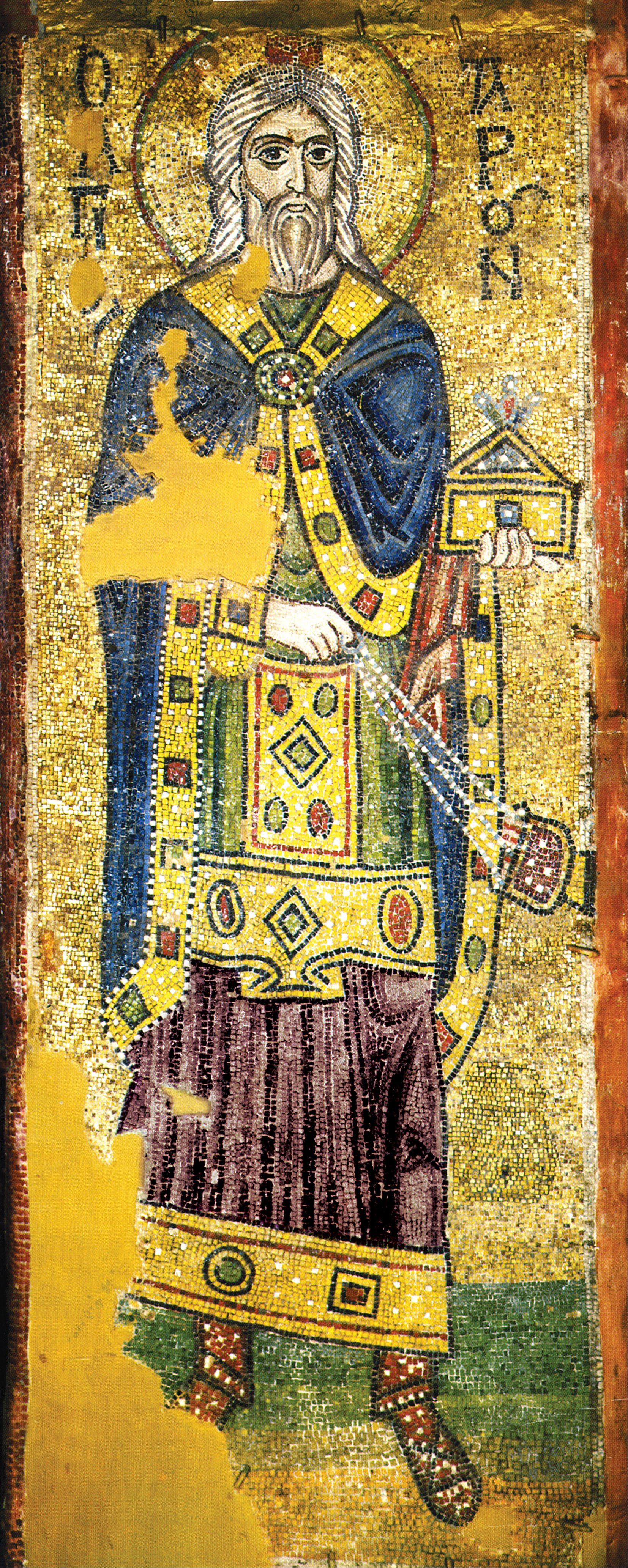


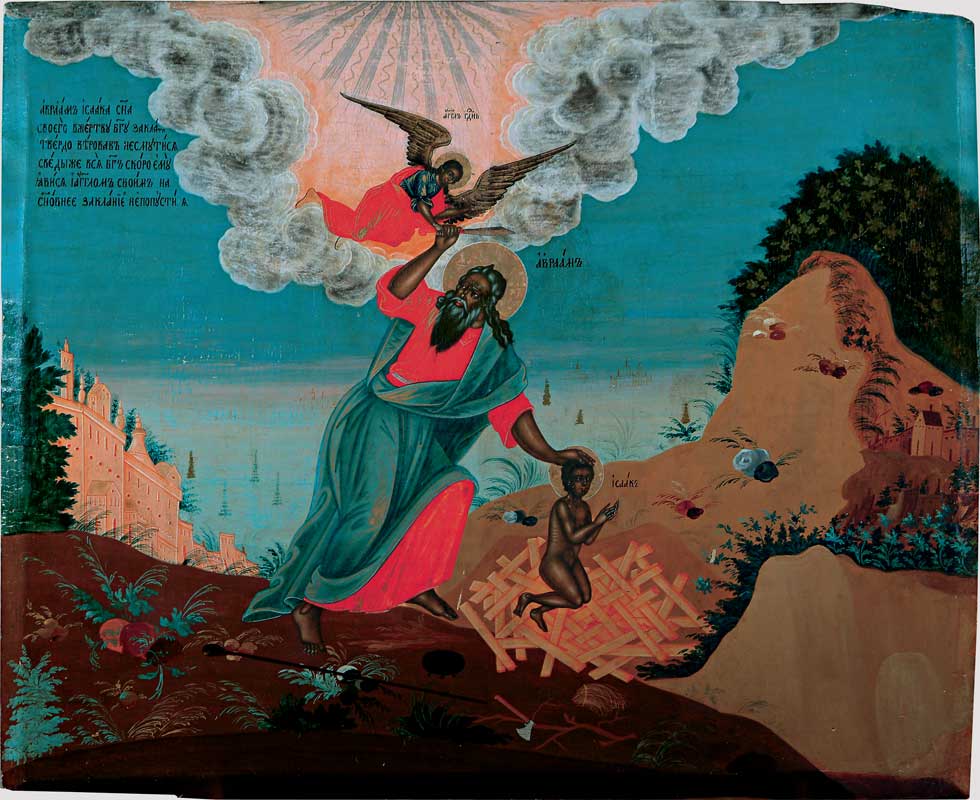





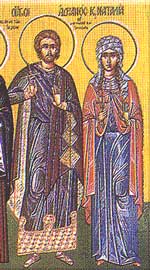


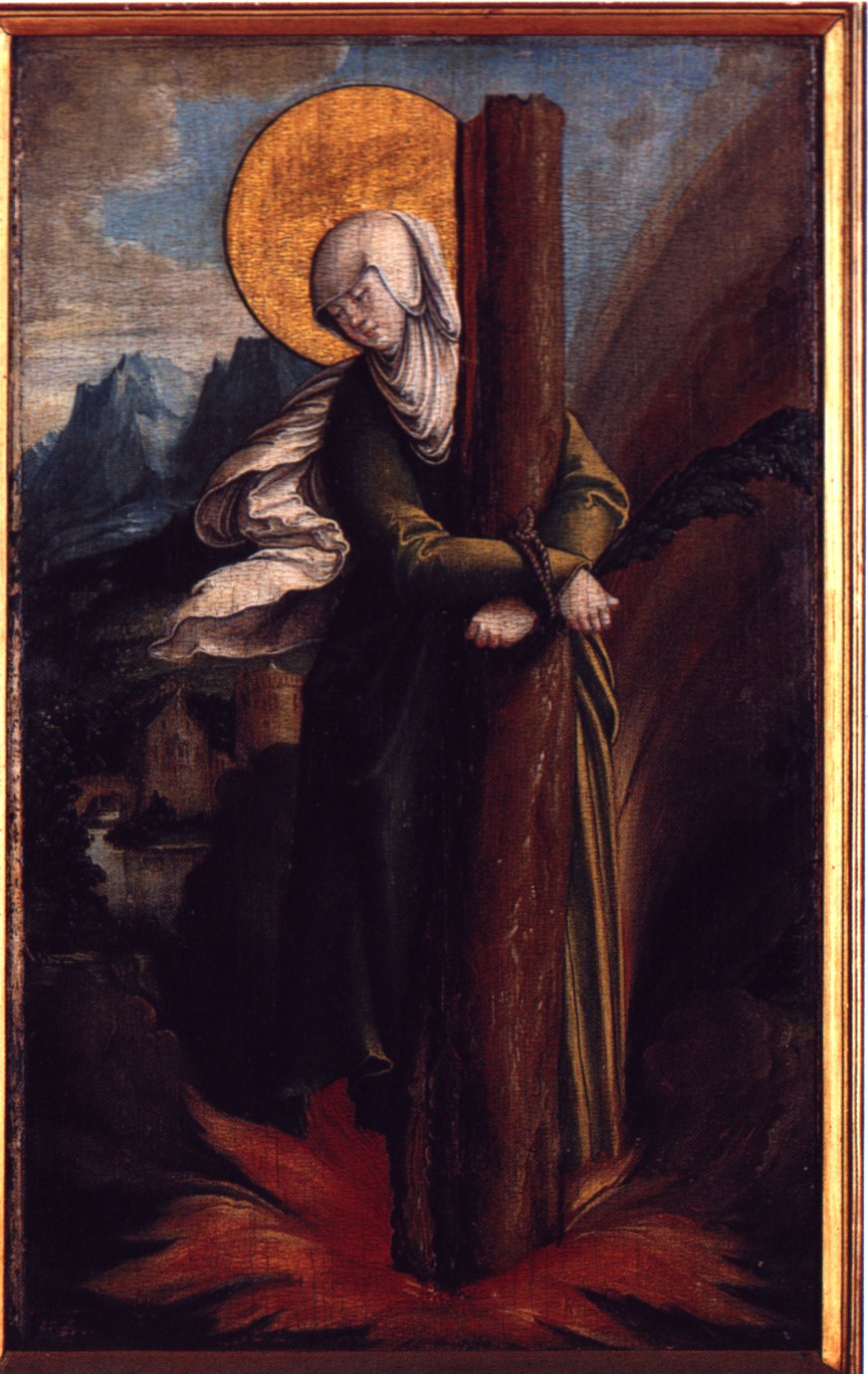


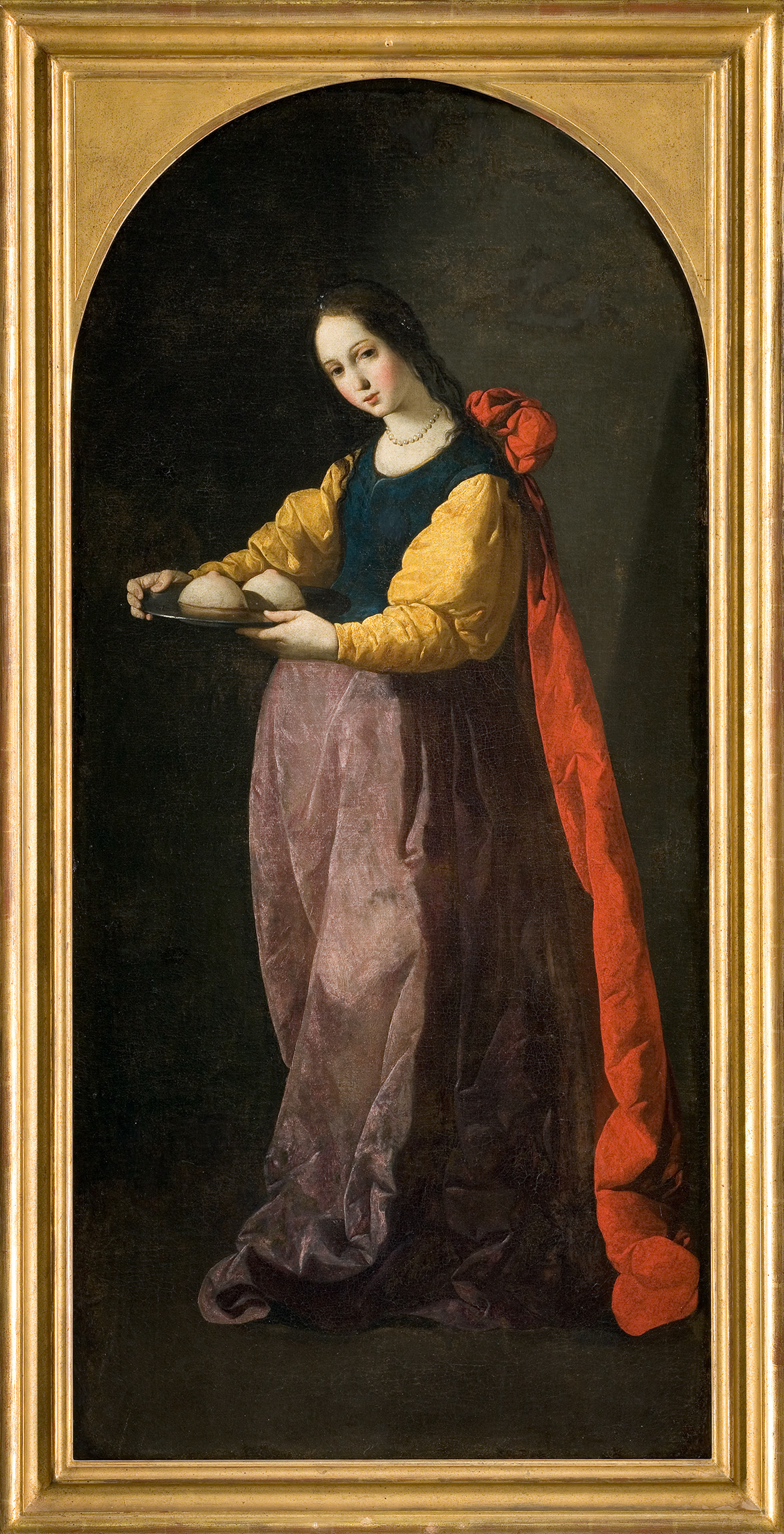


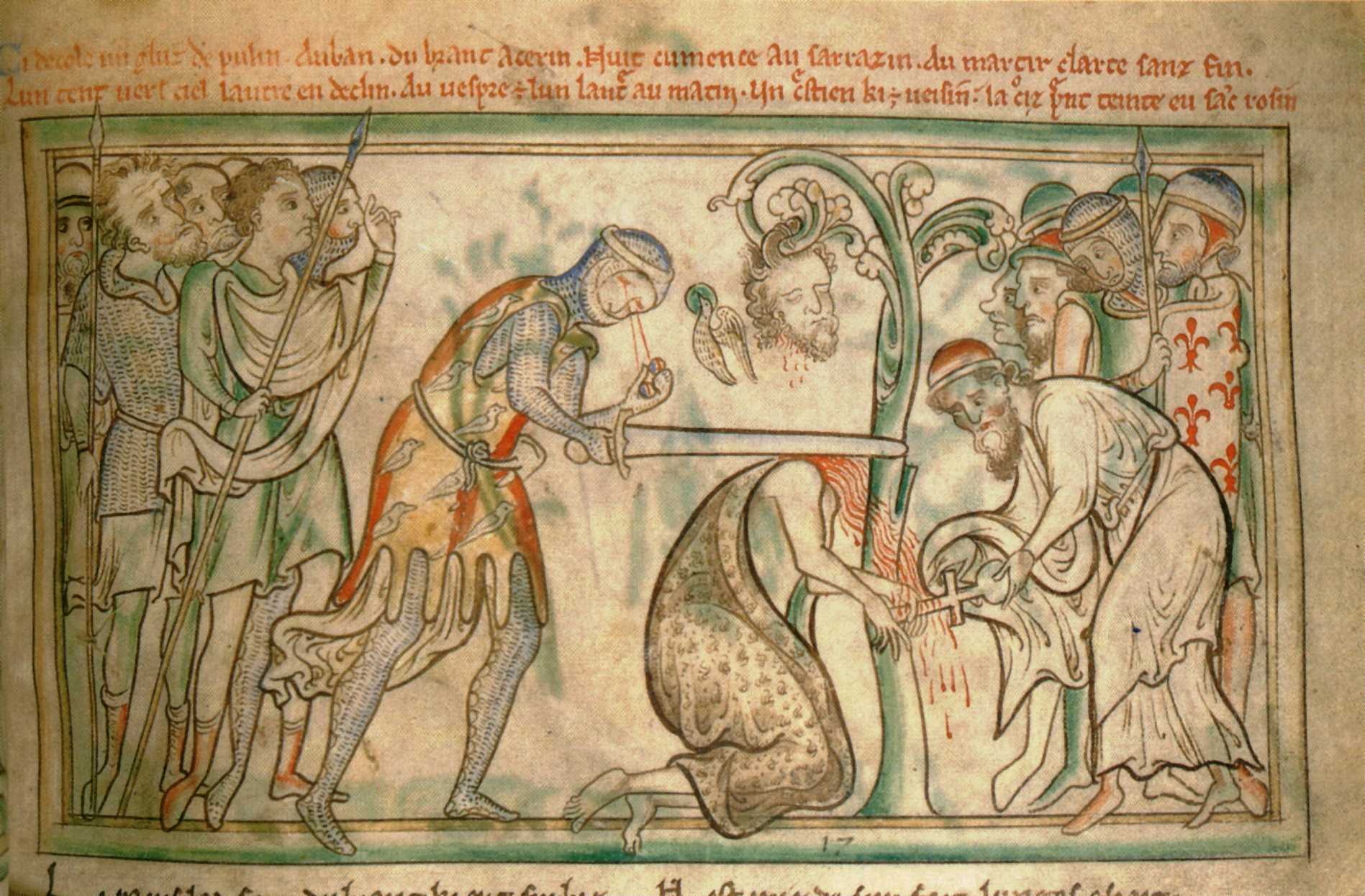


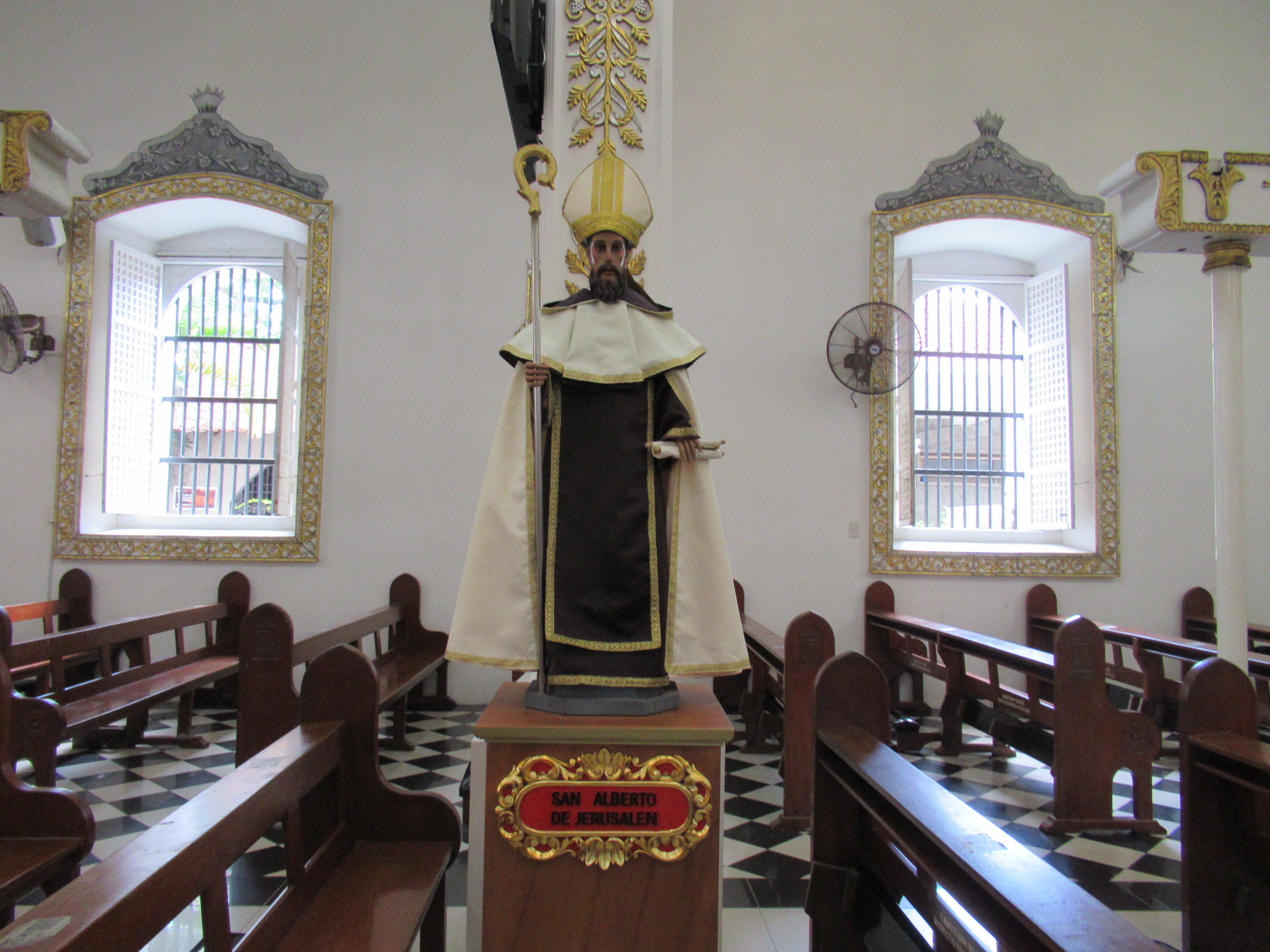


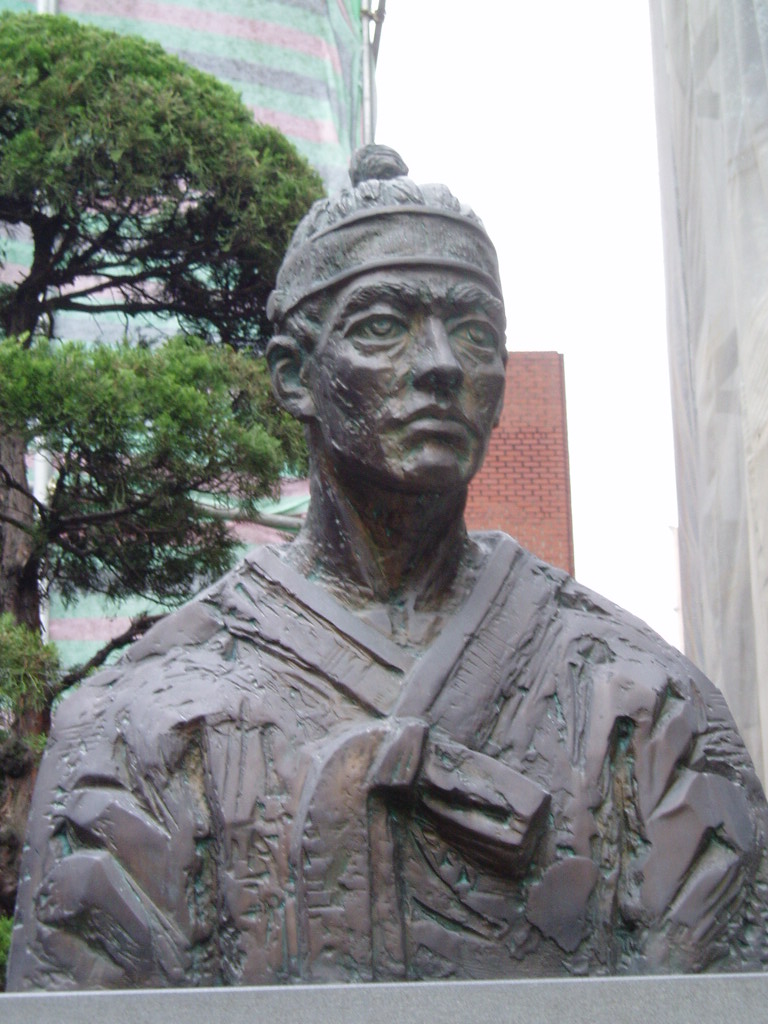


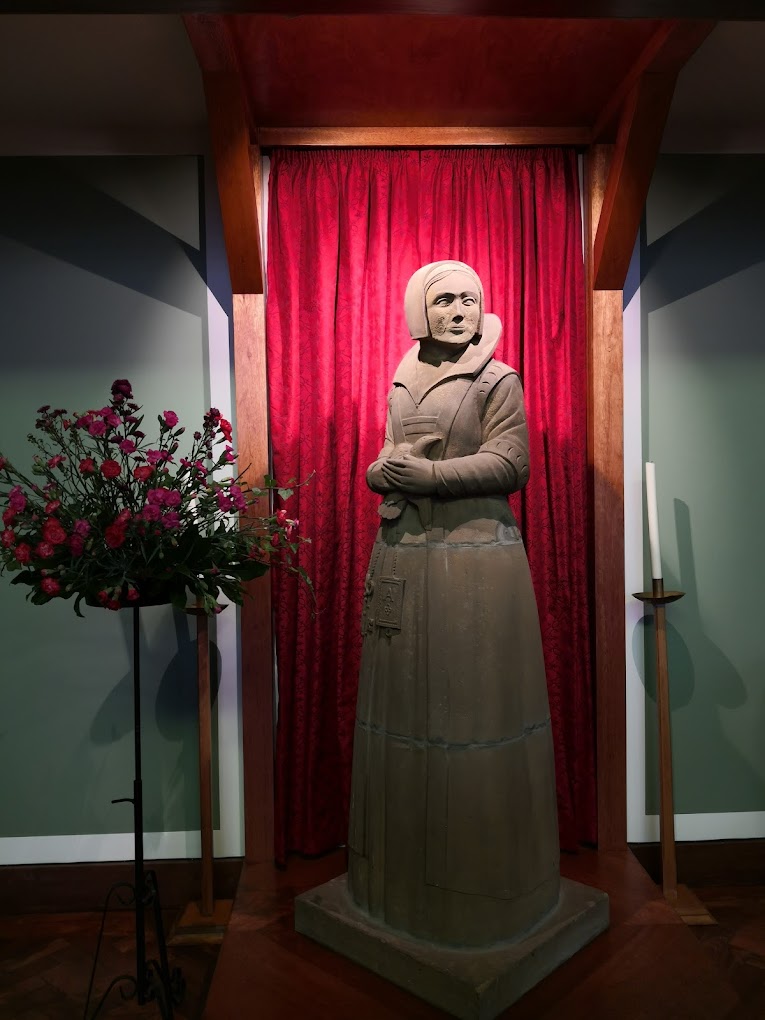


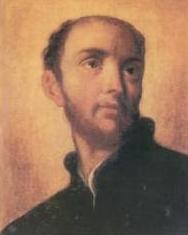


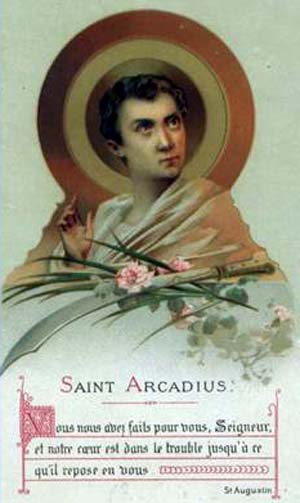





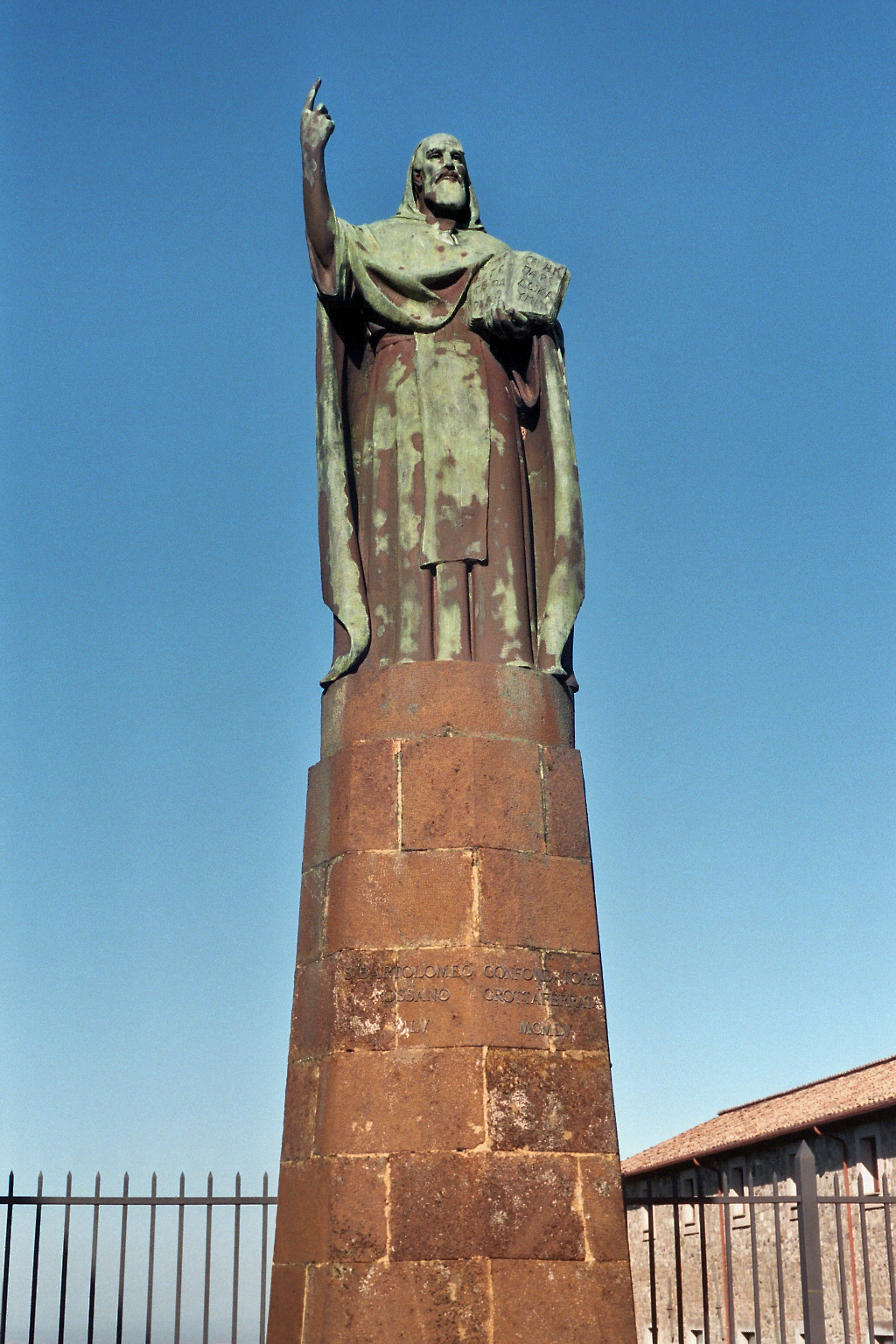


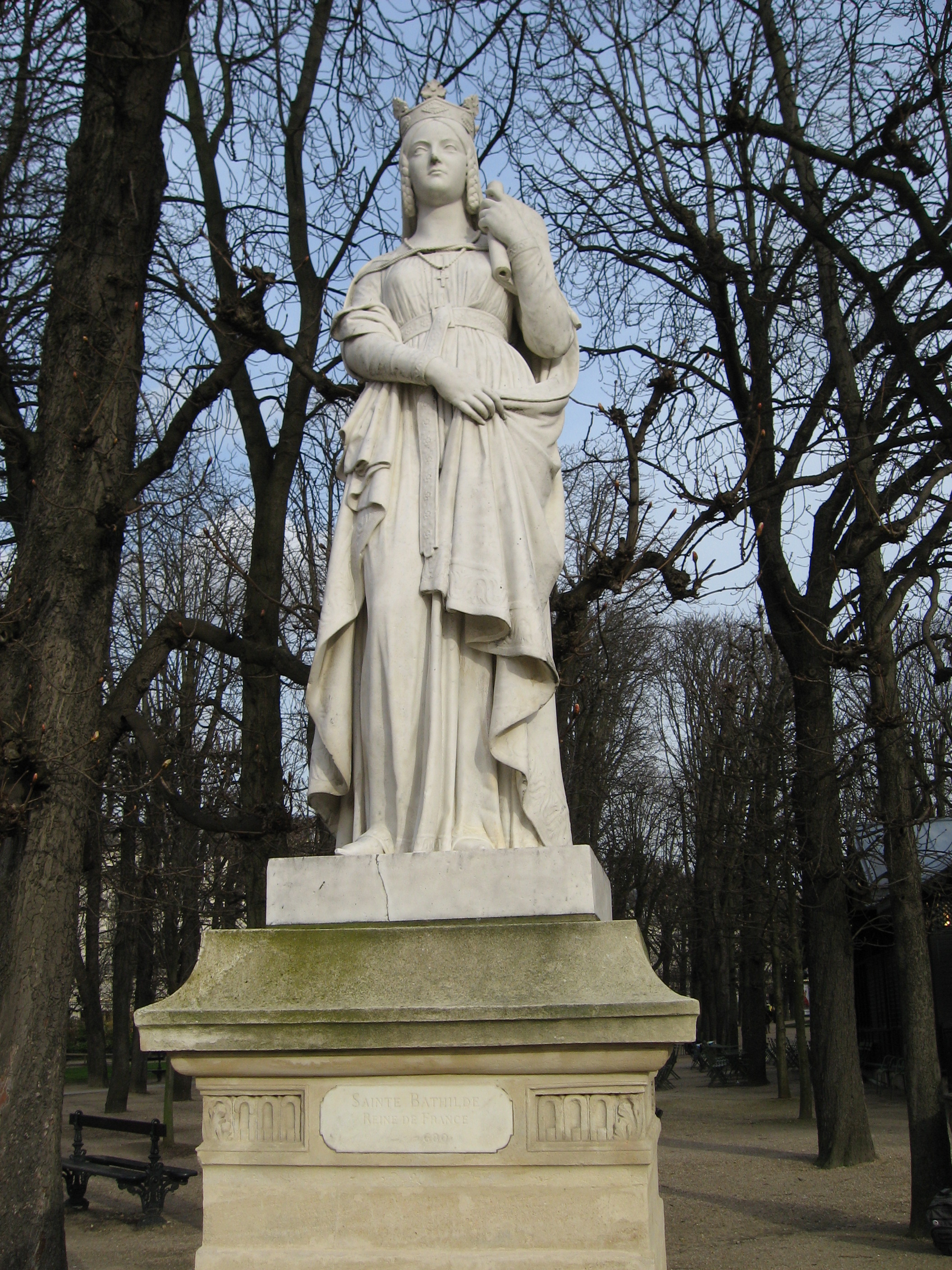


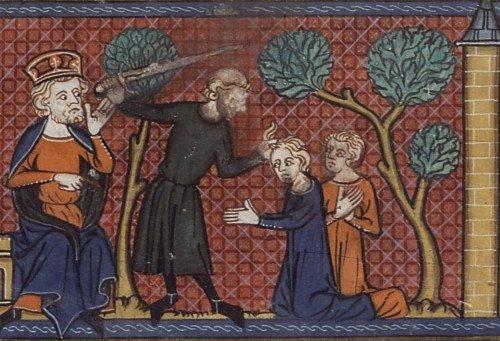


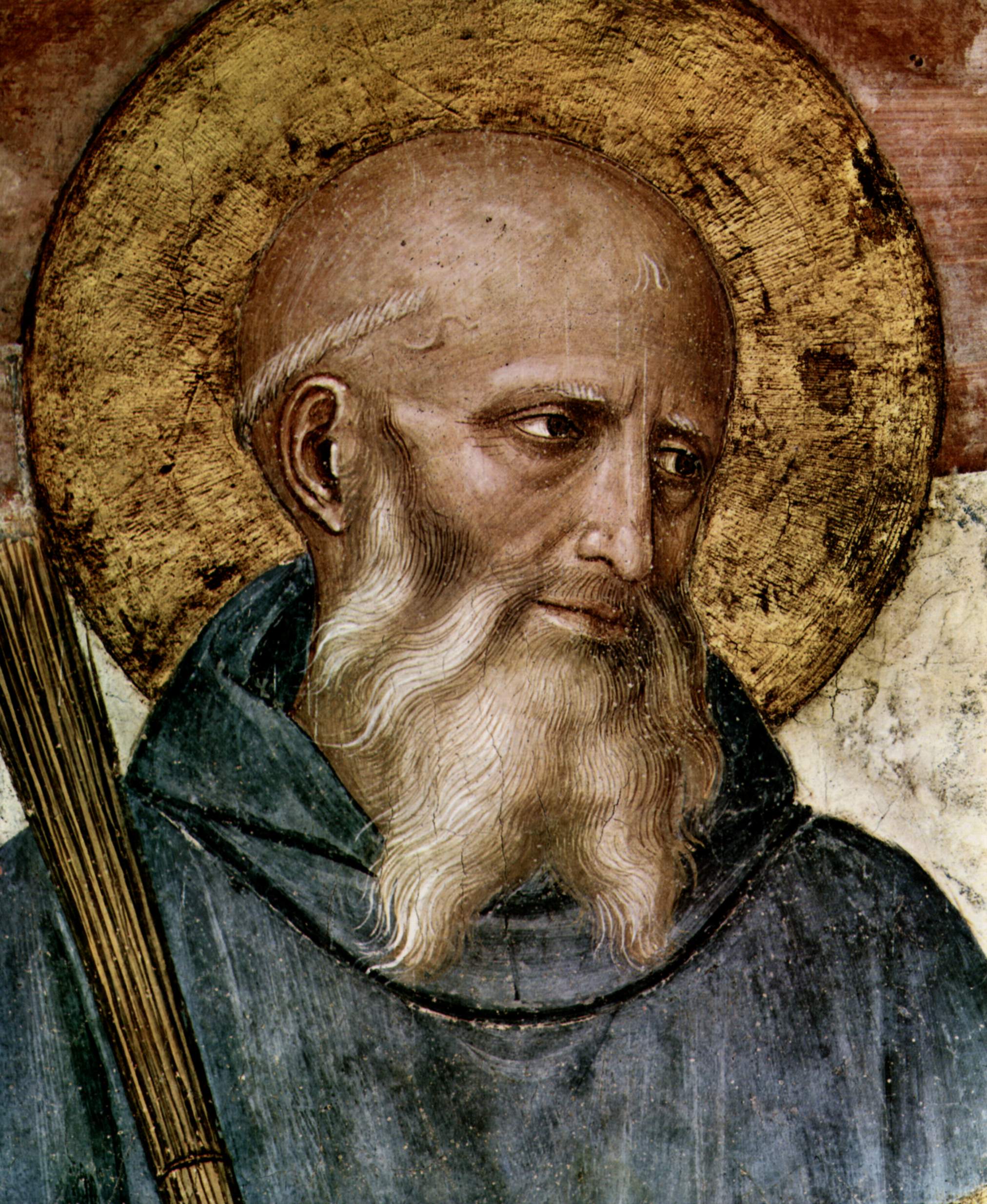

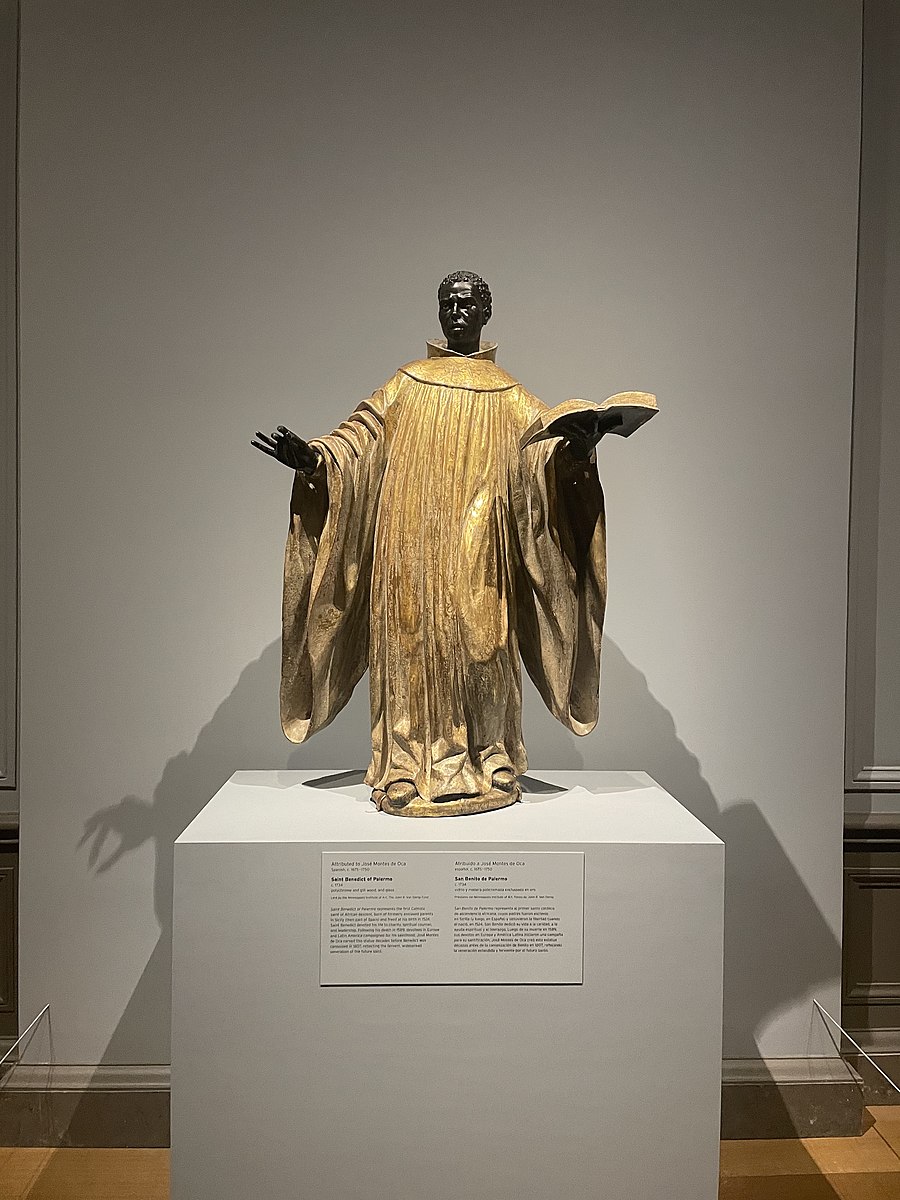


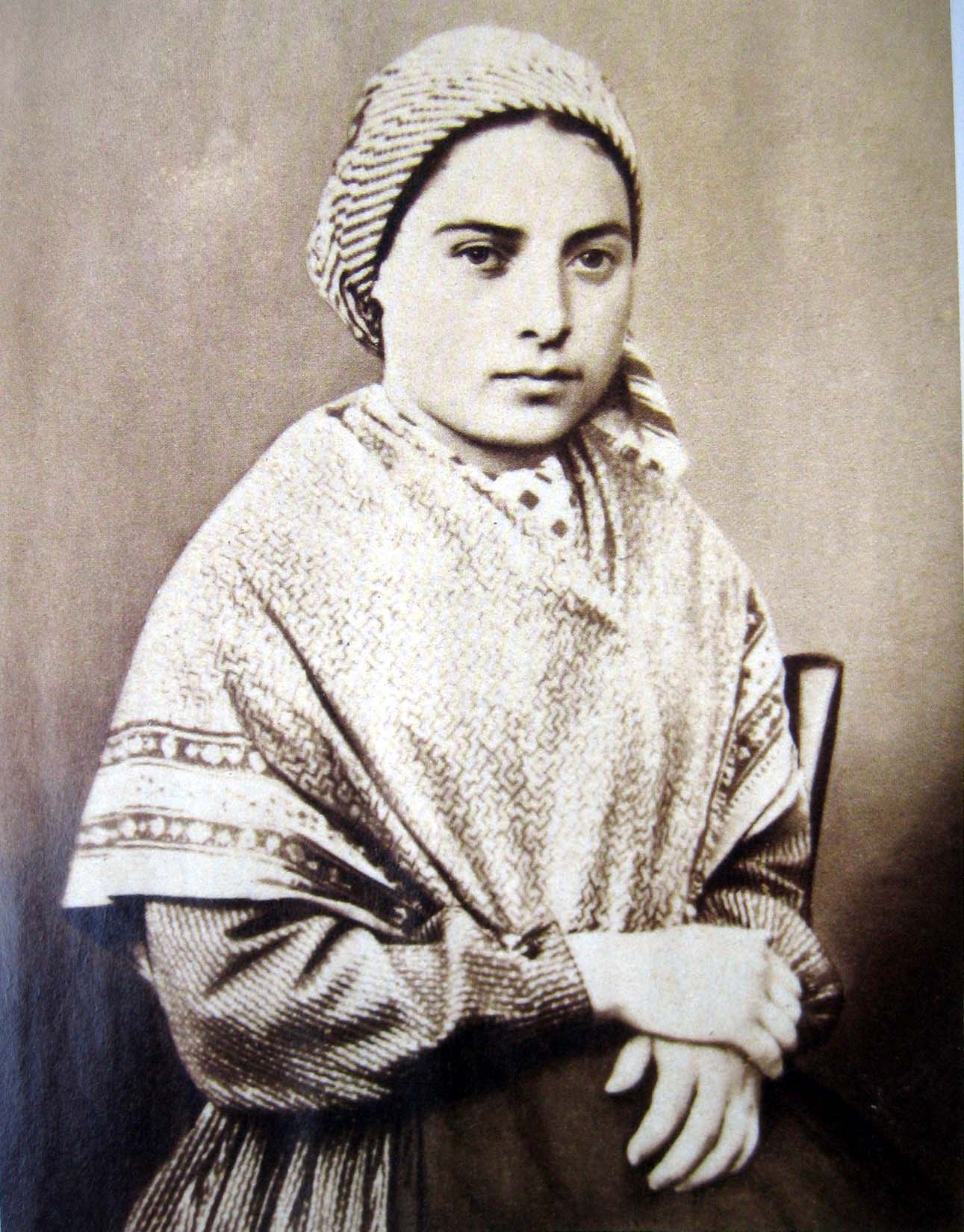


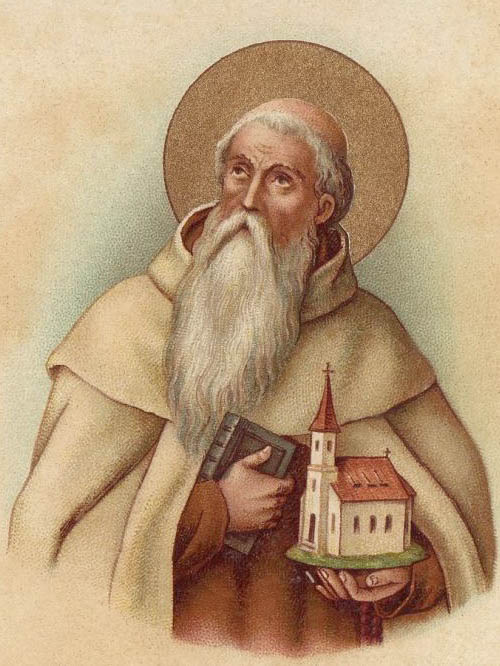

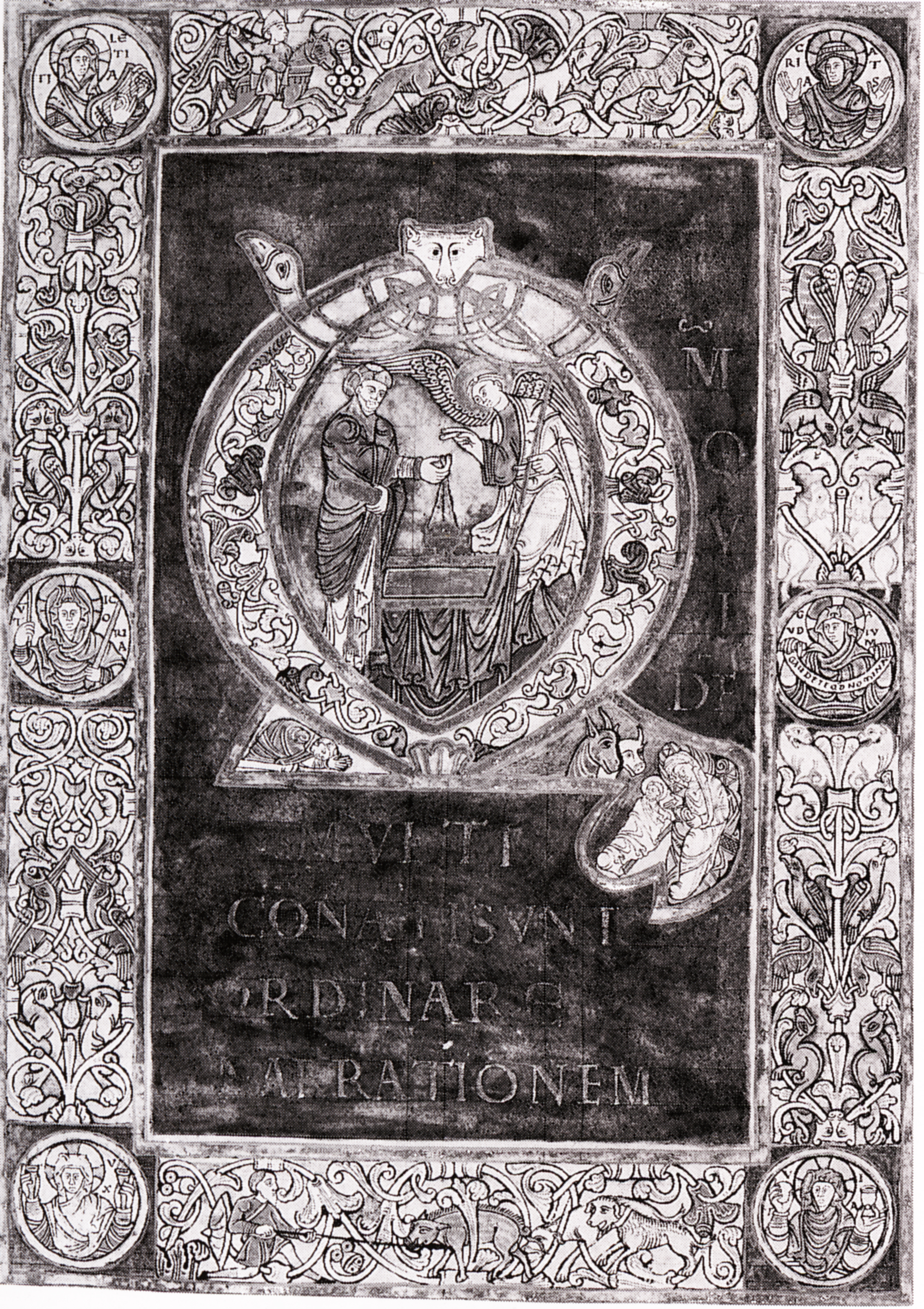
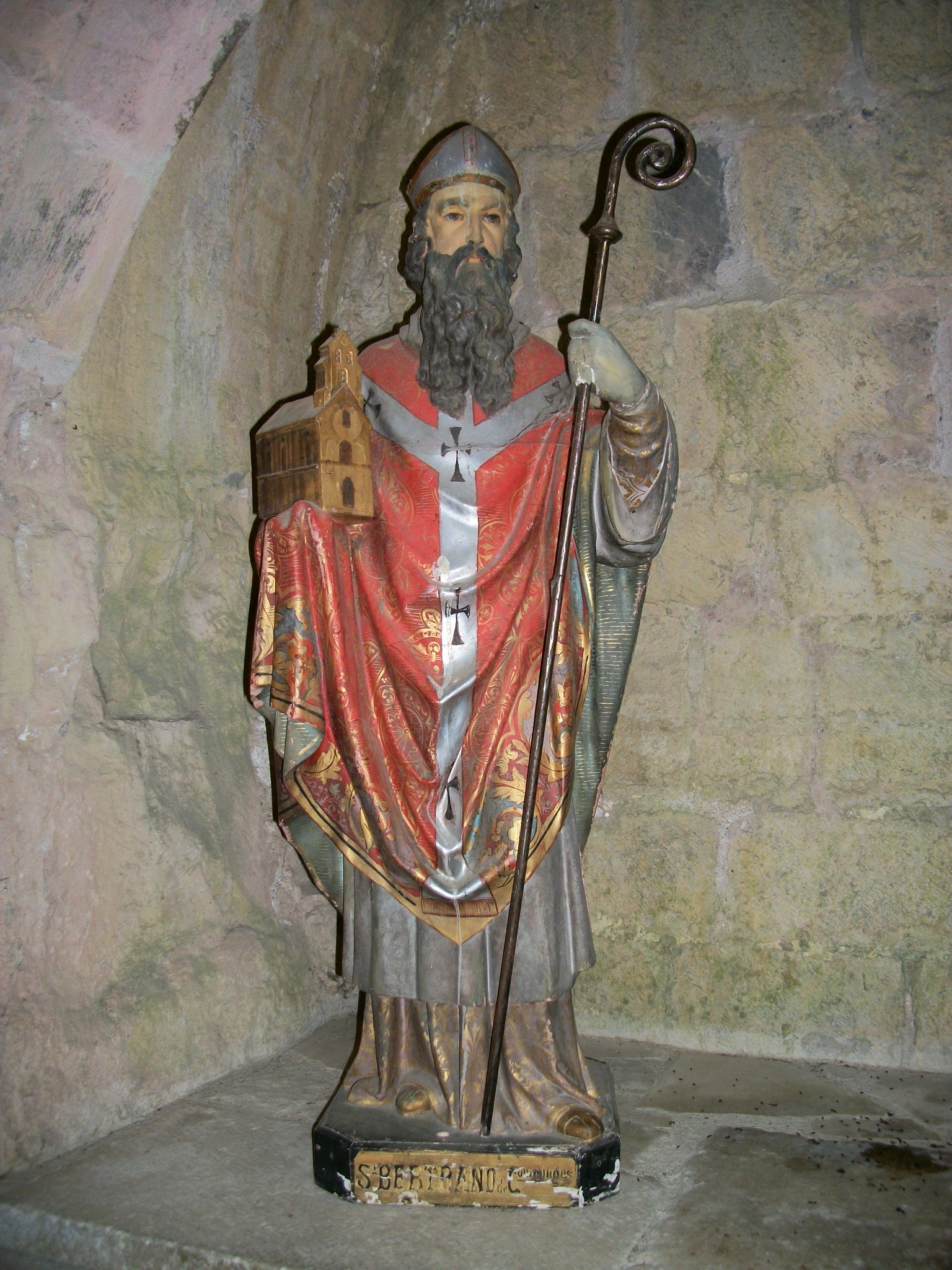


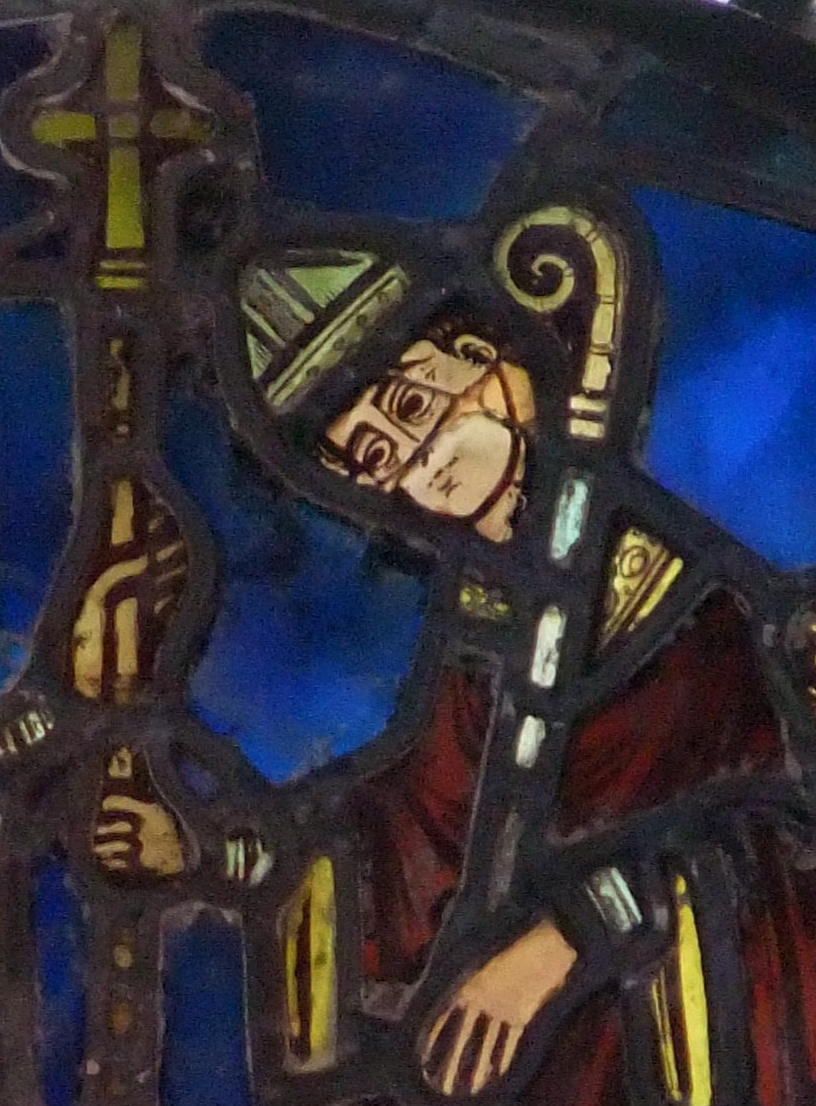
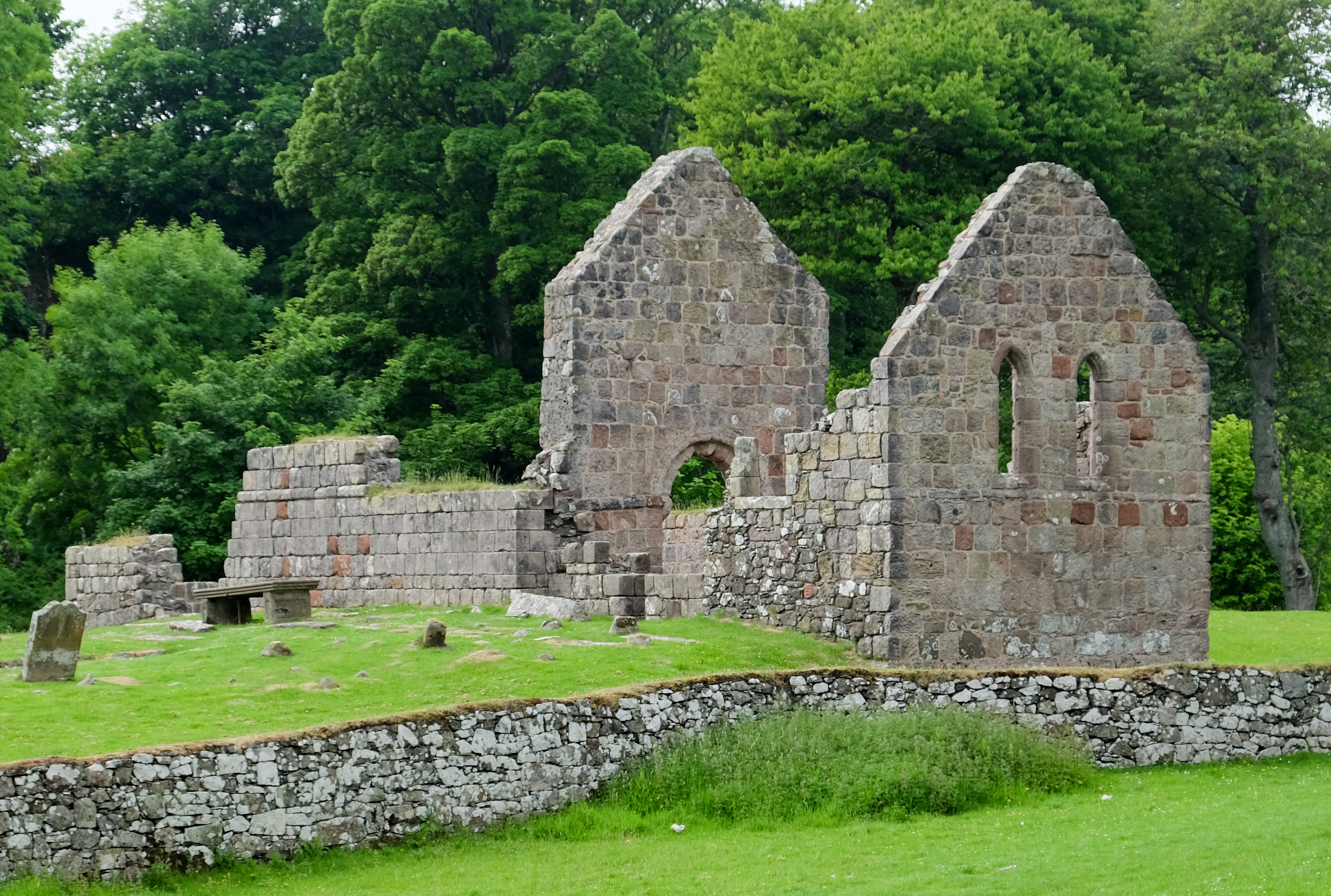


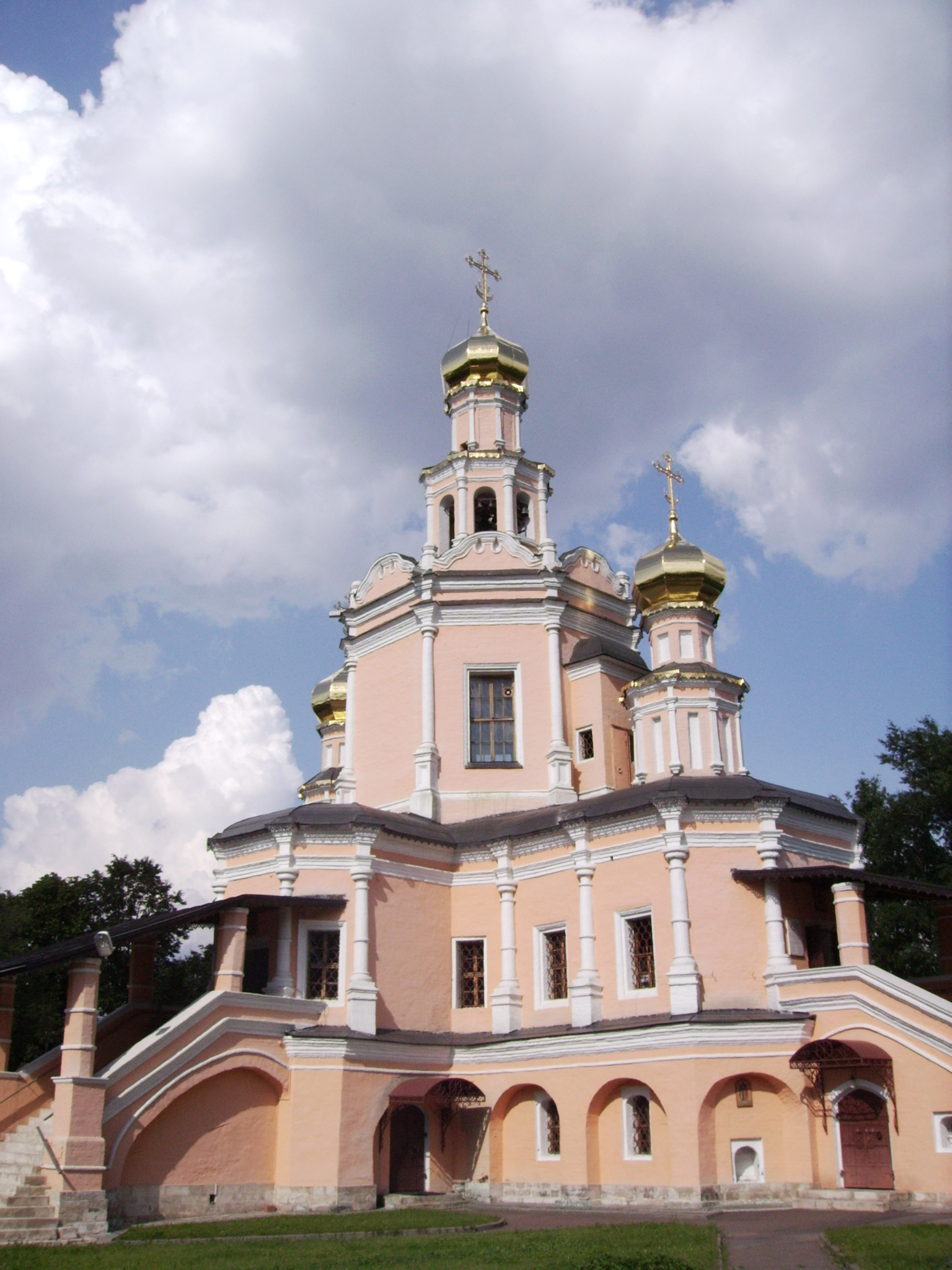


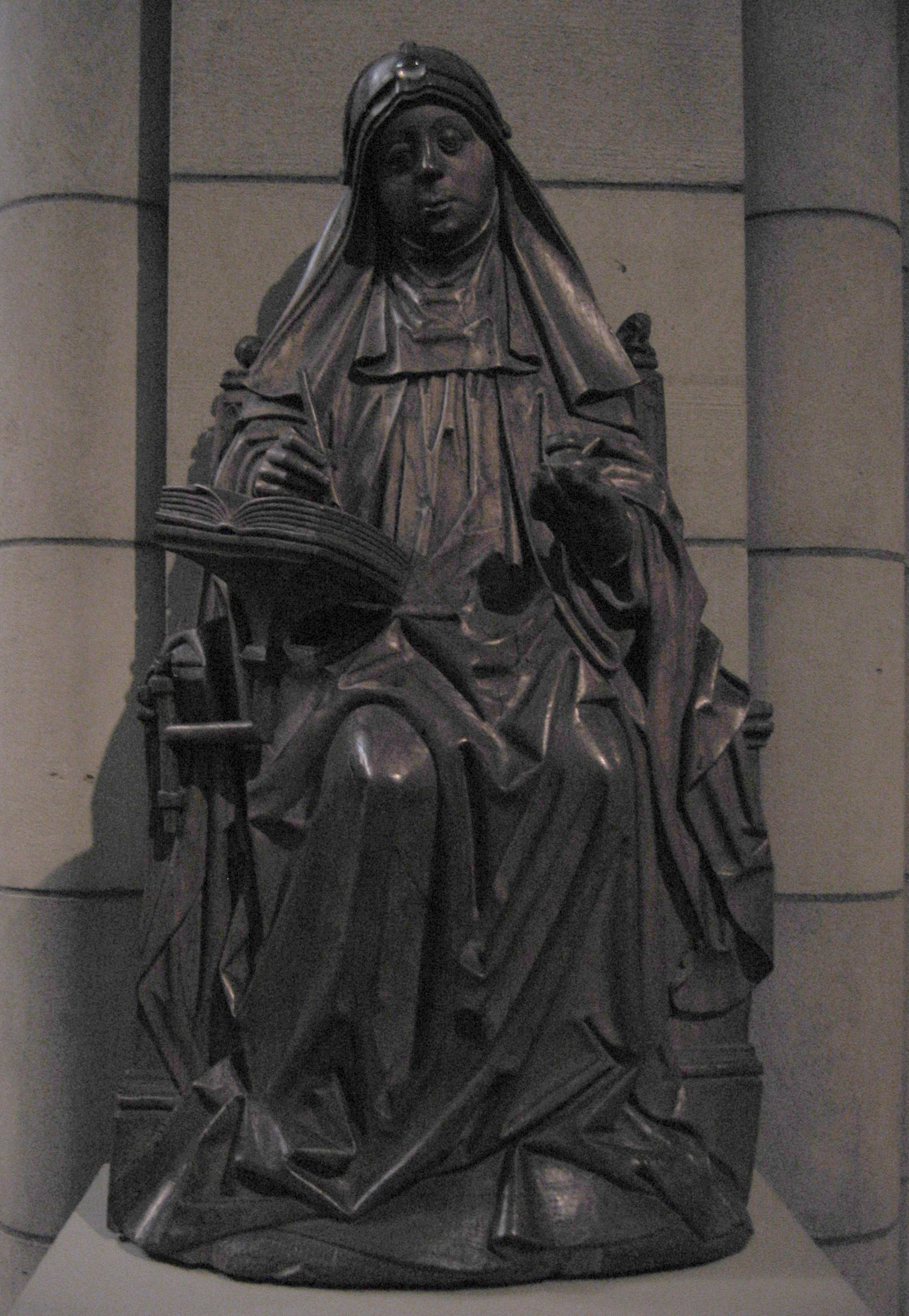


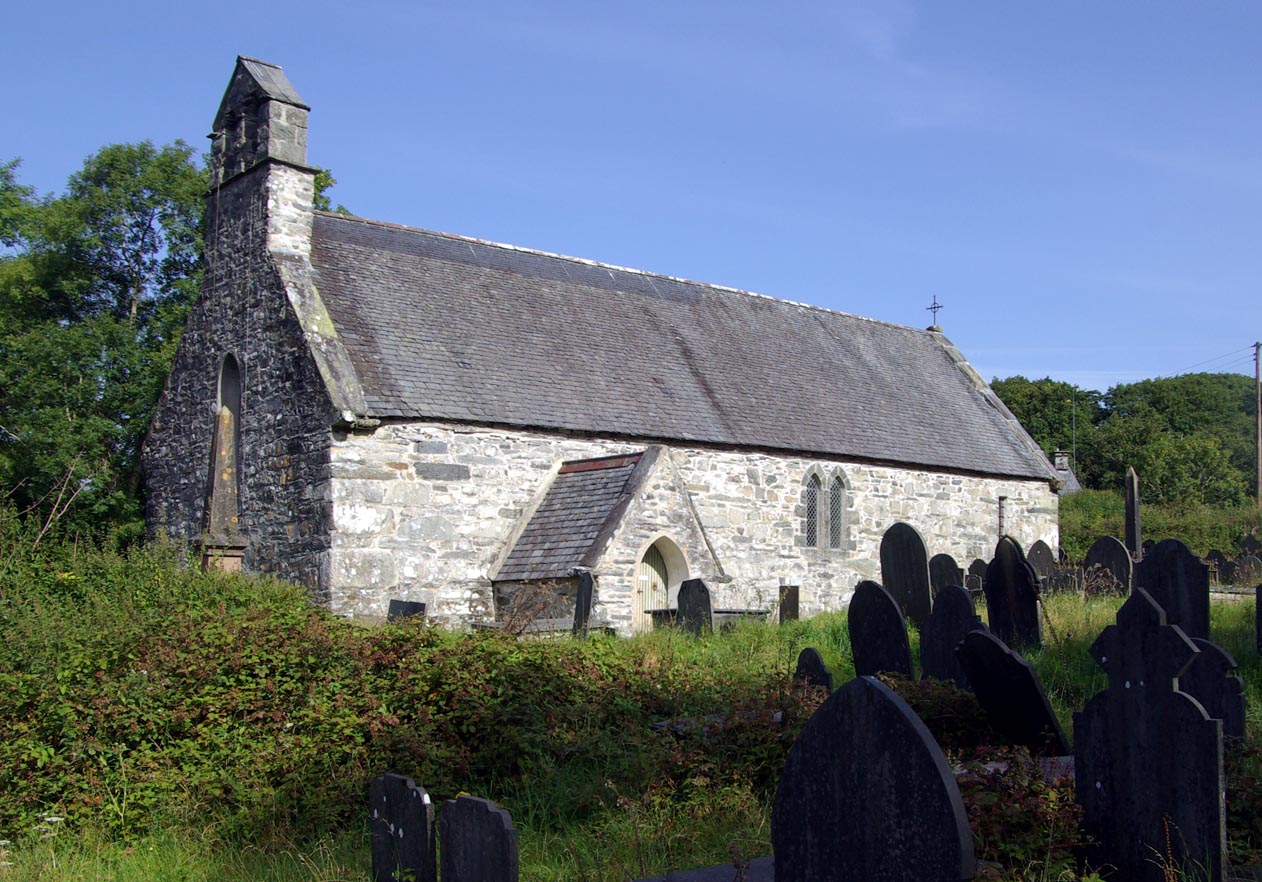




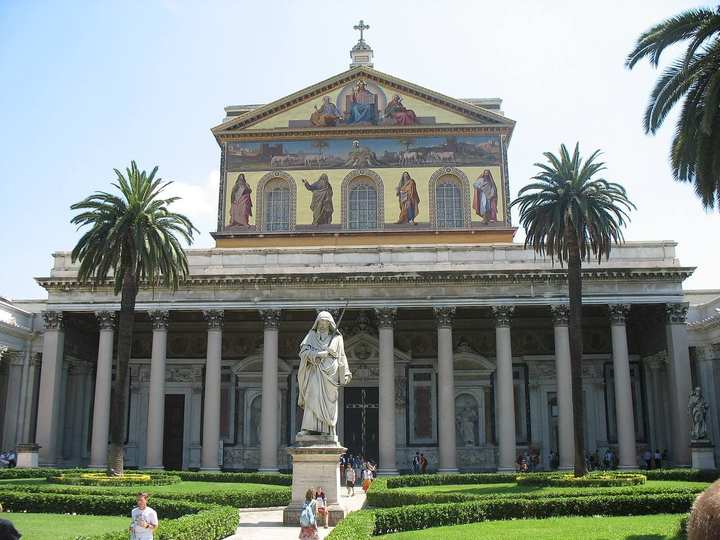
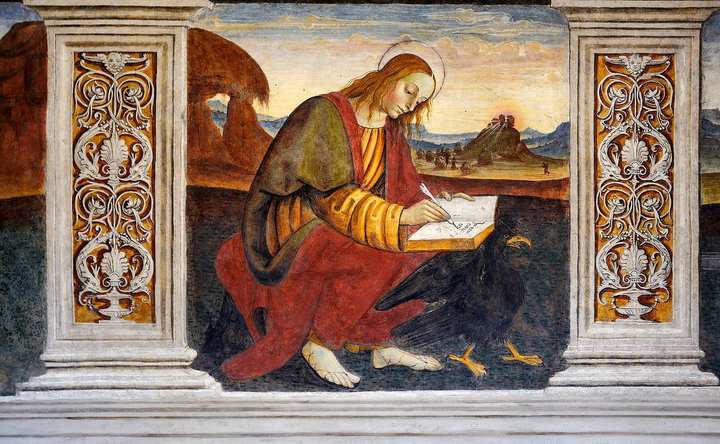
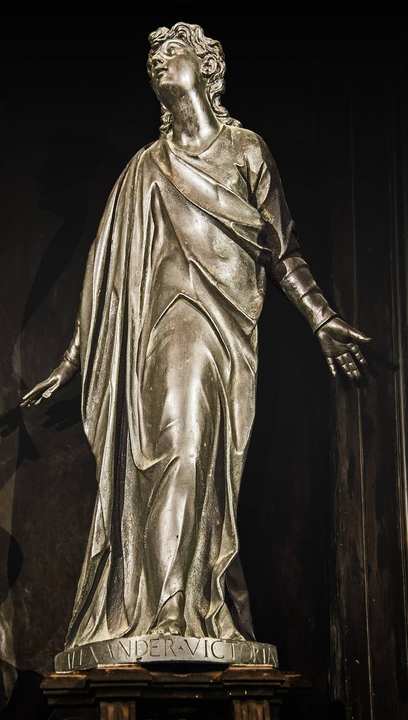
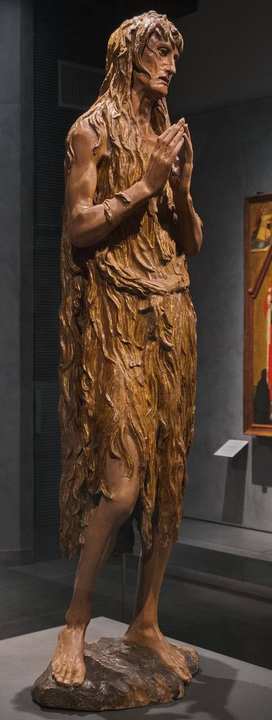
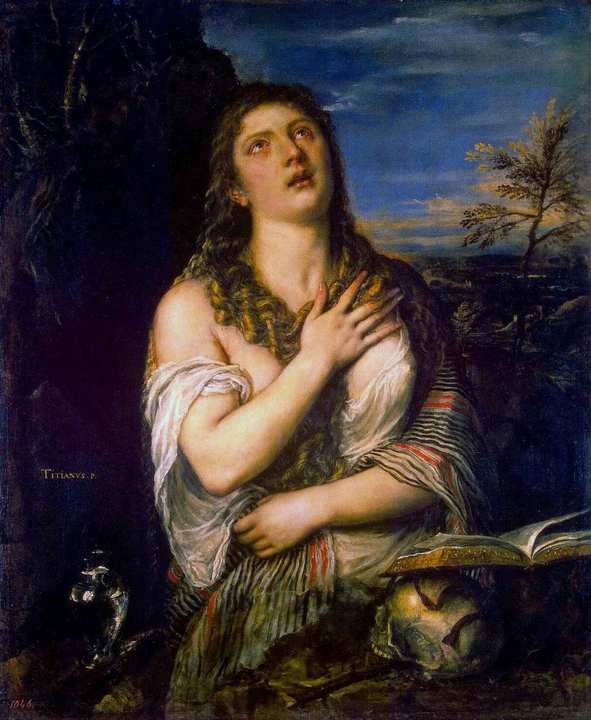
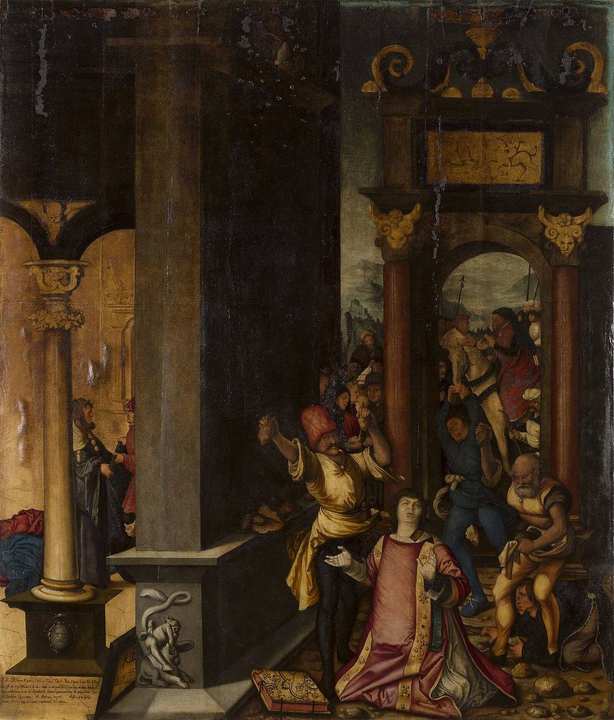
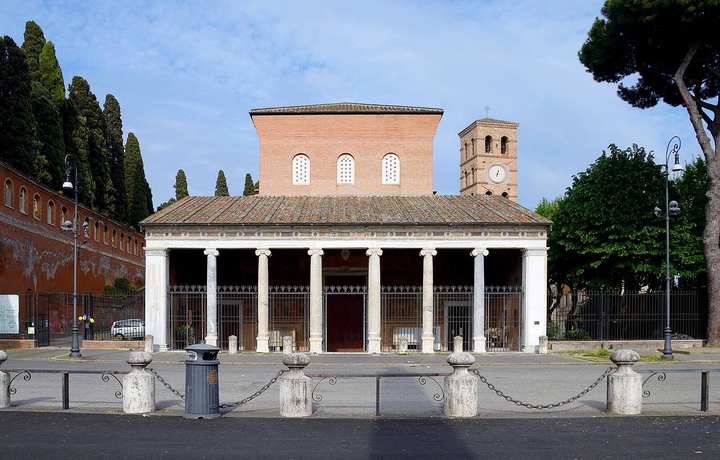
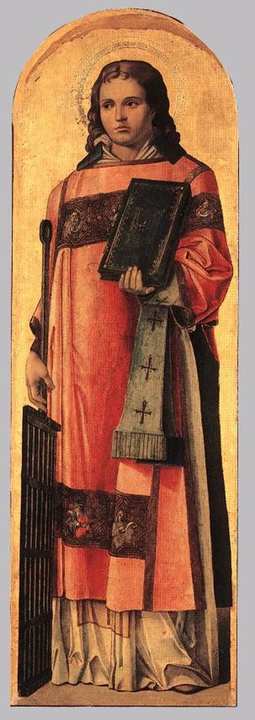
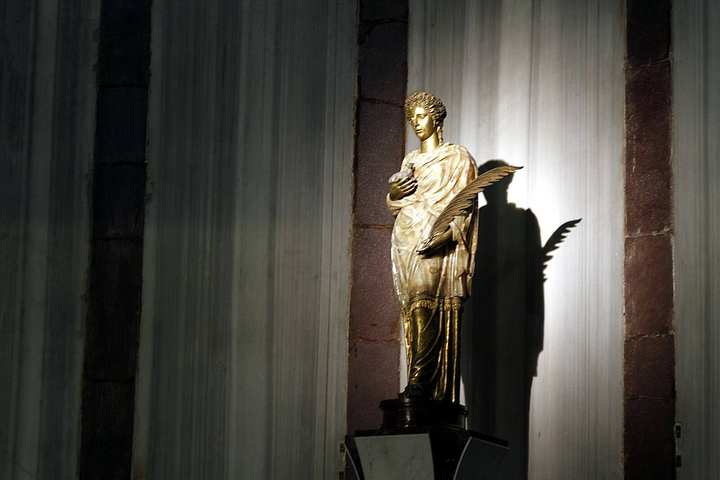
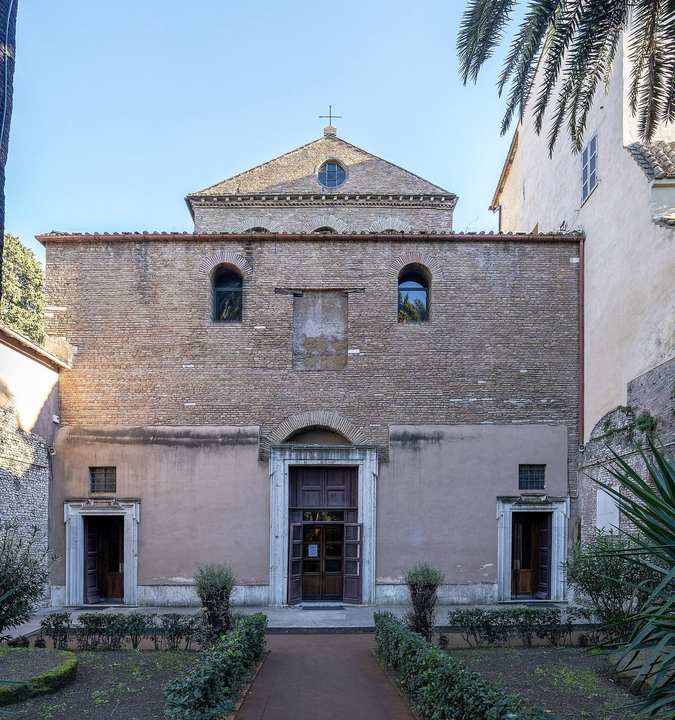
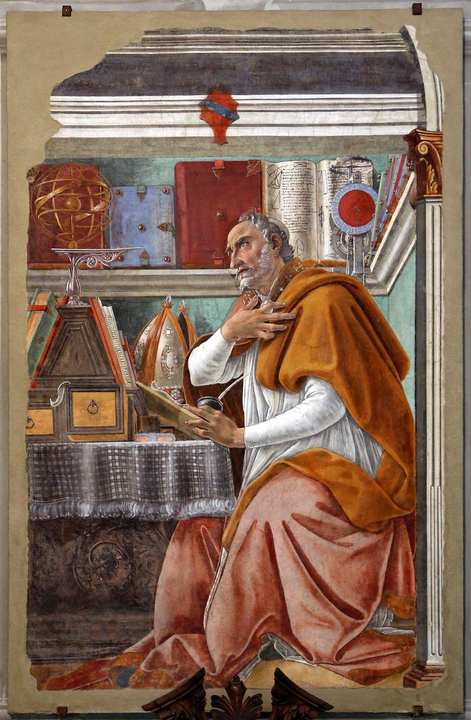
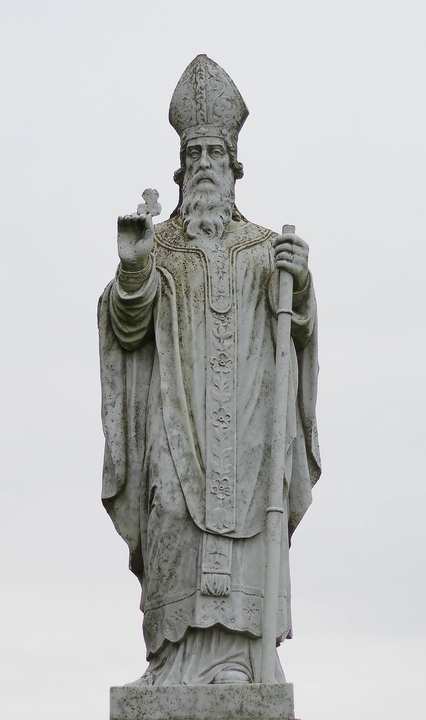
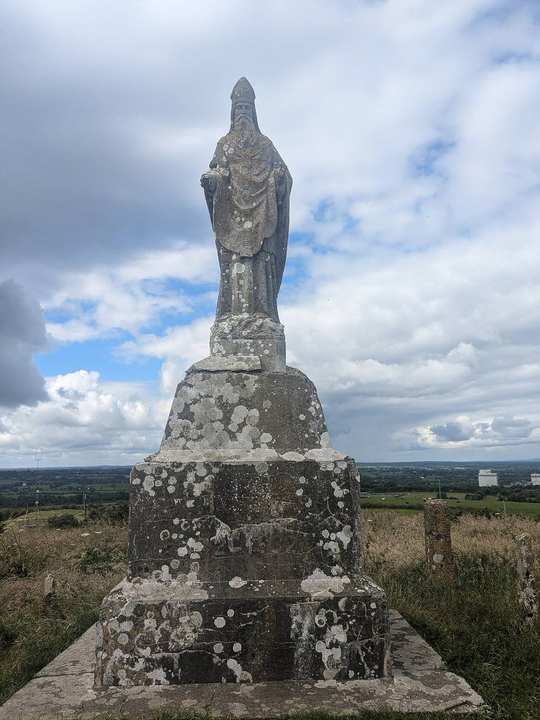
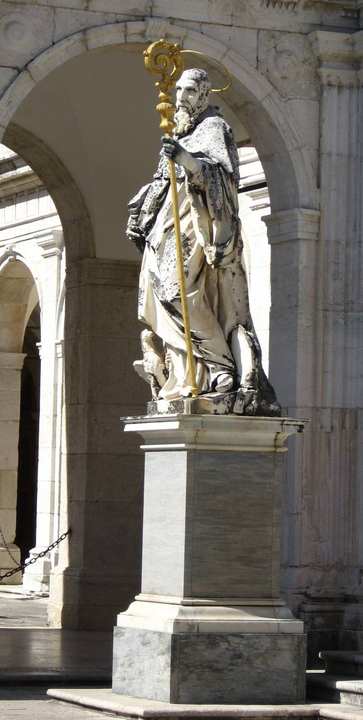
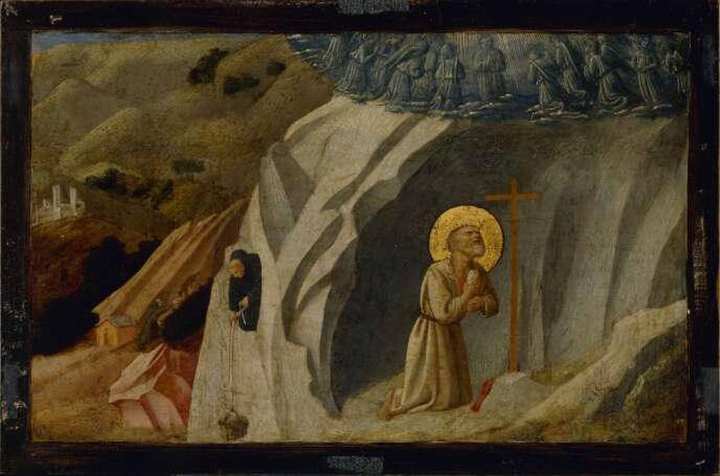
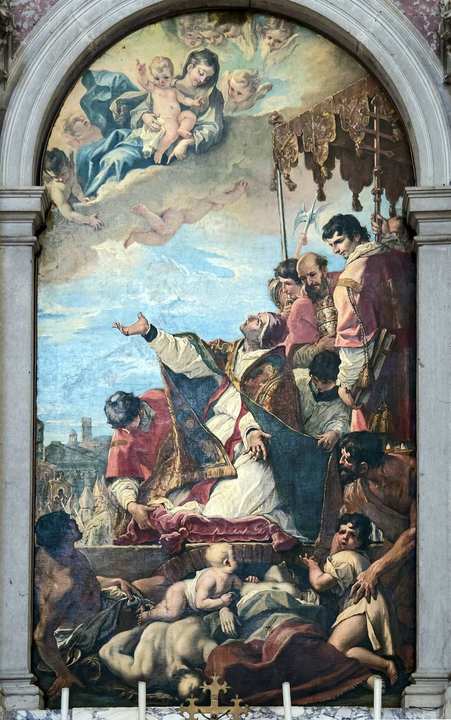
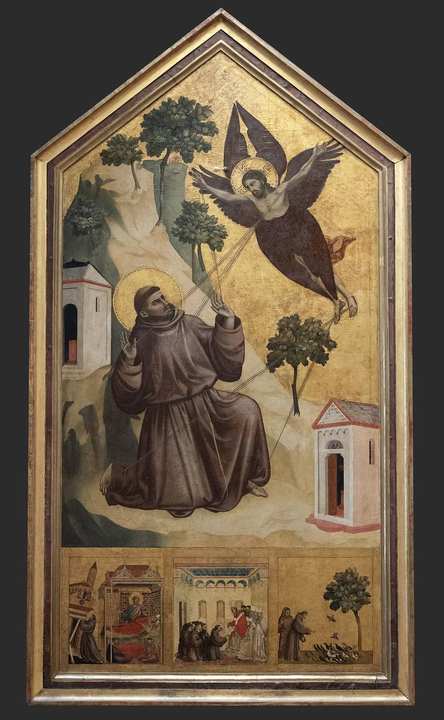
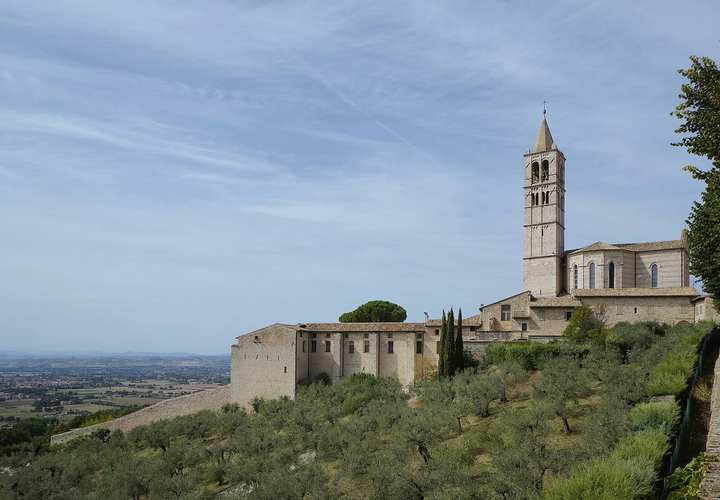
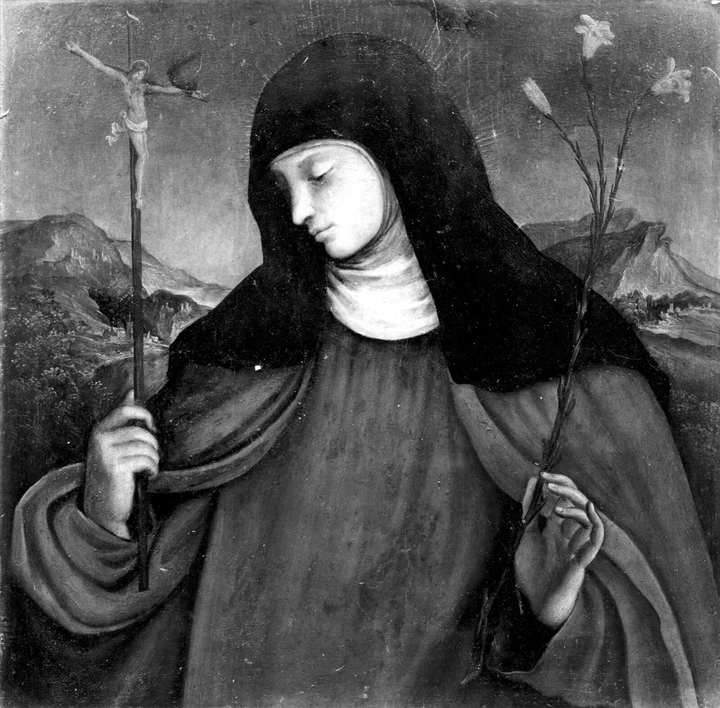
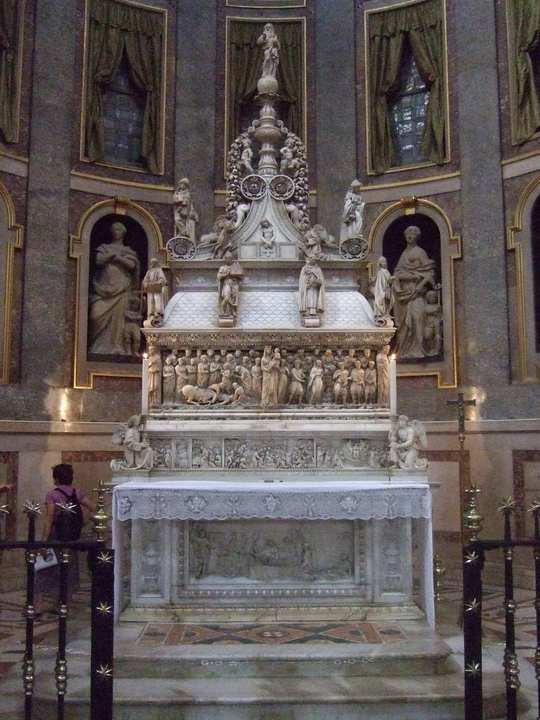
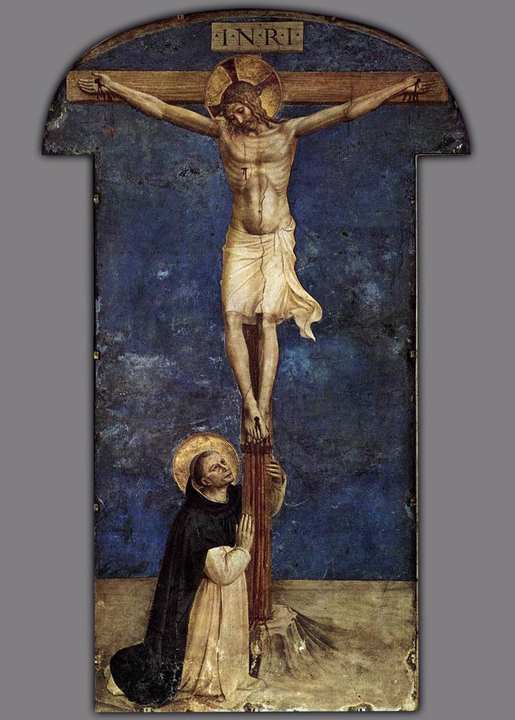
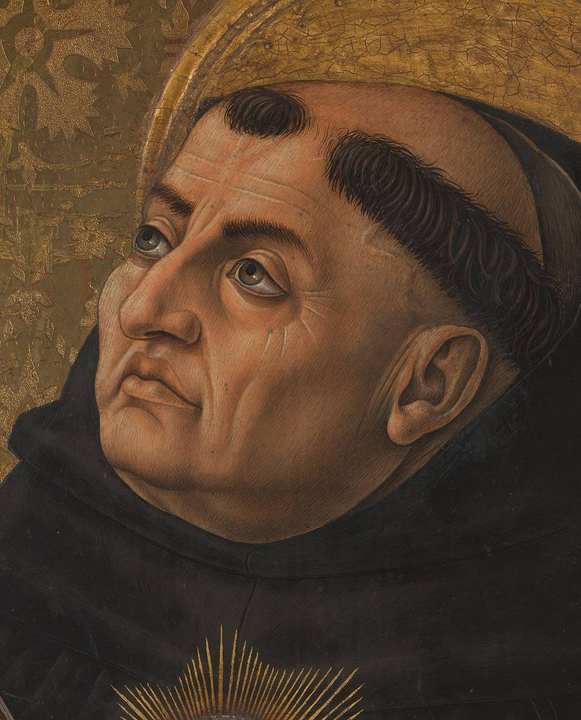
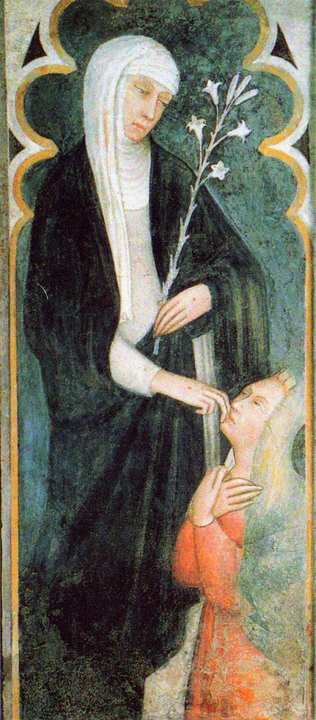
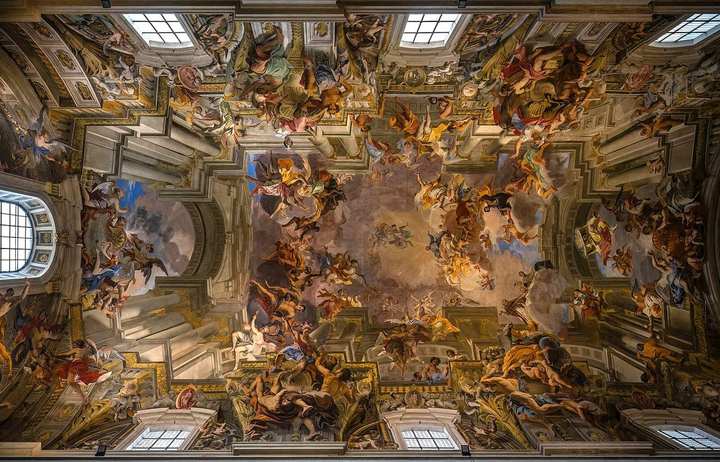
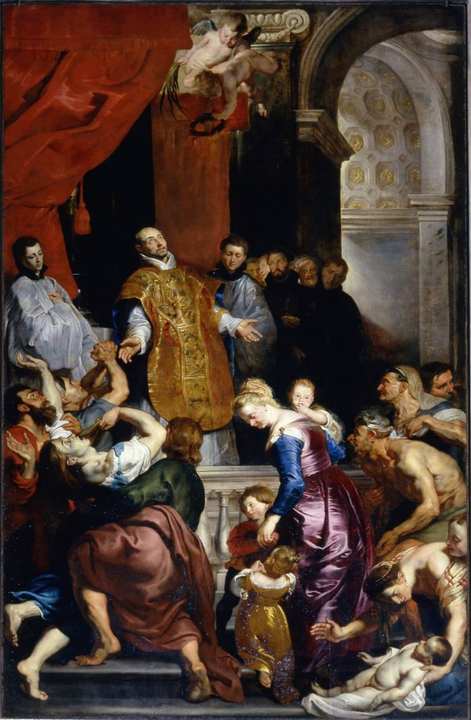

.jpg)


.jpg)
_-_Saint_John_the_Evangelist_by_Vittoria.jpg)

.jpg)

.jpg)


_-_St._Gregory_the_Great_by_Sebastiano_Ricci.jpg)


.jpg)


