
The reading
How it began
Anna Maria Redi enters the Carmel of St. Teresa in Florence, lives a hidden life of the Sacred Heart, and dies after a brief illness in 1770. The body does not follow the ordinary course. The nuns record a fragrance and a suppleness that lasted. She is canonized in 1934, a saint of the same family as Thérèse, earlier and less famous.
The day itself
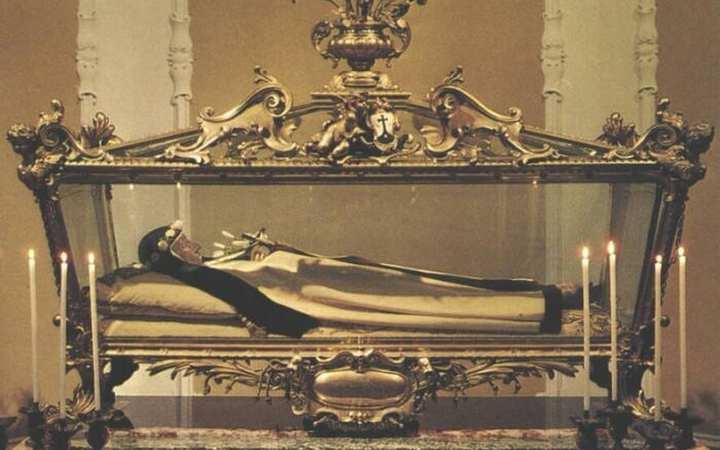
Anna Maria Redi was born in Arezzo in 1747 and entered the Discalced Carmel of Florence at seventeen, taking the name Teresa Margaret of the Sacred Heart. She died on 7 March 1770, twenty-two years old, after a short and painful illness the nuns described as a strangury. The community recorded that the body stayed flexible, that the face did not take on the ordinary colour of death, and that a fragrance was noticed in the cell and then in the vault. She was buried in the Carmel. The body has remained there, shown in the monastery chapel in Florence, a young Carmelite under glass. Pius XI canonized her on 19 March 1934. Her doctrine, if a hidden nun can be said to have one, is the Sacred Heart as a life of obedience inside a cloister, written down by her confessor from the little she was willing to say. The preservation is the reason a pilgrim can still see her face. The canonization is the reason the Church proposes the life.
Reading
How to read St. Teresa Margaret of the Sacred Heart
Another Carmelite who wanted to be nobody. The intact body is the usual divine indiscretion toward that wish.
Church status
How this sign has been received
Church-approved
Canonized 1934. Relics in the Florentine Carmel of the Discalced.
Sources
- Discalced Carmel, Florence
- Process of St. Teresa Margaret
For the classroom
St. Teresa Margaret of the Sacred Heart (Died 1770; found intact, Florence, Discalced Carmel). Grade in this encyclopedia: Church-approved. A Florentine Carmelite who died at twenty-two. The body remained flexible and incorrupt, the face beautiful in death, and has been shown in the Carmel of Florence.