Stop 1
Bethlehem
The Gospel account
Bethlehem is the first stop because it is the birth, not because it was Jesus' home. Luke, chapter 2, places the birth in a census. A decree went out from Caesar Augustus that the whole world should be enrolled. Luke says this enrolling was first made by Cyrinus, the governor of Syria. Joseph went up from Nazareth in Galilee to Judea, to the city of David, called Bethlehem, because he was of the house and family of David, to be enrolled with Mary, his espoused wife, who was with child.
Luke does not dress the scene. When they were there, her days were accomplished. The Douay-Rheims gives the birth in one sentence: "And she brought forth her firstborn son, and wrapped him up in swaddling clothes, and laid him in a manger; because there was no room for them in the inn" (Luke 2:7). Shepherds were keeping the night watches over their flock. An angel told them: "Fear not; for, behold, I bring you good tidings of great joy, that shall be to all the people: For, this day, is born to you a Saviour, who is Christ the Lord, in the city of David" (Luke 2:10-11). The sign was the infant in the manger. A multitude of the heavenly army praised God. The shepherds went with haste, found Mary and Joseph and the infant, and told what had been said. Mary kept all these words, pondering them in her heart. The child was circumcised on the eighth day and named Jesus, the name given before he was conceived. Luke then takes the family to the Temple in Jerusalem for the presentation, and afterwards home to Nazareth. The finding of the boy Jesus in the Temple, at twelve years old, also belongs to Luke 2, but that scene is in Jerusalem, not in the cave at Bethlehem.
Matthew, chapter 2, tells a different part of the same infancy, not a second birth story. Jesus was born in Bethlehem of Juda in the days of King Herod. Wise men came from the east to Jerusalem asking, "Where is he that is born king of the Jews? For we have seen his star in the east, and are come to adore him" (Matthew 2:1-2). Matthew does not say how many wise men there were, or that they were kings. The number three, and the names later given to them, are tradition, not the text. Herod was troubled. The chief priests and the scribes pointed him to Bethlehem, because the prophet had said the ruler of Israel would come from there. Matthew is using the prophecy of Micheas, that Bethlehem Ephrata, small among the thousands of Juda, would bring forth the ruler. The star led the wise men to the house. They found the child with Mary his mother, adored him, and offered gold, frankincense, and myrrh. Warned in sleep, they did not return to Herod. Joseph was told to take the child and his mother into Egypt. Herod, seeing that he was deluded, killed the male children in Bethlehem and the coasts thereof, from two years old and under. The Church keeps them as the Holy Innocents. After Herod's death the family returned, but not to settle in Judea, because Archelaus reigned there. They went into Galilee and dwelt in Nazareth.
The Church reads the two chapters together. Luke's road is Nazareth to Bethlehem, then back to Nazareth. Matthew's road is Bethlehem, Egypt, and then Nazareth. The manger, the shepherds, the city of David, and the prophecy are what the Gospels give. The cave in which the Church prays is the place those chapters have been kept.
Luke also gives Bethlehem its older name in the story of David. This is the city of David, a few miles south of Jerusalem, not the fortress of David inside Jerusalem itself. Keeping those two cities of David apart saves a great deal of confusion later, when the Cenacle on Mount Zion comes into view.
Now
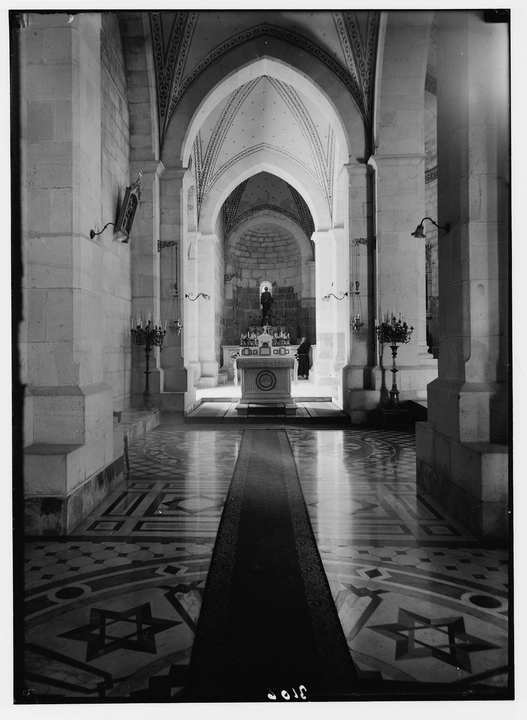
Pilgrims go to Bethlehem because the Church has prayed on this hillside since the fourth century, and because the Gospel names the town. The church over the traditional birthplace is the Basilica of the Nativity, on Manger Square. Saint Helena, the mother of the Emperor Constantine, is remembered as the promoter of the first great churches of the Holy Land. A basilica was raised here in the time of Constantine, in the 330s. Little of that first building is still standing as a wall a visitor can touch. It was badly damaged in the Samaritan revolt of the sixth century. The Emperor Justinian rebuilt on a larger scale, and the church the pilgrim enters is substantially that sixth-century basilica: a long nave with four rows of columns, in the form of a cross. Wooden trapdoors in the floor open onto sections of the mosaic pavement of the Constantinian church. On the upper walls, fragments of Crusader mosaic remain, with Latin and Greek inscriptions. The Latin Patriarchate of Jerusalem notes scenes from the New Testament, images of councils, ancestors of Jesus in medallions, and an inscription naming the painter Basil.
The entrance is the Door of Humility. The older doorway was much taller. In the Ottoman period, after 1516, it was reduced to a low opening, about a metre and a half high, so that a rider could not come in on horseback. Christians have taken the forced bow as a fitting way to approach the place where the Son of God was laid in a manger.
Under the sanctuary is the Grotto of the Nativity, reached by curving stairs. At the eastern end, beneath a small altar, a fourteen-pointed silver star is set into the marble floor. The Latin inscription reads Hic De Virgine Maria Jesus Christus Natus Est, "Here Jesus Christ was born of the Virgin Mary," with the date 1717. A round opening in the star lets a pilgrim touch the stone beneath. Nearby, tradition places the manger, and an altar remembers the adoration of the wise men. The Gospel does not mark a star on a floor. The star is a sign put there by the Church, not a relic of the night itself. Lamps of the communities that share the basilica hang in the grotto.
The basilica is not a Latin church alone. Under the Status Quo, the old Ottoman settlement of rights which still governs the great shared shrines, the Greek Orthodox, the Armenian Apostolic Church, and the Catholics, through the Franciscans, each have their places and their times. The altar of the Nativity is in the care of the Greek Orthodox and the Armenians. A Catholic who wants the Latin liturgy goes next door.
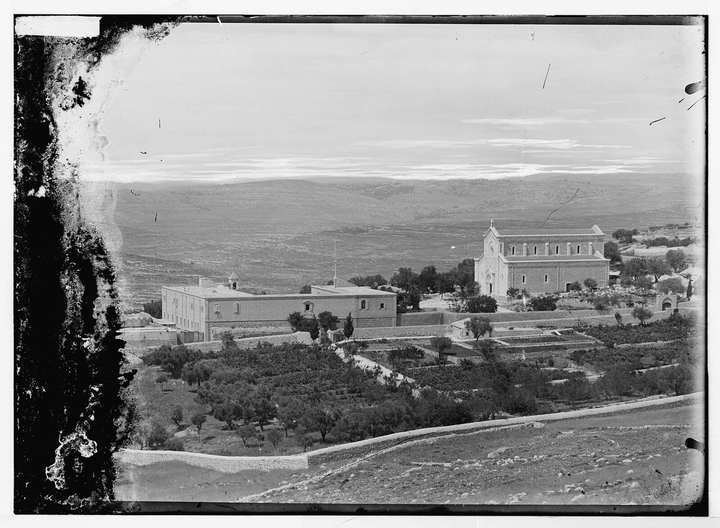
Adjoining the basilica on the north is the Church of Saint Catherine, the Catholic parish church, with the Franciscan convent. The Franciscans have lived in Bethlehem since 1347. Saint Catherine's has medieval origins and was enlarged over time; the church a pilgrim sees was rebuilt in the nineteenth and twentieth centuries. It is administered within the Latin Patriarchate of Jerusalem. The Latin Patriarch celebrates Midnight Mass here on Christmas Eve. Beneath it lie further grottoes tied to the memory of Saint Jerome, who lived and worked in Bethlehem, and of the Roman noblewomen Saint Paula and Saint Eustochium, who settled here with him. The passage from Saint Catherine's into the Nativity grotto is the way Latin pilgrims often enter the cave.
Two other places in the town belong to the same days, and both should be kept in their proper rank.
The Gospel sends the shepherds from the fields to the manger. The field itself is tradition rather than a named place in the text. At Beit Sahour, east of the basilica, the Custody of the Holy Land keeps the Catholic Shepherds' Field, the traditional place of that night. The chapel, built in 1953 to the design of the architect Antonio Barluzzi, is round, like a tent, and stands over a grotto, with remains of a Byzantine monastery on the site.
A short distance from the basilica, the Franciscans also keep the Chapel of the Milk Grotto. Tradition says the Holy Family sheltered in a cave, and that a drop of Our Lady's milk whitened the stone. The Gospel does not mention this cave. It is a devotion beside the biblical story, not part of the biblical story. People still come to pray there, especially parents.
Why people go is simple enough to say and hard to exhaust. They go to kneel where the Church has said, for sixteen centuries, that the Word made flesh was laid in a manger. They go to hear Luke 2 read in the place the reading names. They go at Christmas, when the square fills and the Patriarch's Mass is sung at Saint Catherine's. They go, too, because Bethlehem is a living Palestinian town, not a museum, and the parish is a real parish.
Did you know
The silver star was not always there in peace. It was placed by the Catholics in 1717. It was removed in 1847, in the long quarrel over rights in the basilica, and the Ottoman authorities put a star back in 1853. The fourteen points echo Matthew 1:17, which counts fourteen generations from Abraham to David, fourteen from David to the deportation to Babylon, and fourteen from the deportation to Christ. What is written on the star is the sentence that Jesus Christ was born here of the Virgin Mary.
Photographs
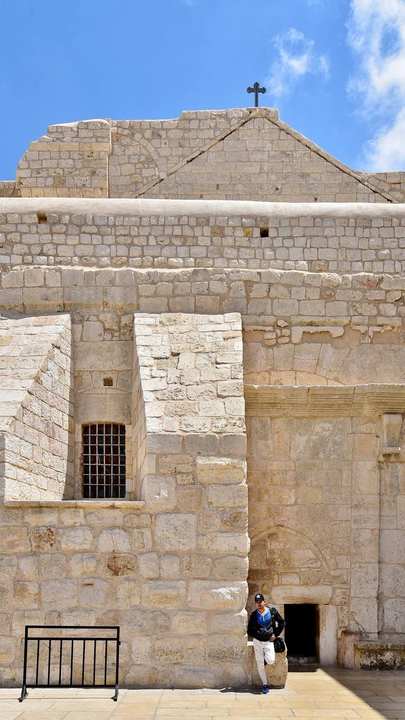
The Door of Humility, the low entrance of the Basilica of the Nativity, photographed in 2019.
Wikimedia Commons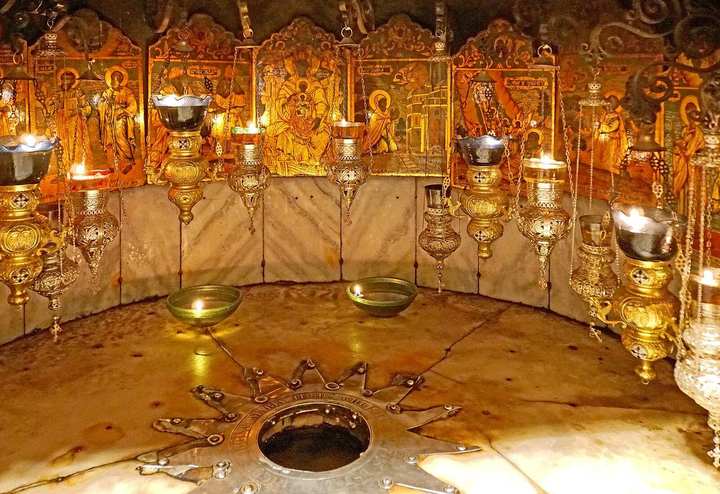
The fourteen-pointed silver star in the floor of the Grotto of the Nativity, marking the traditional place of the birth.
Wikimedia Commons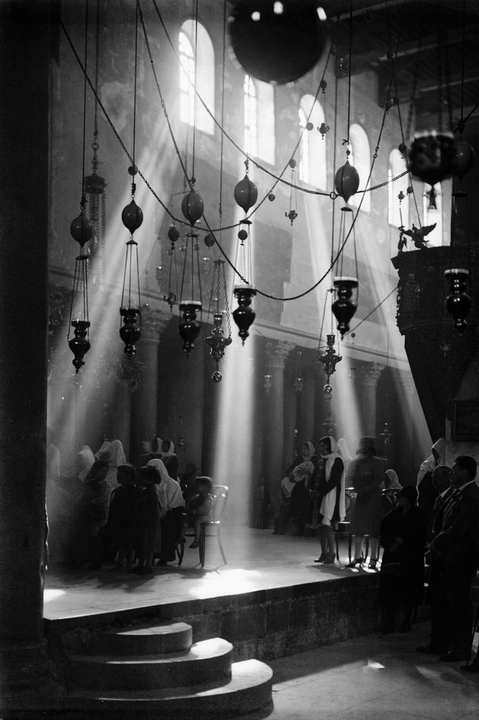
The nave of the Basilica of the Nativity, a historical photograph of the interior by the American Colony.
Wikimedia Commons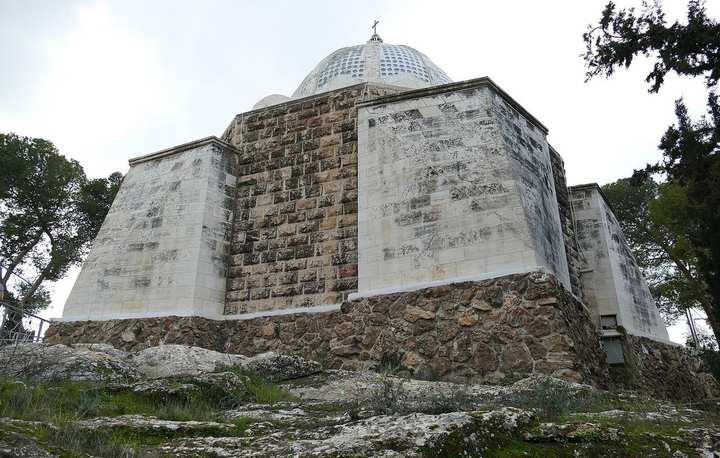
The Catholic Shepherds' Field chapel at Beit Sahour, the round chapel of the Custody of the Holy Land.
Wikimedia Commons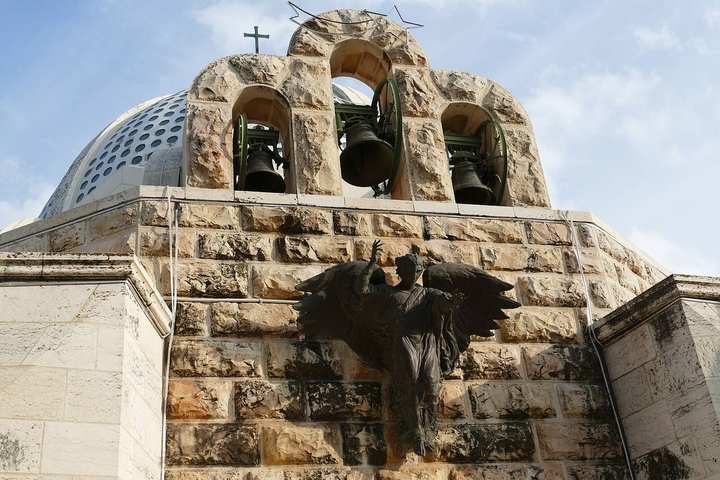
Another view of the same Catholic chapel and its setting at Beit Sahour.
Wikimedia Commons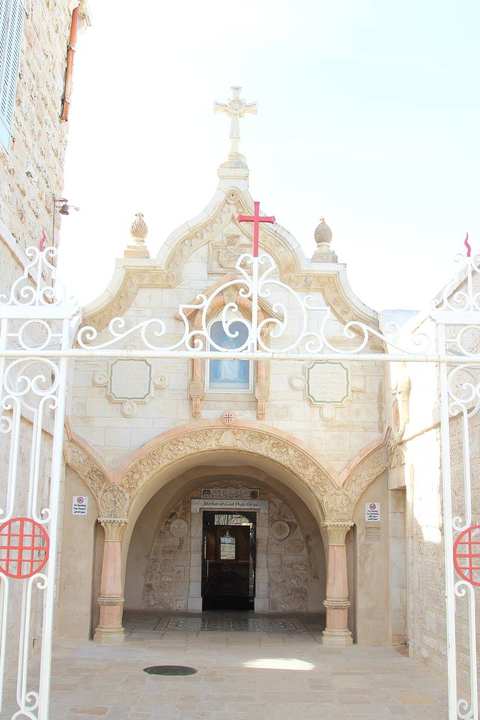
The entrance of the Milk Grotto chapel in Bethlehem. This is the traditional cave, not a scene described in the Gospel.
Wikimedia Commons
A film
The Christian Media Center, which serves the Custody of the Holy Land, published a short film on the restoration of the grotto itself.
On the map
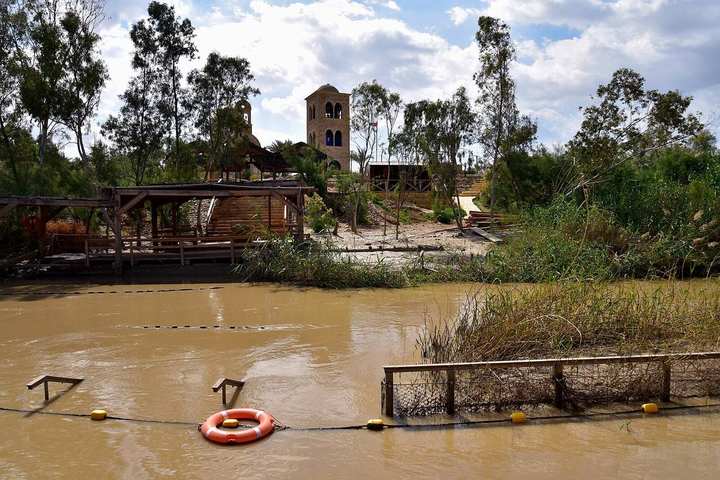
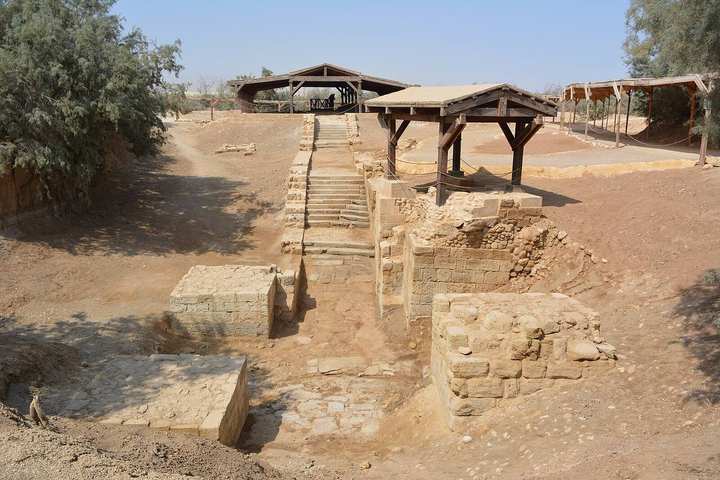
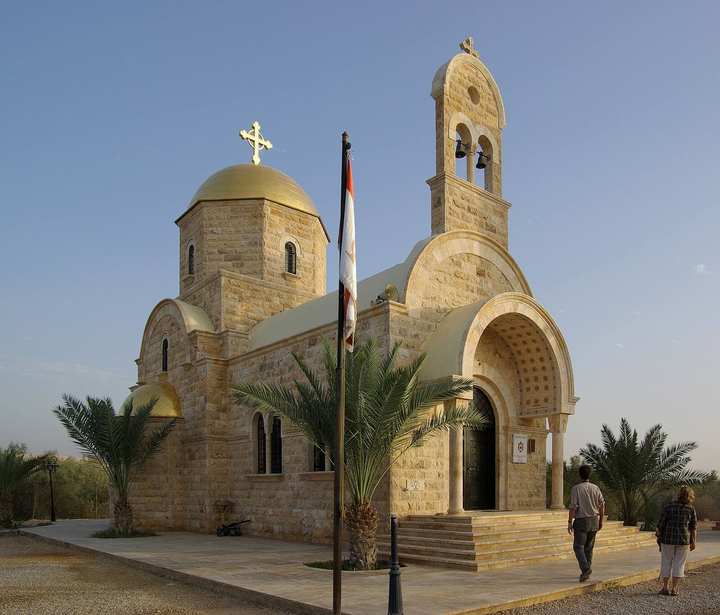
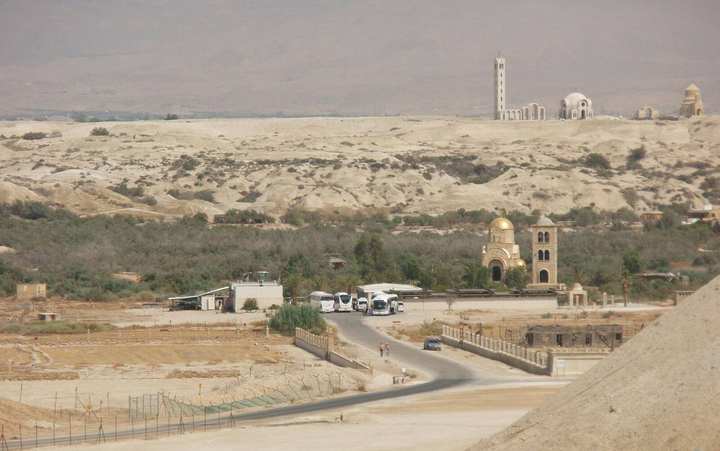
Bethlehem lies in the hills of Judea, a little south of Jerusalem. The Basilica of the Nativity stands about eight or nine kilometres south of the Church of the Holy Sepulchre, in a straight line. On this journey it is the southern starting point. Nazareth, Cana, and Capernaum are all far to the north, in Galilee. The Jordan baptism place is not on the way north through the hills. It is east of Jerusalem and Bethlehem, down in the rift valley, near the river and north of the Dead Sea. Emmaus, at the Franciscan shrine of El-Qubeibeh, is north-west of Jerusalem, so Bethlehem and Emmaus sit on opposite sides of the holy city. The shepherds' chapel at Beit Sahour is the near neighbour of the basilica, on the eastern side of the town, not a separate region.
Sources
Gospel of Luke, chapter 2; Gospel of Matthew, chapters 1 and 2; the prophecy of Micheas, chapter 5, as Matthew uses it. Douay-Rheims, Challoner revision, for the quotations. Latin Patriarchate of Jerusalem, Bethlehem parish, Church of Saint Catherine (lpj.org). Catholic Weekly, Father John Flader on the basilica, the Door of Humility, and the star. Custody of the Holy Land on the Shepherds' Field. Published coordinates of the Church of the Nativity and the Church of the Holy Sepulchre. Wikimedia Commons file pages named above. Christian Media Center film of the grotto restoration, confirmed by title and channel.
,_2019_(01).jpg)
.jpg)


.jpg)

.jpg)


_Kafr_Kanna_(1).jpg)

.jpg)
.jpg)


.jpg)
.jpg)


,_view_from_the_southwest_LOC_matpc.06269.jpg)

