This is the RCIA road — parishes also call it the Order of Christian Initiation of Adults. Ten lessons, in the order a class usually goes: God, the Creed, Jesus, the Church, Baptism, Mass, Confession, conscience, prayer, then a real parish. It doesn’t replace that parish. It means you don’t walk into the first meeting empty-handed.
Each lesson is an explanation written here, not the Catechism itself. The paragraph numbers are cited. The official text is on the Holy See’s site.
Ask anything about the Faith. The Act of Contrition is the prayer of sorrow. A Priest gives absolution. The class itself is at a parish.
Lesson 01 · about 12 minutes
God is already there
This doesn’t start with a self-help plan. It starts with God, who is already there. One God. Not a mood inside you. Not a mascot for a country. From all eternity God is Father, Son, and Holy Spirit. Three Persons, one God. The world is something God chose to make.
You can notice God in the world, and in your own hunger. That isn’t the Gospel yet. The Gospel is that God has spoken. Through the prophets. Then, in person, through the Son.
If a funeral, a child, a failure, or a beauty you couldn’t explain pushed you toward a door, you’re not late. A screen can tell you the truth. It can’t baptise you. A parish can.
“You have made us for yourself, O Lord, and our heart is restless until it rests in you.”
Sycamore, session 2. Played from YouTube under their terms.
Scripture. Genesis 1:1; John 1:1–18; Hebrews 1:1–2.
See Catechism §§ 27–49 (the desire for God), 232–267 (the Trinity). Holy See
Pray. The Sign of the Cross, slowly. Then the Our Father, once. You may say it.
A question you can ask: Who is God?
Lesson 02 · about 12 minutes
The Creed, in plain words
At Mass, people stand and say the Nicene Creed. It isn’t a draft. It’s the Faith the Apostles preached, guarded at Nicaea and Constantinople, said in a short form.
One God, the Father. One Lord, Jesus Christ, true God from true God, who came down for us, was born of the Virgin Mary, was crucified under Pontius Pilate, rose, and will come to judge. The Holy Spirit. One holy Catholic and apostolic Church. One Baptism. The resurrection of the dead, and the life of the world to come.
You don’t have to sand the words down until they feel like you. Learn what they mean. Say where you get stuck. The Apostles’ Creed is the same Faith, shorter, often used at Baptism. Learn one of them by heart before you worry about winning an argument.
“We hold that faith which has been believed everywhere, always, by all.”
Father Stephen Wang, Sycamore Seek. Played from YouTube under their terms.
Scripture. Matthew 28:19–20; 1 Corinthians 15:3–8.
Pray. The Apostles’ Creed, from the prayers page, with your eye on the text.
A question you can ask: What does the Creed mean?
Lesson 03 · about 12 minutes
Jesus, true God and true man
The centre is a person. Jesus of Nazareth is the eternal Son. He took a human nature from the Virgin Mary, and He didn’t stop being God. One Person. Two natures. Not a man who later became God. Not a God who only seemed to have a body.
He taught. He healed. He was crucified under Pontius Pilate. He really died. He rose. The Resurrection isn’t a metaphor for spring. The Apostles said they saw Him, ate with Him, and were sent by Him. The Church stands or falls on that.
Later signs — a shroud, a Host, an apparition — are not the foundation. They point back to Him. If you want the Gospel itself, read Mark in one sitting. Then John 1 and John 20.
“He became man so that we might become God.”
Sycamore, session 4. Played from YouTube under their terms.
Scripture. John 1:14; Philippians 2:6–11; Luke 24:36–43.
See Catechism §§ 422–682, especially 456–483 and 638–658. Holy See
Pray. Lord Jesus Christ, Son of God, have mercy on me.
A question you can ask: Who is Jesus?
Lesson 04 · about 12 minutes
Why a Church, and why a Pope
Jesus renamed Simon and said, “You are Peter, and on this rock I will build my Church.” He gave him the keys. The Catholic Church reads that as an office that continues. The Pope is the Bishop of Rome, Peter’s successor. He isn’t sinless. The promise was that the Church would not fail, not that every Pope would be a Saint.
Around him are the Bishops, and the Priests and Deacons who serve with them. A parish is the ordinary place where the Word is preached, the Eucharist is offered, and sins are forgiven. Infallibility is narrow. It isn’t a claim that every interview is God dictating.
Becoming a Catholic means joining that visible body. Some of the history is ugly. You can say so in class. The holiness of the Church is Christ’s. Sinners in the Church, including Popes, don’t get to rewrite the Creed.
“Where the bishop is, there let the people be.”
Sycamore, session 5. Played from YouTube under their terms.
Scripture. Matthew 16:18–19; John 21:15–17.
See Catechism §§ 748–945 (the Church), 880–892 (the Pope). Holy See
Pray. One Our Father for the Pope, and for the Bishop of the place where you live.
A question you can ask: Why is there a Pope?
Lesson 05 · about 12 minutes
Baptism, and what you do this week
Baptism is the door. Water, and the words “in the name of the Father, and of the Son, and of the Holy Spirit,” join a person to Jesus’ death and Resurrection. Original sin and personal sins are forgiven. The person becomes a member of the Church. It isn’t only a sign of a decision you already finished in private.
If you were already baptised with water and those words, the Catholic Church doesn’t do it again. You’re prepared to be received, confirmed, and brought to Communion. If you were never baptised, you’re a catechumen. Parishes often still say RCIA. The restored name is the Order of Christian Initiation of Adults. Same road. The Easter Vigil is the usual night, when the Priest and the Bishop judge you’re ready. This App doesn’t issue that certificate.
This week: go to Sunday Mass, and don’t receive Communion yet. Find the parish office, or stay after Mass, and say, “I want to become a Catholic,” or “I was baptised elsewhere and I want to be received.” Write down the name and the date. Ask about a sponsor.
“Baptism is God’s most beautiful and magnificent gift.”
Father Stephen Wang, Sycamore Seek. Played from YouTube under their terms.
Scripture. Matthew 28:19; John 3:5; Romans 6:3–4; Acts 8:26–38.
See Catechism §§ 1213–1284 (Baptism), 1285–1321 (Confirmation). Holy See
Pray. Come, Holy Spirit.
A question you can ask: I want to become a Catholic. What do I do?
Lesson 06 · about 14 minutes
What happens at Mass
Mass is where Catholics meet Jesus in the Eucharist. A Priest takes bread and wine and says Jesus’ words: “This is my Body… This is the chalice of my Blood.” The Church teaches that the whole Christ becomes present. Bread and wine don’t stay as they were, hiding behind a symbol. The Council of Trent called that change transubstantiation.
The hour has a shape, which helps when you’re new. Mercy. Readings from Scripture, and a homily. The Creed. Prayers for the living and the dead. Bread and wine brought up. The Eucharistic Prayer. People answer Amen. The peace of Christ. The Lamb of God. Catholics in a state of grace, keeping the fast, receive Communion. If that isn’t you yet, stay and pray. Don’t go forward. That isn’t a rejection. It’s honesty.
Watch the film, then go and see the same hour with your body. You won’t get it from a video alone. You’re not supposed to.
“It would be easier for the world to survive without the sun than to do without the Holy Mass.”
Father Stephen Wang, Sycamore Seek. Played from YouTube under their terms.
Scripture. Luke 22:19–20; John 6:51–58; 1 Corinthians 11:23–29.
See Catechism §§ 1322–1419, especially 1374–1376. Holy See
Pray. One Our Father in the pew before Mass begins.
A question you can ask: What happens at Mass?
Lesson 07 · about 10 minutes
Confession
Jesus gave the Apostles power to forgive sins and to hold them. A Priest acts for Him and gives absolution. You bring sorrow, you say the Act of Contrition, you say the serious sins as you remember them, and you accept a penance. The Priest never repeats what you said.
If you’re not Catholic yet, you don’t make a Catholic Confession yet. Tell God the truth now. Stop what you can stop. Let the class do its work. At the Vigil, people who are baptised for the first time are washed of all sin. People already baptised celebrate Reconciliation as part of being received. Ask your catechist which one you are.
Scruples are different from honesty. A formed conscience isn’t a machine for accusing yourself of everything. If you can’t tell a sin from a worry, say that to a Priest when you may.
“The good God is more eager to pardon a repentant sinner than a mother to snatch her child from the fire.”
Father Mike Schmitz, Ascension Presents. Played from YouTube under their terms.
Scripture. John 20:21–23; Psalm 51; Luke 15:11–32.
Pray. The Act of Contrition. It’s a promise of the Sacrament, not a substitute for it.
A question you can ask: How does Confession work?
Lesson 08 · about 12 minutes
A conscience you can trust
Forming a Catholic conscience means lining up your moral judgment with what is true, not with a feeling or a social feed. That’s what the Catechism is talking about in paragraphs 1776–1802.
Conscience is a judgment: this act, here, is to be done or refused. If you’re sure, you follow it. Being sure doesn’t make you right. A sincere person can be sincerely wrong. The question is whether you couldn’t have known, or whether you refused the means of knowing — Scripture, the Church’s teaching, a confessor, a bit of time.
So this isn’t “follow your heart,” and it isn’t “ignore your heart.” Form the judgment. Read the Commandments and the Beatitudes as one life. Ask what the Church has actually taught. Pray. If you can, sit with a Priest who won’t flatter you.
“Conscience is the aboriginal Vicar of Christ.”
Father Stephen Wang, Sycamore Seek. Played from YouTube under their terms.
Scripture. Romans 2:14–16; Psalm 119:105; Matthew 5:1–12.
See Catechism §§ 1776–1802, and 2052–2557. Holy See
Pray. The Confiteor, slowly, at night.
A question you can ask: What does conscience mean?
Lesson 09 · about 12 minutes
Prayer, and Mary
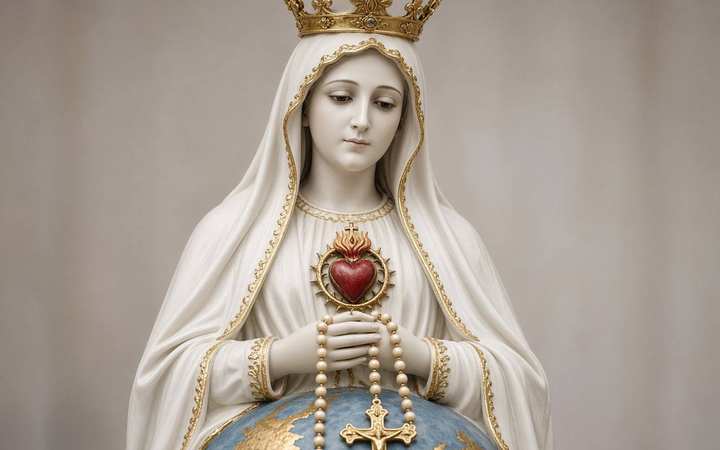
Our Lady of Fátima, with the Rosary. This lesson is how the Church prays with her.
Prayer is lifting your mind and heart to God. You don’t need a new personality. You need a time, a text, and honesty. Start with the Sign of the Cross, the Our Father, and the Hail Mary. One decade of the Rosary is enough on a day when the whole chain feels long. You say the words, and you look at one scene from the Gospel.
The Church does not worship Mary. Worship belongs to God alone. Mary is given the highest honour among creatures, because she is the Mother of God and because she said yes. Asking her to pray is like asking a holy friend, except she is alive in God and uniquely joined to her Son.
If someone told you Catholics think Mary saves them instead of Christ, they described a different religion. The Hail Mary in this App keeps the words “full of grace.” That’s how the Church has heard Luke 1:28. Say it that way.
“For me, prayer is a surge of the heart; it is a simple look turned toward heaven.”
A sung Salve Regina. Follow it even if you don’t sing yet.. Played from YouTube under their terms.
Scripture. Luke 1:28; Luke 11:1–4; John 19:26–27.
See Catechism §§ 2558–2865 (prayer), 2676–2679 (the Hail Mary), 971 (Mary). Holy See
Pray. One decade: the Our Father, ten Hail Marys, the Glory Be.
A question you can ask: Help me pray. Who is Mary?
Lesson 10 · about 8 minutes
Now go to a parish
Everything above is teaching. Teaching isn’t the same as being received. The Church does that through people: a Priest, catechists, a sponsor, a community that knows your name, and the rites along the road. Those rites are in the book the parish uses. They aren’t generated here.
This week, if you haven’t already: be at Sunday Mass. Introduce yourself. Ask when OCIA or RCIA meets. Bring a question you actually have. If you were baptised, bring any record you can find. If you can’t find it, say so. If you’re already Catholic and you’ve been away, skip the enquiry class and ask for Confession.
Ask in Faith will answer from the Church’s teaching and point you back here. It isn’t a Priest. It won’t tell you that you’re absolved, and it won’t decide you’re ready for the Vigil. That belongs to the parish that will baptise you or receive you.
“You cannot have God for your Father if you do not have the Church for your mother.”
Father Stephen Wang, Sycamore Seek. Played from YouTube under their terms.
Scripture. Acts 2:41–42.
See Catechism §§ 1212, 1229–1245, 2041–2043. Holy See
Pray. A Hail Mary for the Priest and the catechists you haven’t met yet.
A question you can ask: I’ve been away. Where do I start?
Talk to a parish
Ask for RCIA, or for the Order of Christian Initiation, at the parish where you can actually be on Sunday. If you’re already Catholic and you’ve been away, ask for Confession first. The guide here will stay with the question. The Sacrament won’t happen on this screen.