
Teachers
This file presents Catholic teachers whose recorded words can still form a person in the faith. The videos named here are embedded by their real YouTube watch URLs. They are not downloaded or rehosted. A URL appears only when it has been opened and confirmed. Where a photograph or a film could not be confirmed, the teacher is named and the link is omitted.
These four are given in a fixed order. Father Mike Schmitz is the main living teacher of Scripture and of the Sunday pulpit for this site. Blessed Fulton Sheen, Mother Angelica, and Father Mark Beard are teachers whose work continues after their death or their silence. Practical Q and A of the kind that treats tattoos, smoking, and similar matters belongs to a later file. The Bible in a Year is pointed to briefly from Home in a later file; it is not the teaching library of this page.
Father Mike Schmitz
Father Mike Schmitz is a priest of the Diocese of Duluth in Minnesota. He is chaplain to the Newman Centre at the University of Minnesota Duluth, and for years he has taught through Ascension Presents, the free video apostolate of Ascension Press. The channel is:
https://www.youtube.com/@ascensionpresents
His gift is to take the Church's faith as it actually is, and to speak it so that a university student, a parent, or a person returning after a long absence can hear it without being spoken down to. He teaches Sacred Scripture as the story of salvation, not as a book of isolated inspirational sentences. He teaches the Mass as sacrifice and worship, not as a performance to be graded by feeling. He teaches the moral life as the life of a baptised person who has a share in Christ's priesthood, not as a list of private preferences. The tone is plain, often humorous, always Catholic. He does not invent a new religion for the internet. He hands on what the Church already holds.
A person listening to him for the first time should notice three habits of his teaching. First, he begins from what Catholics already do, or already fail to do, and then names the doctrine underneath the habit: genuflection, the Amen, the Offertory, the way people say they "get nothing out of Mass." Second, he keeps the Trinity in view. The sacrifice of the Mass is the Son offered to the Father in the power of the Holy Spirit; almost all the prayers of the Mass are addressed to the Father; the six times the congregation speaks aloud to Jesus are not accidents. Third, he refuses the false choice between a cold correctness and a soft feeling. Knowledge of the faith is for love of Christ. Ignorance is not humility. Sentiment without truth is not charity.
He is a priest of a real diocese, with a real chaplaincy. The videos are not a substitute for his parish Mass or for the hearer's own parish Mass. They are formation that prepares a person to pray the Mass and to read the Bible as a Catholic. That is why this file keeps his biblical teaching and his sermons at the centre, and leaves the daily Bible-in-a-Year plan and the short practical Q and A for their own places later in the series.
What a person should listen to first is his biblical teaching and his sermons on the Mass. Begin with a short map of the whole Bible, so that Genesis, Exodus, the prophets, and the Gospels cease to feel like separate rooms with no corridor between them. Then hear him on how an adult is to read Scripture: not as children's stories only, not as a book of slogans, not as a roulette wheel for answers, but as the Word in which God speaks through human authors, with every book true in the truth proper to its genre. Then hear him walk through the Mass itself, part by part, so that genuflection, the readings, the Creed, the Offertory, the Consecration, and Holy Communion are no longer habits without meaning. Then hear a longer sermon in which he insists that the heart of religion is worship, and the heart of worship is sacrifice, and that a baptised Catholic is a kingdom priest who must not waste that priesthood by only watching the ministerial priest pray.
Confirmed watch URLs for that path:
A Sunday homily may follow when the person wants the same teacher at the ambo rather than at the desk. One confirmed example from Sundays with Ascension:
Do not begin here with the Bible in a Year podcast. That daily reading plan has its own short pointer later. Do not begin here with short practical answers about tattoos, smoking, and similar questions. Those belong to a different file. This page is for the big teaching: Scripture, the Mass, and the life that flows from both. A person who has heard the five links above has already been given enough to pray with for weeks. Ascension Presents holds many more of his talks. Return to the channel after the first path is finished, and choose the next talk by the need of the soul, not by the algorithm's habit of offering whatever is loudest.
The Bible in a Year with Father Mike Schmitz is a modern help for a person who wants to hear the Scriptures through one year. YouTube names the series The Bible in a Year (with Fr. Mike Schmitz), and names Ascension Presents as its author. The readings proclaimed at Mass remain the Church's reading. This is a help a person may use. It is not a programme the reader is pressed into, and the faith does not depend on finishing it.
https://www.youtube.com/playlist?list=PLeXS0cAkuTPqFMtZQ379qdEmcfxO1SvXc
Blessed Fulton Sheen
Archbishop Fulton John Sheen was born Peter John Sheen in El Paso, Illinois, in 1895, and came to be known by his mother's maiden name, Fulton. He was ordained a priest of the Diocese of Peoria in 1919. He took advanced degrees in philosophy, including a doctorate from the Catholic University of Louvain, and taught for years at the Catholic University of America. He wrote scholarly and popular books. He was a Father of the Second Vatican Council. He served as national director of the Society for the Propagation of the Faith in the United States, and he pressed the missions and the poor upon the attention of Catholics who might otherwise have stayed at home in comfort. Pope Pius XII made him an auxiliary bishop of New York in 1951. Pope Paul VI later named him Bishop of Rochester. He died in New York on 9 December 1979, at prayer before the Blessed Sacrament. His feast day, established at his beatification, is 9 December.
On 24 September 2026, in St Louis, Missouri, Cardinal Luis Antonio Tagle, acting as papal delegate, proclaimed the apostolic letter of Pope Leo XIV by which Archbishop Sheen was declared Blessed. He is therefore Blessed Fulton Sheen: not yet a canonised saint, and no longer merely Venerable. The Church may publicly venerate him. The beatification had been prepared for years, delayed, and then resumed. The miracle recognised for the beatification was the healing of a child whose parents had sought Archbishop Sheen's intercession. Further purported miracles are under study for a possible canonisation. This file does not invent a title. It uses the title the Church now uses.
Blessed Fulton Sheen's teaching is the Gospel spoken into a microphone and then into a television camera, with chalk and a blackboard, for an audience that included Catholics, Protestants, and people who claimed no faith at all. For two decades he hosted The Catholic Hour on radio. From 1951 he hosted Life Is Worth Living on television, and later The Fulton Sheen Program. He won an Emmy. He did not treat the medium as a toy. He treated it as a pulpit that could reach the lonely, the clever, the bored, and the wounded in their own sitting rooms. His themes return again and again: the Cross, the Eucharist, sin and conversion, loneliness and the need to care for others, the person of Christ who entered human loneliness and was not overcome by it, the demand that a Christian give God what God has asked and not only what the Christian prefers to offer. He wrote many books. The televised talks remain the easiest door for a new listener.
What marks him as a teacher of the Church, and not merely as a famous broadcaster, is the source he claimed for his insight. He spent a daily holy hour before the Blessed Sacrament. He said the story he never tired of telling was the story of Jesus. Pope John Paul II, meeting him near the end of Sheen's life, told him that he had written and spoken well of the Lord Jesus Christ and that he was a loyal son of the Church. At the beatification Mass, Cardinal Tagle called him a storyteller of Jesus and recalled Sheen's word at the Council: that only a Church wounded by poverty can convert a doubting world. The blackboard talks on loneliness, the Cross, the Body of Christ, and the Ascension are therefore not nostalgia. They are still a school of doctrine and of prayer for anyone who will sit still for half an hour.
Where to begin: one complete episode of Life Is Worth Living, listened to without rushing, and then a second on the Cross or the Body of Christ. Confirmed watch URLs:
A confirmed playlist collecting many episodes of Life Is Worth Living:
https://www.youtube.com/playlist?list=PL_7YIx7jtxgZYeiMeKyFTHxCoNwLmdvC-
EWTN also carries Life Is Worth Living as a programme. The titles on older uploads may still say Venerable. The Church's present title is Blessed. A person beginning with the Loneliness episode will hear Sheen's method at once: a concrete human wound, a cause, a remedy in charity, and then Christ who knows loneliness from the inside. That is enough for a first evening. The blackboard, the humour, and the sudden seriousness are part of the teaching. They are not decoration.
Mother Angelica
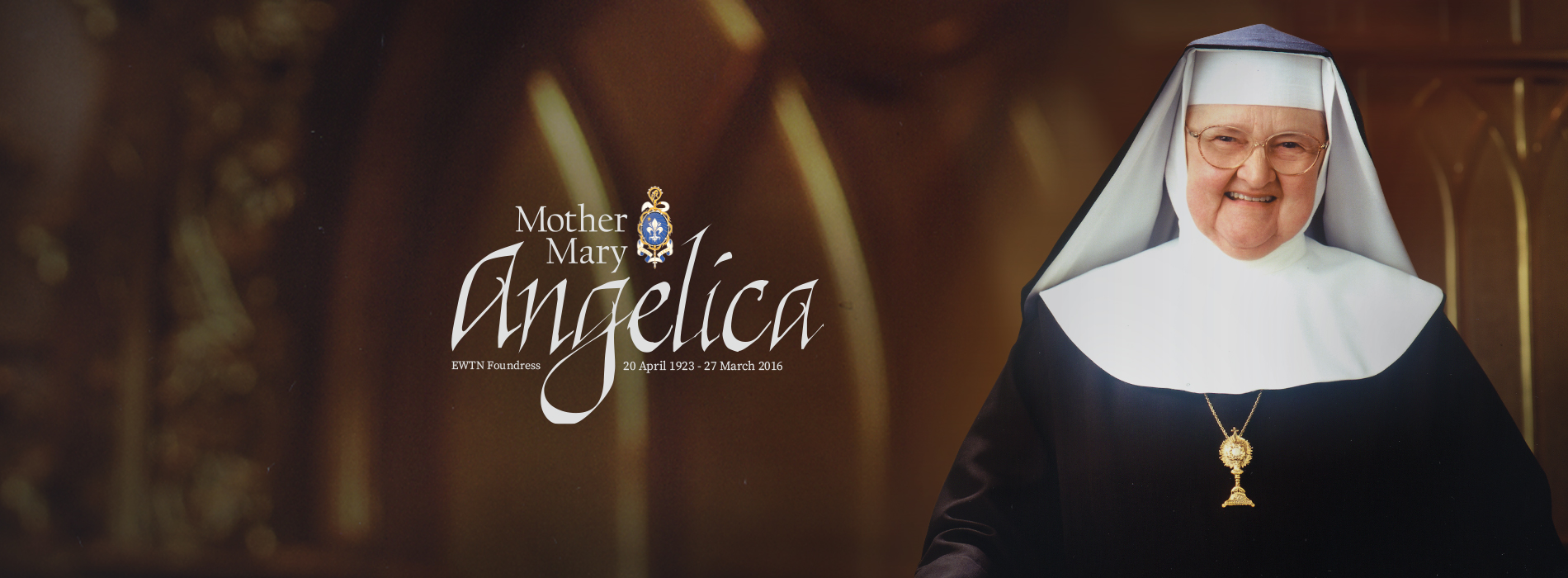
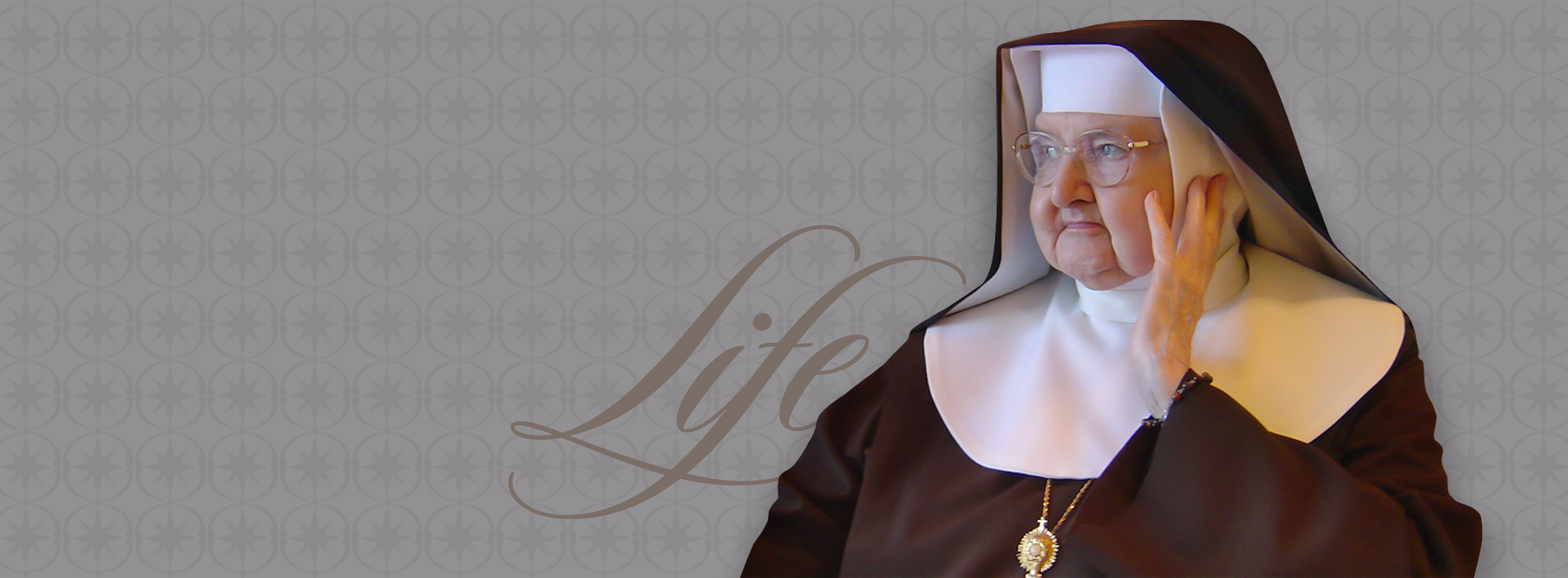
Mother Mary Angelica of the Annunciation, born Rita Antoinette Rizzo in Canton, Ohio, on 20 April 1923, founded the Eternal Word Television Network. She entered religious life in 1944 as a Poor Clare of Perpetual Adoration. After years of illness and a promise made to God if she could walk again, she founded Our Lady of the Angels Monastery in Irondale, Alabama. From a garage studio, with almost no money and no professional broadcasting background, she put Catholic teaching on satellite television. EWTN went on the air in 1981. Mother Angelica Live made her face and voice known across the English-speaking Catholic world and far beyond it. The network grew into the largest Catholic media apostolate of its kind, with television, radio, news, and publishing, supported by viewer gifts rather than by a commercial formula that would soften the faith.
Her teaching is direct, witty, and unembarrassed about doctrine, prayer, suffering, and the demand of holiness. She spoke as a Poor Clare who adored the Blessed Sacrament and who expected ordinary Catholics to live as if God were real. She did not treat the Faith as a private mood. She treated it as truth that saves, and she said so with jokes that landed and with warnings that were meant to be heard. After strokes and long silence, she died on 27 March 2016. The shows remain. The monastery and the Shrine of the Most Blessed Sacrament in Hanceville, Alabama, remain. EWTN remains.
What a student should take from her is not celebrity and not a collection of sayings cut free of context. Take the pattern of her life: adoration, obedience to the Church, boldness in using new means for an old faith, and a refusal to let debt, criticism, or illness decide whether the Gospel would be spoken. On air she could move from a kitchen story to the particular judgement without apology. She told people to get cracking. She told them that God expects his people to do the ridiculous so that he can do the miraculous. Those lines belong on her own memorial pages and in the recorded shows; they are not invented here. A person formed by Mother Angelica Live Classics will be less afraid of being an obvious Catholic, and more ready to pray when prayer is dry.
A real photograph of Mother Angelica, hosted by EWTN on her memorial pages, is confirmed here:
Another confirmed photograph from the same EWTN memorial site:
Where to begin with her words: Mother Angelica Live Classics, the EWTN compilation of her studio talks. Confirmed watch URLs from EWTN's own channel:
A confirmed YouTube playlist titled EWTN Mother Angelica Live Classics:
A person who has never heard her should start with Let Not Your Hearts Be Troubled, then Silence of Heart and Mind. The humour is not an escape from the Cross. It is how she carried people toward it. EWTN's own pages for Mother Angelica's life, words, and works remain the proper biographical home: https://www.ewtn.com/motherangelica/
Father Mark Beard
Father Mark Bryan Beard was a priest of the Diocese of Baton Rouge. He was born in Baton Rouge on 26 July 1961. He held a master's degree in business administration from Louisiana State University, worked in his family's engineering and manufacturing business, and held a United States patent. After a pilgrimage to Medjugorje in 2000 he began to discern the priesthood. He entered Notre Dame Seminary in New Orleans in 2004 and was ordained on 30 May 2009 at St Joseph's Cathedral. He served as associate pastor in several Louisiana parishes, and then for twelve years as pastor of St Helena Catholic Church in Amite. In those years the parish was revitalised: attendance grew, the campus was built up for tours and retreats, and he also administered Our Lady of Hope Catholic Retreat Centre in Osyka, Mississippi. He preached with force about the whole Catholic faith, about the sanctity of life, about marriage, about not straddling the fence between Christ and the world, and about the judgement that follows death without delay. He was devoted to the Blessed Virgin Mary. He is not a canonised saint. He is a diocesan priest who has died, and whose recorded homilies still convert and steady people.
He died on 2 August 2023 in a car accident on Interstate 55 near Osyka, Mississippi, while travelling as a pastor about his work. Bishop Michael Duca announced the death. Louisiana's governor, a parishioner of St Helena, spoke of him as a close friend and a great pastor. Funeral rites were celebrated in Baton Rouge and in Amite. He is buried at Amite Memorial Gardens.
His teaching, as heard in the final homily, is urgent without being theatrical for its own sake. He tells the faithful to stop apologising for being Catholic, to learn the faith, to refuse exceptions on abortion, to treat contraception as a refusal of God's lordship over life, to marry before Christ in the Church, and to remember that judgement is not a committee meeting. He says his job is to pitch the whole truth; whether the hearer catches it is on the hearer. That is a priest's burden, not a pundit's performance. The short On the Day I Die keeps the same horizon: death is real, and the day of death is not a joke. Listen, examine your conscience, go to Confession if you need to, and return to the Sunday Mass of your parish. Do not turn a dead priest into an internet saint. Pray for the repose of his soul, and thank God for the years he preached.
Where to begin: his final Sunday homily, often called The Fence, preached days before his death, in which he refuses a Catholicism of exceptions and reminds the hearer that the soul is judged at the nanosecond of death. Then the short titled along the lines of On the Day I Die. Confirmed watch URLs:
Photographs of Father Beard at the altar of St Helena have circulated with his memory. No single altar photograph URL could be confirmed for this file without risk of inventing or misassigning an image, so none is printed here. The man is known by his voice and by the parish he served. A person who listens to The Fence will hear why so many mourned him: he pitched the whole teaching of the Church and left the catching to the hearer's freedom and to God's grace. Pray for him. Learn from him. Do not confuse a beloved dead priest with a canonised saint.
How to use this file
A person new to these teachers should not try to hear everything in a week. Take Father Mike's biblical and Mass path first. Add one episode of Blessed Fulton Sheen in the evening. When the heart needs a motherly voice that will not flinch, take Mother Angelica. When the will needs a hard mercy about life, death, and not straddling the fence, take Father Mark Beard and then pray for him. The Church is not a library of personalities. These teachers serve the same faith, the same sacraments, and the same Lord. Their recordings are helps. The Mass, Confession, and a living parish are the ordinary place where the teaching becomes life.
No invented quotations are used in this file. No artificial images are offered. Titles of the Blessed and of Mother and Father are written as the Church and common Catholic speech use them. The Church is named the Church.